I’m partial to the bells and whistles at 23andme and seldom check my AncestryDNA results. Today, though – eureka! An estimated 4th cousin with a Shared Ancestor Hint, John William Aldridge. I checked G.J.’s family tree and immediately knew exactly who she is – the granddaughter of one of my great-grandfather’s sisters. Our most recent common ancestors (MRCA) are John and Louvicey Artis Aldridge, and we’re actually 2nd cousins once removed.
Monthly Archives: September 2013
John William Aldridge.
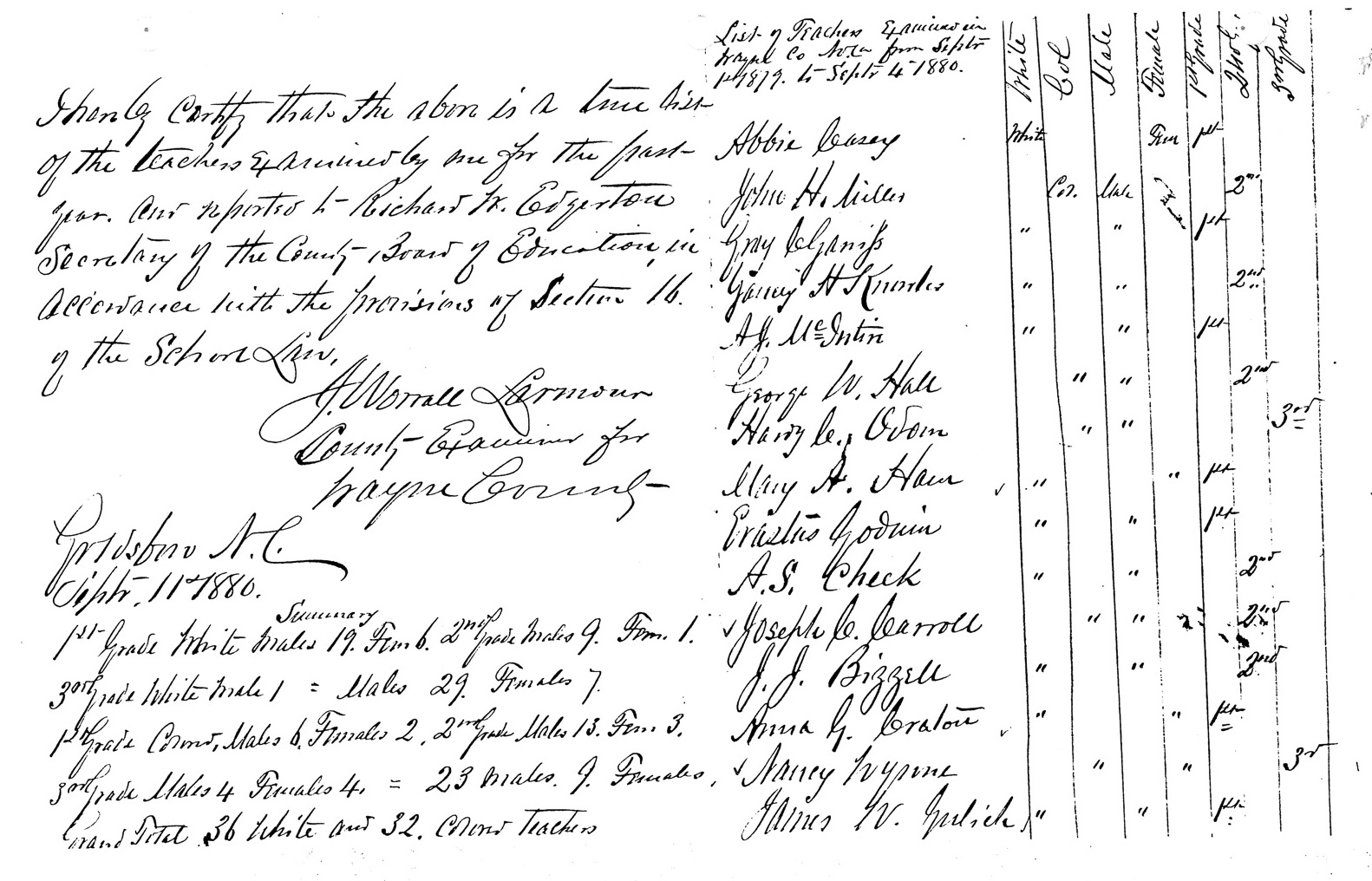
John Aldridge and his brothers George and Matthew Aldridge were hired to teach in Wayne County in the late 1870s. For reasons unknown, they were assigned to schools in the far north of the county, some 15 miles north of Dudley:


From the same unsigned family history:
John Aldridge met Luvicie Artis at the school where he taught; she was one of his students. He built a 7 room house for her when they got married. John was a stout man with a reddish brown complexion and wavy black hair. He stopped teaching when he married Luvicie and started to farm and run a general store. The store was burned down in 1911. He sent his children to a private school. He died in 1910 of a congested chill. He was 58 years old when he died, and was worth about $30,000 at that time.

If John was worth $30,000 when he died, it was all in realty. His personal estate was paltry:

Bessie Lee Henderson.
Bessie Henderson is the fulcrum. Or Bessie’s death anyway. The point at which my Hendersons diverged from the line, left Dudley’s track, frayed the thread that bound to them to their people. Her death launched my grandmother out of Wayne County and away from what could have been. Given all that happened later, the ways things turned out, it is not hard not to see why my grandmother cast the first few months of her life as the glory days. She was with her own mother and surely cherished.
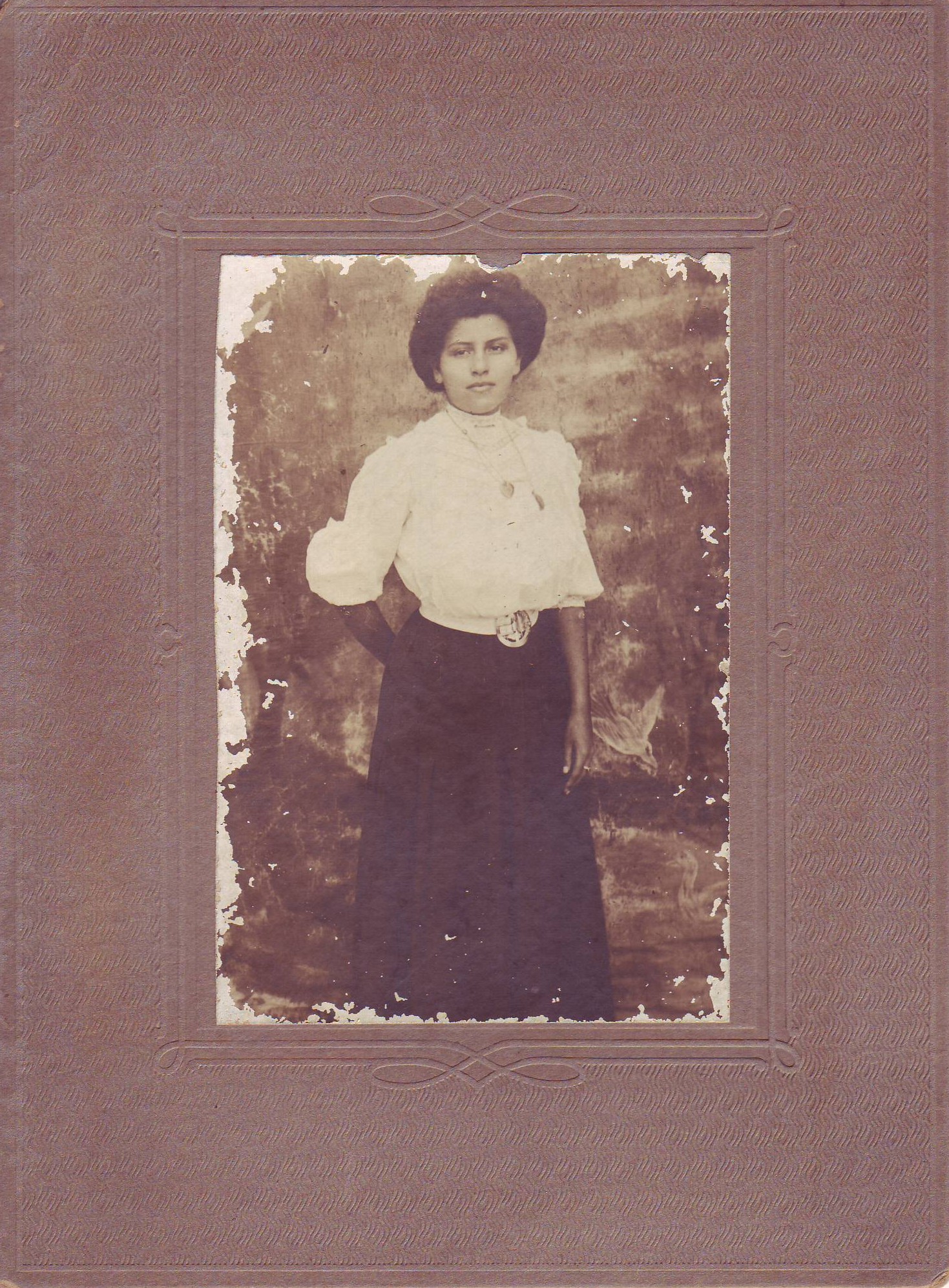
Let’s look at her. At the only photo we have. Probably the only one there ever was.
She is a broad-faced, heavy-lidded beauty, the barest hint of a smile playing on her lips, a high-yellow Mona Lisa. Thick dark hair pulled up a la Gibson Girl; a hint of widow’s peak; a straight-bridged nose; a full bottom lip. The fat lobes of her ears depend from the nest of her hair. I recognize them as my grandmother’s.
What was the occasion? Why the first photograph of her life? It was surely taken in Goldsboro, or maybe Mount Olive, the small town and smaller town that bracketed Dudley, the crossroads at which she passed her entire short life. There are no props. The painted backdrop is mottled and indistinct, save a white bird swooping downward, a wingtip brushing her left hand. The portrait is three-quarter length, and it is hard to gauge her size. She was surely of no great height, perhaps an inch or two over five feet, and slim, but with a hint of hippiness. Her daughter and nieces were narrow-shouldered, but she seems not to have been so.
One arm, folded behind, rests on her hip. The other hangs loosely at her side, a slender hand brushing her thigh. I do not recognize the fingers; they are not my grandmother’s. Her arms, exposed below the elbows of her ruffled white blouse, are much, much browner than her face, evidence of her time in her grandfather’s fields, straw hat shielding her brow. There is a ring on her left middle finger. There are also two lockets hanging from her neck. She barely knew her mother; her father was a kind but distant white man; she never married. Who then gave her these trinkets? What became of them? What tiny images hid in the clefts of the lockets? Who loved her?
Like her own mother before her, Bessie was just nineteen when she died. She looks older here. A little weary maybe. A little sad. A second child born out of wedlock would get her drummed out of the church that her grandfather had helped found. The baby’s daddy joined church weeks later. Within months, Bessie was cold in her grave.
My grandmother tells it this way:
I thought of many times I wondered what my mama looked like. Bessie. And how old was she, or whatever. See, she was helping Grandpa Lewis. The pig got out of the pasture and, instead of going all the way down to where the gate opened, she run him back in there, to try to coax him in there. And when they picked him up and put him over the fence, she had the heavy part, I reckon, or something, and she felt a pain, a sharp pain, and so then she started spitting blood. Down in the country, they ain’t had no doctor or nothing, they just thought she was gon be all right. And I don’t think they even took her to the doctor. Well, she would have had to go to Goldsboro or Mount Olive, one, and doctors was scarce at that time, too, even if it was where you had to go a long ways to get them. And so she died. She didn’t never get over it. I don’t remember ever staying down there. ‘Cause they brought me up to Wilson to live with Mama and Papa. I stayed with them after Bessie died. My sister says she does, but I don’t remember Bessie. You never know what you’ll come to.
——
Photo in the collection of Lisa Y. Henderson. Interview of Hattie Henderson Ricks by Lisa Y. Henderson, all rights reserved.
Adam Artis’ children, part 3: Frances Seaberry.
From an unsigned narrative (“The Adam Artis Family History”) written, I think, by one of Adam Artis’ great-grandchildren:
“Adam Artis had about five wives and 39 children. His first legal wife was Frances Hagens of Eureka. She was very fair and had beautiful long black silky hair. Adam was very tall and slender. He owned a large farm in Eureka and was a first class carpenter. They lived in a nice two story house. Frances’ brother, Napoleon Hagens, owned a very large plantation near Eureka. He had several tenants and/or slaves there. He was very mean to his wife and tenants. He would sit on the fence in the shade and watch the tenants plow. If they didn’t plow the way he wanted them to, he would crack them with a whip. One day a tenant grabbed the whip and beat Napoleon’s shirt off.”
This is a nice starting point, if not entirely accurate. Frances Seaberry was Adam’s second legal wife. If he had 39 children, not even his last surviving daughter could name them. Her half-brother Napoleon Hagans never owned slaves, though he had many tenants, and he cast a shadow large enough that his sister’s descendants thought his last name was hers.
Also, “Frances and Adam Artis had 9 children (Hayward, William, Walter, Addie, Jesse, Doc, Georgianna, Luvicie and Ida.) Luvicie and Ida were twins. Frances died when the twins were only 13 years old.”
In fact, they had 11:
Ida Artis was born about 1861. (And was not Louvicey’s twin.) She married Isaac Reid (1853-??), son of Zion and Lucy Reid, about 1876 .Their children were Frances Reid (1877-??) and Lorenzo Eli Reid (1879-1952). Ida Artis Reid died 1880-1900.
Napoleon Artis, known as “Doc,” was born 28 February 1863. He married Sallie Taylor; their sons were Humphrey, Leslie and Odell. Doc died 16 October 1942. His descendants still live on land along Route 222 between Stantonsburg and Eureka once owned by Adam Artis.
“When Luvicie Artis was 13 years old, she married John Aldridge of Dudley. John was the son of Robert and Eliza Aldridge. … Luvicie had very high cheek bones. Luvicie was a mid-wife and nurse. She died at the age of 64. She only wanted to eat peas and sweet potatoes. She wouldn’t eat much meat or green vegetables, and would drink hardly any water.”
Louvicey Artis was born in 1865 and married John Aldridge in 1879. Their 11 surviving children were Zebedee Aldridge, Lula Aldridge, Frances Aldridge Cooper, John J. Aldridge, James Thomas Aldridge, Amanda Aldridge Newsome, Beulah Aldridge Carter, Correna Aldridge Newsome, Catherine Aldridge Davis and Christine Lenora Aldridge Henderson. Vicey Artis Aldridge died 13 February 1927.
Louvicey’s twin, Eliza Artis, married Haywood Everett. Before 1900, the couple migrated to Arkansas and settled in Lonoke County. They had no children, and Eliza died 10 October 1936.
Georgeanna Artis was born 1867. She married Henry Reid (1859-1930), son of John and Mozana Hall Reid (and first cousin to Isaac Reid, above) on 29 Nov 1883. Their children: Alice Reid Williamson, Cora Reid, William H. Reid, Brodie Reid, Lenny Reid, Nita Reid, Henry N. Reid, Linda B. Reid, and Georgia Reid. She died 18 August 1923 in Goldsboro NC.
Adam Toussaint Artis Jr. was born in 1868. He married Rena G. Wynn in 1893 in Wayne County and had one son, Lafayette. He migrated to Washington DC, and married Agnes West in 1904. Their son was Harry L. Artis.
Haywood Artis was born in 1870. He migrated to Norfolk, Virginia, in the 1890s, and married Harriet Hawthorne. Their children included Bertha Artis, Jesse Artis, Hattie Artis Johnson, Mae Willie Artis, Haywood Artis Jr., and Charles Artis.
Emma Artis, born 1872, married Robert H. Locust and died within months of the wedding. [A tidbit: Robert H. Locust’s second wife, Fannie Aldridge, was the sister of John Aldridge (Louvicey Artis’ husband) and Amanda Aldridge Artis (Adam Artis’ third wife.]
Walter Scott Artis was born 2 October 1874. He married Hannah E. Forte. Their children: Napoleon Artis, Beatrice Artis, Estelle Artis, Adam Toussaint Artis III, and Elmer H. Artis. Walter Artis died 25 June 1951.
William Marshall Artis was born 28 August 1875 and married Etta Diggs. Their children: Margaret Artis, William M. Artis Jr., Frances Artis, Irene Artis Carter, Adam H. Artis, Fletcher Artis, Doris V. Artis, Haywood Thomas Artis and Beulah M. Artis Exum. William died 28 September 1945.
Jesse Artis was born in 1878, presumably not long before his mother’s death.
Irving Houser gets a McNeely Girl.
Me: Okay, and Emma, she was up in Bayonne.
My grandmother: This man went up there in his young years. I think he had an eye on her. People used to say that the men — all of Mama and her sisters were supposed to have been catches, you know. They were good-looking women and everything, and they just said the men said it didn’t matter which one it was so long as they got one of them.
Me: One of the McNeely girls?
My grandmother: McNeelys. Mm-hmm.
Me: So he came back and married Aunt Emma and carried her to New Jersey. To Bayonne — oh! Irving Houser, Sr.
——
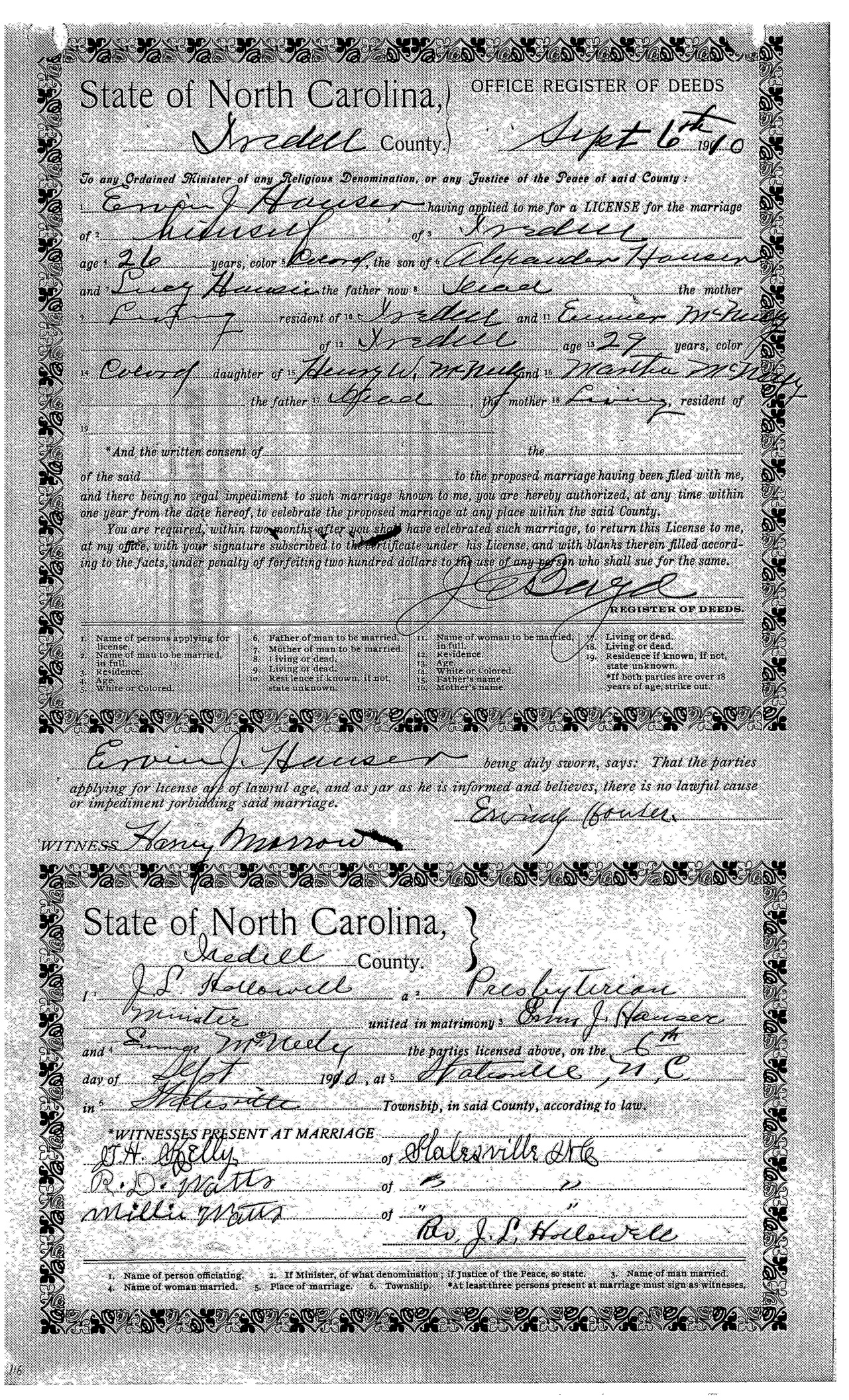
Irving L. Houser was born in 1885 in Iredell County to Alexander “Dan” and Lucy Houser. He and Emma McNeely were married 6 September 1910 in Statesville. The couple migrated to Bayonne, New Jersey, and settled on Andrew Street.
Six years later, in a span of three days, Irving appeared twice in New York City newspapers. First:
OLD JOBS OFFERED BAYONNE STRIKERS
Standard Oil Co. Tells Them They May Come Back, But Without Increase of Wages.
MRS. CRAM PLANS NEW VISIT.
Says She Will Consult a Lawyer and Won’t Be Barred — Federal Conciliators at Work.
The Standard Oil Company refused yesterday to grant the wage increases demanded by employees whose strike has tied up practically every big Plant in the Constable Hook section of Bayonne, N.J. for more than a week, but offered to take the strikers back at the old wage scale whenever the men wanted to resume work. The Committee of Ten, which learned these terms from George B. Hennessey, General Superintendent of the Bayonne plant, endeavored to report to the body of strikers. The police prevented them because no police permit to hold a mass meeting had been requested, but one was issued for a meeting this morning, at which the strikers will decide whether to accept or decline the terms.
…
Pending today’s meeting, the strikers were quiet yesterday. Early in the morning there had been some disorder at Avenue E and Twenty-fourth Street, bringing a squad of policemen, who fired as many more. They caught Irving Houser of 92 Andrew Street, an employee of the Edible Products Company, which plant is near the Tidewater Oil Company, and locked him when they found a revolver in his pocket.
New York Times, 18 Oct 1916.
Then,
Bayonne, N.J.
Miss Viola Houser, of Orange, N.J., visited her brother and sister, Mr. and Mrs. Irving Houser, Andrew Street, on Sunday, October 10.
New York Age, 21 Oct 1916.
Amid social unrest and social calls, Irving and Emma had three children: Mildred Wardenur (1913), Henry A. (1915) and Irving L. Houser Jr. (1920). For many years, Irving worked in various jobs in an oil refinery, but by time he registered for the “Old Man’s Draft” of 1942, he was employed at Bayonne City Hall. By then, he had purchased a house at 421 Avenue C, a site now occupied by Bayonne Giant Laundromat. Irving Houser Sr. died in 1962.
When your pilgrimage is over.
… Self life that might hender and draw you to earthly thing it inpels you on in to Godlines Paul sed I die dailey to the things of this world yeal your life dailey and hold your life in submision to the will of God and live by his word that you may grow unto the fulles measure of the staturs of Chris the one that lives wright is the ones who will a bide bide with him the day of his coming and stand when he a …
… Come by your God like impression God will take care of you no matter where you are cax aside all fear and put your trust in God and you are save. Then when your pulgrimage is over and you are call from labor to reward you will be greeted with that holy welcome that is delivered to all true missionaries come in the blessed of my father …
My grandmother had a large, dusty black Bible that had belonged to her “mama,” Sarah Henderson Jacobs Silver. (The Bible’s original owner was Carolina Vick, a midwife in east Wilson — her family’s birth and death dates are inscribed in its leaves.) When I first thumbed through the Book in the early 1990s, I found two scraps of paper stuck deep in its chapters. Pencilled in a square, unsophisticated hand were these bits of Sarah’s sermons. She had left the Congregationalism of her upbringing and joined the Holiness movement sweeping the country in the early 1900s. My grandmother was not impressed:
I was just thinking ‘bout that today, ‘bout how we used to do. Mama’d make us go to Holiness Church and stay down there and run a revival two weeks. And we’d go down there every night and lay back down there on the bench and go to sleep. Then they’d get us up, and then we didn’t have sense enough to do nothing but go to sleep and get up.
Mama’d go every night. And they’d be shouting, holy and sanctified, jumping and shouting. I don’t know, that put me out with the Holiness church. And sanctified people. I know Mama wont doing right.
Evangelist Sarah spent night after night jumping and shouting, leaving my adolescent grandmother to wash and iron the endless loads of laundry they took in from white customers. Sarah apparently met her second husband, Rev. Joseph Silver, founder of one of the earliest Holiness churches in eastern North Carolina, on the revival circuit. They married in 1933 and divided the five years before her death between Wilson and his home in Halifax County.

Sarah H. Jacobs and her Bible, with my uncle Lucian J. Henderson in the background, taken in Wilson NC circa 1930. (I have the Bible, but some time between when I first saw — and transcribed — the sermon scraps and when I took possession after my grandmother’s death in 2001, the pieces of paper were lost.)
Photo of Sarah Henderson Jacobs Silver in the collection of Lisa Y. Henderson. Interview of Hattie Henderson Ricks by Lisa Y. Henderson; all rights reserved.
Richard Artis.
There had been a photograph of Adam Artis, cousin Daisy told me, but it was stored with other things in an old barn, and rain ruined it. She recalled an image of a tall, brown-skinned man — or the suggestion of brown skin, anyway, in the soft sepia and charcoal tones of portraits of that day — but not what he actually looked like.
If no photograph of Adam exists, however, there is one of his youngest brother. This image, in fact, is the only one known of any of Vicey Artis and Solomon Williams‘ children.

Richard Artis was born in 1850 in Greene County, very near Wayne. He spent his youth out of sight of censustakers, but in 1873, he married Susanna Yelverton (also known as Susanna Hall,) the daughter of free woman of color Nicey (or Caroline) Hall and a white Yelverton. Their children included: Lucinda Artis Shearod, Emma Artis Reid, Ivory L. Artis, Loumiza Artis Grantham, Richard Artis Jr., Susan Artis Cooper, Jonah Artis, Charity Artis Coley, Frances Artis Newsome, John Henry Artis and Walter Clinton Artis.
Richard Artis farmed in northern Wayne County all his life. He died of apoplexy on 12 February 1923 in Great Swamp township and was buried the next day by his sister’s son, Adam Wilson.
——
Photo courtesy of Teresa C. Artis.
Death of a colored man.
“Death of Colored Man.”
John Colvert, aged 70 years, a respected colored man, died Thursday night at his home on Green Street. Funeral arrangements have not been made as he has relatives in the west who will attend.
Statesville Landmark, 10 Oct 1921.
This, of course, is John Walker Colvert, son of Walker Colvert. But who in the world were the “relatives in the west”??? His mysterious sisters and their progeny? And what was “the west”? Ohio? Missouri? California?

John Colvert was buried in Green Street cemetery, a square, three-acre concavity surprisingly devoid of markers in the heart of black Statesville. His and his wife Addie’s tombstones stand at the edge of South Elm Street, near that of his daughter Selma, and they are the only Colvert grave markers I have been able to locate.
 Scuffalong: Genealogy.