
Special thanks to cousin A.W.P., granddaughter of Dr. and Mrs. Joseph H. Ward, for bringing this to my attention:

Yes.

Special thanks to cousin A.W.P., granddaughter of Dr. and Mrs. Joseph H. Ward, for bringing this to my attention:
Yes.
A couple of weeks ago, I spent a delightful Friday afternoon in Augusta, Georgia, getting to know my cousin M.H. and his wife C.H. M.’s grandmother was Emma McNeely Houser, beloved and much-admired aunt of my grandmother Margaret Colvert Allen. M. and C. were every bit as warm and friendly as I’d expected, and the whole time we laughed and swapped stories. I wish he’d been able to meet my grandmother.
Here’s me and M.:

And here’s my great-grandmother Carrie McNeely Colvert Taylor, Aunt Emma holding a grandchild, Aunt Minnie McNeely Hargrove, and Uncle John McNeely, sometime in the early 1940s in Jersey City, New Jersey:

As I’ve written about here, visits to Norfolk, Virginia, to spend time with cousin Tilithia at her cafe were highlights of my grandmother’s childhood. They later lost contact, however, and it was not until I connected with B.J., a descendant of Tilithia’s sister Mattie Brewington Braswell, that I learned that Tilithia lived until 1965. I wish Mother Dear had known that.
In my earlier post, I mentioned that Tilithia was married to railroad fireman Walter Godbold during the years after World War I that my grandmother visited. “Her marriage to Godbold did not last,” I noted, “and the 1930 census found him back in Rocky Mount NC (described as divorced) and her still in Norfolk, holding herself out to be a widow while maintaining the little restaurant at 426 Brambleton Avenue.”
Ancestry.com’s Virginia Divorce Records database shed some light on this fractured set-up:
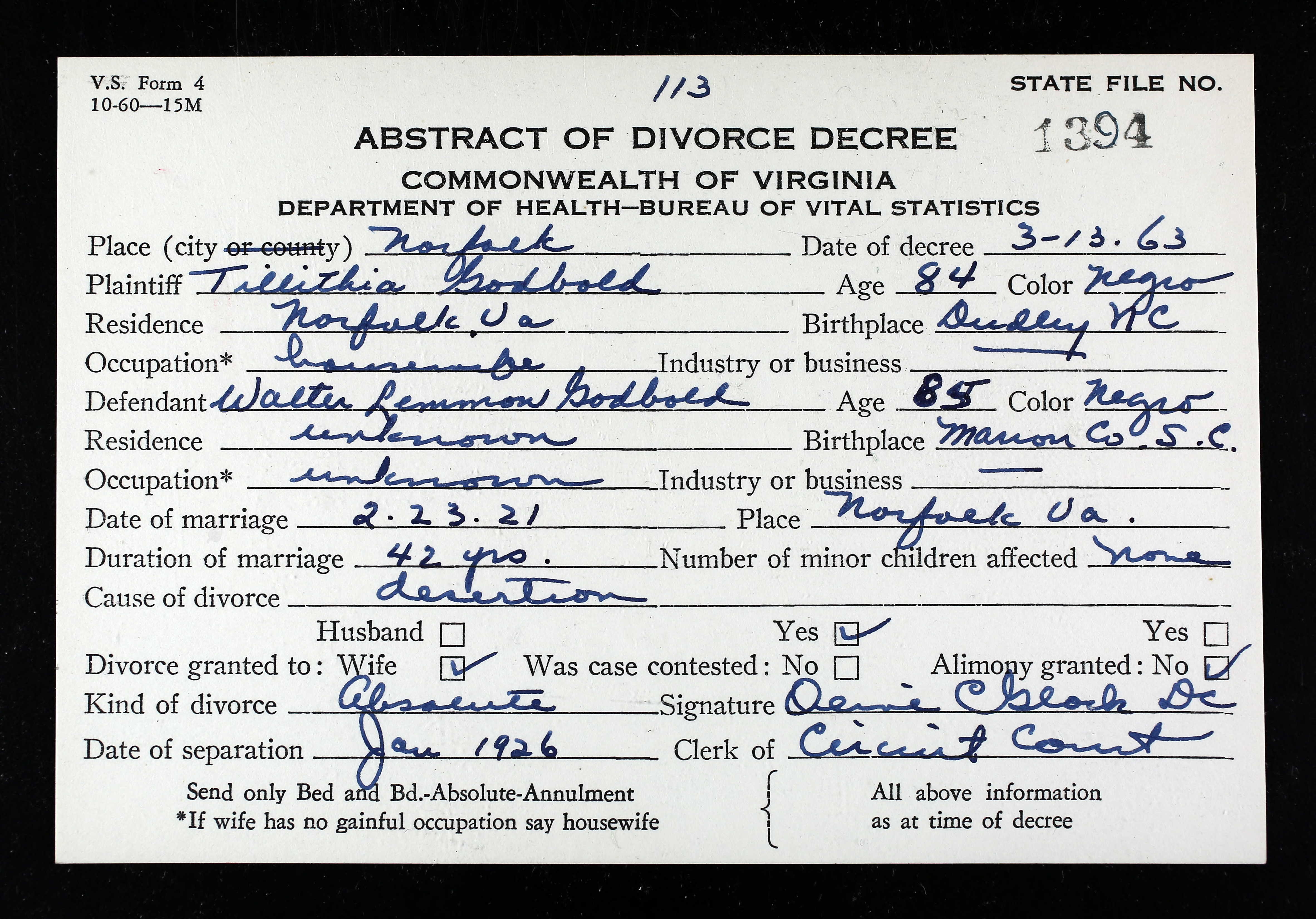
Yes. Apparently, Tilithia and Walter — married in 1921 and separated in early 1926 — stayed married for nearly 40 more years. Only in 1963 did Tilithia receive the divorce she finally filed for (and Walter contested.) Grounds: desertion. Walter was not new to that game, though he turned the tables in his go-round with Tilithia. Here’s the divorce record noting the dissolution of a previous marriage to a woman from his hometown, granted seven months before he married Tilithia:

And what could have led an 84 year-old woman to seek a divorce from a man she probably had not seen in decades? A third shot at love. Less than a month after her marriage to Godbold was dissolved, Tilithia married John Carter Dabney, a retiree nearly twenty years her junior.

This union, if happy, did not last long. A year and-a-half later, on 21 November 1965, Tilithia Brewington King Godbold Dabney passed away. Her heart failed, but presumably did not break.

On 4 September 1945, the “Colored News-Briefs” column of The Hopewell Times, included this brief passage:

That Graham Whirley‘s death by gunshot was not reported salaciously says a lot about the regard in which he was held both inside and out of his community in Hopewell.
Three days later, the Colored News-Briefs column carried a detailed account of Graham’s funeral, held at New Vine Baptist Church in Charles City County the previous Tuesday:

“Will My Mother Know Me There?” — we’ll come back to that.
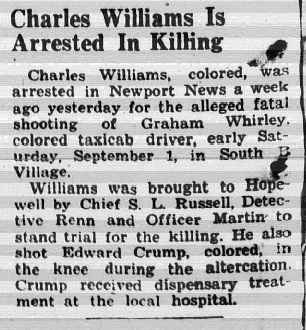
This brief piece was published 14 September. I haven’t yet found follow-up articles that reveal details of Graham Whirley and Charles Williams’ fatal encounter or of the outcome of Williams’ trial. What I have found, however, are numerous examples of the esteem in which Hopewell’s working-class African-American community held this relatively young man.
The first mention, on 8 December 1936, was a sweet one — “Miss Susie Whirley of Richmond was in the city last week visiting her brother at his home in City Point.” Though Graham’s social life — party attendance and motor excursions — received remarks (especially when he was courting a woman called Miss Carrie B. Lightly,) his singing brought the most notice. Time after time, the colored news noted that he had “rendered” a beloved hymn at a Baptist church in or around Hopewell:
In the middle of this, on 22 May 1944, the column announced that “Mr. and Mrs. Graham Whirley of City Point have returned after spending their honeymoon in Baltimore, Maryland.” That, of course, was where his half-brother John Whirley and sister Matilda Whirley Brinage lived. Just sixteen months after he remarried, Graham Whirley, taxi driver and sought-after soloist, was dead. Despite his move across the James River, he had never left his home church, and he is buried at New Vine.
 Scuffalong: Genealogy.