Land, Maternal Kin, North Carolina

Roadtrip chronicles, no. 3: Eagle Mills ramble.

Monday afternoon came the highlight of the whole little road trip. I’d arranged to meet P.P. at a little cafeteria at the crossroads that is Harmony, North Carolina. I first spoke with her a little over a month ago, when she responded to my blog post about Walker Colvert’s will. P. is a distant cousin, another descendant of Thomas and Rebecca Nicholson Nicholson, and I was giddy with anticipation.

After lunch, at her direction, I headed north on Highway 21 toward Houstonsville. The sky was overcast, and a little drizzle had begun that would deepen into steady rain before long. I was undeterred. Over the next few hours, we traced the back roads of Eagle Mills and Union Grove townships, rolling through fallow fields, pastures, and woodlands, crossing and recrossing Hunting Creek and its tributaries. This was Colvert and Nicholson ground zero, and the highlights of our ramble warrant their own blogposts, soon to come.

My everlasting gratitude goes to Cousin P.P. for her generosity of time and knowledge.

Standard
Land, Maternal Kin, North Carolina, Other Documents

Roadtrip chronicles, no. 2: Iredell County records.

I was killing time in a way, but I wanted to do so usefully, so I arrived at the Register of Deeds office shortly after it opened at 8 A.M. I side-eyed this —

IMG_5993

— and headed into the search room. I had a few loose questions: did Walker Colvert in fact never file a deed for his acres in Union Grove? Did John W. Colvert file any deeds? Where did Abner and Harriet Nicholson Tomlin live?

I took these notes:

  • Who were the William and Lucy A. Dalton from whom Lon W. Colvert purchased his first property in 1906? What was their relationship, if any, with his first wife Josephine Dalton?
  • No recorded deeds for Walker Colvert.
  • No recorded deeds for John W. Colvert.
  • However, John’s wife Adeline Colvert bought two lots on Harrison Street in Statesville in 1912 for $472. Huh? John and Adeline married in 1905. As far as I know, they remained married until his death in 1921. So why was she purchasing property in her own right in 1912? The house built on the property sheltered John and Addie’s descendants as late as 1959, and probably later. There’s a plat filed at Book 33, page 398, for the section of Statesville in which the lots lay. I forgot to get a copy.
  • Abb Tomlin had one recorded deed — for the $40 purchase of an acre of land from William and Laura Pearson on 19 June 1891. The tract adjoined the AT&O Railroad and is probably the same one that Abb and Harriet Nicholson Tomlin‘s son and heir Harvey Golar Tomlin sold to Lon W. Colvert in 1906.
  • My grandmother believed T. Alonzo “T.L.” Hart to be a real estate lawyer. I haven’t found any evidence that he attended law school or practiced law, but there is no question that he knew his way around a land acquisition. Between 1887 and 1922, he recorded 14 deeds for purchases in or near Statesville totaling well over 200 acres. Three small purchases in 1911 and 1920 were from Andy King (1839-1919) and his heirs. King was a farmer and rock quarry laborer whose near neighbors were Logan and Laura Sherrill.
Standard
Births Deaths Marriages, Maternal Kin, Newspaper Articles, North Carolina, Photographs

Roadtrip Chronicles, no. 1: Statesville cemeteries.

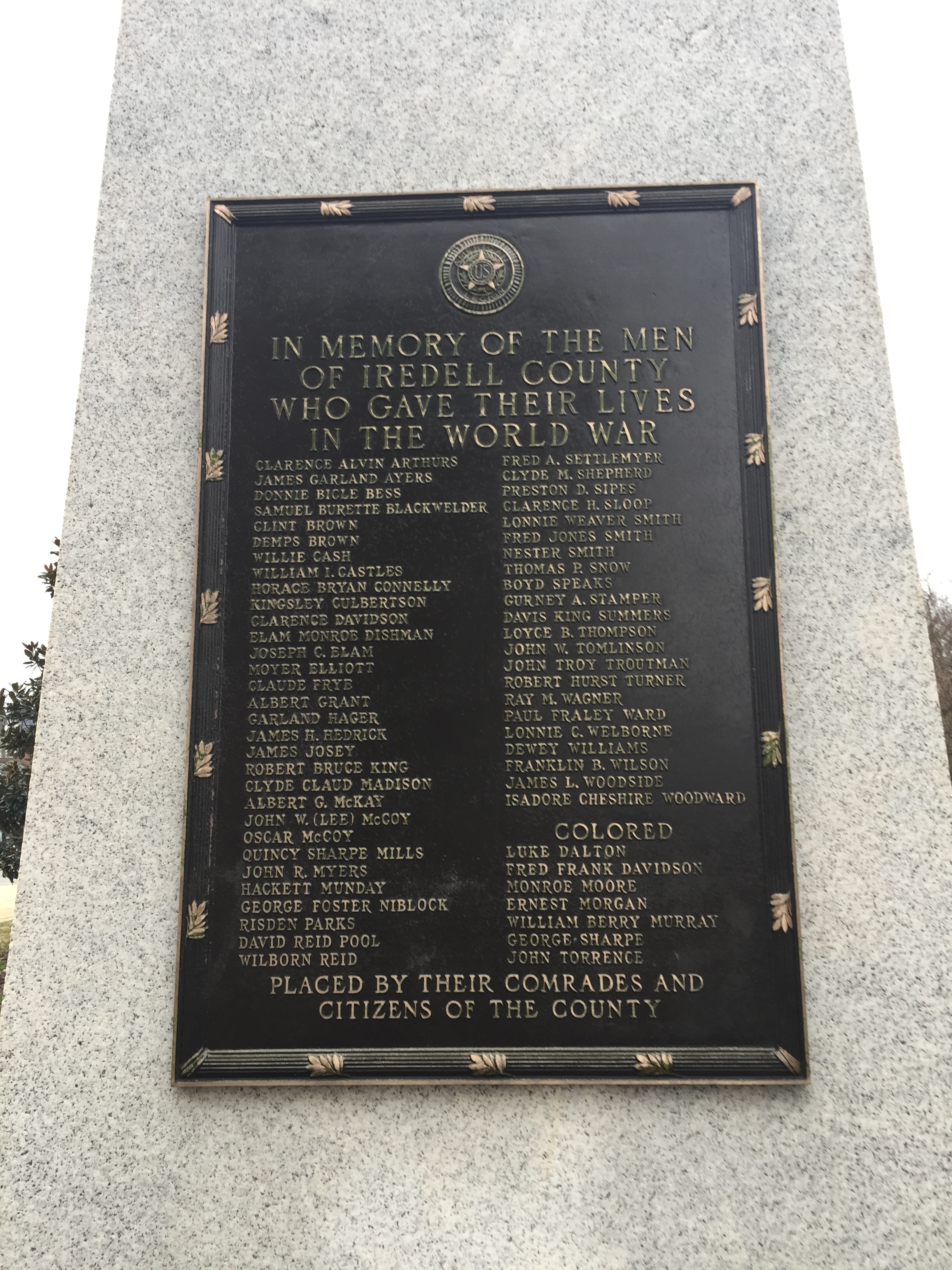
I made it to Statesville in good time Sunday and drove straight to the only place I really know there — South Green Street. My great-aunt, Louise Colvert Renwick, had lived there for decades, across from the street from the Green Street cemetery. As I approached her house, my eye caught a small memorial just off the curb.

IMG_5958

Funny what you see when you’re looking. (And look closely at the plaque. Committee member Natalie Renwick is my first cousin, once removed.)

It seems odd to me that, when we were all gathered at Aunt Louise’s for the first Colvert-McNeely reunion, no one mentioned that Colverts and McNeelys were buried across the street. (Or maybe my 14 year-old self just paid no attention?) I’ve only found three graves — those of John Colvert, his wife Addie Hampton Colvert, and their daughter Selma — but there are certainly many more. Lon W. Colvert, for one. (Or was it? His death certificate indicates “Union Grove,” but why would he have been buried up there?*) And his son John W. Colvert II. And Addie McNeely Smith and Elethea McNeely Weaver and Irving McNeely Weaver, who was brought home from New Jersey for burial.

The cemetery looks like this though:

IMG_5971

And not because it’s empty. Though closed to burials for 50 or more years, it is probably nearly full of graves either unmarked or with lost or destroyed markers. Here’s one that’s nicely marked, however, and that would I recall before 24 hours had passed:

IMG_5972

From Green Street, I headed across town to Belmont, Statesville’s newer black cemetery. I knew Aunt Louise, her husband and son Lewis C. Renwick Sr. and Jr. were buried in Belmont, and I was looking for several McNeelys whose death certificates noted their burials here. I found Ida Mae Colvert Stockton‘s daughter Lillie Stockton Ramseur (1911-1980) and her husband Samuel S. Ramseur (1912-1989). Then Golar Colvert Bradshaw‘s husband William Bradshaw (1894-1955) and son William Colvert Bradshaw (1921-1988). (William was buried with his second wife. Golar, who died in 1937, presumably was interred at Green Street.) No McNeelys though. I expected to find both Lizzie McNeely Long and Edward McNeely, who had a double funeral in 1950, but their graves seem to be unmarked.

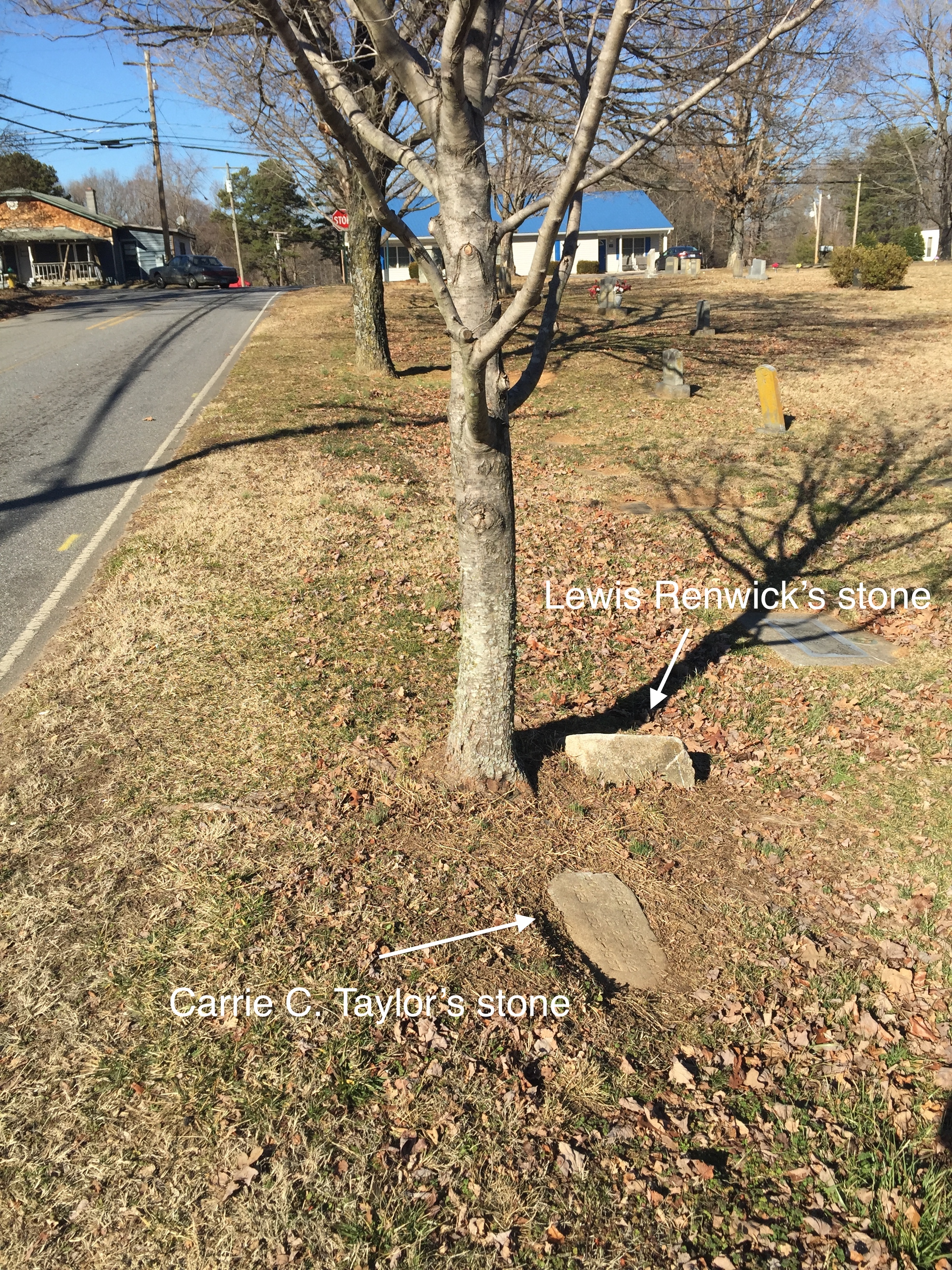
I was also looking for my great-grandmother, Carrie McNeely Colvert Taylor. The whole business was turning into a big disappointment. At street’s edge, I turned to head back to my car. And gasped. There, at my feet, wedged at the base of a tree:

IMG_5988

What in the world? This is clearly not a gravesite. And, on the other side of the tree, there’s an identical stamped concrete marker for Lewis C. Renwick Sr., who died almost exactly a year after Carrie. What’s odd, though, is that he has a granite marker a couple hundred feet away in another section of the cemetery with his wife (Carrie’s daughter Louise) and oldest son. Is Grandma Carrie actually buried in the Renwicks’ family plot? Were her and Lewis Renwick’s makeshift stones pulled up to be replaced by better markers? If so, where is Grandma Carrie’s? And why were both dumped at the edge of the cemetery?

IMG_5992

Here’s an overview of Belmont cemetery. (1) is the approximate location of Carrie M.C. Taylor’s broken marker. (2) is the approximate location of the Renwick plot.

IMG_6168

I’ll pose those questions to Statesville’s cemetery department. If Grandma Carrie has no permanent stone, she’ll get one.

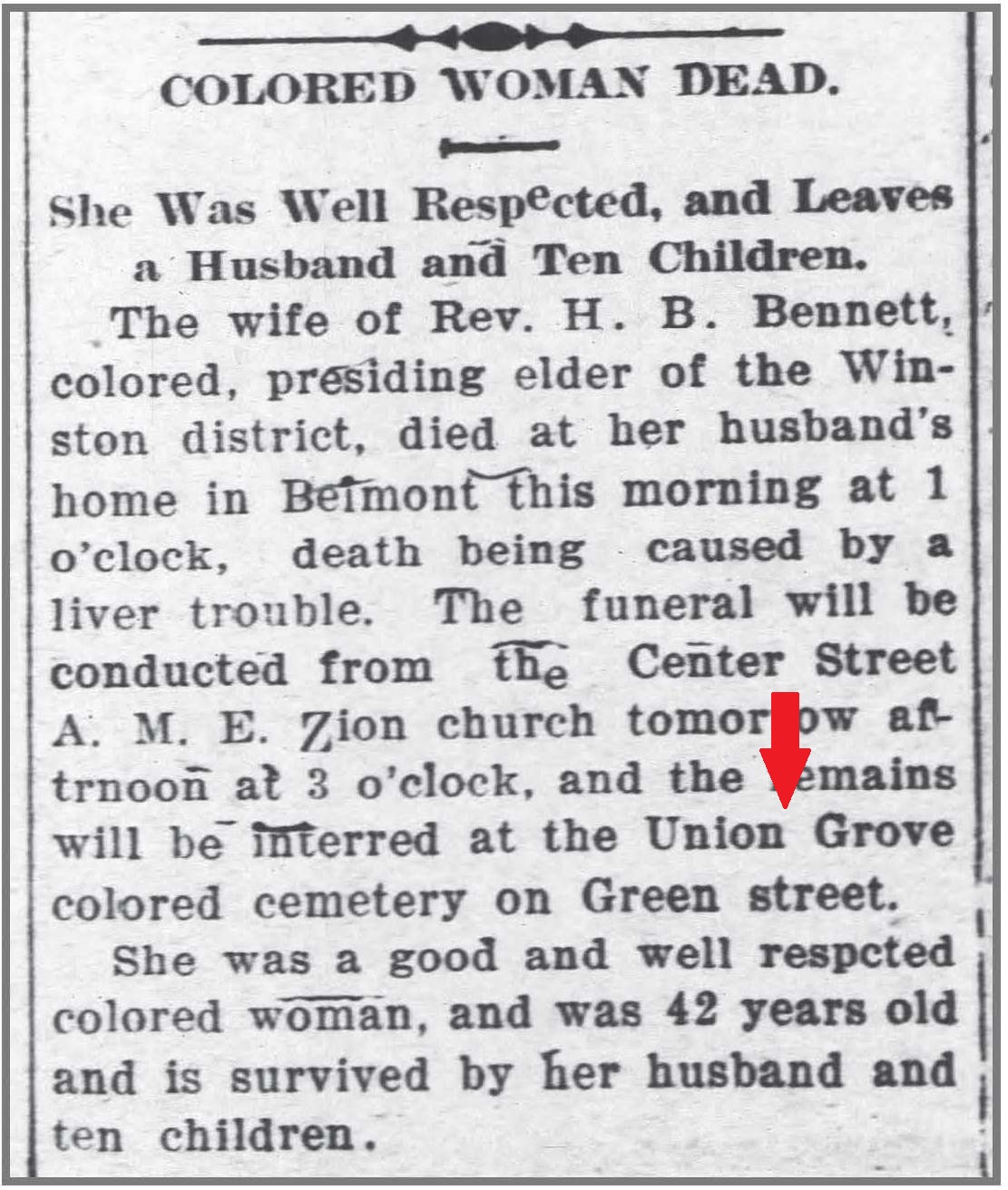
* After noticing that Irving Weaver’s obit also mentioned Union Grove cemetery, though the McNeelys had no ties to that township in northern Iredell County, I searched for clues in contemporary newspapers. Mystery cleared. Green Street cemetery is Union Grove cemetery:

Stville_Evening_Mascot_4_3_1909

The Evening Mascot (Statesville), 3 April 1909.

Standard
Agriculture, Land, Newspaper Articles, North Carolina

An educated colored man comments.

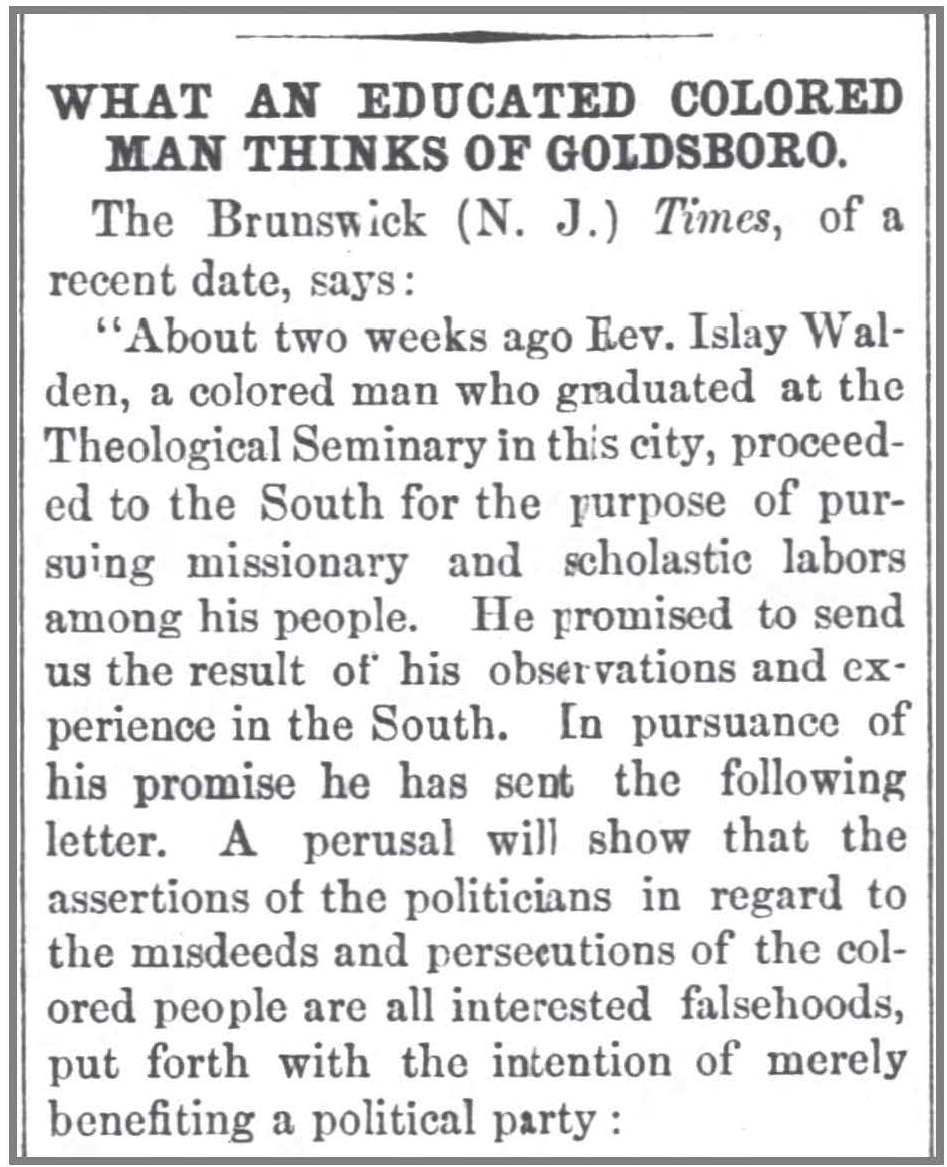
clipping_1703338

After a few observations about colored dockworkers in Norfolk and the spirit of brotherly love that enveloped black and white railroad workers, Alfred Islay Walden arrived in Wayne County. At Mount Olive, he asserted confidently that “nearly all the families own their homes and farms” and marveled at the reported wealth of “some men.” The former is not true, but the latter could have been a reference to the members of the Simmons and Wynn families, whose relative wealth dated back to their status as free skilled craftsmen and landowners in the antebellum era.

The week in Dudley is particularly interesting, as all of my paternal grandmother’s Henderson and Aldridge ancestors and relatives lived in this community in 1879, when Walden was perambulating. The “excellent school carried on by the American Missionary Society” was probably the school conducted at First Congregational Church, which my forebears founded and attended. The many who taught first and second grades in public schools included my great-great-grandfather John W. Aldridge and his brothers Matthew W. and George W. Aldridge. I’m not sure who owned the saw and shingle mills, but the landowners included the Aldridge brothers and their father Robert Aldridge, Lewis Henderson and his father James Henderson, Hillary B. Simmons’ father George W. Simmons, and other extended kin.

Gboro_Messenger_28_Aug_1879_Islay_Walden_letter

Goldsboro Messenger, 28 August 1879.

Standard
Other Documents, Photographs

52 Ancestors in 52 Weeks: 6. So far away.

I thought first about this week’s challenge in a spatial sense. Who was so far away? My grandmother in Philadelphia, to whose home we voyaged every summer from North Carolina? My New York relatives? My Chicago cousins? And then I remembered this, an “autobiography” I wrote as a class assignment in fifth grade. Forty years ago. So far away indeed.

——

THE AUTOBIOGRAPHY OF LISA HENDERSON

by Lisa Henderson 

This Autobiography is dedicated to: my parents for providing me with memories

Table of Contents:

Preface i Autobiography 1 Time Line 7 Family Tree 8 Book List 9

Preface

This autobiography was written by me as a project. I hope it will be a success to me.

The Autobiography of Lisa Henderson

I guess I have a good sense of timing. June 26 in the late [meaning ‘upper,’ as in temperature] 90’s was when I was born. Just in time for a tan. I was born at 4:50 P.M. at Mercy Hospital. I weighed 7 pounds 10 ounces and was 22 inches long. When I was about six months old, I came down with bronchitis. It was one of my few very serious childhood diseases. I moved from 706 Ward Boulevard to 1401 Carolina St., at about 8½ months. I lived on Carolina St. until a little more than a year ago when I moved again. At 14 months I started walking. I was at my Uncle J____’s house. I took my first steps at home though. From ages 1½ to 3 years I stayed with Mrs. Speight while my parents worked. I played with my cousin M____. We had wood blocks to play with. Sometimes we went on walks with A____ and B____ her two [grand]sons. Once, going to her house I fell in the street and busted my knee. I know I had a fit. We went to the Philadelphia and I went to the Philadelphia Zoo for the first time when I was about two. When I was three my sister was born. Mama and Daddy named her K____. She got meningitis when she was about 6 months old and stayed in the hospital 21 days. At age four I entered nursery school at Kiddie Kollege of Knowledge. Most of my immediate friends and cousins in Wilson who were of age were there, too. My teachers were Mrs. H___ and Mrs. P___. At 4½ I broke my fingernail in half in a 2-inch door. I was taken to the emergency room at the clinic. I got it all plastered up. T____ and I used to slide off the cast and look at my black, blue, purple and green finger. When I was five I entered kindergarten at Kiddie Kollege of Knowledge. All my friends and cousins except four people were gone to the first grade. Kindergarten wasn’t very exciting. I guess the most exciting thing was graduation. At graduation I got a Timex Cinderella watch. During the summer between kindergarten and first grade I got my [smallpox] vaccination. I got it on my back because in order to please complainers they were putting it back there instead of on your arm. In that same summer I got cellulitis. A mosquito bit me and I scratched it and scratched it and scratched it, until it got infected and ate my first layer of cells. I came back to Wilson from Virginia and went to the doctor. He said I had to go to the hospital. I stayed there 6 days. I went to B.O. Barnes School when I was in first grade. My teacher’s name was Mrs. B____. It was in the first grade that I met V___ and J____. She came from Mrs. H____’s room. In the second grade I met another good friend J____ and B____. I was in Mrs. M____s room. In January we had Mrs. F___ because Mrs. M____ had to go to the hospital. I got my first dog when I was in the second grade. His name was Tiger. When he got run over I had a fit. Also, when I was in the second grade my father had an accident. He was playing volleyball when a boy threw the ball and hit his finger. The ball flew with such force that the finger was broken. He said he could see the bone and flesh when it happened. Were it healed is still a big knot. Upon entering third grade I realized something. Of all my three years in elementary school I had been in the same homeroom as B____ and M____. I was named secretary of the class by my teacher, Mrs. P____. In fourth grade I went to Vinson-Bynum from B.O. Barnes. My teacher was Mrs. E____. In fourth grade I rode a bus to school for the first time. It was Bus 73. In the later part of fourth grade I moved to 2___ Bel Air Avenue. I rode Bus 70 when I moved to Bel-Air. I met W____ in the 4th grade.

——

And, yes, that’s The End. I don’t know what else to say about this pithy summary of my first 10 years, except I seemed to have lots of fits and had a very narrow notion of what aspects of life and people in it warranted memorialization.  I got an A, though. And that family tree in the table of contents? It marks the first time I ever asked questions about my ancestors.

Lisa 5th grade

1974-75.

Standard
Maternal Kin, Photographs, Religion

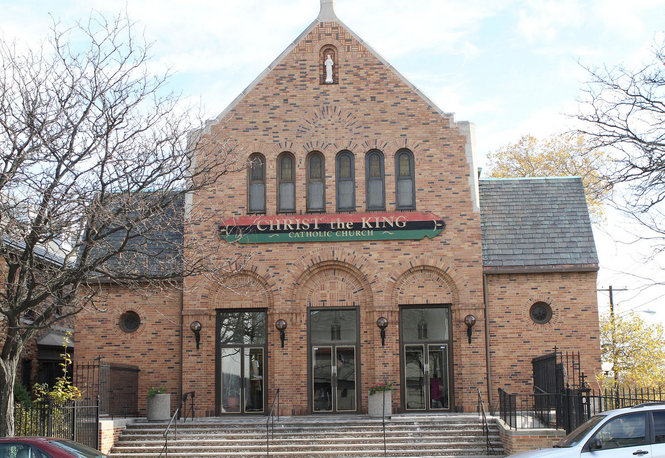
Church home, no. 9: Christ the King Catholic Church, Jersey City, New Jersey.

After my recent 52 Challenges post, I started wondering about the church my great-grandmother and cousins are standing in front of. My grandmother and her sisters were reared Episcopalian (and AME Zion), so I assumed that it was an Episcopal church. To my surprise, my cousin G.W., son of the oldest daughter of my great-aunt Launie Mae Jones Colvert, identified it as Christ the King Catholic Church.

Catholic??? Aunt Launie Mae was Catholic?

Another cousin, K.J., chimed in. She’d talked to her mother, who said that in Aunt Launie Mae “had told her she converted to Catholicism after my grandfather was sick (with TB), and the Catholic church was there for her.” (Aunt Launie Mae’s husband was Isaiah James Jones (1912-1984), a native of Georgia.) This would have been in the early 1940s. The things you learn when you least expect.

11898265-standard

(I wonder what happened to those beautiful wooden doors?)

Standard
Enslaved People, Maternal Kin, North Carolina, Paternal Kin, Photographs, Virginia

Freedom’s faces.

Yesterday was the 150th anniversary of Congress’ passage of the Thirteenth Amendment, which abolished slavery in the United States. On Facebook, several friends posted links to sites featuring “never-before-seen” photographs of formerly enslaved Americans, most taken in the 1930s. As I clicked through these images, struck by the strength and endurance embodied, I had a sudden thought — I’ve got a few photos of former slaves, too. And they’re my own people.

——

McNEELY -- Martha M McNeely in blue dress

Martha Margaret Miller McNeely. Born about 1855 in Rowan County, North Carolina, to Margaret McConnaughey and Edward Miller. Enslaved by John M. McConnaughey. My matrilineal great-great-grandmother.

 NICHOLSON -- Harriet Nicholson 2

Harriet Nicholson Tomlin Hart. Born in 1861 in Iredell County, North Carolina, to Lucinda Cowles and James Lee Nicholson. Enslaved by Thomas A. Nicholson, her grandfather. My maternal great-great-grandmother.

Mary Brown Allen

Mary Brown Allen. Born about 1849 in Amelia County, Virginia, to Catherine Booker and James Brown. Owner unknown. Maternal great-great-grandmother.

Aspilla Ward Hagans

Apsilla “Appie” Ward Hagans. Born 1849 in Greene County, North Carolina, to Sarah Ward and Dr. David G.W. Ward, her owner. Wife of my great-great-great-great-uncle Napoleon Hagans.

Mittie_Ward

Mittie Ward Vaughn. Born 1849 in Greene County, North Carolina, to Sarah Ward and Dr. David G.W. Ward, her owner. Twin of Appie, above. Mother of son of my great-great-great-great uncle Napoleon Hagans.

——

In tribute to these and countless others, known and unknown, who walked through this country’s darkest days.

Standard
Births Deaths Marriages, Land, Newspaper Articles, North Carolina

Dr. Ward’s empire.

Wilson_Advance__8_22_1889_DGW_Ward_estate_land_sale

Wilson Advance, 22 August 1889.

The Civil War set Dr. David G.W. Ward back, but not for long. When he died in 1887, he stood possessed of more than 1900 acres in Wilson and Greene Counties.

[As an aside, Ward’s administrator, Frederick A. Woodard, was elected Democratic Congressman to the U.S. House of Representatives in 1892. He lost his bid for re-election to George H. White, a visionary African-American who was the last black Southerner elected to Congress until the post-Civil Rights era. I attended a middle school named for Woodard.]

[As another aside — literally — I think it’s safe to say that Sarah Ward’s children received nothing from the doctor’s estate.]

Standard
Enslaved People, Maternal Kin, North Carolina, Other Documents

Rules for patty rollers.

By an act of Assembly, passed in the year 1802, the County Court have power to establish Rules and Regulations for the government of the Patrollers in their respective counties;

In pursuance of the power thus granted, the County Court of Rowan, at August session, 1825, made and established the following regulations for the government of Patrols, to wit:

1st. Patrols shall be appointed, at least four in each Captain’s district.

2d. It shall be their duty, for two of their number, at least, to patrol their respective districts once in every week; in failure thereof, they shall be subject to the penalties prescribed by law.

3d. They shall have power to inflict corporal punishment, if two be present agreeing thereto.

4th. One patroller shall have power to seize any negro slave who behaves insolently to a patroller, or otherwise unlawfully or suspiciously; and hold such slave in custody until he can bring together a requisite number of Patrollers to act in the business.

5th. Previous to entering on their duties, Patrols shall call on some acting magistrate, and take the following oath, to wit:

“I, A. B. appointed one of the Patrol by the County Court of Rowan, for Captain B’s company, do hereby swear, that I will faithfully execute the duties of a Patroller, to the best of my ability, according to law and the regulations of the County Court.

Signed, A. B.”    “Witness, C. D. J. P.”

Whereupon, the officiating magistrate shall make out and deliver to him, or them, the following certificate, to wit:

“I, C. D. one of the acting magistrates of Rowan County, do hereby certify, that A. B. came before me, on this the _______ day of ______ A. D. 182__ and was duly sworn faithfully to execute the duties of a Patroller for this County, in Captain B’s company, according to law and the regulations of the County Court in such case made and provided.

Signed,   ____________ C. D. J. P.”

And no Patroller, without this certificate, shall be allowed the privileges and compensation otherwise extended to them.

6th. If any Patroller, while in the discharge of his duty, shall get drunk, or behave in a riotous or disorderly manner, he shall forfeit and pay the sum of five dollars, to be recovered in the name of the chairman of the County Court. He is also, by law, subject to indictment.

7th. The Sheriff of the county shall have the acts of Assembly relating to Patrols, together with these regulations, printed; and, in future, furnish each set of Patrols with a copy of the same; and he shall be allowed for the cost of printing, in his settlement with the county Trustee.

— from Patrol Regulations for the County of Rowan; Printed by Order of the County Court, at August Term, Anno Domini 1825, http://docsouth.unc.edu/nc/rowan/rowan.html  

Standard