Births Deaths Marriages, Free People of Color, North Carolina, Paternal Kin, Photographs

Edward & Susan Henderson Wynn.

Image

Image

Edward James Wynn (1838-1922) was the son of Gray Winn and Sarah “Sallie” Greenfield Winn.  His wife, Susan Henderson Wynn (1854-1907), was the daughter of James H. Henderson and Louisa Armwood Henderson. They are buried in a small family cemetery near Dudley in southern Wayne County.

Standard
Births Deaths Marriages, Migration, Newspaper Articles, North Carolina, Oral History, Paternal Kin, Virginia

We got strayed apart.

I was thinking about Cousin Tilithia when I was a little girl.  She had a restaurant large enough to work in and serve patrons.  It wasn’t real big, but they were serving patrons, and Mama carried me up there, and we spent the night there.  And whenever she’d come to Wilson she’d stay with us.  

Tilithia Godbold, she lived in Norfolk, and she married this man.  That wasn’t her children’s daddy.  King was her children’s daddy.  Godbold was the man she married later. He lived over in Rocky Mount, and he worked in the roundhouse or something.  I think he fixed the train, but he wasn’t the one on the train.  And Godbold, Tilithia’s husband, he stayed there in Rocky Mount.  ‘Cause Tilithia lived in Norfolk.  Her and her five or six girls or whatever it was, and she was running what they call the Strand Café.  And it was down on the first floor, and they lived up over it.  Go out there, and it was a sleeping compartment.  I was over there one time, and I remember it.  I think I was about seven or eight years old.  Went with Mama over there.  We was just running all over the place.  She had us waiting tables.  I wanted to wait tables. I was wondering, I asked Mama, “Well, why come we couldn’t have a place like that?”  And all that food!  Look like whatever the food was – I didn’t even know what it was ‘cause we ain’t never had none.  It was a whole lot of stuff, look like they had, I didn’t want it, but then I know it looked good, and we ate down there in the café.  

And another time Mama took me over there on the train to see her.  And it was right down in South Philadelphia where we went to their house.  Where they was staying.  And when I moved up here, her sister, she was telling me ‘bout how the children were there in Norfolk, her sister and all them.  I said, well, I could remember some of them, but I don’t remember what –  and I asked where some of the girls was.  Some of them in Norfolk and some of ‘em, one’s dead.  [Inaudible] the family.  We got strayed apart. 

——
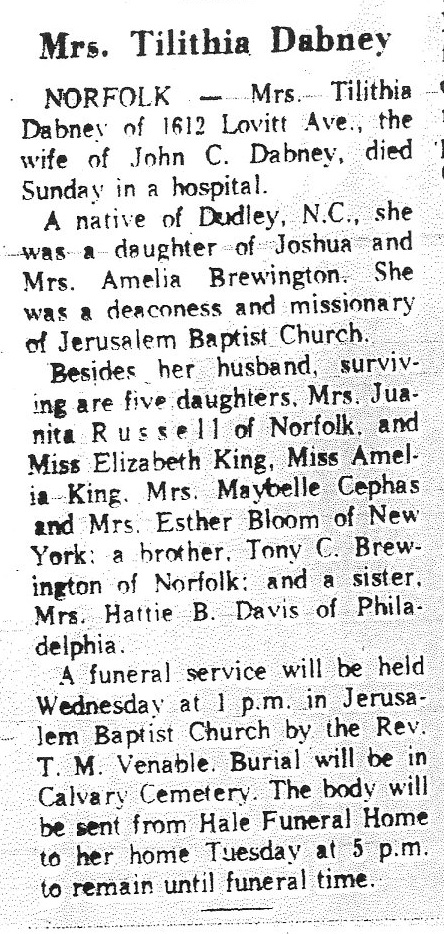
My grandmother reminisced fondly of “Ta-LIE-a-thy” and her cafe, but was not entirely sure how they were related. Not long into my research, I discovered that Tilithia Brewington King Godbold Dabney was born 1878 to Joshua and Amelia Aldridge Brewington. She was, then, the first cousin of my grandmother’s father, J. Thomas Aldridge. Tilithia married Emanuel King in 1898 and, by 1910, the couple and their daughters Juanita, Elizabeth, Amelia, May Bell and Tilithia had settled in Norfolk, Virginia. Tilithia and Emanuel divorced and, by 1920, she was married to railroad fireman Walter Godbold and running her cafe. Her marriage to Godbold did not last, and the 1930 census found him back in Rocky Mount NC (described as divorced) and her still in Norfolk, holding herself out to be a widow while maintaining the little restaurant at 426 Brambleton Avenue.
This was about all I could locate on Cousin Tilithia until 2009, when I met — genealogically speaking — B.J., a descendant of Tilithia’s sister Mattie Brewington Braswell (and my fourth cousin.)  Ours has been a most fecund collaboration, and it was she who discovered Tilithia’s obit and what had become of her daughters. My grandmother would have pleased to know that the branches of our family had found their way back from being “strayed apart.”

Image Virginian Pilot, 22 November 1965.

Interview of Hattie H. Ricks by Lisa Y. Henderson; all rights reserved.

Standard
Births Deaths Marriages, North Carolina, Paternal Kin, Photographs

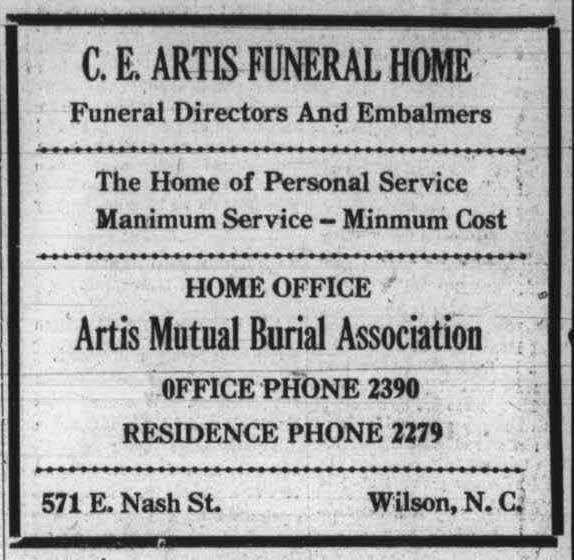
The Home of Personal Service.

Columbus Estell “C.E.” Artis was born in 1886 near Eureka, Wayne County NC to Adam T. Artis and his fourth wife, Amanda Aldridge Artis. Census records and city directories show that he tried his hand at a number of businesses, including grocery stores and “eating houses.” The 1915 directory of the town of Wilson NC described him as an undertaker, but it’s not clear for whom he worked or if he owned his own business at that time. He spent several years in Washington DC during and after World War I, but a 1922 newspaper article makes references to Batts Brothers and Artis as local undertakers, and the 1925 Wilson city directory carries this entry:

ARTIS & FLANAGAN (CE Artis, WE Flanagan) funeral directors 563 E Nash phone 1183

Here’s Artis’ business  described in 1979 in National Register of Historic Places Inventory — Nomination Form for  “East Wilson Business Area,” Wilson Central Business and Tobacco Warehouse Historic District:

One of only two black funeral directors in Wilson, Columbus Estelle Artis (1886- 1973) had this modest, one-story, three-storefront building [at 567-571 East Nash Street] erected in 1922. His funeral business occupied the 571 store until the mid 1950s when he retired and closed his business; the other two stores have always been used for rental purposes, except for a brief period from ca 1945 until ca 1951 when Artis expanded his funeral home into the 569 store. The stuccoed brick structure has narrow stores at 567 and 569 that contain a simple door and a large adjacent display window, both of which have transoms of clear glass. The store at 571 East Nash Street has a central door with flanking display windows, also with transoms. Unfortunately, all of the windows and three of the window transoms have been boarded up. The blind northwest elevation originally abutted the drug store occupied by Darcey D. Yancy during the 1940s and 1950s; this building was razed in the mid 1960s. The rear elevation of the Artis building has a one central door per store. The southeast elevation wall is adjacent to the Jackson Chapel First Missionary Baptist Church, which has maintained offices of the Artis building since 1980.

(Historic designation notwithstanding, Jackson Chapel tore down the buildings in the 1990s to make way for a church expansion and parking lot.)

C.E. Artis’ distinctive, wide-nibbed, angular cursive — r’s slashed diagonally — appears on hundreds of Wilson and Wayne County death certificates.  Like James Guess in Goldsboro, with whom he competed to some extent, C.E. Artis was often called upon to bury his kin, including several of his siblings. Among the funerals he conducted were:

Vicy Aldrich, 13 Feb 1927.  Buried Aldrich cemetery, Dudley NC.  Daughter of Adam and Frances Seaberry Artis, Vicey Artis Aldridge was C.E.’s half-sister.

+ Baby Jacobs, 22 Apr 1928.  Buried Rountree cemetery, Wilson. Unnamed stillborn son of Hattie Mae Jacobs, who was the granddaughter of Vicey A. Aldridge.

+Napoleon Artis, 9 Sep 1928.  Buried family cemetery, Wayne County.  Son of C.E.’s half-brother Walter S. Artis, who was son of Adam and Frances Seaberry Artis.

Jane Sauls, 16 Dec 1928. Buried Union Grove cemetery, Wayne County. Daughter of Sylvania Artis Lane, who was sister of C.E.’s grandmother Vicey Artis Williams.

+ Mable Barnes, 18 Apr 1929.  Buried family cemetery, Wayne or Wilson County. Daughter of C.E.’s brother Robert E. Artis.

+ Ivery Artis, 24 Jul 1930.  Buried Wayne County. Son of Morrison Artis, who was first cousin of C.E.’s father Adam T. Artis.  Also, Morrison’s first wife, Jane Artis, was Adam’s sister.

+ Alberta Artis, 9 Jun 1931.  Buried Wayne County.  Granddaughter of C.E. Artis’ paternal aunt Delilah Williams Exum.

+ Lucinda Artis, 23 Jun 1931.  Buried Wayne County.  Widow of C.E.’s uncle Jesse Artis.

+ Susiannah Artis, 11 Sept 1931.  Buried Wayne County.  Widow of C.E.’s uncle Richard Artis.

+ Leslie Exum, 4 Jul 1934.  Buried Wayne County.  Grandson of C.E.’s half-brother Jesse Artis, son of Adam and Frances Seaberry Artis. Leslie’s wife Beulah Artis Exum was daughter of C.E.’s half-brother, William M. Artis.

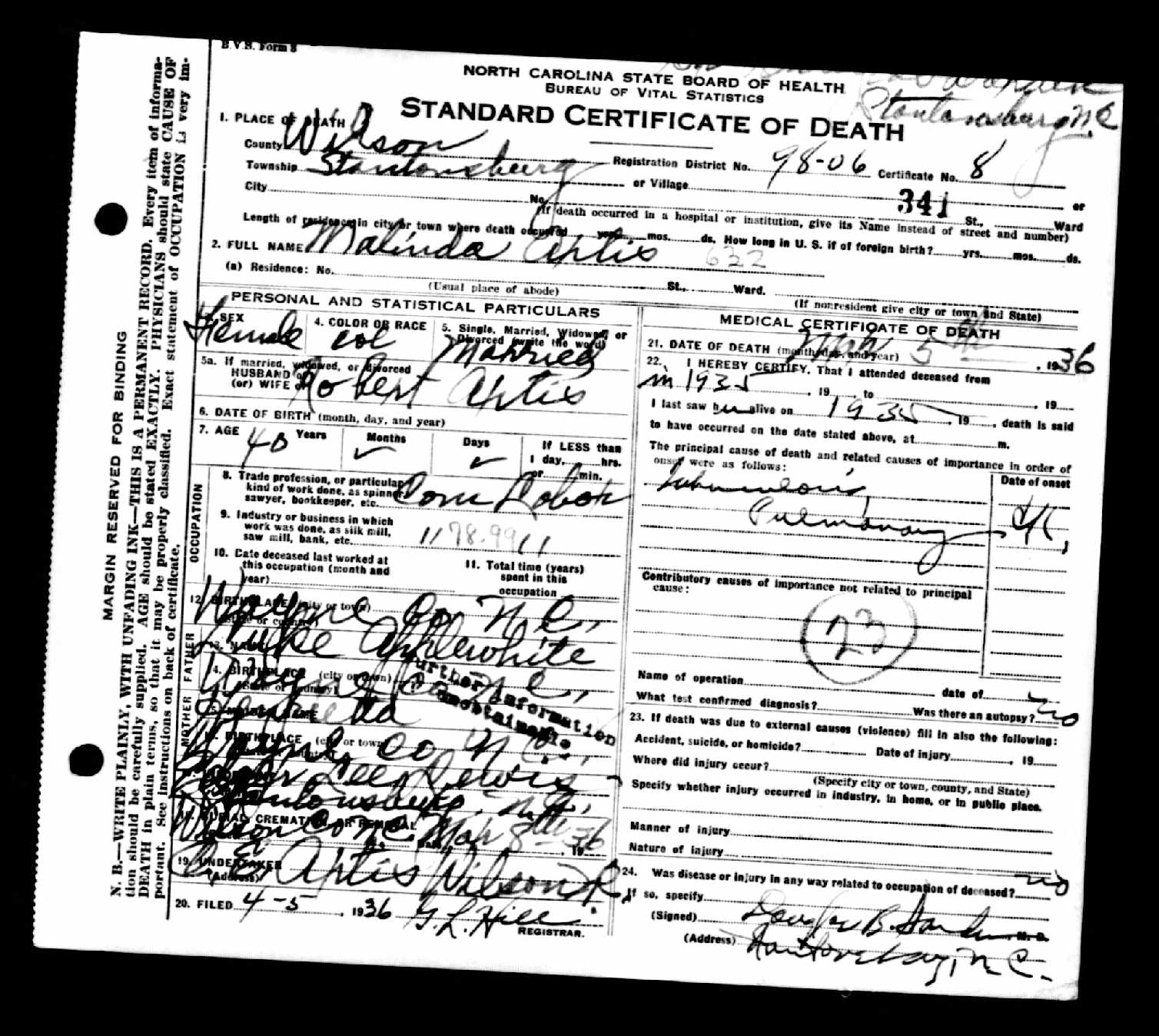
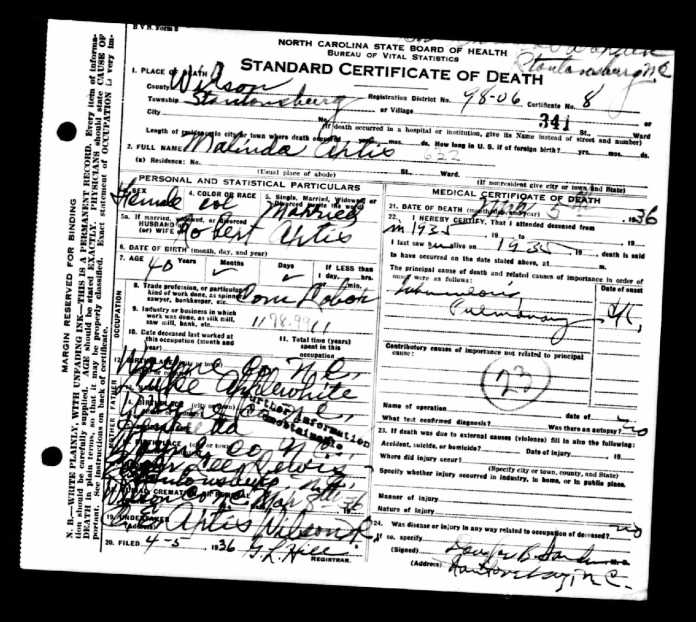
+ Malinda Artis, 5 Mar 1936.  Buried Wilson County.  Second wife of C.E.’s brother Robert Artis.
malinda artis

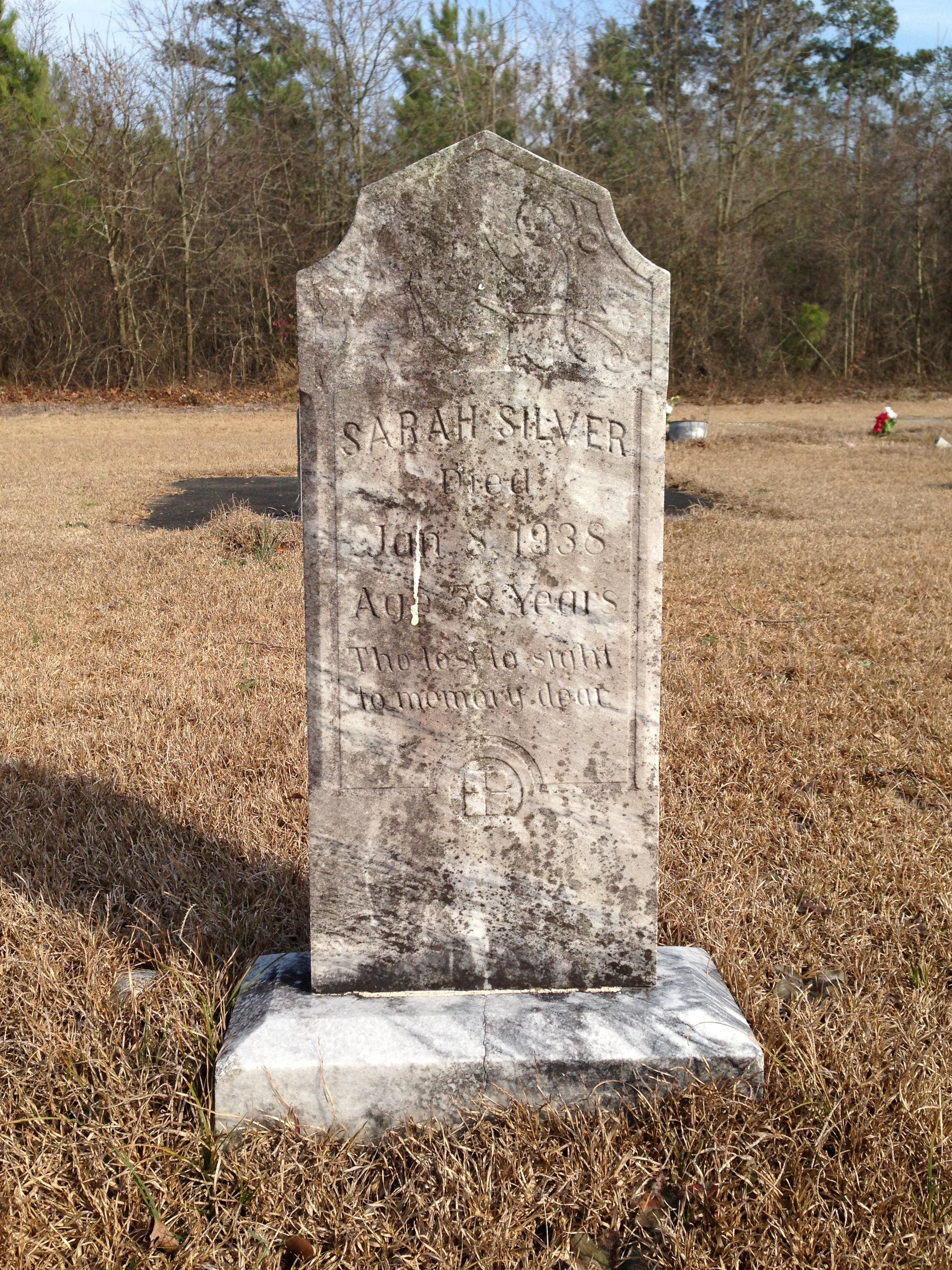
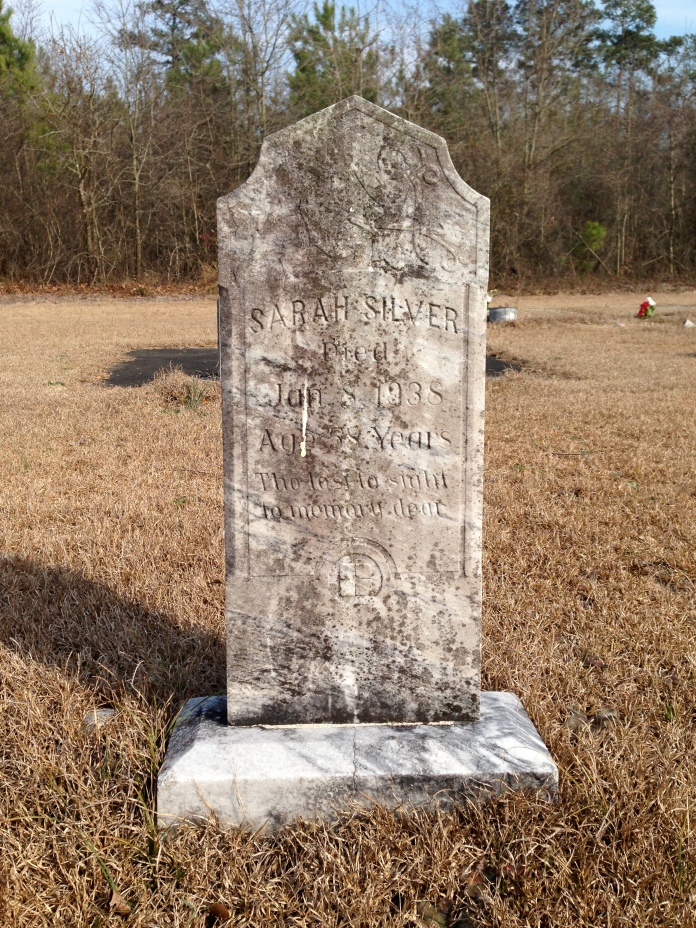
+ Sarah Jacobs Silver, 8 Jan 1938. Buried Wayne County [in fact, in the Congregational Church cemetery].  Silver’s great-niece Hattie Henderson (alias Jacobs) was the granddaughter of C.E.’s half-sister Louvicey Artis Aldridge.  Silver also lived on Elba Street in Wilson NC, around the corner from C.E.’s Green Street home.
IMG_1651

+ Viola Artis, 1 Feb 1938.  Buried Wayne County.  Granddaughter of C.E.’s brother Henry J.B. Artis.

+ William Wilson, 5 Mar 1939.  Buried Wilson County. Grandson of C.E.’s aunt, Zilpha Artis Wilson.

+ Delilah Exum, 18 Jul 1939.  Buried Wayne County.  C.E.’s father’s sister.

+ Julius Artis Jr., 18 Dec 1939. Buried Wilson County.  Grandson of C.E.’s brother Henry J.B. Artis.

+ Katie Artis King, 22 June 1940.  Buried family cemetery, Wayne County.  C.E.’s stepmother, his father Adam’s last wife.

+ John G. Reid, 29 Dec 1941. Buried Turners Swamp cemetery, Wayne County.  Husband of C.E.’s first cousin, Emma Artis Reid, daughter of Richard Artis Sr.

+ Ada Dixon Sauls, 28 January 1945. Buried Baptist church cemetery, Snow Hill. Wife of C.E.’s cousin, Cain D. Sauls.

+ Liberty P. Artis, 10 Jul 1945.  Buried family cemetery, Wilson County.  Son of C.E.’s brother Robert.

+ William Artis, 28 Sep 1945.  Buried “family (Seabury)” cemetery, Wayne County.  C.E.’s half-brother, son of Adam T. Artis and Frances Seaberry Artis.

+ Scott Artis, 6 Apr 1947.  Buried Red Hill cemetery, Wayne County. Son of  Morrison Artis, son of Sylvania Artis Lane, who was C.E.’s grandmother’s sister.

+ Bettie Reid, 2 Dec 1947.  Buried family cemetery, Wayne County.  Elizabeth “Bettie” Wilson Reid was C.E.’s first cousin.  Her mother, Zilpha Artis Reid, was Adam Artis’ sister.

+ Solomon Shearard, 6 Feb 1948.  Buried Rest Haven cemetery, Wilson.  Husband of C.E.’s sister Josephine.  Name generally spelled “Sherrod.”

+ Annie Marie Cooper, 16 Oct 1948.  Buried Rest Haven cemetery, Wilson.  Daughter of C.E.’s youngest sister Alberta.

+ Annie C. Best, 4 Jan 1949.  Buried Rest Haven cemetery, Wilson. Daughter of C.E.’s half-brother Jesse.

+ Minnie Belle Artis, 4 Apr 1950.  Buried family cemetery, Wilson County.  Daughter of C.E.’s brother Robert.

+ Walter Scott Artis, 25 Jun 1951.  Buried Fort cemetery, Wayne County.  C.E.’s half-brother, son of Adam and Frances Seaberry Artis.

+ Noah Artis, 16 May 1952.  Buried family cemetery, Wilson County.  C.E.’s half-brother, son of Adam and Lucinda Jones Artis.
Pages from index

The Carolina Times, 19 September 1942.

Standard
Enslaved People, Maternal Kin, North Carolina

Where did they go?, no. 2.

Jacob, age 65, $450. Abraham, age 45, $1100. Charles, age 25, $1500. George, age 24, $1500. Douglas, age 21, $1500. John, age 2, $150. Cephas, age 1, $100. Edwin, age 1, $100. Willy, infant, $100. Hagar, age 70, age $100. Margaret, age 42, $850. Caroline, age 23, $1200. Lucianna, age 20, $1200. Eliza, age 17, $1200. Mary Ann, age 13, $1000. Grace, age 10, $500. Martha, age 7, $350. Angeline, age 7, $350. Mag, age 3, $200. 

These are the enslaved people — total value, $13,450 — that John M. McConnaughey reported to a Confederate tax assessor canvassing Rowan County, North Carolina, in 1863. Who were these 19 people? What were their links to one another?

Let’s start with the women. Hagar, at age 70, could have been the mother (or grandmother) of any or all of the McConnaughey slaves except Jacob. She was enumerated with McConnaughey in the 1850 slave schedule — 58 year-old mulatto female — and 1860 federal slave schedule — 68 year-old mulatto female. However, as detailed below, the composition of McConnaughey’s slaves changed extensively in the 1850s, and her relationship to others cannot be determined. In 1866, Hagar McConnaughey and David Litaker registered their 13-year cohabitation at the Rowan County courthouse, but she is not found in the 1870 census. Litaker appears as a single man, living in a household of white Litakers, and we can safely assume that Hagar had passed away. In 1867, when Benjamin McConnaughey married Adaline Gilliam, he listed his parents as March and Hagar McConnaughey. Here, perhaps, was Hagar’s first husband. Was he also owned by John M. McConnaughey?

Margaret was the mother or grandmother of at least six of McConnaughey’s slaves — George, Caroline, Mary Ann, Grace, Martha, Angeline and John — comprising a single extended family. Where was her husband? Among the small units of slaves like John McConnaughey’s (and the majority of other North Carolina slaveholders), husbands and wives rarely belonged to the same master or lived on the same farm. Death certificates and marriage records for several of Margaret’s children name Edward Miller as their father. (John’s father, however, is reputed to have been John McConnaughey himself.) The couple did not file their cohabitation, and Edward may have died before Emancipation.  He probably had belonged to and lived on one of several neighboring farms owned by white Millers.

There are two other young women, “Lucianna” and Eliza, who were of an age to have been Margaret’s children. Were they? When Louisiana McConnaughey and Hezekiah Mitchell registered their six-year cohabitation in Rowan County in 1866, Louisiana noted that John McConnaughey had been her master. Three year-old Mag may have been Louisiana and Hezekiah’s child.  If so, was she named for Margaret, possibly her grandmother? I haven’t found Louisiana, Hezekiah or Mag in the 1870 census or elsewhere, and have no evidence of their kinship to Margaret.

An Eliza McConnaughey appears in 1870 in the crazy-quilt household of John McConnaughey. McConnaughey never married and the only other white person reported under his roof was his nephew, Dr. Joseph L. McConnaughey, 34. The remainder of the household consisted of Peggy Ferran, 70 and blind; domestic servant/cook Eliza McConnaughey, 25, with her probable daughters, Alice, 7, and Rena, 4; 14 year-old Henry Ellis, a schoolboy; farm laborer Ed McConnaughey, 45; Dallas McConnaughey, 14; Harriet Barr, 40, also a domestic servant; and farm laborer-cum-schoolgirl (and my great-great-grandmother), Martha Miller, 14. Nearly all, it appears, were the former slaves of John McConnaughey (Martha and possibly Eliza) or of Joseph, who inherited them after his father James C. McConnaughey’s death in 1864 (Ed, Dallas, possibly Harriet, and possibly Eliza and her daughter Alice.)

Jacob did not register a cohabitation in Rowan County and does not appear under the surname McConnaughey in the 1870 census of the county.

In 1866 in Rowan County, Abram McConnaughey (the “Abraham” above) registered his six-year cohabitation with Eliza Barger. The family appears in the 1870 census of Mount Ulla, Rowan County: A. McConnaughey, 57, Eliza, 45, Peggy, 30, Francis, 14, Mitchel, 10, George, 4, and Charlotte McConnaughey, 1.  (They are listed next door to Margaret McConnaughey, her granddaughter Angeline and son John.)  In 1872, Abram married Phillis Cowan in Rowan County, and the license lists his parents as James Kerr and Esther McConnaughey. In 1893, he married again, to Jennie Rosebro, and gave his parents as James Kerr and Hester Ann Robinson. It is not clear who the parents are of the children listed in the household, and it seems possible that both Eliza and Peggy were, if not Abram’s wives, women by whom he had children. Two of Abram’s sons married in Rowan. William Giles McConnaughey, who married in 1867, listed his parents as Abram and Vina McConnaughey. The following year, James McConnaughey listed his parents as Abram and Phillis Lavina McConnaughey. In 1889, when Charlotte McConnaughey married Charles Brown in Rowan County, she listed her parents as Abram McConnaughey and Peggy Barber. (Is this the Peggy above?)

There are two Charles McConnaugheys in the 1870 census of Rowan County.  One is a 36 year-old listed in the household of John Barger.  Abram and Eliza McConnaughey’s cohabitation registration reveals that Eliza have been owned by John Barger (and her children with her.)  If the Charles in Barger’s household was a son of Abraham and Eliza, he would not have been the Charles listed above.  The other is a Charles McConnaughey, 40, listed with wife Phillis and ten children in Atwell township.  This Charles is a little old to be the same as the one listed in 1863 and may instead have been the Charles owned by James C. McConnaughey.

Margaret McConnaughey’s son George is found in all post-Emancipation records as “George Miller,” having adopted his father’s surname. I have assumed that his wife, Eliza Kerr, and oldest child, Baldy Alexander Miller, born 1858, had a different owner. However, the cohabitation registration for George Washington Miller and Eliza Catherine Kerr seems to indicate that both were the former slaves of John M. McConnaughey. There was in Eliza of the right age in the 1863 list, but no young Baldy or Alex.

In 1870, the McDowell County censustaker enumerated a railroad laborer named Douglas McConaughy in a camp in Old Fort township. [He appears to have been working on the Mountain Division of the Western Railroad, a project that extended the railroad over the continental divide and connected both ends of the state.]  Though his age is off by about six years, this may have been the Douglas listed among John M. McConnaughey’s slaves. Was Douglas also Margaret’s son? By age he could have been, but there is no evidence to prove so. (Of note, however: Mary Ann McConnaughey Miller named one of her sons James Douglas. For his uncle, perhaps?)

John McConnaughey was Margaret’s youngest son and is supposed to have been the son of John M. McConnaughey. He appears twice in the 1870 census, once with his mother and again in his sister Mary Ann Miller’s household.

Cephas, Edwin and Willy have not been found post-Emancipation.

Margaret McConnaughey’s six known children were born in 1835, 1840, 1847, 1853, 1855 and 1861. Given the gaps in their birth years, it is reasonable to assume that she bore additional children, perhaps Douglas (1842), Louisiana (1843) and Eliza (1846). (Though, of course, if Eliza were George Miller’s wife, she would not have been his sister.) Unfortunately, the available evidence is insufficient to establish these relationships or others among McConnaughey’s slaves.

Standard
Births Deaths Marriages, Maternal Kin, Newspaper Articles, Photographs, Virginia

Marion Allen Lomans.

She was the aunt for whom my aunt was named. She was a teacher. She married late and had no children. And she died when my mother was small. That was about all I knew about my grandfather’s oldest sister, Marion Ellen Allen Lomans.

My uncle let me copy a scarred and badly tinted photo:

Marion Lomans

She looked like an Allen sister, but I was no less mystified. (Frankly, other than Aunt Julia, they were all a bit mysterious — how did I never meet Aunt Edith?  Or Aunt Nita until I was an adult? Or even Uncle Buster, who lived right in Newport News?)

And then M., my mother’s first cousin, sent this picture, which charmed me to no end — Aunt Marion and her students at John Marshall School:

Marion Allen & class

And then I found her obituary:

MA_Lomans_Obit_Daily_Press_15_Apr_1942

Virginian Pilot, 15 November 1942.

And so I learned a few more things: that, despite her marriage to Mr. Lomans, a World War I veteran whom she had married “recently” and whose Christian names were actually Gillespie Garland, she was still living at home at the time of her death. That she was a member of the United Order of Tents (a secretive charitable organization founded by black women in the mid-19th century) and the Good Samaritans (another?). That she taught for only six years. That Aunt Tee — that’s Edith — was unmarried and living in New York City when Marion died.  That Marion died at Whittaker Memorial Hospital, an institution that her father served as a board member.  That she was buried from Zion Baptist,  the church that nurtured her father. Still, who was she?

Standard
Births Deaths Marriages, North Carolina, Paternal Kin

Adam Artis’ children, part 4: Amanda Aldridge.

When Frances Seaberry Artis died in 1878, Adam Artis was left with no fewer than 11 children under the age of 18. Despite this brood, his relative wealth made him an attractive widower. He soon remarried, and he didn’t have to go far to do it. In November 1880, less than a year after his daughter Louvicey wed John W. Aldridge, Adam Artis married John’s sister, Amanda A. Aldridge.

Adam and Amanda Aldridge Artis’ children included:

Louetta Artis, born 1881, seems to have died in young adulthood. No record of any marriage has been found.

Robert Elder Artis, born 1883, was probably named after his maternal grandfather, Robert Aldridge. He was farmer in the Pikeville area of northern Wayne County and married three times, to Christana Simmons, Malinda Applewhite and Amanda Long. His children included Eva Mae, Robert Arzell, Mabel Irene, Challie, Adam, Edgar Lee, Etta Christine, Georgia, Nora and Maggie Artis.

Columbus Estell Artis, born 1886, was called “C.E.” For 30 years, he operated a funeral home in Wilson NC and was counted among the most prosperous of the town’s African-American citizens. He married twice, to Ada Diana Adams and Ruby Barber, and had at least one child, Naomi.

Josephine Artis, born 1887, was the longest and last living of all of Adam’s children. She married Solomon Sherrod in 1907 and settled in Wilson in the 1920s. Their children were: Booker T. Sherrod, Alliner Sherrod Davis, Jarvis Estelle Sherrod, Doretta Elizabeth Sherrod Davis, Leonard Oscar Sherrod, Minnie Bell Sherrod Parker, Solomon Conton Sherrod Jr., Harriet Sherrod, Amanda Bell Sherrod, Flora Annie Lee Sherrod Simms, Beulah Olivia Sherrod Williams and Elmer Lee Sherrod.  Josephine Sherrod died 8 April 1988, a month before her 101st birthday.

June Scott Artis, born 1889, farmed in the Stantonsburg area of Wilson County, not far from his father’s lands near Eureka, Wayne County. He married Ethel Pearl Becton and had four children, James Brody Artis, Edgar Joel Artis, Amanda Bell Artis Jones, and Gladys L. Artis. June Scott died in June 1973, less than three months after his brother C.E.

Lillie Beatrice Artis, born 1891, married three times in her short life — to Celebus Thompson, McDaniel Whitley and Chester Pridgen. Her children included Genetta Thompson, Wheeler Thompson, Columbus Whitley, Sampson Whitley, Floyd Marvin Whitley, Walter Andrew Whitley, Robert Whitley, William Jessie Whitley, Wilhelmena Pridgen and Mildred Beatrice Pridgen.  Lillie died in 1935 of heart issues complicated by pregnancy.

Henry J.B. Artis, born 1894, married Laurina House. His father Adam is buried in a small plot on land still owned by J.B.’s descendants. His children were Lillie Odessa Artis Baker, Julius House Artis, Roosevelt Artis, Columbus Estelle Artis II, Henry J.B. Artis Jr., Esther Artis Bunch, Jesse C. Artis, Mae H. Artis, Dorena Artis, and James Lacey Artis.  J.B., too, died in 1973, a month before his brother C.E.

Annie Deliah Artis, born 1897, married Wiley Hodges, then William Sauls. She had no known children and died in 1957.

Amanda Aldridge Artis died a few days after the birth of daughter Amanda Alberta Artis in 1899. Josephine Artis Sherrod, then about 12, told me that she discovered her mother’s lifeless body. John and Louvicey Artis Aldridge — the child’s uncle in one direction and half-sister in another — took in the infant to rear with their large brood. Alberta married James W. Cooper and had several children. She died in Wilson NC in 1985.

Standard
North Carolina, Other Documents, Paternal Kin, Rights

The right to vote?

This soft-backed composition book, deposited at the North Carolina State Archives in Raleigh, records the names of “colored” residents of Nahunta township, Wayne County, who paid poll taxes in the late summer of 1912. Paying such taxes was a prerequisite to vote in North Carolina, but few of these men actually registered, and probably fewer voted.  (The women, of course, could not have voted under any circumstance.) The first two pages overflow with my kinsmen, Artises (including Adam T., his sons, grandsons, brothers and nephews) and a couple of Aldridges (both sons of George W. Aldridge.)

Pages from Colored_Poll_Tax_1912

Pages from Colored_Poll_Tax_1912-2Pages from Colored_Poll_Tax_1912-3

Standard
Land, North Carolina, Oral History, Other Documents, Paternal Kin

Where we lived: 114 West Lee Street.

My parents were skeptical.

Me: Well, what about where, up, like, Lee Street.  There were some black people that lived up that way.

My father: Where?

Me: On the other side of the tracks.  Lee Street.

My mother: There were?

My father: I don’t know.

Me: Uh-huh. That’s where your grandparents lived. That’s where their house was.

Him: Lee Street?

Me: Mm-hmm. Right. Like if you come up – what was the name of that restaurant that everybody used to talk about? Golden Leaf? The Golden something –

Him: Okay.

Me: If you take that street, and you cross over the track, and you go left, and then you can — you know how it kind of splits or something?

Him: Yeah. Wont no black folk in there.

Me: Yeah, it was.

Him: Where?

Me: That’s where the Taylors lived. There was a little section.

Him: Oh, that was when — you talking ‘bout way back in the day.

——

Back in the day, indeed. On 11 February 1896, for $550, George D. Green and his wife Ella sold Mike Taylor a lot in the town of Wilson. Situated on a corner, the parcel fronted 143 feet on Pine Street and 83 feet on Lee. In the 1900 census of the town of Wilson, Wilson County, neither streets nor house numbers are listed, but it’s reasonable to assume that the Taylors — Mike, a drayman; his wife Rachel, who did washing; and their children “Rodgrick,” Maggie, Mattie, Maddie, Bertha E., and Hennie G. — were living there, and the 1908-1909 Wilson city directory lists Taylor, a driver, at 114 West Lee.

The 1910 census of Wilson paints a clearer picture of the little enclave in which the Taylors lived. Though he did not note house numbers, the censustaker inked “Lee St” along the edge of Sheet 27A of his survey of Enumeration District 116. The page records 50 residents, of whom 30, living in five consecutive households, were black. With the Taylors were the families of Jim and Annie Parrott, John and Cora Norfleet, John and Pattie Lassiter, Sam and Maggie “Ennicks” [Ennis], and Frank and Lizzie Bullock. The men worked a variety of jobs: a blacksmith, two odd jobs laborers, a gardener, a drayman. The women were cooks or laundresses.

The censustaker’s path is not clear. The Taylors were on the corner at 114 West Lee. According to the 1908-09 directory, the Bullocks were in the next block at 202 West Lee. The Ennises — Maggie was Mike and Rachel’s daughter — lived in the small house built on the back of the Taylor lot at 409 North Pine. In the 1912-13 city directory, Pattie Lassiter is listed at 200 West Lee, but John Norfleet was at 306 E. Barnes, on the other side of downtown. The Parrotts are found in neither directory. In any case, it is clear that these families formed a tiny cluster, and this cluster was unique in its surroundings. On the enumeration sheets before and after that listing the Taylors and their neighbors, the residents are overwhelmingly white.

For most of the 20th century, Wilson maintained a well-defined residential segregation pattern, with black neighborhoods confined to the east side of the Atlantic Coast Line (later Seaboard Coast Line, now CSX) railroad. Daniel Hill, a mile or so west of downtown, was the notable exception. For first quarter of the century, however, African-Americans claimed another tiny toehold, now forgotten, just west of the tracks at Pine and Lee.

Image

Sanborn map of Wilson NC, September 1913.

The 1913 Sanborn map, the earliest detailing the neighborhood, reveals a relatively large one-story frame house with an L-shaped porch wrapping around its west front corner. By time the 1922 Sanborn map was drawn, the city’s street numbering system had changed, and the address was now 108 West Lee.  The Taylors had also added a small porch to the back of the house.

Rachel and Mike Taylor remained at 108 West Lee until their deaths in 1925 and 1927. The address is now a vacant lot.

Standard
Births Deaths Marriages, Maternal Kin, Migration, Newspaper Articles, North Carolina, Photographs

Sarah McNeely Green.

Image

There were three uncles, and some male cousins, but the McNeelys were basically a family of women.  My grandmother was the middle daughter of her mother’s three and grew up among six aunts who had many girls.

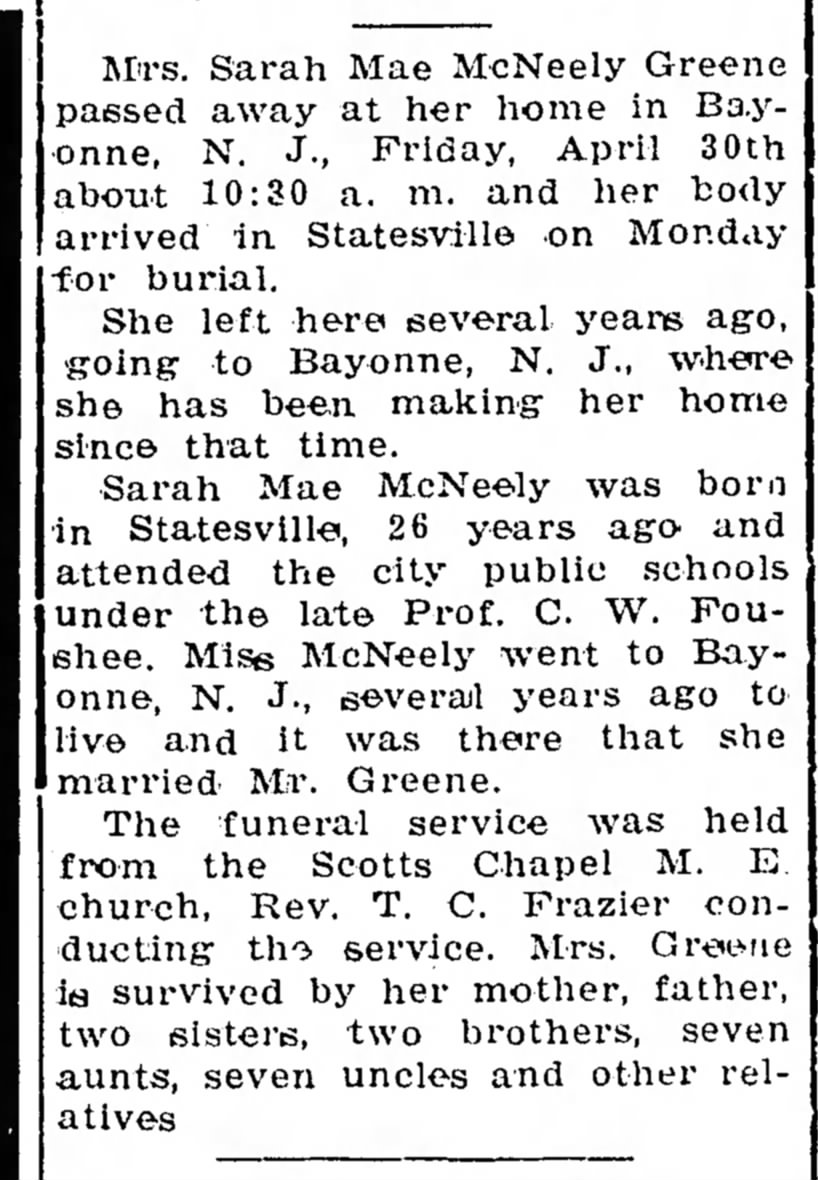
Janie McNeely, called “Dot,” was the youngest of Henry and Martha McNeely’s daughters.  Born in 1894, she worked as a laundress and reared her children in Statesville’s Rabbit Town section before migrating to Columbus, Ohio, in the 1940s.  Janie’s oldest child was Sarah Mae McNeely, born in 1911. She was followed by Frances V. McNeely (1913), Willa Louise McNeely (1918), Carl Graham Taylor (1923) and William Maurice McNeely (1925).

Sarah worked with her mother and sister at Statesville Laundry in the early 1930s. Soon after, she joined her grandmother, uncle John, aunt Emma and cousins in Bayonne, New Jersey, where she married a Mr. Green. (No one, including her obituary writer, seems to know his first name.)

Image

Statesville Landmark, 3 May 1937.

A few days later, in the Statesville Record‘s “News of Our Colored People”:

Image Statesville Record, 7 May 1937.

[Was Sarah survived by Mr. Green or not? Who was her father? And who were the extra aunt and all those uncles?]

Image

Photographs in the collection of Lisa Y. Henderson.

Standard
Births Deaths Marriages, Land, Maternal Kin, Other Documents, Virginia

Where we lived: ten acres near Westover Church.

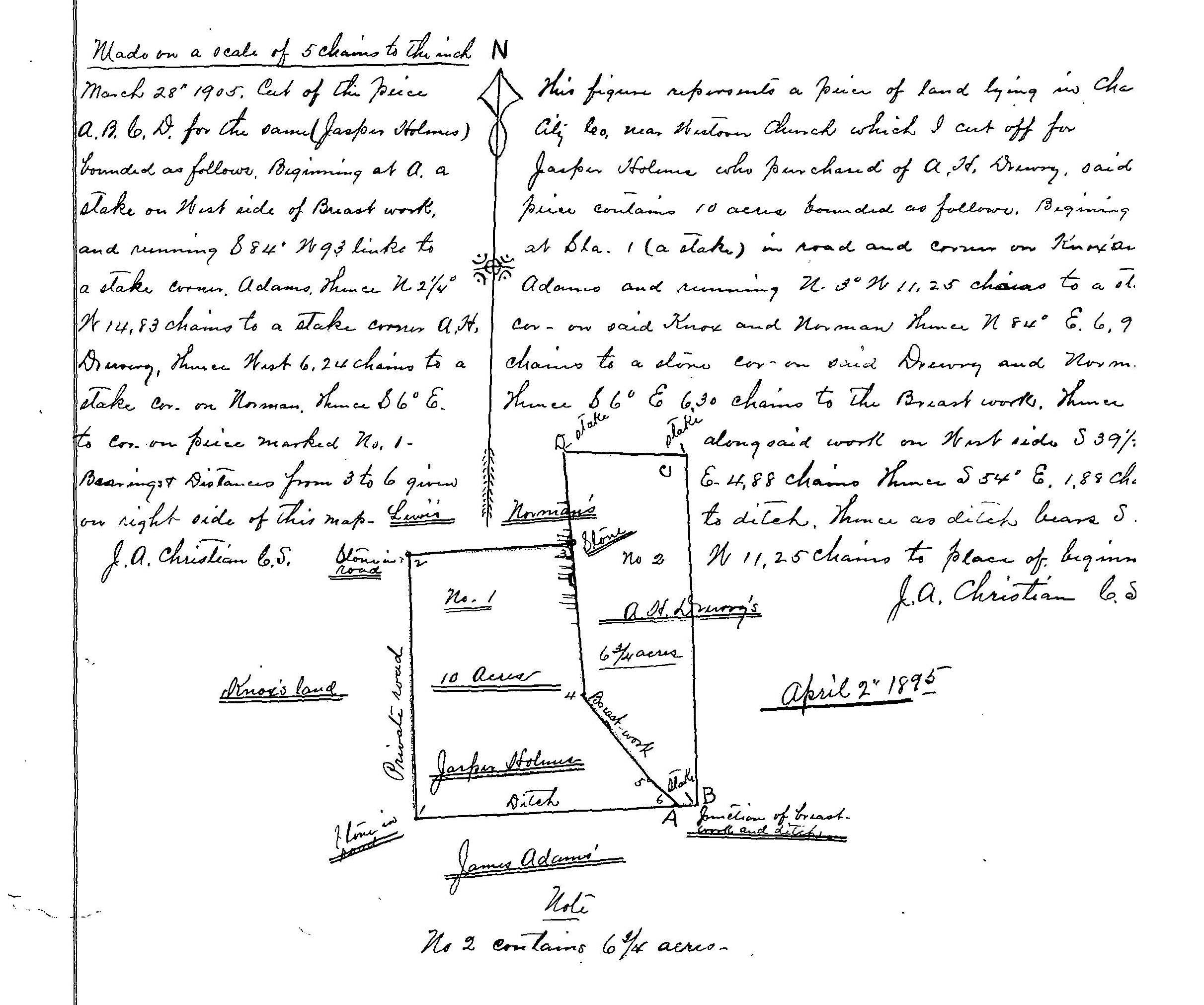
In 1909, ten years after their father’s death, sole surviving heirs Mary Agnes Holmes Allen and Julia Holmes sold two parcels that Jasper Holmes had purchased in 1873 and 1879. “This figure represents a piece of land lying in Cha City Co, near Westover Church” wrote the surveyor who laid off the land and prepared this plat:

Pages from ALLEN -- Estate Litigation Docs

Westover, dating back nearly 400 years, is one of the oldest Episcopal parishes in Virginia. The current church was built in 1631 and remains active. Confederate breastworks running between the church and Evelynton plantation, on the south side of John Tyler Memorial Highway, are still visible.

Standard