Births Deaths Marriages, Maternal Kin, Newspaper Articles, North Carolina, Oral History, Photographs

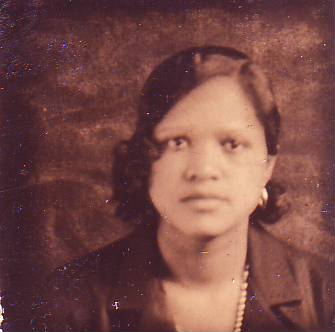
She was smart, and she was musical.

Image

FINALS AT COLORED SCHOOL.

Statesville Colored Graded School Closed Tuesday Night with a Very Creditable Performance.

The closing exercises of the Statesville graded school were held Tuesday night in the new building. Before the exercises began at 8.30, a representative of this paper had the pleasure of looking thru the building and inspecting the most creditable exhibits of the work accomplished by the pupils of the second, third, fourth, fifth, sixth and seventh grades. The exhibit showed surprising skill in drawing, sewing, fancy needle work and other forms of handiwork.

When the exercises began, the auditorium and two adjoining school rooms were filled, and the good order maintained was a noticeable feature.  The opening chorus and duet by members of the graduating class were much appreciated by the audience.

“Resolved: That girls are more expensive to raise than boys,” was the subject of the debate discussed in an interesting manner by Eugene Harris and Harry Chambers, on the affirmative, and Guy B.Golden and Jettie M. Davidson, on the negative.

GRADUATING EXERCISES.

Class History.      Buster B. Leach

Class Prophecy.   Annie B. Headen

Class Poem.      Willie D. Spann

Solo — ‘Be Still, O Heart.’   Thomas R. Hampton

Class Will.   Maurie Dobbins

Valedictory.    Louise Colvert

Class Song – ‘Fealty’

CLASS ROLL.

Mary Louise Colvert, Maurie Catherine Dobbins, Lillian Gennetta Moore, Willie DeEtte Spann, Buster Brown Leach, Annie Bell Headen, Thomas Richard Hampton, Eloise Earnestine Bailey.  

Class Motto – We Learn Not for School, But for Life.

The colored people of Statesville take great pride in their school.  They have a modern school building, steam heated and supplied with the latest equipment, something which very few towns and cities of the State have provided for its colored population.  C.W. Foushee, the principal, has proven himself to be a good school man.  He is assisted by eight teachers.

— Statesville The Landmark, 7 June 1923.
Image

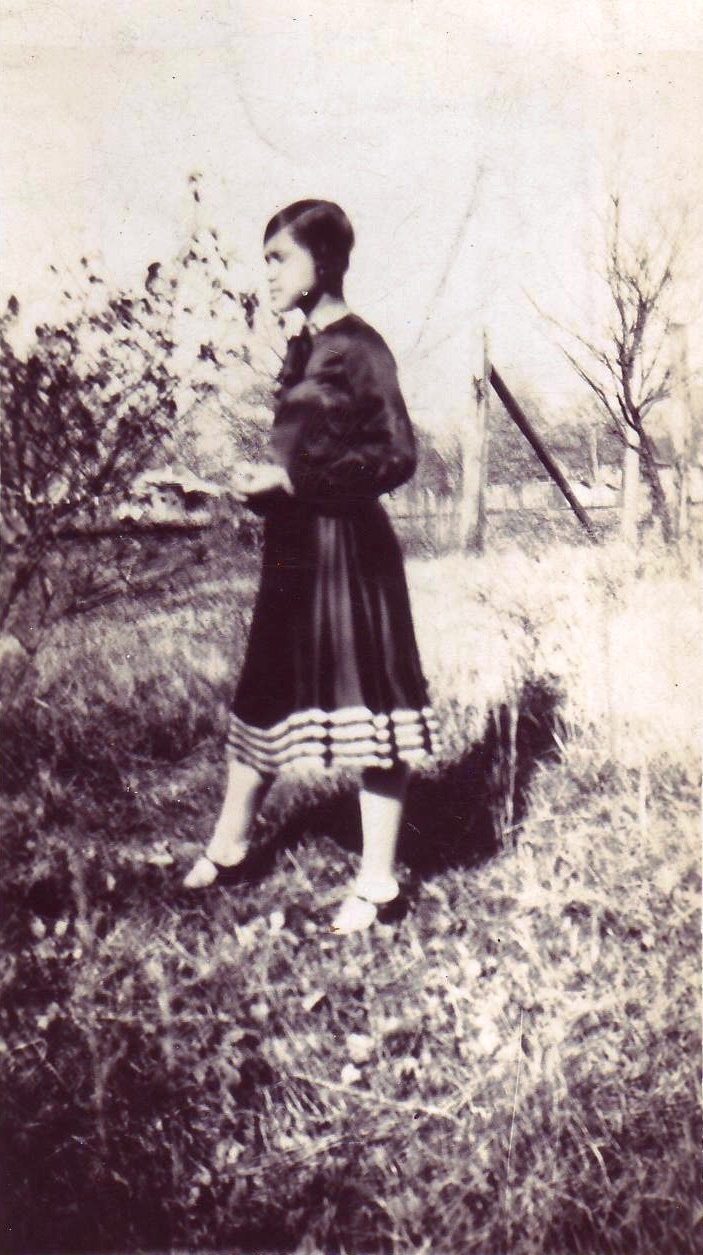
Louise went up to New Jersey and finished high school.  They didn’t have a black high school in Statesville.  They just had tenth grade.  And she went to Jersey and finished high school in Jersey and then took a course in teacher’s education somewhere.  I don’t know whether it was Winston-Salem or Salisbury.  And then she taught at – Louise played an organ, I mean, she could play the piano. Yeah, she was just as smart as she could be.  And she not only could teach, but she was musical. And she had heard she could get a job anywhere because she could do that.  And I know Golar used to teach school, but Louise would do her commencement exercise for her.  She would, Louise would do that, and they would have concerts.  Not concerts, but the whole county would compete.  And Golar’s thing would always bring a group of children, ‘cause Louise would teach them, you know. I don’t know, I can’t remember the name of that place.  But she had a school out there.  Williams Grove. And Louise used to do all the playing for that school, and they would ask her to prepare them for the thing. They had these county somethings.  But it involved the whole county.  The schools were all over Iredell County.  And they would come together, and they would, it would be a big march, and then they would meet somewhere in particular, and then they would compete with the groups of singers and everything like that.  And, child, when Louise started that stuff, when she started teaching, she had groups singing – young people and the older people, and then Golar would take her to her school and get her to teach her children.

Happy birthday, Aunt Louise.
Mary Louise Colvert Renwick (6 October 1906-15 September 1989)
——

Interview of Margaret C. Allen by Lisa Y. Henderson; all rights reserved. Photographs in the collection of Lisa Y. Henderson. 

Standard
DNA, Maternal Kin, Photographs, Virginia

DNAnigma, no. 9: John Allen’s haplogroup.

JC Allen 2

John Allen resembled his mother Mary Brown Allen in the fullness of his face, in his heavy brow, and in the shape of his wide, straight mouth. Where her skin was a smooth walnut-brown, however, his was the creamy pale yellow of a pat of butter.  Of his father, we know nothing at all except this: he was white.  This conclusion, which has long rested on family lore, physical appearance and common-sense conjecture, has been confirmed in the Y-DNA haplogroup of his male descendants. The DNA of my uncle, son of John Allen’s son John Jr., yielded haplotype R1b1b2a1a1.  R1b is the most common haplogroup in western Europe and is particularly prevalent in men whose ancestors lived in modern-day England, Ireland and France.  Y-DNA is passed solely along the patrilineal line, from father to son.  (In other words, my grandfather and his brothers, then their sons, then the sons of those sons, inherited. By my count, seven of my great-grandfather’s patrilineal descendants survive.  Their ages range from 10 to 81.)  It does not recombine, and thus Y-DNA changes only by chance mutation at each generation. For this reason, it is useful in making connections among the male descendants of a common ancestor.  Additional testing may help solve the mystery of John Allen’s paternity. [Update here.]

Photograph in the collection of Lisa Y. Henderson.
Standard
Births Deaths Marriages, North Carolina, Oral History, Paternal Kin

Two sisters.

We would visit A’nt Nancy in Goldsboro.  Her oldest daughter married the undertaker, Jim Guess.  And her youngest daughter, me and her was the same age.  Bessie Lee.  And Mama used to go over there to see A’nt Ella. And A’nt Ella stayed up there on that other little street back there, but her and Nancy were sisters.  Two sisters.  So, I said,  ‘I’m going over there, and they all never come and see me or nothing.’  So I stopped going, and after Mama died, I just forgot about it.  ‘Cause they ain’t never bothered nothing about it.  And then too, they seemed like they were cool.  They wasn’t friendly enough.  Like to say, if you’re family and have something to talk about, or go talk about anything, just make up something to say.  Act like you like ‘em whether you did or not, while they was around.  So I stopped going over there.  ‘Cause Bessie Lee ….  Let’s see, the last time I was over there, she had gone some place and so I didn’t get to see her that time.  So I said, she didn’t never want to come to Wilson to see me, and I had always asked her ‘bout coming to Wilson, and she said she was coming over there sometime, but she never did.  So I just stopped going to Goldsboro, too.  I don’t know what happened to them.

Nancy, born about 1865, and Louella Henderson, born about 1876, were daughters of James and Louisa Armwood Henderson.  In 1881, Nancy married Isham Smith, freeborn son of Milly Smith and her enslaved husband Peter Ward. They settled in the Harrell Town section of Goldsboro, where Isham worked as a wagon driver and then an undertaker. Their children were: Annie Smith Guess (1883), Oscar Smith (1884), Furney Smith (1886), Ernest Smith (1888), Elouise Marie Smith (1890), Johnnie Smith (1891), Mary E. Smith Southerland (1894), James Smith (1896), Willie Smith (1899), Effie May Smith Stanfield (1904), and Bessie Lee Smith (1911). (Was Bessie really a daughter? Or a granddaughter?) Isham died in 1914, and Nancy married Patrick Diggs four years later.  After Patrick’s death, Nancy restored her first husband’s surname.  She died in Goldsboro in 1944 after suffering a fractured pelvis from a fall from her bed.

Louella Henderson is more difficult to trace. My grandmother recalled that Ella was married twice, the first time to a King, and moved from Goldsboro to a city in the North Carolina Piedmont, perhaps Gastonia. Wayne County census records reveal an Adam and Ella King, but their marriage license lists Ella’s maiden name as Herring. An Ella Wilson witnessed Nancy Henderson Smith’s second marriage, but the Ella Wilson (wife of Ed) listed in the 1930 census is much too young. Though she must have lived into the 1920s at least, I can find no certain trace of Ella after the 1880 census. [Update here.]

[P.S. The continuing connection between Nancy Henderson Smith and her siblings’ families is evidenced by the frequency with which her son-in-law James Guess was called upon to handle their funerals. Nonetheless, knowledge of the connection seems to have dropped off sharply after her death. I have met only one person — my grandmother — who knew that undertaker James Guess (whom people had heard of) had married into the family or that any Smiths in Goldsboro were their kin. And I’ve been unable to locate any Smith descendants.]

Interview of Hattie H. Ricks by Lisa Y. Henderson; all rights reserved.

Standard
Maternal Kin, Oral History, Virginia

Mystery sister.

In the early 1940s, my uncle recently said, a mysterious woman appeared at his grandparents’ house. My uncle alone was there because he stayed with them sometimes during the school year; his aunt Marion was his teacher. In the manner of the day, no one bothered to introduce a child to an adult, but he gathered that the woman was Papa Allen’s sister. This was a surprise to him, as he had not known his grandfather to have any such relatives. The woman looked much like Papa, with very light skin. He never saw her again, and whether she ever returned he cannot say.

Who was this woman? She was not Emma Allen Whirley, John Allen‘s younger half-sister, who was not light-skinned and probably was dead by 1940. Could she have been Nannie, the 5 year-old listed in Graham and Mary Allen‘s household in the 1880 census of Charles City County? Nannie’s birth predated Graham and Mary’s marriage, and it is not clear which is her parent. Her pale skin suggests that Mary was her mother, and her father was, perhaps, the same white man that begot John. No other record of her has been found.  She may have been the mother of Junius and Milton Allen, the grandsons recorded with Graham and Mary in the 1900 census, but I suspect that they were born to Emma before her marriage. Otherwise, if Nannie is the woman who appeared on Marshall Avenue just before the outbreak of World War II, she has eluded detection in the record.

Standard
DNA, Paternal Kin

DNAnigma, no. 8: the Quester.

I’ll call him “Eric.” He rides the top of my list at Ancestry DNA, and at 23andme is my closest match beyond those relatives I consider my immediate family.  He is an adoptee, born out West in 1980. He tested to find clues to his parentage and to his ethnic background, and I was the first blood relative he’s ever “met.”

Ancestry estimated our relationship at 3rd cousins, and I encouraged him to test with 23andme, which posited 2nd to 3rd cousins (2.43% shared DNA across 6 segments.) More critically, 23andme revealed that my connection to Eric is through my father, with whom he is an estimated 1st to 2nd cousin, sharing 6.76% across 18 segments! (He and my sister share 3.3% across 7). A 1st or 2nd cousin of my dad, who is 79 years old? How in the world???

Common matches between Eric and my father allowed me to focus on my grandmother’s side as the link. My grandmother had one known sibling. (Well, maybe, two, as I’ve recently learned of a possible half-brother who’s only a few years older than I am. I’m not including him as a possibility for now.) Her half-sister M., with whom she shared a mother, was born in 1907. Full first cousins share, on average, 12.5% DNA, so my father and M.’s children would share about half that. In other words, those cousins would share with my father the approximate percentage of DNA that my father shares with Eric. The male cousins were too old to have been Eric’s father (and, if they were, Eric would share only about 3% with my father.) Thus, they are eliminated as Eric’s father or grandfather. And I can eliminate the female cousins on the ground that he does not share their haplogroup, which is H3.

Arriving at this point, I was momentarily stumped. And then I remembered that uncles and great-great-nephews also share roughly 6.25% DNA.  (And constitute a relationship that makes more sense given Eric and my father’s relative ages.)  This train of thought, I think — and without going into requisite detail — will ultimately lead us to the truth.

Standard
Births Deaths Marriages, Enslaved People, Free People of Color, North Carolina, Other Documents, Paternal Kin

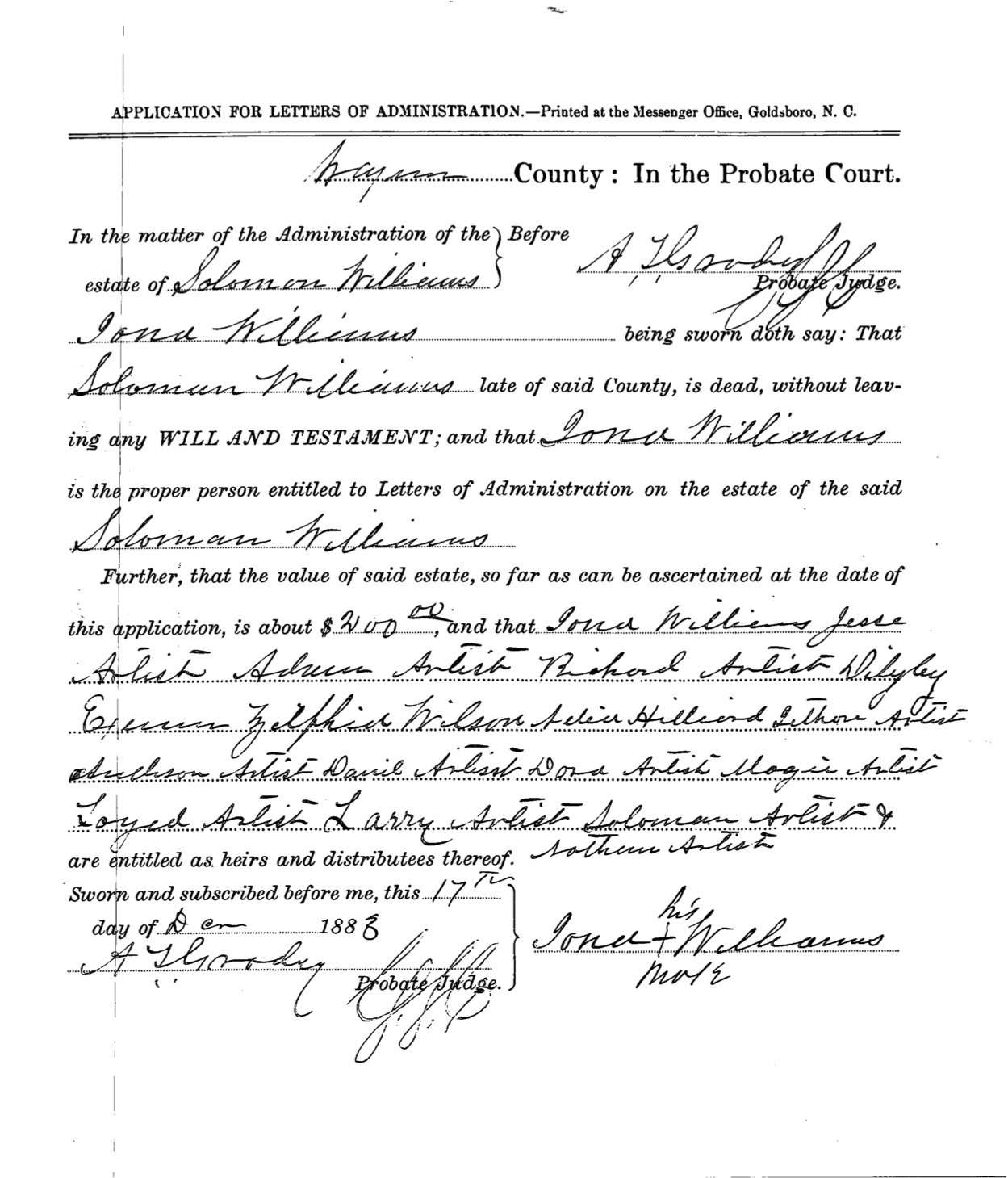
The estate of Solomon Williams.

Image

Vicey Artis, a free woman of color, and Solomon Williams, a slave, had eleven children together – Zilpha Artis Wilson, Adam Toussaint Artis, Jane Artis Artis, Loumiza Artis Artis, Charity Artis, Lewis Artis, Jonah Williams, Jethro Artis, Jesse Artis, Richard Artis and Delilah Williams Exum — before they were able to marry legally.  On 31 August 1866, they registered their 35-year cohabitation in Wayne County.  Vicey died soon after, but Solomon lived until 1883.  The document above, found among Solomon’s estate papers, names son Jonah as administrator and lists his and Vicey’s six surviving children and the heirs of their deceased children.

Little is known about Solomon. He was born about 1800. A few slaveowning Williams families lived in Vicey Artis’ vicinity in Greene County, but there is no evidence to link Solomon to them. He appears in the 1870 and 1880 censuses of Nahunta township, Wayne County, heading households comprised of his daughters and their children, and is recorded as father on the marriage licenses of daughter Lomisy (Loumiza) Williams and son Adam Artis and the death certificates of children Jonah Williams, Richard Artis and Delila Exum.

Standard
Births Deaths Marriages, Maternal Kin, North Carolina

North Carolina death certificates: COLVERT.

North Carolina did not require death certificates until 1914. The following abstracts record the deaths of several generations of Colverts.

Lew Colvert.  Died 27 Mar 1915, Statesville, of cerebral paralysis.  Resided near Center Street, Statesville.  Black. Aged about 40. Married. “Laborer for city driving team mules.” Born in Iredell County NC to unknown father and Rebecca Colvert of Iredell County NC. Buried colored cemetery; J.W. Nicholson & Co., undertaker. Informant, L.W. Colvert.

A Runaway and a Driver Hurt

Wednesday afternoon Mr. Isidore Wallace’s team was being driven from the depot with a load of roots and herbs.  Just as the wagon turned into Front street from Center a sack of herbs fell off the wagon and struck one of the horses.  This frightened them and they ran away, colliding with an electric lightpole on the sidewalk.  The colored driver, Lou Colvert, was thrown off and a wheel passed over his head, inflicting a severe but not serious injury.  One of the horses broke loose from the wagon and the other ran on to the stables.  The wagon was slightly damaged. 

— Statesville Semi-Weekly Landmark, 11 Oct 1895.

——

Becky Colvert.  Died 26 May 1915, Statesville, of general paresis. Widow. Born 1839. Resided Harrison Street. Born to Jerry Gray and Lettie Gray, both of Iredell County. Buried Zion Hill cemetery; J.W. Nicholson, undertaker.  Informant, John Colvert.

——

Selma Eugenia Colvert.  Died 7 Oct 1916 of exhaustion from severe burns. Single. Born 25 Aug 1889 to John Colvert of Iredell County and Adaline Hampton of Wilkes County. Informant, John Colvert.

IMG_2082

——

John Colvert.  Died 6 Oct 1921, Statesville, of endarteritis. Black. Married to Adline Colvert. Age 71. Worked as laborer/teamster driving team. Born Iredell County to Walker Colvert and Elvira Gray, both of Iredell County.  Married to Adline Colvert.  Teamster laborer, driving team.  Buried “colored cemetery,” 9 Oct.  Informant, Adline Colvert.

——

Frances Josephine Bradshaw. Died 6 November 1925, Statesville, of colitis.  Colored. Minor.  Born 12 May 1924, Statesville, to Will Bradshaw of Rowan County and Golar Colvert of Iredell County. Informant, Will Bradshaw.

Me: Now, who was it that you were telling me that — was it William Bradshaw’s sister?  What was it about, something about — there was a baby that couldn’t eat certain things. 

My grandmother: Oh, yes.  His sister….  Oh, she was the prettiest thing I ever saw in my life.  Like a doll.  Oh, she was a beautiful child.  And had this curly black hair just like Papa’s.  She was such a pretty little girl.

Me: And who fed her something that she wasn’t supposed to have?

My grandmother: You see, Golar, Mat and Walker’s mother was different from our mother. 

Me: Right.

My grandmother: And they would always go out in the country to visit these people.  You know.  And Golar took her children and went out, you know.  To visit.  And she, I don’t know what was wrong with the child that she couldn’t eat any, certain things she couldn’t eat.  And string beans was one of them.  And when she gave her some string beans, and it just …  just killed her.  And, ahhh, that child suffered.  My God, that child suffered.  I can remember that evening.  I can remember so well seeing that child.  She just suffered.  [Pants heavily.]  It was, I mean, that’s just the way she was breathing and everything.  So one morning after she had been sick, her daddy came over there, he said, “You all better come over to the house if you want to see the baby, ‘cause she is dying.”  I said, “You are crazy.”

My mother: What’d she have, Mama?

My grandmother: I don’t know what she had.  Don’t know what she had.  But they say whatever it was – it just tore her intestines.  … And little William.  William, he just grieved over that, he just grieved for that child.  William. We were just so sorry for that child.  And then on top of that, then his mother died.  It was just awful.

——

Laura Colbert.  Died 21 April 1926, Statesville, of mitral insufficiency. Widow of Louis Colbert. Age 66. Cook. Father, Noahie Sharpe of Iredell County. Mother, unknown. Informant, Adgie Colbert.

——

Lon Walker Colvert.  Died 23 Oct 1930, Statesville,  of encephalitis and catarrh pneumonia in Statesville NC.  Clinical test done by C.R. Nicholson, MD. Born 10 Jun 1875 to John Colvert and Harriet Nicholson.  Buried 24 Oct 1930 at Union Grove.

——

Adeline Hampton Colvert. Died 4 March 1940, Statesville, of uremia. Resided 623 Harrison Street. Negro. Widow of John Walker Colvert. Born 12 July 1864, Wilkesboro NC to Horace Hampton and Myra [last name unknown], both of Wilkes County. Buried Greenwood cemetery. Informant, Lillie Colvert.

IMG_2080

——

George Randolph Colvert.  Died 31 Jan 1959, Statesville NC.  Resided 423 Harrison Street. Laborer. Never married. Born 9 April 1917 to [illegible] Summers (name blacked out) and Lillie Mae Colvert.  Buried Belmont cemetery. Informant, Lillie Mae Colvert.

——

Ida Mae Stockton. Died 23 August 1967, Statesville, of cerebral hemorrhage. Resided 403 Harrison. Widow of Eugene Stockton. Born 27 June 1891, Iredell County, to John W. Colvert and Adline Hampton. Buried Belmont cemetery. Informant, Lillie M. Ramseur.

——

Interview of Margaret C. Allen by Lisa Y. Henderson, all rights reserved.

Standard
Free People of Color, North Carolina, Other Documents, Paternal Kin

Honorary commissioner.

HAGANS_--_Napoleon_Hagans_Cotton_Expo

In a nod to his relative political and economic clout, Napoleon Hagans was named an Honorary Commissioner of the 1884 World Industrial and Cotton Centennial.  (The certificate is little hard to read, but that’s his name at the center fold.) According to the official program, Hon. H.K. Bruce [sic, this was surely Blanche K. Bruce, Republican Senator for Missouri 1875-1881] was Chief of Department, Colored Exhibits, and North Carolina’s “Honorary State Commissioners (Colored)” were J.S. Leary of Fayetteville and Jno. H. Williamson of Louisburg.

The 1884 World’s Fair was held in New Orleans, Louisiana, at a time when nearly one third of all cotton produced in the United States was handled in that port city. The Cotton Planters Association first advanced the idea for the fair, dubbed “World Cotton Centennial” because 1784 marked the earliest surviving record of export of a shipment of cotton from the United States to England.

The U.S. Congress lent $1 million to the Fair’s directors and gave $300,000 for the construction of a large Government & State Exhibits Hall on the site. However, the planning and construction of the fair was marked by corruption and scandals, and the Louisiana state treasurer absconded abroad with $1.7 million of state money, including most of the fair’s budget.

Despite such serious financial difficulties, the Fair succeeded in offering many attractions to visitors. It covered 249 acres stretching from Saint Charles Avenue to the Mississippi River and could be entered directly by railway, steamboat, or ocean-going ship. The main building enclosed 33 acres and was then the largest roofed structure ever constructed. The building was illuminated with 5,000 electric lights – still a novelty at the time and said to be ten times the number then existing in the rest of New Orleans. There was also a Horticultural Hall, an observation tower with electric elevators, and working examples of multiple designs of experimental electric street-cars. The Mexican exhibit was particularly lavish and popular, constructed at a cost of $200,000 dollars, and featuring a huge brass band that was a great hit locally.

On December 16, 1884, two weeks behind schedule, President Chester Arthur opened the Fair via telegraph.  It closed on June 2, 1885. In an unsuccessful attempt to recover financial losses, the grounds and structures were reused for the North Central & South American Exposition from November 1885 to March 1886. Thereafter the structures were publicly auctioned off, most going only for their worth in scrap.

The site today is Audubon Park and Audubon Zoo in Uptown New Orleans.

Adapted from World Cotton Centennial, www.wikipedia.org. Copy of certificate courtesy of William E. Hagans.

Standard
Births Deaths Marriages, Maternal Kin, Military, Other Documents, Photographs, Virginia

Edward N. Allen.

After John C. Allen‘s birth in 1876, Graham and Mary Brown Allen had four children together. Emma, their only daughter, was followed by Willie, Alexander and Edward Noble.

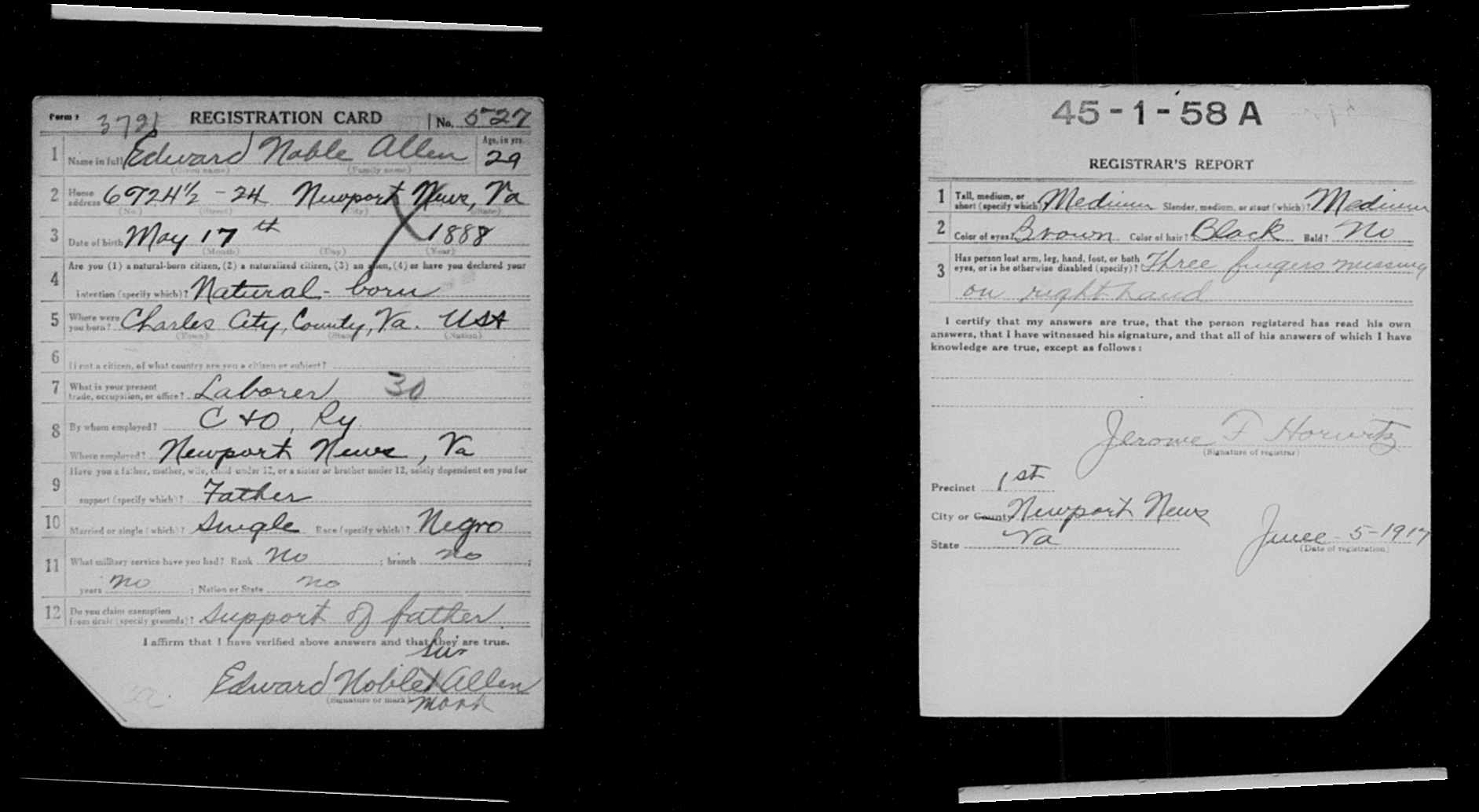
Edward N. Allen grew up in Charles City County, but followed his half-brother John to Newport News some time after 1910. He was working there as a laborer for the Chesapeake & Ohio Railroad when he registered for the draft at the outbreak of World War I. (And had had a tough life, as he reported missing three fingers on his right hand.)

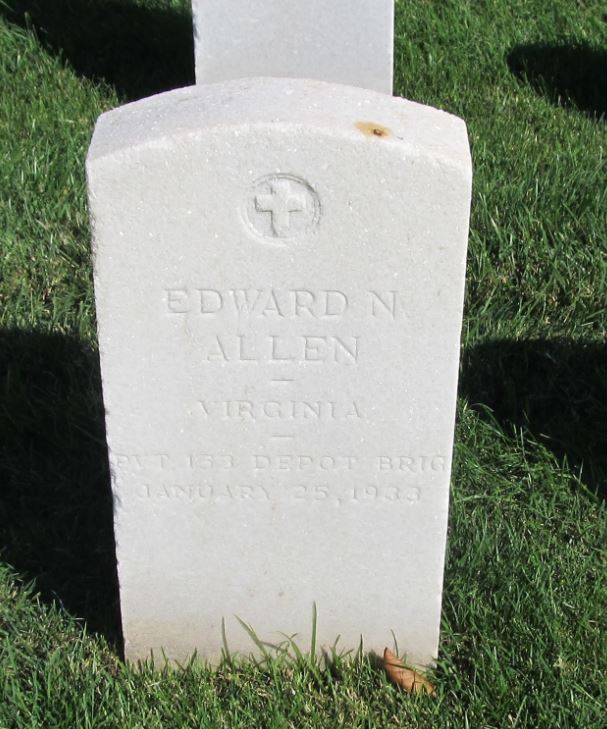
ImageEdward survived the war, but his life over the next 15 years is hidden from history. He apparently never married or had children. Unless he is the Virginia-born Edward Allen that is listed as a farmhand in upstate New York in 1920, he appears in neither that nor the 1930 census. He was back in Charles City County by the early 1930s, though, and died in early 1933 at the U.S. Marine Hospital in Norfolk. He was only in his early 40’s, but beset with an old man’s diseases.

Edward_N_Allen_Death_Cert

Edward Noble Allen is buried in Hampton National Cemetery.

Image

Standard