Agriculture, Civil War, Free People of Color, North Carolina, Paternal Kin

Confederate Citizens File: Mathew Aldridge.

Form of the estimate and assessment of agricultural products agreed upon by the assessor and tax-payer, and the value of the portion thereof to which the government is entitled, which is taxed in kind, in accordance with the provisions of Section 11 of “an Act to lay taxes for the common defence and carry on the government of the Confederate States,” said estimate and assessment to be made as soon as the crops are ready for market.

Mathew Aldridge

Cured Fodder Quantity of gross crop. — 1000 Tithe or one-tenth. – 100 Value of one-tenth. — $3.00

I, Mathew Aldridge of the County of Wayne and State of North Carolina do swear that the above is a true statement and estimate of all the agricultural products produced by me during the year 1863, which are taxable by the provisions of the 11th section of the above stated act, including what may have been sold of consumed by me, and of the value of that portion of said crops to which the government is entitled. /s/ Mathew X Aldridge

Sworn to and subscribed to before me the 3 day of December 1863, and I further certify that the above estimate and assessment has been agreed upon by said Mathew Aldridge and myself as a correct and true statement of the amount of his crops and the value of the portion to which the government is entitled. /s/ J.A. Lane, Assessor.

Confederate Papers Relating to Citizens or Business Firms, 1861-1865, National Archives and Records Administration.

Standard
Agriculture, Free People of Color, Land, North Carolina, Rights

But for marl.

I don’t know if I’m an Armwood or not, but (1) my great-great-great-great-grandfather James Henderson’s second wife, Louisa, was Henry Armwood’s cousin, (2) I’ve got a DNA match with one of Henry Armwood’s descendants, and (3) Inez Armwood Watson always said we were kin. Either way, I claim him just on the strength of the moxie he displayed when he, a tenant farmer, fought back against the landowner who sought to cheat him of his cotton.

Herring v. Armwood, 130 NC 177 (1902).

B.W. Herring filed this suit in Duplin County, North Carolina, to recover from William Henry Armwood two bales of cotton worth $81 that he alleged belonged to him. Armwood responded that the cotton was worth much more than $81 and that it was not Herring’s. Further, countered Armwood, he rented the farm on which the cotton was raised under this contract: “I, B.W. Herring, do hereby agree to rent my farm to Henry Armwood for the year of 1899 for five bales of cotton of the first picking, weighing five hundred pounds, or the equivalent in money. I do also agree to dig marl to the amount of two thousand bushels, more or less, and Henry Armwood agrees to haul the same and scatter on the land.” Armwood was to use the marl in lieu of commercial fertilizers to improve the land and increase crop yield. However, Herring refused to dig the marl, and Armwood’s crops suffered.

At trial, Herring testified that Armwood paid only three of five bales of cotton he owed in rent. Armwood took two more bales raised on the rented land to Ruffin Cameron’s to be ginned and those bales were seized. Herring’s testimony is somewhat confusingly recounted in the opinion, but he seems to assert that he did not agree to dig any marl for the 1899 crop, but that he used it as an experiment in 1898 on about 16 of the 40 acres he rented to Armwood.  Armwood countered: “It was agreed that the two thousand bushels of marl shoul dbe hauled on the crop for 1899. I lived on the plaintiff’s land in 1898, and hauled marl for 15 or 16 acres. The crops were increased by the use of the marl 50 to 75 per cent. I hauled the marl from Mr. Dan Lee Flowers. He had the bed, and furnished Mr. Faison Hicks, Mr. Ab Herring, Andrew Barfield, and others in the neighborhood. My crop was decreased by the failure to use the marl at least 50 per cent.” Herring objected to this testimony on the grounds that it was too remote, and the trial judge sustained the objection. Though Dan Lee Flowers testified in support of Armwood, the judge rendered a verdict and judgment for Herring. Armwood appealed.

The North Carolina Supreme Court neatly framed the issue: “The sole question involved in this appeal, when stripped of its technical paraphernalia, is whether an action for damages will lie for a breach of contract in failing to furnish fertilizers, whereby the yield of the crop was decreased, because such damage or failure in the yield will be too remote.” And decided: “… the conclusion is irresistible that a lessening in the yield would be the natural result of a failure to use the marl, if marl be beneficial to the growth and development of the crops, and that the lessened yield would be incidental to such breach, and therefore plaintiff would be liable.” Further, everybody knows that fertilizers increase yield and marl can greatly increase production. “… [i]f damages be recoverable for a breach of contract which decreased the yield, they can also be recovered for a breach of contract whereby the yield was not increased.” Armwood had a right to present his proof to the jury. Error in the lower court, and a new trial awarded.

Standard
Agriculture, Business, Newspaper Articles, North Carolina, Paternal Kin

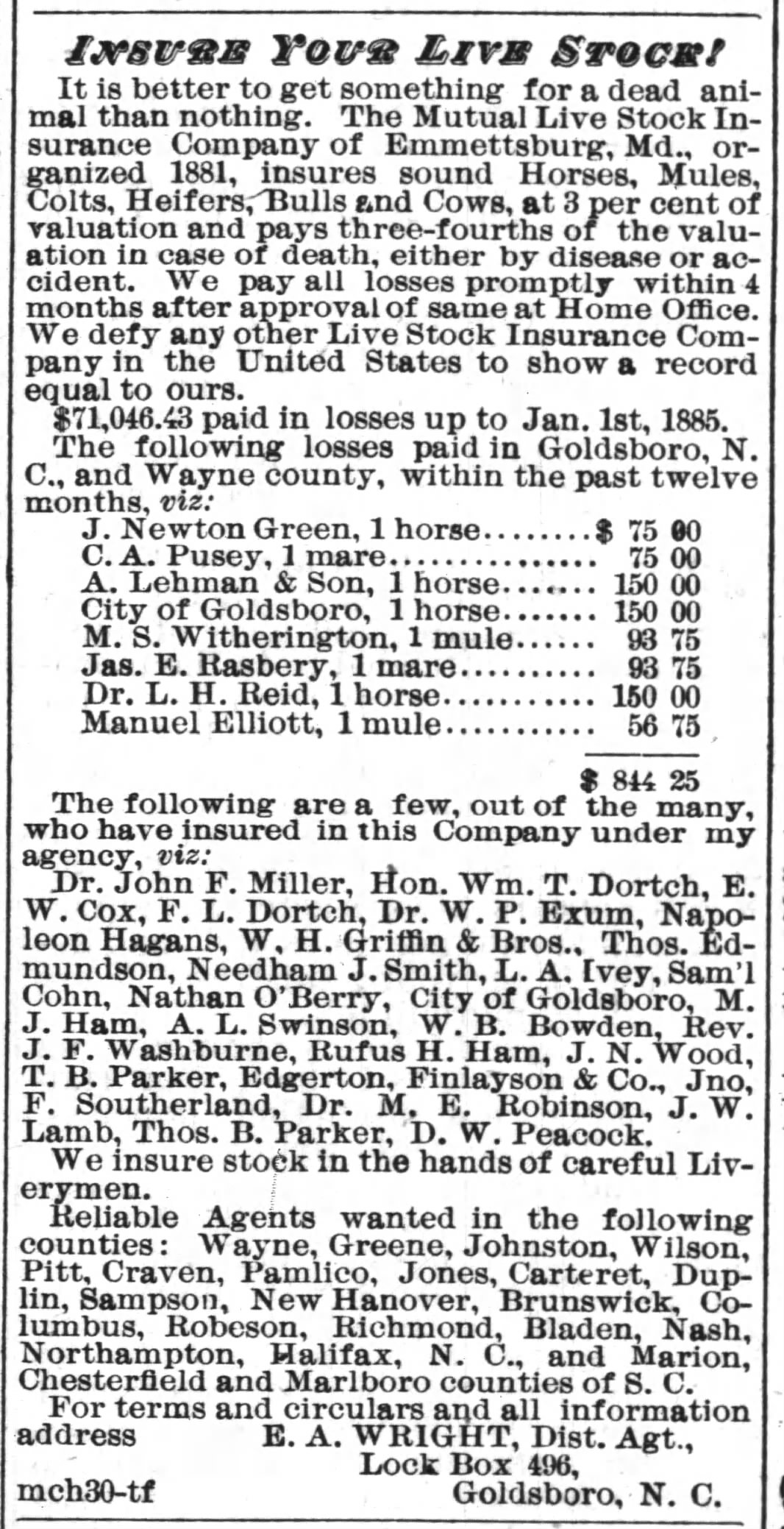
It is better to get something than nothing.


Image

Goldsboro Messenger, 30 March 1885.

Apparently, Napoleon Hagans was a big believer in insurance. The Insurance Press compiled life insurance claims paid out on a weekly basis, state by state. In the 9 September 1896 issue, the sole listing for North Carolina was: Fremont, Napoleon Hagans, $5000 — the payment he received after his wife Appie Ward Hagans’ death.

Standard
Agriculture, Free People of Color, Land, North Carolina, Other Documents, Paternal Kin

He never said he had any claims on the land.

The first in an occasional series excerpting testimony from the transcript of the trial in J.F. Coley v. Tom Artis, Wayne County Superior Court, November 1908. Paragraph breaks inserted for better readability.

The Plaintiff introduces W.S. Hagans, who being duly sworn testifies as follows:

I sold this land, the 30 acre, 24 acre, and the 9 1/3 acre pieces to Mr. Coley. Mr. Cook had been negotiating with me for the purchase of the 30 acre tract and the 24 acre tract. He did not want the 9 1/3 acre tract. I met Mr. Cook on several different occasions, until finally we met at Eureka one afternoon, he was considering it, and we finally decided on the deal. Mr. Cook was to give me $40.00 per acre for the the 30 acre tract, and the 24 acre tract. Before Mr. Cook did this however, he informed me that there was a missing link in the title, that he had found after investigating it. I told him that that was perfectly alright, as there had never been any question about it.

After our conference at Eureka, the day was set for me to meet him in Goldsboro, where he was to pay me the consideration, the price of the land, and I in turn to give him a deed for the land. He did not come on that day, but ‘phoned me at Fremont that he did not succeed in raising the money, but to please hold it open until tomorrow.

Early tomorrow morning, before sunrise, a bitter cold morning, the Defendant [Tom Artis] came to my house in Goldsboro. I asked him what brought him to town on such a cold morning, he said he came to bring a message from Mr. J.F. Coley, that Mr. Coley said that he wanted to buy that land, and would take all three of the tracts instead of two, said the Defendant to me, “that will be to your advantage.” The Defendant stated to me that Mr. Cook’s time was out yesterday. I expressed surprise that the Defendant should be familiar with those circumstances. Afterwards I said to the Defendant, that while Mr. Cook’s time was out yesterday, that Mr. Cook had phoned me yesterday & said he had a great effort to reach me, and finally did so asking me to hold the matter open until tomorrow. I told him that I would feel honor bound if Mr. Cook should come to me with the purchase price for the two tracts of land, to let him have it, although I would prefer selling the three tracts together. The Defendant said to me that if Mr. Cook got possession of this place that he the Defendant would not be able to stay there as Mr. Cook was a very disagreeable man to get along with. I told the Defendant that I would not deed this property to Mr. Cook, or to any one else until they made the same promise to me in reference to the Defendant’s staying where he has, that I made to my father in the presence of the Defendant.

The Defendant remained in shooting distance of me all of the day, waiting for me to see Mr. Cook that he might get from me a final message to take back to Mr. Coley. I saw Mr. Cook, and he informed me that the reason he couldn’t take it was that he had experienced great difficulty in raising that money. That money was hard. I was really glad of this, and so informed the Defendant, for I wanted to sell the three tracts if possible, together. Then I asked the Defendant to say to Mr. Coley on his return home, that I would meet him at the Defendant’s house on Friday, I think it was, but having business out there, I drove past, and got the Defendant and took him out to the Plaintiff’s place of business that was on Thursday, I went the day before the time set, and stated to the Defendant the object of my going down there, and asked him to go with me.

We went down there and Mr. Coley and I had a talk aside from the Defendant, and finally wound up in the Defendan’t presence. The conversation we had in the presence of Tom was Mr. Coley might have the three pieces of land, in consideration of $3250, and I take his paper. This was said in the Defendant’s immediate presence, he sitting on the buggy beside me. We left, the Defendant expressing himself as highly pleased that Mr. Coley had bought the three pieces of land, said he thought I had made a fine trade. He made no objection at any time to the sale of the land. He encouraged it all the while. He never intimated to me that he had any claims on this land of any kind. None whatever.

I got the land about 1899, deed of partition between my brother [Henry E. Hagans] and myself. After I got the land I rented that to the Defendant. The first year I think, I charged him 850 lb. of lint cotton, thinking all the while that my brother having acted for us both got 850 lb. for the two places, the 30 and the 24 acre lot.The Defendant informed me that my brother had been charging only 800 lb., and I agree to the 800 lb. He did not at any time when delivering this cotton say that he was paying it as interest and taxes. (Defendant objects.) He has never said anything about paying it as any way than rent. He has never mentioned taxes to me on that property. I listed that land and paid the taxes.

I had some work done on that house since I came in possession. The Defendant patched the roof and also built a porch. I do not wish to state that I had it built. I paid for the lumber. The Defendant did the work himself.

The Defendant came to my place in front of the gin house last fall, and said to me that he had understood that I was going to sell those three pieces of land down there, we called it the Tom Pig place, the Calv Pig place and the Adam [Artis] place. He said he wanted to buy the Tom Pig place or the 30 acre. He asked me if I would prefer selling it all together. I asked him what he would want to give me for the 30 acre tract piece, and he said he would give me $800.00 for it. I told him I couldn’t take that, as I had already been offered $40.00 an acre, or $2160 for the two places. He asked me to give him time that he might hear from his boys in Norfolk, that he was confident that he could raise the purchase price for the 30 acre tract, if not for it all. The Defendant and Durden Fort were present at the time. Durden Fort has since died. In payment of this land, Mr. Coley’s notes were security fort this property. Mr. Coley’s home place I think. 60 some odd acres in addition to what I sold was given as security. One note is due in January.

CROSS-EXAMINED.

Tom said to me, “I think you sold those three pieces of land well.” He said that on the buggy. Mr. Coley and I behind the barn talked about this land. He wanted to get the land for $3000. I had an idea that Mr. Coley was a pretty good trader, and wanted to get it as cheap as possible, and I told him behind the barn what three pieces I wanted to sell him them for. I didn’t have to go through any particular form, we didn’t close the thing out, we continued the conversation until we separated. The pieces of land were all understood. He said in the presence of Tom, “For the three pieces of land I will give you $3250.00.” I thought it was necessary to innumerate the three pieces so he would see what he was getting.

Tom has lived on that place ever since I had it. I don’t know to my personal knowledge if he lived off of it. I was in school at the time, or at any rate away from home. Durden Fort was present at the conversation we had. He died in the summer. I had him as a witness. I did not rent my land at the same price every year to every body, not necessarily, to some I did, some I didn’t. The reason I charged him 800 lb. was because my brother rented it to him for 800, and I thought it was all he was able to pay, and there were other considerations. There were other considerations that induced me to charge only 800 lb. of lint cotton for the land. (Plaintiff objects.) It arose out of a conversation I had with my father [Napoleon Hagans] and Tom. My father was in feeble health in 1896. He called my brother and myself under the cart shelter at the home place and said to us that he was not going to live long, and he did not know to which one of us, that is his two sons, would fall heir to that property. Tom was present. That was the land in controversy. (Plaintiff objects), but as long as the Defendant, whom he called “Pig” paid his rent, let him remain. We promised. He did not say how much rent. I did not know as far as I remember that Tom paid to my father 800 lb. of lint cotton. I don’t know. I would rather believe he did. (Plaintiff objects.)

Standard
Agriculture, Free People of Color, Land, North Carolina, Other Documents, Paternal Kin, Politics, Rights, Vocation

I worked for it.

TESTIMONY OF NAPOLEON HIGGINS.

NAPOLEON HIGGINS, colored, sworn and examined.

By Senator VANCE:

Question. Where do you reside?  Answer. Near Goldsborough. I don’t stay in Goldsborough, but it is my county seat. I live fifteen miles from town.

Q. What is your occupation?  A. I am farming.

Q. Do you farm your own land?  A. Yes, sir.

Q. How much do you own?  A. Four hundred and eighty-five acres.

Q. How did you get it?  A. I worked for it.

Q. Were you formerly a slave?  A. No, sir; I was a free man before the war.

Q. You say you worked for it?  A. Yes, sir; I worked for it, and got it since the war.

Q. What is it worth per acre?  A. I don’t know, sir, what it is worth now. I know what I paid for it.

Q. What did you pay for it?  A. I believe I paid $5,500, and then I have got a little town lot there that I don’t count, but I think it is worth about $500.

Q. Then you have made all that since the war?  A. Yes, sir.

Q. How much cotton do you raise?  A. I don’t raise as much as I ought to. I only raised fifty-eight bales last year.

Q. What is that worth?  A. I think I got $55 a bale.

Q. How many hands do you work yourself?  A. I generally rent my land. I only worked four last year, and paid the best hand, who fed the mules and tended around the house, ten dollars; and the others I paid ten, and eight and seven.

Q. That was last year?  A. Yes, sir.

Q. What did you give them besides their pay?  A. I gave them rations; and to a man with a family I gave a garden patch and a house, and a place to raise potatoes.

Q. What about the rate of wages in your section of the country; does that represent them?  A. Yes, sir; of course a no account hand don’t get much, and a smart one gets good wages.

Q. Have you made any contracts for this year?  A. Yes, sir; but I am only hiring two hands this year.

Q. What do your tenants pay you for the use of your land?  A. Some of the tenants give me a third of the corn and a third of the cotton. Then I have got some more land that I rent out to white men, and they give me a fourth of the cotton, and another gives me a thousand pounds of lint cotton for twenty acres.

Q. Does anybody interfere with your right to vote down there?  A. No, sir.

Q. Or with any of the rights of your race?  A. No, sir; we vote freely down there. Of course, if one man can persuade you to vote with him, that is all right. But you can vote as you please.

Q. What are your politics? A. I am a republican, and that is the way my township generally votes.

Q. You say there is no interference with the rights of your race there?  A. Not that I know of.

Q. There has been something said here about the landlord and tenant act. Do you think that does anybody any harm? A. I think it is a good law.

Q. The object of it is to give you a lien on everything your tenant has until your rent is paid?  A. Yes, sir; and I think I am entitled to that.

Q. These white tenants can’t run off any of your cotton until you are paid?  A. No, sir; I am five or six miles from them, and they can’t run it off. They might do it and I not see them if I did not have the law to back me; and they are just as apt to run it off as not when they start.

Q. Then you think it is a good protection to you in your rights?  A. Yes, sir; I do.

Q. Do you have any schools down there?  A. Yes, sir.

Q. How is the money raised for them? Most of it is by a property tax, is it not?  A. Yes, sir.

Q. And the poll tax all goes to education except twenty-five cents on the dollar?  A. Yes, sir.

Q. Do you know how much land your race has acquired in that county?  A. I reckon they have got fifteen hundred acres in our township; but I could not tell how much in the county.

Q. Is there any distinction made between the whites and the blacks down there in the renting of lands?  A. None that I know of.

Q. Both are paid the same wages?  A. Yes, sir; unless a man wants to hire some man to lock his doors and look after and keep his keys; then they pay him more. And if it is a colored man that he has confidence in, they pay him the same.

Q. Is there any distinction there to take all white men as tenants?  A. No, sir; in our township they take them without regard to color. If a man is a smart man, he gets in just the same as a white man. Colored men rent from white men, and white men from colored men.

Q. Did you ever have any talk with any of those people who went to Indiana?  A. No, sir; I never saw one who went.

Q. Did you ever hear any of the speeches of any of these men who were stirring up these men?  A. No, sir.

Q. Did you see any of their circulars?  A. No, sir.

Q. Nor hear of any inducements offered to them? A. No, sir.

Q. Did you get any letters from any of them who went out there?  A. No, sir; I wasn’t acquainted with any who went. I learned more of it at Goldsborough last Monday night, when I was coming on here, than I ever knew before.

Q. Are there any complaints among your people to discriminations in the courts, between the whites and blacks?  A. Yes, sir; I have heard them say that the same evidence that will convict a colored man for stealing won’t convict a white man.

Q. When they are convicted, are they punished alike? Yes, sir; in the same cases. I have spoke to them and told them, lots of times, that of course they would be convicted many times where a white man would get out, and the only way to avoid that was to quit stealing. I told them, a white man has got more sense and more money to pay lawyers and knows better how to hid his rascality, and the best way for the colored man to keep out of the penitentiary was to quit stealing.

By Senator WINDOM:

Q. Is it the general impression among colored people down there that they don’t get justice?  A. Yes, sir; when two or three colored men get convicted they think so. But there are more black men convicted because there are more of them tried.

Q. You say they have not got sense enough to get out of it when they get in; they have attorneys, do they not? A. Yes, sir; but very often they have not got the money to feed up an attorney; and, you know, they more you pay a lawyer the more he sticks with you.

Q. Is there not discrimination there in the employment of mechanics? A. No, sir; I never heard of it.

By Senator VOORHEES:

Q. Do you know of any of these people, white and black, who have been convicted that you thought were convicted wrongfully?  A. No, sir.

Q. You thought they were rightfully convicted?  A. Yes, sir.

Q. You have been on juries yourself; did you ever make any difference between them?  A. No, sir; I have sat on juries there many times, and sat on a case of a white man who was tried for his life.

Q. Was there any other colored man on that jury? A. No, sir; I was the only one on that one; but I have been on others.

Q. You have sat on juries when white men’s cases were being tried, both on the criminal and on the civil sides of the court?  A. Yes, sir.

Q. Did any white man object to you sitting on them?  A. No, sir.

Q.Then most of this talk about discrimination and injustice is by men who have been disappointed in the results of their suits?  A. Yes, sir.

Q. You see no cause for it yourself?  A. No, sir.

Q. You have heard white men complain just as bitterly?  A. Yes, sir; of course. I suppose they are like I am.  I always try to beat the case.

By Senator WINDOM:

Q. You say you think this land and tenant act a good thing; do you think the renter is in favor of it?  A. I don’t know; they never say anything to me about it. I am on the other side of that question.

Q. Does not the fact that you own 285 [sic] acres of land give you a little better standing in the community than most of your colored friends?  A. Of course; I suppose it does.

Q. How did you start it?  A. I rented a farm and started on two government horses. I went to the tightest man I know and got him to help me. I rented from Mr. Exum out there.

Q. Are there others who have succeeded as well as you?  A. Yes, sir; there are. One or two men who have succeeded better than me. There are several of them in good circumstances there in our township. I think, altogether, they own 1,500 acres there.

Q. How many colored people own this?  A. I reckon 150.

Q. The 1,500 acres is divided up among 150 people?  A. No, sir; a good many of them have got none.

Q. This is what I asked you: How many own this 1,500 acres, all put together?  A. I reckon a dozen. It might not be more than eight. It is from eight to a dozen, anyhow. But there are a number who own some little lots of land of four or five acres that I have not mentioned.

This, of course, was Napoleon Hagans (not Higgins)’ testimony before a Senate Select Committee investigating the migration of hundreds of African-Americans from the South to Kansas Indiana in the late 1870s, allegedly because of “denial or abridgment of their personal and political rights and privileges.”  Hagans’ testimony about the source of his relative wealth, as well his opinions about the political and judicial climate for colored men in his part of North Carolina, were well-received by the committee, which concluded that all was well in Dixie. Nonetheless, it is perhaps possible — if one suppresses natural feeling and attempts to stand in Napoleon’s shoes — to detect a very subtle undercurrent of resistance here and there in the essential conservatism of his words.

Transcript in Senate Report 693, 2nd Session, 46th Congress: Proceedings of the Select Committee of the United States Senate to Investigate the Causes of the Removal of the Negroes from the Southern States to the Northern States, Washington DC, beginning Tuesday, 9 March 1880.

Standard
Agriculture, Enslaved People, Land

Visceral touches.

Although the Smithsonian’s National Museum of African American History and Culture, under construction in Washington, will exhibit slave quarters recovered from South Carolina, they will lack visceral touches like the Whitney Plantation’s relentless humid heat and distant trains.  — Eve M. Kahn, “A Restored Louisiana Plantation and Its Lifeblood,”  New York Times, July 26, 2013.

This is cute writing, but it is also truth. I stood shakily at the edge of a North Carolina tobacco field one July, the sun like a ball-peen hammer on the crown of my head, and wept when a horsefly ripped a divot from my forearm. It is humbling, and terrifying, to consider the everyday of the lives of my ancestors, and nothing quite drives the imagination like one’s own acute physical discomfort.

Standard