

B.A.H., Washington DC, 28 March 1941.
Happy birthday to my sweet mama!
B.A.H., Washington DC, 28 March 1941.
Happy birthday to my sweet mama!
David Sloan Aldridge is the mystery brother. Born about 1858, he was Robert and Mary Eliza Balkcum Aldridge‘s fourth son and fifth child and appears with them in the Wayne County censuses of 1860, 1870 and 1880. By 1896, David, also called Sloan, had married Lillie Uzzell, though no license has been found. The couple filed three deeds for real estate purchases in Goldsboro and Grantham township in the late 1890s. In 1900, David and Lillie (called Dilley in the census) are listed in Goldsboro, and he received his share of his father’s estate in 1902. And then he disappeared.
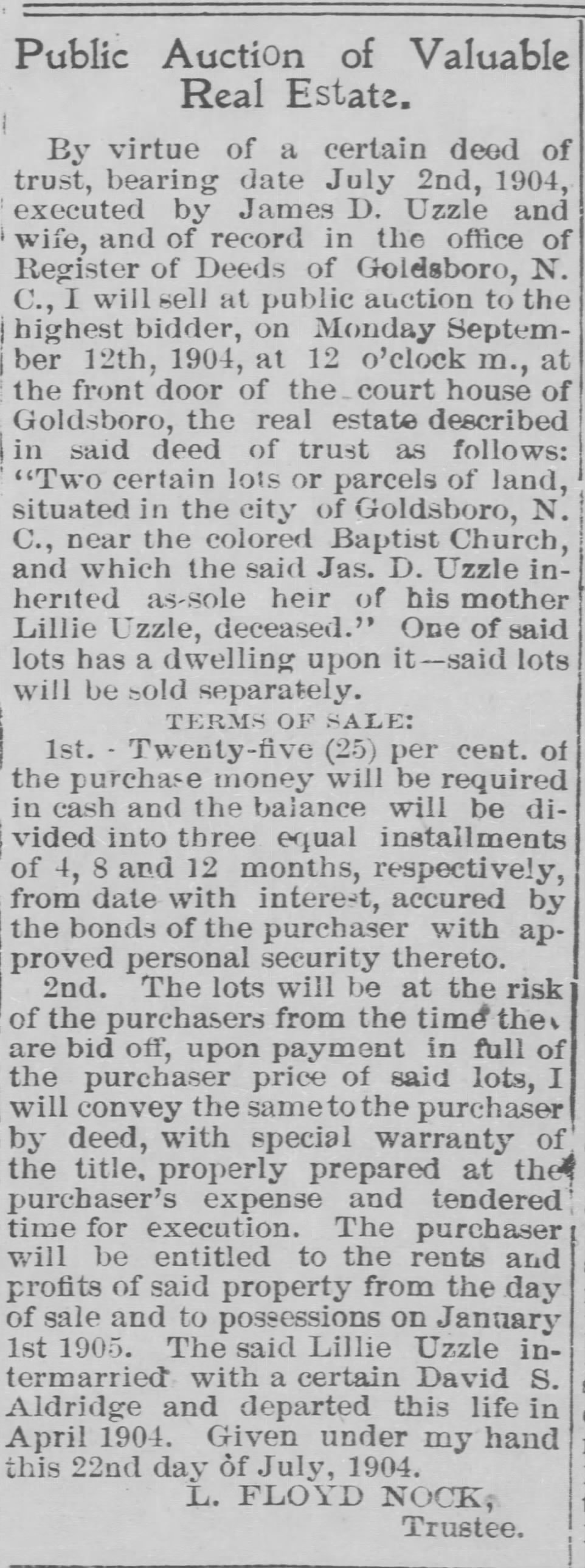
Goldsboro Weekly Argus, 1 September 1904.
I have not found David S. Aldridge in the 1910 census or after. Until I found this article last night, I had no record of him beyond Robert Aldridge’s estate settlement. The lots offered at auction were jointly purchased by David and his wife. In 1904, after his wife’s death, David sold his share in the property to Lillie Uzzell’s sole heir, her adult son, and, after this notice was published, disappears from the record again.
Sarah Henderson Jacobs Silver left two Bibles. One, a gift from her second husband, Rev. Joseph Silver, had originally belonged to his first wife, Felicia Hawkins Silver. The other passed through several hands before arriving in mine.
There are three inscriptions inside the front cover. “This book was give to Sarah Jacobs from Ganny Caroline 1920 of Wilson NC” — that’s my grandmother’s handwriting. Then, faintly: “Present by Mrs Caroline Vick of Wilson N.C. present in May 18th year 1904.” Then: “Gladys OKelley book give to her by Charity Pitt keep as long as I live no one to take it a way from me year 1913 Dec 23.”

Who are these folk?
Carolina Williamston Vick was born in Newton County, Georgia in 1844. How or why she came 425 miles north to settle in Wilson, North Carolina, may never be known, but a clue might lie in her maiden name. “Williamson” was a prominent southwest Wilson County family that included slaveholders. Did some migrate — or sell their slaves — South? In any case, Carolina was in Wilson by 1880 when she is listed in a household headed by 28 year-old Robert Vick. They are married and have three children, Alice, 18, Willie, 15, and Cora Vick, 3. (It appears that the older two were Robert’s step-children.) By 1900, Carolina was living in the 700 block of Green Street (around the corner from the Elba Street house) and spent the reminder of her life living with a rotating series of children, grandchildren, in-laws and lodgers and serving as a midwife to women in the community. “Granny Caroline” died in July 1925, when my grandmother was 15 years old.

As for Gladys O’Kelly (or Gladys O. Kelly), the nine year-old that so vigorously assorted her ownership in 1913 — see below.
The Bible’s frontispiece introduces another owner:

Unfortunately, her name is too common to begin to identify her.
As was custom in good quality Bibles of the era, the book’s text is halved by a shiny section of maps and illustrations and charts. My grandmother filled blank pages and the backs of leaves with the births and deaths and marriages of her family, her handwriting gradually shifting from a barely recognizable, youthful, curlicued version to the one I know so well.

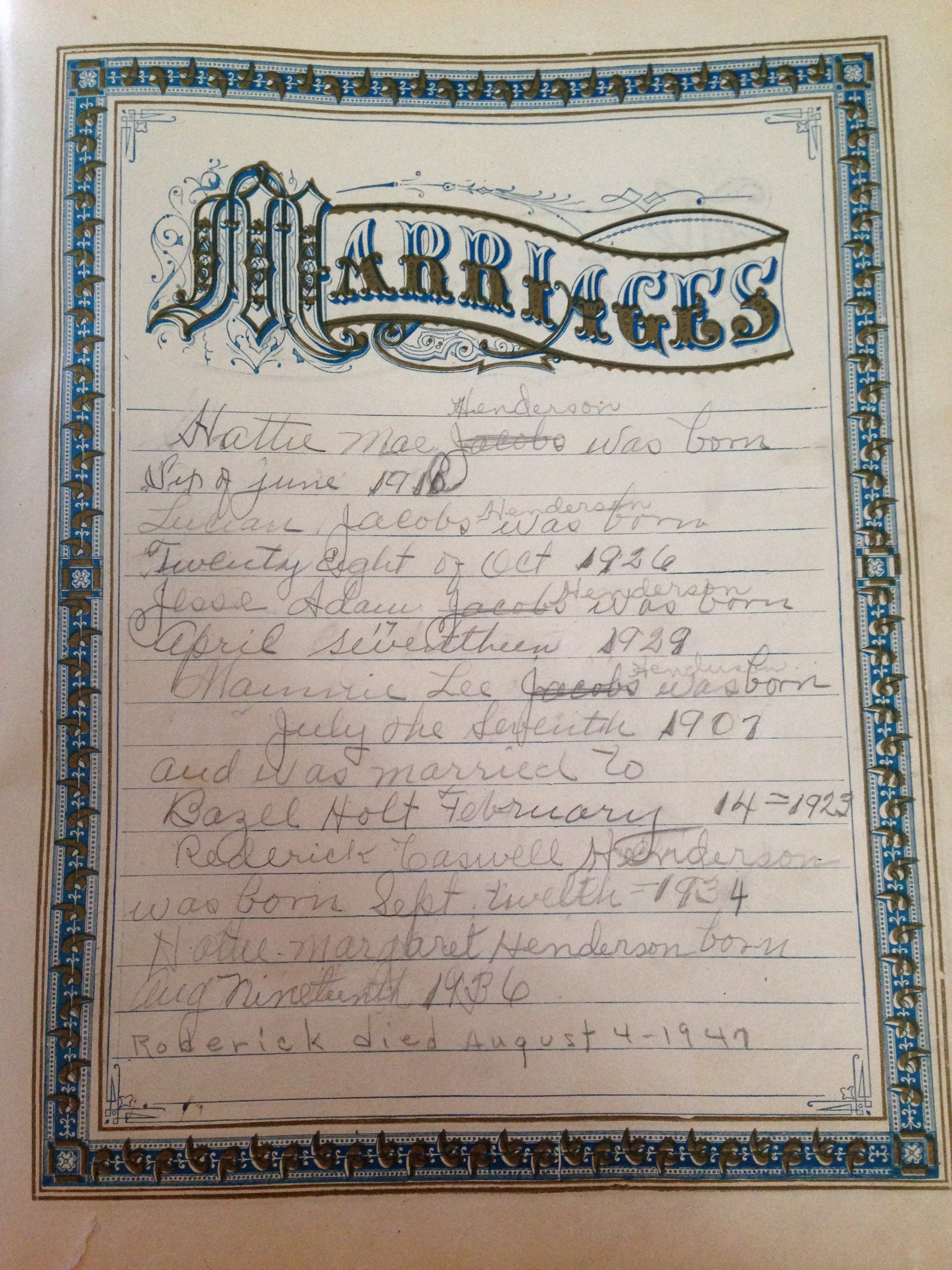
The “Births” page introduces another family. Or maybe families. Gladys O’Kelly is there, and there are two Carolina Vick entries.

The others seem to be members of an extended family I found in the 1880 census of Hillsboro, Orange County, North Carolina: Yunk Strayhorn (45), his wife Patsey (36), son Isaac (18), son-in-law Louis Pitt (25) and daughter Charity Pitt (23), children Rose (24), Jane (17), Henry and Reuben (13), Sandy (23) and Clara (21), and grandchildren Richard (3), Adeline (12) and Margaret (9). (Lewis Pitt married Charity Strayhorn in Edgecombe County in 1872 and moved to Wilson.) Little Gladys O’Kelly? She seems to have been the daughter of Rose Strayhorn’s daughter Gatsey and her husband, Reubin O’Kelly, both of Orange County.
And then there are Madison Perry, son of Carolina Vick’s daughter Cora, who married Isham Perry, and the Shiverses:
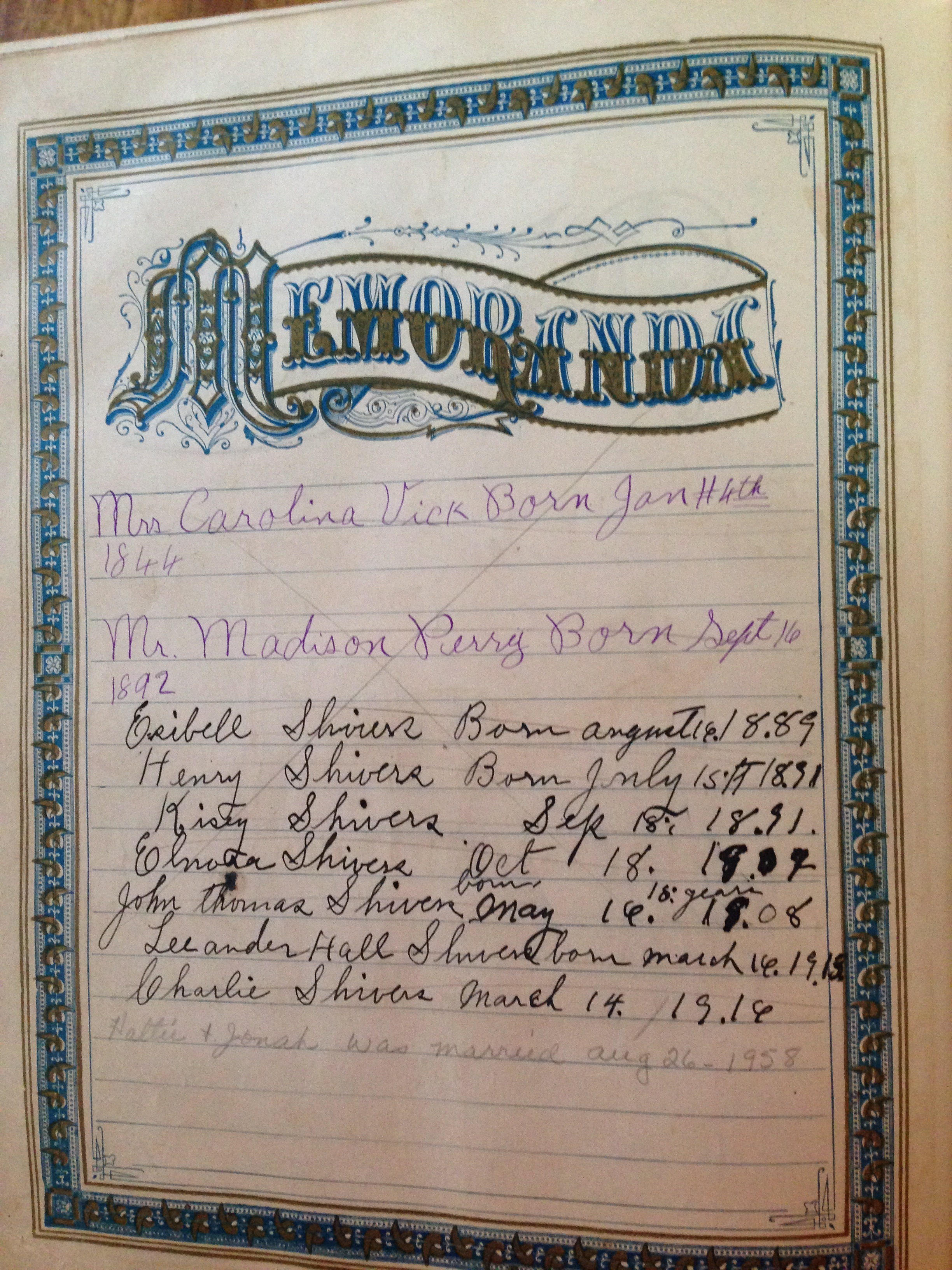
 I’ve been unable to find all the Shiverses, and what I have found doesn’t align cleanly with the dates inscribed here (for example, John and Nicey Shivers, born about 1872 and 1880, are listed in the 1900 census with six-month-old daughter Kizzy), but this appears to be a family that lived in Greenville, Pitt County at the turn of the 20th century.
I don’t hope to be able to reconstruct how this Bible bounced all over eastern North Carolina like this before coming to rest with my family, which has had it nearly 100 years. I share it here in hopes that descendants of the other families who cherished it will find themselves in its pages.
My parents married in 1961. When my mother arrived in Wilson shortly after, my father took her around to meet the elders who had not been able to travel to Virginia for the wedding. Along the way, they stopped at Dew’s Rest Home. As my mother stepped through the door, Aunt Nina threw up a cautionary hand: “Wait. You ain’t expecting, is you?” My mother, mortified: “No, ma’am!” “All right. ‘Cause it’s some uggggly folks in here!”
My paternal grandmother had a thousand stories about Nina — with a long I — Frances Faison Kornegay Hardy. Though she called her “aunt,” Nina in fact was her cousin. She was born March 15, 1882, probably in northern Duplin County, to John Henry Aldridge and Addie Faison. (John H. Aldridge, born 1844, was the son of John Mathew Aldridge, and first cousin of my grandmother’s grandfather, John W. Aldridge.) She seems to have been married briefly to Joe Kornegay in 1899 in Wayne County, but I have not found her in the 1900 census. By 1910, she had made her way 40 or so miles north to Wilson and was boarding in the household of Jesse and Sarah Jacobs as “Nina Facin.” The census also shows a “Nina Facon” living and working as a servant in the household of Jeff Farrior in Wilson. Though described as white, this is almost surely Aunt Nina, who cooked and cleaned for the Farriors most of her working life. Though she and her husband lived just outside Wilson on what is now Highway 58, she was at home only on her days off.
Said my grandmother:
Aint Nina lived up over the Farrior house on Herring Avenue. Herring’s Crossroads, whatever you call it. And that’s where she come up there to live. Well, the maid, as far as the help, or whoever, they stayed on the lot, where they’d have somewhere to sleep. So Aint Nina was living on Nash Road, way down there, and when we went to see her, me and Mamie would run down there five miles. She was working for Old Man Farrior then. When she was living out in the country, she was working for white people, and so she went up to their house and cooked for them. And when we’d go down to her house, she’d have to come from up there and cook when she get home. So we would go and spend a day, but it would be more than likely be on her day off. But when we had the horse and buggy, Mama drove out there once, and we went, I went with Papa with the wagon to where you grind corn to make meal, down to Silver Lake or whatever that place was down there. Lord, them were the good old days.
The Farriors, their back porch was closed in. It had windows. And had a marble floor in the back, and that stairway was on, where it was closed in on the back porch, you could go upstairs, and there was a room up there. You couldn’t go from out of that room into the other part of the house. You had to come back down them steps then go in the house. And that’s where Aint Nina stayed. I said, Lord, I wouldn’t want to have stayed up there. And then something happen … She had to come down and go down the steps, go upstairs, I mean, and come out of the kitchen, and then go up them steps out on this porch in her room. So she stayed up there. Lord, I wouldn’t want to stay up there. She get sick out there, she couldn’t get nobody. I didn’t see no – I was up in there one time, and I went up there just to look around. Well, she had a nice room, nice bed and chair and dresser and everything. There was a whole set in the room where she was. That was the only time I was up there. But I wouldn’t want to stay up there.
In 2004, J.M.B., a Farrior descendant, sent me copies of several photos of Aint Nina. My grandmother had described her (“She wasn’t real short. But she was heavy built, and she had big limbs. But she wasn’t that fat, but she just had big limbs and had a big face.”), and I had seen a couple of pictures of her before, like this one, taken in the mid-1950s with my uncle’s children:

And this one,

[There’s a photo booth shot that I can’t find right now. But I will. UPDATE: I found it. 1/3/2016]
But these …
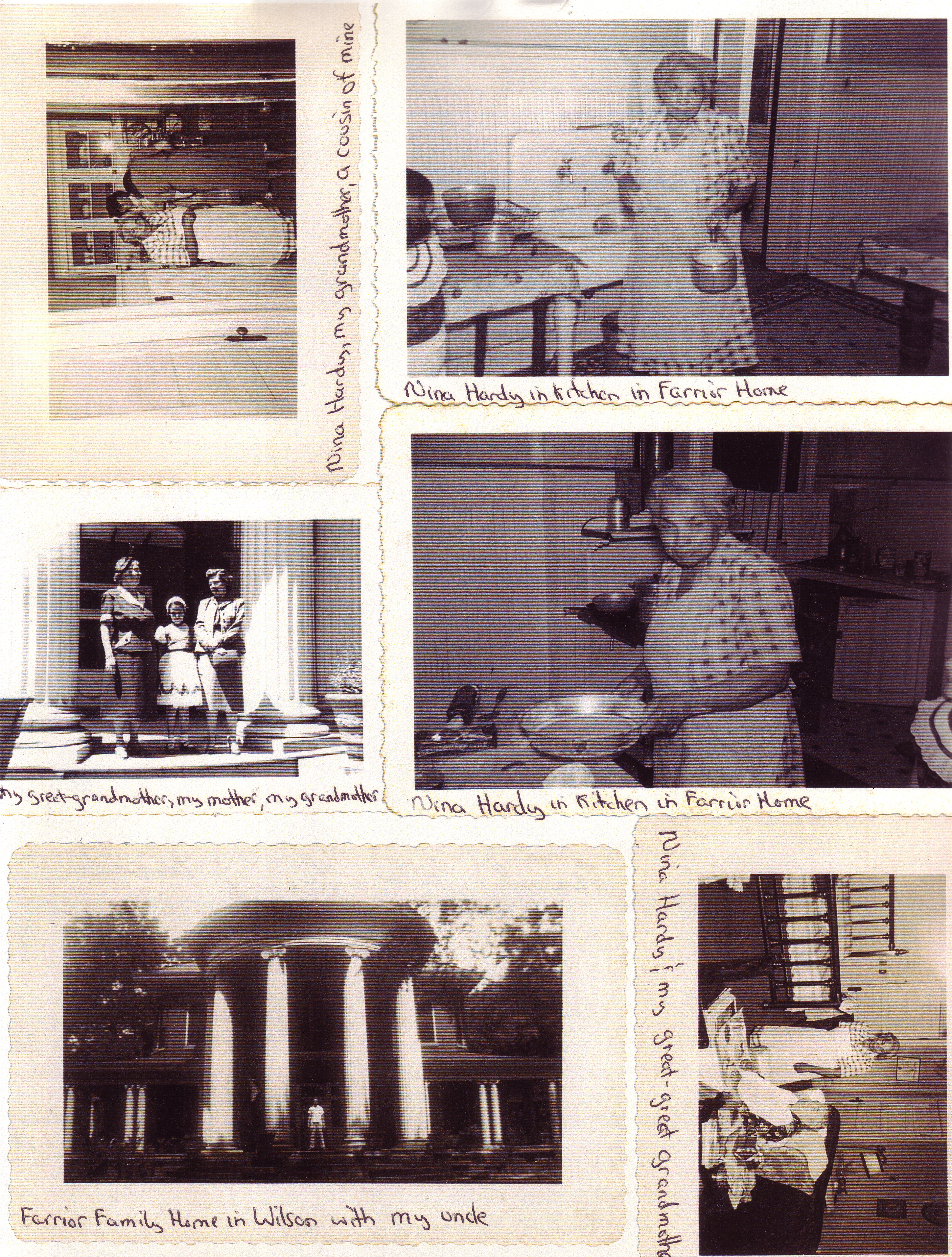
… these touch me. Nina at work. Nina in a kitchen with a floured pan, perhaps making biscuits, perhaps the dumplings my grandmother relished. Nina, her own legs aching, tending to whitefolks. The columned Farrior mansion, since torn down, with Nina’s little room tucked out of sight.
In 1917, Nina married Julius Hardy in Wilson township. It is likely their house that my grandmother and great-aunt visited out on Nash Road:
They had guinea chickens. A car run over a chicken and killed it, and it kept going. And we, me and Mamie, was going out there, and we picked up the chicken and carried it ‘round there. And Aint Nina poured water and scald the chicken and picked it and cooked it, and we had the best time eating it. Wont thinking ‘bout we was going out there to eat. And so we come walking in there with that chicken, and she wanted to know, “Well, where’d you get that?” “A car run over it, and we picked it up and brought it on over so you could cook it.” And she said, “Yeah, it’s good. A car just killed it?” And it wasn’t too far from the house. And I reckon it was one of her chickens anyhow. Honey, she cooked that old stewed chicken, had to put pastry and vegetables in it. Lord, we stayed out all that time, then had to come home from way out there. But we was full.
And her brother, his name was James Faison, lived across the street from her, and his wife, and I think the lady had been married before because they wasn’t his children. It was two girls. And he worked at the express, at the station. The place was on that side, Nash Street station was over on this side. Baggage used to come over there. The baggage place where’d you take off the train. That’s where you put it over on that side at that time. And he was working over there.
Nina was a font of information about the family back in Dudley that my grandmother barely knew. Mama Sarah was impatient with questions about the past. Nina, on the other hand …
Mama never talked about her daughter Hattie. But A’nt Nina, she would tell everything. Mama got mad with her, said, “You always bringing up something. You don’t know what you talking ’bout.” So she’d go behind — Mama wouldn’t want her to tell things. And she never did say, well, if she said, I wouldn’t have known him, but I never did ask her, who Hattie’s daddy was. I figured he was white. Because she looked — her hair and features, you know, white.
Even as she waited on others, Nina struggled with her health:
But she was kind of sickly, and I went up there for something. See ‘bout her. Carry her something. And then when her leg was sore, and she come to stay with us. Oh, she stayed with us a long time ‘cause she had to go to the doctor, had to be taken to the doctor with that leg. That leg was still big. But it was much bigger than the other one. But it healed over. But it was so knotty-looking, like it’d heal up and draw up in places, and it just looked so bad, and so she’d wear her dresses long. But she had big feet! Oooo, she had big feet. With those big legs … And she was the one that Mama made Mamie iron her clothes on Sunday. ‘Fore you even got to playing, had to get her clothes. She was at Rocky Mount in the hospital with that leg. They had operated on that leg and Mama would go every Sunday and take her clothes, bring her dirty clothes home and wash ‘em and bring them back to her. So, Lord, we had a time with that. And I looked at that big leg and just said, ‘Wooo…. What in the world is that?’ Looked like it just swelled up. And I saw a lady right here in Philadelphia. I had passed, and I seen her, and she had a great big leg. And so by that woman having that big leg, I said, ‘Lord have mercy, I hope I don’t get that. I wonder what’s wrong with it? How come the swelling won’t go down in it?’ People don’t know what they’ll have to go through…. Yeah, ‘cause we went over there, and you didn’t have — it was an open sore, and it was always running. She had to keep her foot up and had to keep the flies from on it, and so I said, well, finally it got better, but that leg healed up, it drawed up and you could tell where the sore was all on her leg. And that leg was much bigger than the other one. It took a long time to heal. It was all healed up though before she died.


Every big family has the sweetest one. That would have been “Dot.”


Remembering my father’s first cousin, Doris “Dot” Holt Beasley (1932-2010).
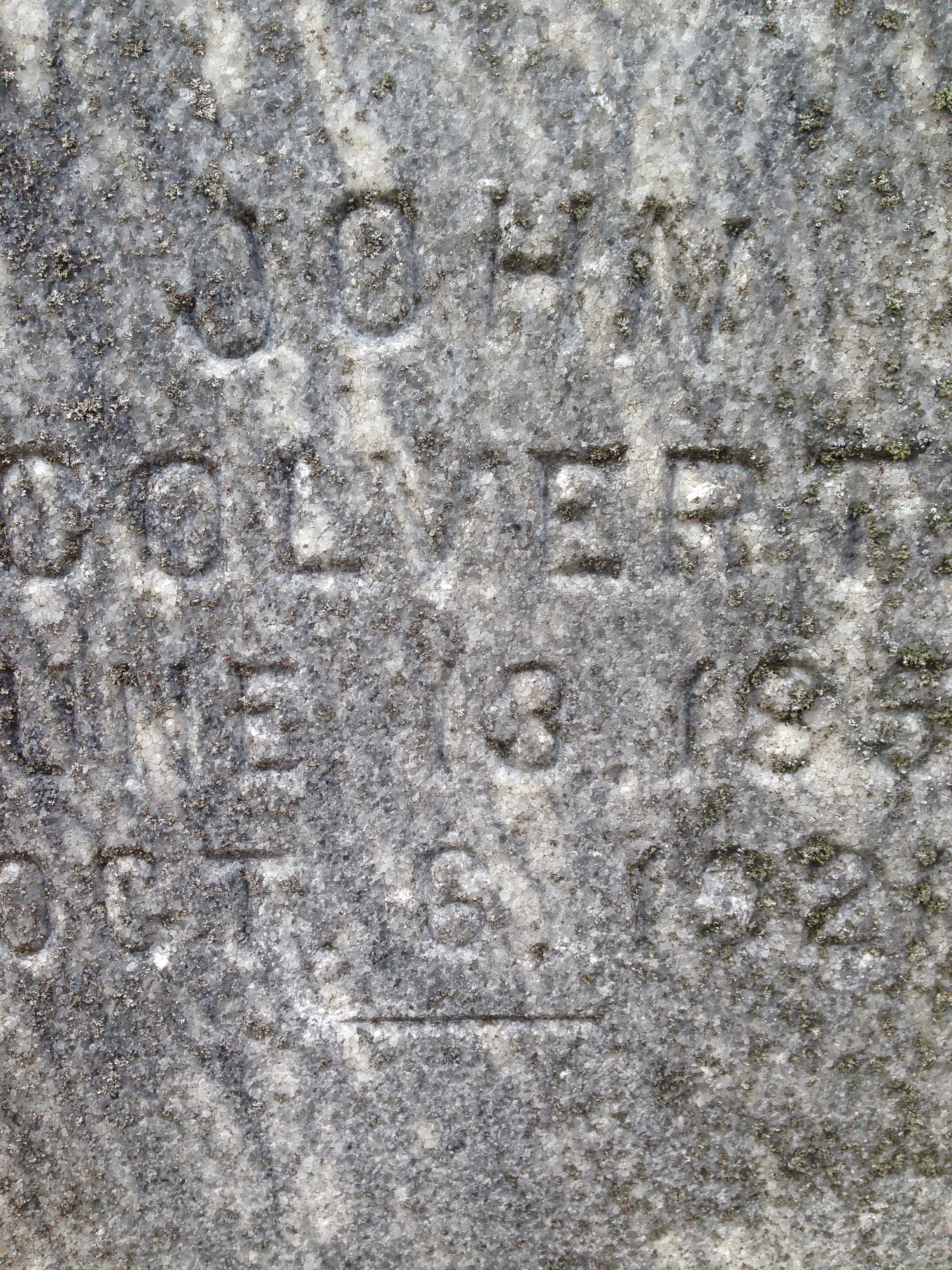
Green Street cemetery is a three-acre square smack in the middle of Statesville’s African-American southside. My great-aunt’s house faced the graveyard, but I don’t recall anyone ever talking about family members being buried there. Nonetheless, several years ago, I found three: my great-great-grandfather John W. Colvert, his wife Adaline Hampton Colvert (the double stone below) and their daughter Selma Eugenia Colvert, who is buried nearby. I suspect that others rest there, including John Colvert’s parents, his son Lon W. Colvert, Lon’s first wife Josephine Dalton Colvert, and his children Walker Colvert and Golar C. Bradshaw.

A right turn out of my parents’ neighborhood puts me onto Highway 58. Head southeast, cross the edge of Stantonsburg, over Contentnea Creek and the Greene County line, and, 13 miles from home, you reach Lane Road. Turn left, round the curve, and there, neatly marked and kept, is the Edwards cemetery. Here are buried Daniel Artis‘ daughter Clara, her husband Henry Edwards, and their descendants.
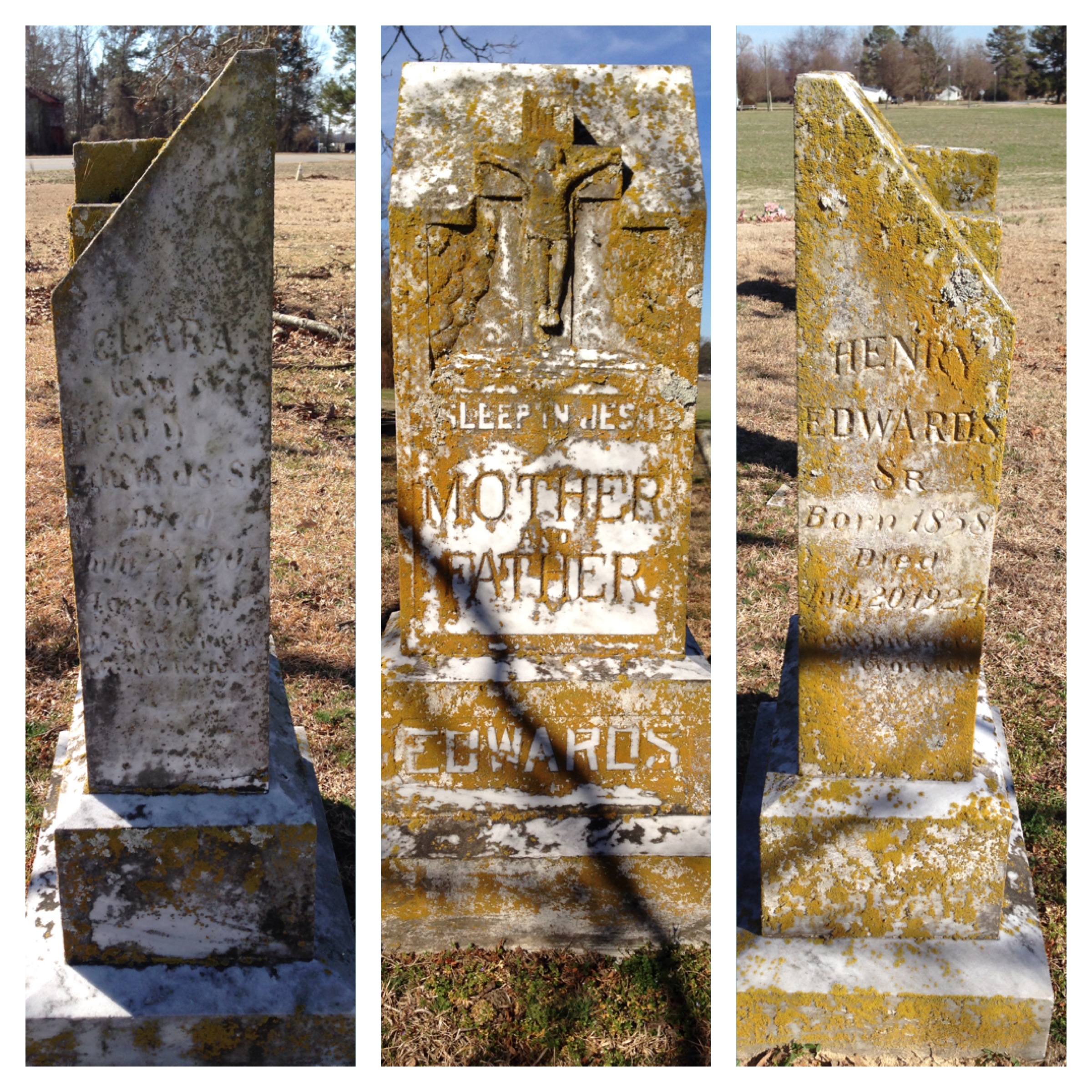
Photo taken today, Lisa Y. Henderson.
This is what we knew: Joseph Henry Ward, born circa 1870 in or near Wilson, North Carolina, was the son of Napoleon Hagans and a sister of Napoleon’s wife, Apsilla Ward Hagans. I couldn’t find him in the 1870 or 1880 censuses, but by 1900 he was listed in Indianapolis, Indiana, working as a physician.
The hunt for Joe Ward’s people thus began.
In the 1910 census of Indianapolis, a nephew, Augustus Moody, born about 1893, is listed in the Ward household. I searched for Augustus in 1900 and found him in Washington DC in this household: William Moody (born 1872), wife Sarah S. (1876) and children Augustus (June 1894) and Crist (1896), plus sister-in-law Minerva Vaughn (1890), mother-in-law Mittie Vaughn (1854), and mother Fannie Harris (1854) — all born in North Carolina. Soooo … Augustus’ mother was Sarah S. Moody, and Sarah’s mother was Mittie Vaughn. Okay, and how was Joe Ward related to these folks?
I went back to the 1880 census of Wilson County and found: Sarah Darden (57, mother), Algia Vaughn (23, son-in-law), Mittie (22, daughter), Joseph (8), Sarah (6), and Macinda (5 mos.), the last three Sarah’s grandchildren. From this I deduced that Mittie Vaughn, daughter of Sarah Darden, had at least two children, Joseph and Sarah, before 1880. I then located young Sarah’s marriage license to William Moody, which listed her maiden name as Ward. So Joseph and Sarah were listed in the 1880 census in their stepfather’s name, not their mother’s, and “Joseph Vaughn,” son of Mittie Vaughn, is in fact the Joseph Ward I was looking for.
How did I know Algernon was a stepfather? He was only 22 years old when he married Mitty Finch, 27, in Wilson on May 6, 1879. (Finch?!?!?! That’s an as-yet unexplained anomaly.) I also found a cohabitation registration for grandmother Sarah Ward and Sam Darden, dated 12 July 1866. This registration, which formalized the marriages of ex-slaves, noted that they had been married five years, well after the births of Sarah’s children Mittie and Appie. If Sam was not their father, who was?
The first clue: in 1902, when William S. Hagans (son of Napoleon and Appie Ward Hagans) registered to vote in Wayne County, North Carolina, under the state’s grandfather clause, he named “Dr. Ward” as his qualifying ancestor. I didn’t know what to make of that — I couldn’t find a Dr. Ward in Wayne County — so I laid it to the side for a bit.
Then I found a reference to Appie and Mittie’s previously unknown brother. On 16 June 1870, Henry Ward, son of D.G.W. Ward and Sarah Darden, married Sarah Forbes in Wilson, North Carolina. If we assume that Henry, Appie and Mittie had the same father, who is this D.G.W. Ward? Was he the “Dr. Ward” that William claimed as his qualifying ancestor under the grandfather clause?
In the 1860 census, D.G.W. Ward (45) and wife Adline (19) appear in Speights district, Greene County, which borders Wilson County to the southeast. Ward reported owning $26,500 in real property and a whopping $112,000 in personal property! (As the 1860 slave census shows, this wealth largely consisted of 54 slaves.) He was one of the, if not the, wealthiest men in the county. And he was a physician. Here, indeed, was Dr. Ward.
David George Washington Ward was married twice — perhaps circa 1840 to Mariah H. Vines, who died after having one child; then to Emily Adeline Moye in 1859. Between those marriages, he fathered at least three children with Sarah, an enslaved woman.

 Remembering my mother’s elder sister, my aunt, the Reverend Marion Allen Christian (2 June 1932-13 February 2011).
She gripped a balled handkerchief, or a tissue, in that hand almost always. You’d only notice that little finger, crooked up above the rest, when she made certain gestures, like smoothing her dress across her lap. It was a source of endless fascination when I was a child, and she would obliging turn her hand this way and that so we could get a closer look. Her pinkie finger, it was, curled permanently into a C-shape.
Here’s how it happened:
My grandmother: Ooo, I had a lot of friends. We had a lot of friends. We could not visit people all in the neighborhood. We could not go, the children came to our house. You know, to play and all that kind of – to play ball. We’d play ball in the evening, and they’d put me in the field because I couldn’t catch no ball on account of my finger. [Laughs.] I always had to go in the field. Louise and Launie Mae were whizzes. Louise was a terrible bad ball — I mean, she could play some ball. But Launie Mae was good, too. But, honey, they’d put me out there way out there in the field where didn’t no – just as soon as I’d reach up to catch that ball that thing would knock it out.
Me: Right. How did you hurt your finger?
My grandmother: Ah, you know, they had windows that you’d put a stick under.
Me: To prop them up?
My mother’s cousin: Didn’t have a sash.
My grandmother: Yeah. And I was in there playing and took that stick out there, and it broke something. But anyway, Mama said she had gone to town. That’s what they say when they went into Statesville. And she said when she came back, Golar came out meeting her with me in her arms, and said she had on a little dress, and said she turned the dress up and blood was coming through the dress off me, you know, my finger and everything. It scared her to death. So they carried, she carried me to the doctor’s, and they put splints on to get it – it was broken, you know. He put splints on. But, see, I would pick ‘em off.
Me: Just take it right off.
My grandmother: Take ‘em off. And take ‘em off. And hold my hand like that. [Balling her hand into a fist.]
Me: Okay. So that’s how it healed. It healed closed. How old were you then? Real little?
My grandmother: I guess I was little. I don’t know how old I was. Two, three. I don’t know whether Launie Mae was there or not. I know Louise was, but I don’t know ‘bout all of ‘em. But, anyway, I was just big enough to crawl up to the window and pull the stick out.
I have many favored photos of my grandmother, and this is one of the last:

At home, in her easy chair, just back from church, with that little finger.
Remembering Margaret Colvert Allen (2 August 1908-11 February 2010).
 Scuffalong: Genealogy.