Births Deaths Marriages, Free People of Color, North Carolina, Other Documents, Paternal Kin

Chears and bee gums.

Per the “Account of the Sale of the property of Matthew Aldridg Deceased sold by Joseph Hollowell Adm. on a credit of six months, Nov 20th 1868,” his widow, Catherine Boseman (or Simmons) Aldridge, purchased five “chears”, cart wheels and an axle, two tables (one small), two beds and furniture, “one cubbard & contents,” a clock, a gun, “3 Bee Gumes & work bench,” a tub dipper, kitchen furniture, a blind mare and two beehives. Green Simmons, George Simmons and David Winn purchased tools, and “Robbert Aldridg,” who likely was Matthew Aldridge’s brother, bought the fourth and fifth beehive choices.  A note on William Carter for a $27.50 debt, due 1 January 1869, was described as doubtful.  The Application for Letters of Administration in the file notes that Aldridge’s heirs were John Henry AldridgeWm. AldridgeFrances Aldridge, Della AldridgeMary Ann AldridgeJoanna Aldridge, and James Thomas Aldridge.

William Aldridge was one of the founders of the First Congregational Church of Dudley, and Frances Aldridge Wynn and Mary Ann Aldridge Baker’s descendants were prominent members of the church for several generations. John H. Aldridge had a daughter, Nina Frances Faison Hardy, who played an important role in my grandmother’s young life. More about Aunt Nina later.

Standard
Births Deaths Marriages, Land, North Carolina, Paternal Kin

Coley v. Artis.

At the heart of Wayne County Superior Court proceedings stemming from the suit in J.F. Coley v. Tom Artis (1908) was a dispute over 30 acres of land. Thomas “Tom Pig” Artis began renting the property in 1881 from W.J. Exum.  In 1892, Exum’s widow Mary sold it to Napoleon “Pole” Hagans.  In 1896, after Napoleon’s death, the land passed to his sons Henry and William S. Hagans, and in 1899 Henry sold his interest to his brother.  In 1908, William S. Hagans sold the 30 acres to J.F. Coley.  Coley filed suit when Tom Artis laid claim to it, arguing that Napoleon had sold it to him.  Tom claimed that the 800 lbs. of cotton he tendered to Napoleon Hagans (and later, his son William) was interest on a mortgage, but William Hagans and other witnesses maintained that the payment was rent.

The trial transcript is replete with testimony revealing the personal relationships among witnesses. Tom Artis testified that he rented the “Adam Artis place.” William Hagans testified that his father was in feeble health in 1896 when he called him and Henry together “under the cart shelter” to tell them he would not live long and did not know to whom the land would fall.  William testified that Pole asked them to let “Pig” stay on as long as he paid rent, and they promised to do so.  Tom Franks testified that “Pole was a first-rate business man.” Jonah Williams, Adam Artis’ brother, testified that he borrowed money from Napoleon to open a brickyard in the spring of 1893 and had preached his funeral.  He also noted that “Tom married my sister [Loumiza Williams Artis, who was deceased by time of this trial].  He is not a member of my church.  I turned him out.  He is a Primitive Baptist.  I preached Napoleon Hagans’ funeral.”  Jesse Artis, another of Adam Artis’ brothers, testified that he had worked on Hagans’ property as a carpenter for 18 years and noted, “I don’t know that Tom and I are any kin, just by marriage.”   John Rountree testified that he was a tenant renting from Hagans on thirds.  Simon Exum, Delilah Artis‘ husband, testified: “I am no kin to Tom [Artis] as far as I know, except by Adam.  His first wife was my wife’s sister.”  H.S. Reid testified that he was Tom Artis’ son-in-law.

The court found for Coley and against Artis.

——

Thomas Artis was a son of a free woman of color, Celia Artis, and her enslaved husband, Simon Pig. Though, ultimately, nearly all free colored Artises are descended from a common ancestor in southside Virginia, by the late 1800s knowledge of these remote links had faded. There were dozens of Artis families in Wayne County during the antebellum period, and the relationships between them are unknown. Celia Artis was a close neighbor of Adam Artis, but the families apparently did not regards themselves as kin.  Still, they were inextricably intertwined.  The Artises, Haganses and Reids had been neighbors in the Eureka area for generations. Celia Artis and Henry S. Reid’s grandmother Rhoda Reid were the wealthiest free women of color in the county. Adam Artis married Napoleon Hagans’ half-sister Frances Seaberry. Adam’s sister Loumiza married Tom Artis, as noted above. Henry S. Reid, son of Washington and Penninah Reid, married Tom Artis’ daughter. Henry’s first cousin Henry Reid, son of John and Mozana Hall Reid, married Adam Artis’ daughter Georgianna Artis. Adam Artis’ son William Marshall Artis and grandson Leslie Artis married Tom Artis’ nieces, Etta and Minnie Diggs. And on and on.

Documents found in file of the Estate of Thomas Artis (1911), Wayne County, North Carolina Estate Files, 1663-1979, familysearch.org

Standard
Births Deaths Marriages, North Carolina, Oral History, Paternal Kin

Her story.

Bessie Henderson has died, and her children remain.

Mamie Lee was the first child, and my grandmother was the second. And the second Hattie Mae.  The first was Sarah Henderson Jacobs’ daughter.

That’s who they named me after.  I asked them why they named me Hattie after a dead person.  “What?  You don’t like Hattie?  Well, I just thought ’twas nice.”  And after I looked at her picture, I said, “Well, she was pretty.”  Since Jack knew her, and he wanted her picture, when I come up to Philadelphia, I give him the picture.  ‘Cause they grew up together.  And his children thought she was white, wanted to know what old white girl was that.  Mama never talked about her.  But A’nt Nina, she would tell everything.  Mama got mad with her, said, “You always bringing up something.  You don’t know what you talking ’bout.”  And she never did say – well, if she said, I wouldn’t have known him, but I never did ask her – who Hattie’s daddy was.  I figured he was white.  Because she looked — her hair and features, you know, white.

Jack Henderson told my grandmother that he remembered “when she was got,” that he was nearby when it was happening, that Tom had Bessie over a barrel, literally.  Bookish and soft, James Thomas Aldridge tended his mother and younger sisters and his ailing father’s dry goods store while dreaming of a bigger and better world faraway.  He would have been a nerd if they’d had them then.  Bessie’s pregnancy changed his life:

‘Cause his mama didn’t want her son to get married.  ‘Cause he wanted to be a doctor, and so she was gon help him be one.  And if he got married and started having children, he couldn’t be a doctor.  And down there in a little town like Dudley, you had to go away from there ‘cause it wont no more than ‘bout sixth, seventh grade.  And you had to go to a larger place if you wanted to go to school. 

So the pregnancy stirred him, thrust him out toward his reveries, away from Dudley and the grey-eyed baby whose mother was soon to die.  Tom, already 24 years old but claiming to be much younger, fled to Raleigh, where he entered Shaw University’s preparatory division and exited its college eight years later on his way to Meharry Medical School.  He would become a doctor, indeed, a big-time, money-making, Cadillac-driving Saint Louis doctor, elected president of the National Medical Association in 1961.  But it’s his daughter’s story we’re telling right now, the daughter who never got past sixth grade, who never met her father ‘til she was good and grown.

Let me back up.  Sometime around 1905, Mama Sarah and her husband, a good man named Jesse A. Jacobs Jr., moved 40 miles north of Dudley to Wilson, a tobacco market bursting with new golden-leaf millionaires.  Colored folks from all over coastal Carolina, drawn to the town’s bustling opportunity, built a vibrant community on the southeast side of the railroad that cleaved the town in two. Sarah took in washing and ironing, did seasonal work at tobacco factories, and reared Jesse’s brood, who turned out largely ungrateful.  Her own daughter died in 1908, aged 14, and nobody knows why.

Meanwhile, down in Dudley, Lewis and Mag Henderson faded in their iron bedstead with only their teenaged granddaughter Bessie to manage the household.  Lucian Henderson likely farmed his parents’ reduced acreage with his own, but it was left to Bessie to cook and clean and sew and launder and do all the other relentless drudgery that needed doing.  Her mother was long dead, and there were no other close relatives nearby upon whom to rely.  Did she resent her responsibilities?   Did she chafe under the grind of pot-stirring and water-fetching and skillet-scouring and jar-slopping?  What did she want?  She was a chancey girl, a risk-taker, one who took her pleasure where she found it, even when it clamped the lid tighter on her trap.  She was a beautiful girl, but nearly unmarriageable, as she dragged her heavy belly through the spring of 1910.

Bessie gave birth to my Hattie Mae on June 6, very likely attended by the child’s grandmother, a midwife named Louvicey Artis Aldridge.  Though Vicey had forbidden a marriage between this girl and her special boy Tom, she was not altogether unmoved by her grandbaby, who looked much more Aldridge than Henderson. Vicey and her daughters played small intermittent roles in my grandmother’s early life, but there is no doubt: Sarah Henderson Jacobs was the family’s matriarch and matrix, though no children of her own lived even to adulthood. She reared Bessie’s children and kept them clothed and fed and sheltered, if not exactly loved.

Standard
Births Deaths Marriages, North Carolina, Other Documents

Aunt Jane and the alligator.

While perusing the November 2001 issue of Trees, the publication of the Wilson County Genealogical Society, I ran across a previously unnoticed article about Jane Sauls and her daughters and their encounter with an alligator on their farm near Stantonsburg.  (“Unnoticed” in that I’d read it years ago, but not appreciated what I was reading.) Jane was a first cousin to my great-great-great-grandfather, Adam T. Artis (1831-1919).

Pages from November 2001

Jane Lane Sauls was born circa 1842 in Greene County NC. She died on 16 Dec 1928 in Stantonsburg township, Wilson County, North Carolina.  She was one of several children of Sylvania Artis, a free woman of color, and her husband Guy Lane, an enslaved man, but is not found in the 1850 or 1860 censuses.

In the 1870 census of Nahunta township, Wayne County, farm laborer John Sauls, 35, wife Jane, 27, and children Mary, 3, and Silvany, 1, are listed with Trecinda Barnes, 20, Jane Barnes, 7, and Edwin Barnes, 1. No marriage record for Jane and John has been located, and their relationship to the Barneses is unknown.

The 1880 census of Nahunta township, Wayne County, shows farmer John Sauls, 45, wife Jane, 36, daughters Mary, 12, Silvany, 9, Anner, 7, and Lucy, 6, plus Jane’s sister Fanny Lane, 14.  (Sister? Really? I’d bet niece.)

On 30 Nov 1894, J.W. Coley applied for a marriage license for Morrison Artis of Wayne County, 50, colored, son of Guy Coley and Sylvania Coley, both dead, and Jane Farrior of Wayne County, 35, colored, of unnamed parents, both dead. (This is the only instance of Coley as a surname for Guy.) The ceremony was performed by D.F. Ormond, Justice of the Peace, on 6 Dec 1894 at John Sauls’ house.in Nahunta township, before B.W. Best, John Sauls, and J. Reid.  Morrison Artis was Jane Lane Sauls’ brother.  Some of the siblings adopted their mother’s surname, Artis; others used their father’s, Lane.

The 1900 census of Nahunta township, Wayne County, shows John Sauls, wife Jane, daughters Mary and Sylvania Sauls, and “grandchildren” Louvenia (Apr 1883), Henry (Oct 1885) and John Lane (Oct 1886). In fact, these children were probably the children of Jane’s brother Alford Lane.

The 1910 census of Nahunta township, Wayne County, shows John Sauls, 76, wife Jane, 56, Mary, 38, Sylvany, 36, Anna, 33, and Snobe, 10, plus niece Louvenia Lane, 23, and boarder Freeman Swinson,14. Anna reported that she was divorced; Snobe was her son.  John B. Sauls, alias Snow B. Nobles, died in 1925. His father was Columbus Nobles.  Freeman Swinson was the son of Jane’s sister Mariah Artis Swinson.

The 1920 census of Nahunta township, Wayne County NC shows Anna Sauls, 45, widowed, sharing a household with her sisters Sylvania, 46, and Mary, 49, widowed mother Jane, 76, and cousin Levenia Sauls, 28.

Jane Lane Sauls died 16 Dec 1928 in Stantonsburg township, Wilson County, of paralysis due to hypertension and cerebral hemorrhage.  Her death certificate reported that she was born in 1842 in Greene County NC to Guy Lane and Sylvania Artis, both of Greene County, and she was the widow of John Sauls. She was buried 17 Dec 1928, Union Grove cemetery, Wayne County, by C.E. Artis, Wilson NC.  (C.E., son of Adam Artis, was her cousin.)  The informant was Anna Sauls, Rt. 6 Box 94, Stantonsburg.

Anna Sauls died 20 Dec 1950 in Stantonsburg township, Wayne County, of cerebral hemorrhage. Her death certificate reports that she was a widow and was born 1 Jan 1878 in Wayne County to John Sauls and Jane Lane. She was buried 23 Dec 1950, Union Grove cemetery, Wayne County NC. The informant was Louvenia Sauls, R#2 Box 300, Stantonsburg NC.

Sylvania Sauls died 23 Oct 1957 in Stantonsburg township, Wilson County, of cerebral hemorrhage.  Her death certificate reports that she was about 87 years old and was born in Wayne County NC to John Sauls and Jane Lane. She was buried 28 Oct 1957 in Union Grove cemetery.  The informant was Louvenia Sauls.

Mary Sauls died 29 Dec 1960 in Fremont township, Wayne County, of cerebral hemorrhage. [Did all these women really die of strokes, or was that a default diagnosis?] Her death certificate reports that she was born 3 Sep 1861 in Wayne County to Johnnie Sauls and Jane Lane. Mary was buried 3 Jan 1961, Union Grove cemetery, Wayne County.  The informant was Anna Ray, Rt. 2 Box 143, Fremont NC.

Standard
Births Deaths Marriages, Enslaved People, Maternal Kin, North Carolina, Oral History, Other Documents

Lucinda Cowles, also known as Lucinda Nicholson.

I give and bequeath to my beloved son Thomas A. the following Negroes to wit Carlos Nelson Lucinda and Joe.

——

On 19 Nov 1850, James Nicholson wrote out his last will and testament. Two days later, before he could sign it, he slipped into death.  The document was registered 19 Jun 1852 in Will Book 4, page 666 at the Iredell County Register of Deeds Office. Nicholson’s only heirs were his widow Mary Allison Nicholson and sons Thomas A. and John M. Nicholson.  James left Thomas 185 acres and John 242 acres and gave them a 75-acre mill tract in common.  Mary Nicholson received slaves Milas, Dinah, Jack, Liza and Peter; John received slaves Elix, Paris and Daniel; and Thomas received the four named above.  In addition, James bequeathed Thomas and John slaves Manoe, Armstrong, Manless, Calvin and Soffie jointly.

Thomas A. Nicholson put Lucinda to work in his home preparing meals and otherwise caring for his family. As Thomas’ son James Lee Nicholson grew to adulthood, he took increasing notice of the woman who cooked his suppers, laundered his shirts and emptied his slops. In 1861, she gave birth to his first child, a daughter that she named Harriet Nicholson. Lucinda and Harriet remained in Thomas Nicholson’s household till Emancipation, when they were provided with a small house and other support.

As the story goes, Harriet did not learn her father’s identity until her mother Lucinda revealed it on her deathbed. Lee Nicholson passed away when Harriet was 10 years old, leaving a widow and two small boys. Lucinda may have died even earlier, as she has not been found in the 1870 census. She had one other child, a son named William H. Nicholson, whose father was Burwell Carson. Based on information supplied by Harriet, William’s death certificate lists Lucinda’s maiden name as Cowles. We know nothing else about her life.

Standard
Births Deaths Marriages, North Carolina, Paternal Kin, Photographs

John H. & Sarah Simmons Henderson.

Image

John Henry Henderson, son of James and Louisa Armwood Henderson, married Sarah Elizabeth Simmons, daughter of Bryant and Elizabeth Wynn Simmons, in about 1886. The couple remained in the Dudley area their entire lives and reared three children — Frances, Charles Henry and Henry Lee — to adulthood.  John died of pulmonary tuberculosis in 1924.

Standard
Births Deaths Marriages, Free People of Color, North Carolina, Paternal Kin

Robert Aldridge.

Again from “The Adam Artis Family History“:

Robert Aldridge was born in 1819, in or near Savannah, Georgia. He owned about 700 acres of land in Dudley. He ran a brick kiln, where he employed a lot of extra hands to make bricks. He was taken ill in the woods opossum hunting and never recovered. He died in 1871 at the age of 52. He had 7 or 8 brothers and sisters.

Sentence by sentence:

(1) I suppose that it is remotely possible that Robert Aldridge was born in or near Savannah, but it seems highly unlikely. More probably, as reported in the 1850 census, he was born in Duplin County NC and was the free colored son of a white woman.  An extended family of white Aldridges lived in the Duplin/Greene/Lenoir County area and at least one, Winnie Aldridge, had children of color during the right timeframe.

(2) At his death, Robert owned just under 600 acres of land near Dudley, as his estate division attests.

(3) His brick kiln was located on present-day Durham Lake Road, near the lake, which is a dammed stretch of Yellow Marsh Branch.

(4) Interesting.

(5) Actually, he died about 1899.

(6) If he did, who were they???  I am reasonably sure that John Matthew Aldridge was a brother, but that’s it.

Standard
Births Deaths Marriages, Maternal Kin, Newspaper Articles, North Carolina

The belle of her set.

IN THE “MOVIES.”

Colored Girl is Said to be Playing Part in Large Moving Picture Company.

Kittie Reeves, a mulatto girl who possesses more than the usual amount of good looks, lived in this city several years ago, but now is said to be a leading woman in a well-known motion picture company. Kitty Reeves lived here from her early childhood. Her name was Kitty Smith before she married Charles Reeves, a highly respected negro, a son of Fletcher Reeves, the veteran hearse driver of the old Wadsworth Livery Stables for numbers of years. Kitty was always said to have been the belle of her set. She was a bright and accomplished young negress, but the lure of the stage was always within her, and when Black Patti came through here in 1910, Kitty Reeves applied for a place in the chorus.  Immediately upon signing the contract, her name became Katherine Reeves. The tour was a success, but during the between-season lay-off, Katherine secured a place in a well-known manicuring establishment in Philadelphia.

The girl was possessed of fair skin with coloring. Her hair was long, but black with many freckles on her face. After learning the secrets of the manicurists’ art, Katherine underwent treatment for some time. When she ceased working on her face and hair, a great transformation had taken place. No longer was the hair black, but it had been turned to a dull auburn. The freckles had departed from her face, and she bore all of the appearances of a white person.

After leaving Philadelphia, Katherine became connected with a well-known motion picture firm in the State of New York. Many of her colored friends in the city claim to have recognized her a number of times playing leading parts in the film plays. So far as is known, this is the only person from Charlotte who has ever appeared upon the screens as an actress for motion pictures.

Charlotte Observer, 29 December 1912.

Ten years before this article appeared, twenty-one year-old Frank Reeves applied for a marriage license for himself and Kate Smith, 18. Both lived in Mecklenburg County. Frank (called Charles, above) was the son of Fletcher and Angeline McConnaughey Reeves Kate’s parents were listed as Thomas and Mary Smith.  S.H. Hilton, justice of the peace, married the young couple on 1 Aug 1902 at the county courthouse.

The marriage did not prosper. When the censustaker reached their neighborhood in 1910, he found Frank and Kate’s only child, 7 year-old Wilbur, living with his paternal grandparents. Charles (or Frank) and Kate (or Kittie or Katherine) do not appear together in that census or any other. (She had gone off with Black Patti by that time and, presumably, was pursuing her career as a star of the silent screen.)

Standard
Births Deaths Marriages, Education, Free People of Color, North Carolina, Other Documents, Paternal Kin

John William Aldridge.

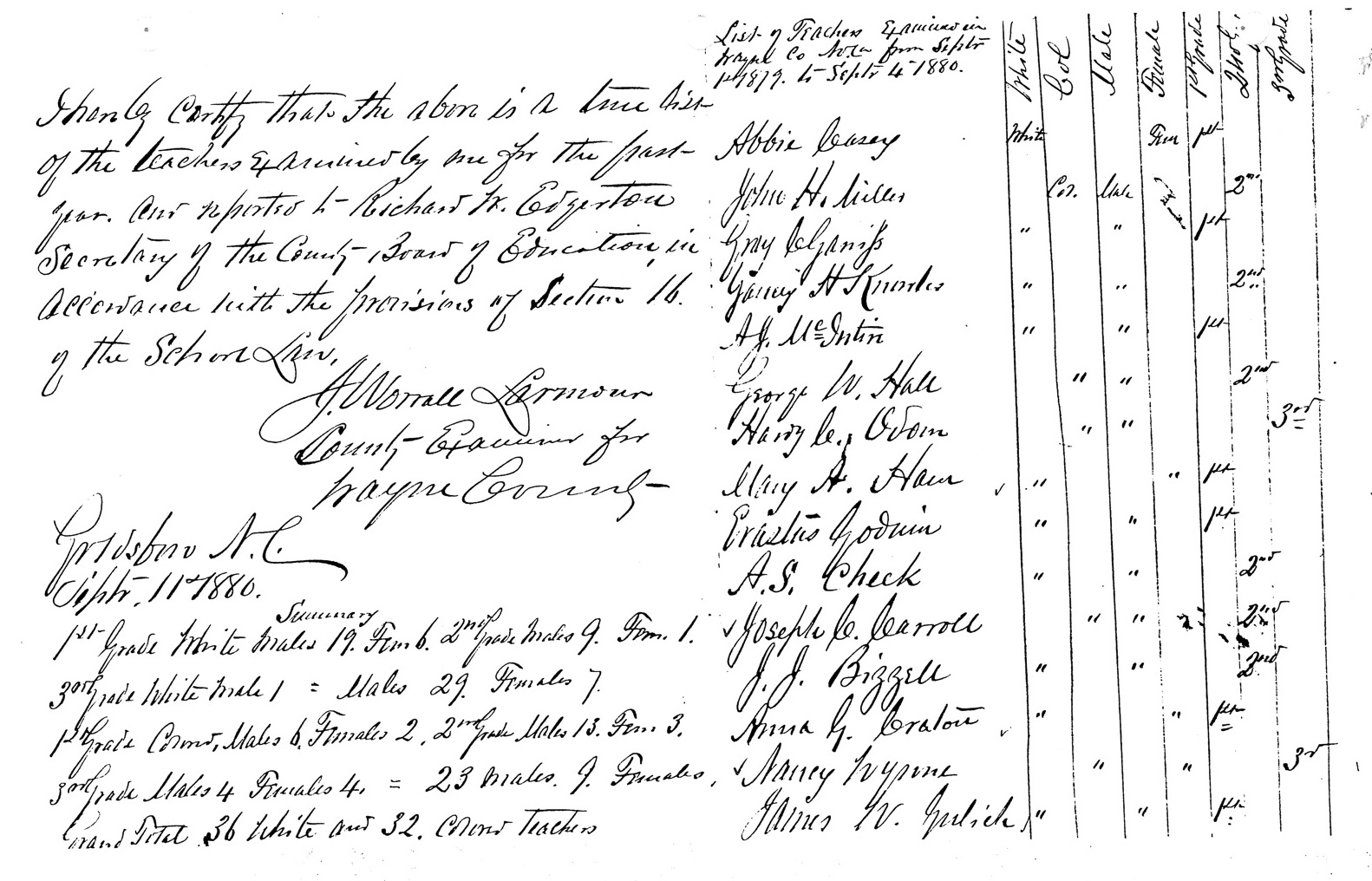
John Aldridge and his brothers George and Matthew Aldridge were hired to teach in Wayne County in the late 1870s. For reasons unknown, they were assigned to schools in the far north of the county, some 15 miles north of Dudley:


ALDRIDGE -- Aldridge_School Records

ALDRIDGE -- Aldridge_School Records 2 

From the same unsigned family history:

John Aldridge met Luvicie Artis at the school where he taught; she was one of his students. He built a 7 room house for her when they got married. John was a stout man with a reddish brown complexion and wavy black hair. He stopped teaching when he married Luvicie and started to farm and run a general store. The store was burned down in 1911. He sent his children to a private school. He died in 1910 of a congested chill. He was 58 years old when he died, and was worth about $30,000 at that time.

ALDRIDGE_--_John_Aldridge_Vicey_Artis_Marriage_License

If John was worth $30,000 when he died, it was all in realty. His personal estate was paltry:
JW Aldridge Estate Doc
Standard