
 Napoleon and Appie Hagans’ grave marker stands in a cornfield several hundred feet west of his house. One side of the plinth memorializes his life; the opposite side, hers.

Photographs taken by Lisa Y. Henderson in July 2010.
Napoleon and Appie Hagans’ grave marker stands in a cornfield several hundred feet west of his house. One side of the plinth memorializes his life; the opposite side, hers.
Photographs taken by Lisa Y. Henderson in July 2010.

Joshua Brewington, son of Raiford Brewington and Bathsheba Manuel Brewington, was born in 1846 in Sampson County and died in 1931 in Wayne County. His wife, Amelia Aldridge Brewington, daughter of Robert Aldridge and Mary Eliza Balkcum Aldridge was born in 1855 in Sampson County and died in 1895 in Wayne County. Their children were: Tilithia Brewington King Godbold Dabney (1878-1965), Bashua M. Brewington (1879-1899), Hattie Bell Brewington Davis (1880-1981), Mattie Amelia Brewington Braswell (1883-1952), Elijah Coleman Brewington (1886), Amelia Brewington (1888), Lundy Brewington (1891-1914), Toney Cemore Brewington (1894-1973), and Murine Brewington (1895).
Joshua and Amelia Brewington are buried in the cemetery of the First Congregational Church, Dudley, North Carolina.
“Sleep on and take thy rest.”
——
Photo by Lisa Y. Henderson, August 2010.
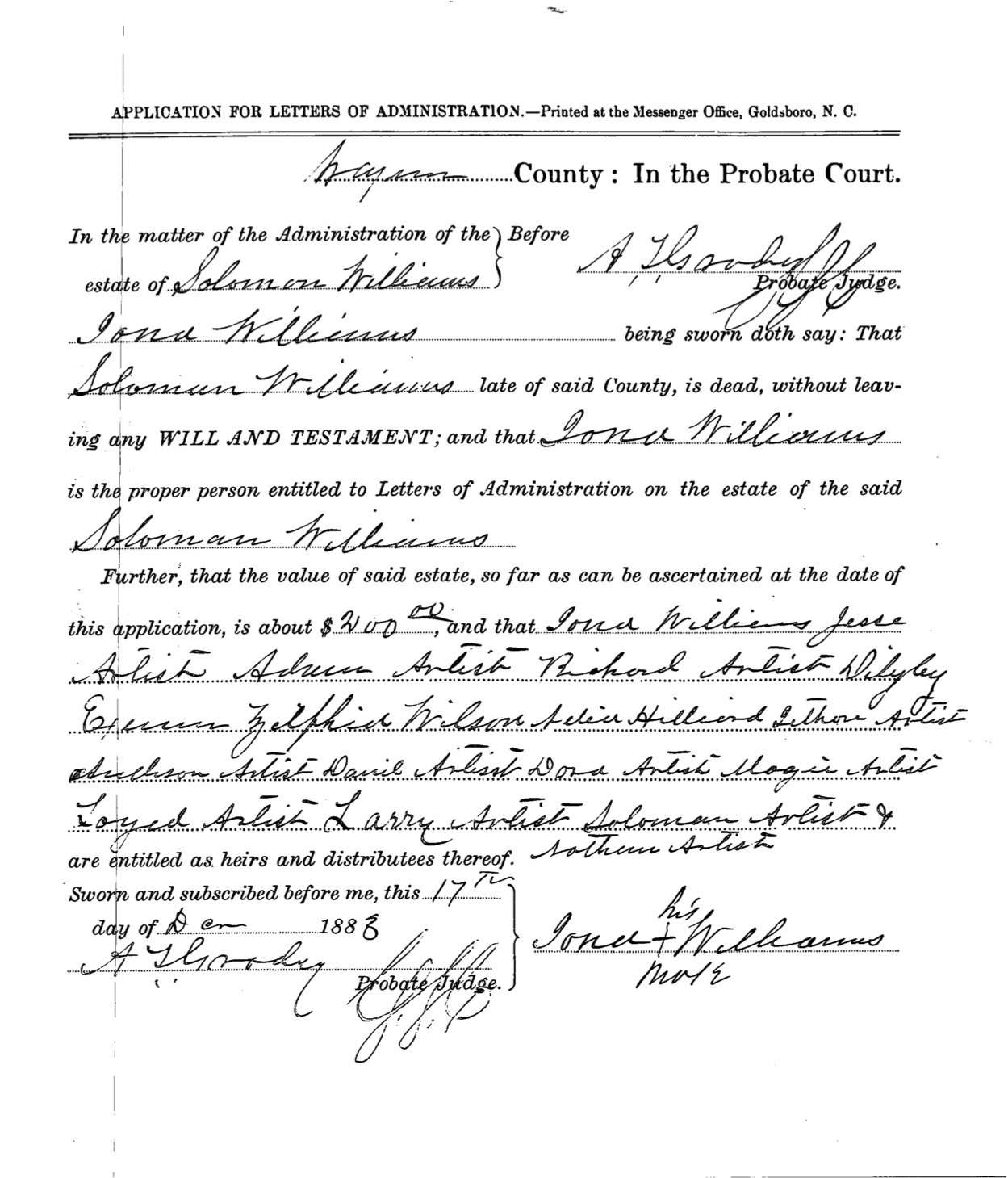
Vicey Artis, a free woman of color, and Solomon Williams, a slave, had eleven children together – Zilpha Artis Wilson, Adam Toussaint Artis, Jane Artis Artis, Loumiza Artis Artis, Charity Artis, Lewis Artis, Jonah Williams, Jethro Artis, Jesse Artis, Richard Artis and Delilah Williams Exum — before they were able to marry legally. On 31 August 1866, they registered their 35-year cohabitation in Wayne County. Vicey died soon after, but Solomon lived until 1883. The document above, found among Solomon’s estate papers, names son Jonah as administrator and lists his and Vicey’s six surviving children and the heirs of their deceased children.
Little is known about Solomon. He was born about 1800. A few slaveowning Williams families lived in Vicey Artis’ vicinity in Greene County, but there is no evidence to link Solomon to them. He appears in the 1870 and 1880 censuses of Nahunta township, Wayne County, heading households comprised of his daughters and their children, and is recorded as father on the marriage licenses of daughter Lomisy (Loumiza) Williams and son Adam Artis and the death certificates of children Jonah Williams, Richard Artis and Delila Exum.

In a nod to his relative political and economic clout, Napoleon Hagans was named an Honorary Commissioner of the 1884 World Industrial and Cotton Centennial. (The certificate is little hard to read, but that’s his name at the center fold.) According to the official program, Hon. H.K. Bruce [sic, this was surely Blanche K. Bruce, Republican Senator for Missouri 1875-1881] was Chief of Department, Colored Exhibits, and North Carolina’s “Honorary State Commissioners (Colored)” were J.S. Leary of Fayetteville and Jno. H. Williamson of Louisburg.
The 1884 World’s Fair was held in New Orleans, Louisiana, at a time when nearly one third of all cotton produced in the United States was handled in that port city. The Cotton Planters Association first advanced the idea for the fair, dubbed “World Cotton Centennial” because 1784 marked the earliest surviving record of export of a shipment of cotton from the United States to England.
The U.S. Congress lent $1 million to the Fair’s directors and gave $300,000 for the construction of a large Government & State Exhibits Hall on the site. However, the planning and construction of the fair was marked by corruption and scandals, and the Louisiana state treasurer absconded abroad with $1.7 million of state money, including most of the fair’s budget.
Despite such serious financial difficulties, the Fair succeeded in offering many attractions to visitors. It covered 249 acres stretching from Saint Charles Avenue to the Mississippi River and could be entered directly by railway, steamboat, or ocean-going ship. The main building enclosed 33 acres and was then the largest roofed structure ever constructed. The building was illuminated with 5,000 electric lights – still a novelty at the time and said to be ten times the number then existing in the rest of New Orleans. There was also a Horticultural Hall, an observation tower with electric elevators, and working examples of multiple designs of experimental electric street-cars. The Mexican exhibit was particularly lavish and popular, constructed at a cost of $200,000 dollars, and featuring a huge brass band that was a great hit locally.
On December 16, 1884, two weeks behind schedule, President Chester Arthur opened the Fair via telegraph. It closed on June 2, 1885. In an unsuccessful attempt to recover financial losses, the grounds and structures were reused for the North Central & South American Exposition from November 1885 to March 1886. Thereafter the structures were publicly auctioned off, most going only for their worth in scrap.
The site today is Audubon Park and Audubon Zoo in Uptown New Orleans.
Adapted from World Cotton Centennial, www.wikipedia.org. Copy of certificate courtesy of William E. Hagans.

Obituary of Anna J. Henderson Simmons, daughter of James and Louisa Armwood Henderson.
Logansport, Indiana, Pharos-Times, 18 June 1906.
Adam T. Artis was 30 years old at the start of the Civil War, a farmer and carpenter who had already begun to amass relative wealth. Men much poorer than he lost stock and provisions to foraging Union soldiers, and I wondered why he had not filed with Southern Claims Commission to recoup any losses. Perhaps he had none, but the more likely answer is that, because he supplied fodder and other items to the Confederate government, he knew he was ineligible for reimbursement from the United States.
Form of the estimate and assessment of agricultural products agreed upon by the assessor and tax-payer, and the value of the portion thereof to which the government is entitled, which is taxed in kind, in accordance with the provisions of Section 11 of “an Act to lay taxes for the common defence and carry on the government of the Confederate States,” said estimate and assessment to be made as soon as the crops are ready for market.
Adam Artis by wife
Cured Fodder Quantity of gross crop. — 1500 Tithe or one-tenth. — 150 Value of one-tenth. — $4.50
I, Adam Artis of the County of Wayne and State of North Carolina do swear that the above is a true statement and estimate of all the agricultural products produced by me during the year 1863, which are taxable by the provisions of the 11th section of the above stated act, including what may have been sold of consumed by me, and of the value of that portion of said crops to which the government is entitled. /s/ Adam X Artis
Sworn to and subscribed to before me the 3 day of December 1863, and I further certify that the above estimate and assessment has been agreed upon by said Adam Artis and myself as a correct and true statement of the amount of his crops and the value of the portion to which the government is entitled. /s/ J.A. Lane, Assessor.

The Confederate Papers Relating to Citizens or Business Firms, 1861-1865 (NARA M346), often called the “Confederate Citizens File,” is a collection of 650,000 vouchers and other documents relating to goods furnished or services rendered to the Confederate government by private individuals and businesses. The “Citizens File” was created by the Confederate Archives Division of the Adjutant General’s Office from records created or received by the Confederate War and Treasury Departments that were in the custody of the U.S. War Department. The Citizens File was created to aid in determining the legitimacy of compensation claims submitted for property losses allegedly inflicted by Union forces. The records were used by the Treasury and Justice Departments, Southern Claims Commission, Court of Claims, and congressional claims committees to determine whether the claimant had been loyal to the Union or had aided the Confederate government and thus not eligible for compensation.
——
Document accessed at www.fold3.com.
 Martin John Locus (1843-1926) and Delphia Taylor Locus (1850-1923). Martin was the son of Martin Locus and Eliza Brantley Locus of southeastern Nash and later western Wilson County. Delphia was the daughter of Dempsey Taylor and Eliza Pace Taylor of northern Nash County.
——
I knew Locuses (and Lucases, their later variant) growing up. There were a few who actually lived in Wilson, but most were from the western part of the county and Nash County. There is no tradition of Locus ancestry in my family history, and nothing I’ve documented suggests it. However, DNA testing has revealed too many matches with descendants of the Locuses (and related families, like Brantley and Eatman) to ignore. So far:
What’s the link? I know it’s on my father’s side. Common sense tells me that the most likely connections are:
Photo courtesy of Europe Ahmad Farmer.
Per the “Account of the Sale of the property of Matthew Aldridg Deceased sold by Joseph Hollowell Adm. on a credit of six months, Nov 20th 1868,” his widow, Catherine Boseman (or Simmons) Aldridge, purchased five “chears”, cart wheels and an axle, two tables (one small), two beds and furniture, “one cubbard & contents,” a clock, a gun, “3 Bee Gumes & work bench,” a tub dipper, kitchen furniture, a blind mare and two beehives. Green Simmons, George Simmons and David Winn purchased tools, and “Robbert Aldridg,” who likely was Matthew Aldridge’s brother, bought the fourth and fifth beehive choices. A note on William Carter for a $27.50 debt, due 1 January 1869, was described as doubtful. The Application for Letters of Administration in the file notes that Aldridge’s heirs were John Henry Aldridge, Wm. Aldridge, Frances Aldridge, Della Aldridge, Mary Ann Aldridge, Joanna Aldridge, and James Thomas Aldridge.
William Aldridge was one of the founders of the First Congregational Church of Dudley, and Frances Aldridge Wynn and Mary Ann Aldridge Baker’s descendants were prominent members of the church for several generations. John H. Aldridge had a daughter, Nina Frances Faison Hardy, who played an important role in my grandmother’s young life. More about Aunt Nina later.
Under an act of Congress approved March 3, 1871, a three-member commissioners Southern Claims Commission received, examined, and considered the claims of “those citizens who remained loyal adherents to the cause and the Government of the United States during the war, for stores or supplies taken or furnished during the rebellion for the use of the Army of the United States in States proclaimed as in insurrection against the United States.” The commissioners’ principal duties were to satisfy themselves of each claimant’s loyalty and certify the amount, nature, and value of the property taken or furnished.
The files of claimants under this act are rich with personal details, including age and place of birth; residence during the Civil War; occupation; names and ages of family members; names of neighbors; and types of crops grown and animals raised. For free people of color, these records are especially valuable, as there seldom are other sources for this type of information.
Robert Aldridge is my only known direct ancestor to file with the SCC. Indexes show that his claim was assigned number 14,758; that he asserted losses of $832.00; and that, in 1873, he was allowed $573.00 in compensation.
Some years ago, while in Washington DC, I made a beeline up Pennsylvania Avenue to the National Archives to get a look at Robert’s folder. I sat in the research room, a faint smile on my lips, heart rate slightly elevated, alert. And then: “I’m sorry. That file is missing.” Gone. And has been for years, for it was never microfilmed, and even indexes leave blank the summary of its contents.
To think of this still makes me nauseous, as Robert Aldridge is an elusive figure with murky antecedents and obscure dealings. Few of his deeds were recorded, and the extent of his landholdings is unclear. A statement to the SCC — in his own words, precious in and of itself — would have been a goldmine of information.

Around the time he testified before the US Senate, Napoleon Hagans had this house built below the south bank of Aycock Swamp, near Fremont in northern Wayne County. It remains occupied and is featured in J. Daniel Pezzoni and Penne Smith’s Glimpses of Wayne County, North Carolina: An Architectural History (1998):
“The house, a single-pile center-hall-plan dwelling, has retained much of its charming original hip-roofed front porch, now supported by replacement square columns. Windows are surmounted by moulded peaked arch surrounds. … One original single-shouldered exterior end chimney was plastered; the other was replaced by a concrete-block flue. …”
A stone monument marking the graves of Napoleon and his wife Apsilla Ward Hagans stands in a cornfield about one hundred yards west of the house.
Photo by Lisa Y. Henderson, December 2010.

 Scuffalong: Genealogy.