Agriculture, Free People of Color, Land, North Carolina, Other Documents, Paternal Kin, Politics, Rights, Vocation

I worked for it.

TESTIMONY OF NAPOLEON HIGGINS.

NAPOLEON HIGGINS, colored, sworn and examined.

By Senator VANCE:

Question. Where do you reside?  Answer. Near Goldsborough. I don’t stay in Goldsborough, but it is my county seat. I live fifteen miles from town.

Q. What is your occupation?  A. I am farming.

Q. Do you farm your own land?  A. Yes, sir.

Q. How much do you own?  A. Four hundred and eighty-five acres.

Q. How did you get it?  A. I worked for it.

Q. Were you formerly a slave?  A. No, sir; I was a free man before the war.

Q. You say you worked for it?  A. Yes, sir; I worked for it, and got it since the war.

Q. What is it worth per acre?  A. I don’t know, sir, what it is worth now. I know what I paid for it.

Q. What did you pay for it?  A. I believe I paid $5,500, and then I have got a little town lot there that I don’t count, but I think it is worth about $500.

Q. Then you have made all that since the war?  A. Yes, sir.

Q. How much cotton do you raise?  A. I don’t raise as much as I ought to. I only raised fifty-eight bales last year.

Q. What is that worth?  A. I think I got $55 a bale.

Q. How many hands do you work yourself?  A. I generally rent my land. I only worked four last year, and paid the best hand, who fed the mules and tended around the house, ten dollars; and the others I paid ten, and eight and seven.

Q. That was last year?  A. Yes, sir.

Q. What did you give them besides their pay?  A. I gave them rations; and to a man with a family I gave a garden patch and a house, and a place to raise potatoes.

Q. What about the rate of wages in your section of the country; does that represent them?  A. Yes, sir; of course a no account hand don’t get much, and a smart one gets good wages.

Q. Have you made any contracts for this year?  A. Yes, sir; but I am only hiring two hands this year.

Q. What do your tenants pay you for the use of your land?  A. Some of the tenants give me a third of the corn and a third of the cotton. Then I have got some more land that I rent out to white men, and they give me a fourth of the cotton, and another gives me a thousand pounds of lint cotton for twenty acres.

Q. Does anybody interfere with your right to vote down there?  A. No, sir.

Q. Or with any of the rights of your race?  A. No, sir; we vote freely down there. Of course, if one man can persuade you to vote with him, that is all right. But you can vote as you please.

Q. What are your politics? A. I am a republican, and that is the way my township generally votes.

Q. You say there is no interference with the rights of your race there?  A. Not that I know of.

Q. There has been something said here about the landlord and tenant act. Do you think that does anybody any harm? A. I think it is a good law.

Q. The object of it is to give you a lien on everything your tenant has until your rent is paid?  A. Yes, sir; and I think I am entitled to that.

Q. These white tenants can’t run off any of your cotton until you are paid?  A. No, sir; I am five or six miles from them, and they can’t run it off. They might do it and I not see them if I did not have the law to back me; and they are just as apt to run it off as not when they start.

Q. Then you think it is a good protection to you in your rights?  A. Yes, sir; I do.

Q. Do you have any schools down there?  A. Yes, sir.

Q. How is the money raised for them? Most of it is by a property tax, is it not?  A. Yes, sir.

Q. And the poll tax all goes to education except twenty-five cents on the dollar?  A. Yes, sir.

Q. Do you know how much land your race has acquired in that county?  A. I reckon they have got fifteen hundred acres in our township; but I could not tell how much in the county.

Q. Is there any distinction made between the whites and the blacks down there in the renting of lands?  A. None that I know of.

Q. Both are paid the same wages?  A. Yes, sir; unless a man wants to hire some man to lock his doors and look after and keep his keys; then they pay him more. And if it is a colored man that he has confidence in, they pay him the same.

Q. Is there any distinction there to take all white men as tenants?  A. No, sir; in our township they take them without regard to color. If a man is a smart man, he gets in just the same as a white man. Colored men rent from white men, and white men from colored men.

Q. Did you ever have any talk with any of those people who went to Indiana?  A. No, sir; I never saw one who went.

Q. Did you ever hear any of the speeches of any of these men who were stirring up these men?  A. No, sir.

Q. Did you see any of their circulars?  A. No, sir.

Q. Nor hear of any inducements offered to them? A. No, sir.

Q. Did you get any letters from any of them who went out there?  A. No, sir; I wasn’t acquainted with any who went. I learned more of it at Goldsborough last Monday night, when I was coming on here, than I ever knew before.

Q. Are there any complaints among your people to discriminations in the courts, between the whites and blacks?  A. Yes, sir; I have heard them say that the same evidence that will convict a colored man for stealing won’t convict a white man.

Q. When they are convicted, are they punished alike? Yes, sir; in the same cases. I have spoke to them and told them, lots of times, that of course they would be convicted many times where a white man would get out, and the only way to avoid that was to quit stealing. I told them, a white man has got more sense and more money to pay lawyers and knows better how to hid his rascality, and the best way for the colored man to keep out of the penitentiary was to quit stealing.

By Senator WINDOM:

Q. Is it the general impression among colored people down there that they don’t get justice?  A. Yes, sir; when two or three colored men get convicted they think so. But there are more black men convicted because there are more of them tried.

Q. You say they have not got sense enough to get out of it when they get in; they have attorneys, do they not? A. Yes, sir; but very often they have not got the money to feed up an attorney; and, you know, they more you pay a lawyer the more he sticks with you.

Q. Is there not discrimination there in the employment of mechanics? A. No, sir; I never heard of it.

By Senator VOORHEES:

Q. Do you know of any of these people, white and black, who have been convicted that you thought were convicted wrongfully?  A. No, sir.

Q. You thought they were rightfully convicted?  A. Yes, sir.

Q. You have been on juries yourself; did you ever make any difference between them?  A. No, sir; I have sat on juries there many times, and sat on a case of a white man who was tried for his life.

Q. Was there any other colored man on that jury? A. No, sir; I was the only one on that one; but I have been on others.

Q. You have sat on juries when white men’s cases were being tried, both on the criminal and on the civil sides of the court?  A. Yes, sir.

Q. Did any white man object to you sitting on them?  A. No, sir.

Q.Then most of this talk about discrimination and injustice is by men who have been disappointed in the results of their suits?  A. Yes, sir.

Q. You see no cause for it yourself?  A. No, sir.

Q. You have heard white men complain just as bitterly?  A. Yes, sir; of course. I suppose they are like I am.  I always try to beat the case.

By Senator WINDOM:

Q. You say you think this land and tenant act a good thing; do you think the renter is in favor of it?  A. I don’t know; they never say anything to me about it. I am on the other side of that question.

Q. Does not the fact that you own 285 [sic] acres of land give you a little better standing in the community than most of your colored friends?  A. Of course; I suppose it does.

Q. How did you start it?  A. I rented a farm and started on two government horses. I went to the tightest man I know and got him to help me. I rented from Mr. Exum out there.

Q. Are there others who have succeeded as well as you?  A. Yes, sir; there are. One or two men who have succeeded better than me. There are several of them in good circumstances there in our township. I think, altogether, they own 1,500 acres there.

Q. How many colored people own this?  A. I reckon 150.

Q. The 1,500 acres is divided up among 150 people?  A. No, sir; a good many of them have got none.

Q. This is what I asked you: How many own this 1,500 acres, all put together?  A. I reckon a dozen. It might not be more than eight. It is from eight to a dozen, anyhow. But there are a number who own some little lots of land of four or five acres that I have not mentioned.

This, of course, was Napoleon Hagans (not Higgins)’ testimony before a Senate Select Committee investigating the migration of hundreds of African-Americans from the South to Kansas Indiana in the late 1870s, allegedly because of “denial or abridgment of their personal and political rights and privileges.”  Hagans’ testimony about the source of his relative wealth, as well his opinions about the political and judicial climate for colored men in his part of North Carolina, were well-received by the committee, which concluded that all was well in Dixie. Nonetheless, it is perhaps possible — if one suppresses natural feeling and attempts to stand in Napoleon’s shoes — to detect a very subtle undercurrent of resistance here and there in the essential conservatism of his words.

Transcript in Senate Report 693, 2nd Session, 46th Congress: Proceedings of the Select Committee of the United States Senate to Investigate the Causes of the Removal of the Negroes from the Southern States to the Northern States, Washington DC, beginning Tuesday, 9 March 1880.

Standard
Births Deaths Marriages, Free People of Color, North Carolina, Paternal Kin

Robert Aldridge.

Again from “The Adam Artis Family History“:

Robert Aldridge was born in 1819, in or near Savannah, Georgia. He owned about 700 acres of land in Dudley. He ran a brick kiln, where he employed a lot of extra hands to make bricks. He was taken ill in the woods opossum hunting and never recovered. He died in 1871 at the age of 52. He had 7 or 8 brothers and sisters.

Sentence by sentence:

(1) I suppose that it is remotely possible that Robert Aldridge was born in or near Savannah, but it seems highly unlikely. More probably, as reported in the 1850 census, he was born in Duplin County NC and was the free colored son of a white woman.  An extended family of white Aldridges lived in the Duplin/Greene/Lenoir County area and at least one, Winnie Aldridge, had children of color during the right timeframe.

(2) At his death, Robert owned just under 600 acres of land near Dudley, as his estate division attests.

(3) His brick kiln was located on present-day Durham Lake Road, near the lake, which is a dammed stretch of Yellow Marsh Branch.

(4) Interesting.

(5) Actually, he died about 1899.

(6) If he did, who were they???  I am reasonably sure that John Matthew Aldridge was a brother, but that’s it.

Standard
Births Deaths Marriages, Education, Free People of Color, North Carolina, Other Documents, Paternal Kin

John William Aldridge.

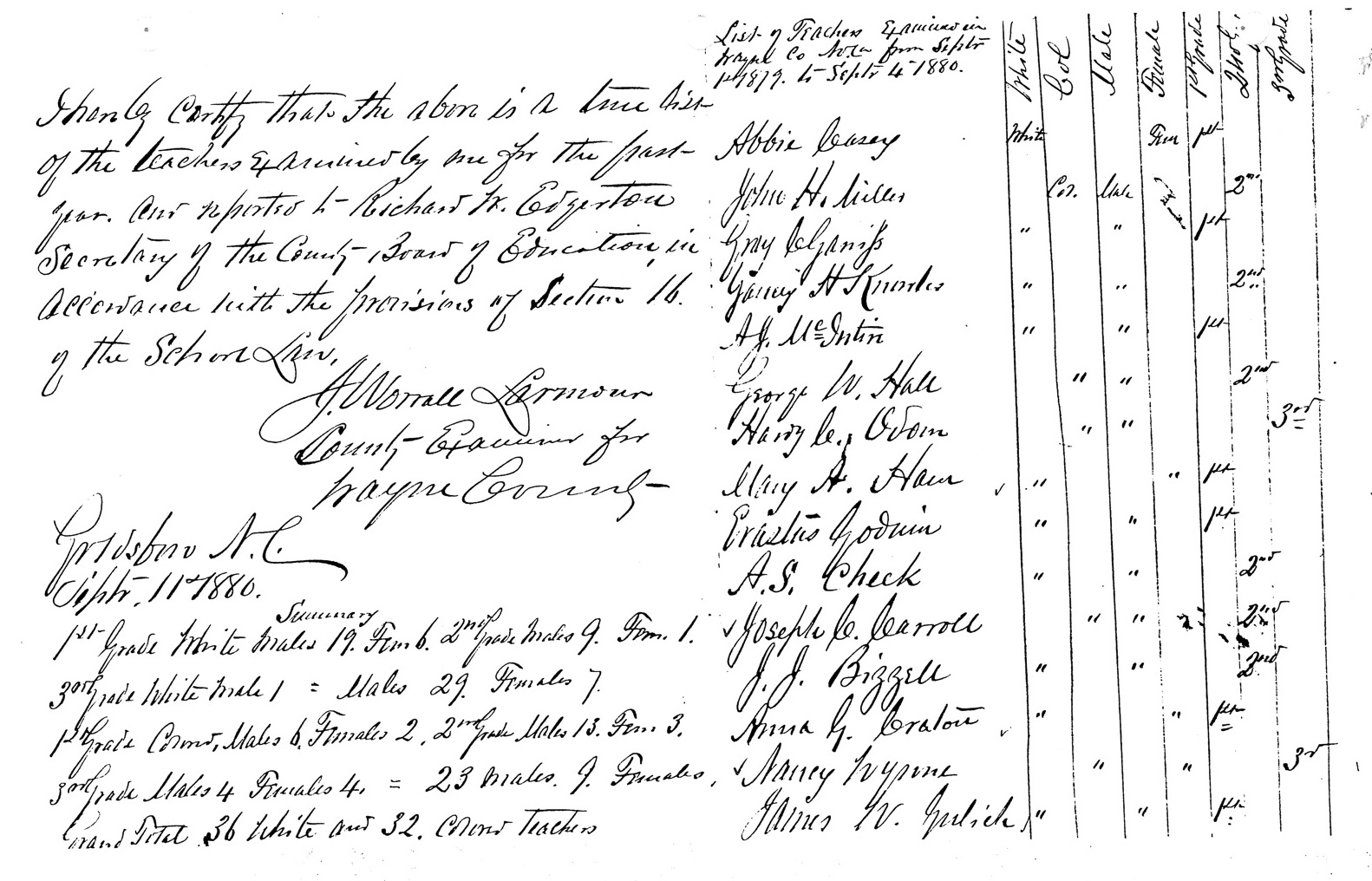
John Aldridge and his brothers George and Matthew Aldridge were hired to teach in Wayne County in the late 1870s. For reasons unknown, they were assigned to schools in the far north of the county, some 15 miles north of Dudley:


ALDRIDGE -- Aldridge_School Records

ALDRIDGE -- Aldridge_School Records 2 

From the same unsigned family history:

John Aldridge met Luvicie Artis at the school where he taught; she was one of his students. He built a 7 room house for her when they got married. John was a stout man with a reddish brown complexion and wavy black hair. He stopped teaching when he married Luvicie and started to farm and run a general store. The store was burned down in 1911. He sent his children to a private school. He died in 1910 of a congested chill. He was 58 years old when he died, and was worth about $30,000 at that time.

ALDRIDGE_--_John_Aldridge_Vicey_Artis_Marriage_License

If John was worth $30,000 when he died, it was all in realty. His personal estate was paltry:
JW Aldridge Estate Doc
Standard
Births Deaths Marriages, Free People of Color, North Carolina, Paternal Kin, Photographs

Richard Artis.

There had been a photograph of Adam Artis, cousin Daisy told me, but it was stored with other things in an old barn, and rain ruined it. She recalled an image of a tall, brown-skinned man — or the suggestion of brown skin, anyway, in the soft sepia and charcoal tones of portraits of that day — but not what he actually looked like.

If no photograph of Adam exists, however, there is one of his youngest brother. This image, in fact, is the only one known of any of Vicey Artis and Solomon Williams‘ children.

Image

Richard Artis was born in 1850 in Greene County, very near Wayne. He spent his youth out of sight of censustakers, but in 1873, he married Susanna Yelverton (also known as Susanna Hall,) the daughter of free woman of color Nicey (or Caroline) Hall and a white Yelverton. Their children included: Lucinda Artis Shearod, Emma Artis Reid, Ivory L. Artis, Loumiza Artis Grantham, Richard Artis Jr., Susan Artis Cooper, Jonah Artis, Charity Artis Coley, Frances Artis Newsome, John Henry Artis and Walter Clinton Artis.

Richard Artis farmed in northern Wayne County all his life. He died of apoplexy on 12 February 1923 in Great Swamp township and was buried the next day by his sister’s son, Adam Wilson.

——

Photo courtesy of Teresa C. Artis.

Standard
Free People of Color, North Carolina, Paternal Kin

The apprenticeship of “base-born” children.

Apprentice records show a dozen or so free colored Henderson children in Onslow County in the first quarter of the nineteenth century.  It seems likely that they were from one extended family – and my kin – but proof is thin.  There is persuasive evidence that the mother of Nancy Henderson, a free woman of color, was a white woman named Nancy Ann Henderson, but no evidence to date that this Nancy Ann had additional free colored children.  James and Bryan were Patsey Henderson’s children; Durant, Willis, Miranda, Patsey, Gatsey, Minerva, William and Betsey were Nancy’s children; and there is considerable evidence to suggest that Nancy Henderson and Patsey Henderson were sisters.  My comments and speculations are in italics.

Sucky Henderson was bound to Richard Trott in 1809. Sucky, Polly and Naomi below possibly were too close in age to Nancy and Patsey Henderson to have been their children. Sisters instead?

Polly Henderson to Isaac Barber in 1809.

Durand Henderson, son of Nancy Henderson, to Henry Hyde in 1811. Durant Henderson was also called Durant Dove. He and his brother Willis were the subject of a North Carolina Supreme Court case, about which more later. He is the progenitor of today’s Lenoir County Doves.

Sukey Henderson to Richard Trott in 1811.

Naomi Henderson to Adam Trott in 1811.

Durant Henderson and Willis Henderson to John Jones in 1818.

James Henderson and Bryan Henderson, sons of Patsey Henderson, to Jesse Gregory in 1821.

Miranda Henderson and Patsey Henderson, daughters of Nancy Henderson, to Nancy Henderson in 1821. Who was the Nancy Henderson to whom the children were bound? A child could not be bound to his or her own parent. Was she Nancy Ann Henderson, Nancy Henderson’s mother?

Patsey Henderson, age 5 or 6, to Jason Gregory in 1822. Was this Nancy’s child (as above)? Or Patsey’s?

Gatsey Henderson and William Henderson, reputed children of Simon Dove, to James Glenn Sr. at August term, 1822. Nancy Henderson and Simon Dove never married, but had several children together. In the 1850 census of Upper Richlands, Onslow County, Nancy Henderson, 55, headed a household that included Gatsey, 30, Nervy, 25, Monday, 6, Lott, 4, Jessee, 1, and Sally Ann Henderson, 6 months. 

James Henderson and Bryan Henderson to Jason Gregory in 1823.

Betsy Henderson to James Glenn Jr. in 1823.

Betsy, Nancy and Appie [no surnames] to David Mashborn in 1823.  Are these Hendersons? If so, is Appie another of Nancy Henderson’s daughters?

Miranda Henderson, James Henderson, Martha Henderson and Bryant Henderson to James Glenn in 1824. Two of Nancy’s children and two of Patsey’s, bound together.

Miranda Henderson to Elizabeth Williams in 1824.

William Henderson to Lemuel Williams in 1824.

James Henderson and Bryan Henderson, “the baseborn children of Patsey Henderson,” to James Glenn Sr. in 1824.

Betsy Henderson and Gatsey Henderson, daughters of Nancy Henderson, to Lewis Mills in 1824.

Patsy Henderson to Amos Askew in 1824.

William Henderson, son of Nancy Henderson, to Lemuel Williams in 1827.

Durant Dove and Willis Dove were bound to James Mills in 1828. These boys were otherwise known as Durant and Willis Henderson.

Durant Henderson and Willis Henderson to James Mills in 1829.

Standard
Births Deaths Marriages, Free People of Color, North Carolina, Paternal Kin

The case for Leasy Hagans’ children.

Leasy Hagans is one of my great-great-great-great-grandmothers. She was born circa 1800, perhaps in Nash County. Though Hagans might have been her married name, the involuntary apprenticeship of her children makes it more likely that she was unmarried. “Lesy Hagins” appears as a head of a household of five children in the 1820 census of Nash County. Though it is not inconceivable that all were hers, some may have been young siblings.  The only other Hagans in the county is Lukens Hagins — I cannot work out any other reasonable interpretation of the spelling of that first name — another colored female aged 14-26 with two children under 14. In the 1840 census of Davis District, Wayne County, Leecy Hagins is a 36-55 year-old colored woman living with a boy aged less than ten years and a girl aged 10-24 years.  (Note that prior to the creation of Wilson County in 1855, Nash and Wayne shared a short border.)  In the 1850 census of the North Side of the Neuse, Wayne County, Leacy Hagans, age 50, heads a household that includes ten year-old Napoleon Hagans. He is almost certainly her grandson and appears elsewhere in the same census with Aaron and Levisa Seaberry, his stepfather and mother.

There is a small web of census and apprenticeship connections among several people that suggest that they are among Leasy Hagans’ children:

William Hagans and Calvin Hagans. In 1833, William, 16, and Calvin Hagans, 10, were apprenticed to Council Bryan in Wayne County. In the 1850 census of Wayne County, Calvin appeared as a 27 year-old farmhand in the household of William Thompson. Leasy Hagans’ household was next door.

Levisa Eliza Hagans. In the 1850 census of Wayne County: Aaron Seaberry, 32, wife Levisa, 26, her son Napolian, 11, their daughter Francis, 4, and Celia Seaberry, 17, relationship unknown. As noted above, Napoleon also appears in Leasy Hagans’ household that year, and I deduce that he was her grandson.

Matilda Hagans. In the 1850 census of Wayne County: Mary Hagins, 18, Matilda Hagins, 25, Leasy Hagins, 2, and John Hagins, 1, appear in the household of John L. Fulks, a white carpenter. I believe Leasy and John were Matilda’s children. Was, then, Leasy named for her grandmother Leasy?

Mary A. Hagans. In 1839, William Thompson apprenticed Mary A. Hagans in Wayne County. As noted above, Mary, Matilda and Matilda’s presumed children live together in 1850.

The evidence, admittedly, is thin, but it is suggestive.

Standard
DNA, Free People of Color, North Carolina, Paternal Kin

DNAnigma, no. 6.

I recognized his name immediately and shot off a message to his Ancestry.com inbox. … And then another message. … And then another one. … And still, crickets. In the meantime, I had an email from his first cousin, and I shared news of the match with her. She was excited and said she’d prod him.  Apparently, he is prod-proof.

In any case, this is another match between descendants of Adam T. Artis, with an Aldridge twist. H.B.’s great-grandfather was Henry J.B. Artis, son of Adam by his fourth wife, Amanda Aldridge, who was a daughter of Robert and Eliza Balkcum Aldridge. H.B. and I are roughly 4th cousins, which Ancestry correctly predicted.

Standard
Births Deaths Marriages, Free People of Color, North Carolina, Other Documents, Paternal Kin, Rights

Her freedom has never been disputed.

State of North Carolina Onslow County

To all persons whom it may concern we the under Signed being called on to State what we Know concernning the Freedom of Nancy Dove formerly Nancy Henderson do certify that Nancy Ann Henderson the Mother of the said Nancy Dove was a Free born white Woman and that the Freedom of the said Nancy Dove never has been disputed given under our hands this 3rd March 1860  /s/ John Mills {seal} Nancy Parker {seal}

Test J.W. Thompson X

——

I believe that Nancy Henderson alias Dove and my great-great-great-great-great-grandmother Patsey Henderson were sisters. More on that later.

Standard
Births Deaths Marriages, Enslaved People, Free People of Color, North Carolina, Other Documents, Paternal Kin

Up from slavery.

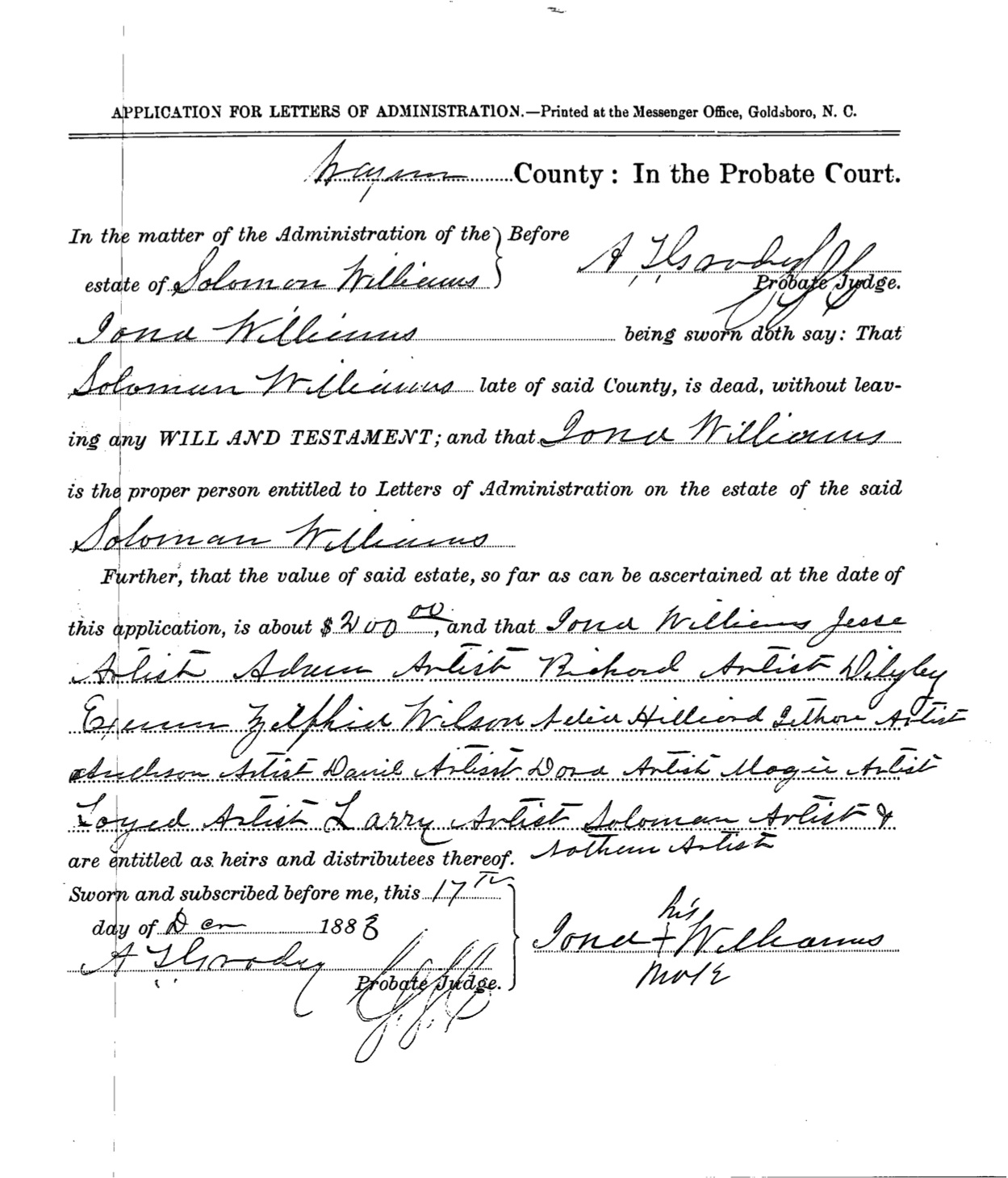
artis-solomon-williams-estate-records-dragged

Vicey Artis, a free woman of color, and Solomon Williams, a slave, had eleven children together – Zilpha Artis Wilson, Adam Toussaint Artis, Jane Artis Artis, Loumiza Artis Artis, Charity Artis, Lewis Artis, Jonah Williams, Jethro Artis, Jesse Artis, Richard Artis and Delilah Williams Exum — before they were able to marry legally.  On 31 August 1866, they registered their 35-year cohabitation in Wayne County.  Vicey died soon after, but Solomon lived until 1883.  The document above, listing his and Vicey’s six surviving children and heirs of their deceased children, is found among his estate papers.

Standard
Births Deaths Marriages, Free People of Color, North Carolina, Oral History, Other Documents, Paternal Kin

He was gon make something off the crop.

And Papa was sick, and somebody had to watch him.  He wasn’t down in the bed, but his mind was kind of off.  Now he’d listen to you, you’d talk to him, and anything he wanted, had to tell you about it.  “Naw, you can’t go there.  I got to go home.  I got to go home.”  Said he had to go home.  I said, “We are home.”  Said, “Naw, we’re not.”  That’s the way his mind worked.  Like that. 

So after Mamie got married in Greensboro, I come on back to Wilson, and then, after I come back, I hated I’d come back ‘cause I had to – Papa’s mind was bad, and I had to stay home.  To keep him.  He’d go ‘way from the house and couldn’t find his way back. And he was ruptured from the time I can remember. And so at that time Mama was working in the factory, and school wasn’t open, but when school opened, I had to stay home and look out for him.  And then, so finally, when he died.  He was supposed to have an operation.  He was ruptured, and Carrie, she claimed she didn’t know it.  And I said, now, I was the youngest child was there, and I knowed that all that stuff that was down ‘tween his legs was something wrong with him.  He went up to Mercy Hospital for something, probably his rupture – I know he had to go to the hospital for treatments or something.  Anyway, the last time, Carrie came down and she was fussing about if she’d known Papa had to have an operation, she’d have come down and he’d have had it.  Instead of waiting until it was too late.  Now the last week they wasn’t expecting him to live.  But, no bigger than I was, I knew he had it.  And she was grown, old enough for my mother, and then she talking ‘bout she didn’t know he was ruptured?  Well, all his tubes was, ah –  And he always had to wear a truss to hold hisself up.  And when he’d be down, I’d be down there sweeping at the school, and he’d be out there plowing a field he rented out there, and he’d come up, lay down on the floor and take a chair and he’d put his legs up over the chair like that, and I’d wet the cloths from the bowl where was in the hall, some of the old dust cloths, and hand them to him, and he’d put them down on his side, and you could hear it ‘bluckup’ and that thing would go back there.  But see it had got, his intestines, that tissue between there had bursted, and the doctor told him he needed an operation.  So he was gon get it, but he didn’t have money enough to get it.  Didn’t save up money enough to have the operation.  So none of the children – all of them know, as large as his – but leastways he couldn’t hide himself, ‘cause even from a little child, I could see that for years, and I wondered what it was.  ‘Cause I know everybody didn’t have it, at least didn’t have all that in their britches ….  And Carrie come down there, and she fuss Mama out about him not having the operation and this kind of stuff.  And she said, “Well, we never had the money to get the operation.”  We tried to go and get it, and we’d pay on it by time.  But, naw, he wanted, he was gon make something off the crop, and he’d pay.  Pay it and have it then.  But he never got the chance.  So when they put him in the hospital and operated on him, say when they cut him, he had over a quart of pus in him.  I think it was on a Thursday, and he lived ‘til that Tuesday.

NorthCarolinaDeathCertificates1909-1975ForJessieAdamJacobs——

Oh, this breaks my heart. (And she was absolutely right. July 6, 1926, was a Tuesday.)

Excerpts from interviews of Hattie Henderson Ricks by Lisa Y. Henderson; all rights reserved.

Standard