Land, North Carolina, Oral History, Paternal Kin, Photographs

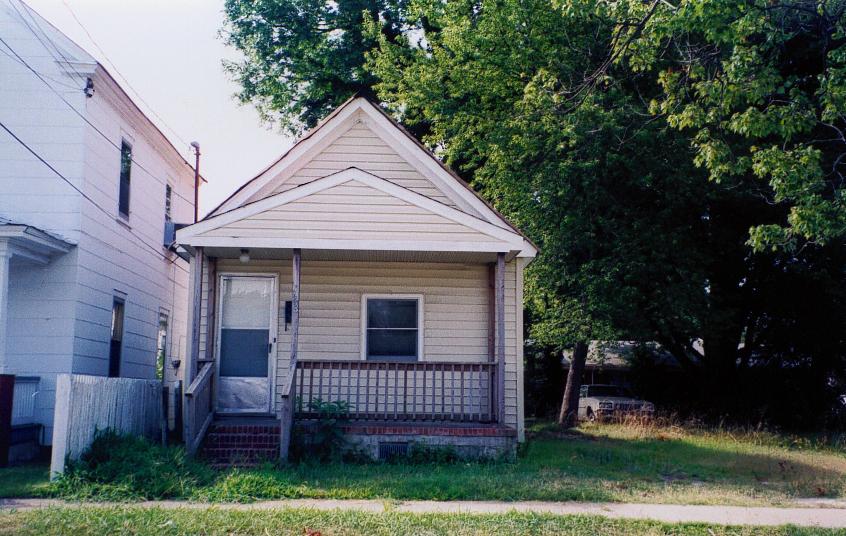
Where we lived: 303 Elba Street.

Image

The windows were broken and the front door gaped wide open, and I stood in the middle of Elba Street, uncomprehending. An aged neighbor paused on her porch, and I marched over: “Good morning. ’Scuse me. How long has next door been empty?” “Andrews & Andrews …,” she began, and – wait, she think I want to RENT? – I up my decibels, “No, how long has it been empty?” She shrugged, “A good while. They might gon demolish it.” … Demolish?

This was my grandmother’s house. Sort of. Her great-aunt and -uncle — Sarah and Jesse Jacobs — had bought it nearly new in 1908, and my grandmother arrived as an infant three years later when her mother died. She grew up on Elba Street, and her children were – literally – born there, and there they remained until 1938, when Mama Sarah died, and several truths were revealed. One, in 1923, Papa and Mama Sarah had sold the house to his children. Second, contrary to promise and belief, my grandmother never been formally adopted. Papa’s daughters ruthlessly drove this last point home by ordering her and her children out. My father was a small boy, but remembers moving – his hat blew off as he rode away in the back of a truck. Despite the eviction, my grandmother was not done with Elba. One of Papa’s sons sold her his share in exchange for a train ticket back to New York, and the sisters were forced to pay her from the house’s sale.

This place has been gone from my family for 75 years, and yet, for me, it’s Mother Dear’s house. The stories I recorded cemented its place in my imagination – the mantel clock that struck as she rallied from pneumonia, the chiggers that had to be scalded from the walls, the little stable for Papa’s horse, the hoodoo’d peach tree….

“I’ve always wanted to see inside,” I tell the neighbor. “I’m going in.” A glance up and down to check for unwanted notice, a halloo at the threshold, and I stepped through into a small center hall, which surprised me.  To either side, multi-function front rooms and, behind, a third room, a bath, and a kitchen under a shed roof, all strewn with the detritus of squatters. Of these last three rooms, only the kitchen was there in my grandmother’s day, and the only obviously original features were the mantels in the front rooms and the heart-pine floors under worn linoleum.

Soon this house will go the way of so much of abandoned east Wilson, which has never recovered from the ravages of the crack epidemic that scoured the neighborhood early and hard. There was nothing much left at 303 Elba to speak to me, but I’m glad I peeked in.  It will give shape to my listening to my grandmother’s words, and that’s a gift.

 
Standard
Land, Maternal Kin, Oral History, Photographs, Virginia

Where we lived: 748-21st Street.

My uncle: That’s where I was born and where John was born.

Me: At 748?

My uncle: That’s it.

My cousin: This crib right here?

My uncle: That’s where I was born

Me: [Laughing.] Wow.

Image

Tax records show that this tiny house — less than 800 square feet — was built around 1910. It now has two bedrooms and one bath, but the bath was undoubtedly a late addition. John C. Allen may have been the first to move a family into the dwelling; the Allens are shown there in the 1910 census of Newport News. John, who worked as a shipyard painter, reported that he owned the house subject to mortgage.

Image

By 1920, the Allens had moved just around the corner to 2107 Marshall Avenue, the house I knew in childhood as my great-aunt Julia‘s. John Allen kept 748 and rented it out until his middle son married. John C. Allen Jr. and his wife Margaret Colvert Allen lived there until their fourth child, my mother, was two weeks old.

My grandmother: I lived I don’t know how many years in Mr. Allen’s house without any electricity. And just as soon as I moved out –

Me: He had it wired?

My grandmother: He had it wired.  And one of the neighbors said she went out there in the street and laid him out.  Said, that child over there with those children, washing and ironing and working herself to death, and you wait until she leaves out of your house, your son’s house?  She said she laid him out.

——

Photograph by Lisa Y. Henderson, 2002; interviews of C. Allen and Margaret C. Allen by Lisa Y. Henderson, all rights reserved.

Standard
Births Deaths Marriages, Land, North Carolina, Paternal Kin

Coley v. Artis.

At the heart of Wayne County Superior Court proceedings stemming from the suit in J.F. Coley v. Tom Artis (1908) was a dispute over 30 acres of land. Thomas “Tom Pig” Artis began renting the property in 1881 from W.J. Exum.  In 1892, Exum’s widow Mary sold it to Napoleon “Pole” Hagans.  In 1896, after Napoleon’s death, the land passed to his sons Henry and William S. Hagans, and in 1899 Henry sold his interest to his brother.  In 1908, William S. Hagans sold the 30 acres to J.F. Coley.  Coley filed suit when Tom Artis laid claim to it, arguing that Napoleon had sold it to him.  Tom claimed that the 800 lbs. of cotton he tendered to Napoleon Hagans (and later, his son William) was interest on a mortgage, but William Hagans and other witnesses maintained that the payment was rent.

The trial transcript is replete with testimony revealing the personal relationships among witnesses. Tom Artis testified that he rented the “Adam Artis place.” William Hagans testified that his father was in feeble health in 1896 when he called him and Henry together “under the cart shelter” to tell them he would not live long and did not know to whom the land would fall.  William testified that Pole asked them to let “Pig” stay on as long as he paid rent, and they promised to do so.  Tom Franks testified that “Pole was a first-rate business man.” Jonah Williams, Adam Artis’ brother, testified that he borrowed money from Napoleon to open a brickyard in the spring of 1893 and had preached his funeral.  He also noted that “Tom married my sister [Loumiza Williams Artis, who was deceased by time of this trial].  He is not a member of my church.  I turned him out.  He is a Primitive Baptist.  I preached Napoleon Hagans’ funeral.”  Jesse Artis, another of Adam Artis’ brothers, testified that he had worked on Hagans’ property as a carpenter for 18 years and noted, “I don’t know that Tom and I are any kin, just by marriage.”   John Rountree testified that he was a tenant renting from Hagans on thirds.  Simon Exum, Delilah Artis‘ husband, testified: “I am no kin to Tom [Artis] as far as I know, except by Adam.  His first wife was my wife’s sister.”  H.S. Reid testified that he was Tom Artis’ son-in-law.

The court found for Coley and against Artis.

——

Thomas Artis was a son of a free woman of color, Celia Artis, and her enslaved husband, Simon Pig. Though, ultimately, nearly all free colored Artises are descended from a common ancestor in southside Virginia, by the late 1800s knowledge of these remote links had faded. There were dozens of Artis families in Wayne County during the antebellum period, and the relationships between them are unknown. Celia Artis was a close neighbor of Adam Artis, but the families apparently did not regards themselves as kin.  Still, they were inextricably intertwined.  The Artises, Haganses and Reids had been neighbors in the Eureka area for generations. Celia Artis and Henry S. Reid’s grandmother Rhoda Reid were the wealthiest free women of color in the county. Adam Artis married Napoleon Hagans’ half-sister Frances Seaberry. Adam’s sister Loumiza married Tom Artis, as noted above. Henry S. Reid, son of Washington and Penninah Reid, married Tom Artis’ daughter. Henry’s first cousin Henry Reid, son of John and Mozana Hall Reid, married Adam Artis’ daughter Georgianna Artis. Adam Artis’ son William Marshall Artis and grandson Leslie Artis married Tom Artis’ nieces, Etta and Minnie Diggs. And on and on.

Documents found in file of the Estate of Thomas Artis (1911), Wayne County, North Carolina Estate Files, 1663-1979, familysearch.org

Standard
Free People of Color, Land, North Carolina, Photographs

Napoleon Hagans’ house.

Image

Around the time he testified before the US Senate, Napoleon Hagans had this house built below the south bank of Aycock Swamp, near Fremont in northern Wayne County. It remains occupied and is featured in J. Daniel Pezzoni and Penne Smith’s Glimpses of Wayne County, North Carolina: An Architectural History (1998):

“The house, a single-pile center-hall-plan dwelling, has retained much of its charming original hip-roofed front porch, now supported by replacement square columns. Windows are surmounted by moulded peaked arch surrounds. … One original single-shouldered exterior end chimney was plastered; the other was replaced by a concrete-block flue. …”

A stone monument marking the graves of Napoleon and his wife Apsilla Ward Hagans stands in a cornfield about one hundred yards west of the house.

Photo by Lisa Y. Henderson, December 2010.

Standard
Agriculture, Free People of Color, Land, North Carolina, Other Documents, Paternal Kin, Politics, Rights, Vocation

I worked for it.

TESTIMONY OF NAPOLEON HIGGINS.

NAPOLEON HIGGINS, colored, sworn and examined.

By Senator VANCE:

Question. Where do you reside?  Answer. Near Goldsborough. I don’t stay in Goldsborough, but it is my county seat. I live fifteen miles from town.

Q. What is your occupation?  A. I am farming.

Q. Do you farm your own land?  A. Yes, sir.

Q. How much do you own?  A. Four hundred and eighty-five acres.

Q. How did you get it?  A. I worked for it.

Q. Were you formerly a slave?  A. No, sir; I was a free man before the war.

Q. You say you worked for it?  A. Yes, sir; I worked for it, and got it since the war.

Q. What is it worth per acre?  A. I don’t know, sir, what it is worth now. I know what I paid for it.

Q. What did you pay for it?  A. I believe I paid $5,500, and then I have got a little town lot there that I don’t count, but I think it is worth about $500.

Q. Then you have made all that since the war?  A. Yes, sir.

Q. How much cotton do you raise?  A. I don’t raise as much as I ought to. I only raised fifty-eight bales last year.

Q. What is that worth?  A. I think I got $55 a bale.

Q. How many hands do you work yourself?  A. I generally rent my land. I only worked four last year, and paid the best hand, who fed the mules and tended around the house, ten dollars; and the others I paid ten, and eight and seven.

Q. That was last year?  A. Yes, sir.

Q. What did you give them besides their pay?  A. I gave them rations; and to a man with a family I gave a garden patch and a house, and a place to raise potatoes.

Q. What about the rate of wages in your section of the country; does that represent them?  A. Yes, sir; of course a no account hand don’t get much, and a smart one gets good wages.

Q. Have you made any contracts for this year?  A. Yes, sir; but I am only hiring two hands this year.

Q. What do your tenants pay you for the use of your land?  A. Some of the tenants give me a third of the corn and a third of the cotton. Then I have got some more land that I rent out to white men, and they give me a fourth of the cotton, and another gives me a thousand pounds of lint cotton for twenty acres.

Q. Does anybody interfere with your right to vote down there?  A. No, sir.

Q. Or with any of the rights of your race?  A. No, sir; we vote freely down there. Of course, if one man can persuade you to vote with him, that is all right. But you can vote as you please.

Q. What are your politics? A. I am a republican, and that is the way my township generally votes.

Q. You say there is no interference with the rights of your race there?  A. Not that I know of.

Q. There has been something said here about the landlord and tenant act. Do you think that does anybody any harm? A. I think it is a good law.

Q. The object of it is to give you a lien on everything your tenant has until your rent is paid?  A. Yes, sir; and I think I am entitled to that.

Q. These white tenants can’t run off any of your cotton until you are paid?  A. No, sir; I am five or six miles from them, and they can’t run it off. They might do it and I not see them if I did not have the law to back me; and they are just as apt to run it off as not when they start.

Q. Then you think it is a good protection to you in your rights?  A. Yes, sir; I do.

Q. Do you have any schools down there?  A. Yes, sir.

Q. How is the money raised for them? Most of it is by a property tax, is it not?  A. Yes, sir.

Q. And the poll tax all goes to education except twenty-five cents on the dollar?  A. Yes, sir.

Q. Do you know how much land your race has acquired in that county?  A. I reckon they have got fifteen hundred acres in our township; but I could not tell how much in the county.

Q. Is there any distinction made between the whites and the blacks down there in the renting of lands?  A. None that I know of.

Q. Both are paid the same wages?  A. Yes, sir; unless a man wants to hire some man to lock his doors and look after and keep his keys; then they pay him more. And if it is a colored man that he has confidence in, they pay him the same.

Q. Is there any distinction there to take all white men as tenants?  A. No, sir; in our township they take them without regard to color. If a man is a smart man, he gets in just the same as a white man. Colored men rent from white men, and white men from colored men.

Q. Did you ever have any talk with any of those people who went to Indiana?  A. No, sir; I never saw one who went.

Q. Did you ever hear any of the speeches of any of these men who were stirring up these men?  A. No, sir.

Q. Did you see any of their circulars?  A. No, sir.

Q. Nor hear of any inducements offered to them? A. No, sir.

Q. Did you get any letters from any of them who went out there?  A. No, sir; I wasn’t acquainted with any who went. I learned more of it at Goldsborough last Monday night, when I was coming on here, than I ever knew before.

Q. Are there any complaints among your people to discriminations in the courts, between the whites and blacks?  A. Yes, sir; I have heard them say that the same evidence that will convict a colored man for stealing won’t convict a white man.

Q. When they are convicted, are they punished alike? Yes, sir; in the same cases. I have spoke to them and told them, lots of times, that of course they would be convicted many times where a white man would get out, and the only way to avoid that was to quit stealing. I told them, a white man has got more sense and more money to pay lawyers and knows better how to hid his rascality, and the best way for the colored man to keep out of the penitentiary was to quit stealing.

By Senator WINDOM:

Q. Is it the general impression among colored people down there that they don’t get justice?  A. Yes, sir; when two or three colored men get convicted they think so. But there are more black men convicted because there are more of them tried.

Q. You say they have not got sense enough to get out of it when they get in; they have attorneys, do they not? A. Yes, sir; but very often they have not got the money to feed up an attorney; and, you know, they more you pay a lawyer the more he sticks with you.

Q. Is there not discrimination there in the employment of mechanics? A. No, sir; I never heard of it.

By Senator VOORHEES:

Q. Do you know of any of these people, white and black, who have been convicted that you thought were convicted wrongfully?  A. No, sir.

Q. You thought they were rightfully convicted?  A. Yes, sir.

Q. You have been on juries yourself; did you ever make any difference between them?  A. No, sir; I have sat on juries there many times, and sat on a case of a white man who was tried for his life.

Q. Was there any other colored man on that jury? A. No, sir; I was the only one on that one; but I have been on others.

Q. You have sat on juries when white men’s cases were being tried, both on the criminal and on the civil sides of the court?  A. Yes, sir.

Q. Did any white man object to you sitting on them?  A. No, sir.

Q.Then most of this talk about discrimination and injustice is by men who have been disappointed in the results of their suits?  A. Yes, sir.

Q. You see no cause for it yourself?  A. No, sir.

Q. You have heard white men complain just as bitterly?  A. Yes, sir; of course. I suppose they are like I am.  I always try to beat the case.

By Senator WINDOM:

Q. You say you think this land and tenant act a good thing; do you think the renter is in favor of it?  A. I don’t know; they never say anything to me about it. I am on the other side of that question.

Q. Does not the fact that you own 285 [sic] acres of land give you a little better standing in the community than most of your colored friends?  A. Of course; I suppose it does.

Q. How did you start it?  A. I rented a farm and started on two government horses. I went to the tightest man I know and got him to help me. I rented from Mr. Exum out there.

Q. Are there others who have succeeded as well as you?  A. Yes, sir; there are. One or two men who have succeeded better than me. There are several of them in good circumstances there in our township. I think, altogether, they own 1,500 acres there.

Q. How many colored people own this?  A. I reckon 150.

Q. The 1,500 acres is divided up among 150 people?  A. No, sir; a good many of them have got none.

Q. This is what I asked you: How many own this 1,500 acres, all put together?  A. I reckon a dozen. It might not be more than eight. It is from eight to a dozen, anyhow. But there are a number who own some little lots of land of four or five acres that I have not mentioned.

This, of course, was Napoleon Hagans (not Higgins)’ testimony before a Senate Select Committee investigating the migration of hundreds of African-Americans from the South to Kansas Indiana in the late 1870s, allegedly because of “denial or abridgment of their personal and political rights and privileges.”  Hagans’ testimony about the source of his relative wealth, as well his opinions about the political and judicial climate for colored men in his part of North Carolina, were well-received by the committee, which concluded that all was well in Dixie. Nonetheless, it is perhaps possible — if one suppresses natural feeling and attempts to stand in Napoleon’s shoes — to detect a very subtle undercurrent of resistance here and there in the essential conservatism of his words.

Transcript in Senate Report 693, 2nd Session, 46th Congress: Proceedings of the Select Committee of the United States Senate to Investigate the Causes of the Removal of the Negroes from the Southern States to the Northern States, Washington DC, beginning Tuesday, 9 March 1880.

Standard
Land, Maternal Kin, North Carolina, Oral History

Land along the railroad.

Me: What did, why did Grandpa Henry come to Statesville? Was he a farmer? What did he do?

My grandmother: I don’t know. I really don’t know.

Me: He was from Rowan County.

My grandmother: He certainly didn’t have no farm in Statesville. It seems to me he had a big, big lot  of land where they had this house. Where they built this house. But it was near a railroad, and trains — cinders from the trains fell on the house and burnt it.

——

On 21 Dec 1903, G.M. Austin and wife J.A. Austin sold H.W. McNeely of Iredell County a parcel bounded as follows: “Beginning at a stake 300 feet from Bettie Van Pelts S.E. corner and 50 feet from the center of Rail Road, and running N. 10 degrees E. 200 feet to a stake then S. 11 W. 200 feet to a stake 50 feet N of the center of the Rail Road, then N 79 degrees W. 100 feet to the beginning also 1/2 acres adjoining the above lot, and known as the J.V. Houston land it being same land sold for taxes by M.A. White by deed from T.Y. Cowper.” McNeely paid $164.

Extract from interview of Margaret C. Allen by Lisa Y. Henderson; all rights reserved.

Standard
Births Deaths Marriages, Land, Maternal Kin, North Carolina, Other Documents

Jule McNeely leaves a toehold.

I did not doubt that Henry and Julius McNeely were brothers, but here is proof-positive: Julius died widowed, childless and intestate, and his sole heirs were Henry’s children.Image“Jule” McNeely’s thin estate file, opened in 1913 in Rowan County Superior Court, is devoted to the distribution of his tiny plot of farmland to John, Luther, Emma, Addie, Carrie, Ed, Litha, Janie, Lizzie and Minnie McNeely as tenants in common. When Addie died in the middle of matters, a guardian was appointed for her children, “Ardenia” [actually, Ardeanur], 14, and James Smith, 9. At issue: “Beginning at a stone on D.S. Cowan’s line, and runs S. two degrees W 7.10 chains to a stone thence; N. 85 degrees W. 3.50 chains to a stone, thence; N. 2 degrees E. 6.50 chains to a stone on Cowan’s line, thence; E. to the beginning, containing two and a half acres more or less.” “The above land is the old Jule McNeely place, lying just east of Mount Ulla in Rowan County, and” — despite its tininess — “is a very desirable lot.” The heirs’ attorney petitioned for the sale of the lot, noting that it was too small to be advantageously divided or to justify continued possession by so many heirs, all of whom lived in Iredell County except Emma and her husband Ervin Houser of Bayonne, New Jersey. The petition was granted, and at auction on April 21, 1917, Carrie’s husband Lon W. Colvert placed the highest bid at $80.

[Sidenote: Before I found this file, I did not know that (1) Lizzie McNeely was first married to Watt Kilpatrick; (2) when Addie McNeely Smith died; or (3) Lon Colvert owned property in Rowan County, much less property that had belonged to his wife’s late uncle.]

Standard
Agriculture, Enslaved People, Land

Visceral touches.

Although the Smithsonian’s National Museum of African American History and Culture, under construction in Washington, will exhibit slave quarters recovered from South Carolina, they will lack visceral touches like the Whitney Plantation’s relentless humid heat and distant trains.  — Eve M. Kahn, “A Restored Louisiana Plantation and Its Lifeblood,”  New York Times, July 26, 2013.

This is cute writing, but it is also truth. I stood shakily at the edge of a North Carolina tobacco field one July, the sun like a ball-peen hammer on the crown of my head, and wept when a horsefly ripped a divot from my forearm. It is humbling, and terrifying, to consider the everyday of the lives of my ancestors, and nothing quite drives the imagination like one’s own acute physical discomfort.

Standard
Enslaved People, Land, North Carolina, Paternal Kin, Photographs

A thousand acres between creek and swamp.

Kinchen Taylor’s estate papers include two plats. One laid off his widow Mary Blount Taylor’s dower. The second divided his remaining land into two large parcels:

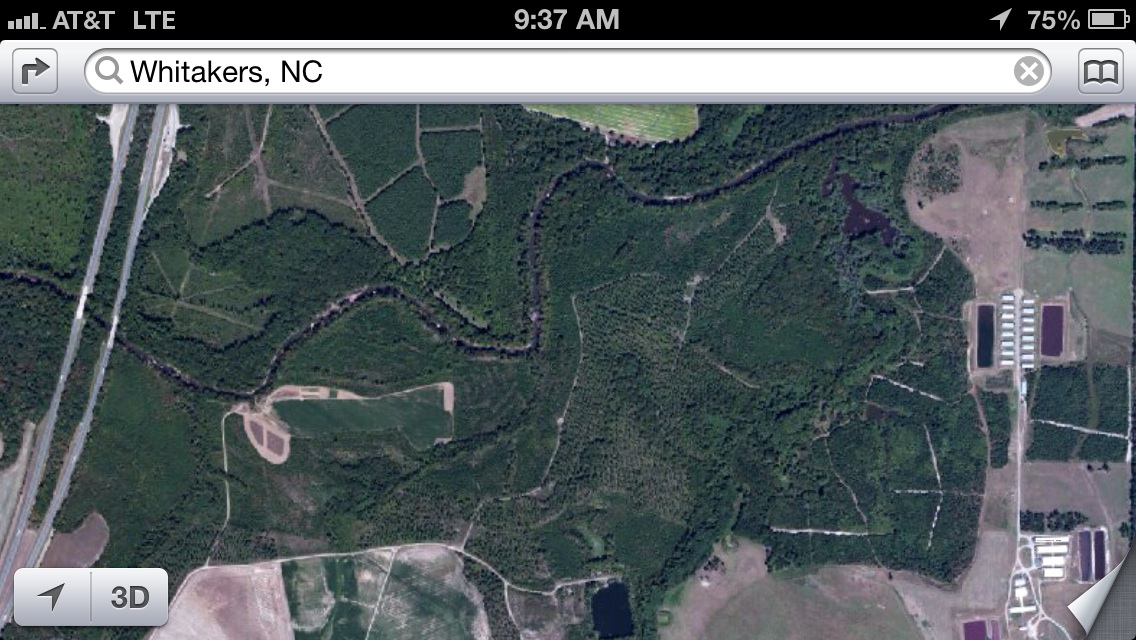
ImageIn some ways, Taylor’s old lands have not changed dramatically. Pine forest and tilled fields still predominate the landscape; far northern Nash County remains rural. Nonetheless, Taylor and enslaved workers like Green and Fereby, who walked and worked it intimately, might be pressed to recognize his property.

Image

I-95 — a far cry from the path shown in the plat — roars with traffic just west of Taylor’s acreage, hauling truckers and tourists from Maine to Florida. If you tilt your head sharply to the right, you’ll see that Fishing Creek, crawling across the top of the screen, still follows the same general course. Beaver Dam Swamp, however, has been dammed just below its confluence with the creek, forming a small body called Gum Lake. The watercourse of the swamp, probably largely drained, is barely detectable as an undulating line of taller vegetation angling southwest from the pond. Lost somewhere in its tangle of canes and catbrier is the Old Mill shown on the plat.

On the other side of Beaver Dam swamp, to the far right of the Google Map view, is an industrial hog farm, identifiable by the white structures with adjacent dark lozenges — barns holding up to 2500 hogs a piece and the lagoons that capture the stupendous quantities of waste they produce. This perhaps would have startled Kinchen Taylor most, as his hogs would have been free-range until time for fattening. (And it should startle you, too, as this is huge, nasty business.)

The file of Kinchen Taylor (1853), Nash County, North Carolina Estate Files 1663-1979, https://familysearch.org, original, North Carolina State Archives;

Standard