Maternal Kin, North Carolina, Other Documents, Religion

Roadtrip chronicles, no. 7: Iredell County Public Library.

Iredell County Public Library has a nice local history and genealogy room, and during my sojourn I spent a nice hour or two there, disturbed only by the raucous banter of three students prepping for a nursing assistant exam. Anyway.

A back wall of cabinets contains files from the Homer Keever collection, and I found several of interest. Under “Black Churches,” I found a four-page handwritten document, apparently compiled by Alice Murphy Ramseur in 1973, entitled “Historial [sic] Data of Holy Cross Episcopal Church.” Holy Cross, of course, was the church my grandmother grew up in in Statesville. Its earliest services were held in 1887 in “the old brick storehouse on depot hill” and with success moved to the Good Samaritan Hall at 118 Garfield Street. This was all very interesting, and then: “May 24, 1899 the Bishop conmfirmed twelve Members they was William Pearson, Mrs Laura S. Pearson, Mrs. Lucy Chambers, Henry McKneely, Mrs Marther McKneely, Mr John Reeves, Mr. Will McCulland, Mrs Rebecca S. Allison, Mrs Clara S. Seaborn, Miss Carrie Bidding, Mr Mik Stevenson.”

Henry McNeely? What was this Presbyterian doing joining an Episcopal Church? Had Martha been an Episcopalian all along?

Here’s the entire piece, with thanks and acknowledgement to the library:

IMG_6072

IMG_6073

IMG_6074

IMG_6075

Standard
Maternal Kin, North Carolina, Other Documents, Politics, Rights

So that we may know their strength.

In 1868, Francis E. Shober was elected as a Democrat to the Forty-first United States Congress from North Carolina’s Sixth Congressional District. However, the election was contested by his Republican opponent, Nathaniel Boyden, who accused Democrats of placing ballot boxes at the polls that were not clearly marked; of intimidating and threatening Republican voters; and circulating a race-baiting forged document –  purporting to come from the chairman of the National Republican Executive Committee – designed to discourage freedmen from voting for Boyden: If we can elect Grant we will not need the negro vote again, and we can assure you our next Congress will inaugurate a system of colonization that will remove the negro from your midst. … By all means, get the negroes to register and enroll, so that we may know their strength.

House and Senate reports are the designated class of publications by which congressional committees formally report and make recommendations to the Senate or House concerning, among other things, their investigative or oversight activities.  These reports are publicly distributed as part of the official U.S. Serial Set record of each Congress. Documents related to Boyden v. Shober appear in the 41st Congressional Serial Set. Among several others, Ransom Miller gave testimony in the matter in Salisbury, North Carolina:

Ransom Miller testimony

In April 1870, the House of Representatives committee investigating the matter reported that although there was probably some minor intimidation and fraud, there was not enough to change the results of the election. Shober was seated and re-elected in 1870.

Adapted in part from http://ncpedia.org/biography/shober-francis-edwin

Standard
Maternal Kin, Newspaper Articles, North Carolina, Photographs

A terrible thought ….

I ran across this article in the 19 May 1933 edition of the Statesville Landmark detailing the tragic death of a boy playing in the Green Street (then Union Grove) cemetery.

Stville_Rec__amp__Landmark_5_19_1933_graveyard_death

“… Five pieces of marble — two in the base, two parallel upright pieces, seven inches apart, and a horizontal top piece.”

IMG_4585

I been all through this cemetery. There are relatively few markers there. This, however, still stands. It is the double headstone of my great-great-grandfather John W. Colvert and his wife Adeline Hampton Colvert. Though it is possible that there once were others, it is now the only one of its kind in Green Street. Was this the monument that killed Noisey Stevenson?

Standard
Enslaved People, Maternal Kin, North Carolina, Photographs, Religion

Roadtrip chronicles, no. 6: Western Rowan County churches.

In Church Home, no. 9, I wrote about Back Creek Presbyterian, the church that my great-great-great-great-grandfather Samuel McNeely helped found and lead. I wanted to see this lovely edifice, erected in 1857, for myself:

IMG_6157

And I wanted to walk its cemetery. I didn’t expect to see the graves of any of its many enslaved church members there, but thought I might find Samuel McNeely or his son John W. Dozens of McNeelys lie here, many John’s close kin and contemporaries, but I did not find markers for him or his father. (I later checked a Back Creek cemetery census at the Iredell County library. They are not listed.)

IMG_6163

Within a few miles of Back Creek stands its mother church, Thyatira Presbyterian. This lovely building was built 1858-1860, but the church dates to as early as 1747. There are McNeelys in Thyatira’s cemetery, too, and this is the church Samuel originally attended.

IMG_6155

Just up White Road from Thyatira is Mount Zion Missionary Baptist Church. I visited its cemetery in December 2013 and took photos of the the graves of descendants of Joseph Archy McNeely (my great-great-grandfather Henry McNeely‘s nephew), Mary Caroline McConnaughey Miller and John B. McConnaughey (siblings of Henry’s wife, my great-great-grandmother Martha Miller McNeely.) Green Miller and Ransom Miller’s lands were in the vicinity of this church.

IMG_6145

Photos taken by Lisa Y. Henderson, February 2015.

Standard
Enslaved People, Maternal Kin, North Carolina, Oral History, Photographs

Roadtrip chronicles, no. 5: Daltonia.

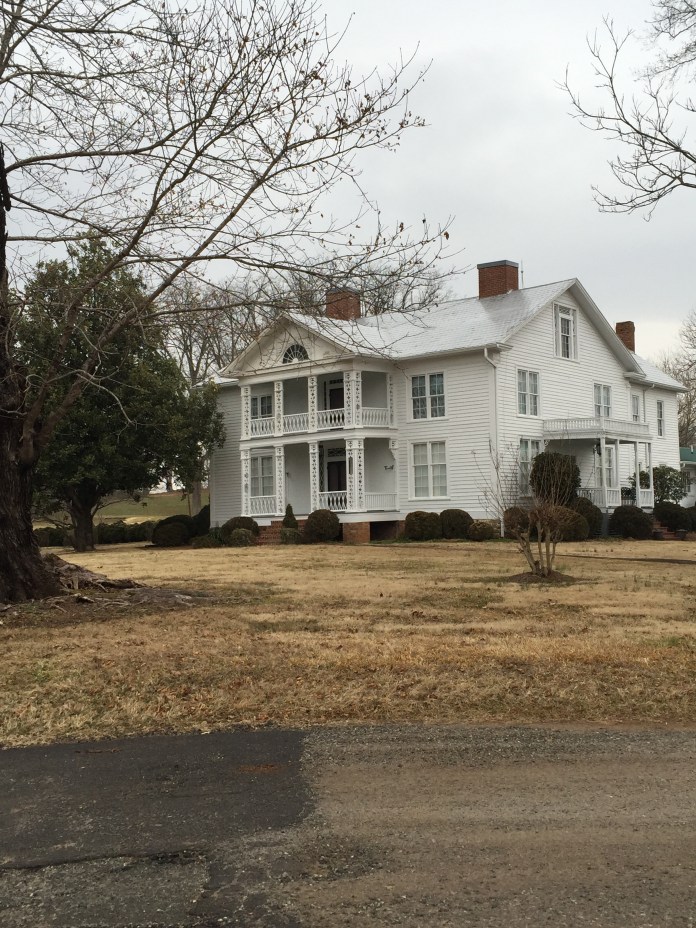
I saw that big, block of a white house, but I didn’t know what I was looking at. And, really, I wasn’t even much looking at it, because my whole attention was zeroed on a small building a couple hundred feet beside and behind it. A one and-a-half story log cabin sitting on fieldstone piers, mud-chinked, with small windows in the gable ends and central front door. In pristine condition. What was this?

IMG_6022

I turned to P.P., who shifted uncomfortably in her seat. “I don’t even want to say this,” she started, “but it’s true. It’s just so ugly.”

“Please do. Please do,” I urged.

“Well, the official story is that’s where the Daltons lived while they were building the house.”

The house — oh. This was Daltonia.
IMG_6027

“But that log cabin was Anse Dalton’s house.”

Wait. “Anse Dalton!? Anderson Dalton? That was — he was the father of my great-grandfather Lon W. Colvert‘s first wife, Josephine.”

“Yes, well, after the War, he was a driver for the Daltons. But in slavery …”

Yes? “In slavery, he was a — I hate to say it — he was used to breed slaves. That’s what they called this — ‘the slave farm.'”

I sat with that for a minute.

“It’s terrible,” she continued. “They thought, just like you can disposition an animal, you could breed people with certain traits. He had I-don’t-know-how-many children.”

I knew about slave breeding, of course. About the sexual coercion of both enslaved men and women, particularly in the Upper South. I’ve read slave narratives that speak of “stockmen,” but never expected to encounter one in my research. I thanked P.P. for her openness, for her willingness to share the stories that so often remain locked away from African-American descendants of enslaved people. Not long ago, I started working on a “collateral kin” post about the Daltons. I knew Josephine Dalton was born about 1878 to Anderson and Viney (or Vincey) Dalton; that her siblings included Andrew (1863), Mary Bell (1876), Millard (1880), Lizzie (1885) and Emma (1890); and that she was from the Harmony/Houstonville area. I’d stumbled upon articles about Daltonia and had conjectured that her parents had belonged to wealthy farmer John Hunter Dalton. I’d set the piece aside for a while though, because I had no specific evidence of the link beyond a shared surname. However, here was an oral history that not only placed Josephine’s father among Dalton’s slaves, but detailed the specific role he was forced to play in Daltonia’s economic and social structure.

P.P. did not know Anse Dalton, but Anse’s son Millard and her grandfather had grown up together. P.P. was reared in her grandfather’s household and vividly recalled Millard Dalton riding up to visit on his old white horse. “You can have her till I go home,” he’d tell her as he handed off the reins.

I can finish my Dalton piece now. Though I will never know the names of the children that Anderson fathered as a “stockman,” genealogical DNA testing may yet tell the tale, and I have a clearer picture of Josephine Dalton Colvert’s family and early life.

Photographs taken by Lisa Y. Henderson, February 2015.

Standard
Enslaved People, Land, Maternal Kin, North Carolina, Other Documents

Roadtrip chronicles, no. 4: Rowan County deeds.

My notes from an hour or so spent poking around the Rowan County Register of Deeds’ office:

  • No deeds filed by my Henry W. McNeely.
  • Julius McNeely bought his one and only parcel of land — the one his half-brother Henry’s children inherited — for $20 on 5 January 1876 from J.M. and H.E. Goodman.
  • In 1869, John W. McNeely applied for a homestead exemption. The application, filed at Deed Book 44, page 247, attached descriptions of his real and personal property. His real property consisted one tract of land bordered by Joshua Miller on the north, Frederick Menius on the east, “Dr. Luckey” and Ephraim Overcash on the south, and Jacob Shuliberinger and Mrs. Malissa Pool on the west, containing 235 acres and valued at $940.
  • On 7 January 1880, Ransom Miller, husband of Mary Ann McConnaughey, paid $900 to John S. Henderson, trustee for the estate of Archibald Henderson and Jane C. Boyden, for 135 acres. The land’s bounds lay on the north side of Sills Creek and touched on the Buffalo Big Road, crossed Second Creek and followed its meander to the intersection of Back Creek. On 1 December 1883, Ransom paid G.W. and C.C. Corriher $600 for 40 1/2 acres west of Neely’s Mill Road.
  • On 18 September 1889, Green E. Miller, husband of Grace Adeline Miller, paid $220 to John S. Henderson, trustee for the estate of Archibald Henderson and Jane C. Boyden, for about 22 acres. [Archibald Henderson Jr. and Jane C. Henderson Boyden were children of Salisbury lawyer Archibald Henderson. John Steele Henderson was Archibald Jr.’s son.] The plot description: “beginning at a stone in a field, South of where the said Green Miller now lives” running at one corner to a stake or stone in Ransom Miller’s line. The land was part of the Foster tract on the east side of Sill’s Creek and the west side of the Neely’s Mill Road, but not immediately adjoining either. Green had contracted to buy the property on 30 November 1886.
  • Oddly, on 28 May 1897, Green Miller and John Henderson sold 10 acres of the above tract to “Grace Adeline Miller, wife of Green Miller” for $100. [What was this about? Records seem to indicate that Adeline and Green remained married until her death in 1918. Why did he partition the land? And, why, if Green had purchased the full tract in 1889, was John Henderson listed as a grantor?]

Screen Shot 2015-02-15 at 3.06.40 PM

This section of the Cleveland, North Carolina, USGS quadrangle topographical map helps narrow the location of Ransom, Green and Adeline Miller’s properties in Steele township, Rowan County. (1) is the point at which (2) Second Creek branches into Back Creek and Sills Creek. That Ransom and Green’s lands adjoined supports a conclusion that Ransom was, in fact, the man referred to in the letter published in local newspapers about a damaging hailstorm in the area. The road running north-south is today called White Road. (3) marks the location of Mount Zion Missionary Baptist Church, attended to this day by descendants of Adeline’s daughter Mary Caroline Miller Brown, her brother John B. McConnaughey and cousins of Martha Miller McNeely‘s husband Henry W. McNeely.

Standard
Land, Maternal Kin, North Carolina

Roadtrip chronicles, no. 3: Eagle Mills ramble.

Monday afternoon came the highlight of the whole little road trip. I’d arranged to meet P.P. at a little cafeteria at the crossroads that is Harmony, North Carolina. I first spoke with her a little over a month ago, when she responded to my blog post about Walker Colvert’s will. P. is a distant cousin, another descendant of Thomas and Rebecca Nicholson Nicholson, and I was giddy with anticipation.

After lunch, at her direction, I headed north on Highway 21 toward Houstonsville. The sky was overcast, and a little drizzle had begun that would deepen into steady rain before long. I was undeterred. Over the next few hours, we traced the back roads of Eagle Mills and Union Grove townships, rolling through fallow fields, pastures, and woodlands, crossing and recrossing Hunting Creek and its tributaries. This was Colvert and Nicholson ground zero, and the highlights of our ramble warrant their own blogposts, soon to come.

My everlasting gratitude goes to Cousin P.P. for her generosity of time and knowledge.

Standard
Land, Maternal Kin, North Carolina, Other Documents

Roadtrip chronicles, no. 2: Iredell County records.

I was killing time in a way, but I wanted to do so usefully, so I arrived at the Register of Deeds office shortly after it opened at 8 A.M. I side-eyed this —

IMG_5993

— and headed into the search room. I had a few loose questions: did Walker Colvert in fact never file a deed for his acres in Union Grove? Did John W. Colvert file any deeds? Where did Abner and Harriet Nicholson Tomlin live?

I took these notes:

  • Who were the William and Lucy A. Dalton from whom Lon W. Colvert purchased his first property in 1906? What was their relationship, if any, with his first wife Josephine Dalton?
  • No recorded deeds for Walker Colvert.
  • No recorded deeds for John W. Colvert.
  • However, John’s wife Adeline Colvert bought two lots on Harrison Street in Statesville in 1912 for $472. Huh? John and Adeline married in 1905. As far as I know, they remained married until his death in 1921. So why was she purchasing property in her own right in 1912? The house built on the property sheltered John and Addie’s descendants as late as 1959, and probably later. There’s a plat filed at Book 33, page 398, for the section of Statesville in which the lots lay. I forgot to get a copy.
  • Abb Tomlin had one recorded deed — for the $40 purchase of an acre of land from William and Laura Pearson on 19 June 1891. The tract adjoined the AT&O Railroad and is probably the same one that Abb and Harriet Nicholson Tomlin‘s son and heir Harvey Golar Tomlin sold to Lon W. Colvert in 1906.
  • My grandmother believed T. Alonzo “T.L.” Hart to be a real estate lawyer. I haven’t found any evidence that he attended law school or practiced law, but there is no question that he knew his way around a land acquisition. Between 1887 and 1922, he recorded 14 deeds for purchases in or near Statesville totaling well over 200 acres. Three small purchases in 1911 and 1920 were from Andy King (1839-1919) and his heirs. King was a farmer and rock quarry laborer whose near neighbors were Logan and Laura Sherrill.
Standard
Births Deaths Marriages, Maternal Kin, Newspaper Articles, North Carolina, Photographs

Roadtrip Chronicles, no. 1: Statesville cemeteries.

I made it to Statesville in good time Sunday and drove straight to the only place I really know there — South Green Street. My great-aunt, Louise Colvert Renwick, had lived there for decades, across from the street from the Green Street cemetery. As I approached her house, my eye caught a small memorial just off the curb.

IMG_5958

Funny what you see when you’re looking. (And look closely at the plaque. Committee member Natalie Renwick is my first cousin, once removed.)

It seems odd to me that, when we were all gathered at Aunt Louise’s for the first Colvert-McNeely reunion, no one mentioned that Colverts and McNeelys were buried across the street. (Or maybe my 14 year-old self just paid no attention?) I’ve only found three graves — those of John Colvert, his wife Addie Hampton Colvert, and their daughter Selma — but there are certainly many more. Lon W. Colvert, for one. (Or was it? His death certificate indicates “Union Grove,” but why would he have been buried up there?*) And his son John W. Colvert II. And Addie McNeely Smith and Elethea McNeely Weaver and Irving McNeely Weaver, who was brought home from New Jersey for burial.

The cemetery looks like this though:

IMG_5971

And not because it’s empty. Though closed to burials for 50 or more years, it is probably nearly full of graves either unmarked or with lost or destroyed markers. Here’s one that’s nicely marked, however, and that would I recall before 24 hours had passed:

IMG_5972

From Green Street, I headed across town to Belmont, Statesville’s newer black cemetery. I knew Aunt Louise, her husband and son Lewis C. Renwick Sr. and Jr. were buried in Belmont, and I was looking for several McNeelys whose death certificates noted their burials here. I found Ida Mae Colvert Stockton‘s daughter Lillie Stockton Ramseur (1911-1980) and her husband Samuel S. Ramseur (1912-1989). Then Golar Colvert Bradshaw‘s husband William Bradshaw (1894-1955) and son William Colvert Bradshaw (1921-1988). (William was buried with his second wife. Golar, who died in 1937, presumably was interred at Green Street.) No McNeelys though. I expected to find both Lizzie McNeely Long and Edward McNeely, who had a double funeral in 1950, but their graves seem to be unmarked.

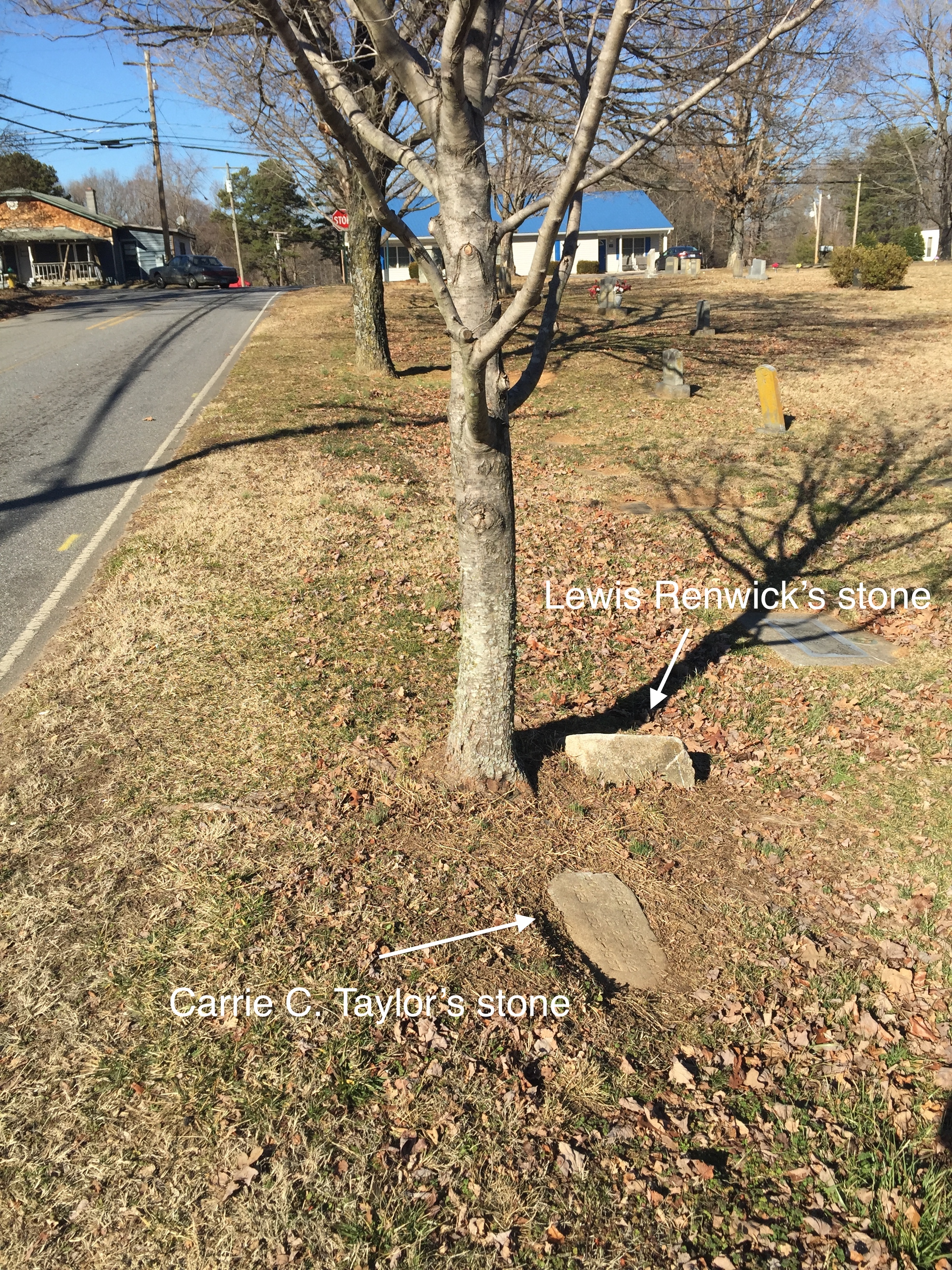
I was also looking for my great-grandmother, Carrie McNeely Colvert Taylor. The whole business was turning into a big disappointment. At street’s edge, I turned to head back to my car. And gasped. There, at my feet, wedged at the base of a tree:

IMG_5988

What in the world? This is clearly not a gravesite. And, on the other side of the tree, there’s an identical stamped concrete marker for Lewis C. Renwick Sr., who died almost exactly a year after Carrie. What’s odd, though, is that he has a granite marker a couple hundred feet away in another section of the cemetery with his wife (Carrie’s daughter Louise) and oldest son. Is Grandma Carrie actually buried in the Renwicks’ family plot? Were her and Lewis Renwick’s makeshift stones pulled up to be replaced by better markers? If so, where is Grandma Carrie’s? And why were both dumped at the edge of the cemetery?

IMG_5992

Here’s an overview of Belmont cemetery. (1) is the approximate location of Carrie M.C. Taylor’s broken marker. (2) is the approximate location of the Renwick plot.

IMG_6168

I’ll pose those questions to Statesville’s cemetery department. If Grandma Carrie has no permanent stone, she’ll get one.

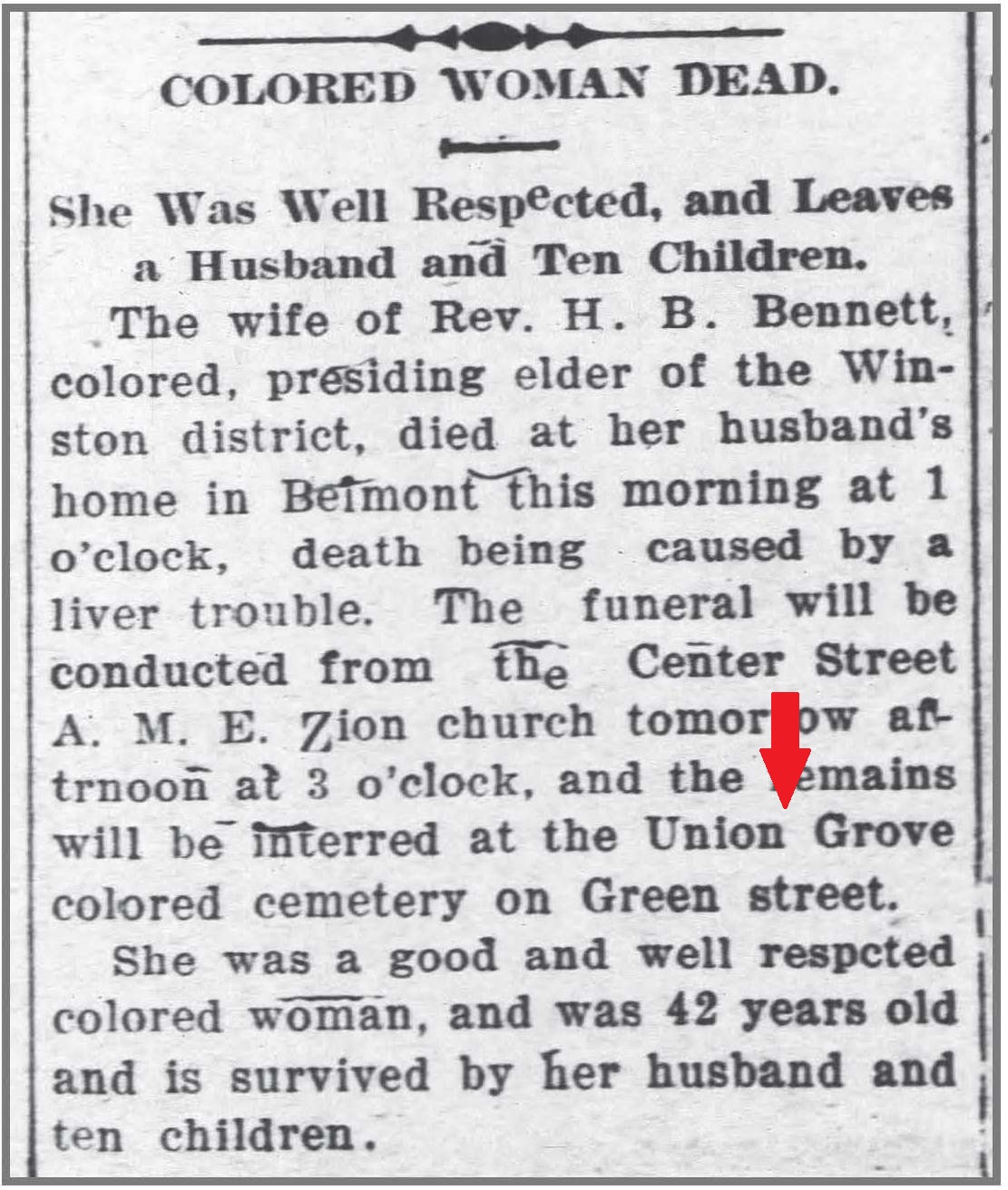
* After noticing that Irving Weaver’s obit also mentioned Union Grove cemetery, though the McNeelys had no ties to that township in northern Iredell County, I searched for clues in contemporary newspapers. Mystery cleared. Green Street cemetery is Union Grove cemetery:

Stville_Evening_Mascot_4_3_1909

The Evening Mascot (Statesville), 3 April 1909.

Standard
Maternal Kin, Photographs, Religion

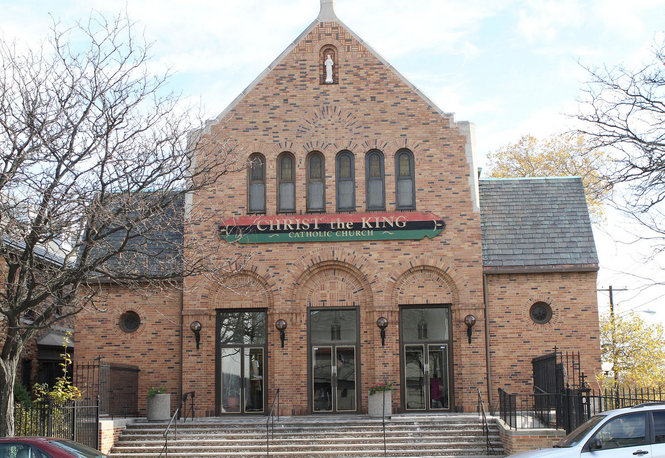
Church home, no. 9: Christ the King Catholic Church, Jersey City, New Jersey.

After my recent 52 Challenges post, I started wondering about the church my great-grandmother and cousins are standing in front of. My grandmother and her sisters were reared Episcopalian (and AME Zion), so I assumed that it was an Episcopal church. To my surprise, my cousin G.W., son of the oldest daughter of my great-aunt Launie Mae Jones Colvert, identified it as Christ the King Catholic Church.

Catholic??? Aunt Launie Mae was Catholic?

Another cousin, K.J., chimed in. She’d talked to her mother, who said that in Aunt Launie Mae “had told her she converted to Catholicism after my grandfather was sick (with TB), and the Catholic church was there for her.” (Aunt Launie Mae’s husband was Isaiah James Jones (1912-1984), a native of Georgia.) This would have been in the early 1940s. The things you learn when you least expect.

11898265-standard

(I wonder what happened to those beautiful wooden doors?)

Standard