Births Deaths Marriages, Maternal Kin, Newspaper Articles, North Carolina, Photographs

Death of a colored man.

“Death of Colored Man.”

John Colvert, aged 70 years, a respected colored man, died Thursday night at his home on Green Street.  Funeral arrangements have not been made as he has relatives in the west who will attend.

Statesville Landmark, 10 Oct 1921.

This, of course, is John Walker Colvert, son of Walker Colvert. But who in the world were the “relatives in the west”???  His mysterious sisters and their progeny? And what was “the west”?  Ohio? Missouri? California?

IMG_2081

John Colvert was buried in Green Street cemetery, a square, three-acre concavity surprisingly devoid of markers in the heart of black Statesville. His and his wife Addie’s tombstones stand at the edge of South Elm Street, near that of his daughter Selma, and they are the only Colvert grave markers I have been able to locate.

Standard
Births Deaths Marriages, Maternal Kin, Newspaper Articles, North Carolina, Oral History

Elizabeth. And Elizabeth.

Henry McNeely had two Lizzies.

The first Elizabeth McNeely appears as a 13 year-old in Henry’s household in the 1870 census of Rowan County. In a letter written in 1987, my grandmother explained that the girl was abandoned at her father’s doorstep. (Before Emancipation, or after?) He reared her, but I know nothing further about her.

My grandmother’s earliest memory involved the second Elizabeth McNeely, who was Henry’s oldest daughter with Martha Miller McNeely. My grandmother recalled riding on a train from Statesville to Winston-Salem to visit her mother’s sister.

Me: Which sister was that?

My grandmother: Lizzie.

Me: It was like a day trip, or y’all went for —

My grandmother: I don’t remember. You know, I was kind of young.

Me: Yeah. Yeah. You were what? Like, two?

My grandmother: Yeah. I think two. Somebody said I wouldn’t, I couldn’t possibly remember, but I do. I do because, you know, it looked like the trees were going like that. [Moves her hand across her face quickly.] ‘Round and ’round. And I was sitting up in the window. I know I was looking out the window. And that was one of my first memories.

This Elizabeth McNeely was born in 1877. In 1900, she married William Watt Kilpatrick in Statesville, and I discovered JUST TODAY, via their license, that her full name was Margaret Lougene Elizabeth McNeely. The marriage seems not to have been a happy one:

CUT AT A CHURCH FESTIVAL.

One Negro in Jail and Another Under Bond – Cases in the Local Courts.

Watt Kilpatrick was before Justice Carlton Wednesday for wife-beating and was fined $5 and the cost.

Statesville Landmark, 21 September 1906.

At the time of the 1910 census, around the time my grandmother went by train to visit, the couple were living in Oldtown, Forsyth County. Seven years later, when Watt registered for the World War I draft, he gave his address as 17 Roanoke in Winston-Salem and reported working as a shape puller at R.J. Reynolds Tobacco Company. Lizzie “Patrick” was listed as his next of kin, but resided in Statesville. When the censustaker returned in 1920, Watt was sharing a house with another woman, and Lizzie was not to be found.

On 1 February 1923, the Statesville Landmark posted this notice:

SUPERIOR COURT ADJOURNS.

… Elizabeth Kilpatrick, colored, was granted a divorce from Watt Kilpatrick.

Four months later, she married John Long. She spent the rest of her life in Iredell County.

In 1950, Lizzie Long died in a housefire. Beyond the basic tragedy of her death, there is something unsettling about this account of the “accident.”

Image

Statesville Landmark, 28 September 1950.

(My grandmother would have expressed a tart opinion about what happened, but I didn’t know to ask her.) Whatever the case, the shock of Lizzie’s death sent her youngest brother into cardiac arrest, and the family had to bury two McNeelys that September.

Standard
Maternal Kin, Newspaper Articles, North Carolina, Vocation

The colored fire company.

Members of the colored fire company of Statesville left yesterday for Oxford to attend the State tournament. Among those who went were F.F. Chamber, vice president of the State association; J.P. Chambers, first foreman and J.H. Gray second foreman of the local company; J.A. Brown, Clarence Carlton, W.G. Kimbrough, Jim Dalton, Luther McNeely, J.W. Byers, S.Y. Allison, J.P. Murphy and Smith Byers.

Statesville Landmark, 20 August 1912.

Standard
Newspaper Articles, Paternal Kin, Politics, Rights

Uncle Caswell makes a fine point. … And then ….

Image

Colored American, Washington DC, 20 June 1903.

——

(1) Who knew Caswell C. Henderson was “one of the best known Republicans in the County of New York”?

(2) Uncle Caswell worked at the United States Custom House, where positions were highly sought-after. In other words, they were patronage jobs. Now I understand the path the farmer’s son from North Carolina took to get one.

(3) It appears that Caswell wasn’t a white man at work after all. He was merely one when below the Mason-Dixon line.

Standard
Maternal Kin, Newspaper Articles, North Carolina, Rights

Julius weathers Reconstruction and maintains his political life.

County Affairs.

The County Commissioners met, as usual, on first Monday in the month. The usual routine business was transacted. $45.50 was allowed to the out-door paupers of the county. The keeper of the poor reported an average of 17 paupers for the month of August – 8 white and 9 negroes. An itemized statement of expense for said month amounted to $39.08. A number of accounts were ordered to be paid, for various expenditures. D.E. Leonard, of Lexington, was granted to sell liquor at C.E. Mill’s old stand.

JUDGES OF ELECTION.

Oak Dale: Jno K Goodman, A E Sherrill, Jno T Goodman, Julius McNeely, (col).

The Carolina Watchman, 9 September 1886.

Standard
Births Deaths Marriages, Maternal Kin, Newspaper Articles, North Carolina, Oral History, Photographs

Edward Murray McNeely.

My mother’s brother went to World War I. Not Uncle John and Uncle Luther.  Oh, they were old.  Old men.  They went to the Spanish-American War.  Edward went to World War I — 

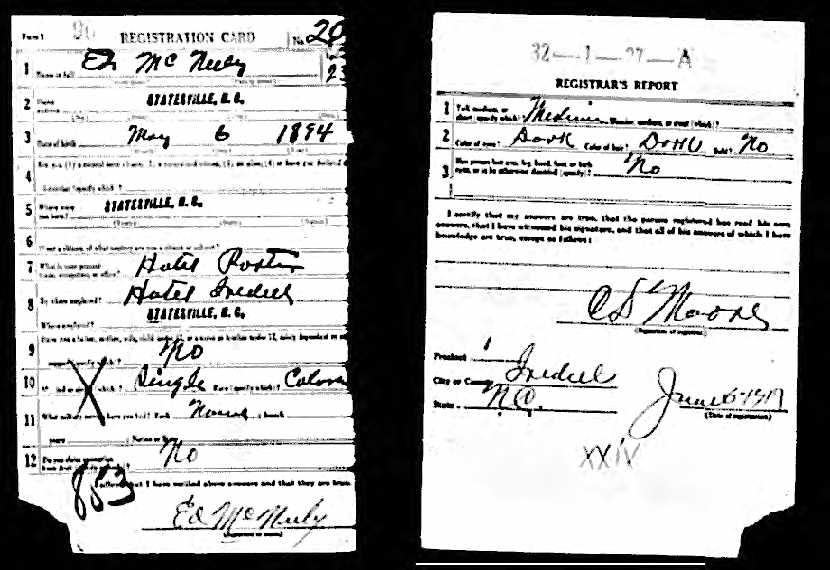
ed mcneely draft card

Yeah.  If he went.  ‘Cause he was the laziest man, dodged everything.  Running all the time.  The ladies were just crazy about him.  He had to leave Statesville.  He went to Asheville and, too ….  They were just about to lynch him because of, you know, these women running after him.  He went to New York.  I think he married two or three women up there.  [I laugh.]  Honey, he was sharp as a tack.  Lord, Lisa, that was one good-looking man.  Tall.  Like Carey.  And he was sharp.  I remember when I went to New York from Hampton to work, went to Jersey from Hampton to work.  He carried me to New York.  First time I had ever been to New York, and he carried me to New York to this Elks Club.  He was a big-time Elk, you know.  And those men swore that I was not his niece, that I was somebody else.  And they said, “Man, you know that’s….”  And I liked to dance with them, you know, and all.  And I would just go with him – I mean, I didn’t go there a lot of times, but I might have went two, three times, but he would take me to that Elks Club.  And he would never let me have anything to drink.  He would drink some wine or something like that.  But he would take me, and one time when I was in New York — Wardenur and I, he used to take us.

McNEELY -- Edward McNeely


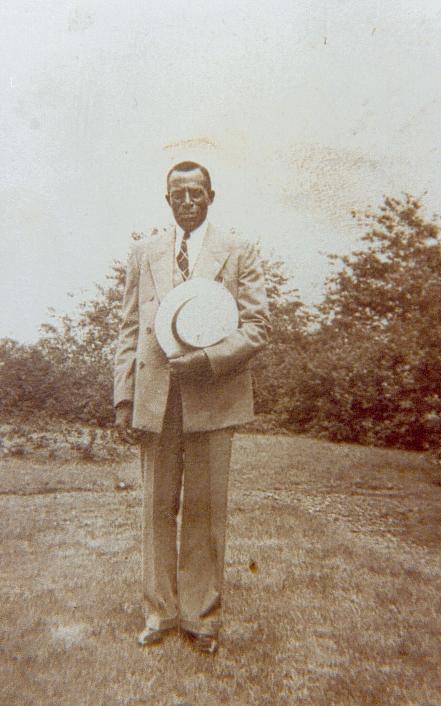
Edward Murray McNeely, born 15 June 1894, was the youngest of Henry and Martha McNeely’s sons. He married Lucille Tomlin in 1910 in Statesville and worked as a bellhop in a local hotel. He and Lucille had a son, Quincy Edward McNeely, in late 1910. When the marriage broke up, the boy and his mother moved to Asheville and were lost to the rest of the family. (Or to my grandmother, his first cousin, in any case.) Ed McNeely was in fact inducted into the Army in 1917, but I have no details of his service. By the late 1920s, he had migrated north to join his mother and several siblings in and around Bayonne, New Jersey. In 1942, he registered for the “Old Man’s Draft” and reported his address as 344 Grand Avenue, Brooklyn. (A two-story brownstone in Clinton Hill worth $1 million today. He also gave his height as  5’11, some considerable inches shorter than my cousin Carey.) When he died on 28 September 1950, Edward was living at 454 Avenue C in Bayonne and was married to Delphine Peterson McNeely. Two days later, the Statesville Daily Record published this tragic report:

“Double Funeral Service Planned”

Double funeral services will be conducted for brother and sister here Monday.

Lizzie Long, who burned to death when her home on Bingham Street was almost completely destroyed by fire Thursday morning, will be buried with her brother who died that night in New York.  The brother, Edward McNeeley, a veteran of World War I, died in Veterans hospital, Staton [sic] Island, upon hearing the news of his sister’s death.  His body will be returned here Monday morning and services will be conducted jointly for them at 2:30 p.m. Monday.  Burial will be in Belmont cemetery.  

The funeral will be conducted by Rev. Spurgeon Frost at Rankintown Congregational church.

Photo of Edward McNeely in collection of Lisa Y. Henderson. Interview of Margaret C. Allen by Lisa Y. Henderson, all rights reserved.
Standard
Maternal Kin, Newspaper Articles, North Carolina

Uncle Julius gets bamboozled.

MILL BRIDGE, April 5.

Mr. Editor: — One day last week a well dressed gentleman of color, wearing a flashy, gold looking watch chain, with checks on the First National Bank of New York for $2500, put in his appearance at the house of Julius McNeely, one of our most trustworthy, hard-working darkies. Jule being of a hospitable nature did what he could to make his visitor comfortable. The said gentleman of color represented himself as Mr. Ed. Brown, a relative of Margaret (Jule’s wife), having left this country twenty-three years ago, that he had been in the U.S. Army and Navy, traveled over the world, made plenty of money and was now traveling in the interest of the Western Colored Emigration Society; he gave glorious descriptions of California and offered to furnish transportation free to all who would go with him to the land of milk and honey. Jule and Margaret listened with delight to the many wonderful stories he told of the outside world, and on last Friday morning prepared his breakfast and went to the field to work, leaving him reposing in bed. When lo! Upon returning they found he had skipped, taking with him Jule’s new double-barrel breach-loading shot gun that cost $25, a gold ring belonging to the school marm, worth $10, 50 cents in wash and a pint of Jule’s medicinal whiskey. He made his way to Cleveland, bought a ticket to Statesville with the stolen half dollar and boarded the 12 o’clock train with the gun and ring. Julius is sorrowing, and offers to pay $10 or any amount above that he can raise to anybody who will “cotch dat nigger devil.”

Said negro is of small stature, copper or ginger cake colored with a broad scar on the left side of his neck, a black spot on the upper part of his nose between his eyes and a mole on one of his cheeks. He is between 38 and 40 years of age and his hair is slightly mixed with gray. He was raised at Davidson College and came in the possession of Mrs. Kate Barnes, Dr. Kerr’s niece. He ran away from Charlotte, where his mother now lives, for stealing, and had been staying about Salisbury with Wylie Dodge and Harriet Brown previous to his coming out here. He left this neighborhood in 1866, at which time he was in the employ of a writer. He stole a gold watch from Mrs. Ray and sold it to William Stockton, of Salisbury. The watch was recovered, but Ed. Was not heard of since until he turned up at Julius McNeely’s, last week. He is a professional rogue, and the local papers will please hand him around.    J.T. RAY.

The Carolina Watchman, Statesville, 11 April 1889.

Standard
Maternal Kin, Newspaper Articles, North Carolina, Politics

The friends of prohibition.

Mt. Ulla.

A meeting of the friends of prohibition was held at Wood Grove, Mt. Ulla Township, on the 4th instant. W.L. Kistler. Esq., was called to the chair and Rev. J. G. Murray, col. was elected secretary. The object of the meeting was explained by Dr. S.W. Eaton. The following resolution was offered by J.T. Ray and unanimously adopted after appropriate remarks from Rev. J.G. Murray and other.

Whereas, In consideration of the evil of Intemperance, caused by the sale and use of intoxicating liquors upon society, which promotes crime and other known vices, and thereby increasing taxation upon the citizens for the suppression, and also entailing injury in some or other upon all classes and conditions of our fellow men, Therefore

Resolved, That we do hereby heartily approve of the action of our County Commissioners in refusing to grant license for the retailing of intoxicating liquors to be used as a beverage in Rowan County.

Upon motion the chairman and secretary were requested to appoint a committee for permanent organization to meet on Saturday the 11th inst., at 3 o’clock, P.M.

The committee for permanent organization are as follows: White – S.A. Lowrance, D.M. Barrier, J.C. Gillespie, J.T. Ray, J.K. Goodman, S.C. Rankin, S.F. Cowan, J.M. Harrison, M.A. File, R. Lyerly, J.K. Graham, Esq.  Colered – W.W. Kilpatrick, Ransom Miller, Henry McNeely, Andy Gillespie, Amos Foster, George Miller, R.A. Kerr, James Rankin, Julius McNeely, Silas Gillespie, Gabriel Kerr.

Upon motion the meeting adjourned to meet on Saturday the 11th inst., at 3 o’clock, P.M.   W.L. KISTLER, Ch’m. J.G. MURRAY, Sec.

The Carolina Watchman, Salisbury NC, 9 June 1881.

ImageWood Grove, Rowan County, Library of Congress Prints and Photographs Division.

——

Henry McNeely and his half-brother Julius McNeely were joined on the committee by Henry’s brother-in-law George Miller and his wife Martha’s brother-in-law Ransom Miller.

Standard
Births Deaths Marriages, Maternal Kin, Newspaper Articles, North Carolina, Other Documents

A colored man of rare powers of mind.

Harriet pursued him, my grandmother said. Relentlessly. Followed him to Ohio to make her case for marriage. Certainly, that she, a widow in her early 40s, found (or allowed herself to become) pregnant suggests an impetus for her plans. Still, Thomas Alonzo “T.L.” Hart was not easily swayed. Their only child Bertha Mae was born in 1902 and not until December 1904 did he apply for a marriage license at the Iredell County Courthouse.

Alonzo was born about 1866 to Ephraim and Caroline Hart. Little is known about the years before he married Harriet Nicholson Tomlin. My grandmother asserted that he was a non-practicing lawyer, but no record has been found of his education or training.  In the late 1890s, he moved briefly to Ohio; a visit home was nearly disastrous:

——

Alonzo Hart, colored, who formerly lived here but has recently been in residence in Toledo, Ohio, was arrested yesterday on a warrant sworn out by Mr. O.P. Sowers, the latter charging him with having his purse and $90 in cash which he lost on Monday, December 26th.  Hart deposited $100 in cash with Justice White for his appearance at the trial which is set for to-morrow.  The defendant is represented by Mr. H.P. Owen and the plaintiff by Mr. L.C. Caldwell.  Mr. Sowers is positive that he lost his purse on the sidewalk in front of the Cooper block on Center Street.  It is said that Hart was present at the time and as he has been pretty flush with cash since then he is suspected of having picked it up.  — Statesville Landmark, 6 Jan 1899.

——

But:

At Alonzo Hart’s trial for theft, the witness testified that Hart was not the man, “and as there was no other evidence against him, [Hart] was discharged, Mr. Sowers paying the costs.” — Statesville Landmark, 11 Jan 1899.

Despite his ignominious arrest, Hart remained in Iredell County, farming in Shiloh township while his sister Etta kept house. A couple of years after marrying Harriet, he again made the local newspaper:

Alonzo Hart, colored, was severely injured Sunday night by Will Stevenson, colored, in a fight in the Poplar Branch neighborhood.  Hart received several severe cuts about the body and one on the neck.  The cause of the trouble is unknown.  A warrant for Stevenson is in the hands of the police. — Statesville Landmark, 18 Sep 1906.

——

Fifteen years later, Hart helped prevent a lynching by negotiating the surrender of a black man wanted for killing a white man:

BOB BENSON SURRENDERS.

“Slayer of Robert Dishman Surrenders to Alonzo Hart, Colored, and Sends for the Sheriff — Others Capture Benson Before the Sheriff Arrives on the Scene and Take Him to Lincolnton — Now in the Mecklenburg Jail”

Working on clues set forth by Alonzo Hart, colored, Bob Benson was captured late yesterday evening by Messrs George Ayers, Fred Claywell, Pam Morrow, Vance Jenkins and Everett Wilkinson.

Lacking only a few hours of being a fugitive from justice a week, Bob Benson, who assaulted and killed Robert Dishman is today resting behind bars in the Mecklenburg county jail, where was taken to escape possible violence.  Thus ended one of the most thrilling searches for a criminal in the history of the county.

Friday during the search on Third creek, near Morrison’s store, Alonzo Hart came to Sheriff Alexander and asked the sheriff if he should find Benson and turn him over to the sheriff would there be any violence.  Upon receiving the sheriff’s promise that he would keep Benson from violence and see that he received justice, Hart said he would do all in his power to get in touch with Benson and have him give him up to the sheriff.

Early Sunday morning between 6 and 7 o’clock Benson came to the home of Hart, which is south of Hoyt Morrison’s store, wearing only a shirt and an old sack tied around his loins, and begged Hart for something to eat and a chance to rest.  According to Hart, Benson said he had been lying in a thicket near Third creek during the search Friday night and Saturday, and had more than one time heard searching parties passing near him so close that he could plainly understand their conversation.

Throughout the day, Sunday, Hart persuaded Benson that it was best for him to give up to the officers, which Benson agreed to do provided he was turned over to the officers, who would take care of him.  About 5 o’clock yesterday afternoon Hart came to town after the sheriff and was seen by some of the party who captured Benson, who surmised Hart was in town on business concerning Benson, and went immediately to Hart’s home, where they captured Benson in one of the rooms of the house.

Benson was carried by his captors to the Lincoln county jail last night.  Early this morning Sheriff Alexander had Benson moved to the Mecklenburg County jail at Charlotte, so as to be doubly sure of his safety.

It was just one week ago yesterday evening, about 8 o’clock, on the Chipley Ford road, six miles north of Statesville, that Bob Benson, a negro, dealt Robert Dishman, white, a blow, or blows, on his head with a stick or other weapon, that resulted in Dishman’s death about 30 hours later at the Carpenter-Davis hospital.  It was a week ago today that the searchers for Benson assumed the proportion of a posse.  A few officers and others had begun the search soon after the killing.

Probably the search for a criminal in no other case in Iredell county has attracted more interest than has been evidenced in the Benson case.  Reports which came to the officers and the posse kept this interest alive.

After the crime he is alleged to have committed Benson lost himself in the neighborhood of his home and in the neighborhood of his victim for the first night of his get-away.  The earlier hours of the day following the crime brought some reports of his having been seen.  Late the same afternoon came the report that up to that time had had the semblance of assurance — someone had seen him making his way from woods to woods in the country around the pump station.  It was then that the crowd assumed the proportion of a posse and it was on this clue that the bloodhounds were introduced and initiated.  They struck a trail and followed it to the right house but the wrong person.  The search continued that night, dissipating other reports of Benson’s whereabouts.  The same program was gone over day after day and night after night.

The all night man hunt was without reward Thursday.  Benson had not been seen since he was shot at about 4:30 o’clock that afternoon, near the home of Mr. D.L. Raymer.

The bloodhounds were brought from Salisbury about 7 o’clock that night and were placed where Benson was last seen, but did not hit a trail durng the night.  — Statesville Landmark, 26 Sep 1921.

——

THE BOB BENSON REWARD.

Attorney Z.V. Long Will Share Burden of a Decision in This Matter to Iredell Superior Court.

No decision yet has been reached in paying the reward of $300 [illegible] by the County and $200 by the [illegible] for the apprehension of Bob Benson, colored, who killed Robert Dishman and who has been convicted and sentenced to electrocution.

Two claims are offered for the reward, one by Alonzo Hart, colored, whose home Benson went and [illegible] until a number of white men went and got him and took him to the Lincolnton jail, while Hart was in town looking for Sheriff Alexander to report Benson’s presence at his house.

The matter of determining proper disposition of the reward was left to County Attorney Z.V. Long.  Since it has become apparent that an amicable settlement can not be made this way, the matter will be left to Iredell Superior court to say how and to whom the reward shall be paid.  — Statesville Landmark, 5 December 1921.

——

Harriet Nicholson Tomlin Hart died in 1924. When Alonzo Hart’s sister died four years later, the Landmark breathlessly reported every detail of the disposition of her sizeable estate, worth about $81,000 in 2013 dollars.

Margaret Richardson Leaves Will Disposing of $6,000 Estate

The will of the late Margaret Richardson, colored, which has been filed with the Clerk of Superior Court John L. Milholland for probate, provides for the distribution of the estate, estimated to have a value of $6,000, as follows:

The farm, one mile north of Statesville, is given to a sister, Lula Loyd; two acres laid off the northern end of the farm, adjoining the lands of J.C. Duke, and the city pump station, to Gilmer Walker; all the rest of the land and personal property to be sold and the cash distributed as follows: $10 to Mollie Alexander of Wilkes County; $10 each to Florence Camp and Minnie Brawley, both of Toledo, Ohio; $100 to Alonzo Hart of Iredell county; $25 to Zion Methodist church, colored, on South Center street; $25 to Broad Street Presbyterian church, colored; $25 to John Adkins, of Winston-Salem; $300 to Lula Loyd; $100 to Preston Smith of Virginia; $200 to Alonzo Loyd and the rest of the property to be divided equally among Lula Loyd, Bertha May Hart, Mollie Alexander, Florence Camp, Minnie Brawley, Earl Smith, and Rebecca Bailey.  Mr. John A. Scott, Jr., is designated as executor of the will. — Statesville Landmark, 19 Mar 1928.

——

At the end of the following year, Thomas Alonzo Hart succumbed to tuberculosis at a Hoke County sanatorium. His final appearance in the Landmark was a respectful and laudatory one:

FUNERAL SERVICE FOR ALONZO HART.

Will Be Held Sunday Afternoon from Centre Presbyterian Church — Was Respected Colored Citizen

Funeral services for Alonzo Hart, 63, well known colored man, whose death occurred Tuesday at State Sanatorium, where he had been a patient for a short time, will be held from Center presbyterian church Sunday, December 22, at 2:30 o’clock in the afternoon.  Interment will follow in the cemetery there.  The surviving members of the family are one daughter, two step-sons and four sisters.

Alonzo Hart, by his extraordinary habits of frugality and industry, had accumulated a considerable estate.  Although living in an age of speedy travel, he held on to an older and slower method of transportation, his regular visits to town having been made in his buggy, drawn by his faithful, dependable mule.  He was a colored man of rare powers of mind, having a valuable library and keeping fully informed on the events of the day by reading newspapers and periodicals.  A unique Iredell citizen has passed to his reward. — Statesville Landmark, 19 Dec 1929.

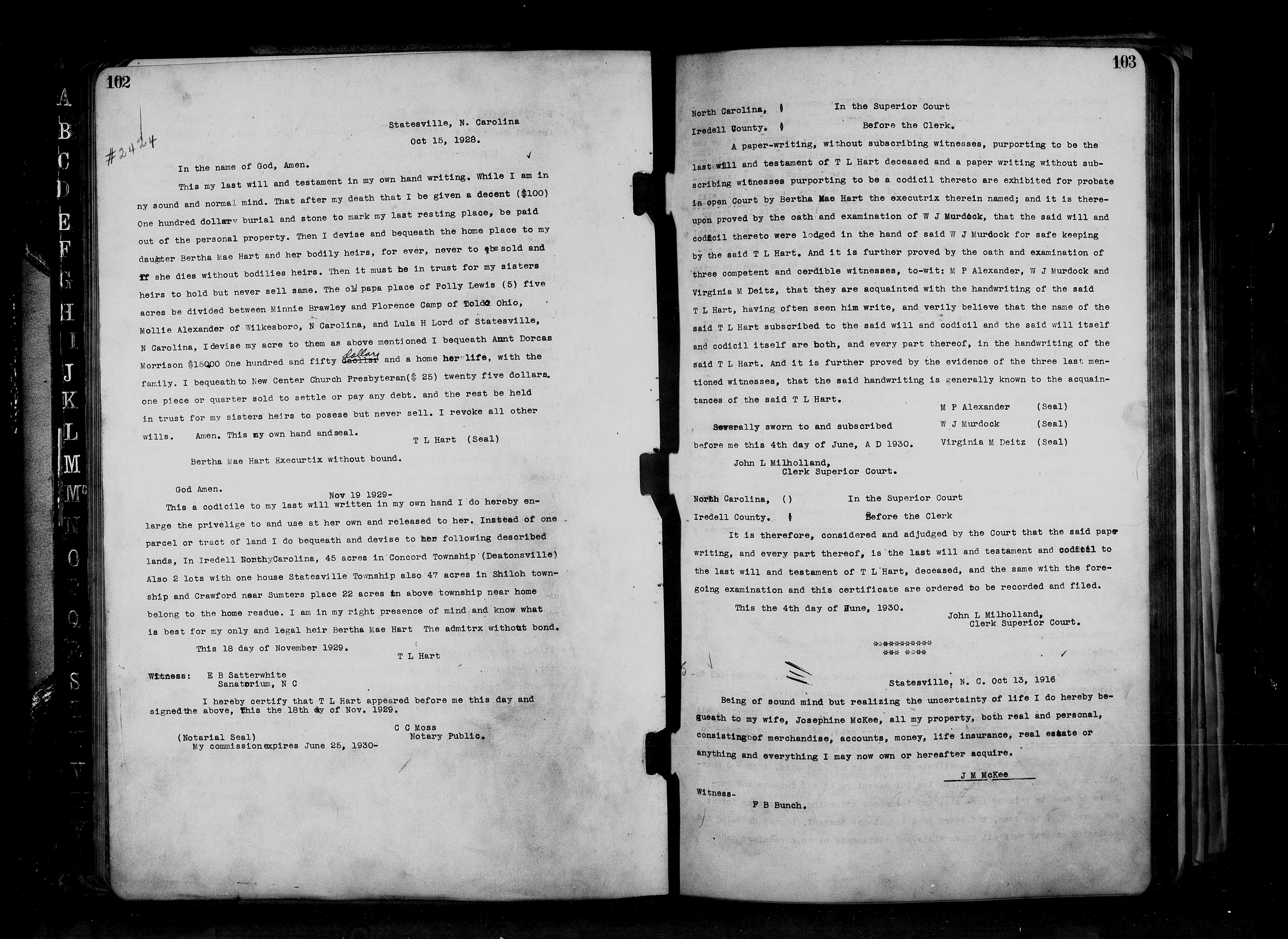
His will confirms Hart’s prosperity and reveals as well his deep ties to his family:
TL Hart Will

Standard
Births Deaths Marriages, Maternal Kin, Newspaper Articles, North Carolina, Oral History

Introducing Martha McNeely.

My grandmother had the sweetest memories of her mother’s mother, Martha Margaret Miller McNeely.Image

In the 1920s, Martha McNeely left Statesville for Bayonne, New Jersey, where her daughter Emma McNeely Houser had settled, followed by several siblings. She settled a few blocks in from the river at 87-A West Sixteenth Street, a 1920 duplex that is still occupied. Said my grandmother:

I went up there one summer from Hampton and worked, and she would let me help her in the kitchen and everything like that, and so I told her, I said, “I’ll cut the corn.”  And she said, “Baby, you can’t cut no corn.  You can’t cut my corn.”  And I said, “Yes, I can, too.”  She said, “I’m sure you can’t, but if you insist, let me see you cut it.”  So I cut the ear of corn like Mama had done, you know.  And she said, “Mmph.  Your mammy taught you.”  [Laughs.]  I didn’t ever forget that.  “Your mammy taught you.”  I said, “Yes, she did.”

And the same story, another time:

… She was so sweet and — I said, “Grandma, now, I can cut the corn.” And she liked to cook. She didn’t think anybody could cook but her. I said, “I can cut the corn for you.” She said, “Honey, you can’t cut no corn for me.” I said, “Yes, I can, too.” And so she said, “well, I’ll let you try it,” she said, “to get rid of you.” So I cut this corn down. She would split the grain, split the grain, and then you cut the top of the grain off, and you cut the second one off, and then you scrape it. And when I did this first ear, she said, “Hmph! Your mammy must have taught you!” “She did.”

When my great-great-grandmother died in 1934, two newspapers marked her passing.  On June 16th, the Bayonne Times announced:

“McNEELY – Martha, at her residence, 87A West Sixteenth street, on Saturday, June 16, 1934, beloved mother of Mrs. Emma Houser, Mrs. Carrie Colvert, Miss Minnie McNeely, John and Edward.  Notice of funeral later.”

Two weeks later, the New York Age informed readers that:

“Mrs. MARTHA McNEELY, one of the older residents of our city, died at her home on Saturday.  Her body was taken to Statesville, N.C. for burial.  Funeral service was preached by Rev. W. Atkinson at Wallace Temple.”

Photo of Martha M. McNeely in the collection of Lisa Y. Henderson.

Standard