Births Deaths Marriages, Maternal Kin, North Carolina, Oral History, Photographs, Virginia

Remembering Margaret Colvert Allen.

She gripped a balled handkerchief, or a tissue, in that hand almost always. You’d only notice that little finger, crooked up above the rest, when she made certain gestures, like smoothing her dress across her lap. It was a source of endless fascination when I was a child, and she would obliging turn her hand this way and that so we could get a closer look. Her pinkie finger, it was, curled permanently into a C-shape.

Here’s how it happened:

My grandmother:  Ooo, I had a lot of friends.  We had a lot of friends.  We could not visit people all in the neighborhood.  We could not go, the children came to our house.  You know, to play and all that kind of – to play ball.  We’d play ball in the evening, and they’d put me in the field because I couldn’t catch no ball on account of my finger.  [Laughs.]  I always had to go in the field.  Louise and Launie Mae were whizzes.  Louise was a terrible bad ball —  I mean, she could play some ball.  But Launie Mae was good, too.  But, honey, they’d put me out there way out there in the field where didn’t no – just as soon as I’d reach up to catch that ball that thing would knock it out.

Me:  Right. How did you hurt your finger?

My grandmother:  Ah, you know, they had windows that you’d put a stick under.

Me:  To prop them up?

My mother’s cousin: Didn’t have a sash.

My grandmother:  Yeah.  And I was in there playing and took that stick out there, and it broke something.  But anyway, Mama said she had gone to town.  That’s what they say when they went into Statesville.  And she said when she came back, Golar came out meeting her with me in her arms, and said she had on a little dress, and said she turned the dress up and blood was coming through the dress off me, you know, my finger and everything.  It scared her to death.  So they carried, she carried me to the doctor’s, and they put splints on to get it – it was broken, you know.  He put splints on.  But, see, I would pick ‘em off.

Me:  Just take it right off.

My grandmother:  Take ‘em off.  And take ‘em off.  And hold my hand like that.  [Balling her hand into a fist.]

Me:  Okay.  So that’s how it healed.  It healed closed.  How old were you then?  Real little?

My grandmother:  I guess I was little.  I don’t know how old I was.  Two, three.  I don’t know whether Launie Mae was there or not.  I know Louise was, but I don’t know ‘bout all of ‘em.  But, anyway, I was just big enough to crawl up to the window and pull the stick out.

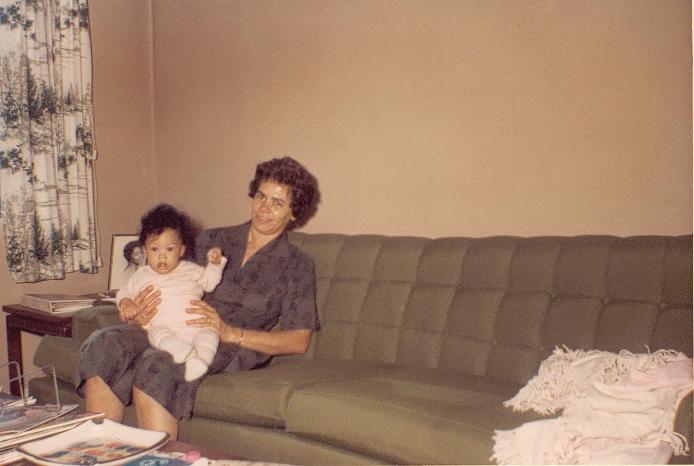
I have many favored photos of my grandmother, and this is one of the last:

MCA

At home, in her easy chair, just back from church, with that little finger.

Remembering Margaret Colvert Allen (2 August 1908-11 February 2010).

Standard
Births Deaths Marriages, North Carolina, Oral History, Paternal Kin, Photographs

Remembering Mother Dear.

I had pneumonia twice.  The first day I went down to Graded School, that day it rained.  I come back – there was a hole in my shoe, and I slopped in all the water and got my feet wet.  That’s what Mama said, anyhow, and I taken with a fever.  

If I got wet – when I went to Graded School, it rained, and I slopped in all the water coming back from there.  Had a hole in my shoe.  Had pasteboard in there.  And then I’d go to sneezing and coughing.  And so Mama said, “You know you oughtn not to got wet!”  Well, how was I gon help from getting wet?  Had to come from school!  So that was the first year I went to school.  I remember that.  And I was sick that whole rest of the year.  I mean, wasn’t strong enough to go down to Graded School – she wouldn’t let me go down there.  So I stayed home, and Mama put all them old rags, that old flannel cloth, and she’d put it in red onions and hog lard.  And I had pneumonia.  And they was sitting up with me.  Said I hadn’t spoken in three days.  And so that old clock where Annie Bell took, it was up there on the mantel, it struck two o’clock.  Mama was sitting on one side of the stove, and Papa on the other.  So I said, when the clock struck, I said, “It’s two o’clock, ain’t it, Mama?”  And they thought I was dying.  So they had been sitting up with me.  So I think didn’t think nothing ‘bout it.  I went on back to sleep.  I didn’t know nothing ‘bout it.  Said I had double pneumonia.  So Mama got – honey, I had to wear a piece of cloth up here on my chest, one on the back, with Vick’s salve and hog grease or whatever that stuff was, mixed all up together and pinned it to my undershirt.  

And I thought about it, with Bessie dead — she died when I was eight months old.  And Mama Sarah took me as a baby and brought me to Wilson.  And I was the only child there.  Well, that’s how come, look like Papa, he felt sorry for me, I reckon.  Her husband did, and I called him the only Papa I knew.  So they all – I was always sickly and puny and: “Give her anything she wanted,” that’s what Dr. Williams – white doctor – so he said, “She can’t live nohow.”  And that’s when I had the pneumonia.  And so I didn’t want nothing but water.  So, “Well, give her all the water she want ‘cause she can’t live nohow.”  But I fooled ‘em!  Dr. Williams’ gone, Mama’s gone, all of ‘em, and I’m sitting right here!” 

IMG_2161

The mantel at 303 Elba Street, 2014.

And for most of my life, she was right there indeed. Every summer, when we drove up from North Carolina to spend a week with her in Philadelphia. Every winter, when she came down to spend the holidays with us and my aunt’s family and her sister. Later, when I was in law school and grad school, I spent my breaks with her, and I even lived with her a short bit when I moved to Philadelphia. I will regret till I’m gone that I did not visit her more often after I left, but when I did I had the good sense to record her stories. Her death was my first real loss, the one that broke the spell, and it pangs me almost as much now as it ever did. I miss this woman.

Image

Remembering Hattie Mae Henderson Ricks (6 June 1910-15 January 2001), my Mother Dear.

Standard
Births Deaths Marriages, Maternal Kin, Migration, North Carolina, Oral History, Photographs

Minnie Beulah McNeely Hargrove.

But there was Aunt Minnie, and then after Aunt Lethea died, Aunt Lethea told her to take care of me, and she just took me on, you know.  And she was always crazy about me.  The first percale sheets that I ever had Aunt Minnie sent them to me, and I never bought anything but percale sheets.  Boy, they were just so luxurious and so nice and everything.

Jay stayed with Aunt Min ‘cause Aunt Min reared him after Aunt Lethea died.  And he was at this same house with Aunt Minnie and Grandma.  Let’s see.  It was Aunt Min and Grandma and Uncle Luther and Jay and I.  We were all in the same house during the summer that I worked up there.

Ardeanur. And she had a brother named James.  And their mother died when they were little children, and Min reared them.  Reared the children.

——

Aunt Minnie, who had no children of her own, reared everyone’s. When her sister Addie McNeely Smith died in 1917, Minnie took responsibility for her children, Ardeanur and James. When sister Elethea McNeely Weaver died five years later, Minnie stepped in to care for her youngest boy, 11 year-old Irving “Jay” Weaver, and promised to keep an eye on Lethea’s favorite niece, my grandmother.

Aunt Min shared a home with her mother Martha Miller McNeely in Bayonne, New Jersey, and after her mother’s death, she and Ardeanur moved to Columbus, Ohio, to live near another sister, Janie McNeely Taylor. She was in her fifties when she defied her disapproving family and married John Hargrove. He did not live long to plague her, though, and in a reversal of roles, she spent her last years with Ardeanur.  Minnie Beulah McNeely Hargrove died 2 December 1982 in Columbus.  She was 93 years old.

Image

Above: Minnie hovering behind her flock. From left, a Murphy boy, Bertha Hart Murdock, Bertha’s cousin Alonzo Lord, Aunt Minnie, and Ardeanur Hart Smith, Statesville, circa 1920.

Image

Minnie in Bayonne, perhaps the late 1920s.

Image

Minnie in later years, Columbus, Ohio.

Image

Aunt Min marries John Hargrove, Columbus, early 1950s.

Image

Minnie McNeely Hargrove at the 1980 Colvert-McNeely family reunion, Newport News, Virginia. I was not there. At the time, I was too callow to know what I was missing. Today, I kick myself. I never met her.

Interview of Margaret C. Allen by Lisa Y. Henderson; all rights reserved.

Standard
Maternal Kin, Migration, North Carolina, Oral History

Finally they just trickled on.

Me: When did your aunts and uncles that moved to Ohio — when did they move?  And who was the first one to go.  Why did they pick Ohio?

My grandmother: Well, Mama had a sister named Janie, and she had three children by this man.  And he didn’t even –

Me [unfortunately, interrupting *sigh*]: That was J.T. and Charles and —

My grandmother: No, no, no, no, no.  That was –

Me:  Oh, Willa and them.  Okay.  Yeah. 

My grandmother:  Mm-hmm.  And he went to Columbus, Ohio, and he would want them to come, but they didn’t ever go.  So finally my Aunt Min and my cousin moved to Ohio — Columbus.  And my Aunt Dot and her family just trickled on.

Me:  Okay. So Aunt Min and who? 

My grandmother:  Ardeanur. 

Me:  Ardeanur.  Okay.

My grandmother:  Ardeanur. And she had a brother named James. And their mother died when they were little children, and Min reared them. Reared the children. So anyway after they went to Ohio, after she went, after Aunt Dot went to Ohio, I think.  Ardeanur and Aunt Min lived in Jersey City. But they moved out there.

Me:  Okay. So that’s how everybody wound up in Columbus.

My grandmother:  Columbus, Ohio.

——

Janie C. “Dot” McNeely, born 1894, was the youngest of the McNeely sisters. I’m not sure who the man who moved to Ohio is, but he probably was James M. Taylor, whom she married in 1923 shortly before their son Carl was born. (They’d had a daughter, Willa Louise, in 1918 and had a second son in 1925. Janie and her children (including older daughters Sarah and Frances) appear in Statesville in the 1930 census without James Taylor.

It’s still not clear to me when the McNeelys moved to Ohio. My grandmother’s statements about who went first seem to conflict, but I am fairly certain that she meant to say that Janie and her children were there before Minnie and Ardeanur. Minnie and Ardeanur were in Bayonne, New Jersey, before 1930, when Janie was still in Statesville.  However, because all of them — wherever they were — seem to have been omitted from the 1940 census, it’s difficult to guess when the move to Ohio took place.

Unfortunately, the Ohio branch of the McNeelys is now largely unknown to my family. Janie’s daughter Willa may still be living, but last we heard was fighting Alzheimer’s. Few of Janie’s children had children, maybe only one, and links to them have been lost.
Standard
Births Deaths Marriages, North Carolina, Oral History, Paternal Kin, Photographs

Is Mama dead let me know at once.

Mama got sick after we come back from Greensboro.  She got sick.  At least, Mama, we never could tell when she was sick.  ‘Cause she put on so much.  If she wanted to go somewhere – go to New York, Norfolk, anywhere she could get, pack that bag, honey, and she’s gone.  And leave us home!  Leave us there.  She took me to New York with her, and she carried Mamie to Norfolk, carried me to Norfolk one time, then she carried Mamie there.  Oh, she was just always wanting to go.  And Papa didn’t have enough sense, but just wherever she said she was going, she was going, and he give her the money and she’d go. 

But Mama didn’t know she had a bad heart until two weeks before she died.  She was always sick, sick all the time.  She’d go to the doctor, and the doctor would tell her it was indigestion and for her not to eat no pork and different things she couldn’t eat.  ‘Cause Mama was fat.  She weighed 200.  She wasn’t too short.  She was just broad.  Well, she was five-feet-four, I think.  Something like that.  And so, but she loved pork, and she’d try to eat some anyhow ‘cause we always had a hog, growing up.  All the time.  So after they said she couldn’t, she tried not to eat no pork, much.  Fish and chicken, we eat it all the time.  But she was so tired of chicken until she didn’t know what to do.  And I was, too.  But Papa loved all pork, so he’d always get a whole half a shoulder or a ham or something and cook it, and she’d eat some.  But when she went to the doctor, and her pressure was up so high, and he told her, “By all means, don’t you eat no pork.  It’s dangerous to eat pork when your pressure is too high.”  And then that’s when she stopped eating pork.  Well, it didn’t help none, I don’t reckon. 

After that, when she was going to Mamie’s, she had that little bag.  A little basket.  A little, old basket ‘bout that tall with a handle on it.  She had all kinds of medicine in there to take.  And Mr. Silver told her, said, “Well, you just take your medicine bag.”  She’d been married to him a good while.  He said, “Well, you shouldn’t go up there by yourself.  Since I’m down here—”  See, she’d go up and stay with him a little while, and then he’d come back to Wilson and stay a while.  So he said, “You just take your little basket there with your medicine in it.”  So, he said, “Well, I’ll go with you up there and then I’ll come back on to Enfield.”  So he went with her down there to the station.  He was picking up the bags to go up there, told her to walk on up to the station and wait for the train.  

So, she went up there to the station and got on there, and went on and got on the train, and when she got off the train, in Selma —  ‘cause she’d done told me to send her insurance and everything to Greensboro, ‘cause she wont never coming back to Wilson no more.  Because she’d done seen, the Lord showed her if she stayed in Wilson, she wouldn’t live.  If she went ‘way from there, she could get well.  So she was going to Mamie’s.  And when she got off the train and went there – she’d just got to the station door.  And she collapsed right there.  And by happen they had a wheelchair, a luggage thing or something.  The guy out there, he got to her, and he called the coroner or somebody, but he was some time getting there.  But anyway, they picked her up and sat her in the wheelchair.  They didn’t want her to be out ‘cause everybody was out looking and carrying on, so they just pushed her ‘round there to the baggage room. 

And so when the coroner got there, he said, “This woman’s dead.”  So they called Albert Gay, and he was working for Artis then.  Undertaker Artis.  And Jimbo Barnes.  And called them and told them that she was dead.  So, Mr. Silver couldn’t even tell them who to notify. He had Mamie living in Thelma, North Carolina, on McCullough Street, but didn’t know what the number of the house was.  So he was so upset. So they had to call the police for the police to go find Mamie Holt.  On McCullough Street.  And her mother, they said, her mother died. Well, she did die.  But they said it was, I think, Thelma.  Not Selma, but Thelma.  “Well, where is Thelma?  It can’t be my mother. ‘Cause my mother don’t live in no Thelma.  I never heard of that place.  She live in Wilson.” But, see, it was Selma where she died. They got it wrong. 

So then Mamie went down to Smitty’s house and had Miss Smitty send a telegram to me.  On the phone.  Charge it to her bill, and she’d pay her: “IS MAMA DEAD LET ME KNOW AT ONCE”   She asked me if Mama was dead.  And I said, when I got that, Annie Miriam and all them, a bunch of kids was out there on the porch, and so at that time, Jimbo or one of ‘em come up.  And when I saw them, I knowed something.  I had just got the telegram.  Hadn’t even really got time to read it.  Had just read it.  And he said, “Well, you done got the news.”  And I said, “The news?  Well, I got a old, crazy telegram here from my sister, asking me is Mama dead, let her know at once.”  He said, “Yeah, we just, we brought her back from Selma.”  I said, “What in the – ”  Well, I went to crying.  And I don’t know.  Albert Gay or some of the children was ‘round there, and they was running.  Everybody in the whole street almost was out in the yard – the children got the news and gone!  That Mama had dropped dead in Selma.  So I said, well, by getting that telegram, I said, that’s what threw me, honey.  I wasn’t ready for that. I’d been saying I reckon Mamie’ll think Mama was a ghost when she come walking in there tonight.  Not knowing she was dead right at the same time. 

Evangelist

Remembering Sarah Henderson Jacobs Silver on the 76th anniversary of her death.

——

Interview of Hattie Henderson Ricks by Lisa Y. Henderson; all rights reserved. Photo in the collection of Lisa Y. Henderson.

Standard
Births Deaths Marriages, Land, Newspaper Articles, North Carolina, Oral History

Bert’s estate.

She wanted a baby badly.

My grandmother:  … that nephew, Dr. Lord’s son, that was Mr. Hart’s nephew.  He got what Bert had. Yes, indeed. ‘Cause, see, it was heir property. And see that’s why Bert tried so hard to have a child.  Because if she didn’t have a child, it was going to whoever had had a child.  You know. And I guess Alonzo did, you know, he was a nephew.  When Bert died, it went to him. See, all this property and everything that Mr. Hart owned there was his family’s stuff.  Wasn’t Grandma Hart’s.

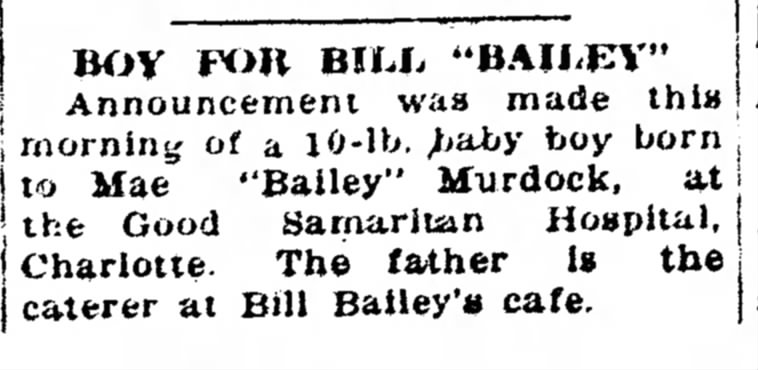
And in 1941, when she nearly 40 years old, Bertha Hart Murdock had one:

Image

Statesville Landmark, 2 April 1941.

But little William Alonzo Murdock died the day after he was born.

Still, the situation for Bert and her property was not as critical as my grandmother had believed. In Alonzo Hart’s original will, made 15 October 1928 in Statesville, he devised “the home place to my daughter Bertha Mae Hart and her bodily heirs, for ever, never to be sold and if she dies without bodilies heirs. Then it must be in trust for my sisters heirs to hold but never sell same.” The remainder of his property went to his sisters’ heirs.

Thirteen months later, as he languished in the state sanitorium in Quewhiffle, dying of tuberculosis, Hart dictated a codicil.  In somewhat opaque and ungrammatical phrasing, Hart “hereby enlarge[d] the privilege to and use at her own and released to her. In stead of one parcel or tract of land I do bequeath and devise to her following described lands, In Iredell North Carolina, 45 acres in Concord Township (Deatonsville) Also 2 lots with one house Statesville Township also 47 acres in Shiloh township and Crawford near Sumters place 22 acres in above township near home belong to the home resdue. I am in my right presence of mind and know what is best for my only and legal heir Bertha Mae Hart.”

In other words, Bertha’s inheritance was generous and unrestricted, and her cousin Alonzo Lord was not to receive anything at all. Things did not go smoothly, however. Hart’s unconventional wording opened the door to challenge, and Bertha was forced to defend her title.

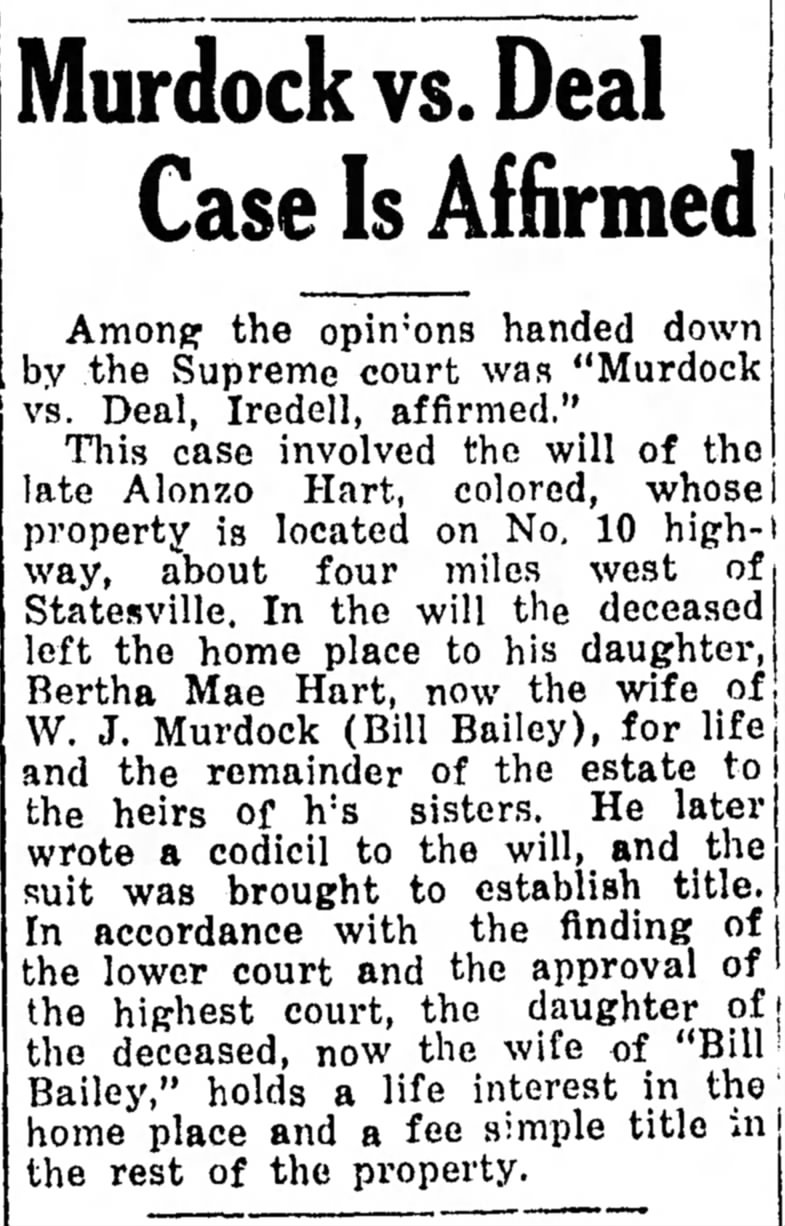
A Hart Est Suit Landmark 11 21 1935

Statesville Landmark, 21 November 1935.

Incredibly, this case went to the North Carolina Supreme Court: Murdock v. Deal208 N.C. 754, 756, 182 S.E. 466, 467 (1935).

By time Bertha died in 1955, her estate seems to have been much reduced, but still comprised some of Alonzo Hart’s land. The bulk of her estate went to Odessa A. Williams, who may have been her cousin. Her half-brother H. Golar Tomlin inherited only a half-interest in a lot. His daughter Annie LaVaughn Tomlin Schuyler received the other half. Another niece, Mattie Johnson, received the negligible sum of one dollar, which raises questions: who in the world was she? I only know of Golda’s one child. Was this in fact Mattie James, oldest daughter of Bert’s other half-brother, Lon Colvert? Why bother with a dollar? And why not give the other nieces, Louise Colvert Renwick, Margaret Colvert Allen, and Launie Colvert Jones, their own dollars?

Murdock Will 8 Jun 1955 R and L

Statesville Landmark, 8 June 1955.

The drama did not end with Bert’s death. In what looks to be the family’s own Bleak House saga, City of Statesville v. Credit and Loan Company, a corporation of the State of North Carolina; W.S. Nicholson and spouse, if any, and if they be deceased, then their unknown heirs, and if any of said unknown heirs be deceased, then their respective heirs, devisees, assignees, and spouses, if any; and the unknown heirs of Minnie Brawley, Florence Camp, Mollie Alexander, and Lula H. Lord, Deceased, and if any of said unknown heirs be deceased, then their respective heirs, devisees, assignees, and spouses, if any; and all other persons, firms and corporations who now have, or may hereafter have, and right title, claim or interest, in the real estate described herein, whether sane or insane, adult or minor, in esse, or in ventre sa mere, active corporations or dissolved corporations, foreign or domestic, 294 S.E.2nd 405, was not decided in the North Carolina Court of Appeals until 1982.

The first sentence of the decision: “The sole issue is whether plaintiff has a valid avigation easement over land owned by defendant.” An avigation easement is a property right acquired from a landowner for the use of air space above a specified height.  Alonzo Hart’s home property was located a few miles west of Statesville, adjacent to land now home to Statesville Regional Airport. (Brawley, Camp, Alexander and Lord were his sisters.) The City of Statesville’s claim that it held prescriptive easements was rejected, and partial summary judgment entered for the defendants.

——

Interview of Margaret C. Allen by Lisa Y. Henderson; all rights reserved.

Standard
Births Deaths Marriages, Free People of Color, North Carolina, Oral History, Paternal Kin, Photographs

Family cemeteries, no. 5: Artis brothers.

I found this small cemetery down a little lane just off Red Hill Road, outside Eureka in Wayne County. A cleared section with several vaults abuts an appalling jungle of viney catbrier, completely impenetrable, in which several large headstones loom. Beyond the thicket is the neatly fenced graveyard of the Bectons, related to a set of Artises by marriage.

IMG_4733The graves of Noah Artis and Patience Mozingo Artis. Noah was one of Adam T. Artis‘ oldest sons, born in 1856 to his first legal wife, Lucinda Jones Artis. Patience was the daughter of Wiley and Agnes Allen Mozingo.

IMG_4739The grave of Amanda Aldridge Artis, who married Adam T. Artis in 1880. She was the daughter of Robert and Mary Eliza Balkcum Aldridge and died days after the birth of daughter Amanda Alberta Artis. Daughter Josephine Artis Sherrod told me that she, 12 years old at the time, found her mother’s lifeless body in bed.

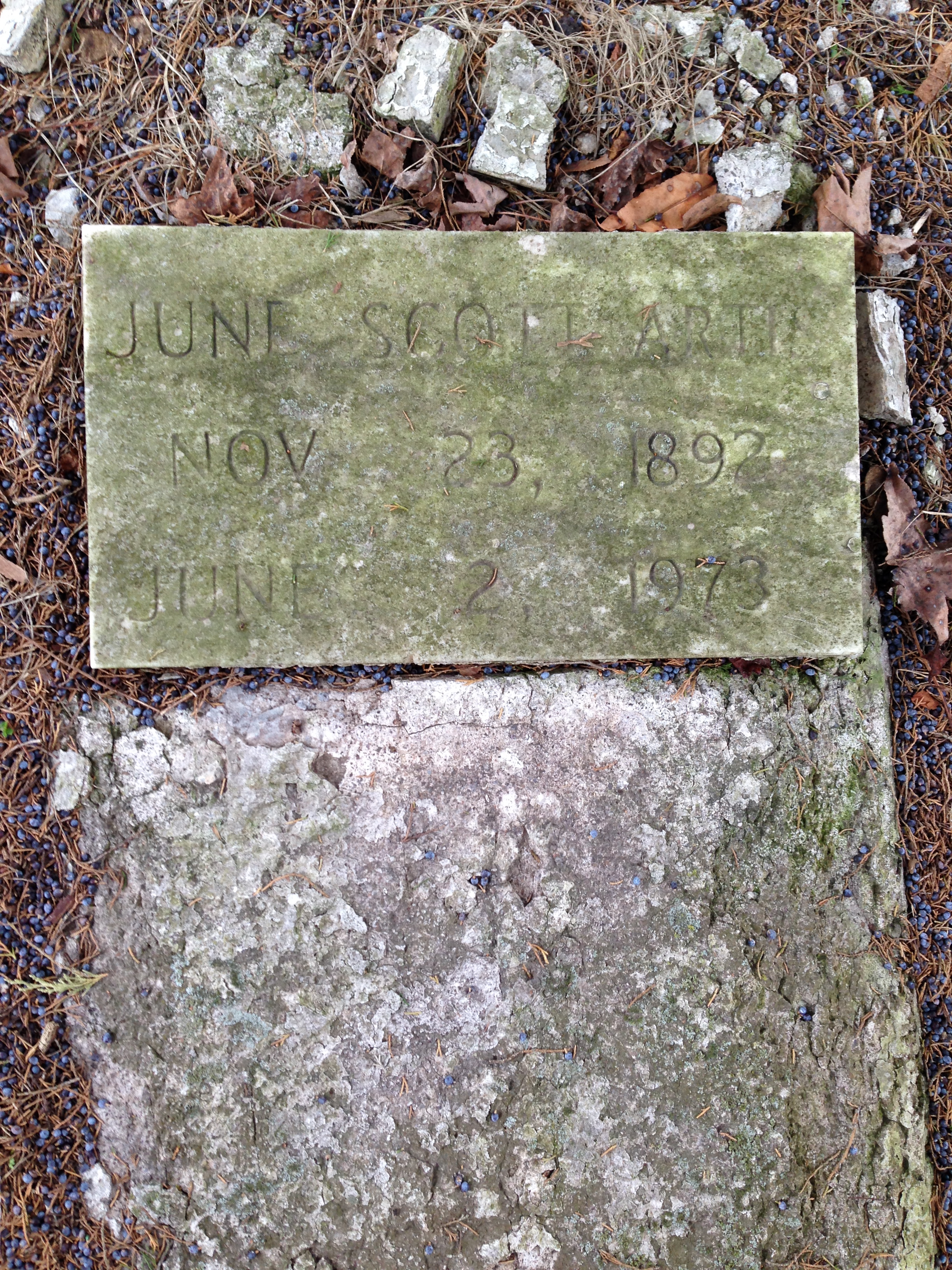
IMG_4728June Scott Artis, son of Adam and Amanda Aldridge Artis, and half-brother of Noah Artis. His wife Ethel Becton Artis is buried beside him.

IMG_4731The grave of Christana Simmons Artis, wife of Adam and Amanda’s son Robert E. Artis, who presumably is also buried here.

Other family in this cemetery:  Mary W. Artis, 1 Jan 1917-5 Oct 1994, wife of Edgar J. Artis; Edgar Joel Artis, 1914-1988, son of June and Ethel Becton Artis; James Brody Artis, 20 Nov 1912-10 Mar 1963, son of June and Ethel Becton Artis; Ethel Becton Artis, 3 Oct 1892-14 Oct 1994, daughter of William and Phoebe Taylor Becton; Dorena Artis Watson, 2 Sep 1925-30 Jul 1968, daughter of Henry J.B. and Laurina House Artis; Laurina Artis, 24 Feb 1895-29 Jul 1961, “wife of J.B.Artis,” daughter of Julius and Hattie Locus House; Roosevelt Artis, 11 Dec 1916-15 Sep 1918, “son of H.J.B. & Laurina Artis.” (Given the number of his children here, it also seems likely that Henry J.B. Artis lies in this cemetery.)

Photographs by Lisa Y. Henderson, December 2013.

Standard
Births Deaths Marriages, Maternal Kin, Newspaper Articles, North Carolina, Oral History, Photographs

Remembering Grandma Carrie.

McNEELY -- Carrie M Colvert with corsage

Me: In her pictures she always looked stern.

My mother: Grandma? 

Me: Carrie.

Ma: Grandma Carrie?  I know it.  But she was funny.  She was funny to me.  She could say some of the, she could say some funny stuff.  I know that’s where Mama gets it from.  The little sayings. 

Image

Statesville Landmark, 20 December 1957.

My grandmother didn’t think much of Charles V. Taylor:

Course she met this guy and married him that she had known him when she was a child.  Taylor.  And went to New Jersey.  She came back home, and Mama had high blood pressure, you know.  But she kept, her doctors kept it in check.  But he hadn’t let her go to the doctor for two times, and she had a stroke and died.  Oooo.  I could have killed that man.  I was so mad with that man I didn’t know what to do.  And when we went down there, Mama just got worse and worse.  She went to the hospital, and they did everything they could at the hospital, and then they let her come home.  And I went down there to see her one time, while she was at home, you know, and she couldn’t talk.  She couldn’t talk, I mean.  And she would try her best to tell me something.  And I just cried and cried and cried and cried and cried. And I didn’t know what she was trying to tell me.  So my sister lived not far from her.  And she was a cafeteria manager, but she would come to see Mama between the meals.  You know, in the morning breakfast and lunch, and then after dinner she’d come.  She really did take care of Mama when she was living with that Thing.  And she went to the hospital and stayed awhile, and he wouldn’t pay the hospital bill.  And I took a note out at the bank, and Louise paid her doctor’s bill and everything, and when she died, he tried to make us pay all the burial expenses.  And his brother came over there and told us, said, “Don’t you pay a penny.  ‘Cause he’s got money, and he’s supposed to use it for that.”  And said, “Don’t you do it.  Don’t you give it to him.”  And that man and the undertaker got together and planned all that stuff against us, you know.  The three of us.  It was terrible.  And Mama had a lot of beautiful clothes, you know, because this man bought her things.  And they were all in there looking at them.  I said, “I don’t want a thing.  I don’t want not one thing.”  I think I got a coat.  It was just like a spring coat.  It was lined.  And I think Louise insisted that I take it, but that was the only thing that I took.

——

McNEELY -- Carrie Colvert thoughtful

Remembering Caroline Martha Mary Fisher Valentine McNeely Colvert Taylor, who died 56 years ago today.

——

Interviews of my mother and Margaret C. Allen by Lisa Y. Henderson; all rights reserved.

Standard
Births Deaths Marriages, Maternal Kin, Oral History, Photographs, Virginia, Vocation

He designed every house he built.

About ten years ago, when we were all in Newport News for a family reunion, I asked my uncle to take us on a tour of houses our grandfather built.

——

He designed every house he built. And there were a couple he designed that he didn’t build. I’ll show you those, too. One of them, he really hated to lose. That was a, Dr. Woodard was a dentist. I mean, a pharmacist. And so, he – that was one of the lots that Daddy had sold, and so I think Daddy was a little ticked with the guy. He sold him the lot and designed the house, then the man went to another contractor. But you know what was interesting at that time? There were about five or six good general contractors around, you know, that did small buildings. And Daddy was one of those, but these guys were pretty competitive. They had a decent market. Daddy built an average of about a house a year, I guess. The war cut him off, you know. He had to get reestablished after the war. But he had a friend named Buster Reynolds. And Buster Reynolds was reputed to have made his money in the numbers, and so when the numbers were getting real hot and heavy, when it was reputed that the Mafia was trying to take the numbers over, Buster got out. And he built this service station, and he had a Texaco franchise, and he had Daddy to build the station. And Texaco liked the work so much that Daddy built two more stations for Texaco. And both of the stations that were built in the black community are still up. They’re not gas stations anymore, but the buildings are still up. And the one that was built Overtown is gone. But even the station that was in the white community Texaco had him to build that one, too. And with the money Daddy bought – I’ll never forget – he bought an International truck, great big truck, to carry his materials around.

Texaco 2

——

… the churches that he used to do expansions and modernizations on all the time, but I know one of ‘em is gone, and I don’t know where the other one is. I know the one – he used to take me down to that one from time to time. But I don’t know where they are now. The thing he did throughout all of these communities – he had a strong maintenance clientele, but Daddy was a – you see these cabinet shops now? Well, Daddy used to make, put in new cabinet work in people’s kitchens for them. And, so, that’s what carried him through the winter. ‘Cause he would also do designs and drawings for other contractors. Like Jimmy’s daddy. Mr. Scott. He used to do most of their design work, he’d sit there and draw those drawings for them. But that’s what got him through the winter. That and he used to do a lot of maintenance. Put in new windows, cabinet work, doors. Put little small additions to houses. But that was generally for a white clientele. He used to do a lot of work for the shipyard management people up in North Huntington Heights.

——

This house Daddy was building when he died. He was building it for a family named Kramer. A white family. See the one with the little entrance and the white wrought iron?

House 1

1316 – 22nd Street

——

The 800 block of Hampton Avenue, this is where Daddy owned those lots. Slow down … this house right here. This tan house. 855. This house was built at that time for the Tynes family, which owned a very nice house and property up in the next block.

Hampton Avenue 1

855 Hampton Avenue

But the Tynes family ran into some – I guess it was financial difficulty. Anyway, that house was sold to Wendell Walker, who was a lawyer and a part of the Walker family. You know his father was a lawyer, who was William. And his son William jr. is Howard Walker’s father, who was my classmate. And then there were, like, four sons and a daughter, I believe it was. Three of ‘em were lawyers, and then Wendell and Phillip were lawyers. The son William was an engineer, but when he came back home, he was manager of Aberdeen. He went into real estate and insurance. Daddy sold him the lot, designed and built the house.

——

Hampton Avenue 3.1

819 Hampton Avenue

Let me tell you about this house right here. This house was the undoing. This house was built for his friend Leroy Ridley. And there were, I think, four lots – four or three lots. Leroy Ridley was the son of John Ridley, who founded Crown Savings Bank with Pa Pa Allen. Okay? But he became – one of the Ridley sons, he became the one who took over the bank. And the man turned out to be not the most moral and forthright businessman. He talked into Daddy into $5000 worth of extras in this house, which was almost the same size as the house. And then when it came time to close the deal, he refused to pay Daddy because he said Daddy had not duly executed the extensions in the contract to do that. And not only that – Daddy had borrowed money from his bank. The long and short of the story is the last of that was paid when Pa Pa’s estate was executed [in 1961, 13 years after John Allen’s death.] We told Mother to pay that loan off ‘cause she still owed a thousand dollars. But this house turned out to be what kept Daddy from building Mama her house. ‘Cause he was gon build it on another lot. See? But when he got caught in that deal, then he couldn’t. So then he had to sell off all the lots that he had for houses, okay? So that’s when he sold this lot – the Woodard lot. And designed that house for Dr. Woodard.

Me: This incredible – this house right here?

My uncle: Yes. That’s Daddy’s design.

My cousin, J: Wow!

Me: Sheeze. Oh, my God.

He did not do it. He designed it. Okay. See, this was an extra lot. This is another one of the large lots he had. You see what I’m saying? And this house was across the street, that was his pride and joy. That was a Cape Cod. But I’m saying, the Ridley house was a fantastic house. I mean, you know, the design was great, but anyway, so this was done for his buddy Picott. Mr. Picott. He was president — well, he wasn’t president – yes, well, he was, of Virginia Education Association, which was the black unit of the National Education Association. He was one of the guys who lost their jobs over the equal rights fight with Mr. Palmer for black teachers to have equal pay. And he left and moved to Richmond, and that’s when he sold his house. But that was a beautiful home. Solid oak floors, cabinetry that Daddy built. All of that, that house. But that’s the thing that – she won’t talk about it too much – but that’s the thing that really embittered Mother, was when she lost the opportunity to build her house because of that deal.

Hampton Avenue 2

816 Hampton Avenue

——

2107 Marshall Ave

2107 Marshall Avenue, my great-grandparents’ house.

You know, he did all that for his father. He put the addition – designed that addition to go on the back. Right behind the bathroom window. Okay, that’s where the bathroom was. And then Daddy designed and started that addition for the house. And that’s when he went to the Army. And they put that addition up there so – so the bottom addition was the barbershop, remember? You remember the beauty shop? Yeah, the bottom addition was the beauty shop, and the upper addition was the bedroom for Aunt Nita for the war. Pa Pa did that for his children.

——

House 3

3105 [I didn’t note the street name]

On the corner here, similar to the Kramer house. Designed it and built it. That was done for Dr. Fultz, who was a dentist. Actually, he was the school dentist. He built 3015. This at that time was a predominantly white neighborhood. Yeah, that’s the house. See that little carpentry he did? Those little arched doorways? That’s the original wood. That’s Daddy’s work.

——

Remembering John Christopher Allen, Jr., carpenter, draftsman, builder, contractor, father of five, grandfather of eight, great-grandfather of six, born 107 years ago today.

—–

Interview by Lisa Y. Henderson; all rights reserved. Photos taken by Lisa Y. Henderson, 2002.

Standard
Births Deaths Marriages, Maternal Kin, Newspaper Articles, North Carolina, Oral History, Photographs, Vocation

Lon Colvert: straight and shady.

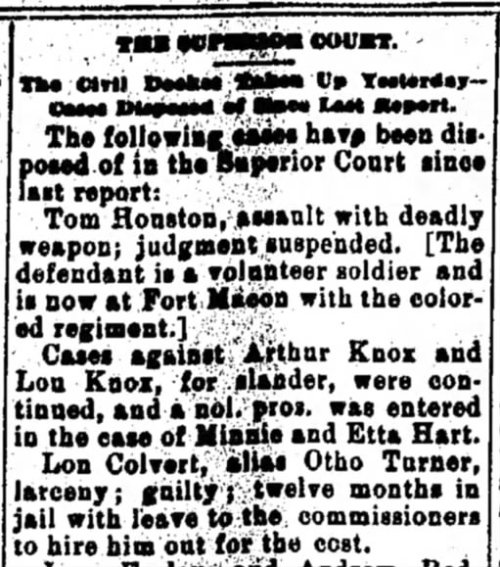
If reports are to be believed, Lon Colvert had a bit of a shaky start. “Otho Turner”?
Image

Statesville Landmark, 18 August 1898.
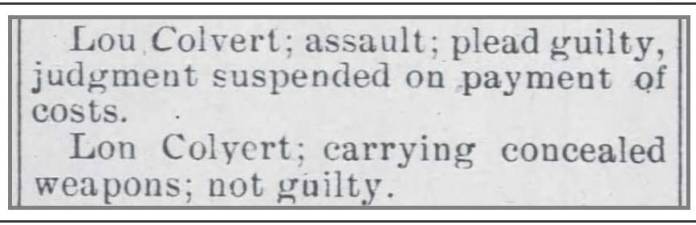
Carolina_Mascot_Sville_2_8_1900

Statesville Carolina Mascot, 8 February 1900.

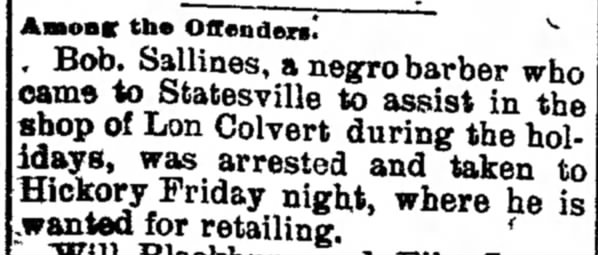
Lou Colvert was Lon’s uncle. No details on Lon packing. But he switched gears a bit.  To retailing, which specifically meant selling liquor — unauthorized.

Iredell County Superior Court —

Lon Colvert, retailing; guilty.  

— Statesville Landmark, 5 Nov 1901.

Another poor outcome.

“Cases Disposed of Since Monday — Some Recruits for the Chain Gang — A City Ordinance Held Invalid”

The following cases have been disposed of in the Superior Court since Monday:    …

Lon Colvert, convicted of retailing, was discharged on payment of the costs. 

— Statesville Landmark, 8 Nov 1901.

But somewhere along in here, he began to right his ship.

Notices of New Advertisements.

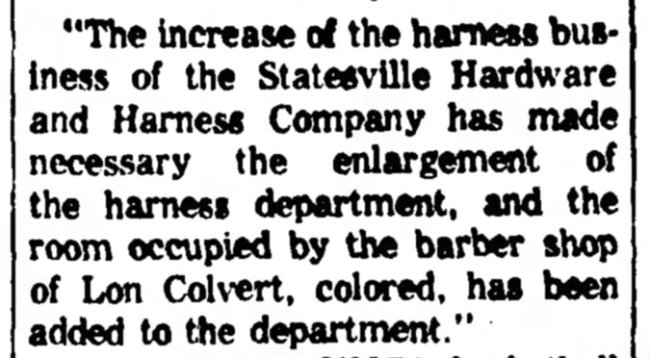
L.W. Colvert has moved his barber shop from Depot Hill to 109 east Broad street.

— Statesville Landmark, 23 Aug 1904.

It’s not clear when Lon first opened his barber shop, or how he got into the business, but it was a good move. Depot Hill was a few blocks south of downtown; the 100 block of East Broad was right at the heart of the business district. He had arrived.

Still, there were setbacks. (I read “liquor” in this “little pilgrimage,” but I could be wrong.)

“Played His Bondsman False and Will Spend his Holidays in Jail.”

Thursday afternoon a colored barber, Lon Colvert by name, braced Mr. J.P. Cathey for a horse and buggy with which to make a little pilgrimage that night, and Mr. Cathey refused.  Lon was just obliged to make that little run, so later he stated the case to Jo. Thomas.  Jo. is the colored individual who worked for Mr. Cathey then and who is now being boarded by the county.  Jo. slipped out with a horse and buggy.  Lon made his trip, came back, paid Jo. one plank, which he shoved down in his jeans, and then Jo. slept the sleep of the consciousless offender.

But the snow that fell during the interval between the exit and return of that buggy caused Jo’s little house of cards to tumble.  Next morning Mr. Cathey saw the tracks, asked Jo. who had got a buggy the night before, and Jo straightaway told the thing that was not.  So Mr. Cathey got off of Jo’s bond, which he had signed not long since, and now Jo. is behind bars.

— Statesville Landmark, 20 Dec 1904.

He pressed on.

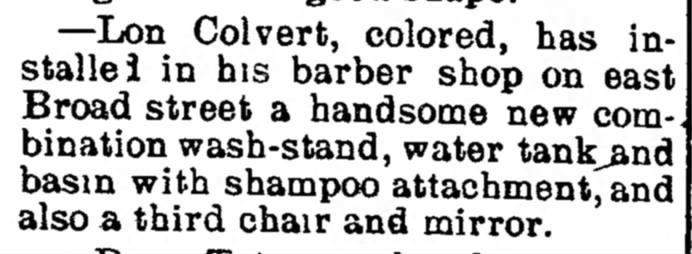
Lon Colvert, colored, has recently equipped his barber shop on east Broad street with a handsome two-chair dressing case and has made other improvements in the shop.

— Statesville Landmark, 1 Jan 1907.

Occasionally, his friends let him down.
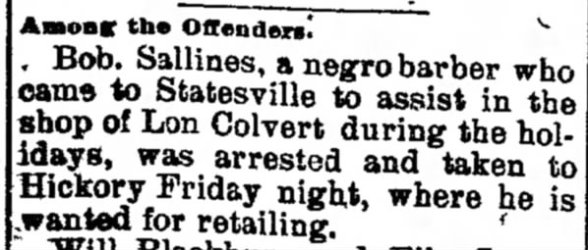
Image

Statesville Landmark, 1 January 1907.

But he had a new wife and a new baby to add to his first three, and the straight and narrow was starting to win.
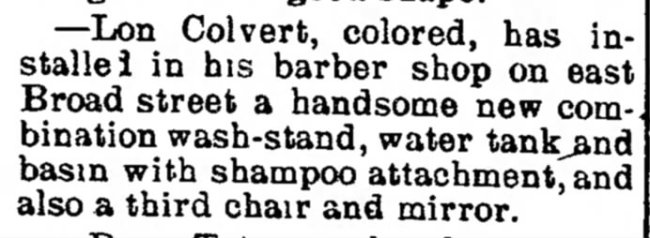
Image

Statesville Landmark, 7 May 1907.

Image

Statesville Landmark, 7 January 1910.

A momentary setback, no more. Lon moved his business back down Center Street toward the train depot and entered the golden age of his entrepreneurship, the period of my grandmother’s childhood.

Papa had a barber shop.  Well, of course, Papa did white customers. And, see, the trains came through Statesville going west to Kentucky and Tennessee and Asheville and all through there.  They came through, and they had, they would stop in Statesville to coal up and water up, you know.  There were people there to fill up that thing in the back where the coal was.  And there was another — it had great, big round things that they’d put in water.  And when those trains would stop for refueling, they would, there were a couple of men who would come. I can see Walker and my uncle and Papa standing, waiting for these men who were on the train to give them a shave and get back on the train in time.  And there wasn’t any need of anybody else coming in at that time ‘cause they couldn’t be waited on.  They were waiting for these conductors and maybe mailmen, but I know there would be at least three at a time.  And Papa would shave them.  And he made a lot of money.

Papa had a taxi, too. Walker drove it most of the time.  And then he would hire somebody to drive it other times.  And then when people had to go to Wilkesboro, Papa would take them.  Because Wilkesboro was a town north of Statesville. And there was no transportation out there.  No buses, no trains, or anything.  So when people would come on the train that were, what they call them, drummers, the salesmen, when they would come through, Papa would carry them up there. 

And he had this clean-and-press in the back of the barbershop. And, look, had on the window, on the store, ‘Press Your Clothes While You Wait.’  I can see those letters on there right now.  ‘Press Your Clothes While You Wait.’  And people would go in there, get their clothes pressed, you know.  And I know ‘barber shop’ was on the door….  ‘L.W. Colvert Barber Shop.’  ‘L.W.’ was on the side of this door, and ‘Colvert’ was on this side of the door.  They had a double door.

There were, of course, risks to doing business. Though I’m casting a side-eye at the carnie. (“H.G.” was Lon’s 21 year-old half-brother Golar, and I never knew he was a partner in the business.)

Damages for Scorching Suit — Court Cases.

Lon Colvert and H.G. Tomlin, doing a pressing club business under the name of Colvert & Tomlin, were before Justice Sloan Saturday in a case in which Chas. Moore, white, a member of the carnival, was asking $18 damage for them.  They pressed a suit for Moore and it was scorched, for which Moore asked damage.  The case was finally compromised by Colvert & Tomlin paying Moore $5 and $1.20 cost. 

— Statesville Landmark, 27 March 1917.

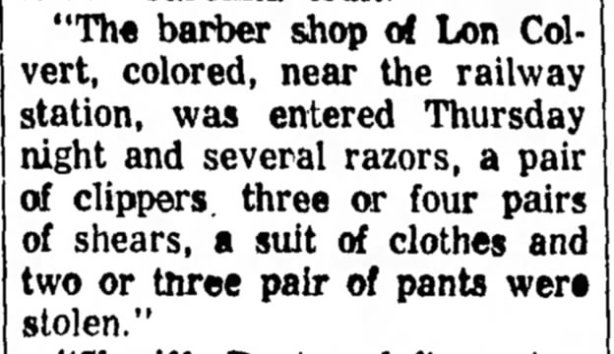
And there was the little matter of a charge of carrying a concealed weapon in 1919; a jury returned a not guilty verdict.  Still, a burglary at the shop was an omen. The good years were coming to an end. Lon was struck with encephalitis in the 1920s and was largely unable to work in his final years.
Image

Statesville Landmark, 25 September 1925.

By this time, Golda had embarked upon a peripatetic life in the Ohio Valley, and  Walker was left to keep his father’s businesses running.  He exercised his best judgment.

Walker Colvert, driver of the Wilkesboro jitney Steve Herman, driver of the Charlotte jitney, and Henry Metlock, driver of the Taylorsville jitney were charged with delivering passengers to the depot rather than the jitney station.  It appearing that all the violations were emergency calls, the defendants were discharged.

Statesville Landmark, 1 Mar 1926.

Lon Colvert died 23 October 1930.  “He was an old resident of Statesville,” his obituary noted, “and for a number of years had a barbershop on South Center street, near the Southern station.”
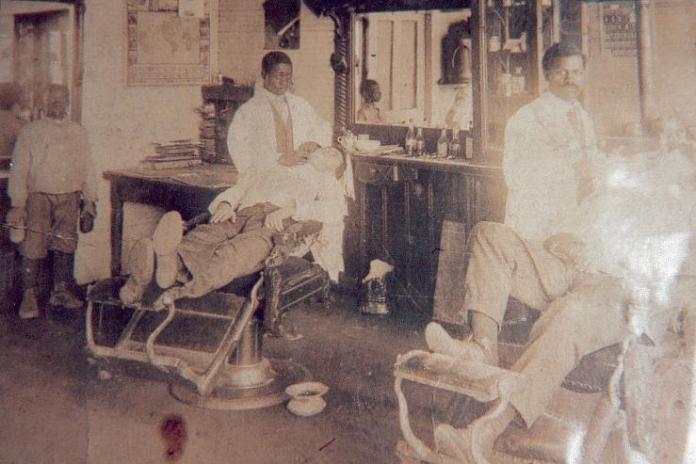
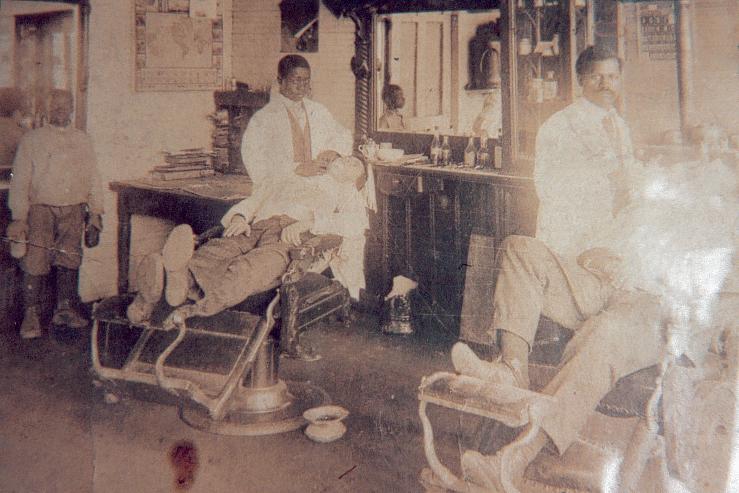
COLVERT -- Barbershop 2 The barbershop, 1918, when it was at 101 South Center Street. Walker Colvert, center, and L.W. Colvert, right.

——

Interview of Margaret C. Allen by Lisa Y. Henderson; all rights reserved. Copy of photograph in possession of Lisa Y. Henderson.

Standard