Births Deaths Marriages, North Carolina, Oral History, Paternal Kin

Her story.

Bessie Henderson has died, and her children remain.

Mamie Lee was the first child, and my grandmother was the second. And the second Hattie Mae.  The first was Sarah Henderson Jacobs’ daughter.

That’s who they named me after.  I asked them why they named me Hattie after a dead person.  “What?  You don’t like Hattie?  Well, I just thought ’twas nice.”  And after I looked at her picture, I said, “Well, she was pretty.”  Since Jack knew her, and he wanted her picture, when I come up to Philadelphia, I give him the picture.  ‘Cause they grew up together.  And his children thought she was white, wanted to know what old white girl was that.  Mama never talked about her.  But A’nt Nina, she would tell everything.  Mama got mad with her, said, “You always bringing up something.  You don’t know what you talking ’bout.”  And she never did say – well, if she said, I wouldn’t have known him, but I never did ask her – who Hattie’s daddy was.  I figured he was white.  Because she looked — her hair and features, you know, white.

Jack Henderson told my grandmother that he remembered “when she was got,” that he was nearby when it was happening, that Tom had Bessie over a barrel, literally.  Bookish and soft, James Thomas Aldridge tended his mother and younger sisters and his ailing father’s dry goods store while dreaming of a bigger and better world faraway.  He would have been a nerd if they’d had them then.  Bessie’s pregnancy changed his life:

‘Cause his mama didn’t want her son to get married.  ‘Cause he wanted to be a doctor, and so she was gon help him be one.  And if he got married and started having children, he couldn’t be a doctor.  And down there in a little town like Dudley, you had to go away from there ‘cause it wont no more than ‘bout sixth, seventh grade.  And you had to go to a larger place if you wanted to go to school. 

So the pregnancy stirred him, thrust him out toward his reveries, away from Dudley and the grey-eyed baby whose mother was soon to die.  Tom, already 24 years old but claiming to be much younger, fled to Raleigh, where he entered Shaw University’s preparatory division and exited its college eight years later on his way to Meharry Medical School.  He would become a doctor, indeed, a big-time, money-making, Cadillac-driving Saint Louis doctor, elected president of the National Medical Association in 1961.  But it’s his daughter’s story we’re telling right now, the daughter who never got past sixth grade, who never met her father ‘til she was good and grown.

Let me back up.  Sometime around 1905, Mama Sarah and her husband, a good man named Jesse A. Jacobs Jr., moved 40 miles north of Dudley to Wilson, a tobacco market bursting with new golden-leaf millionaires.  Colored folks from all over coastal Carolina, drawn to the town’s bustling opportunity, built a vibrant community on the southeast side of the railroad that cleaved the town in two. Sarah took in washing and ironing, did seasonal work at tobacco factories, and reared Jesse’s brood, who turned out largely ungrateful.  Her own daughter died in 1908, aged 14, and nobody knows why.

Meanwhile, down in Dudley, Lewis and Mag Henderson faded in their iron bedstead with only their teenaged granddaughter Bessie to manage the household.  Lucian Henderson likely farmed his parents’ reduced acreage with his own, but it was left to Bessie to cook and clean and sew and launder and do all the other relentless drudgery that needed doing.  Her mother was long dead, and there were no other close relatives nearby upon whom to rely.  Did she resent her responsibilities?   Did she chafe under the grind of pot-stirring and water-fetching and skillet-scouring and jar-slopping?  What did she want?  She was a chancey girl, a risk-taker, one who took her pleasure where she found it, even when it clamped the lid tighter on her trap.  She was a beautiful girl, but nearly unmarriageable, as she dragged her heavy belly through the spring of 1910.

Bessie gave birth to my Hattie Mae on June 6, very likely attended by the child’s grandmother, a midwife named Louvicey Artis Aldridge.  Though Vicey had forbidden a marriage between this girl and her special boy Tom, she was not altogether unmoved by her grandbaby, who looked much more Aldridge than Henderson. Vicey and her daughters played small intermittent roles in my grandmother’s early life, but there is no doubt: Sarah Henderson Jacobs was the family’s matriarch and matrix, though no children of her own lived even to adulthood. She reared Bessie’s children and kept them clothed and fed and sheltered, if not exactly loved.
Standard
Maternal Kin, North Carolina, Oral History

She would always bring him something.

My grandmother: My grandmother used to always bring him something down, she’d come down sometimes Sunday afternoon or Saturday night.

My aunt: Grandma Allen?

My grandmother: No, no, no, no, no. My daddy.

Me: Harriet.

My grandmother: She would always bring him something. In the springtime, when there’d be strawberries and rhubarb, she used to make strawberry pie with rhubarb in ’em. And she would make three or four and stack ’em like that. And cut all the way down. And she would always bring that to Papa.

Margaret C. Allen on this family’s stack pie legacy.

——

Interview of Margaret C. Allen by Lisa Y. Henderson; all rights reserved.

Standard
Births Deaths Marriages, Enslaved People, Maternal Kin, North Carolina, Oral History, Other Documents

Lucinda Cowles, also known as Lucinda Nicholson.

I give and bequeath to my beloved son Thomas A. the following Negroes to wit Carlos Nelson Lucinda and Joe.

——

On 19 Nov 1850, James Nicholson wrote out his last will and testament. Two days later, before he could sign it, he slipped into death.  The document was registered 19 Jun 1852 in Will Book 4, page 666 at the Iredell County Register of Deeds Office. Nicholson’s only heirs were his widow Mary Allison Nicholson and sons Thomas A. and John M. Nicholson.  James left Thomas 185 acres and John 242 acres and gave them a 75-acre mill tract in common.  Mary Nicholson received slaves Milas, Dinah, Jack, Liza and Peter; John received slaves Elix, Paris and Daniel; and Thomas received the four named above.  In addition, James bequeathed Thomas and John slaves Manoe, Armstrong, Manless, Calvin and Soffie jointly.

Thomas A. Nicholson put Lucinda to work in his home preparing meals and otherwise caring for his family. As Thomas’ son James Lee Nicholson grew to adulthood, he took increasing notice of the woman who cooked his suppers, laundered his shirts and emptied his slops. In 1861, she gave birth to his first child, a daughter that she named Harriet Nicholson. Lucinda and Harriet remained in Thomas Nicholson’s household till Emancipation, when they were provided with a small house and other support.

As the story goes, Harriet did not learn her father’s identity until her mother Lucinda revealed it on her deathbed. Lee Nicholson passed away when Harriet was 10 years old, leaving a widow and two small boys. Lucinda may have died even earlier, as she has not been found in the 1870 census. She had one other child, a son named William H. Nicholson, whose father was Burwell Carson. Based on information supplied by Harriet, William’s death certificate lists Lucinda’s maiden name as Cowles. We know nothing else about her life.

Standard
Births Deaths Marriages, North Carolina, Oral History, Paternal Kin, Photographs

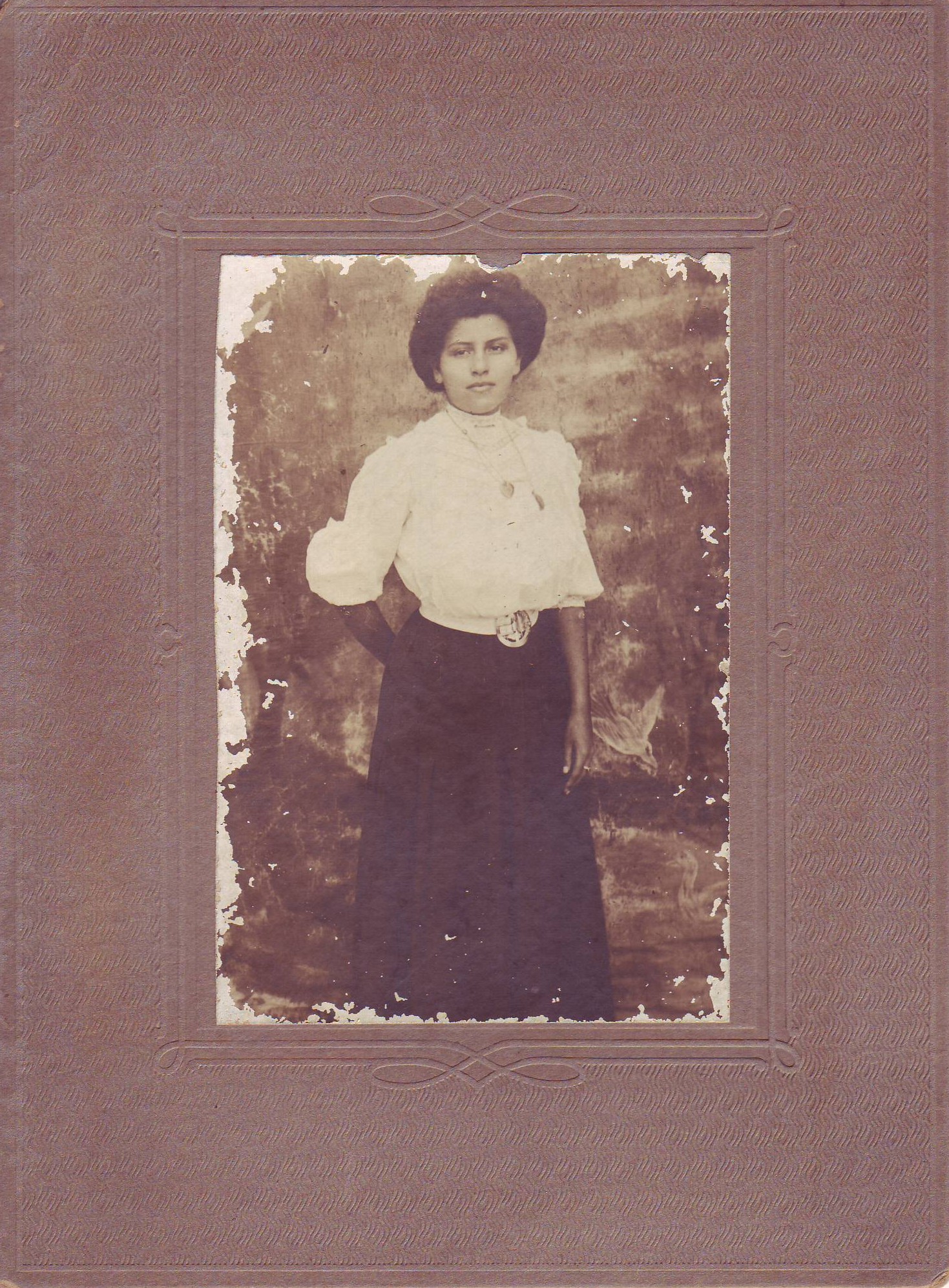
Bessie Lee Henderson.

Bessie Henderson is the fulcrum.  Or Bessie’s death anyway. The point at which my Hendersons diverged from the line, left Dudley’s track, frayed the thread that bound to them to their people. Her death launched my grandmother out of Wayne County and away from what could have been.  Given all that happened later, the ways things turned out, it is not hard not to see why my grandmother cast the first few months of her life as the glory days.   She was with her own mother and surely cherished.

Bessie Henderson 001

Let’s look at her.  At the only photo we have.  Probably the only one there ever was.

She is a broad-faced, heavy-lidded beauty, the barest hint of a smile playing on her lips, a high-yellow Mona Lisa.  Thick dark hair pulled up a la Gibson Girl; a hint of widow’s peak; a straight-bridged nose; a full bottom lip.  The fat lobes of her ears depend from the nest of her hair.  I recognize them as my grandmother’s.

What was the occasion?  Why the first photograph of her life?  It was surely taken in Goldsboro, or maybe Mount Olive, the small town and smaller town that bracketed Dudley, the crossroads at which she passed her entire  short life.  There are no props.  The painted backdrop is mottled and indistinct, save a white bird swooping downward, a wingtip brushing her left hand.  The portrait is three-quarter length, and it is hard to gauge her size.  She was surely of no great height, perhaps an inch or two over five feet, and slim, but with a hint of hippiness.  Her daughter and nieces were narrow-shouldered, but she seems not to have been so.

One arm, folded behind, rests on her hip.  The other hangs loosely at her side, a slender hand brushing her thigh.  I do not recognize the fingers; they are not my grandmother’s.  Her arms, exposed below the elbows of her ruffled white blouse, are much, much browner than her face, evidence of her time in her grandfather’s fields, straw hat shielding her brow.  There is a ring on her left middle finger.  There are also two lockets hanging from her neck.  She barely knew her mother; her father was a kind but distant white man; she never married.  Who then gave her these trinkets?  What became of them?  What tiny images hid in the clefts of the lockets?  Who loved her?

Like her own mother before her, Bessie was just nineteen when she died.  She looks older here.  A little weary maybe.  A little sad.  A second child born out of wedlock would get her drummed out of the church that her grandfather had helped found.  The baby’s daddy joined church weeks later.  Within months, Bessie was cold in her grave.

My grandmother tells it this way:

I thought of many times I wondered what my mama looked like.  Bessie.  And how old was she, or whatever.  See, she was helping Grandpa Lewis.  The pig got out of the pasture and, instead of going all the way down to where the gate opened, she run him back in there, to try to coax him in there.  And when they picked him up and put him over the fence, she had the heavy part, I reckon, or something, and she felt a pain, a sharp pain, and so then she started spitting blood.  Down in the country, they ain’t had no doctor or nothing, they just thought she was gon be all right.  And I don’t think they even took her to the doctor.  Well, she would have had to go to Goldsboro or Mount Olive, one, and doctors was scarce at that time, too, even if it was where you had to go a long ways to get them.  And so she died.  She didn’t never get over it.  I don’t remember ever staying down there.  ‘Cause they brought me up to Wilson to live with Mama and Papa.  I stayed with them after Bessie died.  My sister says she does, but I don’t remember Bessie. You never know what you’ll come to. 

——

Photo in the collection of Lisa Y. Henderson. Interview of Hattie Henderson Ricks by Lisa Y. Henderson, all rights reserved.

Standard
Births Deaths Marriages, Maternal Kin, Newspaper Articles, North Carolina, Oral History, Other Documents, Vocation

Irving Houser gets a McNeely Girl.

Me:  Okay, and Emma, she was up in Bayonne.

My grandmother:  This man went up there in his young years. I think he had an eye on her. People used to say that the men —  all of Mama and her sisters were supposed to have been catches, you know. They were good-looking women and everything, and they just said the men said it didn’t matter which one it was so long as they got one of them.

Me:  One of the McNeely girls?

My grandmother: McNeelys. Mm-hmm.

Me:  So he came back and married Aunt Emma and carried her to New Jersey. To Bayonne — oh! Irving Houser, Sr.

——

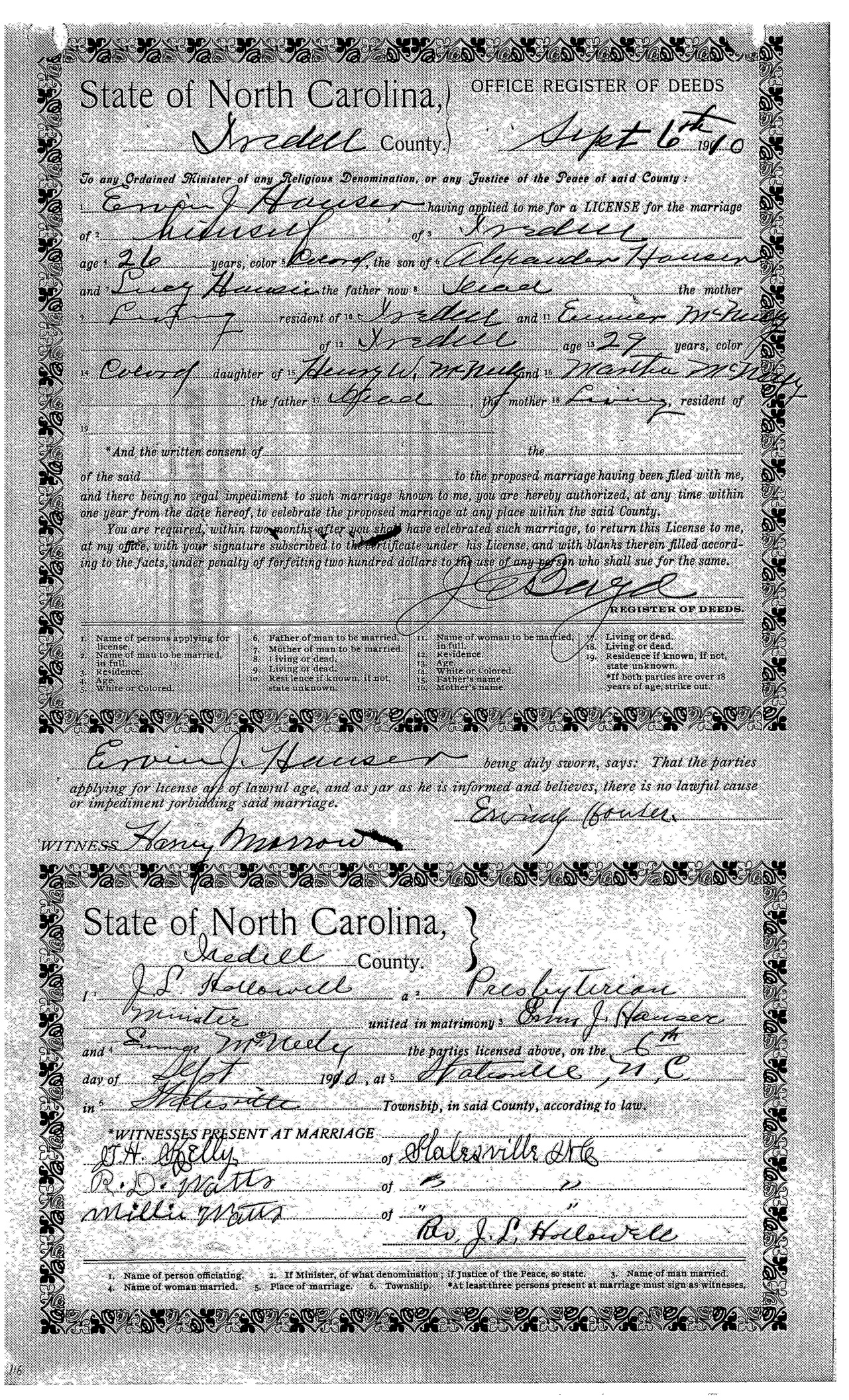
Irving L. Houser was born in 1885 in Iredell County to Alexander “Dan” and Lucy Houser. He and Emma McNeely were married 6 September 1910 in Statesville. The couple migrated to Bayonne, New Jersey, and settled on Andrew Street.

McNEELY -- Ervin Hauser & Emmer McNeely Marr Lic

Six years later, in a span of three days, Irving appeared twice in New York City newspapers. First:

OLD JOBS OFFERED BAYONNE STRIKERS

Standard Oil Co. Tells Them They May Come Back, But Without Increase of Wages.

MRS. CRAM PLANS NEW VISIT.

Says She Will Consult a Lawyer and Won’t Be Barred — Federal Conciliators at Work.

The Standard Oil Company refused yesterday to grant the wage increases demanded by employees whose strike has tied up practically every big Plant in the Constable Hook section of Bayonne, N.J. for more than a week, but offered to take the strikers back at the old wage scale whenever the men wanted to resume work.  The Committee of Ten, which learned these terms from George B. Hennessey, General Superintendent of the Bayonne plant, endeavored to report to the body of strikers.  The police prevented them because no police permit to hold a mass meeting had been requested, but one was issued for a meeting this morning, at which the strikers will decide whether to accept or decline the terms.

     …

Pending today’s meeting, the strikers were quiet yesterday.  Early in the morning there had been some disorder at Avenue E and Twenty-fourth Street, bringing a squad of policemen, who fired as many more.  They caught Irving Houser of 92 Andrew Street, an employee of the Edible Products Company, which plant is near the Tidewater Oil Company, and locked him when they found a revolver in his pocket.

New York Times, 18 Oct 1916.

Then,

Bayonne, N.J.

Miss Viola Houser, of Orange, N.J., visited her brother and sister, Mr. and Mrs. Irving Houser, Andrew Street, on Sunday, October 10.

New York Age, 21 Oct 1916.

Amid social unrest and social calls, Irving and Emma had three children: Mildred Wardenur (1913), Henry A. (1915) and Irving L. Houser Jr.  (1920).  For many years, Irving worked in various jobs in an oil refinery, but by time he registered for the “Old Man’s Draft” of 1942, he was employed at Bayonne City Hall.  By then, he had purchased a house at 421 Avenue C, a site now occupied by Bayonne Giant Laundromat.  Irving Houser Sr. died in 1962.

Standard
Births Deaths Marriages, North Carolina, Oral History, Other Documents, Paternal Kin, Photographs, Religion

When your pilgrimage is over.

… Self life that might hender and draw you to earthly thing it inpels you on in to Godlines Paul sed I die dailey to the things of this world yeal your life dailey and hold your life in submision to the will of God and live by his word that you may grow unto the fulles measure of the staturs of Chris the one that lives wright is the ones who will a bide bide with him the day of his coming and stand when he a …

… Come by your God like impression God will take care of you no matter where you are cax aside all fear and put your trust in God and you are save.  Then when your pulgrimage is over and you are call from labor to reward you will be greeted with that holy welcome that is delivered to all true missionaries come in the blessed of my father …

My grandmother had a large, dusty black Bible that had belonged to her “mama,” Sarah Henderson Jacobs Silver.  (The Bible’s original owner was Carolina Vick, a midwife in east Wilson — her family’s birth and death dates are inscribed in its leaves.)  When I first thumbed through the Book in the early 1990s, I found two scraps of paper stuck deep in its chapters. Pencilled in a square, unsophisticated hand were these bits of Sarah’s sermons. She had left the Congregationalism of her upbringing and joined the Holiness movement sweeping the country in the early 1900s.  My grandmother was not impressed:

I was just thinking ‘bout that today, ‘bout how we used to do.  Mama’d make us go to Holiness Church and stay down there and run a revival two weeks.  And we’d go down there every night and lay back down there on the bench and go to sleep.  Then they’d get us up, and then we didn’t have sense enough to do nothing but go to sleep and get up. 

Mama’d go every night.  And they’d be shouting, holy and sanctified, jumping and shouting.  I don’t know, that put me out with the Holiness church.  And sanctified people.  I know Mama wont doing right.

Evangelist Sarah spent night after night jumping and shouting, leaving my adolescent grandmother to wash and iron the endless loads of laundry they took in from white customers. Sarah apparently met her second husband, Rev. Joseph Silver, founder of one of the earliest Holiness churches in eastern North Carolina, on the revival circuit. They married in 1933 and divided the five years before her death between Wilson and his home in Halifax County.

Evangelist

Sarah H. Jacobs and her Bible, with my uncle Lucian J. Henderson in the background, taken in Wilson NC circa 1930. (I have the Bible, but some time between when I first saw — and transcribed — the sermon scraps and when I took possession after my grandmother’s death in 2001, the pieces of paper were lost.)

Photo of Sarah Henderson Jacobs Silver in the collection of Lisa Y. Henderson. Interview of Hattie Henderson Ricks by Lisa Y. Henderson; all rights reserved.

Standard
Births Deaths Marriages, Maternal Kin, Newspaper Articles, North Carolina, Oral History

Elizabeth. And Elizabeth.

Henry McNeely had two Lizzies.

The first Elizabeth McNeely appears as a 13 year-old in Henry’s household in the 1870 census of Rowan County. In a letter written in 1987, my grandmother explained that the girl was abandoned at her father’s doorstep. (Before Emancipation, or after?) He reared her, but I know nothing further about her.

My grandmother’s earliest memory involved the second Elizabeth McNeely, who was Henry’s oldest daughter with Martha Miller McNeely. My grandmother recalled riding on a train from Statesville to Winston-Salem to visit her mother’s sister.

Me: Which sister was that?

My grandmother: Lizzie.

Me: It was like a day trip, or y’all went for —

My grandmother: I don’t remember. You know, I was kind of young.

Me: Yeah. Yeah. You were what? Like, two?

My grandmother: Yeah. I think two. Somebody said I wouldn’t, I couldn’t possibly remember, but I do. I do because, you know, it looked like the trees were going like that. [Moves her hand across her face quickly.] ‘Round and ’round. And I was sitting up in the window. I know I was looking out the window. And that was one of my first memories.

This Elizabeth McNeely was born in 1877. In 1900, she married William Watt Kilpatrick in Statesville, and I discovered JUST TODAY, via their license, that her full name was Margaret Lougene Elizabeth McNeely. The marriage seems not to have been a happy one:

CUT AT A CHURCH FESTIVAL.

One Negro in Jail and Another Under Bond – Cases in the Local Courts.

Watt Kilpatrick was before Justice Carlton Wednesday for wife-beating and was fined $5 and the cost.

Statesville Landmark, 21 September 1906.

At the time of the 1910 census, around the time my grandmother went by train to visit, the couple were living in Oldtown, Forsyth County. Seven years later, when Watt registered for the World War I draft, he gave his address as 17 Roanoke in Winston-Salem and reported working as a shape puller at R.J. Reynolds Tobacco Company. Lizzie “Patrick” was listed as his next of kin, but resided in Statesville. When the censustaker returned in 1920, Watt was sharing a house with another woman, and Lizzie was not to be found.

On 1 February 1923, the Statesville Landmark posted this notice:

SUPERIOR COURT ADJOURNS.

… Elizabeth Kilpatrick, colored, was granted a divorce from Watt Kilpatrick.

Four months later, she married John Long. She spent the rest of her life in Iredell County.

In 1950, Lizzie Long died in a housefire. Beyond the basic tragedy of her death, there is something unsettling about this account of the “accident.”

Image

Statesville Landmark, 28 September 1950.

(My grandmother would have expressed a tart opinion about what happened, but I didn’t know to ask her.) Whatever the case, the shock of Lizzie’s death sent her youngest brother into cardiac arrest, and the family had to bury two McNeelys that September.

Standard
Births Deaths Marriages, Enslaved People, Maternal Kin, North Carolina, Oral History

Millers & McConnaugheys.

Me:  Did you know any of your grandmother Martha’s people? The Millers?

My grandmother: No, I didn’t.

Me: Did you know any of his people? Henry’s?

Grandmother: No.

Me: It was a lot of them in Rowan — it was a lot of Millers anyway. In Rowan County.

Grandmother: Rowan County? I know they all came from there.

——

In the valuation of Rowan County slaves made by a Confederate tax assessor in 1863, John M. McConnaughey listed 19 slaves.  Among them were: George, 24, $1500; John, 2, $150; Edwin, 1, $100; Margaret, 42, $850; Caroline, 23, $1200; Mary Ann, 13, $1000; Grace, 10, $500; Martha, 7, $250; and Angeline, 7, $250.

Here is the case for these seven people as the family of my great-great-grandmother, Martha Miller McNeely:

1.  George Miller described John McConnaughey as his half-brother in the 1880 census of Rowan County. George’s death certificate lists his parents as Edward Miller and Margaret Miller.

2.  Caroline McConnaughey is listed in the household of her mother Margaret McConnaughey in the 1870 census of Rowan County.

3.  Adeline Miller is listed with her eight month-old son George in the household of Mary [McConnaughey] Miller in the 1870 census of Rowan County. Her marriage license lists her parents as Edward Miller and Margaret Miller. She gave her three children – George, Margaret and Mary Caroline – family names. In the 1880 and 1900 censuses, she and her family are listed next door to Mary Ann Miller and family. In 1888, she witnessed the marriage of John McConnaughey. Her death certificate lists her parents as Ed. and Marg. Miller.

4.  In the 1870 Rowan County census, the household of Mary Ann [McConnaughey] Miller and her husband Ransom Miller included Adeline Miller and John McConnaughey. Mary Anna Miller’s death certificate lists her father as Edward McConaughey, mother unknown.

5.  Martha Miller is listed in the household of her former owner, John Miller McConnaughey, in the 1870 census of Rowan County. (She is a farm laborer, but she also attends school.) Martha’s 1872 marriage license lists her parents as Edwin Miller and Margaret Miller. Her middle name was Margaret. She named her oldest daughter Margaret, her youngest son Edward, and two daughters Caroline (as a first and then a middle name.)

6.  John McConnaughey is listed twice in the 1870 census of Rowan County. First, with  Margaret McConnaughey and Angeline McConnaughey. Then, with Mary Miller. John married four times. Each license listed one parent, Margaret McConnaughey. “John McConeyhead” was a witness to the marriage of Adeline Miller Miller’s daughter Mary C. Miller in 1876. His death certificate lists his parents as Henry McConnaughey and Margaret McConnaughey.

7.  Edwin Miller (or McConnaughey) has not been found outside the 1863 tax list. I include him because of the similarity of his first name to that of Edward/Edwin Miller, father of the above, but there’s no real evidence that he was one of Margaret’s children.

Margaret McConnaughey appears in only one census, 1870, where she is listed as 55 years old. Edward or Edwin Miller has not been found, and the two did not register a cohabitation. Their children:

George W. Miller, born about 1836. He married Eliza Catherine Kerr, probably around 1857. They had three children, Baldy Alexander Miller (1858-1942), Maria Miller (1868-1925) and Onie Jane Miller Johnson (1879-1970). In 1868, George registered to vote with his brothers-in-law Ransom Miller, Green Miller and Henry McNeely. He died 15 March 1915.

Caroline McConnaughey, born about 1842. Her daughter Angeline was born in 1858. The child’s father was Robert Locke McConnaughey, nephew of Caroline’s former owner, John M. McConnaughey.  Caroline apparently died before the 1870 census was taken. She is listed as Caroline McConnaughey (and noted as deceased) on Angeline McConnaughey Reeves’ 1875 marriage license.

Mary Anna McConnaughey, born about 1847. She married Ransom Miller, son of Edmund and Malissa Miller in Rowan County on 27 December 1866. Their children were James Douglas Miller, Florence A. Miller, Ida L. Miller, Margaret E. Miller, Spencer Miller, Lina Miller, Hattie A. Miller, Thomas E. Miller, Richmond Miller.  In 1910, the family lived on Sherrills Ford Road in Steele township. Mary Anna died Christmas Eve 1940 in Boydens Quarters, Rowan County.

Grace Adeline Miller, born 25 June 1853. Her first child, George, was born in 1869. She married Green Miller, son of Edward and Melissa Miller, in 1871, and their children included Margaret Miller and Mary Caroline Miller Brown. She died 30 July 1918.

Martha Margaret Miller, born about 1857. She married Henry W. McNeely in 1872. Their children were Elizabeth McNeely Kilpatrick Long, John McNeely, William Luther McNeely, Emma McNeely Houser, Caroline McNeely Colvert, Addie McNeely Smith, Elethea McNeely Weaver, Minnie McNeely, Edward M. McNeely and Janie McNeely Taylor Manley. Martha and her family moved to Statesville, Iredell County before 1900. In the late 1920s, she moved to Bayonne NJ, where she died 16 June 1934.

John B. McConnaughey was born about 1861. His father likely was not Edward, but a white man. John married Minnie Barr, Romie Harris, Nora Barber and Jane Foster. He died 21 August 1931.

Standard
Births Deaths Marriages, Free People of Color, North Carolina, Oral History, Other Documents, Paternal Kin

He was gon make something off the crop.

And Papa was sick, and somebody had to watch him.  He wasn’t down in the bed, but his mind was kind of off.  Now he’d listen to you, you’d talk to him, and anything he wanted, had to tell you about it.  “Naw, you can’t go there.  I got to go home.  I got to go home.”  Said he had to go home.  I said, “We are home.”  Said, “Naw, we’re not.”  That’s the way his mind worked.  Like that. 

So after Mamie got married in Greensboro, I come on back to Wilson, and then, after I come back, I hated I’d come back ‘cause I had to – Papa’s mind was bad, and I had to stay home.  To keep him.  He’d go ‘way from the house and couldn’t find his way back. And he was ruptured from the time I can remember. And so at that time Mama was working in the factory, and school wasn’t open, but when school opened, I had to stay home and look out for him.  And then, so finally, when he died.  He was supposed to have an operation.  He was ruptured, and Carrie, she claimed she didn’t know it.  And I said, now, I was the youngest child was there, and I knowed that all that stuff that was down ‘tween his legs was something wrong with him.  He went up to Mercy Hospital for something, probably his rupture – I know he had to go to the hospital for treatments or something.  Anyway, the last time, Carrie came down and she was fussing about if she’d known Papa had to have an operation, she’d have come down and he’d have had it.  Instead of waiting until it was too late.  Now the last week they wasn’t expecting him to live.  But, no bigger than I was, I knew he had it.  And she was grown, old enough for my mother, and then she talking ‘bout she didn’t know he was ruptured?  Well, all his tubes was, ah –  And he always had to wear a truss to hold hisself up.  And when he’d be down, I’d be down there sweeping at the school, and he’d be out there plowing a field he rented out there, and he’d come up, lay down on the floor and take a chair and he’d put his legs up over the chair like that, and I’d wet the cloths from the bowl where was in the hall, some of the old dust cloths, and hand them to him, and he’d put them down on his side, and you could hear it ‘bluckup’ and that thing would go back there.  But see it had got, his intestines, that tissue between there had bursted, and the doctor told him he needed an operation.  So he was gon get it, but he didn’t have money enough to get it.  Didn’t save up money enough to have the operation.  So none of the children – all of them know, as large as his – but leastways he couldn’t hide himself, ‘cause even from a little child, I could see that for years, and I wondered what it was.  ‘Cause I know everybody didn’t have it, at least didn’t have all that in their britches ….  And Carrie come down there, and she fuss Mama out about him not having the operation and this kind of stuff.  And she said, “Well, we never had the money to get the operation.”  We tried to go and get it, and we’d pay on it by time.  But, naw, he wanted, he was gon make something off the crop, and he’d pay.  Pay it and have it then.  But he never got the chance.  So when they put him in the hospital and operated on him, say when they cut him, he had over a quart of pus in him.  I think it was on a Thursday, and he lived ‘til that Tuesday.

NorthCarolinaDeathCertificates1909-1975ForJessieAdamJacobs——

Oh, this breaks my heart. (And she was absolutely right. July 6, 1926, was a Tuesday.)

Excerpts from interviews of Hattie Henderson Ricks by Lisa Y. Henderson; all rights reserved.

Standard
Births Deaths Marriages, Maternal Kin, North Carolina, Oral History

William. And William.

Me: There was something I was going to ask you …. Now, I knew — I found out that she had a brother. Named William.

My grandmother: Who?

Me: Nicholson. Ommm, Harriet.

My grandmother: He was a white man, honey.

Me: Her real brother.

Grandmother: It was her half-brother. He was a white man that owned the undertaking business.

——

Harriet Nicholson Tomlin Hart had two brothers named William. One black, one white.

The first, with whom she shared a mother, was William H. Nicholson, born Christmas Day 1842. After her husband Abner’s death, Harriet and her youngest son Golar went to live with him in Charlotte, North Carolina, about 35 miles south of Statesville. In 1900, the censustaker recorded the family at 611 E. Stonewall. William worked as a plasterer, and Harriet is designated as his sister. She acted as informant on his death certificate, filed a few days after he died 17 December 1909, naming his parents as Burwell Carson and Lucinda Cowles. I have found no other references to his life.

The other brother, with whom she shared a father, was William Thomas Leonadas Nicholson, one of two sons of James Lee Nicholson and Martha “Mattie” Colvert Nicholson. (The other was John Walter Lee Nicholson.) William was a boy of 7 when Lee Nicholson died in 1871, and he was reared with his mother’s family in northern Iredell County. (She was the daughter of William I. Colvert, former owner of Walker and John W. Colvert. The latter fathered Harriet Nicholson’s oldest child.) In 1878, the Nicholson family “began to make and sell caskets at the general store they operated [in] northern Iredell County. As was common in the late 1800s, many undertakers were also furniture makers, and the Nicholsons continued to sell caskets and conduct funerals in their furniture store when they moved to Statesville. At the time, a casket’s price was based on the wood used and its size—probably between $25 and $35 for an adult casket. W.T. Nicholson moved the funeral home into its current location in 1920, and he remained its owner until his death in 1951.” William T. Nicholson handled preparations for his sister’s burial — whether he acknowledged her or not — as well as John W. Colvert. Nicholson Funeral Home, at 135 East Front Street, Statesville, remains in operation.

Standard