Births Deaths Marriages, Free People of Color, North Carolina, Other Documents, Paternal Kin

Misinformation Monday, no. 6.

The sixth in a series of posts revealing the fallability of records, even “official” ones.

——

Again, from “The Adam Artis Family History”

Adam Artis had about five wives and 39 children. His first legal wife was Frances Hagens of Eureka. She was very fair and had beautiful long black silky hair. 

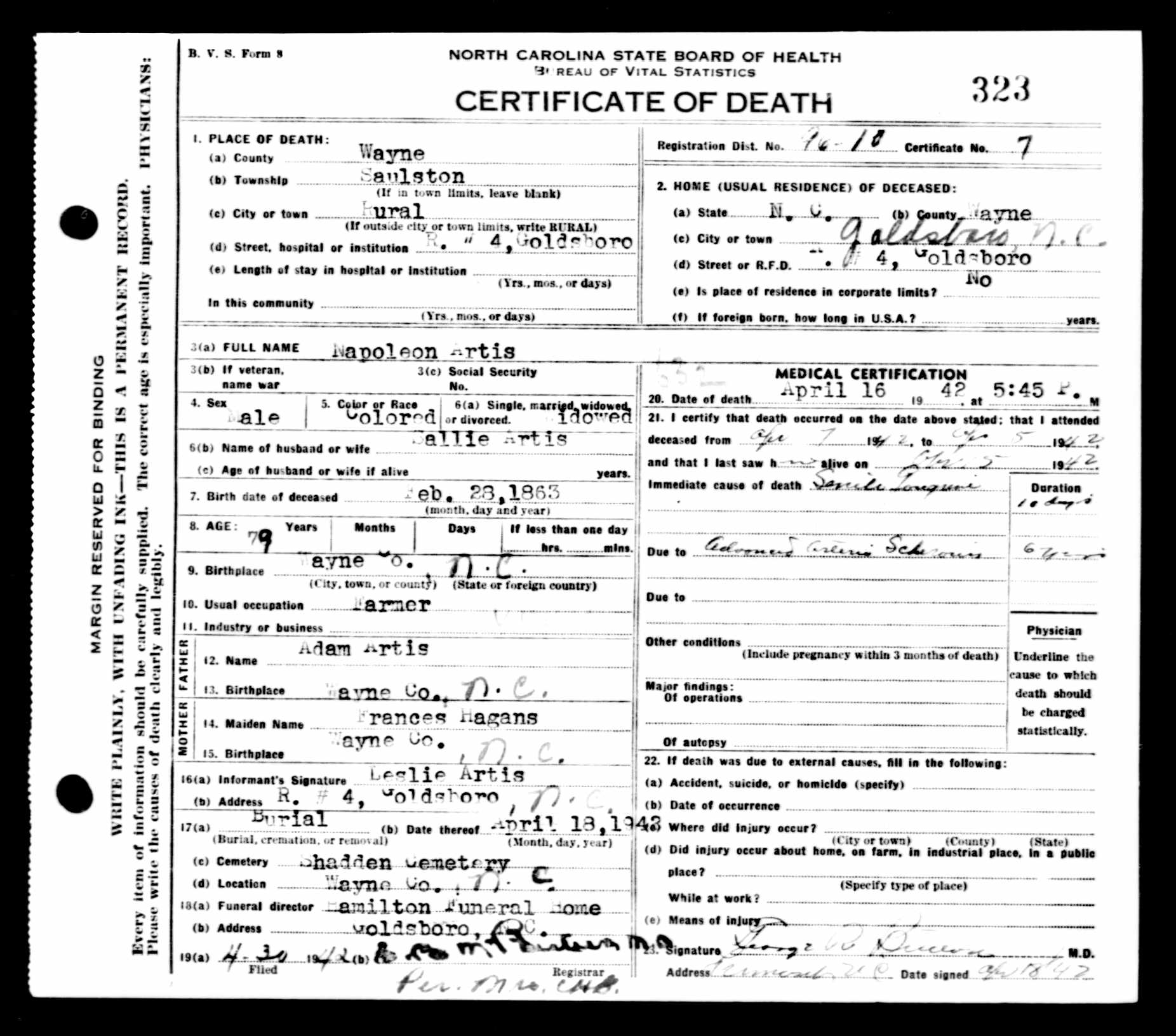
Frances Hagans. By the early 20th century, that this was Frances Artis’ maiden name was accepted wisdom. When four of her children — Vicey Artis Aldridge, Napoleon Artis, William M. Artis and Walter S. Artis — died, their informants replied “Frances Hagans” when asked the name of the mother of the deceased. Researchers find these records and dutifully set down her name this way in the innumerable family trees of her innumerable kin.

NorthCarolinaDeathCertificates1909-1975ForNapoleonArtis

But Frances Artis was not born a Hagans. She was a Seaberry, as her earliest records attest. She is Frances Seaberry, daughter of Aaron and Levisa Seaberry in both the 1850 and 1860 censuses. Most tellingly, it is the name Adam Artis gave the registrar when he applied for their marriage license in 1861.

ARTIS_--_Adam_Artis_Frances_Seberry_Marr_Lic

How, this mix-up? It is a case of transferral. Frances’ mother’s maiden name was Hagans and gave birth to a son, Napoleon Hagans, before she married Aaron Seaberry. Napoleon Hagans grew to become one of the wealthiest “colored” men in Wayne County, larger than life, feared and respected by black and white alike. Given the shadow that Frances’ brother (probably half-brother, in fact) cast, it is not surprising that 50+ years after her death, her descendants assumed that she was a Hagans, too.

Standard
Births Deaths Marriages, Free People of Color, Land, North Carolina, Other Documents, Paternal Kin, Photographs

A lot in Negro Town.

This convoluted case involves a dispute between two parties claiming title to a lot that once belonged to Needham Kennedy, Mathew W. Aldridge’s father-in-law. The ins and outs of the lawsuit are difficult to extract from the decision and, in any case, are not the most interesting aspects of the matter for me. Rather, my focus is on the evidence of relationships among Kennedy’s children (and their spouses) and the light shed on the affairs of a family that had quickly accumulated property post-slavery.

There is astoundingly little in conventional records about Needham Kennedy. I assume he was native to Wayne County, perhaps the former slave of one of several Kennedy families in the area. However, to my confusion and dismay, I have found neither him nor his family in any census records prior to 1900. Where were these landowners???

All the more important, then, is the personal information that can be gleaned from the North Carolina Supreme Court’s decision in Bradford v. Bank of Warsaw, 182 N.C. 225 (1921). The main opinion in the case gives some information, but the fullest, clearest details are set forth in a dissenting opinion. A distillation of it all:

Needham Kennedy bought a lot measuring 42 feet by 210 feet in “’Negro Town,’ a suburb of Goldsboro,” on 12 January 1870 and registered his deed six years later.  He also owned other property. Needham died intestate about 1898, leaving five children – Fannie Kennedy Aldridge, Ida Kennedy Darden, Bryant Kennedy, William Kennedy, and Levi Kennedy  – and a wife, the children’s stepmother, who died in 1908. (Their birth mother was named Patience, maiden name possibly Kennedy.)  After the stepmother’s death, the children arranged to divide the property so that William and Bryant, who lived in New Jersey, would receive cash and their sisters and Levi would divide the land. Ida was to get the contested lot (A); Fannie, lot B; and Levi, lot C.

In 1909 and 1910, William, Bryant and Levi conveyed their interest in A to Ida. The deeds from William and Bryant were not recorded until 1921, and Levi’s was lost and never recorded. On 21 March 1910, at lawyer A.C. Davis’ office, Fannie Aldridge and husband Mathew conveyed her interest in A to Ida and her interest in C to Levi.  Levi and wife and Ida Darden and her husband John conveyed their interest in B to Mathew Aldridge. These deeds were immediately probated, and Fannie, Ida and Levi took possession of their respective lots.  (Levi later sold his.)

To secure a sum of money that Ida owed Mathew, Ida gave him a mortgage on A dated 22 March 1910, which was recorded that day. Ida had received rents from A since her stepmother’s death and continued to do so until 20 May 1912. On that day, Mathew Aldridge sold the mortgaged property to Captain A.J. Brown, who recorded the deed on 11 June 1912.

Captain Brown, and later his heirs, received rents from A from the date of purchase until 27 March 1915. On that day, the heirs sold the lot to defendant Bank of Warsaw, which recorded its deed on 1 May 1916. The bank then began to receive rents.

In the meantime, on 14 July 1916, William, Bryant and Levi Kennedy conveyed their undivided 3/5 interest in lot A to J.J. Ham. The deeds were registered 24 August 1916. On 17 October 1917, Ham conveyed his interest in the lot to N.E. Bradford, who registered the deed 24 October 1917. Thus, both Bradford and the Bank claimed interests in the title to A on the basis of deeds executed by various heirs of Needham Kennedy.

My year of property law class is far behind me, and I won’t attempt to untangle the dense reasoning set forth in the majority opinion in this matter.  Suffice it to say, the Bank of Warsaw lost its appeal.

——

Fannie’s husband Mathew W. Aldridge, brother of my great-great-grandfather John, died in 1920. Seven months later, Fannie married W.D. Farmer.  (What’s the story there?) I have not found her death certificate.

Image

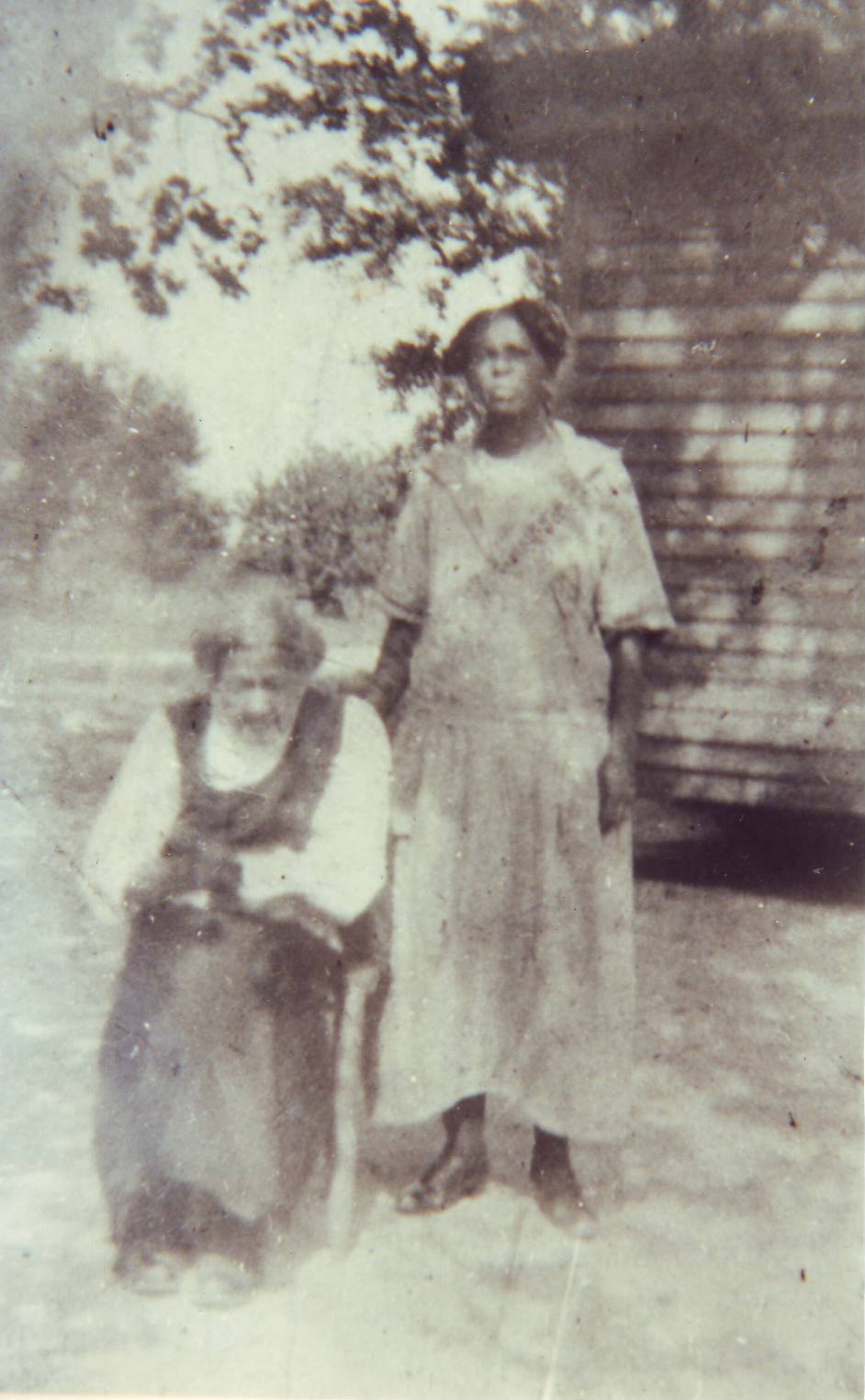
Eliza Balkcum Aldridge and her daughter-in-law, Fannie Kennedy Aldridge, circa 1920.

Levi Kennedy died 6 February 1940 in Goldsboro. His death certificate notes that he lived at 310 W. Pine Street, that he was a clothing merchant, and that he was married to Anna Kennedy.  He was born in 1875 in Goldsboro, and his parents were listed as Needham and Patience Kennedy. He is buried in Elmwood cemetery.

Ida Kennedy Darden Lamb died 18 December 1954 in Goldsboro. She was a widow and resided at 305 West Elm Street. She was born 18 March 1874 to “Needman” and Patience Kennedy.

I’ve been unable to trace William and Bryant Kennedy in New Jersey.

Standard
Births Deaths Marriages, Free People of Color, Migration, North Carolina, Other Documents, Paternal Kin

Misinformation Monday, no. 5.

The fifth in a series of posts revealing the fallability of records, even “official” ones.

——

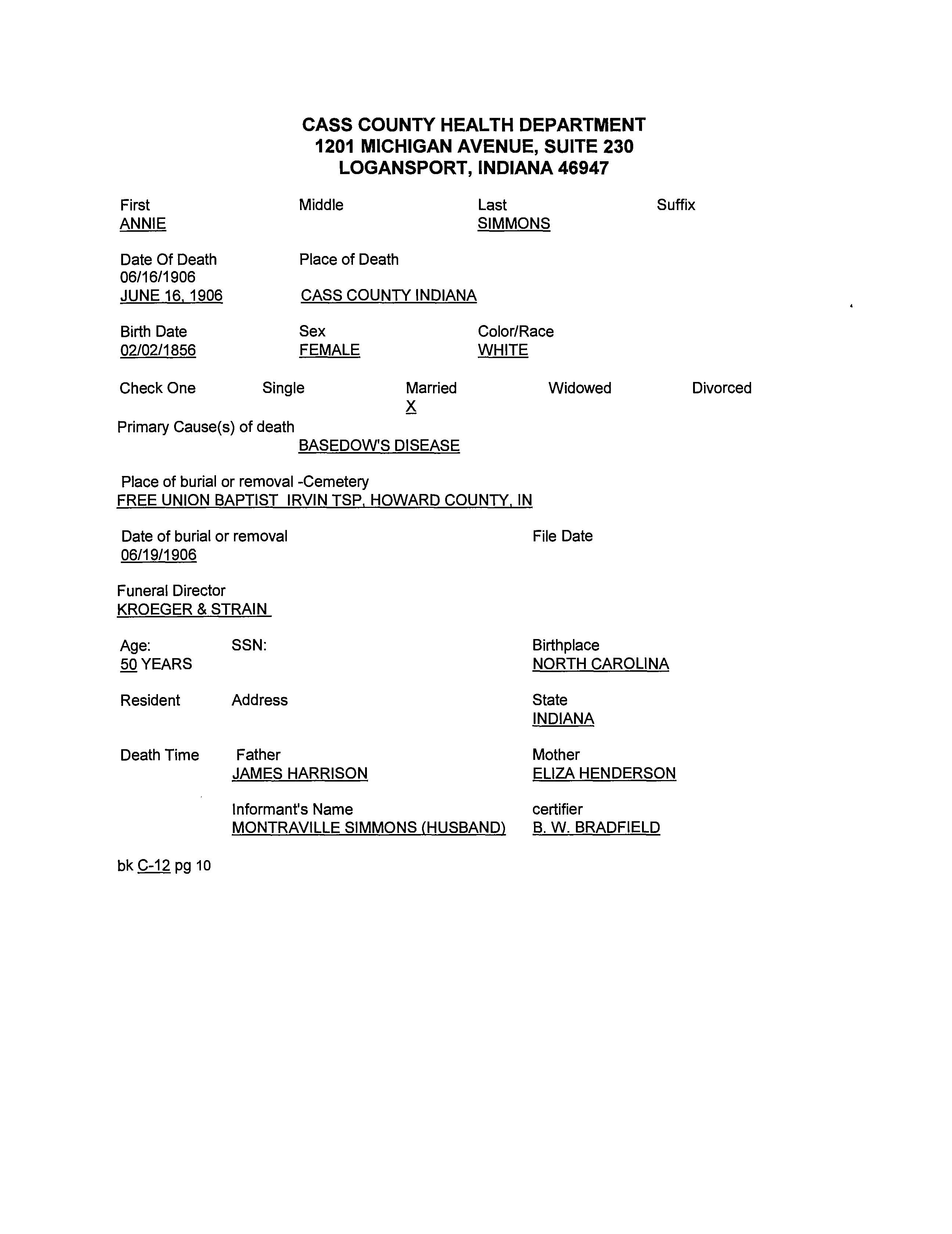
HENDERSON_--_Annie_Simmons_Death_Cert

What’s right with this death certificate? Annie Simmons‘ name — more or less, as she seems to have been called Anna in her youth. Presumably, her date and place of death. Her birthday may be right, though the birth year is probably three or four years late. She was certainly female.

But she was not white.

Annie Simmons was mixed-race, described as “mulatto” in early life and “colored” (and even “African”) thereafter. She is consistently classified in census records in two states (North Carolina and Indiana) and a province (Ontario), as well as her marriage license. The local newspaper avidly carried news of her husband Montraville Simmons’ antics and was quick to point out his non-white status.  (She was certainly married, if unhappily.)

(By the way, Basedow’s disease is more commonly known as Graves’ disease, or hyperthyroidism.)

Annie was probably 54, rather than 50, and she was certainly born in North Carolina, but not to “James Harrison” and “Eliza Henderson.” Rather, as is clearly set forth in her application for a marriage license in Duplin County NC, her parents were James Henderson and Eliza Armwood. Montraville Simmons probably had not seen his in-laws in more than 40 years when he gave this information. His errors are perhaps excusable, but there they are, enshrined as “fact” and forever leading researchers astray.

Standard
Births Deaths Marriages, Land, Maternal Kin, North Carolina, Other Documents, Rights

Murdock v. Deal, 208 N.C. 754, 182 S.E. 466 (1935).

In case you’re interested, here’s the text of the Supreme Court’s decision regarding Bertha Hart Murdock’s land. Property law is not my strong suit, especially as it applies to inheritance, so I will not attempt an explication.

——

This is an action for a declaratory judgment construing the last will and testament of T. L. Hart, deceased, and adjudging that by virtue of said last will and testament the feme plaintiff is the owner of an indefeasible estate in fee simple in certain lands described in the complaint, and has the power, with the joinder of her husband, to convey the same in accordance with her contract with the defendant.

The facts admitted in the pleadings are as follows:

T. L. Hart died in Iredell county, N. C., during the year 1930, having first made and published his last will and testament, which was duly probated by the clerk of the superior court of Iredell county, and recorded in the office of said clerk on June 4, 1930.

By his last will and testament, the said T. L. Hart devised his home place in Iredell county “to my daughter, Bertha May Hart and her bodily heirs, forever, never to be sold, and if she dies without bodily heirs, then it must be in trust for my sisters’ heirs, to hold but never to sell the same.”

By a codicil to his said last will and testament, the said T. L. Hart devised to his daughter, Bertha Mae Hart, a tract of land in Iredell county, containing forty-five acres, and described in the complaint by metes and bounds.

At his death, T. L. Hart left surviving as his only heir at law his daughter, Bertha Mae Hart, who has since intermarried with the plaintiff W. J. Murdock. He also left surviving five sisters, three of whom are married. Each of these sisters has children. Neither of his two unmarried sisters has children. Both are now over fifty years of age.

On April 1, 1935, the plaintiffs and the defendant entered into a contract in writing, by which the plaintiffs agreed to convey to the defendant a fee-simple estate, free and clear of all liens or incumbrances, in two tracts of land, one tract containing twelve acres, and being a part of the home place of T. L. Hart, deceased, which was devised to the feme plaintiff by the said T. L. Hart in his last will and testament, and the other tract containing forty-five acres and being the tract which was devised to the feme plaintiff by T. L. Hart, deceased, by the codicil to his last will and testament. By said contract, the defendant agreed to pay to the plaintiffs the sum of $1,000, upon the execution and delivery to him by the plaintiffs of a deed conveying both said tracts of land to the defendant, in fee simple, in accordance with said contract.

The defendant has refused to accept the deed tendered to him by the plaintiffs, and has declined to pay the plaintiffs the sum of $1,000, in accordance with said contract, on the ground that the feme plaintiff is not the owner of an indefeasible estate in fee simple in said tracts of land, and for that reason the plaintiffs cannot convey to him such an estate in said lands, in accordance with their contract.

On these facts the court was of opinion and so held that the feme plaintiff is the owner of an indefeasible estate in fee simple in the forty-five-acre tract, but that she is not the owner of such an estate in the twelve-acre tract.

It was accordingly ordered, considered, and adjudged that plaintiffs are not entitled to the specific performance by the defendant of the contract set up in the complaint, and that the defendant recover of the plaintiffs the costs of the action. The plaintiffs appealed to the Supreme Court, assigning as error the holding of the court that the feme plaintiff is not the owner of an indefeasible estate in fee simple in the twelve-acre tract described in the complaint.

Opinion

CONNOR, Justice.

There is no error in the judgment in this action. By virtue of the last will and testament of her father, T. L. Hart, deceased, and under the statute, C. S. § 1734, the feme plaintiff is the owner of an estate in fee simple in the twelve-acre tract described in the complaint. This estate, however, is defeasible upon the death of the feme plaintiff without bodily heirs. Whitfield v. Garris, 131 N. C. 148, 42 S. E. 568, and Id., 134 N. C. 24, 45 S. E. 904. It is clear that the words “bodily heirs,” used by the testator, must be construed as meaning children or issue; otherwise the limitation over to the heirs of the sisters of the testator would be meaningless. Rollins v. Keel, 115 N. C. 68, 20 S. E. 209. See Pugh v. Allen, 179 N. C. 307, 102 S. E. 394.

The limitation over to the heirs of the sisters of the testator, upon the death of the feme plaintiff, without bodily heirs or issue, is not void. The provision in the will that the home place of the testator, which includes the twelve-acre tract described in the complaint, shall not be sold by either the feme plaintiff or the remaindermen is void as against public policy. This provision, however, does not affect the validity of the devise either to the plaintiff or to the remaindermen. See Lee v. Oates, 171 N. C. 717, 88 S. E. 889, Ann. Cas. 1917A, 514.

There is nothing in the codicil which affects the estate in the home place of the testator devised in the will to the feme plaintiff.

The judgment is affirmed.

Standard
Education, Newspaper Articles, Other Documents, Vocation

Where we worked: educators.

Henry W. McNeely, Mount Ulla NC — schoolteacher, circa 1870.

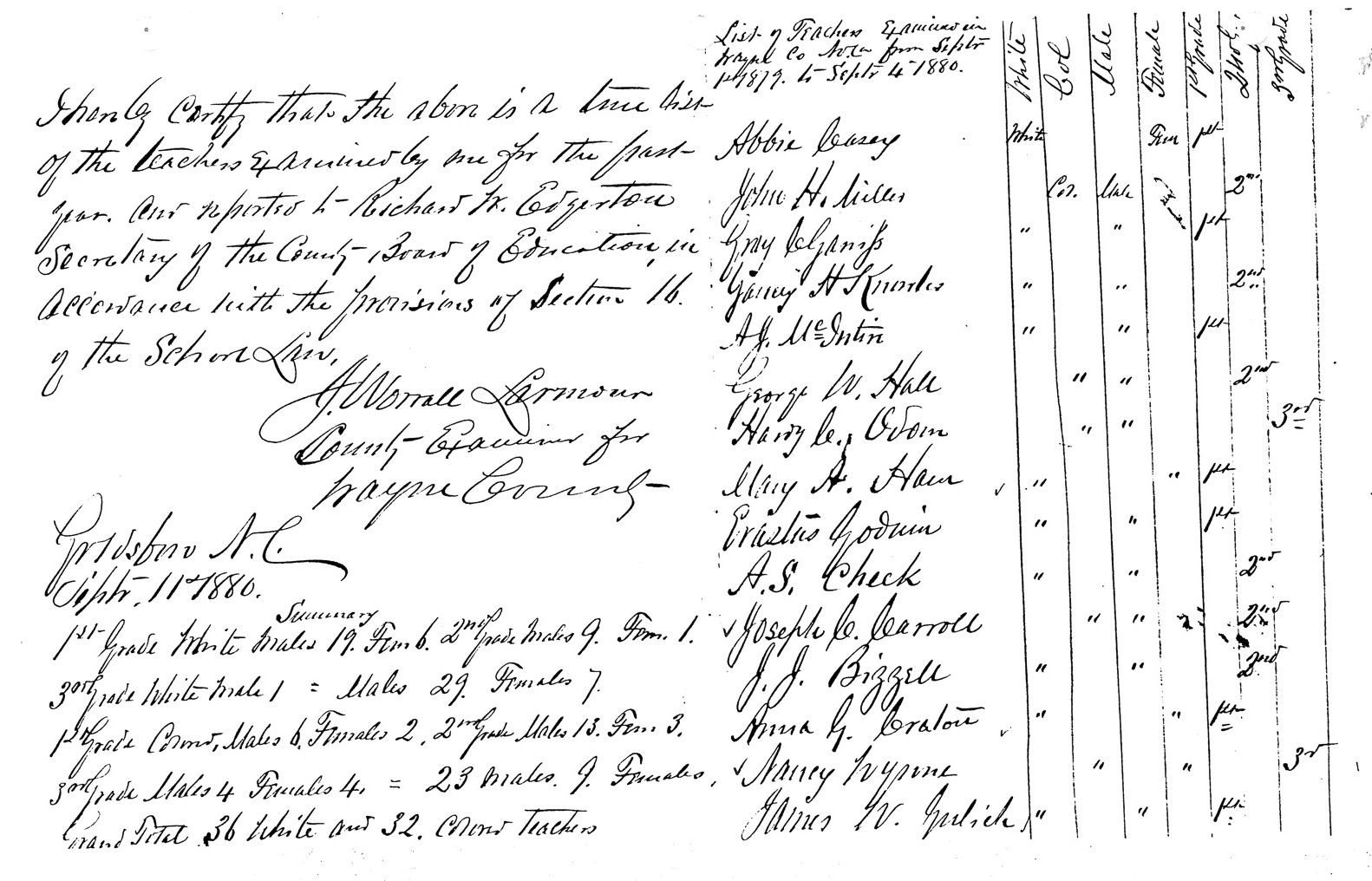
Joseph C. Carroll, Wayne County NC — second grade teacher, circa 1880.

John W. Aldridge, Wayne County NC — second grade teacher, circa 1880.

George W. Aldridge, Wayne County NC — first grade teacher, circa 1880.

Matthew W. Aldridge, Wayne County NC — second grade teacher, circa 1880.

ALDRIDGE -- Aldridge_School RecordsALDRIDGE -- Aldridge_School Records 2

Henry E. Hagans, Goldsboro NC — principal, State Colored Normal School, circa 1892-1920.

     The State Colored Normal School opened in this city yesterday, of which Prof. H.E. Hagans, son of Napoleon Hagans, one of the most respected and prosperous colored men in the State, from the Fremont section, has recently been elected principal.  The ARGUS is glad to note his election.  He merited the preferment, and we wish the school all success under his administration.  [– Goldsboro Weekly Argus, Thursday, 15 Sep 1892]

Clarissa Williams, Wilson NC — teacher, Eureka; Wilson Colored Graded School, circa 1890-1922.

     2 Feb 1901.  Called meeting of the Board, all present. Secretary stated that he had received the resignation of Mrs. Hunt as teacher of 5th grade, Col. school. Resignation accepted to take effect at once. Motion made that Clarrissy Williams be elected to fill the unexpired term of Mrs. Hunt.  Carried. There being no further business Board adjourned, by order of Geo. Hackney, Chairman  E.P. Mangum, Rec. Sec’y

     27 May 1901. Miss Clarissa Williams re-elected a teacher.

     9 June 1902. Teachers elected for Colored School: J.D. Reid, principal; Miss Clarissa Williams; Mrs. Annie Vick; Miss Geneva Battle; Miss Sallie Dortch (Goldsboro, N.C.) [from Minutes of the Wilson Graded Schools, bound volume, Wilson County Public Library]

Tabitha Pace Brunson, Garland AR – teacher, circa 1920.

Louise Colvert Renwick, Statesville NC — teacher, 1920s.

Golar Colvert Bradshaw, Iredell County NC — teacher, 1920s-30s.

Lillie Colvert Stockton, Statesville NC — teacher, Iredell County Schools, 1920s.

Mamie Aldridge Abrams Rochelle, Goldsboro NC, Union SC — teacher, circa 1930-1960s.

Arnetta L. Randall, Washington DC — teacher, Knoxville TN, circa 1930; Washington DC, circa 1940.

Fannie Randall Dorsey, Washington DC — teacher, circa 1930.

Vivian Manley Smith, Wayne County NC — teacher, circa 1930.

Margaret Colvert Allen, Statesville NC — teacher, circa 1930.

Marion Allen Lomans, Newport News VA — teacher, John Marshall School, 1935-1942.

Daisy Aldridge Williams, Asheville NC — teacher, circa 1940.

Mable Williams McCaine, Asheville NC — teacher, circa 1940.

Price B. Brown, Salisbury NC — teacher, circa 1940.

Sallie Bullock Brown, Salisbury NC — wife of Price Brown, “library work at school,” circa 1940.

Oscar Randall, Chicago IL — mathematics teacher, DuSable High School, circa 1940.

——

The eighth in an occasional series exploring the ways in which my kinfolk made their livings in the 19th and early 20th centuries.

Standard
Births Deaths Marriages, Free People of Color, Migration, North Carolina, Other Documents, Paternal Kin, Photographs

The Randalls of Washington DC.

fannie-a-randall  George Randall

On 18 Dec 1890, Fannie Aldridge married Robert Locust in the presence of her sister Lizzie Aldridge, brother M.W. Aldridge, and Robert’s neighbor George W. Reid. Robert’s first wife, Emma Artis, had died the previous year, and it is likely that he met Fannie, who lived at the other end of Wayne County, through her family. Fannie’s sister Amanda was married to Emma’s father Adam T. Artis, and her brother John was married to Emma’s sister Louvicey Artis.

Fannie and Robert’s first two children, William Hardy and Fred Robert, were born in Wayne County. Circa 1895, the family left North Carolina for Washington DC after– it is said —  Robert and a couple of Fannie’s relatives were involved in the murder of a white man. By time Robert, Fannie, his older daughters, and their boys arrived in DC, they were no longer Locusts. Robert, in fact, assumed a whole new name, and was George R. Randall ever after. According to their grandson, in order to collect Fannie’s inheritance when her father’s estate settled in 1902, the couple had to cross over into Alexandria, Virginia, where they were not known and could safely sign documents as Robert and Fannie Locust.

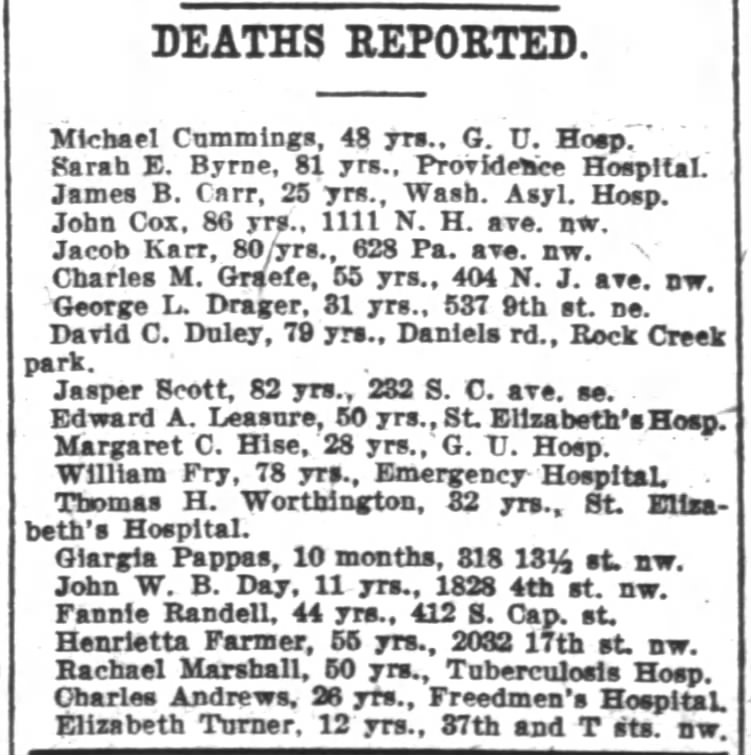
The 1900 and 1910 censuses recorded the family at 1238 Madison, then 138 B Street (no quadrant designated.) On 20 March 1917, Fannie “Randell” of 412 South Capitol Street was dead of heart disease. She was 44.

Wash Post 3 24 1917Washington Post, 24 March 1917.

In their 20 years in DC, she and Robert/George had been able to usher their children along the path to the middle class. Hardy Randall (1891-1967) went to work for the United States Postal Service. Fred R. Randall (1894-1996), a high school football standout, was a parks director. We met decorated officer Oscar Randall (1896-1985) here. Fannie Randall Dorsey (1900-1994) taught school, as did her sister Arnetta Randall (1904-1993). Edna Randall Breedlove (1909-1990) did not work after her marriage to Jesse Breedlove. George Randall died in infancy, as did two unnamed brothers.

Standard
Births Deaths Marriages, North Carolina, Other Documents, Paternal Kin, Photographs

Misinformation Monday, no. 3.

The third in a series of posts revealing the fallability of records, even “official” ones.

——

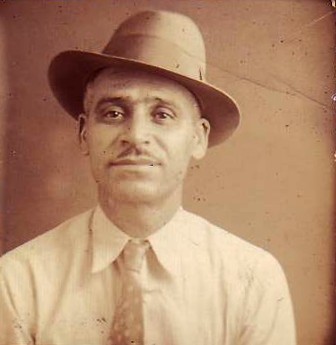
Jack Henderson 001

The “true facts”: Jesse “Jack” Henderson was the son of Loudie Henderson and Joseph Buckner Martin. He was born about 1893.

But …

On 3 Dec 1914, Solomon Ward applied for a marriage license for Jesse Henderson of Wilson, age 21, colored, son of Jesse Jacobs and Sarah Jacobs, both dead, and Pauline Artis of Wilson, age 18, colored, daughter of Alice Artis.  They were married later that day.

Jesse and Sarah Henderson Jacobs, in fact, were Jesse’s foster parents, and both were very much living at the time.  Sarah Henderson Jacobs was Jack’s maternal aunt.

And this …

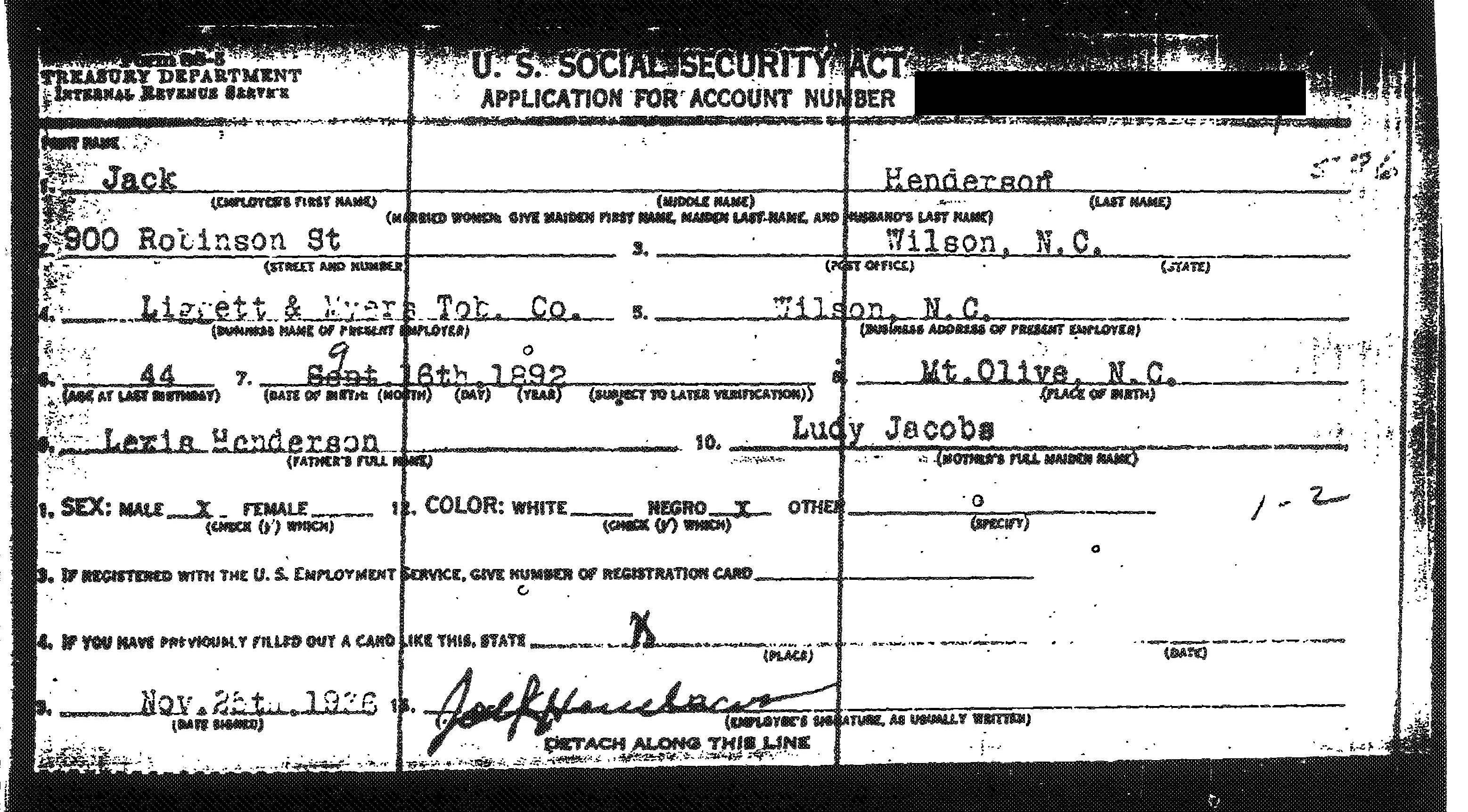
Jack_Henderson_SSN_App_Redacted

First, by reporting his first name as “Jack,” rather than Jesse, to the Social Security Administration, Jack effectuated a legal name change and ensured that few would remember the name he was given at birth.  (He was Jesse or Jessie in the 1910 and 1920 censuses, and when he registered for the draft in World War I, but Jack in the 1930 census and thereafter.)  The names he gave for his parents are mystifying. Lewis Henderson was, in fact, his grandfather. “Ludy” (or Loudie) was his mother’s name, but she was Loudie Henderson, not Jacobs. Jacobs was the surname of the uncle and aunt who reared him after Loudie’s death in childbirth. And note his birthdate: 16 Sept 1892. (His draft registration card listed 1893, month and day unknown.)

And this …

Jack Henderson’s death certificate, with information provided by a daughter, lists his parents as an unknown father and “Lucy (?) Henderson” and his birthdate as 21 April 1898.

“Lucy” certainly was Loudie. My grandmother remembered her great-grandmother’s name variously as “Loudie” or “Lucy,” but a church record and a single census entry, in 1880, confirm that it was Loudie. God only knows Jack’s birthday, but the year was probably late 1892 or 1893, as reflected in the 1900 census and on his Social Security application.

Standard
Births Deaths Marriages, North Carolina, Other Documents, Paternal Kin

A final account.

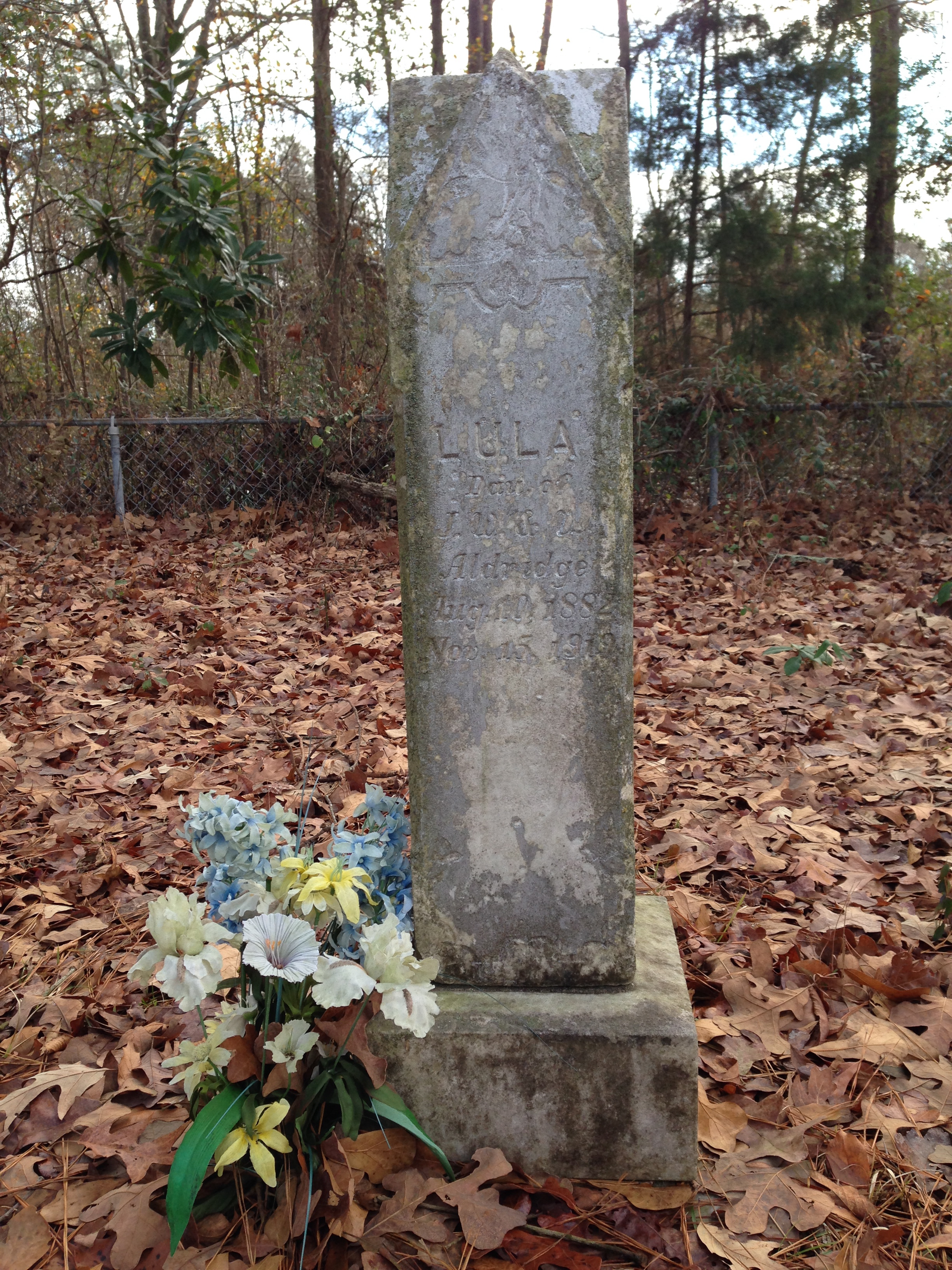
Lula Mae Aldridge died 16 November 1919 in a state hospital after a battle with mental illness. She was 37 years old. Lula had a few hundred dollars, probably inherited from her father, John W. Aldridge, and her brother John J. Aldridge was appointed administrator of her estate.

ImageLula was the oldest of John and Vicey Artis Aldridge‘s daughters, and the second to die that month. (Amanda Aldridge Newsome has succumbed to influenza ten days earlier.) Her family spared no expense for her funeral — $140.00 paid to undertaker L.T. Lightner and $80 to Goldsboro Marble & Granite Works for her marker.

IMG_4675 Lula’s gravestone, Henderson-Aldridge Cemetery, Dudley NC

ImageThis, despite the considerable debt against her estate, primarily in the form of a $277 judgment against her by William Mozingo.  (What in the world?!? I’ll have to look this up.)  Lula’s brothers John and James Thomas Aldridge and her mother Vicey contributed  $337.95 (about $4600 today) to settle her affairs, and the estate closed in 1923.

Image

Standard
Enslaved People, Maternal Kin, North Carolina, Other Documents

Allie’s children.

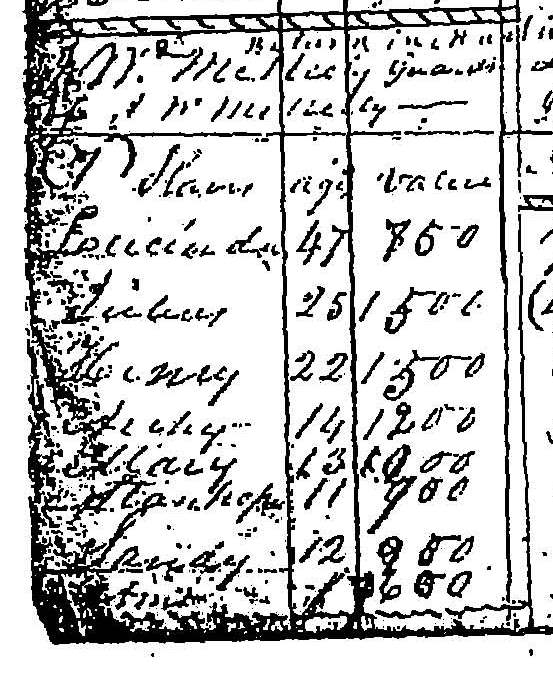
Two of Lucinda McNeely‘s sons are accounted for, but what of her older children, John and Alice?

7 slaves

The record for Alice is frustratingly scant. I have found her exactly twice. Once, in the deed filed by Mary Kilpatrick when she sold Alice, Lucinda and John to Samuel and John McNeely in 1834. The McNeely’s slaves seem to have comprised a single extended family — Lucinda, her children, and grandchildren, and the grandchildren probably were all Alice’s.  The four listed in the 1863 Rowan County tax assessment above are Archy, Mary, Stanhope and Sandy.  Alice is not listed and is presumably dead.  (Though, possibly, of course, sold away.)

Alice’s son Joseph Archy McNeely was born about 1849. In the 1870 census of Atwell township, Rowan County, 22 year-old farm laborer Joseph A. McNeely is listed in a household with Lucinda McNeely, 54 year-old domestic servant, Henry McNeely, 29, schoolteacher, and Elizabeth McNeely, 13. Three years later, Joseph Archy McNeely applied for a license to marry Ella Alexander and listed his parents as Henry Courtney and Aley McNeely.  (This is the second known reference to Alice.)  Over the next 22 years, the couple had at least eight children: Octavia J. (1874), Lucinda (1876), Ann J. (1879), Callie B. (1885), Julius L.A. (1891), Mary E. (1893) and Joseph Oliver (1896).

I have not been able to locate Alice’s daughter Mary after 1863, but in the 1870 census, her sons Sandy and Stanhope appear in their uncle Julius McNeely‘s household as Alexr. and John S. This is the last record I have of either.

Some years ago I decided that Lucinda’s son John was John Rufus McNeely, generally called Rufus, who died 1870-1880 in Rowan County. He married Emeline Atwell about 1855 and was father of five children: Mary, Betty, Charley, Henry and Rufus Alexander McNeely. John’s absence from the 1863 list mystifies me, though, and I’m not sure how I came to this conclusion. For now, I’m withholding sanction.

UPDATE, 26 January 2014: John Rufus McNeely’s 1866 cohabitation registration noted that he was the former slave of John W. McNeely. As the rest of J.W.’s slaves comprised a single family, I renew my conclusion that John Rufus was Lucinda McNeely’s son.

Standard