Enslaved People, Maternal Kin, North Carolina, Other Documents

6 chisels, a hammer & square, a grain box, a sorrell mare, 10 hogs and …

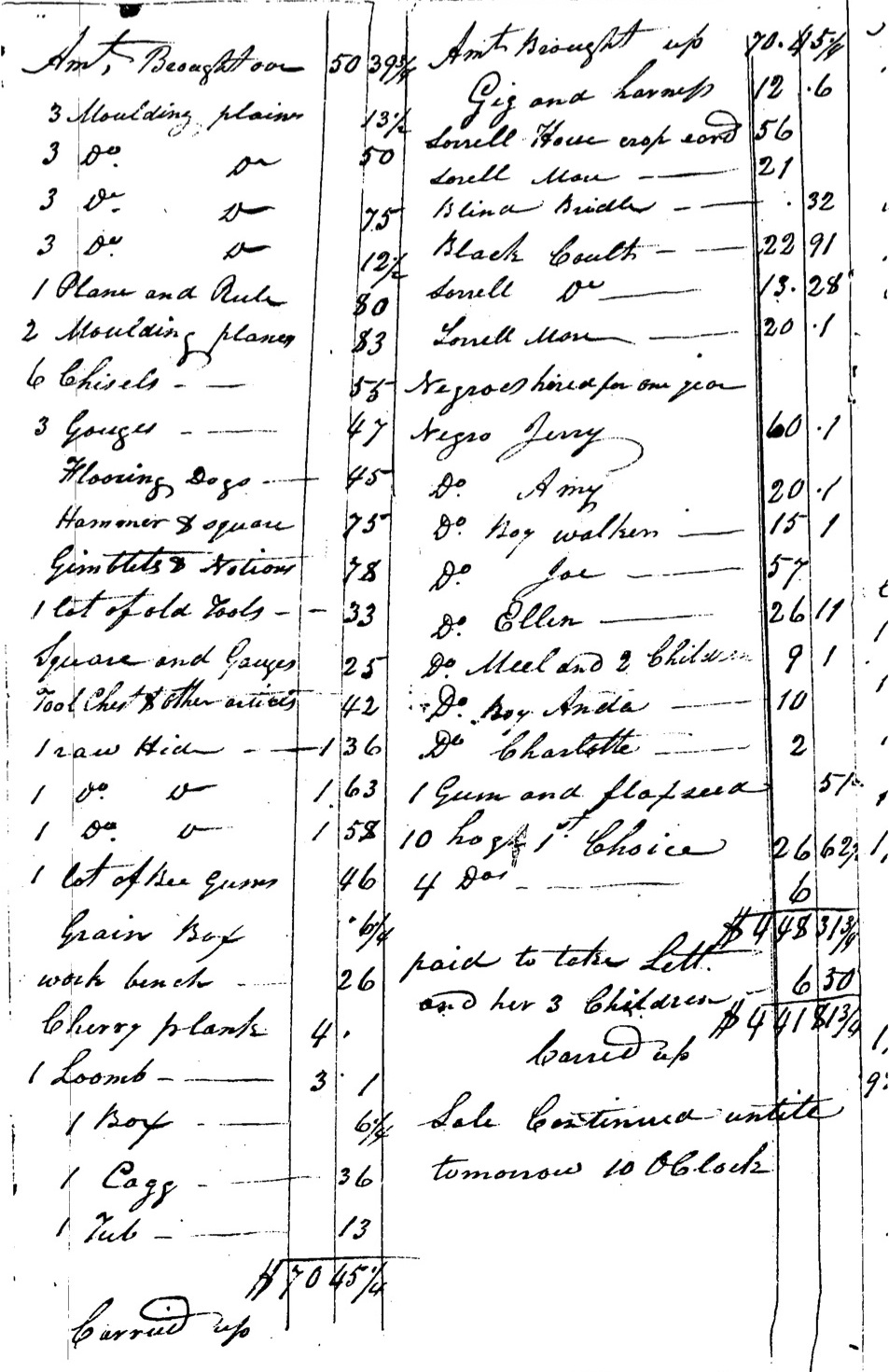
Inventory of the estate of John Alpheus Colvert, Iredell County, North Carolina, 1827.

ImageImage

On the second page, in the second column, are “Negroes hired for one year,” that is, slaves leased to neighbors to earn money for Colvert’s estate. “Boy Walker” was about eight years old. That he was listed without his mother suggests that he was an orphan, though he may have been kin to the others who appear in this list. Walker had arrived in North Carolina only two or three years before, passed to John Colvert from the estate of John’s father Samuel. When John’s died, his son William I. Colvert inherited Walker. William was even younger than his own slave, however, and Walker was likely hired out until the boy came of age.

Standard
Free People of Color, North Carolina, Other Documents, Paternal Kin

Adam Artis’ children, part 2: Lucinda Jones.

artis-guardianship-application

“Adam Artist” and “Lousinda” Jones married 10 October 1855 in Nash County. Lucinda’s father Jacob Ing (who was white) was bondsman, William T. Arrington witnessed, and justice of the peace D.A.T. Ricks performed the ceremony. Lucinda Jones Artis died circa 1860, and in 1870 her children Augustus Kerney, Noah and Mary Jane inherited her share of her father Jacob Ing’s estate.  In 1872, Adam Artis filed this guardianship application in order to manage their estate.

Augustus “Gus” K. Artis was born about 1857. Some time after the birth of their daughter Lena in 1882, Gus and wife Mary migrated to the Little Rock, Arkansas area. The city’s 1914 directory lists him as a laborer at J.W. Vestal & Son, a nursery. He died in 1921.

Noah Artis, born in 1856, remained in northeastern Wayne County, where he farmed, married Patience Mozingo, and fathered children Nora Artis Reid, Pearl Artis, Pauline Artis Harris, Rena Belle Artis, William N. Artis, and Bessie Artis. He died in 1952 in nearby Wilson NC.

Mary Jane Artis, born in 1859, married Henry Artis, son of Warren and Percey Artis. (Though all of Wayne County Artises are probably ultimately related, the exact kinship between Warren Artis, whose father was supposedly Absalom Artis, and Adam Artis is unknown.) Mary Jane remained in the Nahunta area of Wayne County all her life and died after 1900. Her and Henry’s children were Armeta Artis, Alonzo Artis, Lucinda Artis, Callonza Artis, Mattie Artis Davis and Marion Artis.

Standard
Civil War, Enslaved People, Maternal Kin, North Carolina, Other Documents

Total value: $7,600.

1863

Rowan County, North Carolina, 1863. The Civil War is dragging on, and the Rebs need money. In 1861, the Congress of the Confederate States of America had passed a statute authorizing a tax (at 50 cents per $100 valuation) to help finance the war effort. Taxable property included real estate, slaves, merchandise, stocks, securities, and money, and later agricultural products and anything else they could think of. In the 1863 assessment, for the first time, the North Carolina General Assembly required taxpayers to list their slaves by name. Assessments for only eight counties survive. Rowan is one of them.

Look in the bottom left corner. J.W. McNeely identified his seven slaves for the tax assessor, who duly recorded: Lucinda, age 47, value $750. Julius, 25, $1500. Henry, 22, $1500. Archy, 14, $1200. Mary, 13, $1000. Stanhope, 11, $900. And Sandy, 12, $950. Total valuation of Lucinda, her sons, and grandchildren: $7600. Remember Alice, the 3 year-old that Sam and J.W. McNeely bought with Lucinda? She was Archy’s mother, and Mary, Stanhope and Sandy were probably her children, too. Alice herself is gone — dead or sold — and John is not listed, though that seems to be oversight. Julius was born a few years after the McNeelys purchased his mother. His father is unknown, but was probably an enslaved man on a neighboring farm. Henry, though, was John Wilson McNeely’s boy. His only child, in fact. And worth exactly $1500.

Standard
Births Deaths Marriages, Free People of Color, North Carolina, Oral History, Other Documents, Paternal Kin

The death of Lewis Henderson.

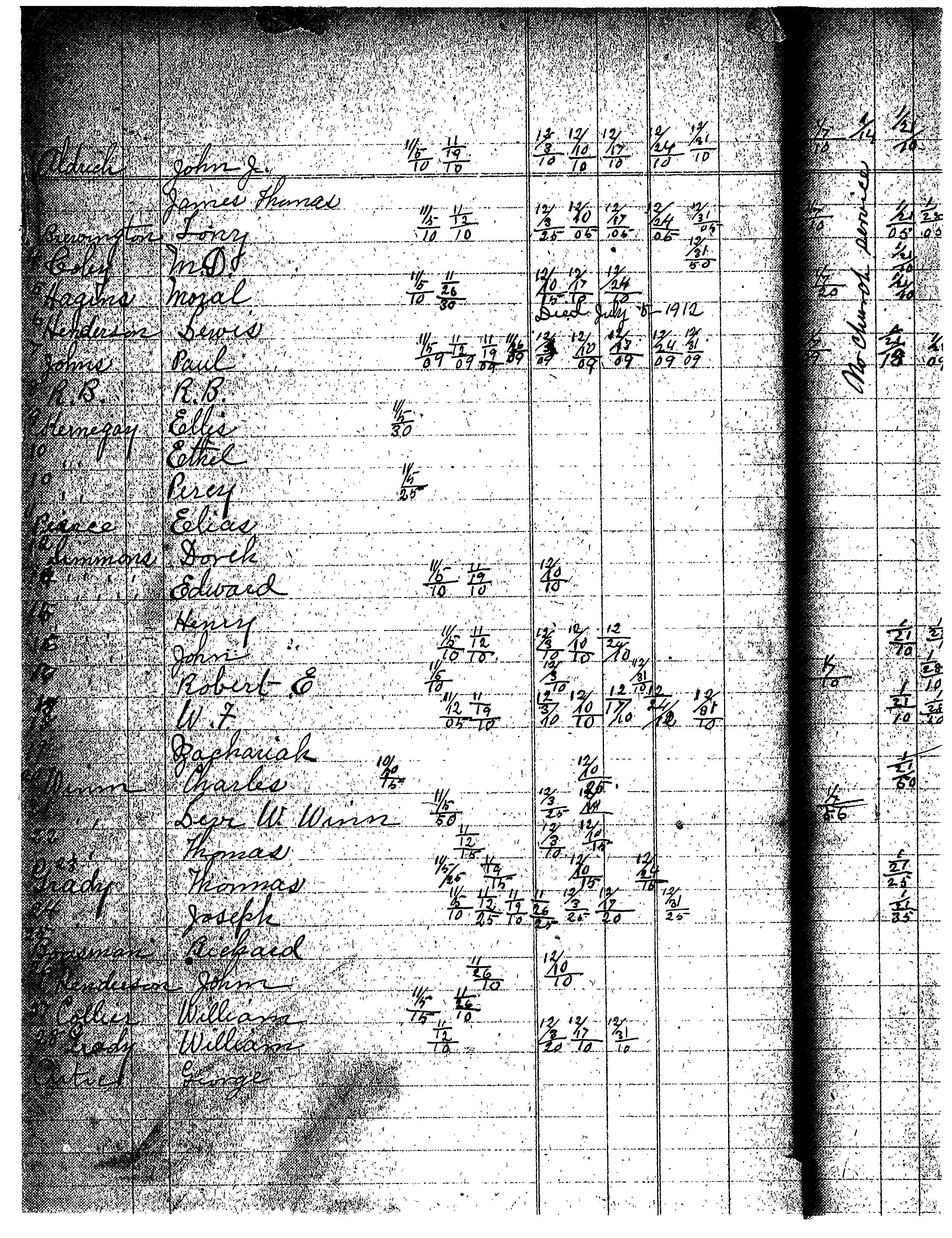
lhenders-20110225152701My grandmother, who was born in 1910, said her great-grandfather Lewis Henderson died when she was very small. She did not remember him, though her sister Mamie had reason to. He threw a brush at her — it hit her in the head —  because she was making too much noise. She could not have been older than four.

North Carolina did not keep death certificates until 1914, and Lewis’ grave is unmarked. How do we know exactly when he died? This is a page from one of the few volumes of early church records that survive for the Congregational Church of Dudley. Lewis had helped found the church in 1870, and this list shows tithes paid by male congregants. The sixth name: Henderson, Lewis. And this notation: “Died July 5 — 1912.” He would have been about 76.

Standard
Enslaved People, North Carolina, Other Documents, Paternal Kin

Kinchen Taylor’s inventory.


179360_500865558526_505368526_6215658_5475447_n

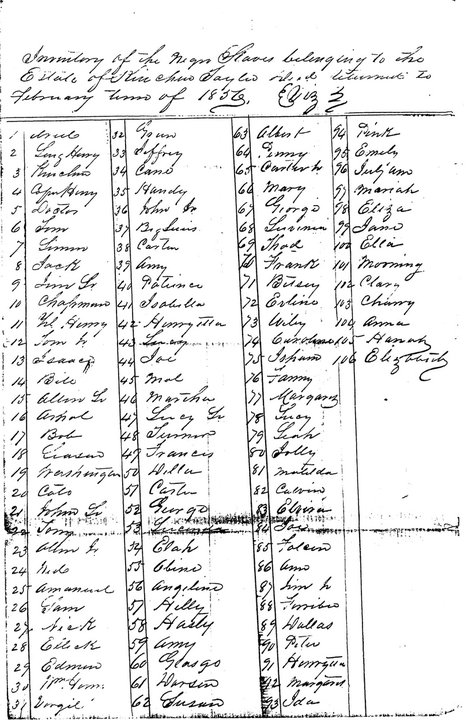
Nash County, North Carolina, 1856. An inventory of the slaves of Kinchen Taylor, deceased. Number 32 is Green. Number 88 is his wife Ferribee; and 89, 90 and 91, their oldest children. Most of Kinchen Taylor’s slaves were divided among his children, but two lots of slaves were sold. Green and Ferribee and their children were included in one of those lots, and it is not clear to whom they went, or if they went together. However, in 1870, in the first post-Emancipation census, they are listed in southern Edgecombe county as an intact family: Green Taylor, 52, his wife Phebe, 55, and children and grandchildren Dallas, 19, Christiana, 15, Mckenzie, 13, Mike, 9, and Sally Taylor, 1. Henry Michael “Mike” Taylor was my great-grandfather.

The file of Kinchen Taylor (1853), Nash County, North Carolina Estate Files 1663-1979, https://familysearch.org, original, North Carolina State Archives.

Standard
Enslaved People, Maternal Kin, North Carolina, Other Documents

How we came to be McNeelys.

Image

Rowan County, North Carolina, 1819. Widow Elizabeth Kilpatrick is close to death. Her daughter Mary is to receive “one feather bed and all my beds clothing of every kind, all my dresser furniture, my chest, one pot, one dutch oven, one pot rack” and “my negro girl named Lucinda.”

Don’t forget Lucinda. She’s my great-great-great-grandmother, and you’ll see her again. And Juda? In paragraph 5? Probably Lucinda’s mother. “All her children (not disposed of)” suggests that Dave, who went to Robert Kilpatrick, and Lucinda, were Juda’s disposed-of children. Who were the others?

Image

Rowan County, North Carolina, 1834. Mary Kilpatrick files a deed for the sale of “one negro woman named Lucinda aged about twenty years one negro child named Alice aged three years and one negro child named John aged between one and two years,” plus a few other sundries to Samuel and John W. McNeely, who are father and son. This is the Lucinda that Mary Kilpatrick inherited from her mother in 1819. Remember John Wilson McNeely. You’ll see him again, too.

Image

Rowan County, North Carolina, 1843. Samuel McNeely‘s will. To his beloved son John W. McNeely, he leaves “a negro woman named Lucinda and all her offspring.” Lucinda, then, may have been the only slave Samuel ever bought, and she returned his investment handsomely.

One of Lucinda’s offspring was Henry W. McNeely, whose father was the very John W. McNeely who owned him.  Henry, my grandmother Margaret Colvert Allen‘s maternal grandfather, was born in 1841 in western Rowan County and died in Statesville, North Carolina, in 1906.

Standard
Civil War, Free People of Color, North Carolina, Other Documents, Paternal Kin

Hillary Herring, Union man.

Image

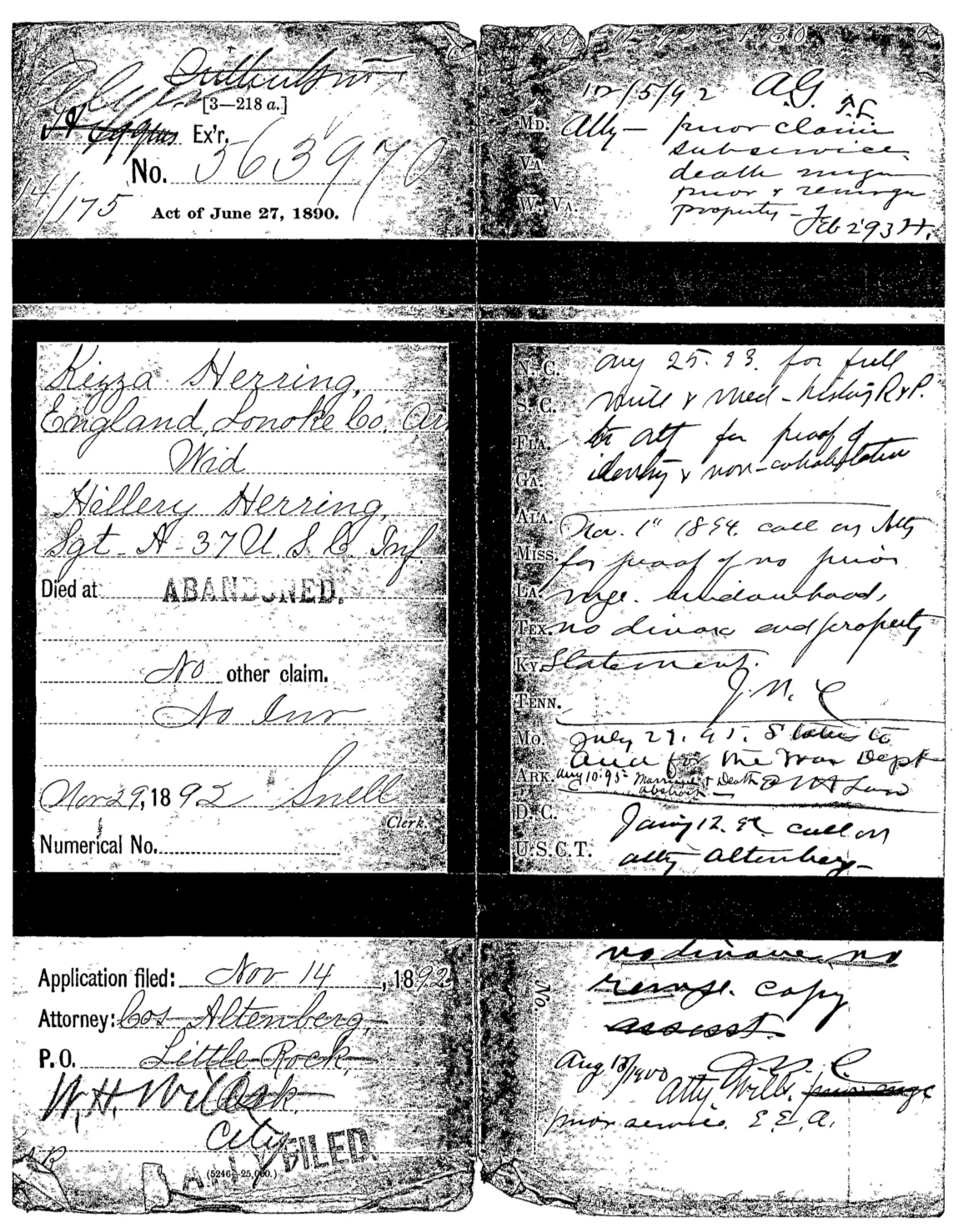
#563,970. Claim of Kizza Harring, widow of Hillary Harring, Co. A, 37 U.S.C.T., for Widow’s Pension.

Hillary Herring enlisted in the Union Army in 1864.  At his enlistment, he reported that he was 23 years old, 6 feet 1/2 inches tall, light-complexioned, with black eyes and dark hair, was born in Onslow County NC, and worked as a farmer. (Census records reveal that he grew up in Wayne County.) Documents in Herring’s widow’s pension application file show that he was discharged from the army on 11 February 1867, making it likely that he fought in the 37th in battles across southern Virginia and eastern NC. (See a history of the 37th U.S.C.T. here.)  He married Kizzy Dudley on 18 December 1869 in Burgaw, Pender County NC. Rev. Elisha Boon performed the ceremony. It was Hillary’s first marriage, but Kizzy was the widow of a John Herring that she’d married in 1863. (Hillary’s kin?) Hillery Herring died 30 June 1876 in Bentonsville, Johnston County, of “disease of lungs.” Dr. Martin Harper attended him during his final illness.  Lewis Hood furnished his coffin and served as undertaker, and Rev. John James Harper, a white man, preached the funeral sermon.

On 21 November 1872, Hillery and Keziah Herring and my great-great-great-grandparents Lewis and Margaret Henderson sold two tracts in Wayne County totalling about 80 acres to John P. Cobb and Jesse Hollowell. The four had purchased the tracts from William R. Davis, but the deed was not recorded. Both Lewis and Hillery were born in Onslow County.  Were they related?  If not, why did they buy land together?


Standard
Free People of Color, North Carolina, Other Documents, Paternal Kin

She desired that her sons be bound.

I’ve spent a whole lot of time trying to figure it out, but I still don’t know much.  I can tell you this: that Martha Henderson, better known as Patsey — and my great-great-great-great-great-grandmother — was desperate.  That she could not adequately feed her children.  That children like hers could be claimed by any passing scoundrel.  That she needed to make the first move.  So she made her way to Wantland’s Ferry, to the Onslow Courthouse, and implored the justice to place her boys with the white man of her choosing.  They were to serve as apprentices until 21, to learn a trade, and maybe, if lucky, how to read and write.  The year was 1821.     

Patsey’s children were freeborn, as was she.  She was likely a dark twig on the family tree of the white Hendersons who lived in Onslow, having arrived by the mid-1700s from Scotland via Maryland.  She was nearly white herself, as were her children, but not so nearly as to confuse the court, which duly recorded them as free people of color and laid down the applicable laws, one of which dictated that “baseborn” children would not run the countryside, but would be made available to ambitious, cash-poor whites as short-term labor.  Not slaves, but not free labor either.  Apprentices.

Patsey could not escape this game, but she could try to work it, to play it, to squeeze from it what benefit she could.  The reality was that there was not much work for free colored women in a slave society – she could never sew or clean or mammy cheap enough to compete — and in sparsely populated rural areas like Onslow, there was even less call for other skills.  She may have been sickly to boot.  Patsey’s children faced real threats to their well-being by every measure of need.  So she struck some deals and went into court and pled that James and Bryant Henderson find shelter with a master she had selected.  Was he their father?  Another relative?  Simply a neighbor?  Her request was granted and, mission accomplished, she died. 

From the minutes of Onslow County Court of Pleas and Quarter Sessions, February term, 1821 —

“Patsey Henderson a free woman of color in Onslow County came into court and desired her two sons (viz) James Henderson and Bryan Henderson be bound to Jesse Gregory agreeable to law and give Jason Gregory and Hezekiah Williams for securities in the sum of $1000 each.”  

Standard
Births Deaths Marriages, Maternal Kin, Other Documents

She is now with child.

Image

During a recent trip to the North Carolina State Archives, I discovered documents related to an Iredell County bastardy action — State v. John Colvert, colored. Harriet Nicholson had been examined by county officials and found to be pregnant. She named John Colvert as the child’s father and, on 26 January 1874, a warrant was issued to force him into court. In May, John Colvert, with Alfred Dalton and Peter Allison giving bond, agreed to “maintain” the child, i.e. pay child support.

I was aware that Harriet and John were not married when their son Lon was born. Indeed, they never married. In an unusual turn for the era, the child was given his father’s last name and was reared by John’s father and stepmother, Walker and Rebecca Colvert. However, the date of the bastardy action struck me. First, in January 1874, Harriet was only 13 years old. (John was 23.) Second, Lon always gave his birth year as 1875. (June 10, to be exact. Belated shout-out.) Was he in fact born a year earlier in 1874? Could Harriet’s condition have been detected early enough for her to been hauled into court in January? Or was Lon Harriet’s second pregnancy, the first having resulted in a stillbirth or infant death?

My grandmother never mentioned an older child. Perhaps she never knew of one. Harriet married Abner Tomlin a couple of years after Lon’s birth and of their several children only one, Harvey Golar Tomlin, lived long enough for my grandmother to know. Her last child, Bertha Mae Hart, was born in 1904 of her second marriage.

Standard