Richard Bradley Aldridge, Sr., will be buried tomorrow just outside Washington DC. Born in Dudley, Wayne County, in 1939, he was the youngest child of John J. and Ora Bell Mozingo Aldridge. Rick’s wife Carmen survives; their only child, Richard Jr., died in 1995. He is also survived by a brother, Edison Monzel Aldridge.
Category Archives: Paternal Kin
Joshua & Amelia Aldridge Brewington.
Joshua Brewington, son of Raiford Brewington and Bathsheba Manuel Brewington, was born in 1846 in Sampson County and died in 1931 in Wayne County. His wife, Amelia Aldridge Brewington, daughter of Robert Aldridge and Mary Eliza Balkcum Aldridge was born in 1855 in Sampson County and died in 1895 in Wayne County. Their children were: Tilithia Brewington King Godbold Dabney (1878-1965), Bashua M. Brewington (1879-1899), Hattie Bell Brewington Davis (1880-1981), Mattie Amelia Brewington Braswell (1883-1952), Elijah Coleman Brewington (1886), Amelia Brewington (1888), Lundy Brewington (1891-1914), Toney Cemore Brewington (1894-1973), and Murine Brewington (1895).
Joshua and Amelia Brewington are buried in the cemetery of the First Congregational Church, Dudley, North Carolina.
“Sleep on and take thy rest.”
——
Photo by Lisa Y. Henderson, August 2010.
Was it that long?
They are now swaddled in acid-free paper in an acid-free box: three coils of plaited hair. Two are narrow as fettucine (and nearly as flat after all this time), tapering through a curl to nothing; the first a deep, deep brown, the other sandy. The third braid is twice as long as the others and, at its thickest, the breadth of an infant’s forearm. If I place the cut end at the nape of my neck, the tip unfurls heavily to the seat behind me.
No visit to my grandmother was complete without her lifting a small green leatherette suitcase from atop a chifforobe in her bedroom. Underneath packets of photographs, which I also had to examine, she eased out the plastic bags preserving the hair cut from her own head (the great thick braid); her mother Bessie‘s (the thin dark brown one); and her mother’s first cousin, her namesake Hattie Mae (the blondeish plait.) Hattie Mae died in 1908 at the age of 13. Bessie died in 1911 at the age of 19. Her own hair she cut in the late 1950s, after enduring years of headaches from the relentless pressure it exerted when coiled atop her head. It was only the second time she’d cut it.
And so Mama was working at the factory, and I used to go up there and look at her. And so that’s when I first cut my hair. I went there, and the lady was asking Mama at the table where she worked to, and she didn’t say nothing to me, but she said, “Unh, who is that child with all of that long hair?” And she took one of my plaits and held it up. I had it in three plaits. I’ll never forget it. I had one down here used to come here. Yeah, it come down to below the shoulder. Like I plait it up, and it be from there. Two plaits here and then this one down across. And I always put that one behind my ear. ‘Cause I didn’t like it parted in the middle. Seem like it just wasn’t right in the middle. So I asked Mama ‘bout cutting my hair, could I cut my hair. ‘Cause everybody: “How come you don’t cut your hair? ‘Cause you’d look pretty in a bob.” I don’t know. I just wasn’t half combing it. And it was nappy. Like I’d go to try to comb it, and knots would be in there. And then I’d get mad with it. Then I’d take the scissors and clip that little piece off. And then all that other part would come off. And so I wondered, “Mama, could – ” “It’s your head. It’s your hair. I don’t care if you cut it off.” And so one day, a fellow stayed up there on Vick Street was a barber downtown, a colored fellow, Charlie Barnes or whatever his name is. So he passed there one day, and I asked him, “Would you cut my hair for me?” And he said, “Yeah.” Said, “You come on down to the shop.” And I said, “Where is the shop?” And he went on and tried to tell me, and then he stopped there one day, and he told me, he said, “You say you want to get your hair cut?” He said, “You got too pretty a hair to cut.” And I said, “Yeah, but I can’t half comb it.” He said, “Well, anytime you want to come on down there, I’ll cut it for you, if it’s all right with your mama. You ask your mama?” I said, “Yeah, she allowed me to cut it.” So sho ‘nough, I went around there one Saturday morning, went down there. And so, he turned around and cut off my plaits on both sides ‘cause I had two plaits there. He cut them off, and then he put some kind of stuff on it and then somehow fluffed it all up. Awww, I thought I was something. I reckon I was ‘bout 12, 13 years old. After then I cut it off in a boyish bob.
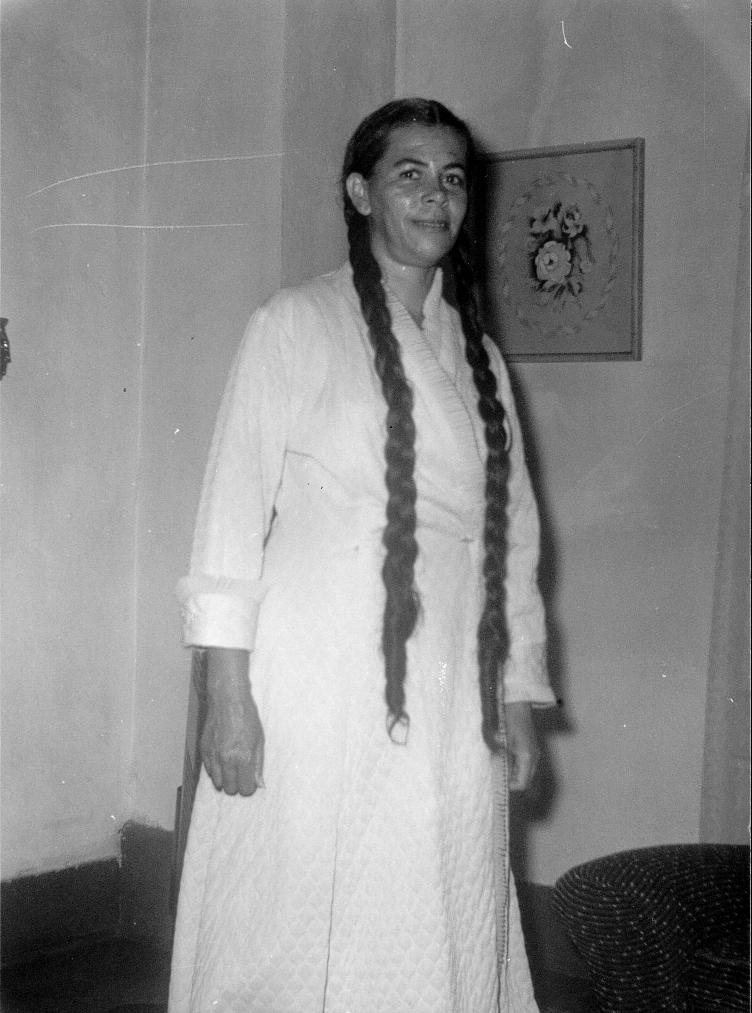
I got a plait of Hattie Mae’s hair and a plait of my mama’s, Bessie’s hair, and then mine. I was looking at that the other day, and I looked at it, and I said, “Huh, it was that long?” Rudy, Rudy Farmer took that picture. ‘Cause I – He saw my hair. I was standing there with my housecoat on. I still got that thing now. And: “Goodness! I didn’t know your hair was that long!” We were staying on Reid Street. And he said, “I’d sure like to have a picture of that.” And I said, “Well, you got a Kodak?” And he said, “Yeah! You’d let me take a picture?” I said, “Yeah.” And so he went home and got it and took a picture of it. I was standing up in one and sitting down in one.
Two sisters.
We would visit A’nt Nancy in Goldsboro. Her oldest daughter married the undertaker, Jim Guess. And her youngest daughter, me and her was the same age. Bessie Lee. And Mama used to go over there to see A’nt Ella. And A’nt Ella stayed up there on that other little street back there, but her and Nancy were sisters. Two sisters. So, I said, ‘I’m going over there, and they all never come and see me or nothing.’ So I stopped going, and after Mama died, I just forgot about it. ‘Cause they ain’t never bothered nothing about it. And then too, they seemed like they were cool. They wasn’t friendly enough. Like to say, if you’re family and have something to talk about, or go talk about anything, just make up something to say. Act like you like ‘em whether you did or not, while they was around. So I stopped going over there. ‘Cause Bessie Lee …. Let’s see, the last time I was over there, she had gone some place and so I didn’t get to see her that time. So I said, she didn’t never want to come to Wilson to see me, and I had always asked her ‘bout coming to Wilson, and she said she was coming over there sometime, but she never did. So I just stopped going to Goldsboro, too. I don’t know what happened to them.
Nancy, born about 1865, and Louella Henderson, born about 1876, were daughters of James and Louisa Armwood Henderson. In 1881, Nancy married Isham Smith, freeborn son of Milly Smith and her enslaved husband Peter Ward. They settled in the Harrell Town section of Goldsboro, where Isham worked as a wagon driver and then an undertaker. Their children were: Annie Smith Guess (1883), Oscar Smith (1884), Furney Smith (1886), Ernest Smith (1888), Elouise Marie Smith (1890), Johnnie Smith (1891), Mary E. Smith Southerland (1894), James Smith (1896), Willie Smith (1899), Effie May Smith Stanfield (1904), and Bessie Lee Smith (1911). (Was Bessie really a daughter? Or a granddaughter?) Isham died in 1914, and Nancy married Patrick Diggs four years later. After Patrick’s death, Nancy restored her first husband’s surname. She died in Goldsboro in 1944 after suffering a fractured pelvis from a fall from her bed.
Louella Henderson is more difficult to trace. My grandmother recalled that Ella was married twice, the first time to a King, and moved from Goldsboro to a city in the North Carolina Piedmont, perhaps Gastonia. Wayne County census records reveal an Adam and Ella King, but their marriage license lists Ella’s maiden name as Herring. An Ella Wilson witnessed Nancy Henderson Smith’s second marriage, but the Ella Wilson (wife of Ed) listed in the 1930 census is much too young. Though she must have lived into the 1920s at least, I can find no certain trace of Ella after the 1880 census. [Update here.]
[P.S. The continuing connection between Nancy Henderson Smith and her siblings’ families is evidenced by the frequency with which her son-in-law James Guess was called upon to handle their funerals. Nonetheless, knowledge of the connection seems to have dropped off sharply after her death. I have met only one person — my grandmother — who knew that undertaker James Guess (whom people had heard of) had married into the family or that any Smiths in Goldsboro were their kin. And I’ve been unable to locate any Smith descendants.]
Interview of Hattie H. Ricks by Lisa Y. Henderson; all rights reserved.
DNAnigma, no. 8: the Quester.
I’ll call him “Eric.” He rides the top of my list at Ancestry DNA, and at 23andme is my closest match beyond those relatives I consider my immediate family. He is an adoptee, born out West in 1980. He tested to find clues to his parentage and to his ethnic background, and I was the first blood relative he’s ever “met.”
Ancestry estimated our relationship at 3rd cousins, and I encouraged him to test with 23andme, which posited 2nd to 3rd cousins (2.43% shared DNA across 6 segments.) More critically, 23andme revealed that my connection to Eric is through my father, with whom he is an estimated 1st to 2nd cousin, sharing 6.76% across 18 segments! (He and my sister share 3.3% across 7). A 1st or 2nd cousin of my dad, who is 79 years old? How in the world???
Common matches between Eric and my father allowed me to focus on my grandmother’s side as the link. My grandmother had one known sibling. (Well, maybe, two, as I’ve recently learned of a possible half-brother who’s only a few years older than I am. I’m not including him as a possibility for now.) Her half-sister M., with whom she shared a mother, was born in 1907. Full first cousins share, on average, 12.5% DNA, so my father and M.’s children would share about half that. In other words, those cousins would share with my father the approximate percentage of DNA that my father shares with Eric. The male cousins were too old to have been Eric’s father (and, if they were, Eric would share only about 3% with my father.) Thus, they are eliminated as Eric’s father or grandfather. And I can eliminate the female cousins on the ground that he does not share their haplogroup, which is H3.
Arriving at this point, I was momentarily stumped. And then I remembered that uncles and great-great-nephews also share roughly 6.25% DNA. (And constitute a relationship that makes more sense given Eric and my father’s relative ages.) This train of thought, I think — and without going into requisite detail — will ultimately lead us to the truth.
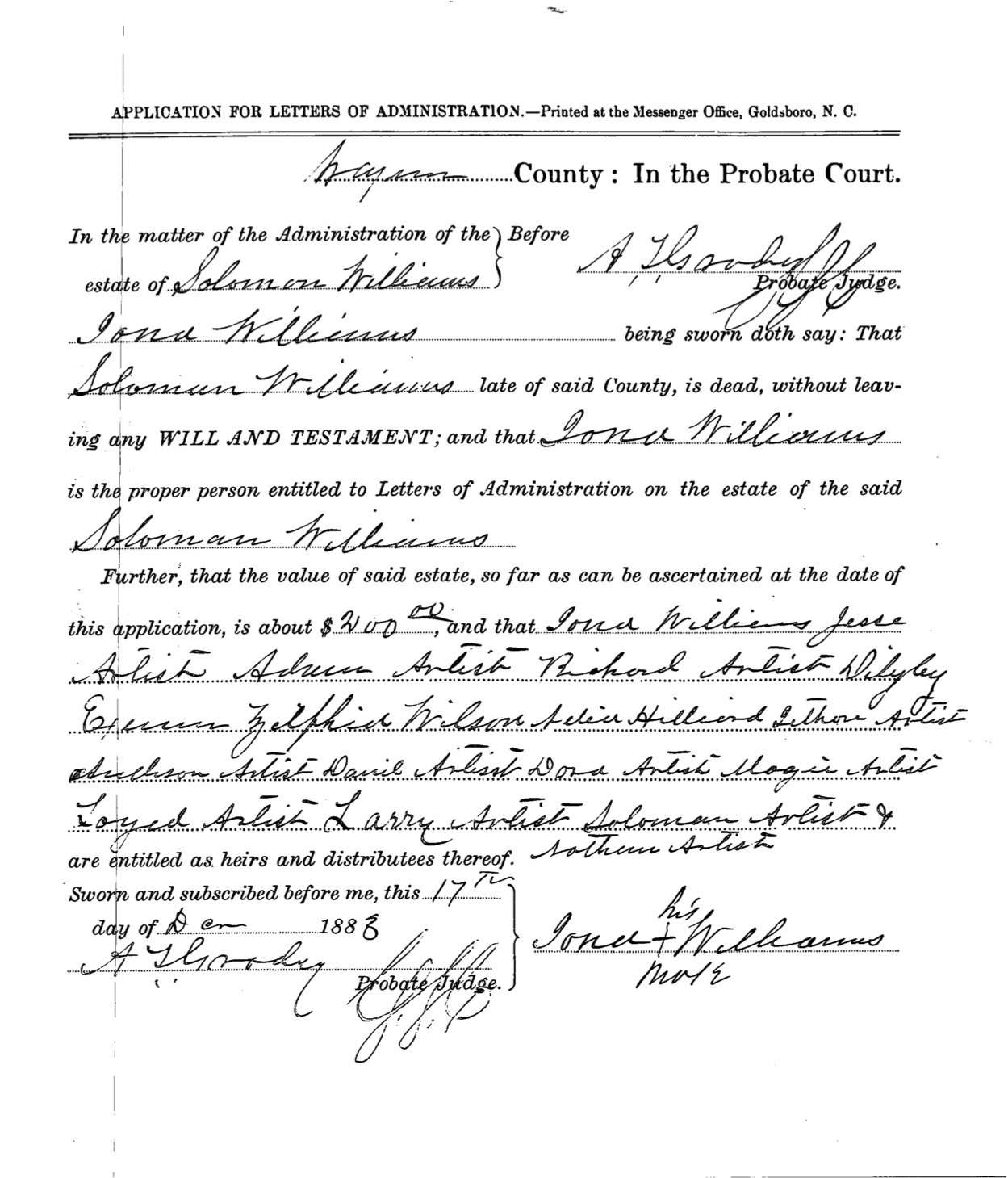
The estate of Solomon Williams.
Vicey Artis, a free woman of color, and Solomon Williams, a slave, had eleven children together – Zilpha Artis Wilson, Adam Toussaint Artis, Jane Artis Artis, Loumiza Artis Artis, Charity Artis, Lewis Artis, Jonah Williams, Jethro Artis, Jesse Artis, Richard Artis and Delilah Williams Exum — before they were able to marry legally. On 31 August 1866, they registered their 35-year cohabitation in Wayne County. Vicey died soon after, but Solomon lived until 1883. The document above, found among Solomon’s estate papers, names son Jonah as administrator and lists his and Vicey’s six surviving children and the heirs of their deceased children.
Little is known about Solomon. He was born about 1800. A few slaveowning Williams families lived in Vicey Artis’ vicinity in Greene County, but there is no evidence to link Solomon to them. He appears in the 1870 and 1880 censuses of Nahunta township, Wayne County, heading households comprised of his daughters and their children, and is recorded as father on the marriage licenses of daughter Lomisy (Loumiza) Williams and son Adam Artis and the death certificates of children Jonah Williams, Richard Artis and Delila Exum.
Honorary commissioner.
In a nod to his relative political and economic clout, Napoleon Hagans was named an Honorary Commissioner of the 1884 World Industrial and Cotton Centennial. (The certificate is little hard to read, but that’s his name at the center fold.) According to the official program, Hon. H.K. Bruce [sic, this was surely Blanche K. Bruce, Republican Senator for Missouri 1875-1881] was Chief of Department, Colored Exhibits, and North Carolina’s “Honorary State Commissioners (Colored)” were J.S. Leary of Fayetteville and Jno. H. Williamson of Louisburg.
The 1884 World’s Fair was held in New Orleans, Louisiana, at a time when nearly one third of all cotton produced in the United States was handled in that port city. The Cotton Planters Association first advanced the idea for the fair, dubbed “World Cotton Centennial” because 1784 marked the earliest surviving record of export of a shipment of cotton from the United States to England.
The U.S. Congress lent $1 million to the Fair’s directors and gave $300,000 for the construction of a large Government & State Exhibits Hall on the site. However, the planning and construction of the fair was marked by corruption and scandals, and the Louisiana state treasurer absconded abroad with $1.7 million of state money, including most of the fair’s budget.
Despite such serious financial difficulties, the Fair succeeded in offering many attractions to visitors. It covered 249 acres stretching from Saint Charles Avenue to the Mississippi River and could be entered directly by railway, steamboat, or ocean-going ship. The main building enclosed 33 acres and was then the largest roofed structure ever constructed. The building was illuminated with 5,000 electric lights – still a novelty at the time and said to be ten times the number then existing in the rest of New Orleans. There was also a Horticultural Hall, an observation tower with electric elevators, and working examples of multiple designs of experimental electric street-cars. The Mexican exhibit was particularly lavish and popular, constructed at a cost of $200,000 dollars, and featuring a huge brass band that was a great hit locally.
On December 16, 1884, two weeks behind schedule, President Chester Arthur opened the Fair via telegraph. It closed on June 2, 1885. In an unsuccessful attempt to recover financial losses, the grounds and structures were reused for the North Central & South American Exposition from November 1885 to March 1886. Thereafter the structures were publicly auctioned off, most going only for their worth in scrap.
The site today is Audubon Park and Audubon Zoo in Uptown New Orleans.
Adapted from World Cotton Centennial, www.wikipedia.org. Copy of certificate courtesy of William E. Hagans.
For 15 years she lived in Canada.
Obituary of Anna J. Henderson Simmons, daughter of James and Louisa Armwood Henderson.
Logansport, Indiana, Pharos-Times, 18 June 1906.
Infant baptisms.
From the records of the First Congregational Church of Dudley NC, an excerpt from a list of infant baptisms that reveals the centrality of the Henderson family in the church’s early congregation. In 1896, two of the nine babies baptized were siblings Minnie and Daniel Simmons, born in 1887 and 1895, children of Hillary and Ann Elizabeth Henderson Simmons.
The following year, Hendersons comprised two-thirds of the infants baptized. Clement Manuel (1897) was the grandson of Edward and Susan Henderson Wynn. (His parents were Alonzo and Sallie Wynn Manuel.) Bessie and Jesse Henderson, born in 1891 and 1893, were children of my great-great-grandmother Loudie Henderson, and Hattie Jacobs (1895) was Sarah Henderson Jacobs‘ daughter.
——
Copy of entry made from originals held by First Congregational Church, Dudley NC.
Confederate Citizens File: Adam Artis.
Adam T. Artis was 30 years old at the start of the Civil War, a farmer and carpenter who had already begun to amass relative wealth. Men much poorer than he lost stock and provisions to foraging Union soldiers, and I wondered why he had not filed with Southern Claims Commission to recoup any losses. Perhaps he had none, but the more likely answer is that, because he supplied fodder and other items to the Confederate government, he knew he was ineligible for reimbursement from the United States.
Form of the estimate and assessment of agricultural products agreed upon by the assessor and tax-payer, and the value of the portion thereof to which the government is entitled, which is taxed in kind, in accordance with the provisions of Section 11 of “an Act to lay taxes for the common defence and carry on the government of the Confederate States,” said estimate and assessment to be made as soon as the crops are ready for market.
Adam Artis by wife
Cured Fodder Quantity of gross crop. — 1500 Tithe or one-tenth. — 150 Value of one-tenth. — $4.50
I, Adam Artis of the County of Wayne and State of North Carolina do swear that the above is a true statement and estimate of all the agricultural products produced by me during the year 1863, which are taxable by the provisions of the 11th section of the above stated act, including what may have been sold of consumed by me, and of the value of that portion of said crops to which the government is entitled. /s/ Adam X Artis
Sworn to and subscribed to before me the 3 day of December 1863, and I further certify that the above estimate and assessment has been agreed upon by said Adam Artis and myself as a correct and true statement of the amount of his crops and the value of the portion to which the government is entitled. /s/ J.A. Lane, Assessor.
The Confederate Papers Relating to Citizens or Business Firms, 1861-1865 (NARA M346), often called the “Confederate Citizens File,” is a collection of 650,000 vouchers and other documents relating to goods furnished or services rendered to the Confederate government by private individuals and businesses. The “Citizens File” was created by the Confederate Archives Division of the Adjutant General’s Office from records created or received by the Confederate War and Treasury Departments that were in the custody of the U.S. War Department. The Citizens File was created to aid in determining the legitimacy of compensation claims submitted for property losses allegedly inflicted by Union forces. The records were used by the Treasury and Justice Departments, Southern Claims Commission, Court of Claims, and congressional claims committees to determine whether the claimant had been loyal to the Union or had aided the Confederate government and thus not eligible for compensation.
——
Document accessed at www.fold3.com.