Free People of Color, Letters, North Carolina, Paternal Kin

The case for Eliza Balkcum Aldridge.

Image

She is obviously a very old woman, stooped and twisted, but with a full head of silvery hair pulled into a loose bun. Her daughter-in-law stands to one side, hand resting protectively on the back of her chair. The only known photographs of Mary Eliza Balkcum Aldridge, two of them, were taken the same day near the end of her long life.

The basic outline of Eliza’s life is established. According to her death certificate, she was born 29 February 1829 in Duplin County. She married Robert Aldridge around 1850, but no marriage license has been found for them. Eleven of her children lived to adulthood. She ran the domestic side of a farmer’s household and slipped out to deliver babies when called upon. She inherited 53 acres from her husband’s estate, but spent her last years in the households of her youngest sons, Robert and Joseph.

The details of her early life are less clear, but I believe she was born to an unorthodox white woman named Nancy Balkcum. Here’s the case:

  • About 30 years ago, a cousin prepared an unannotated family history (apparently based on oral tradition) that notes “Robert [Aldridge] married Eliza Bayscin in 1850.  Eliza was born in Johnson [sic] County, North Carolina in 1830.  She had two sisters, Mary and Maggie.”  Everything in this document must be taken with a grain of salt — it borders on the hagiographic and is very romantic — but the basic story seems to be rooted in fact.
  • In the 1850 census of Sampson County, a 21 year-old named Elizabeth Balkcum appears in the household of Lemuel Balkcum.  Elizabeth does not appear to be his spouse. She is listed last in the household, after minor children. As I’ll explain in another post, Lemuel Balkcum was the grandson of Hester Balkcum, and most likely the son of Nancy Balkcum. Though her name is slightly off, I believe “Elizabeth” is Eliza.
  • In 1854, Nancy Balkcum’s will was probated in Sampson County Court of Pleas and Quarter Sessions. Her legatees were “daughter Margaret Balkcum,” “two daughters Eliza and Mary,” and “son Harman.” (This matches the Mary and Maggie in the family history above, and I am certain its writer never saw Nancy’s will.)
  • In the 1860 census of Newton Grove, Sampson County, Mary E. Aldridge appears with her husband Robert and children. This is the only reference to her as “Mary E.” In subsequent censuses — 1870 and 1880 in Brogden township, Wayne County; 1900 in Providence township, Wayne County; and again in 1910 and 1920 in Brogden township — she is called Eliza Aldridge.
  • Eliza’s son Matthew Aldridge died in 1920 in Goldsboro, Wayne County.  His death certificate lists his mother as “Lizzie Borkem.”
  • Eliza Aldridge died 29 January 1924 of influenza.  She was just short of 95 years old. Eliza’s son Joseph did not know Eliza’s father, but gave her mother’s name as “Nancy.”
  • Son Joseph Aldridge died in 1934 in Wayne County. His death certificate lists his mother as “Eliza Barkin” of Sampson County.
  • Son Robert Aldridge died in 1940 in Wayne County. His death certificate lists his mother as “Eliza Baucom” of Wayne County.
Standard
Free People of Color, North Carolina, Paternal Kin, Religion

Church home, no. 1: First Congregational, Dudley NC.

“History of the First Congregational Church of Dudley, North Carolina, Given by Mr. General Washington Simmons, born December 22, 1856.”

In 1867, after Emancipation, came the first school for Dudley, taught four months by a white confederate soldier, John P. Casey, who was paid by the community families. The only textbook was the “blue-back speller.”

George Washington Simmons, father of General W. Simmons, corresponded with Mr. James O’Hara in Wilmington, Delaware, though whom the services of another white friend, Miss Jane Allen of Delaware, were secured for another two months’ session. She, too was paid by families.

From Oberlin College in 1868, came D.C. Granison, 23 or 24 years of age, the first Negro teacher, who remained for two years, residing in the home of George Washington Simmons. … His correspondence with the A.M.A. brought visitors in 1870, among whom were many to be remembered, especially Rev. D.D. Dodge, at that time pastor of the First Congregational Church in Wilmington, North Carolina. With his guidance our first Sunday School was organized. After several visits, he sent Rev. John Scott of Naugatuck, Connecticut, who began work in 1870. …

Just after Rev. Scott’s ordination, the First Congregational Church of Dudley was organized in what is known as the old “mission home.” … Charter members of the church were George Washington Simmons, James KingLevi Winn Sr., Levi Winn Jr., Henry Winn, George Winn, and members of their families. The first converts were Charity Faison and Sylvania Simmons. They were baptized in the “Yellow Marsh Pond” just north of the cemetery. …

Volume II [of the church records] summarizes the history from March 9, 1870. … The list of members, dating from 1870, is divided by male and female. It includes the names of Frank Cobb, William AldridgeBryant Simmons (Sr. and Jr.), John AldridgeLewis Henderson, Levi Wynn, Richard Brunt, Amos Bowden, Charles Boseman, M.A. Manuel, Solomon Jacobs, George Washington Simmons, …

From the souvenir bulletin of the 100th Anniversary, First Congregational Church United Church of Christ, 1870-1880.  Copy of bulletin in possession of Lisa Y. Henderson.

Standard
Births Deaths Marriages, Free People of Color, Letters, Newspaper Articles, North Carolina, Oral History, Paternal Kin

Comments, upon the death of Rev. Silver.

REV. JOSEPH SILVER DIES AT HIS HOME AT 100 YEARS OLD

Reverend Joseph Silver, Sr., well known and highly respected Negro minister, died Tuesday at his home in the Delmar community, on Enfield Route 3.  He celebrated his 100th birthday anniversary last July 22 at a large gathering of friends and relatives. Rev. Silver had been in poor health about four years and had been confined to his bed for the past four months.

Funeral services will be held from the Plumbline Holiness Church, Sunday afternoon at 2 p.m. The body will lay in state at the church an hour before the funeral.  The Rev. L.G. Young, of Henderson, will preach the funeral and burial will be in the family plot.  Among those expected at the final rites are Bishop M.C. Clemmen of Richmond, Va., and Bishop H.B. Jackson of Ayden.

Rev. Silver began preaching in 1893 when he he organized and built Plumbline Church.  Among other churches built by his ministry are ones at Ayden and Summitt, near Littleton. He was an organizer of the United Holiness Church of America and served on the board of Elders until his death.

Rev. Silver was married three times; first to Felicia Hawkins, who died in 1931, then to Sarah Jacobs of Wilson, who died in 1938; and last to Martha Aldridge of Goldsboro, who survives.  In addition to his wife, Rev. Silver is survived by five sons N.D. and Samuel Silver, of Washington, DC; Gideon, of Pittsburg, Pa.; Joseph, Jr., of Halifax and A.M. Silver of Route 3, Enfield; three daughters, Epsi Copeland and Roberta Hewling, of Enfield, Route 3, and Emma Goines, of Pittsburg, Pa. Eighty grandchildren, 109 great-grandchildren, and 17 great great grandchildren also survive.

— Unnamed newspaper clipping, 10 January 1958.

——

P.O. Box 193 Nashville

N.C.   c/o Brake

Feb. 2, 1958

Dear Hattie –

You heard of Rev. Silver’s death Jan. 7th although I didn’t notify you as I was sick and still is sick but not confine to bed.  Sarah had some things in the home.  A bed which I am sure you wouldn’t care for and a folding single bed which I am going to get but my main reason for writing you she has an oak dresser and washstand that Rev. Silver told me you wanted and said he told you you could get it if you would send for it so it is still there and it is good material if you want it.  Amos has already seen a second hand furniture man about buying it.  The Silver’s will “skin a flea for his hide and tallow.”  The Aldridges holds a very warm place in my heart and always will.  If you wish to do so you may write to Rev. Amos Silver Route 3 Box 82 Enfield and ask him if your mother Sarah’s furniture is still there.  There is also a carpet on the floor in the living room you need not mention my name.  I am very fond of Johnnie Aldridge of Dudly.  Come to see me whenever you can I think you might get with Reka at Fremont some times, she and Luke come to Enfield to see me occasionally  I am going to write Reka next week.  I married your great uncle Rev Joseph Aldridge write me

Your friend and great aunt by marriage.

M.C. (Aldridge) Silver

——

And then this was what my grandmother had to say:

Mr. Silver, he had a bunch, he had 11 children, and his son had a whole bunch of ‘em.  Joseph Silver.  And I went up there one time and one of the brothers was crazy.  And they had one of them there things built up where you could put a person in it, and you can just slide their food right in it.  And it was a seat in there, least it was built in the thing where you could sit on.  When the person would act up, and you can’t do nothing with him, you’d lock him up in that thing, and he had one of them things in the backyard.  Big old thing.  It was just like one of them tanks where oil come in.  And I went in there, peeked through the thing, and I was scared, and I’m drawed all up and looked, but I couldn’t see in there.  But they told me how it was.  …  When Mama got married there on Elba Street, there at the house.  Yeah.  He come up there …  He was a little short brown-skinned man, and he was a elder and the head of the church where was down there in Halifax County.  And all the children ….  Epsie?  Epseline?  What was his first wife’s name?  But him and Mama fell out ‘bout the cooking stove.  She took and got the wood and got the little stove – was four caps on it.  I’ll never forget it.  And it was red-hot in the middle.  And he said, “Don’t put too much wood in that stove!  Get Epsie’s stove that hot!  I know she’ll turn over in her grave!”  And she told him, said, “What?  Epsie ain’t here!”  Said, “I’ll tear the whole stove down!” or something, and she hit the stove!  He didn’t want her to –  They had chinches all over the house.  It was a sealed plank house, and the chinches was all in the, where the cot was up against the wall?  And Mama said she went there and, I told her, I said, when she was telling me ‘bout she was scalding water, had the stove hot and had buckets of water up there on the stove so it would be hot enough to kill the eggs and everything.  And he didn’t want her to pour no water on it, talking ‘bout she got the stove red-hot and Epsie’ll turn over in her grave.   She had that stove that hot.  “Epsie didn’t never used to have it that hot.”  She said, “Well, Epsie ain’t here now, and I’ll burn it up!  House and all!”  She said, “To get rid of these here chinches.”  Chinches all over everywhere!

“Epsie,” of course, was Rev. Silver’s daughter, not his wife. This letter addressed to “Miss Hattie Jacobs  Sanatorium Wilson N.C.,” postmarked Feb 2 1958, Nashville N.C. is in my possession.  Martha Silver’s previous husband had been Joseph Aldridge, younger brother of my grandmother’s grandfather John W. Aldridge.  The Johnnie Aldridge referred to was my grandmother’s uncle.  Reka Aldridge Morrisey Ashford was the daughter of George W. Aldridge, John W. Aldridge’s older brother.  I interviewed my grandmother in her home in Philadelphia in 1994.

Standard
Births Deaths Marriages, Free People of Color, North Carolina, Paternal Kin, Photographs

On the Stoney Run Branch and Wilmington & Weldon Railroad.

On 4 July 1902, dower laid off and partition made of Robert Aldridge‘s land as follows:

Dower — Eliza Aldridge received 53 acres on a run of Stoney Run Branch.

Lot No. 1 — Mathew W. Aldridge received 100 acres on Stoney Run and Hurricane Branches, excluding the Agustus Church and free school house lots.  An interest Mathew had bought from his father was included in the described tract and the residue was valued at $200.

matthew-aldridge

Lot No. 2 — George W. Aldridge received 42 acres on Stoney Run and the county road valued at $200.

george-aldridge

Lot No. 3 — Joseph Aldridge received 53 acres on Stoney Run and the county road valued at $200.

Lot No. 4 — David Aldridge received 80 acres on Stoney Run and the county road valued at $200.

Lot No. 5 — Robert Aldridge received 41 acres on a prong of Stoney Run and the Spring Road valued at $200.

Lot No. 6 — John W. Aldridge received 50 acres on Stoney Run Branch below the mineral spring and the Spring Road valued at $285.

Lot No. 7 — Frances Locust received 33 acres on Stoney Run and the Spring Road valued at $200.

fannie-a-randall

Lot No. 8 — Talitha Brewington, Hattie Brewington, Elijah Brewington, Mattie Brewington, Lundy Brewington, and Toney Brewington jointly and subject to the life estate of Joshua Brewington, received 33 acres on W&W Railroad valued at $193.

Lot No. 9 — Louetta Aldridge received 32 acres on Stoney Run Branch valued at $193.

Lot No. 10 — Lizzie Aldridge received 32 acres on the W&W Railroad and Stoney Run Branch valued at $193.

Lot No. 11 — Louetta Artis, Robert Artis, Columbus Artis, Josephine Artis, J. Scott Artis, J.B. Artis, Lillie Artis, Annie Artis and Elberta Artis, jointly and subject to the life estate of Adam Artis, received 32 acres at the mouth of a ditch on the run of Stoney Run and the railroad valued at $193.

Submitted by Sam C. Casey, Walter C. O’Berry, Ira W. Hatch.

The margins of this document contain notations and signatures acknowledging receipt of moneys due to balance the lot values, including signatures of Lizzie Aldridge, Tilithia King, J.W. Aldridge, Joseph Aldridge, Hattie Brewington, Columbus Artis, Elijah Brewington, Tony C. Brewington, Robert Aldridge, Lundia Brewington, and June Scott Artis, and Eliza Artis’ mark.

John Aldridge, owner of Lot No. 6, paid $7 each to the owners of Lots 8-11, and $57 to the Clerk of Superior Court for costs of the division.

Louetta Aldridge’s share was divided among her siblings “the owner of said amount now being dead this day Aug 22=1904.”

——

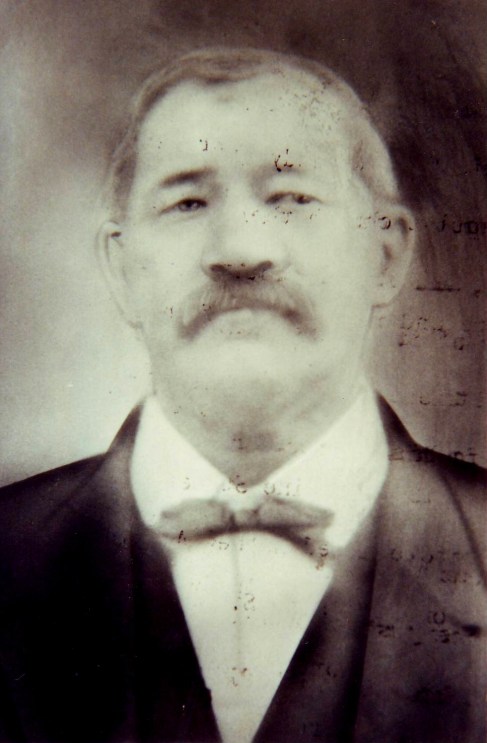
Robert Aldridge, my great-great-great-grandfather, was born circa 1819, probably in Duplin County NC, and died about 1899. He appears as a hireling in the 1850 census in Sampson County in the household of Calvin Simmons. By 1860, he and his wife Mary Eliza Balkcum Aldridge were living in southern Wayne County with their youngest children. His accumulation of property is something of a mystery, as his recorded deeds do not yield the acreage distributed in his estate.  Bits of the land remain in family hands.

There is a Stoney Run in Wayne County today, but it courses several miles northwest of the area in which Robert Aldridge is known to have owned land. I suspect that the waterway referred to above is now known as Yellow Marsh Branch, which has been dammed to form Durhams Lake. Robert owned a brickyard in the vicinity. “Agustus Church” is now Augustus Chapel Missionary Baptist Church, and the current edifice stands on the original land as what is now 599 Durham Lake Road, Dudley. The church celebrated its 145th anniversary in 2012. The Wilmington & Weldon Railroad is now owned by Atlantic Coast Line. My best guess for the “county road” is the road now known as the Old Mount Olive Highway, which runs alongside the railroad.

Abstract of document in the file of Robert Aldridge, Estate Records, Wayne County Records, North Carolina State Archives.

Photos of Mathew Aldridge, George Aldridge and Frances “Fannie” Aldridge Locust, alias Fannie Randall, in the collection of Lisa Y. Henderson.

Standard