Births Deaths Marriages, North Carolina, Other Documents, Paternal Kin

No error.

I was tying up loose ends, so to speak, checking an online database for death certificates of cousins in distant lines. Several Artises married Reids, who were another free family of color from northeastern Wayne County, and a number settled in Wilson County in the early 20th century.

Allen T. Reid was a great-grandson of Zilpha Artis Wilson, sister of my great-great-great-grandfather Adam T. Artis. I started jotting notes from his death certificate — born 1919, married, World War II veteran — then pulled up short. Died 9 Dec 1949 at Central Prison in Raleigh? Of “asphyxiation by court order of the State of North Carolina”?  My cousin was executed?

I quickly found the decision of the North Carolina State Supreme Court in State v. Reid, 230 N.C. 561, 53 S.E.2d 849 (1949), an appeal from Allen Reid’s conviction for burglary with intent to rape (a white woman.) It’s longish, I know, but please read it:

——

Supreme Court of North Carolina

State v. Reid, No. 76, June 16, 1949.

Appeal from Superior Court, Wilson County.  W.H.S. Burgwyn, Special Judge.

Criminal prosecution tried upon indictment charging defendant with the crime of burglary in the first degree.

When the case was called for trial, and before the trial jury was chosen, sworn or impaneled, counsel for the defendant filed a motion challenging the array of petit jurors, upon the ground of disproportionate representation of Negroes on petit juries in Wilson County, and long, continuous and systematic exclusion of Negroes from petit juries solely and wholly on account of their race and color, contrary to the laws of the State of North Carolina and the United States.

The defendant offered evidence in an effort to sustain his challenge to the array of petit jurors. Upon the evidence produced by counsel for defendant, the Court found as a fact that the officers whose duty it was to prepare the jury list and draw the panels of veniremen to be summoned by the Sheriff of Wilson County ‘from which petit jurors were drawn, have not selected and summoned jurors for the December 6 Term, 1948, in violation of G.S. of 1943, Chapter 9, Sections 1, 2, 3 and/or 9, and the Constitution and Laws of the United States, with the unlawful and avowed purpose of discriminating against persons of the Negro race; and that there is no evidence before the Court to show that the said officers have been systematically and continuously, over a long period of years, excluding Negroes from said juries in said county solely on account of their race or color; to the contrary, it has been effectively shown that there are the names of Negroes in the jury boxes of Wilson County, and that one member of that race was drawn and served as a member of the Grand Jury which returned the Bill of Indictment in this case, and that four or five members of the colored race were drawn for the special venire and summoned for the purpose of the trial of this case.‘ Whereupon the Court overruled the motion, and the defendant excepted. Exception No. 15.

It is disclosed by the evidence that Mr. and Mrs. James Barnes, at the time the alleged crime was committed, were living in a ground floor apartment, at 204 Park Avenue, in the City of Wilson.

The night of the alleged crime Mr. Barnes was in Washington, D. C., and Mrs. Barnes retired in the early morning of 2 September, 1948; no other member of the family or guests being in the apartment at the time. About 2:30 a. m., she was awakened by someone placing a hand on her shoulder. She was on an antique bed about three and a half feet high. The person who touched her was on the far side of the bed and when she realized that the hand was on her shoulder, she immediately got off the bed away from the person. The person grabbed her wrists and ordered her to be quiet and not to scream. She asked the person who he was, and he replied, ‘Never mind who I am.‘ She asked him how he entered the room and he said, ‘That’s all right; I got in here.‘ The prosecuting witness managed to free her right wrist after several minutes. The person then ordered her to get back on the bed. She asked him what he wanted. He stated that he wanted to commit an act, which would have been, if accomplished, a crime against nature. He also said to her several times: ‘If you scream, you know what I have.‘ She told him to leave and he told her if she would just get back on the bed it wouldn’t take long. She would not get back on the bed and he began twisting her left wrist. She testified that she realized something had to be done, and she yelled for Mrs. Mayo, the lady in whose home the apartment is located. The person then jumped out the bedroom window, head first. Mrs. Barnes further testified she did not know who the party was, except her assailant was a male person; that when she went to bed the window in her bedroom was approximately two-thirds raised; that there was a screen in the window which hooked into the side of the window and it was in good condition when she retired.

Mrs. Sarah Mayo testified that when she heard Mrs. Barnes scream ‘Sarah,‘ she immediately got out of bed, called her son and went into Mrs. Barnes’ apartment, and found her at the telephone. She noticed that the screen was cut but did not see anyone leave the house.

A witness who lived next door to Mrs. Mayo testified she was reading in bed and heard Mrs. Barnes scream about 2:30 a.m.; that she looked but did not see anyone but heard ‘footsteps running.‘ She then heard a car start.

A member of the Police Department of the City of Wilson, in response to a call, went to the Barnes apartment. He examined the window and found that the screen outside the window had been cut all the way from the top to the bottom with some sharp instrument. He found two razor blades just underneath the window on the outside. The razor blades were ‘Treet‘ blades. He also found a paper wrapping that goes on razor blades. Shortly thereafter police officers found a wrecked Chevrolet car on the railroad track of the Norfolk & Southern Railroad, four blocks from the Barnes apartment. In the car the officers found a wrapping from a ‘Treet‘ razor blade, which was on the floorboard of the front seat. The wrecked car belonged to the father of the defendant. The father testified the defendant took the car on the night of September 1st, and said he wanted to go to a show; that he did not see the car any more until it was pulled in after the wreck. The husband of the prosecuting witness testified he had never used ‘Treet‘ blades, and had no such blades in his home.

Between 8:30 and 8:45 on the morning of 2 September, 1948, A. J. Hayes, Jr., the identification officer of the Wilson Police Department, who was found by the Court to be a fingerprint expert, went to the Barnes apartment and made an investigation for fingerprints. He testified that on the inside of the window through which the entrance to the Barnes apartment had been made, he found a fingerprint on the lower right-hand corner of the window sill and bottom section of the window; and he photographed the fingerprint. At the trial this witness, and two other witnesses who are with the State Bureau of Investigation and were qualified as fingerprint experts, compared the fingerprint found in the Barnes apartment with fingerprints of the defendant made after his arrest in Norfolk, Va., on 25 October, 1948, and each one of them testified that the fingerprint found on the window sill on the inside of the Barnes apartment was identical with the fingerprint of the right index finger of the defendant.

The defendant offered no evidence.

From a verdict of guilty of burglary and sentence of death by asphyxiation, the defendant appeals and assigns error.

Attorney General Harry M. McMullan and Assistant Attorneys General Ralph M. Moody and T. W. Bruton, for the State.

Herman L. Taylor, Raleigh, and C. J. Gates, Durham, for defendant. 

DENNY, Justice.

The exception to the failure of the Court to sustain defendant’s challenge to the entire array of petit jurors is not brought forward, as required by the Rules of this Court, Rule 28. However, the defendant discusses the exception at some length in his brief. Consequently, we have considered the exception and find it without merit.

His Honor’s findings of fact are supported by the evidence and are conclusive on appeal, since the exception presents no reviewable question of law. G.S. s 9-14; State v. Davenport, 227 N.C. 475, 42 S.E.2d 686; State v. Lord, 225 N.C. 354, 34 S.E.2d 205; State v. DeGraffenreid, 224 N.C. 517, 31 S.E.2d 523; State v. Wall, 211 N.C. 487, 191 S.E. 232; State v. Cooper, 205 N.C. 657, 172 S.E. 199; State v. Daniels, 134 N.C. 641, 46 S.E. 743. The question raised has been considered in a number of recent cases before this Court and no useful purpose would be served by a further discussion of the subject here. See State v. Speller, 230 N.C. 345, 53 S.E.2d 294; State v. Speller, 229 N.C. 67, 47 S.E.2d 537; State v. Brunson, 229 N.C. 37, 47 S.E.2d 478; State v. Koritz, 227 N.C. 552, 43 S.E.2d 77, certiorari denied 332 U.S. 768, 68 S.Ct. 80, 92 L.Ed. 354, and a rehearing denied 332 U.S. 812, 68 S.Ct. 106, 92 L.Ed. 390; and the cases cited.

Exception No. 16 is brought forward in the brief, but no argument is made or authority cited in support thereof, hence it will be considered as abandoned. Rules of Practice in the Supreme Court, Rule 28, 221 N.C. 546.

The defendant moved for judgment as of nonsuit at the close of the State’s evidence, on the ground that while the bill of indictment charges the defendant with burglarious entry with the felonious intent to ravish and carnally know Mrs. James Barnes, forcibly and against her will, the evidence he contends, tends to show only an intent to commit a crime against nature, condemned by G.S. s 14-177. 

The conduct of the defendant in breaking and entering the bedroom of the prosecutrix in the night-time, and under the circumstances disclosed by the evidence, indicates the extent to which he was willing to go to accomplish his purpose. He might have preferred and intended to commit a crime against nature, or his statement in that respect might not have been indicative of his actual intent. We think the evidence was sufficient to carry the case to the jury under the allegations contained in the bill of indictment, and it was for the jury to determine, under all the circumstances, whether or not the defendant had the ulterior criminal intent at the time of the breaking and entering, to commit the felony charged in the bill of indictment. State v. Allen, 186 N.C. 302, 119 S.E. 504; State v. Boon, 35 N.C. 244, 57 Am.Dec. 555. 

The trial judge charged the jury on the defendant’s contention in this respect, and instructed the jury to acquit the defendant if it found as a fact that the defendant entered the home of the prosecuting witness with the intent to commit a crime against nature and not with the intent to commit rape, as alleged by the State in the bill of indictment.

In State v. Boon, supra, Pearson, J., in speaking for the Court, said: ‘The evidence of the intent charged is certainly very slight, but we cannot say there is no evidence tending to prove it. The fact of the breaking and entering was strong evidence of some bad intent; going to the bed and touching the foot of one of the young ladies tended to indicate that the intent was to gratify lust. And the hasty retreat without any attempt at explanation, as soon as the lady screamed, was some evidence that the purpose of the prisoner, at the time he entered, was to gratify his lust by force. It was, therefore, no error to submit the question to the jury. Whether the evidence was sufficient to justify a verdict of guilty is a question about which the Court is not at liberty to express an opinion.‘

In the instant case, it is clear the defendant wanted the prosecutrix to know he would resort to other means if she screamed. Whether he had the intent to commit the crime of rape, as charged, or the intent to commit a crime against nature, at the time of breaking and entering, was a question of fact to be determined by the jury.

Evidence as to the conduct of the defendant after breaking and entering may be considered by the jury in ascertaining the intent of the accused at the time of the breaking and entering. But where there is a breaking and entering into a dwelling house of another, in the night-time, with the intent to commit a felony therein, the crime of burglary is consummated, even though the accused person by reason of unexpected resistance or the outcry of his intended victim, may abandon his intent to commit the felony. State v. Hooper, 227 N.C. 633, 44 S.E.2d 42; State v. Allen, supra; State v. McDaniel, 60 N.C. 245; State v. Boon, supra.

Exceptions 65 and 67 are directed to the refusal of the Court below to grant the defendant’s motion for judgment as of nonsuit, challenging the sufficiency of the evidence to warrant its submission to the jury.

The appellant is relying largely on the case of State v. Minton, 228 N.C. 518, 46 S.E.2d 296, where the defendant’s fingerprint was found upon broken glass from the front door of a store that had been unlawfully entered. That case is distinguishable from the present one. The defendant in the Minton case was lawfully in the store in the afternoon of the day on which the crime was committed, and he may have made the fingerprint at that time.

We must keep in mind that a motion for judgment as of nonsuit in a criminal prosecution is properly denied if there is any competent evidence to support the allegations of a bill of indictment; and all the evidence tending to sustain the allegations in the bill of indictment upon which a defendant is being tried, will be considered in a light most favorable to the State, and the State is entitled to every reasonable inference to be drawn therefrom.  State v. Braxton, 230 N.C. 312, 52 S.E.2d 895; State v. Gentry, 228 N.C. 643, 46 S.E.2d 863; State v. Webb, 228 N.C. 304, 45 S.E. 2d 345; State v. Hough, 227 N.C. 596, 42 S.E.2d 659; State v. Ewing, 227 N.C. 535, 42 S.E.2d 676; State v. McKinnon, 223 N.C. 160, 25 S.E.2d 606; State v. Brown, 218 N.C. 415, 11 S.E.2d 321. Here the defendant was never lawfully in the apartment of the prosecutrix, and the presence of his fingerprint on the inside of the window sill in the sleeping quarters of the prosecutrix, when considered with the other evidence, was sufficient to carry the case to the jury.

The defendant has abandoned the remaining sixty-seven exceptions set out in the record.

The exceptions brought forward and argued in the defendant’s brief fail to show any prejudicial error in the trial below.

No error.

——

A few comments:

(1) First degree burglary was a capital crime in North Carolina until 1974.

(2) And then there was this:

Stville Landmark 22 Jan 1949 Statesville Daily Record, 22 January 1949.

Allen Reid’s lawyers, Herman L. Taylor of Raleigh and C.J. Gates of Durham, were African-American. They appealed his case to the United States Supreme Court, which denied cert.

(3) In 1949, “death by asphyxiation” meant the gas chamber.  According to the Statesville Daily Record, on 9 December, Allen Reid, 30, entered the chamber with Audie Lee Brown, 27, convicted of murder. They were seated side-by-side, and “the deadly cyanide pellets dropped at 10:02 a.m. EST.” After the gas cleared, prison officials executed Monroe Medlin, 23. Reid took 13 minutes to die; Brown, a minute less; and Medlin, a minute less than that. The other men on death row moaned “Rock of Ages” as the three took their last walk.

(4) My father was 15 when Allen Reid was executed. He recalls that the belief on the east side of the tracks was that Reid was in a clandestine relationship with Mrs. James Barnes. I found this report, written by a Reid cousin of Allen Reid, online.  I haven’t figured out yet what was appended to. It confirms my father’s recollection and my hunch that Allen Reid’s service in World War II had some bearing on the situation in which he found himself. It also contains unsurprising commentary on North Carolina’s uneven application of the death penalty for this particular crime (and, of course, in general.)
Standard
Births Deaths Marriages, Free People of Color, Land, North Carolina, Other Documents, Paternal Kin

Zilpha’s will.

State of North Carolina, Wayne County    }   I, Zilphy Wilson, of the County and State, aforesaid begin of sound mind and memory, but considering the uncertainty of my earthly existence to make and declare this my last Will and Testament in manner and form following, that is to say: — That my Executor hereinafter named shall provide for my body a decent burial, suitable to the wishes of my relations and friends, and pay all funeral expenses together with my just debts out of the first money that may come into his hands as a part or parcel of my estate.

Item 1. I give and bequeath to my daughter Bettie Reid 7 acres of land to be cut off the North East corner of the tract of land on which I now reside for and during her natural life, and after her death to be equally divided between all of her children that she may have now, or may have living at the time of her death, the said Bettie Reid not to have possession of said Land until the debts against my estate are paid.

Item 2. I give devise and bequeath to my son Adam Wilson and my daughter Vicey Wilson, share and share alike all of the tract of Land on which I now live, with the exception of the seven acres given away in Item first of this will, with all the priviledges and appertances thereunto belonging for and during their natural like, should they both have heirs, then they to have their mother & Father part, and should Adam or Vicey only one of them leave heirs, then and in that case I give said land to the surviving heirs of that one to them and their heirs in the fee simple forever.

Item 3. I give and devise unto my son Adam Wilson and Vicy Wilson, share and share alike, all of my Household and Kichen furniture of every description Farming implements of every description, Tools of Mechanics &c &c, Stocks of all kinds, and all the poultry of kind to them and their heirs in fee simple forever.

Item 4. It is my will and I so direct, that my son Adam Wilson to retain possession of the whole of my land at yearly rental of seven hundred lbs. of lint cotton which is to be applied to the payment of the debts against my estate, as soon as said debts are paid, I direct that Bettie Reid be put in possession of the seven acres of land given to her in a former Item of this Will. I also desire that my daughter Bettie Reed become an equal heir in my household and kitchen furniture with my son Adam and daughter Vicey.   Changes made in Zilphia Wilson’s Will Oct[?] 4, 1893

Item 5. I give and devise unto William and Jonah Wilson children of William Wilson Sixty dollars to be paid to them when they arrive at lawful age.

Item 6. I give and devise unto Johney, Lominary, Levy, Laronzo Locus, Children Louisa Locus Sixty dollars to be paid to them as they arrive at lawful age.

Item 7. It is my will and so direct that the Legacies mentioned in Items 5 & 6 of this Will be assessed by my son Adam and my Daughter Vicy Wilson, and I direct that they pay to each one of the above mentioned heirs, as they arrive of lawful age their proportionable part of said Legacies with interest on the same from the time the debts of the estate are settled.

Lastly, I hereby constitute and appoint my brother Jonah Williams and my son Adam Wilson Executors to this my last Will and Testament, hereby revoking all the Wills heretofore made by me.    Zilphy X Wilson

Signed and sealed in the presence of Fred I. Becton and Thomas Artis, who witnessed the same at her request.  /s/ Richard H. Battle, Fred I. Becton

——

Zilpha Artis Wilson was born about 1828, the first known child of Vicey Artis and Solomon Williams. About 1855, she married John “Jack” Wilson, a free man of color of completely unknown origins. That year, Jack bought 55 acres in Wayne County from Zilpha’s brother Adam Artis and settled his family close to the Artises.

Zilpha and Jack Wilson’s children were William Wilson (1856), Louisa Wilson Locus (1858), Elizabeth “Betty” Wilson Reid (1864-1947), John Adam Wilson (1865-1916) and Vicey Wilson (1869).

Zilpha Wilson’s will was proved 17 December 1902 and recorded at page 421 of Will Book 2, Wayne County Superior Court.

Standard
Newspaper Articles, North Carolina, Paternal Kin

Church home, no. 6: Turner Swamp Primitive Baptist, Eureka NC.

Church Directory “Fremont Items” – Rev. Jonah Williams of Wilson filled his regular appointment at Turners Swamp last Sunday.

The Blade, Wilson NC, 20 Nov 1897.

Turner Swamp Primitive Baptist Church still meets in a small church north of Eureka, Wayne County. Jonah was a brother of my great-great-great-grandfather Adam T. Artis, and descendants of several of their siblings are buried in the church cemetery.

Standard
Births Deaths Marriages, Enslaved People, Free People of Color, North Carolina, Other Documents, Paternal Kin

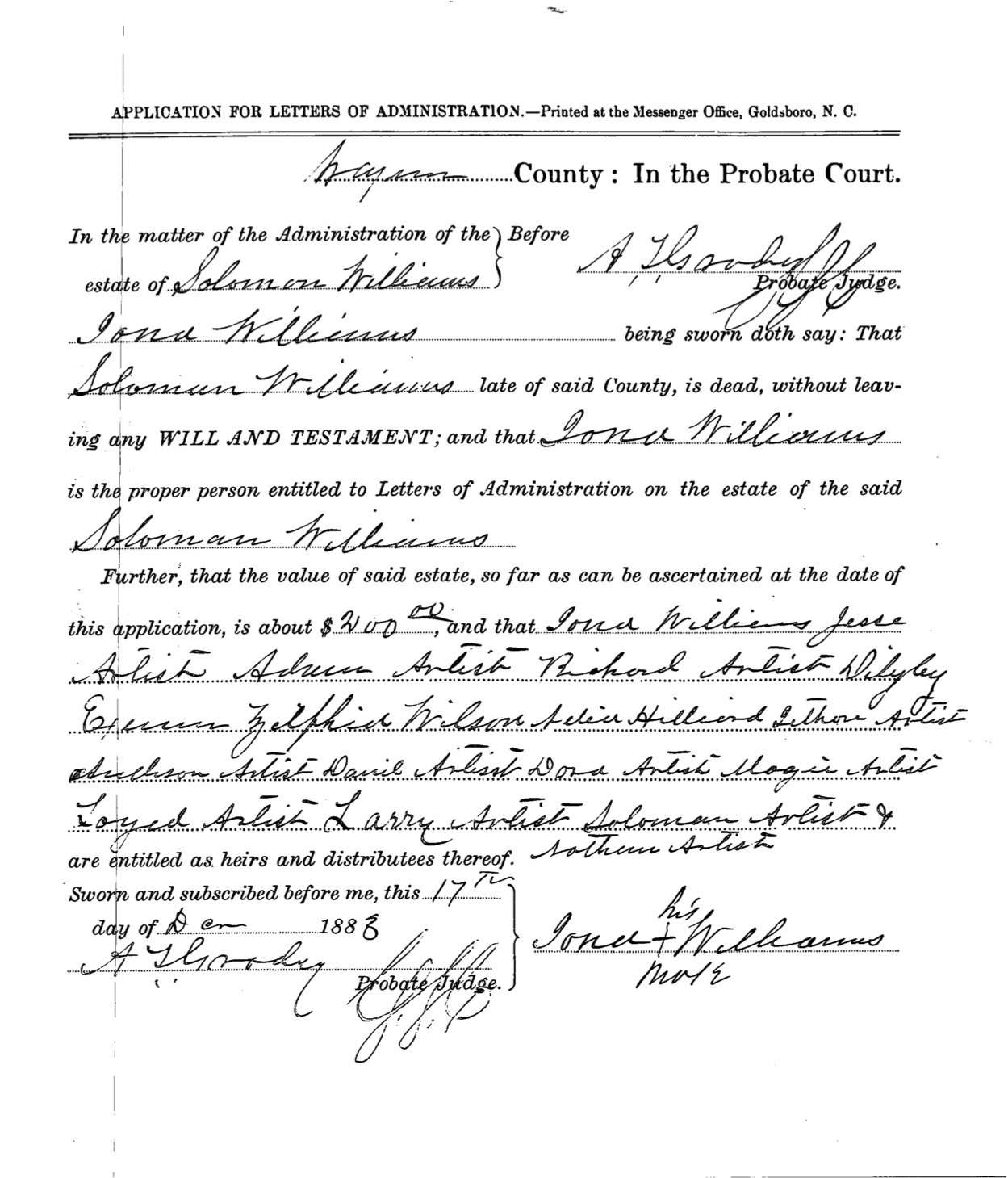
The estate of Solomon Williams.

Image

Vicey Artis, a free woman of color, and Solomon Williams, a slave, had eleven children together – Zilpha Artis Wilson, Adam Toussaint Artis, Jane Artis Artis, Loumiza Artis Artis, Charity Artis, Lewis Artis, Jonah Williams, Jethro Artis, Jesse Artis, Richard Artis and Delilah Williams Exum — before they were able to marry legally.  On 31 August 1866, they registered their 35-year cohabitation in Wayne County.  Vicey died soon after, but Solomon lived until 1883.  The document above, found among Solomon’s estate papers, names son Jonah as administrator and lists his and Vicey’s six surviving children and the heirs of their deceased children.

Little is known about Solomon. He was born about 1800. A few slaveowning Williams families lived in Vicey Artis’ vicinity in Greene County, but there is no evidence to link Solomon to them. He appears in the 1870 and 1880 censuses of Nahunta township, Wayne County, heading households comprised of his daughters and their children, and is recorded as father on the marriage licenses of daughter Lomisy (Loumiza) Williams and son Adam Artis and the death certificates of children Jonah Williams, Richard Artis and Delila Exum.

Standard
Civil War, Free People of Color, North Carolina, Other Documents, Paternal Kin

Confederate Citizens File: Adam Artis.

Adam T. Artis was 30 years old at the start of the Civil War, a farmer and carpenter who had already begun to amass relative wealth. Men much poorer than he lost stock and provisions to foraging Union soldiers, and I wondered why he had not filed with Southern Claims Commission to recoup any losses. Perhaps he had none, but the more likely answer is that, because he supplied fodder and other items to the Confederate government, he knew he was ineligible for reimbursement from the United States.

Form of the estimate and assessment of agricultural products agreed upon by the assessor and tax-payer, and the value of the portion thereof to which the government is entitled, which is taxed in kind, in accordance with the provisions of Section 11 of “an Act to lay taxes for the common defence and carry on the government of the Confederate States,” said estimate and assessment to be made as soon as the crops are ready for market.

Adam Artis by wife

Cured Fodder     Quantity of gross crop. — 1500     Tithe or one-tenth. — 150     Value of one-tenth. — $4.50

I, Adam Artis of the County of Wayne and State of North Carolina do swear that the above is a true statement and estimate of all the agricultural products produced by me during the year 1863, which are taxable by the provisions of the 11th section of the above stated act, including what may have been sold of consumed by me, and of the value of that portion of said crops to which the government is entitled.   /s/ Adam X Artis

Sworn to and subscribed to before me the 3 day of December 1863, and I further certify that the above estimate and assessment has been agreed upon by said Adam Artis and myself as a correct and true statement of the amount of his crops and the value of the portion to which the government is entitled.  /s/ J.A. Lane, Assessor.

Page 6

The Confederate Papers Relating to Citizens or Business Firms, 1861-1865 (NARA M346), often called the “Confederate Citizens File,” is a collection of 650,000 vouchers and other documents relating to goods furnished or services rendered to the Confederate government by private individuals and businesses.  The “Citizens File” was created by the Confederate Archives Division of the Adjutant General’s Office from records created or received by the Confederate War and Treasury Departments that were in the custody of the U.S. War Department. The Citizens File was created to aid in determining the legitimacy of compensation claims submitted for property losses allegedly inflicted by Union forces. The records were used by the Treasury and Justice Departments, Southern Claims Commission, Court of Claims, and congressional claims committees to determine whether the claimant had been loyal to the Union or had aided the Confederate government and thus not eligible for compensation.

——

Document accessed at www.fold3.com.

Standard
Births Deaths Marriages, Land, North Carolina, Paternal Kin

Coley v. Artis.

At the heart of Wayne County Superior Court proceedings stemming from the suit in J.F. Coley v. Tom Artis (1908) was a dispute over 30 acres of land. Thomas “Tom Pig” Artis began renting the property in 1881 from W.J. Exum.  In 1892, Exum’s widow Mary sold it to Napoleon “Pole” Hagans.  In 1896, after Napoleon’s death, the land passed to his sons Henry and William S. Hagans, and in 1899 Henry sold his interest to his brother.  In 1908, William S. Hagans sold the 30 acres to J.F. Coley.  Coley filed suit when Tom Artis laid claim to it, arguing that Napoleon had sold it to him.  Tom claimed that the 800 lbs. of cotton he tendered to Napoleon Hagans (and later, his son William) was interest on a mortgage, but William Hagans and other witnesses maintained that the payment was rent.

The trial transcript is replete with testimony revealing the personal relationships among witnesses. Tom Artis testified that he rented the “Adam Artis place.” William Hagans testified that his father was in feeble health in 1896 when he called him and Henry together “under the cart shelter” to tell them he would not live long and did not know to whom the land would fall.  William testified that Pole asked them to let “Pig” stay on as long as he paid rent, and they promised to do so.  Tom Franks testified that “Pole was a first-rate business man.” Jonah Williams, Adam Artis’ brother, testified that he borrowed money from Napoleon to open a brickyard in the spring of 1893 and had preached his funeral.  He also noted that “Tom married my sister [Loumiza Williams Artis, who was deceased by time of this trial].  He is not a member of my church.  I turned him out.  He is a Primitive Baptist.  I preached Napoleon Hagans’ funeral.”  Jesse Artis, another of Adam Artis’ brothers, testified that he had worked on Hagans’ property as a carpenter for 18 years and noted, “I don’t know that Tom and I are any kin, just by marriage.”   John Rountree testified that he was a tenant renting from Hagans on thirds.  Simon Exum, Delilah Artis‘ husband, testified: “I am no kin to Tom [Artis] as far as I know, except by Adam.  His first wife was my wife’s sister.”  H.S. Reid testified that he was Tom Artis’ son-in-law.

The court found for Coley and against Artis.

——

Thomas Artis was a son of a free woman of color, Celia Artis, and her enslaved husband, Simon Pig. Though, ultimately, nearly all free colored Artises are descended from a common ancestor in southside Virginia, by the late 1800s knowledge of these remote links had faded. There were dozens of Artis families in Wayne County during the antebellum period, and the relationships between them are unknown. Celia Artis was a close neighbor of Adam Artis, but the families apparently did not regards themselves as kin.  Still, they were inextricably intertwined.  The Artises, Haganses and Reids had been neighbors in the Eureka area for generations. Celia Artis and Henry S. Reid’s grandmother Rhoda Reid were the wealthiest free women of color in the county. Adam Artis married Napoleon Hagans’ half-sister Frances Seaberry. Adam’s sister Loumiza married Tom Artis, as noted above. Henry S. Reid, son of Washington and Penninah Reid, married Tom Artis’ daughter. Henry’s first cousin Henry Reid, son of John and Mozana Hall Reid, married Adam Artis’ daughter Georgianna Artis. Adam Artis’ son William Marshall Artis and grandson Leslie Artis married Tom Artis’ nieces, Etta and Minnie Diggs. And on and on.

Documents found in file of the Estate of Thomas Artis (1911), Wayne County, North Carolina Estate Files, 1663-1979, familysearch.org

Standard
Births Deaths Marriages, North Carolina, Other Documents

Aunt Jane and the alligator.

While perusing the November 2001 issue of Trees, the publication of the Wilson County Genealogical Society, I ran across a previously unnoticed article about Jane Sauls and her daughters and their encounter with an alligator on their farm near Stantonsburg.  (“Unnoticed” in that I’d read it years ago, but not appreciated what I was reading.) Jane was a first cousin to my great-great-great-grandfather, Adam T. Artis (1831-1919).

Pages from November 2001

Jane Lane Sauls was born circa 1842 in Greene County NC. She died on 16 Dec 1928 in Stantonsburg township, Wilson County, North Carolina.  She was one of several children of Sylvania Artis, a free woman of color, and her husband Guy Lane, an enslaved man, but is not found in the 1850 or 1860 censuses.

In the 1870 census of Nahunta township, Wayne County, farm laborer John Sauls, 35, wife Jane, 27, and children Mary, 3, and Silvany, 1, are listed with Trecinda Barnes, 20, Jane Barnes, 7, and Edwin Barnes, 1. No marriage record for Jane and John has been located, and their relationship to the Barneses is unknown.

The 1880 census of Nahunta township, Wayne County, shows farmer John Sauls, 45, wife Jane, 36, daughters Mary, 12, Silvany, 9, Anner, 7, and Lucy, 6, plus Jane’s sister Fanny Lane, 14.  (Sister? Really? I’d bet niece.)

On 30 Nov 1894, J.W. Coley applied for a marriage license for Morrison Artis of Wayne County, 50, colored, son of Guy Coley and Sylvania Coley, both dead, and Jane Farrior of Wayne County, 35, colored, of unnamed parents, both dead. (This is the only instance of Coley as a surname for Guy.) The ceremony was performed by D.F. Ormond, Justice of the Peace, on 6 Dec 1894 at John Sauls’ house.in Nahunta township, before B.W. Best, John Sauls, and J. Reid.  Morrison Artis was Jane Lane Sauls’ brother.  Some of the siblings adopted their mother’s surname, Artis; others used their father’s, Lane.

The 1900 census of Nahunta township, Wayne County, shows John Sauls, wife Jane, daughters Mary and Sylvania Sauls, and “grandchildren” Louvenia (Apr 1883), Henry (Oct 1885) and John Lane (Oct 1886). In fact, these children were probably the children of Jane’s brother Alford Lane.

The 1910 census of Nahunta township, Wayne County, shows John Sauls, 76, wife Jane, 56, Mary, 38, Sylvany, 36, Anna, 33, and Snobe, 10, plus niece Louvenia Lane, 23, and boarder Freeman Swinson,14. Anna reported that she was divorced; Snobe was her son.  John B. Sauls, alias Snow B. Nobles, died in 1925. His father was Columbus Nobles.  Freeman Swinson was the son of Jane’s sister Mariah Artis Swinson.

The 1920 census of Nahunta township, Wayne County NC shows Anna Sauls, 45, widowed, sharing a household with her sisters Sylvania, 46, and Mary, 49, widowed mother Jane, 76, and cousin Levenia Sauls, 28.

Jane Lane Sauls died 16 Dec 1928 in Stantonsburg township, Wilson County, of paralysis due to hypertension and cerebral hemorrhage.  Her death certificate reported that she was born in 1842 in Greene County NC to Guy Lane and Sylvania Artis, both of Greene County, and she was the widow of John Sauls. She was buried 17 Dec 1928, Union Grove cemetery, Wayne County, by C.E. Artis, Wilson NC.  (C.E., son of Adam Artis, was her cousin.)  The informant was Anna Sauls, Rt. 6 Box 94, Stantonsburg.

Anna Sauls died 20 Dec 1950 in Stantonsburg township, Wayne County, of cerebral hemorrhage. Her death certificate reports that she was a widow and was born 1 Jan 1878 in Wayne County to John Sauls and Jane Lane. She was buried 23 Dec 1950, Union Grove cemetery, Wayne County NC. The informant was Louvenia Sauls, R#2 Box 300, Stantonsburg NC.

Sylvania Sauls died 23 Oct 1957 in Stantonsburg township, Wilson County, of cerebral hemorrhage.  Her death certificate reports that she was about 87 years old and was born in Wayne County NC to John Sauls and Jane Lane. She was buried 28 Oct 1957 in Union Grove cemetery.  The informant was Louvenia Sauls.

Mary Sauls died 29 Dec 1960 in Fremont township, Wayne County, of cerebral hemorrhage. [Did all these women really die of strokes, or was that a default diagnosis?] Her death certificate reports that she was born 3 Sep 1861 in Wayne County to Johnnie Sauls and Jane Lane. Mary was buried 3 Jan 1961, Union Grove cemetery, Wayne County.  The informant was Anna Ray, Rt. 2 Box 143, Fremont NC.

Standard
DNA, North Carolina, Paternal Kin

DNA Definites, no. 1: Aldridge & Artis.

I’m partial to the bells and whistles at 23andme and seldom check my AncestryDNA results. Today, though – eureka! An estimated 4th cousin with a Shared Ancestor Hint, John William Aldridge.  I checked G.J.’s family tree and immediately knew exactly who she is – the granddaughter of one of my great-grandfather’s sisters. Our most recent common ancestors (MRCA) are John and Louvicey Artis Aldridge, and we’re actually 2nd cousins once removed.

Standard
Births Deaths Marriages, Education, Free People of Color, North Carolina, Other Documents, Paternal Kin

John William Aldridge.

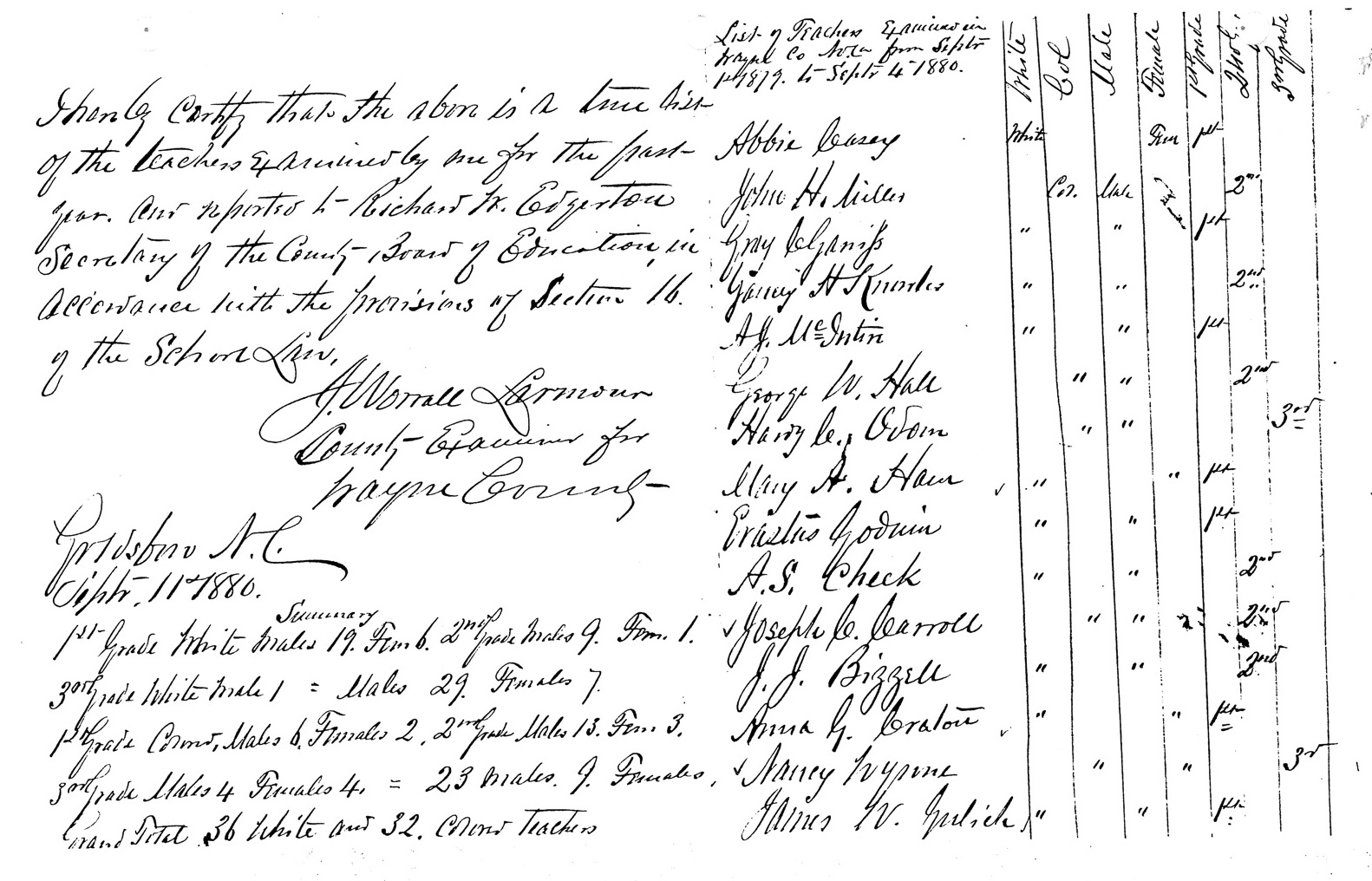
John Aldridge and his brothers George and Matthew Aldridge were hired to teach in Wayne County in the late 1870s. For reasons unknown, they were assigned to schools in the far north of the county, some 15 miles north of Dudley:


ALDRIDGE -- Aldridge_School Records

ALDRIDGE -- Aldridge_School Records 2 

From the same unsigned family history:

John Aldridge met Luvicie Artis at the school where he taught; she was one of his students. He built a 7 room house for her when they got married. John was a stout man with a reddish brown complexion and wavy black hair. He stopped teaching when he married Luvicie and started to farm and run a general store. The store was burned down in 1911. He sent his children to a private school. He died in 1910 of a congested chill. He was 58 years old when he died, and was worth about $30,000 at that time.

ALDRIDGE_--_John_Aldridge_Vicey_Artis_Marriage_License

If John was worth $30,000 when he died, it was all in realty. His personal estate was paltry:
JW Aldridge Estate Doc
Standard
Births Deaths Marriages, North Carolina, Other Documents, Paternal Kin

Adam Artis’ children, part 3: Frances Seaberry.

From an unsigned narrative (“The Adam Artis Family History”) written, I think, by one of Adam Artis’ great-grandchildren:

“Adam Artis had about five wives and 39 children. His first legal wife was Frances Hagens of Eureka. She was very fair and had beautiful long black silky hair. Adam was very tall and slender. He owned a large farm in Eureka and was a first class carpenter. They lived in a nice two story house. Frances’ brother, Napoleon Hagens, owned a very large plantation near Eureka. He had several tenants and/or slaves there. He was very mean to his wife and tenants.  He would sit on the fence in the shade and watch the tenants plow. If they didn’t plow the way he wanted them to, he would crack them with a whip. One day a tenant grabbed the whip and beat Napoleon’s shirt off.”

This is a nice starting point, if not entirely accurate. Frances Seaberry was Adam’s second legal wife. If he had 39 children, not even his last surviving daughter could name them. Her half-brother Napoleon Hagans never owned slaves, though he had many tenants, and he cast a shadow large enough that his sister’s descendants thought his last name was hers.

Also, “Frances and Adam Artis had 9 children (Hayward, William, Walter, Addie, Jesse, Doc, Georgianna, Luvicie and Ida.) Luvicie and Ida were twins. Frances died when the twins were only 13 years old.”

In fact, they had 11:

Ida Artis was born about 1861.  (And was not Louvicey’s twin.) She married Isaac Reid (1853-??), son of Zion and Lucy Reid, about 1876 .Their children were Frances Reid (1877-??) and Lorenzo Eli Reid (1879-1952). Ida Artis Reid died 1880-1900.

Napoleon Artis, known as “Doc,” was born 28 February 1863. He married Sallie Taylor; their sons were Humphrey, Leslie and Odell. Doc died 16 October 1942. His descendants still live on land along Route 222 between Stantonsburg and Eureka once owned by Adam Artis.

“When Luvicie Artis was 13 years old, she married John Aldridge of Dudley. John was the son of Robert and Eliza Aldridge. … Luvicie had very high cheek bones. Luvicie was a mid-wife and nurse. She died at the age of 64. She only wanted to eat peas and sweet potatoes. She wouldn’t eat much meat or green vegetables, and would drink hardly any water.”

Louvicey Artis was born in 1865 and married John Aldridge in 1879. Their 11 surviving children were Zebedee Aldridge, Lula Aldridge, Frances Aldridge Cooper, John J. Aldridge, James Thomas Aldridge, Amanda Aldridge Newsome, Beulah Aldridge Carter, Correna Aldridge Newsome, Catherine Aldridge Davis and Christine Lenora Aldridge Henderson. Vicey Artis Aldridge died 13 February 1927.

Louvicey’s twin, Eliza Artis, married Haywood Everett. Before 1900, the couple migrated to Arkansas and settled in Lonoke County. They had no children, and Eliza died 10 October 1936.

Georgeanna Artis was born 1867. She married Henry Reid (1859-1930), son of John and Mozana Hall Reid (and first cousin to Isaac Reid, above) on 29 Nov 1883. Their children: Alice Reid Williamson, Cora Reid, William H. Reid, Brodie Reid, Lenny Reid, Nita Reid, Henry N. Reid, Linda B. Reid, and Georgia Reid. She died 18 August 1923 in Goldsboro NC.

Adam Toussaint Artis Jr. was born in 1868. He married Rena G. Wynn in 1893 in Wayne County and had one son, Lafayette. He migrated to Washington DC, and married Agnes West in 1904. Their son was Harry L. Artis.

Haywood Artis was born in 1870. He migrated to Norfolk, Virginia, in the 1890s, and married Harriet Hawthorne. Their children included Bertha Artis, Jesse Artis, Hattie Artis Johnson, Mae Willie Artis, Haywood Artis Jr., and Charles Artis.

Emma Artis, born 1872, married Robert H. Locust and died within months of the wedding.  [A tidbit: Robert H. Locust’s second wife, Fannie Aldridge, was the sister of John Aldridge (Louvicey Artis’ husband) and Amanda Aldridge Artis (Adam Artis’ third wife.]

Walter Scott Artis was born 2 October 1874. He married Hannah E. Forte. Their children: Napoleon Artis, Beatrice Artis, Estelle Artis, Adam Toussaint Artis III, and Elmer H. Artis.  Walter Artis died 25 June 1951.

William Marshall Artis was born 28 August 1875 and married Etta Diggs.  Their children: Margaret Artis, William M. Artis Jr., Frances Artis, Irene Artis Carter, Adam H. Artis, Fletcher Artis, Doris V. Artis, Haywood Thomas Artis and Beulah M. Artis Exum. William died 28 September 1945.

Jesse Artis was born in 1878, presumably not long before his mother’s death.

Standard