Births Deaths Marriages, Enslaved People, Free People of Color, Land, Newspaper Articles, Paternal Kin

Six acres on the south side of the road.

Goldsboro_Messenger_3_10_1884_Sol_Wms_estate_debtors_notice

Goldsboro Messenger, 10 March 1884.

 Gboro Messenger 9 11 1884 Wms v Artis

Goldsboro Messenger, 11 September 1884.

Solomon Williams‘ son (and estate administrator) Jonah Williams placed these notices in a local newspaper. Solomon’s six acres could not be meaningfully divided among the eight children that survived him. Ruffin Bridge is another name for Peacock’s Bridge, which spans Contentnea Creek on the Wilson-Greene Counties border. It is not at all clear to me, however, which road would have been regarded as the road from Goldsboro to the bridge.

Standard
Births Deaths Marriages, Free People of Color, Land, North Carolina, Other Documents, Paternal Kin, Photographs

A lot in Negro Town.

This convoluted case involves a dispute between two parties claiming title to a lot that once belonged to Needham Kennedy, Mathew W. Aldridge’s father-in-law. The ins and outs of the lawsuit are difficult to extract from the decision and, in any case, are not the most interesting aspects of the matter for me. Rather, my focus is on the evidence of relationships among Kennedy’s children (and their spouses) and the light shed on the affairs of a family that had quickly accumulated property post-slavery.

There is astoundingly little in conventional records about Needham Kennedy. I assume he was native to Wayne County, perhaps the former slave of one of several Kennedy families in the area. However, to my confusion and dismay, I have found neither him nor his family in any census records prior to 1900. Where were these landowners???

All the more important, then, is the personal information that can be gleaned from the North Carolina Supreme Court’s decision in Bradford v. Bank of Warsaw, 182 N.C. 225 (1921). The main opinion in the case gives some information, but the fullest, clearest details are set forth in a dissenting opinion. A distillation of it all:

Needham Kennedy bought a lot measuring 42 feet by 210 feet in “’Negro Town,’ a suburb of Goldsboro,” on 12 January 1870 and registered his deed six years later.  He also owned other property. Needham died intestate about 1898, leaving five children – Fannie Kennedy Aldridge, Ida Kennedy Darden, Bryant Kennedy, William Kennedy, and Levi Kennedy  – and a wife, the children’s stepmother, who died in 1908. (Their birth mother was named Patience, maiden name possibly Kennedy.)  After the stepmother’s death, the children arranged to divide the property so that William and Bryant, who lived in New Jersey, would receive cash and their sisters and Levi would divide the land. Ida was to get the contested lot (A); Fannie, lot B; and Levi, lot C.

In 1909 and 1910, William, Bryant and Levi conveyed their interest in A to Ida. The deeds from William and Bryant were not recorded until 1921, and Levi’s was lost and never recorded. On 21 March 1910, at lawyer A.C. Davis’ office, Fannie Aldridge and husband Mathew conveyed her interest in A to Ida and her interest in C to Levi.  Levi and wife and Ida Darden and her husband John conveyed their interest in B to Mathew Aldridge. These deeds were immediately probated, and Fannie, Ida and Levi took possession of their respective lots.  (Levi later sold his.)

To secure a sum of money that Ida owed Mathew, Ida gave him a mortgage on A dated 22 March 1910, which was recorded that day. Ida had received rents from A since her stepmother’s death and continued to do so until 20 May 1912. On that day, Mathew Aldridge sold the mortgaged property to Captain A.J. Brown, who recorded the deed on 11 June 1912.

Captain Brown, and later his heirs, received rents from A from the date of purchase until 27 March 1915. On that day, the heirs sold the lot to defendant Bank of Warsaw, which recorded its deed on 1 May 1916. The bank then began to receive rents.

In the meantime, on 14 July 1916, William, Bryant and Levi Kennedy conveyed their undivided 3/5 interest in lot A to J.J. Ham. The deeds were registered 24 August 1916. On 17 October 1917, Ham conveyed his interest in the lot to N.E. Bradford, who registered the deed 24 October 1917. Thus, both Bradford and the Bank claimed interests in the title to A on the basis of deeds executed by various heirs of Needham Kennedy.

My year of property law class is far behind me, and I won’t attempt to untangle the dense reasoning set forth in the majority opinion in this matter.  Suffice it to say, the Bank of Warsaw lost its appeal.

——

Fannie’s husband Mathew W. Aldridge, brother of my great-great-grandfather John, died in 1920. Seven months later, Fannie married W.D. Farmer.  (What’s the story there?) I have not found her death certificate.

Image

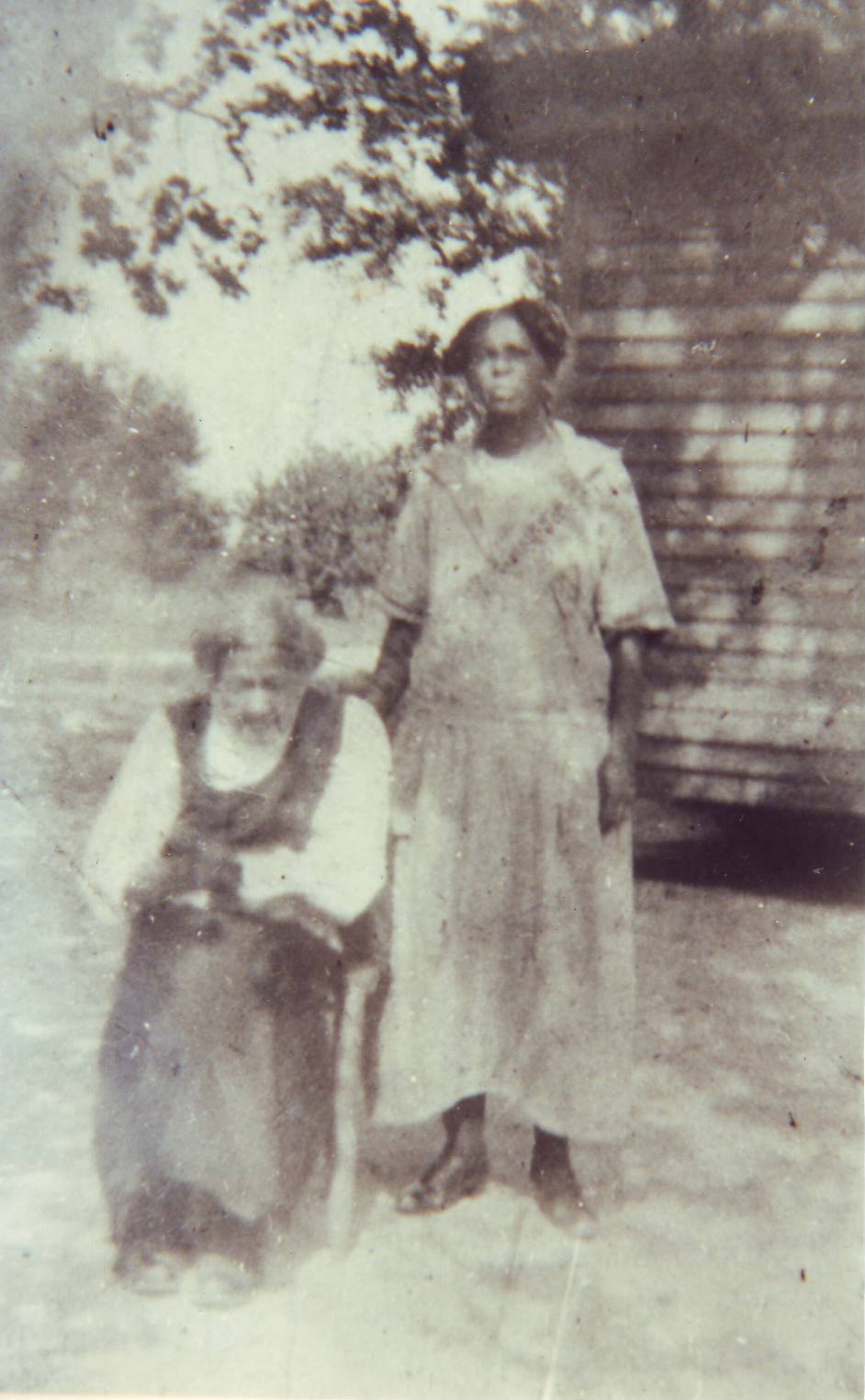
Eliza Balkcum Aldridge and her daughter-in-law, Fannie Kennedy Aldridge, circa 1920.

Levi Kennedy died 6 February 1940 in Goldsboro. His death certificate notes that he lived at 310 W. Pine Street, that he was a clothing merchant, and that he was married to Anna Kennedy.  He was born in 1875 in Goldsboro, and his parents were listed as Needham and Patience Kennedy. He is buried in Elmwood cemetery.

Ida Kennedy Darden Lamb died 18 December 1954 in Goldsboro. She was a widow and resided at 305 West Elm Street. She was born 18 March 1874 to “Needman” and Patience Kennedy.

I’ve been unable to trace William and Bryant Kennedy in New Jersey.

Standard
Births Deaths Marriages, Land, Maternal Kin, North Carolina, Other Documents, Rights

Murdock v. Deal, 208 N.C. 754, 182 S.E. 466 (1935).

In case you’re interested, here’s the text of the Supreme Court’s decision regarding Bertha Hart Murdock’s land. Property law is not my strong suit, especially as it applies to inheritance, so I will not attempt an explication.

——

This is an action for a declaratory judgment construing the last will and testament of T. L. Hart, deceased, and adjudging that by virtue of said last will and testament the feme plaintiff is the owner of an indefeasible estate in fee simple in certain lands described in the complaint, and has the power, with the joinder of her husband, to convey the same in accordance with her contract with the defendant.

The facts admitted in the pleadings are as follows:

T. L. Hart died in Iredell county, N. C., during the year 1930, having first made and published his last will and testament, which was duly probated by the clerk of the superior court of Iredell county, and recorded in the office of said clerk on June 4, 1930.

By his last will and testament, the said T. L. Hart devised his home place in Iredell county “to my daughter, Bertha May Hart and her bodily heirs, forever, never to be sold, and if she dies without bodily heirs, then it must be in trust for my sisters’ heirs, to hold but never to sell the same.”

By a codicil to his said last will and testament, the said T. L. Hart devised to his daughter, Bertha Mae Hart, a tract of land in Iredell county, containing forty-five acres, and described in the complaint by metes and bounds.

At his death, T. L. Hart left surviving as his only heir at law his daughter, Bertha Mae Hart, who has since intermarried with the plaintiff W. J. Murdock. He also left surviving five sisters, three of whom are married. Each of these sisters has children. Neither of his two unmarried sisters has children. Both are now over fifty years of age.

On April 1, 1935, the plaintiffs and the defendant entered into a contract in writing, by which the plaintiffs agreed to convey to the defendant a fee-simple estate, free and clear of all liens or incumbrances, in two tracts of land, one tract containing twelve acres, and being a part of the home place of T. L. Hart, deceased, which was devised to the feme plaintiff by the said T. L. Hart in his last will and testament, and the other tract containing forty-five acres and being the tract which was devised to the feme plaintiff by T. L. Hart, deceased, by the codicil to his last will and testament. By said contract, the defendant agreed to pay to the plaintiffs the sum of $1,000, upon the execution and delivery to him by the plaintiffs of a deed conveying both said tracts of land to the defendant, in fee simple, in accordance with said contract.

The defendant has refused to accept the deed tendered to him by the plaintiffs, and has declined to pay the plaintiffs the sum of $1,000, in accordance with said contract, on the ground that the feme plaintiff is not the owner of an indefeasible estate in fee simple in said tracts of land, and for that reason the plaintiffs cannot convey to him such an estate in said lands, in accordance with their contract.

On these facts the court was of opinion and so held that the feme plaintiff is the owner of an indefeasible estate in fee simple in the forty-five-acre tract, but that she is not the owner of such an estate in the twelve-acre tract.

It was accordingly ordered, considered, and adjudged that plaintiffs are not entitled to the specific performance by the defendant of the contract set up in the complaint, and that the defendant recover of the plaintiffs the costs of the action. The plaintiffs appealed to the Supreme Court, assigning as error the holding of the court that the feme plaintiff is not the owner of an indefeasible estate in fee simple in the twelve-acre tract described in the complaint.

Opinion

CONNOR, Justice.

There is no error in the judgment in this action. By virtue of the last will and testament of her father, T. L. Hart, deceased, and under the statute, C. S. § 1734, the feme plaintiff is the owner of an estate in fee simple in the twelve-acre tract described in the complaint. This estate, however, is defeasible upon the death of the feme plaintiff without bodily heirs. Whitfield v. Garris, 131 N. C. 148, 42 S. E. 568, and Id., 134 N. C. 24, 45 S. E. 904. It is clear that the words “bodily heirs,” used by the testator, must be construed as meaning children or issue; otherwise the limitation over to the heirs of the sisters of the testator would be meaningless. Rollins v. Keel, 115 N. C. 68, 20 S. E. 209. See Pugh v. Allen, 179 N. C. 307, 102 S. E. 394.

The limitation over to the heirs of the sisters of the testator, upon the death of the feme plaintiff, without bodily heirs or issue, is not void. The provision in the will that the home place of the testator, which includes the twelve-acre tract described in the complaint, shall not be sold by either the feme plaintiff or the remaindermen is void as against public policy. This provision, however, does not affect the validity of the devise either to the plaintiff or to the remaindermen. See Lee v. Oates, 171 N. C. 717, 88 S. E. 889, Ann. Cas. 1917A, 514.

There is nothing in the codicil which affects the estate in the home place of the testator devised in the will to the feme plaintiff.

The judgment is affirmed.

Standard
Births Deaths Marriages, Land, Newspaper Articles, North Carolina, Oral History

Bert’s estate.

She wanted a baby badly.

My grandmother:  … that nephew, Dr. Lord’s son, that was Mr. Hart’s nephew.  He got what Bert had. Yes, indeed. ‘Cause, see, it was heir property. And see that’s why Bert tried so hard to have a child.  Because if she didn’t have a child, it was going to whoever had had a child.  You know. And I guess Alonzo did, you know, he was a nephew.  When Bert died, it went to him. See, all this property and everything that Mr. Hart owned there was his family’s stuff.  Wasn’t Grandma Hart’s.

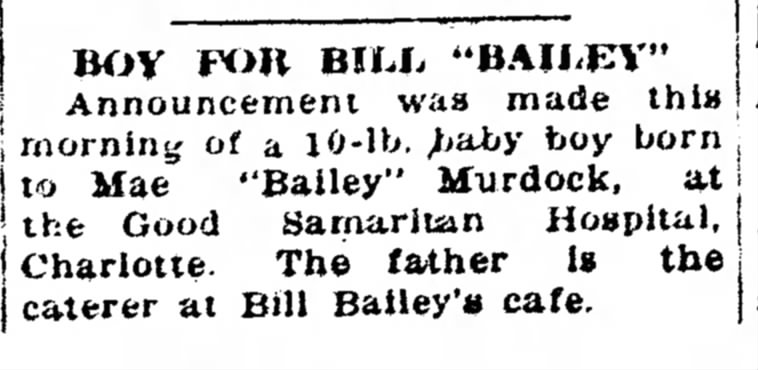
And in 1941, when she nearly 40 years old, Bertha Hart Murdock had one:

Image

Statesville Landmark, 2 April 1941.

But little William Alonzo Murdock died the day after he was born.

Still, the situation for Bert and her property was not as critical as my grandmother had believed. In Alonzo Hart’s original will, made 15 October 1928 in Statesville, he devised “the home place to my daughter Bertha Mae Hart and her bodily heirs, for ever, never to be sold and if she dies without bodilies heirs. Then it must be in trust for my sisters heirs to hold but never sell same.” The remainder of his property went to his sisters’ heirs.

Thirteen months later, as he languished in the state sanitorium in Quewhiffle, dying of tuberculosis, Hart dictated a codicil.  In somewhat opaque and ungrammatical phrasing, Hart “hereby enlarge[d] the privilege to and use at her own and released to her. In stead of one parcel or tract of land I do bequeath and devise to her following described lands, In Iredell North Carolina, 45 acres in Concord Township (Deatonsville) Also 2 lots with one house Statesville Township also 47 acres in Shiloh township and Crawford near Sumters place 22 acres in above township near home belong to the home resdue. I am in my right presence of mind and know what is best for my only and legal heir Bertha Mae Hart.”

In other words, Bertha’s inheritance was generous and unrestricted, and her cousin Alonzo Lord was not to receive anything at all. Things did not go smoothly, however. Hart’s unconventional wording opened the door to challenge, and Bertha was forced to defend her title.

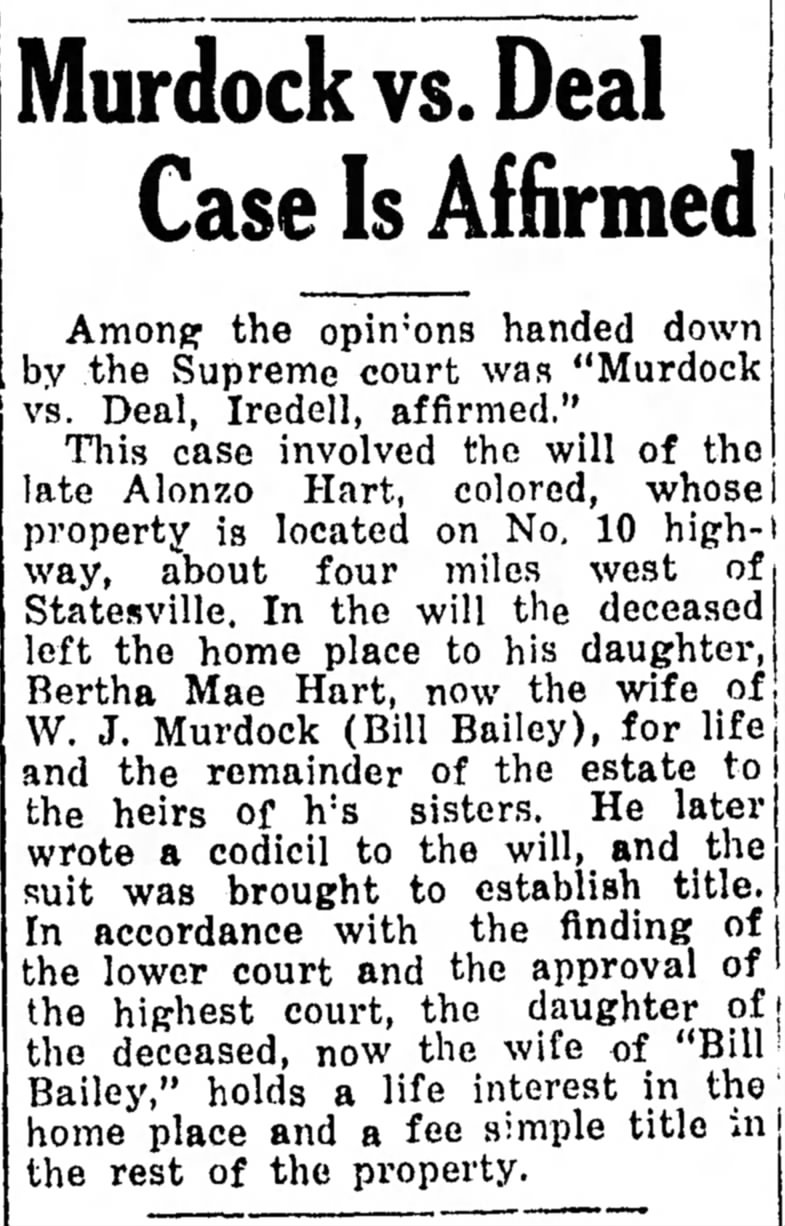
A Hart Est Suit Landmark 11 21 1935

Statesville Landmark, 21 November 1935.

Incredibly, this case went to the North Carolina Supreme Court: Murdock v. Deal208 N.C. 754, 756, 182 S.E. 466, 467 (1935).

By time Bertha died in 1955, her estate seems to have been much reduced, but still comprised some of Alonzo Hart’s land. The bulk of her estate went to Odessa A. Williams, who may have been her cousin. Her half-brother H. Golar Tomlin inherited only a half-interest in a lot. His daughter Annie LaVaughn Tomlin Schuyler received the other half. Another niece, Mattie Johnson, received the negligible sum of one dollar, which raises questions: who in the world was she? I only know of Golda’s one child. Was this in fact Mattie James, oldest daughter of Bert’s other half-brother, Lon Colvert? Why bother with a dollar? And why not give the other nieces, Louise Colvert Renwick, Margaret Colvert Allen, and Launie Colvert Jones, their own dollars?

Murdock Will 8 Jun 1955 R and L

Statesville Landmark, 8 June 1955.

The drama did not end with Bert’s death. In what looks to be the family’s own Bleak House saga, City of Statesville v. Credit and Loan Company, a corporation of the State of North Carolina; W.S. Nicholson and spouse, if any, and if they be deceased, then their unknown heirs, and if any of said unknown heirs be deceased, then their respective heirs, devisees, assignees, and spouses, if any; and the unknown heirs of Minnie Brawley, Florence Camp, Mollie Alexander, and Lula H. Lord, Deceased, and if any of said unknown heirs be deceased, then their respective heirs, devisees, assignees, and spouses, if any; and all other persons, firms and corporations who now have, or may hereafter have, and right title, claim or interest, in the real estate described herein, whether sane or insane, adult or minor, in esse, or in ventre sa mere, active corporations or dissolved corporations, foreign or domestic, 294 S.E.2nd 405, was not decided in the North Carolina Court of Appeals until 1982.

The first sentence of the decision: “The sole issue is whether plaintiff has a valid avigation easement over land owned by defendant.” An avigation easement is a property right acquired from a landowner for the use of air space above a specified height.  Alonzo Hart’s home property was located a few miles west of Statesville, adjacent to land now home to Statesville Regional Airport. (Brawley, Camp, Alexander and Lord were his sisters.) The City of Statesville’s claim that it held prescriptive easements was rejected, and partial summary judgment entered for the defendants.

——

Interview of Margaret C. Allen by Lisa Y. Henderson; all rights reserved.

Standard
Births Deaths Marriages, North Carolina, Other Documents, Paternal Kin

A final account.

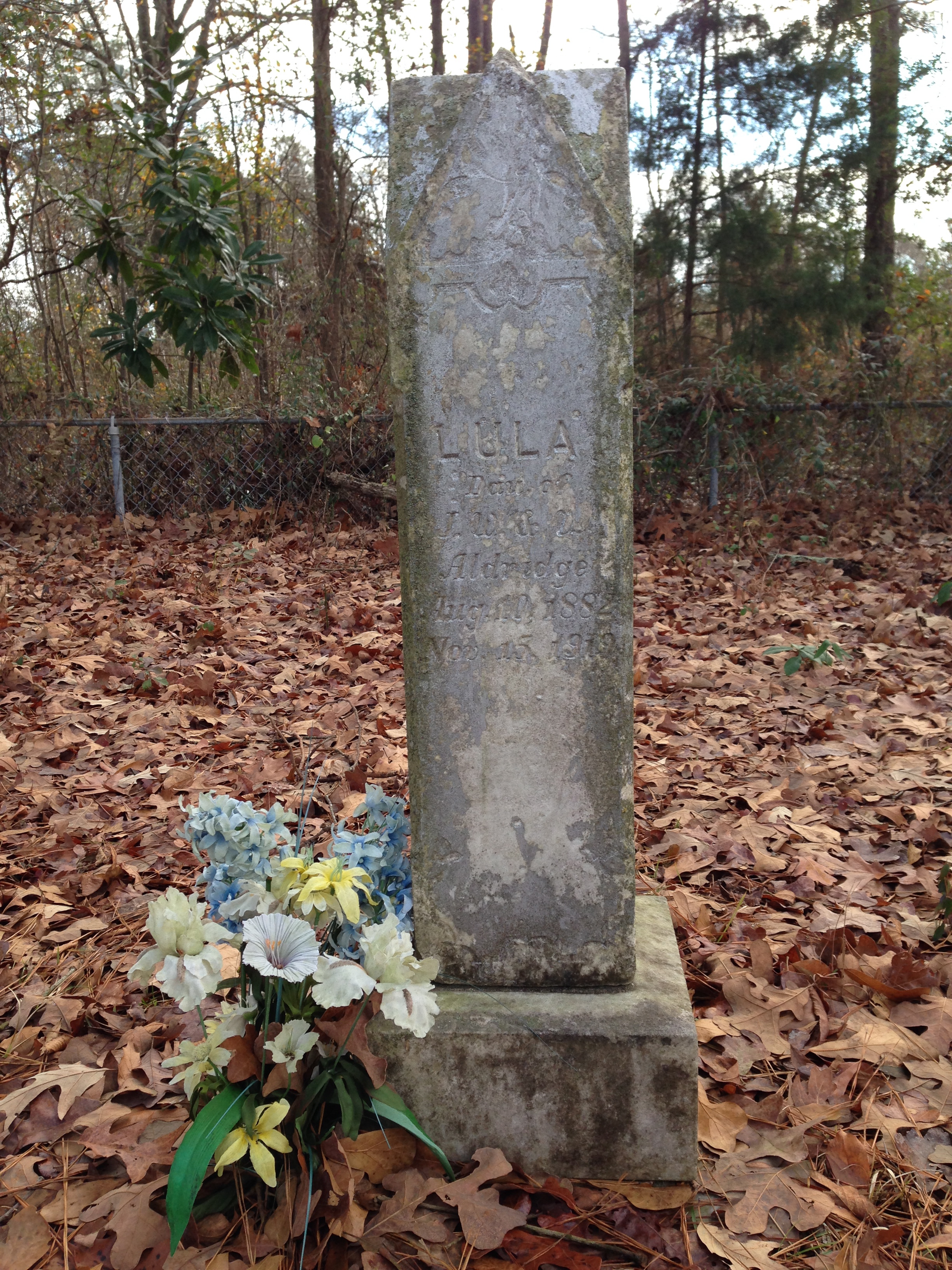
Lula Mae Aldridge died 16 November 1919 in a state hospital after a battle with mental illness. She was 37 years old. Lula had a few hundred dollars, probably inherited from her father, John W. Aldridge, and her brother John J. Aldridge was appointed administrator of her estate.

ImageLula was the oldest of John and Vicey Artis Aldridge‘s daughters, and the second to die that month. (Amanda Aldridge Newsome has succumbed to influenza ten days earlier.) Her family spared no expense for her funeral — $140.00 paid to undertaker L.T. Lightner and $80 to Goldsboro Marble & Granite Works for her marker.

IMG_4675 Lula’s gravestone, Henderson-Aldridge Cemetery, Dudley NC

ImageThis, despite the considerable debt against her estate, primarily in the form of a $277 judgment against her by William Mozingo.  (What in the world?!? I’ll have to look this up.)  Lula’s brothers John and James Thomas Aldridge and her mother Vicey contributed  $337.95 (about $4600 today) to settle her affairs, and the estate closed in 1923.

Image

Standard
Births Deaths Marriages, Land, Maternal Kin, Other Documents, Virginia

Where we lived: ten acres near Westover Church.

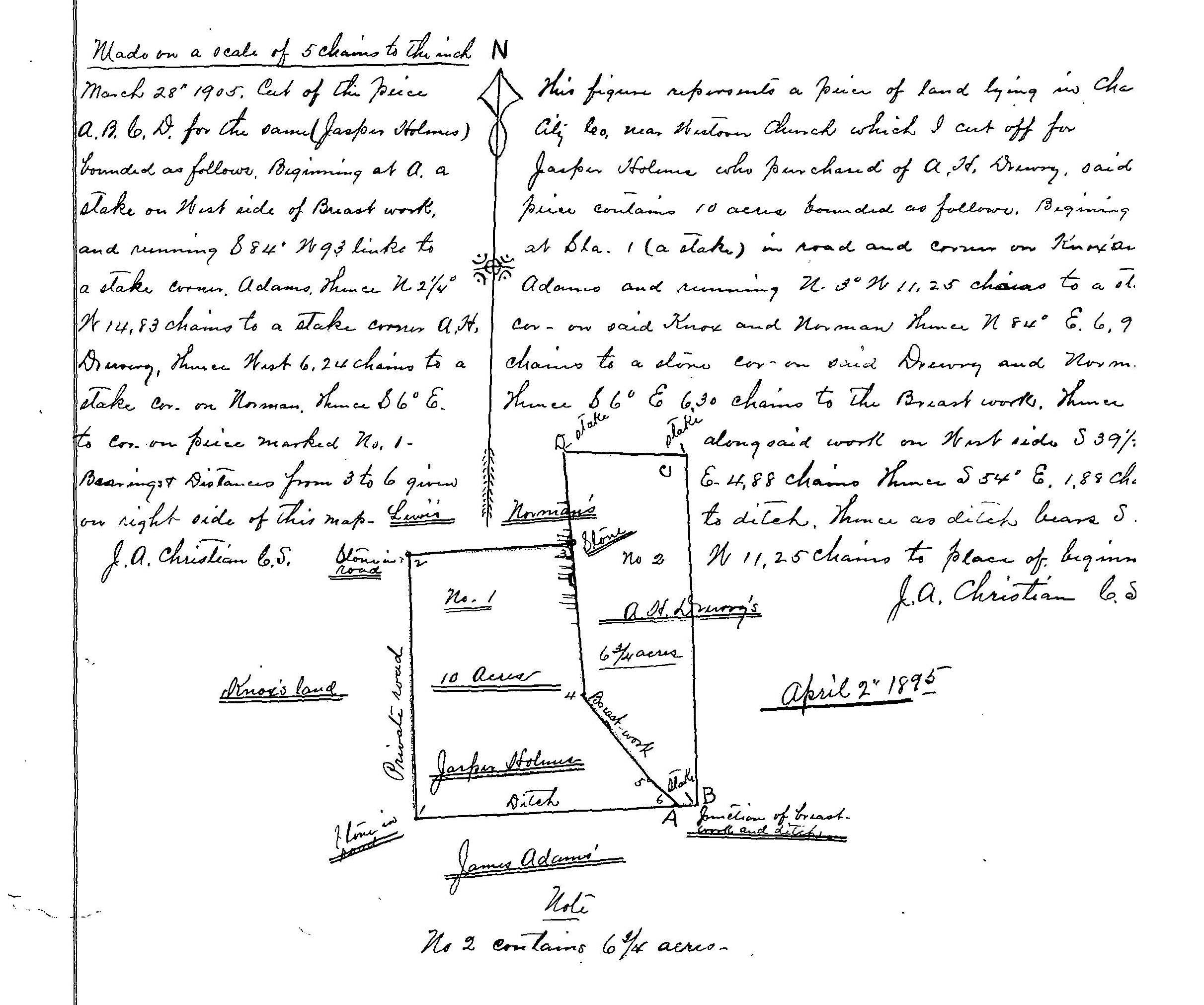
In 1909, ten years after their father’s death, sole surviving heirs Mary Agnes Holmes Allen and Julia Holmes sold two parcels that Jasper Holmes had purchased in 1873 and 1879. “This figure represents a piece of land lying in Cha City Co, near Westover Church” wrote the surveyor who laid off the land and prepared this plat:

Pages from ALLEN -- Estate Litigation Docs

Westover, dating back nearly 400 years, is one of the oldest Episcopal parishes in Virginia. The current church was built in 1631 and remains active. Confederate breastworks running between the church and Evelynton plantation, on the south side of John Tyler Memorial Highway, are still visible.

Standard
Enslaved People, Maternal Kin, North Carolina

Where did they go?, no. 1: Nicholson.

In 1850, James Nicholson of northern Iredell County dictated a will that distributed 17 enslaved people – Milas, Dinah, Jack, Liza, Peter, Elix, Paris, Daniel, Carlos, Nelson, Lucinda, Joe, Manoe, Armstrong, Manless, Calvin and Sophie — among his heirs. I am descended from one, Lucinda, whose daughter Harriet was conceived after she joined Thomas A. Nicholson’s household. As I wrote here, Lucinda is found post-slavery only on death certificates of two of her children.  What of the other 16? Are they any easier to trace?

In a word – no.

Mary Allison Nicholson received five slaves from her husband’s estate.  Son Thomas received three outright and a share in five others. Son John McCombs Nicholson received four and a share in the same five. (It is not at all clear whether the groupings of these 17 people respected family units or were simply combinations devised with an eye for equal value.) Mary died in 1857 and, presumably, her property passed to her sons. However, in the 1860 slave schedule of Iredell County, only two Nicholson slaveholders appear: Thomas, who owned 13, and Martin T. Nicholson, who owned three. (Martin was Thomas’ brother-in-law and first cousin.)  In the population schedule, Thomas reported owning $11,000 worth of personal property, a figure that would have included the value of his slaves. His brother John reported only $565. Had he sold his?

And the bigger question, where did Thomas’ slaves go after Emancipation?  Freedmen did not always adopt the surnames of their immediate masters, of course, but in the 1870 census of Iredell County, only four black residents claimed the surname Nicholson. Eliza Nicholson, age 25, lived in the household of Thomas Nicholson’s son Wes. She presumably is the Liza of James’ estate.  Manless Nicholson, 22, his wife (?) Maggie Nicholson, 24, and daughter Annie, 5, lived in Thomas’ household and worked for him. Manless had been jointly owned by Thomas and his brother. In Yadkin, the adjoining county, 35 year-old Alaxander Nicholson (probably the “Elix” above) is listed in the household of Isabel Cartwright. But that is it.  No more.

Obviously, some people were simply inadvertently omitted from the 1870 schedule, such as Lucinda and her daughter Harriet, who were clearly living in Iredell then, and Milas Nicholson, who appears ten years later in Turnersburg township, Iredell County, as a 33 year-old with a wife and child. Also, the 1880 census of Deep Creek, Yadkin County, shows an 80 year-old Sophia Nicholson who may have been “Soffie.” (And was probably Manlius “Manless” Nicholson’s mother, as a Yadkin County marriage license and his death certificate indicate.)  Of Dinah, Daniel, Nelson, Armstrong and the others, however, there is no trace, either in surrounding counties or under a different surname.

Standard
Births Deaths Marriages, Enslaved People, Free People of Color, North Carolina, Other Documents, Paternal Kin

The estate of Solomon Williams.

Image

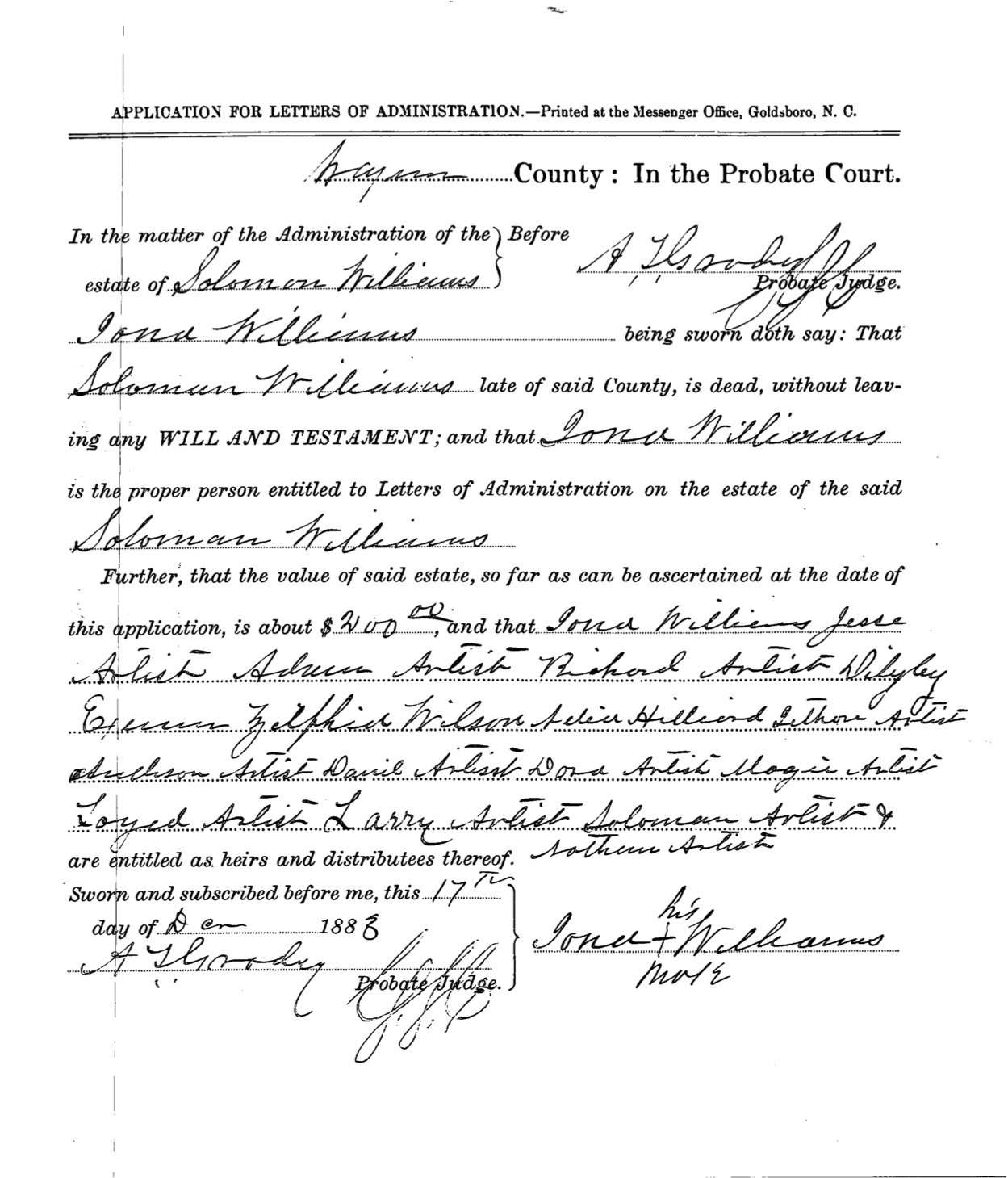
Vicey Artis, a free woman of color, and Solomon Williams, a slave, had eleven children together – Zilpha Artis Wilson, Adam Toussaint Artis, Jane Artis Artis, Loumiza Artis Artis, Charity Artis, Lewis Artis, Jonah Williams, Jethro Artis, Jesse Artis, Richard Artis and Delilah Williams Exum — before they were able to marry legally.  On 31 August 1866, they registered their 35-year cohabitation in Wayne County.  Vicey died soon after, but Solomon lived until 1883.  The document above, found among Solomon’s estate papers, names son Jonah as administrator and lists his and Vicey’s six surviving children and the heirs of their deceased children.

Little is known about Solomon. He was born about 1800. A few slaveowning Williams families lived in Vicey Artis’ vicinity in Greene County, but there is no evidence to link Solomon to them. He appears in the 1870 and 1880 censuses of Nahunta township, Wayne County, heading households comprised of his daughters and their children, and is recorded as father on the marriage licenses of daughter Lomisy (Loumiza) Williams and son Adam Artis and the death certificates of children Jonah Williams, Richard Artis and Delila Exum.

Standard
Births Deaths Marriages, Free People of Color, North Carolina, Other Documents, Paternal Kin

Chears and bee gums.

Per the “Account of the Sale of the property of Matthew Aldridg Deceased sold by Joseph Hollowell Adm. on a credit of six months, Nov 20th 1868,” his widow, Catherine Boseman (or Simmons) Aldridge, purchased five “chears”, cart wheels and an axle, two tables (one small), two beds and furniture, “one cubbard & contents,” a clock, a gun, “3 Bee Gumes & work bench,” a tub dipper, kitchen furniture, a blind mare and two beehives. Green Simmons, George Simmons and David Winn purchased tools, and “Robbert Aldridg,” who likely was Matthew Aldridge’s brother, bought the fourth and fifth beehive choices.  A note on William Carter for a $27.50 debt, due 1 January 1869, was described as doubtful.  The Application for Letters of Administration in the file notes that Aldridge’s heirs were John Henry AldridgeWm. AldridgeFrances Aldridge, Della AldridgeMary Ann AldridgeJoanna Aldridge, and James Thomas Aldridge.

William Aldridge was one of the founders of the First Congregational Church of Dudley, and Frances Aldridge Wynn and Mary Ann Aldridge Baker’s descendants were prominent members of the church for several generations. John H. Aldridge had a daughter, Nina Frances Faison Hardy, who played an important role in my grandmother’s young life. More about Aunt Nina later.

Standard
Births Deaths Marriages, Enslaved People, Maternal Kin, North Carolina, Oral History, Other Documents

Lucinda Cowles, also known as Lucinda Nicholson.

I give and bequeath to my beloved son Thomas A. the following Negroes to wit Carlos Nelson Lucinda and Joe.

——

On 19 Nov 1850, James Nicholson wrote out his last will and testament. Two days later, before he could sign it, he slipped into death.  The document was registered 19 Jun 1852 in Will Book 4, page 666 at the Iredell County Register of Deeds Office. Nicholson’s only heirs were his widow Mary Allison Nicholson and sons Thomas A. and John M. Nicholson.  James left Thomas 185 acres and John 242 acres and gave them a 75-acre mill tract in common.  Mary Nicholson received slaves Milas, Dinah, Jack, Liza and Peter; John received slaves Elix, Paris and Daniel; and Thomas received the four named above.  In addition, James bequeathed Thomas and John slaves Manoe, Armstrong, Manless, Calvin and Soffie jointly.

Thomas A. Nicholson put Lucinda to work in his home preparing meals and otherwise caring for his family. As Thomas’ son James Lee Nicholson grew to adulthood, he took increasing notice of the woman who cooked his suppers, laundered his shirts and emptied his slops. In 1861, she gave birth to his first child, a daughter that she named Harriet Nicholson. Lucinda and Harriet remained in Thomas Nicholson’s household till Emancipation, when they were provided with a small house and other support.

As the story goes, Harriet did not learn her father’s identity until her mother Lucinda revealed it on her deathbed. Lee Nicholson passed away when Harriet was 10 years old, leaving a widow and two small boys. Lucinda may have died even earlier, as she has not been found in the 1870 census. She had one other child, a son named William H. Nicholson, whose father was Burwell Carson. Based on information supplied by Harriet, William’s death certificate lists Lucinda’s maiden name as Cowles. We know nothing else about her life.

Standard