Births Deaths Marriages, Education, Free People of Color, North Carolina, Other Documents, Paternal Kin

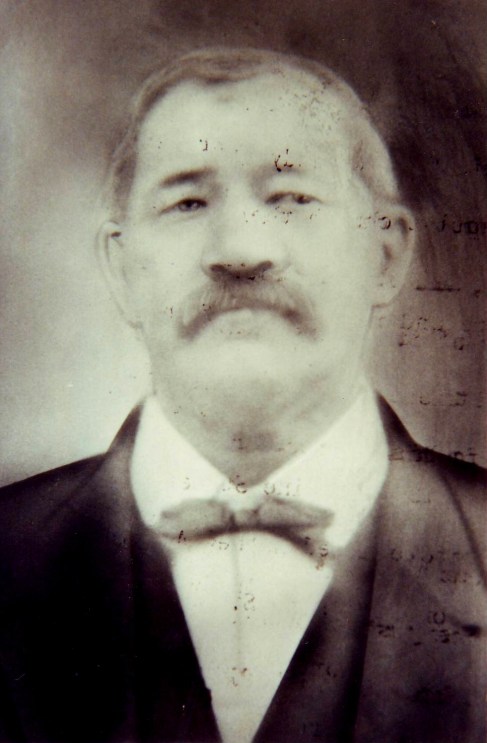
John William Aldridge.

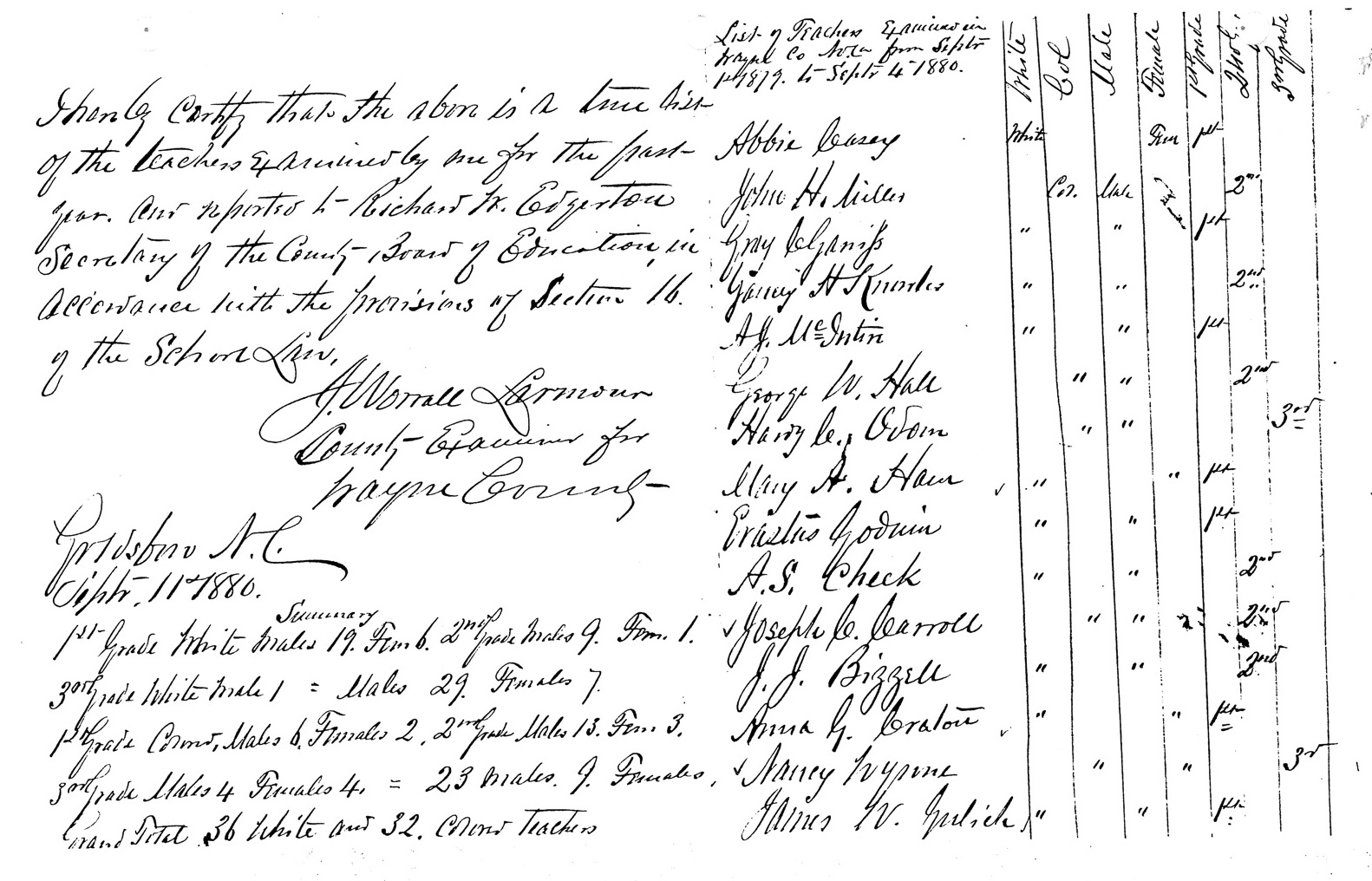
John Aldridge and his brothers George and Matthew Aldridge were hired to teach in Wayne County in the late 1870s. For reasons unknown, they were assigned to schools in the far north of the county, some 15 miles north of Dudley:


ALDRIDGE -- Aldridge_School Records

ALDRIDGE -- Aldridge_School Records 2 

From the same unsigned family history:

John Aldridge met Luvicie Artis at the school where he taught; she was one of his students. He built a 7 room house for her when they got married. John was a stout man with a reddish brown complexion and wavy black hair. He stopped teaching when he married Luvicie and started to farm and run a general store. The store was burned down in 1911. He sent his children to a private school. He died in 1910 of a congested chill. He was 58 years old when he died, and was worth about $30,000 at that time.

ALDRIDGE_--_John_Aldridge_Vicey_Artis_Marriage_License

If John was worth $30,000 when he died, it was all in realty. His personal estate was paltry:
JW Aldridge Estate Doc
Standard
Births Deaths Marriages, Enslaved People, Free People of Color, North Carolina, Other Documents, Paternal Kin

Up from slavery.

artis-solomon-williams-estate-records-dragged

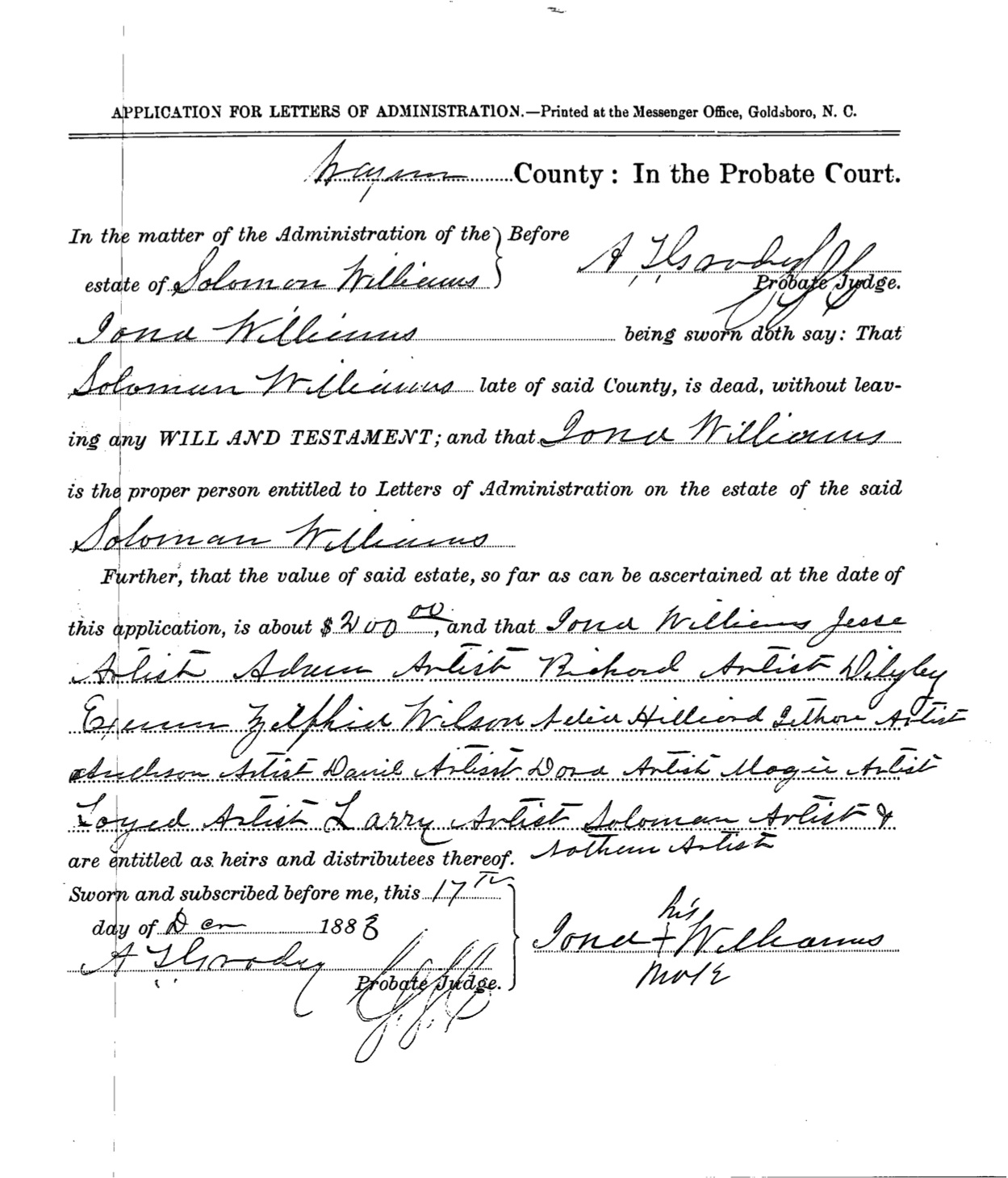
Vicey Artis, a free woman of color, and Solomon Williams, a slave, had eleven children together – Zilpha Artis Wilson, Adam Toussaint Artis, Jane Artis Artis, Loumiza Artis Artis, Charity Artis, Lewis Artis, Jonah Williams, Jethro Artis, Jesse Artis, Richard Artis and Delilah Williams Exum — before they were able to marry legally.  On 31 August 1866, they registered their 35-year cohabitation in Wayne County.  Vicey died soon after, but Solomon lived until 1883.  The document above, listing his and Vicey’s six surviving children and heirs of their deceased children, is found among his estate papers.

Standard
Births Deaths Marriages, Land, Maternal Kin, North Carolina, Other Documents

Jule McNeely leaves a toehold.

I did not doubt that Henry and Julius McNeely were brothers, but here is proof-positive: Julius died widowed, childless and intestate, and his sole heirs were Henry’s children.Image“Jule” McNeely’s thin estate file, opened in 1913 in Rowan County Superior Court, is devoted to the distribution of his tiny plot of farmland to John, Luther, Emma, Addie, Carrie, Ed, Litha, Janie, Lizzie and Minnie McNeely as tenants in common. When Addie died in the middle of matters, a guardian was appointed for her children, “Ardenia” [actually, Ardeanur], 14, and James Smith, 9. At issue: “Beginning at a stone on D.S. Cowan’s line, and runs S. two degrees W 7.10 chains to a stone thence; N. 85 degrees W. 3.50 chains to a stone, thence; N. 2 degrees E. 6.50 chains to a stone on Cowan’s line, thence; E. to the beginning, containing two and a half acres more or less.” “The above land is the old Jule McNeely place, lying just east of Mount Ulla in Rowan County, and” — despite its tininess — “is a very desirable lot.” The heirs’ attorney petitioned for the sale of the lot, noting that it was too small to be advantageously divided or to justify continued possession by so many heirs, all of whom lived in Iredell County except Emma and her husband Ervin Houser of Bayonne, New Jersey. The petition was granted, and at auction on April 21, 1917, Carrie’s husband Lon W. Colvert placed the highest bid at $80.

[Sidenote: Before I found this file, I did not know that (1) Lizzie McNeely was first married to Watt Kilpatrick; (2) when Addie McNeely Smith died; or (3) Lon Colvert owned property in Rowan County, much less property that had belonged to his wife’s late uncle.]

Standard
Enslaved People, Maternal Kin, North Carolina

Juda’s children.

As noted earlier, Elizabeth Kilpatrick’s will seems to establish that Juda, an enslaved woman born perhaps in the 1790s, was the mother of at least two children, the Dave and Lucinda specifically referred to in Kilpatrick’s will. Under its terms, Dave’s ownership passed to son Robert Kilpatrick and Lucinda’s to daughter Mary Kilpatrick. Elizabeth’s estate file shows that her administrator sold Negroes Juda ($50.00), Matthew ($425.00) and John ($200.00) on 29 August 1829 and “Negro Kesy” for $74.75 on 30 October 1830. (Their buyers are not listed.) Assuming that Kesy, Matthew and John are the “children not disposed of” in the will, Juda was the mother of at least five children.  Only Lucinda can be further accounted for.

In 1834, Mary Kilpatrick sold Lucinda and her children Alice, 3, and John, 1, to Samuel and John W. McNeely. John disappears from the record. However, Alice, known as “Allie,” bore at least one son, Joseph Archy, and probably several other children, including Alexander, Stanhope and Mary. All – save Alice, who perhaps had died – appear in J.W. McNeely’s Confederate tax assessment in 1863.

Lucinda herself gave birth to two more sons, Julius, about 1838, and Henry W., in 1841. Julius’ father is unknown, but appears to have been a black man. Henry’s father was John Wilson McNeely himself.

Standard
Enslaved People, Land, North Carolina, Paternal Kin, Photographs

A thousand acres between creek and swamp.

Kinchen Taylor’s estate papers include two plats. One laid off his widow Mary Blount Taylor’s dower. The second divided his remaining land into two large parcels:

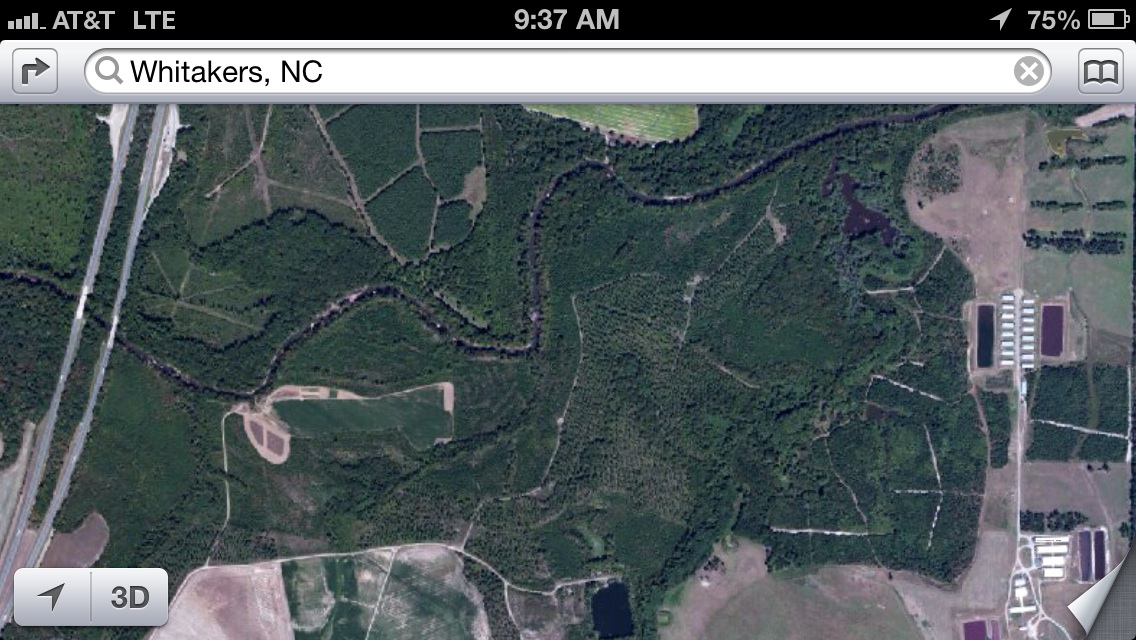
ImageIn some ways, Taylor’s old lands have not changed dramatically. Pine forest and tilled fields still predominate the landscape; far northern Nash County remains rural. Nonetheless, Taylor and enslaved workers like Green and Fereby, who walked and worked it intimately, might be pressed to recognize his property.

Image

I-95 — a far cry from the path shown in the plat — roars with traffic just west of Taylor’s acreage, hauling truckers and tourists from Maine to Florida. If you tilt your head sharply to the right, you’ll see that Fishing Creek, crawling across the top of the screen, still follows the same general course. Beaver Dam Swamp, however, has been dammed just below its confluence with the creek, forming a small body called Gum Lake. The watercourse of the swamp, probably largely drained, is barely detectable as an undulating line of taller vegetation angling southwest from the pond. Lost somewhere in its tangle of canes and catbrier is the Old Mill shown on the plat.

On the other side of Beaver Dam swamp, to the far right of the Google Map view, is an industrial hog farm, identifiable by the white structures with adjacent dark lozenges — barns holding up to 2500 hogs a piece and the lagoons that capture the stupendous quantities of waste they produce. This perhaps would have startled Kinchen Taylor most, as his hogs would have been free-range until time for fattening. (And it should startle you, too, as this is huge, nasty business.)

The file of Kinchen Taylor (1853), Nash County, North Carolina Estate Files 1663-1979, https://familysearch.org, original, North Carolina State Archives;

Standard
Enslaved People, Maternal Kin, North Carolina, Other Documents

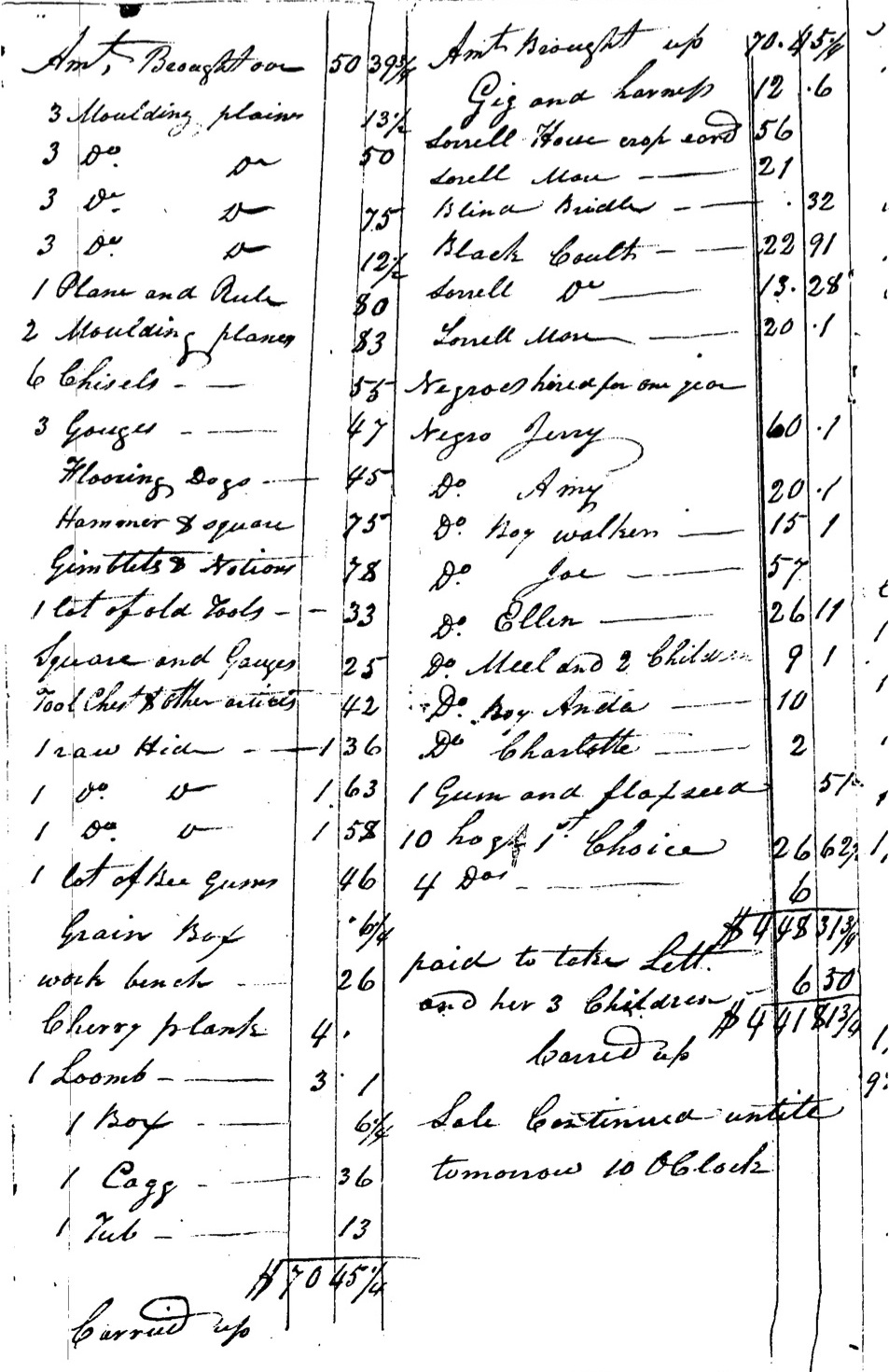
6 chisels, a hammer & square, a grain box, a sorrell mare, 10 hogs and …

Inventory of the estate of John Alpheus Colvert, Iredell County, North Carolina, 1827.

ImageImage

On the second page, in the second column, are “Negroes hired for one year,” that is, slaves leased to neighbors to earn money for Colvert’s estate. “Boy Walker” was about eight years old. That he was listed without his mother suggests that he was an orphan, though he may have been kin to the others who appear in this list. Walker had arrived in North Carolina only two or three years before, passed to John Colvert from the estate of John’s father Samuel. When John’s died, his son William I. Colvert inherited Walker. William was even younger than his own slave, however, and Walker was likely hired out until the boy came of age.

Standard
Free People of Color, North Carolina, Other Documents, Paternal Kin

Adam Artis’ children, part 2: Lucinda Jones.

artis-guardianship-application

“Adam Artist” and “Lousinda” Jones married 10 October 1855 in Nash County. Lucinda’s father Jacob Ing (who was white) was bondsman, William T. Arrington witnessed, and justice of the peace D.A.T. Ricks performed the ceremony. Lucinda Jones Artis died circa 1860, and in 1870 her children Augustus Kerney, Noah and Mary Jane inherited her share of her father Jacob Ing’s estate.  In 1872, Adam Artis filed this guardianship application in order to manage their estate.

Augustus “Gus” K. Artis was born about 1857. Some time after the birth of their daughter Lena in 1882, Gus and wife Mary migrated to the Little Rock, Arkansas area. The city’s 1914 directory lists him as a laborer at J.W. Vestal & Son, a nursery. He died in 1921.

Noah Artis, born in 1856, remained in northeastern Wayne County, where he farmed, married Patience Mozingo, and fathered children Nora Artis Reid, Pearl Artis, Pauline Artis Harris, Rena Belle Artis, William N. Artis, and Bessie Artis. He died in 1952 in nearby Wilson NC.

Mary Jane Artis, born in 1859, married Henry Artis, son of Warren and Percey Artis. (Though all of Wayne County Artises are probably ultimately related, the exact kinship between Warren Artis, whose father was supposedly Absalom Artis, and Adam Artis is unknown.) Mary Jane remained in the Nahunta area of Wayne County all her life and died after 1900. Her and Henry’s children were Armeta Artis, Alonzo Artis, Lucinda Artis, Callonza Artis, Mattie Artis Davis and Marion Artis.

Standard
Enslaved People, North Carolina, Other Documents, Paternal Kin

Kinchen Taylor’s inventory.


179360_500865558526_505368526_6215658_5475447_n

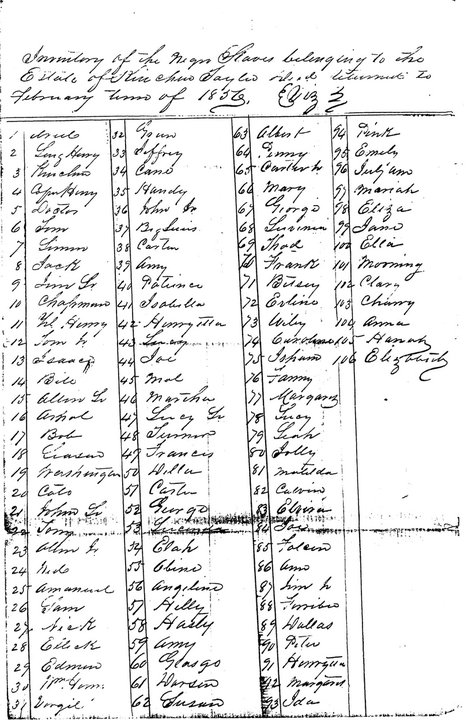
Nash County, North Carolina, 1856. An inventory of the slaves of Kinchen Taylor, deceased. Number 32 is Green. Number 88 is his wife Ferribee; and 89, 90 and 91, their oldest children. Most of Kinchen Taylor’s slaves were divided among his children, but two lots of slaves were sold. Green and Ferribee and their children were included in one of those lots, and it is not clear to whom they went, or if they went together. However, in 1870, in the first post-Emancipation census, they are listed in southern Edgecombe county as an intact family: Green Taylor, 52, his wife Phebe, 55, and children and grandchildren Dallas, 19, Christiana, 15, Mckenzie, 13, Mike, 9, and Sally Taylor, 1. Henry Michael “Mike” Taylor was my great-grandfather.

The file of Kinchen Taylor (1853), Nash County, North Carolina Estate Files 1663-1979, https://familysearch.org, original, North Carolina State Archives.

Standard
Births Deaths Marriages, Free People of Color, North Carolina, Paternal Kin, Photographs

On the Stoney Run Branch and Wilmington & Weldon Railroad.

On 4 July 1902, dower laid off and partition made of Robert Aldridge‘s land as follows:

Dower — Eliza Aldridge received 53 acres on a run of Stoney Run Branch.

Lot No. 1 — Mathew W. Aldridge received 100 acres on Stoney Run and Hurricane Branches, excluding the Agustus Church and free school house lots.  An interest Mathew had bought from his father was included in the described tract and the residue was valued at $200.
matthew-aldridge

Lot No. 2 — George W. Aldridge received 42 acres on Stoney Run and the county road valued at $200.
george-aldridge

Lot No. 3 — Joseph Aldridge received 53 acres on Stoney Run and the county road valued at $200.

Lot No. 4 — David Aldridge received 80 acres on Stoney Run and the county road valued at $200.

Lot No. 5 — Robert Aldridge received 41 acres on a prong of Stoney Run and the Spring Road valued at $200.

Lot No. 6 — John W. Aldridge received 50 acres on Stoney Run Branch below the mineral spring and the Spring Road valued at $285.

Lot No. 7 — Frances Locust received 33 acres on Stoney Run and the Spring Road valued at $200.

fannie-a-randall

Lot No. 8 — Talitha Brewington, Hattie Brewington, Elijah Brewington, Mattie Brewington, Lundy Brewington, and Toney Brewington jointly and subject to the life estate of Joshua Brewington, received 33 acres on W&W Railroad valued at $193.

Lot No. 9 — Louetta Aldridge received 32 acres on Stoney Run Branch valued at $193.

Lot No. 10 — Lizzie Aldridge received 32 acres on the W&W Railroad and Stoney Run Branch valued at $193.

Lot No. 11 — Louetta Artis, Robert Artis, Columbus Artis, Josephine Artis, J. Scott Artis, J.B. Artis, Lillie Artis, Annie Artis and Elberta Artis, jointly and subject to the life estate of Adam Artis, received 32 acres at the mouth of a ditch on the run of Stoney Run and the railroad valued at $193.

Submitted by Sam C. Casey, Walter C. O’Berry, Ira W. Hatch.

The margins of this document contain notations and signatures acknowledging receipt of moneys due to balance the lot values, including signatures of Lizzie Aldridge, Tilithia King, J.W. Aldridge, Joseph Aldridge, Hattie Brewington, Columbus Artis, Elijah Brewington, Tony C. Brewington, Robert Aldridge, Lundia Brewington, and June Scott Artis, and Eliza Artis’ mark.

John Aldridge, owner of Lot No. 6, paid $7 each to the owners of Lots 8-11, and $57 to the Clerk of Superior Court for costs of the division.

Louetta Aldridge’s share was divided among her siblings “the owner of said amount now being dead this day Aug 22=1904.”

——

Robert Aldridge, my great-great-great-grandfather, was born circa 1819, probably in Duplin County NC, and died about 1899. He appears as a hireling in the 1850 census in Sampson County in the household of Calvin Simmons. By 1860, he and his wife Mary Eliza Balkcum Aldridge were living in southern Wayne County with their youngest children. His accumulation of property is something of a mystery, as his recorded deeds do not yield the acreage distributed in his estate.  Bits of the land remain in family hands.

There is a Stoney Run in Wayne County today, but it courses several miles northwest of the area in which Robert Aldridge is known to have owned land. I suspect that the waterway referred to above is now known as Yellow Marsh Branch, which has been dammed to form Durhams Lake. Robert owned a brickyard in the vicinity. “Agustus Church” is now Augustus Chapel Missionary Baptist Church, and the current edifice stands on the original land as what is now 599 Durham Lake Road, Dudley. The church celebrated its 145th anniversary in 2012. The Wilmington & Weldon Railroad is now owned by Atlantic Coast Line. My best guess for the “county road” is the road now known as the Old Mount Olive Highway, which runs alongside the railroad.

Abstract of document in the file of Robert Aldridge, Estate Records, Wayne County Records, North Carolina State Archives.

Photos of Mathew Aldridge, George Aldridge and Frances “Fannie” Aldridge Locust, alias Fannie Randall, in the collection of Lisa Y. Henderson.

Standard