Maternal Kin, North Carolina, Photographs

One of those McNeely girls.

This is a surely a McNeely sister, but which one?

ImageMy grandmother wasn’t sure, but knew it wasn’t her mother Carrie, or Aunt Emma, or Aunts Minnie or Janie. Nor, she thought, was it Aunt Lizzie or Aunt Elethea. Which leaves Addie, but she nixed her, too. Not to second-guess my grandmother — or, well, to second-guess her, but in the most respectful way — I’d put my money on Addie, who died when my grandmother was about 9 years old.

Photograph in collection of Lisa Y. Henderson.

Standard
Maternal Kin, North Carolina

Kinfolk?, no. 1.

In the 1880 census, Richard and Viree Morgan (John W. Colvert‘s sister) are listed in Eagle Mills, Iredell County, sharing a household with 20 year-old Squire Gray. Later that year, Squire married Rachel Way. Their marriage record lists Squire’s parents as E. Gray and R. Gray.

By 1900, Squire Gray, 39, his wife Rachel, 30, and daughters Hatty, 23, and Nelly Gray, 13, shared a household in Biltmore Precinct No. 1, Asheville, with Robert Jones, 50, his wife Caroline, age unknown, their grandchildren Robert, 10, Carrie, 7, and Valley Richardson, 8, and daughter Anne Richardson, 33. Both Squire and Robert worked as teamsters, and Rachel Gray as a cook.

In 1910, Square [sic] Gray, 61, Rachel, 59, Hattie, 18, and Nelly, 16, lived in the household of Dock and Lou Southern on Kenilworth Park in Asheville.

In 1920, Squire Gray, 70, wife Ratchel, 61, daughters Nellie, 40, and Ratchel, 35, and granddaughter Hattie, 1 ½, lived in Asheville on Kenilworth Park. [The names of Hattie and her daughter Rachel had been transposed.]

Squire Gray died 21 June 1921 in South Asheville. His death certificate noted that he was 61 years old, was married to Rachel Gray, and worked as a common laborer. He had been born in Rowan County to Orange Gray and Rachel Colbert. Squire was buried in South Asheville Cemetery.

Squire’s relationship, if any, to either Richard or Elvira Morgan was not noted in the 1880 census, but he may have been Viree’s cousin, a relative of her father Walker Colvert’s first wife, Elvira Gray.  (In fact, it is possible that Elvira Gray was Elvira Colvert’s birth mother.) Or, he may have been a relative of Walker himself, if Rachel Colbert were actually a Colvert.

Standard
Maternal Kin, North Carolina

The Lost Ones, no. 1.

  • Lena Tomlin and siblings. Harriet Nicholson reported to the census taker in 1910 that only three of her nine children were living. Those three were Lon W. Colvert, H. Golar Tomlin and Bertha Hart. The six deceased children were most likely all Tomlins (though it is possible that Harriet gave birth to another Colvert child in 1874.) Census records reveal the name of one, Milas Tomlin, who was born circa 1877. Newspaper articles from 1896 disclose a daughter, Lena Tomlin. And that’s it. My grandmother’s sister Launie Mae told me that several of Harriet and Abner Tomlin’s children drowned. It is good an explanation as any.
  • Lovenia Colvert and Elvira Colvert Morgan. Walker Colvert and Rebecca Parks’ cohabitation registration listed three children – John, Elvira and Lovenia. I have never found another reference to Lovenia Colvert. (Was she a relative who went west?) Her sister Elvira, however, left a slight record.  Though she does not appear in her parents’ household in the 1870 census, in 1874, when she was about 14, Elvira married Richard Morgan, son of Richard Madison and Hilda Morgan. In the 1880 census, Richard and Viree Morgan are listed in Eagle Mills, Iredell County, sharing a household with 20 year-old Squire Gray. By 1900, the Morgans (and Squire Gray, separately) were living in Asheville at 281 S. Main Street. Richard worked as a saloon servant, and Elvira reported that she’d had no children. This is the last record I have found for her.
Standard
Births Deaths Marriages, Enslaved People, Maternal Kin, North Carolina, Oral History, Other Documents

Lucinda Cowles, also known as Lucinda Nicholson.

I give and bequeath to my beloved son Thomas A. the following Negroes to wit Carlos Nelson Lucinda and Joe.

——

On 19 Nov 1850, James Nicholson wrote out his last will and testament. Two days later, before he could sign it, he slipped into death.  The document was registered 19 Jun 1852 in Will Book 4, page 666 at the Iredell County Register of Deeds Office. Nicholson’s only heirs were his widow Mary Allison Nicholson and sons Thomas A. and John M. Nicholson.  James left Thomas 185 acres and John 242 acres and gave them a 75-acre mill tract in common.  Mary Nicholson received slaves Milas, Dinah, Jack, Liza and Peter; John received slaves Elix, Paris and Daniel; and Thomas received the four named above.  In addition, James bequeathed Thomas and John slaves Manoe, Armstrong, Manless, Calvin and Soffie jointly.

Thomas A. Nicholson put Lucinda to work in his home preparing meals and otherwise caring for his family. As Thomas’ son James Lee Nicholson grew to adulthood, he took increasing notice of the woman who cooked his suppers, laundered his shirts and emptied his slops. In 1861, she gave birth to his first child, a daughter that she named Harriet Nicholson. Lucinda and Harriet remained in Thomas Nicholson’s household till Emancipation, when they were provided with a small house and other support.

As the story goes, Harriet did not learn her father’s identity until her mother Lucinda revealed it on her deathbed. Lee Nicholson passed away when Harriet was 10 years old, leaving a widow and two small boys. Lucinda may have died even earlier, as she has not been found in the 1870 census. She had one other child, a son named William H. Nicholson, whose father was Burwell Carson. Based on information supplied by Harriet, William’s death certificate lists Lucinda’s maiden name as Cowles. We know nothing else about her life.

Standard
Births Deaths Marriages, Maternal Kin, Newspaper Articles, North Carolina, Oral History, Other Documents, Vocation

Irving Houser gets a McNeely Girl.

Me:  Okay, and Emma, she was up in Bayonne.

My grandmother:  This man went up there in his young years. I think he had an eye on her. People used to say that the men —  all of Mama and her sisters were supposed to have been catches, you know. They were good-looking women and everything, and they just said the men said it didn’t matter which one it was so long as they got one of them.

Me:  One of the McNeely girls?

My grandmother: McNeelys. Mm-hmm.

Me:  So he came back and married Aunt Emma and carried her to New Jersey. To Bayonne — oh! Irving Houser, Sr.

——

Irving L. Houser was born in 1885 in Iredell County to Alexander “Dan” and Lucy Houser. He and Emma McNeely were married 6 September 1910 in Statesville. The couple migrated to Bayonne, New Jersey, and settled on Andrew Street.
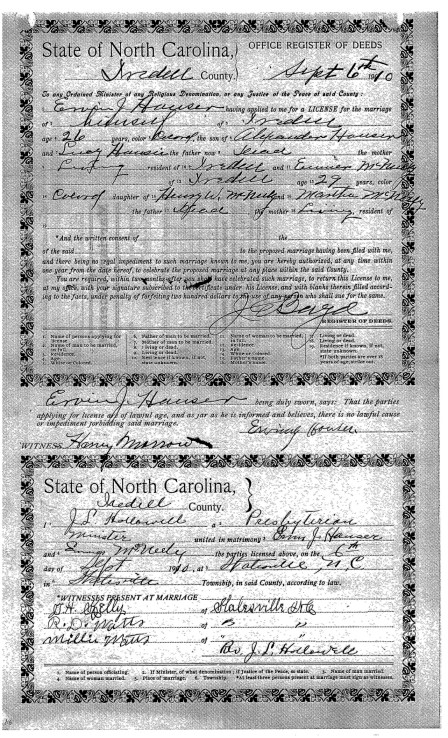
McNEELY -- Ervin Hauser & Emmer McNeely Marr Lic

Six years later, in a span of three days, Irving appeared twice in New York City newspapers. First:

OLD JOBS OFFERED BAYONNE STRIKERS

Standard Oil Co. Tells Them They May Come Back, But Without Increase of Wages.

MRS. CRAM PLANS NEW VISIT.

Says She Will Consult a Lawyer and Won’t Be Barred — Federal Conciliators at Work.

The Standard Oil Company refused yesterday to grant the wage increases demanded by employees whose strike has tied up practically every big Plant in the Constable Hook section of Bayonne, N.J. for more than a week, but offered to take the strikers back at the old wage scale whenever the men wanted to resume work.  The Committee of Ten, which learned these terms from George B. Hennessey, General Superintendent of the Bayonne plant, endeavored to report to the body of strikers.  The police prevented them because no police permit to hold a mass meeting had been requested, but one was issued for a meeting this morning, at which the strikers will decide whether to accept or decline the terms.

     …

Pending today’s meeting, the strikers were quiet yesterday.  Early in the morning there had been some disorder at Avenue E and Twenty-fourth Street, bringing a squad of policemen, who fired as many more.  They caught Irving Houser of 92 Andrew Street, an employee of the Edible Products Company, which plant is near the Tidewater Oil Company, and locked him when they found a revolver in his pocket.

New York Times, 18 Oct 1916.

Then,

Bayonne, N.J.

Miss Viola Houser, of Orange, N.J., visited her brother and sister, Mr. and Mrs. Irving Houser, Andrew Street, on Sunday, October 10.

New York Age, 21 Oct 1916.

Amid social unrest and social calls, Irving and Emma had three children: Mildred Wardenur (1913), Henry A. (1915) and Irving L. Houser Jr.  (1920).  For many years, Irving worked in various jobs in an oil refinery, but by time he registered for the “Old Man’s Draft” of 1942, he was employed at Bayonne City Hall.  By then, he had purchased a house at 421 Avenue C, a site now occupied by Bayonne Giant Laundromat.  Irving Houser Sr. died in 1962.

Standard
Births Deaths Marriages, Maternal Kin, Newspaper Articles, North Carolina, Photographs

Death of a colored man.

“Death of Colored Man.”

John Colvert, aged 70 years, a respected colored man, died Thursday night at his home on Green Street.  Funeral arrangements have not been made as he has relatives in the west who will attend.

Statesville Landmark, 10 Oct 1921.

This, of course, is John Walker Colvert, son of Walker Colvert. But who in the world were the “relatives in the west”???  His mysterious sisters and their progeny? And what was “the west”?  Ohio? Missouri? California?

IMG_2081

John Colvert was buried in Green Street cemetery, a square, three-acre concavity surprisingly devoid of markers in the heart of black Statesville. His and his wife Addie’s tombstones stand at the edge of South Elm Street, near that of his daughter Selma, and they are the only Colvert grave markers I have been able to locate.

Standard
Maternal Kin, Newspaper Articles, North Carolina, Vocation

The colored fire company.

Members of the colored fire company of Statesville left yesterday for Oxford to attend the State tournament. Among those who went were F.F. Chamber, vice president of the State association; J.P. Chambers, first foreman and J.H. Gray second foreman of the local company; J.A. Brown, Clarence Carlton, W.G. Kimbrough, Jim Dalton, Luther McNeely, J.W. Byers, S.Y. Allison, J.P. Murphy and Smith Byers.

Statesville Landmark, 20 August 1912.

Standard
Births Deaths Marriages, Maternal Kin, North Carolina, Oral History

William. And William.

Me: There was something I was going to ask you …. Now, I knew — I found out that she had a brother. Named William.

My grandmother: Who?

Me: Nicholson. Ommm, Harriet.

My grandmother: He was a white man, honey.

Me: Her real brother.

Grandmother: It was her half-brother. He was a white man that owned the undertaking business.

——

Harriet Nicholson Tomlin Hart had two brothers named William. One black, one white.

The first, with whom she shared a mother, was William H. Nicholson, born Christmas Day 1842. After her husband Abner’s death, Harriet and her youngest son Golar went to live with him in Charlotte, North Carolina, about 35 miles south of Statesville. In 1900, the censustaker recorded the family at 611 E. Stonewall. William worked as a plasterer, and Harriet is designated as his sister. She acted as informant on his death certificate, filed a few days after he died 17 December 1909, naming his parents as Burwell Carson and Lucinda Cowles. I have found no other references to his life.

The other brother, with whom she shared a father, was William Thomas Leonadas Nicholson, one of two sons of James Lee Nicholson and Martha “Mattie” Colvert Nicholson. (The other was John Walter Lee Nicholson.) William was a boy of 7 when Lee Nicholson died in 1871, and he was reared with his mother’s family in northern Iredell County. (She was the daughter of William I. Colvert, former owner of Walker and John W. Colvert. The latter fathered Harriet Nicholson’s oldest child.) In 1878, the Nicholson family “began to make and sell caskets at the general store they operated [in] northern Iredell County. As was common in the late 1800s, many undertakers were also furniture makers, and the Nicholsons continued to sell caskets and conduct funerals in their furniture store when they moved to Statesville. At the time, a casket’s price was based on the wood used and its size—probably between $25 and $35 for an adult casket. W.T. Nicholson moved the funeral home into its current location in 1920, and he remained its owner until his death in 1951.” William T. Nicholson handled preparations for his sister’s burial — whether he acknowledged her or not — as well as John W. Colvert. Nicholson Funeral Home, at 135 East Front Street, Statesville, remains in operation.

Standard
Land, Maternal Kin, North Carolina, Oral History

Land along the railroad.

Me: What did, why did Grandpa Henry come to Statesville? Was he a farmer? What did he do?

My grandmother: I don’t know. I really don’t know.

Me: He was from Rowan County.

My grandmother: He certainly didn’t have no farm in Statesville. It seems to me he had a big, big lot  of land where they had this house. Where they built this house. But it was near a railroad, and trains — cinders from the trains fell on the house and burnt it.

——

On 21 Dec 1903, G.M. Austin and wife J.A. Austin sold H.W. McNeely of Iredell County a parcel bounded as follows: “Beginning at a stake 300 feet from Bettie Van Pelts S.E. corner and 50 feet from the center of Rail Road, and running N. 10 degrees E. 200 feet to a stake then S. 11 W. 200 feet to a stake 50 feet N of the center of the Rail Road, then N 79 degrees W. 100 feet to the beginning also 1/2 acres adjoining the above lot, and known as the J.V. Houston land it being same land sold for taxes by M.A. White by deed from T.Y. Cowper.” McNeely paid $164.

Extract from interview of Margaret C. Allen by Lisa Y. Henderson; all rights reserved.

Standard