
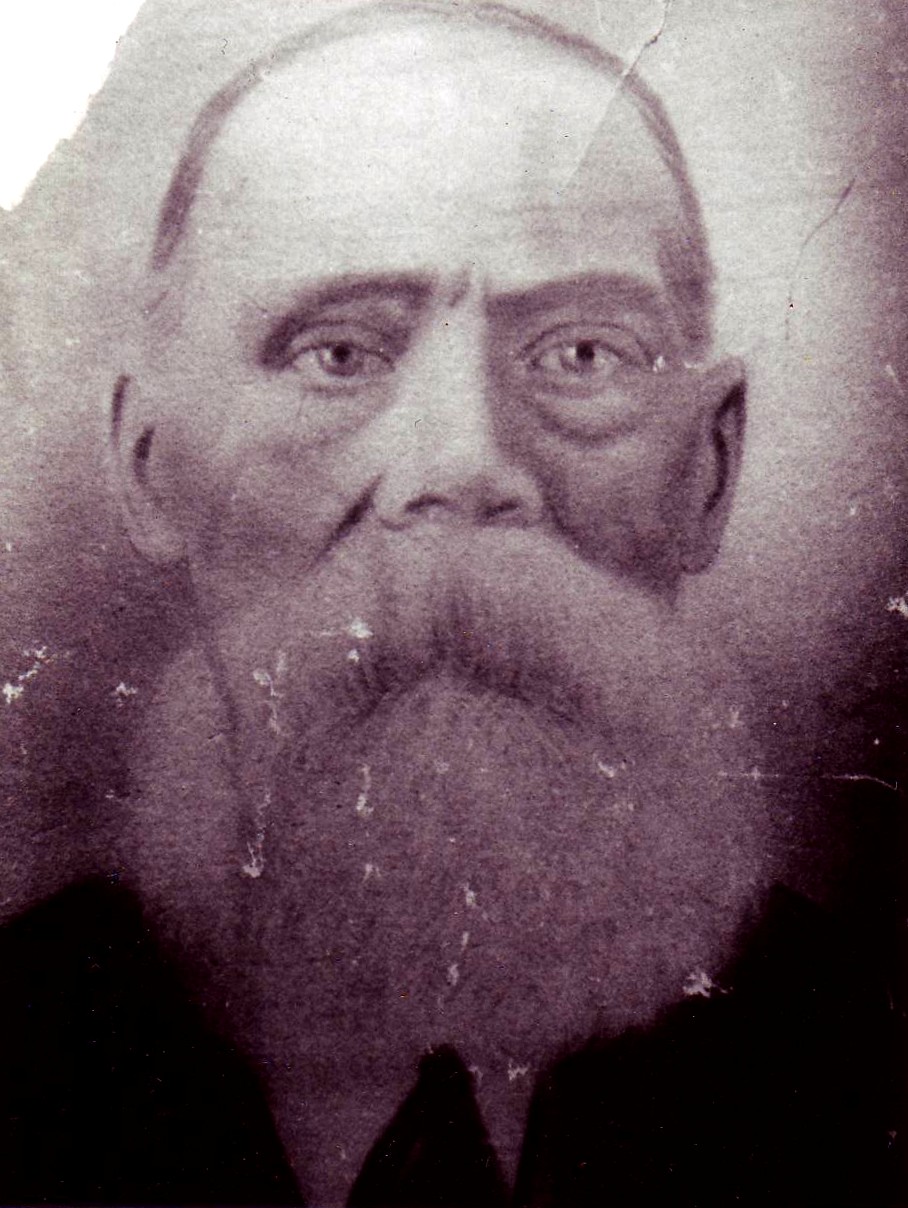
Though his brother Bryant disappeared from the record after apprenticeship, James Henderson achieved adulthood and shows up in the 1850 census as a mechanic and the father of four children whose last name was Skipp. The children too were apprentices, which tells us that their mother, like James’ own, was unmarried. “Skipp” was an uncommon name in the area. I know nothing else about her, and she apparently was dead by time the censustaker rode through their corner of Onslow County. When James wandered 50 miles northeast to Sampson County to a tiny community of free people of color north of present-day Clinton, his sons Lewis and James Henry and daughter Eliza went with him. By this time, they had assumed their father’s last name. Lewis Henderson, born about 1836, was my great-great-great-grandfather. There are no photographs of Lewis, but there is one of his brother James Henry, who was blue-eyed and bushy-bearded and generally indistinguishable from his Anglo-Saxon neighbors.
Sometime around 1856 Lewis married a woman much like himself, free-born and colored and of uncertain antecedents. Her first name was Margaret, and her last name seems to have been Balkcum. And we do know what Grandma Mag looked like. My great-aunt Mamie showed me the battered tintype; I was 21 years old and nearly lost consciousness. Mag was born in 1836, too. She was perhaps middle-aged when she sat for her portrait — her age, like her racial stock, is indeterminate. But she had straight iron-gray hair parted down the middle and pulled back severely; high, broad cheekbones; and thin lips marking an ultra-wide mouth. A handsome woman, if not a pretty one. She seems to be smiling; there is a twinkle in her gray eyes.

My grandmother remembered her like this:
We used to go down to Dudley to see Grandma Mag – we called her Mag, but her name was Margaret – before she died. I remember her being alive, but she was in bed sick. She was always in the bed. Her hair looked like white, and she had it parted right in the middle and all carried back, don’t even look like she had none. Couldn’t tell how much she had ‘cause she was laying on it, what I saw of it. I don’t ever remember her getting up and down. I remember ‘cause I wanted to know why she was in the bed all the time. And I don’t remember seeing her walk but one time. She stayed sitting around so much until she couldn’t hardly half walk – but she didn’t have nair stick with her. She’d just hold on to different things. I don’t know, I wouldn’t never ask a person, ask ‘em, “What’s wrong with your legs?” or “What’s the matter with you. How come you can’t walk no better?” But Mamie stayed with Grandma Mag and them until Grandpa Lewis died. The house they was staying in where was up by the railroad, was just about to fall down. So Mama Sarah built them a house.
——
Photos of James H. Henderson and Margaret Henderson in the collection of Lisa Y. Henderson.
 Scuffalong: Genealogy.