DNA, North Carolina, Paternal Kin

DNAnigma, no. 3: An Artis match, after all.

I was geeked. After all, my great-great-great-grandfather Adam T. Artis had 25+ children, and I have thousands of cousins in their descendants. (Not to mention the descendants of Adam’s many siblings.)  I was crestfallen, then, when H.A. responded that he was descended from Absalom Artis, through Warren Artis, then Henry, then Alonzo, then William Henry Artis. I know the Absalom Artis line (though I didn’t know Warren was in it), and I have no known connection to them. Absalom was born in Virginia circa 1780 and was in northern Wayne County by the early 1800s. He and Adam lived in close proximity, but the record gives no clue to other links. Of course, ultimately, all of the free colored Artises in Wayne County – indeed, throughout Virginia and NC and out into Indiana and Ohio – were likely kin, but the links are so remote that reconstructing them is likely impossible. H.A. and I share enough DNA that our common ancestor had to have been within the last 5 generations or so. In other words, more recent than any common ancestor of Adam and Warren or Absalom.

But then….

While reviewing my notes for a post about Adam’s second set of children, I was reminded that his daughter Mary Jane Artis had married an Artis. Henry Artis. Son of Warren and Pearcy Artis. And mystery solved! H.A. and I are not related through his patrilineal Artis line, but via a wife whose father was my great-great-great-grandfather.

Standard
Free People of Color, North Carolina, Oral History, Paternal Kin

Lewis & Mag’s children, part 1: sons.

Lewis and Margaret Balkcum Henderson had nine or so children in Sampson County before shifting a few miles north into Wayne County, where they settled with other free-issue families near a tiny crossroads town called Dudley.  Before the Civil War, Margaret bore Lewis T. (1856), James Lucian (1858), Isabella J. (1860), Ann Elizabeth (1862), and Caswell C. (1864), and after, Mary Susan (1868), Carrie (1870), Sarah Daisy (1872), and Loudie (1874).

Of Lewis T., Isabella and Mary Susan, there is not enough known to talk about; they died as children.  But Lucian was my grandmother’s favorite great-uncle; the only one of Lewis and Mag’s children to stay in Dudley and farm.  He and his wife Susie (born a McCullin) had only one child, a daughter Cora Q., who died early and is remembered only by her headstone in the cemetery of the Congregational Church.  (I am endlessly fascinated by the Q.  What could it possibly have stood for?) Lucian so impressed my grandmother that she named her firstborn son after him. He is gone, but my cousins Lucian Jr., the III and the IV, remain.

My grandmother said:

Uncle Lucian, now he look more like an Indian to me than anybody.  Didn’t have too much hair, but what he had was straight and was that brownish color like it was fair.  We’d come down there and stay with them.  Get off the train and run all the way down there to their house.  That wont nothing.  And they had two beds in that front room.  One on one side and one on the other’n, and they slept on that one side, and me and Mamie slept in the other’n.  In the same room.  ‘Cause it wasn’t no door to it, and the fireplace was in the front room.  I don’t think they ever had a lamp or no light.  We’d go to bed with the chickens and get up with the chickens.  ‘Cause time it’s day, Uncle Lucian was up.  A’nt Susie couldn’t cook.  Because she couldn’t be over the stove, she’d fall out if she was over the stove.  She never left the house that I know of.  ‘Cause she had this thing, that, her head shook all the time.  I said to Mama Sarah, I said, “That thing’s gon shake her head off.”  I told Mama, “She’s gon shake her head off.”  She said, “It was a palsy, that’s how come.”  So Uncle Lucian always got up and cooked breakfast.  And, Lord, I used to love to go down there.  We would get up early mornings, and Uncle Lucian would cook breakfast and, honey, that old ham where he cooked you could smell a mile!  Honey, you could smell that ham before you even got there.  It was on the highway, and we didn’t go all the way ‘round the bend and come up the road.  We’d come down over the fence and come down the cornrow and come up to the house.  And he’d make rice, and it would be that ham gravy.  And the biscuits, they looked like they’s hamburg muffins, the biscuits was so big.  And you talking ‘bout good.   Ooo, you’d be ‘bout to have a fit, it smelled so good. Cooking ham and rice, and had to have ham gravy, just pour water in there from frying.  Great big old milk biscuits.  You eat one of them — you couldn’t even eat a whole one, ’cause they was so big.  And cooked on a little old bitty tin stove, a four-cap stove — the burner wont no more than bigger than that — where you had to put two, three pieces of wood in the stove, and the pipe run right straight up in the house.  Yeah, I thought that was some good days and some good food.  Look like to me, I thought it was the best.  We had good food at home, but seem like down there, it just taste better.  We didn’t have no ham everyday like they had down there, and by him having and curing it, the way they cured ham, his was different from what we had.  Like with that pepper and salt and stuff and seasoning outdoors.  And every one they’d kill, he’d get the hog and cook ‘em and hang ‘em in his packhouse. 

But every great-uncle was not as favored as Lucian.  There was also Caswell, from whom my father gained his middle name, but about whom my grandmother was ambivalent.  Caswell was in New York City by 1890, where he was a white man on his job with the Customs House, but moved among colored folks at home in the Tenderloin and later in Harlem and the Bronx:

Uncle Caswell come to Wilson visiting Mama Sarah.  He didn’t never bring his wife down there ‘cause he was passing for white, and she was kind of brown-complexioned.  But he’d leave our house, and he would go and get a paper every morning down there to Cherry Hotel.  Walk down there for the exercise and get that paper.  He’d go in the hotel there and ask for a paper and talk to the people, and they all said, “Who is this white man?”  And then he’d come all the way back a different way, then walk back down Green Street and come on home, so they wouldn’t know he was crossing the tracks.   And so he wanted Mamie, he didn’t want me, he wanted Mamie to come stay with him and his wife.  And he was gon send her to school and take care of her.  He’d buy all her clothes and everything.  But me, he ain’t said nothing ‘bout me.  But Mama said, “Naw, you can’t. I don’t want her to go to New York.  ‘Cause she don’t know nothing ‘bout New York, and, too, that would leave Hattie down here by herself.”  She said, “They’s gon stay, she gon stay with me ‘cause I promised Bessie that I’d take care of them as long as I lived.  I promised Bessie I’d keep ‘em together.  But if you want to give her something, or help me out with her, buy ‘em clothes or something like that, you can.”  So I didn’t like that. He ain’t said nothing ‘bout me.  But then they said I liked to read, and so he saved the papers where he was taking, and he would send ‘em in the mail to me.  But he sent Mamie candy.  And I told him I wont no goat!  Uncle Caswell didn’t like me.  And I started to tell him he was down there trying to be cute, playing, wanting folks to think he was white.  Passing for white.  Well, he could pass for white.  Least that’s what he was doing up in New York.  ‘Cause he was working at the roundhouse, had a good job.

——

Interview of Hattie H. Ricks by Lisa Y. Henderson; all rights reserved.

Standard
DNA, Free People of Color, North Carolina, Paternal Kin, Photographs

DNAnigma, no. 2: Armwood????

There was a woman at home whom we called Cousin Inez. She had been born down in Dudley a few years after my grandmother, and we thought that connection was what motivated her insistence that we were kin. When I began my genealogical sleuthing, I discovered that Cousin Inez had been born an Armwood — another link, though not a blood one. The second wife of my great-great-great-great-grandfather James Henderson had been Louisa Armwood. I am not descended from her, but many of my cousins are. So, cousin-ish, but not actually kin.

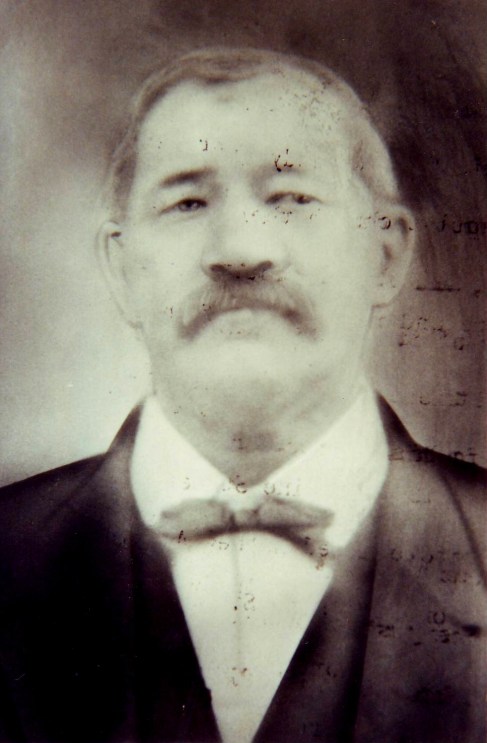
Then, a couple of months ago, Ancestry.com pegged me as a  4th-6th cousin to a woman I’ll call A.G. This surprised me on two counts. (1) I’d recently “met” A.G. on a cousin’s family page on Facebook. A.G. and my cousin D. are related via the Simmonses, a free family of color centered in southern Wayne County. I’m not a Simmons – that I know of – but D. and I are 3rd cousins and some change via Lewis Henderson. (2) A.G. is an Armwood! Her ancestor William Armwood, son of Major and Eliza Armwood and born about 1835, married Martha “Matta” Simmons, daughter of William and Penny Winn Simmons, in Sampson County. This is William:

william-armwoodSo, what are the possibilities? What do we know?

  • A 4th to 6th cousin relationship suggests a common ancestor in the early 1800s. (Ancestry estimates very conservatively, so we may be closer.)
  • The relationship is almost certainly on my father’s side.
  • All of A.G.’s mother’s lines, back to the mid-1800s, were in the Wayne/Duplin/Sampson County area.
  • I have focused on her Armwood and Simmons lines because they are most familiar and intersect mine indirectly, but I may be making unwarranted assumptions.
  • A.G.’s Simmons line includes Wynn/Winn and Medlin lines. And I don’t know the maiden name of Major Armwood’s wife.
  • My Hendersons did not arrive in the area until the 1850s. I’ll eliminate them.
  • For the time being, I’ll eliminate my Euro-descended lines.
  • My Hagans line was probably from Nash County. I’ll eliminate them, too.
  • A.G. has a Yelverton line from northern Wayne County. Perhaps an Artis or Seaberry connection?
  • My Aldridge and Balkcum lines began with white women who bore children by black or mixed-race men circa 1820-1830 in Duplin and Sampson County. Is one of these unknown fathers the link to A.G.?


Standard
Free People of Color, North Carolina, Other Documents, Paternal Kin

Adam Artis’ children, part 2: Lucinda Jones.

artis-guardianship-application

“Adam Artist” and “Lousinda” Jones married 10 October 1855 in Nash County. Lucinda’s father Jacob Ing (who was white) was bondsman, William T. Arrington witnessed, and justice of the peace D.A.T. Ricks performed the ceremony. Lucinda Jones Artis died circa 1860, and in 1870 her children Augustus Kerney, Noah and Mary Jane inherited her share of her father Jacob Ing’s estate.  In 1872, Adam Artis filed this guardianship application in order to manage their estate.

Augustus “Gus” K. Artis was born about 1857. Some time after the birth of their daughter Lena in 1882, Gus and wife Mary migrated to the Little Rock, Arkansas area. The city’s 1914 directory lists him as a laborer at J.W. Vestal & Son, a nursery. He died in 1921.

Noah Artis, born in 1856, remained in northeastern Wayne County, where he farmed, married Patience Mozingo, and fathered children Nora Artis Reid, Pearl Artis, Pauline Artis Harris, Rena Belle Artis, William N. Artis, and Bessie Artis. He died in 1952 in nearby Wilson NC.

Mary Jane Artis, born in 1859, married Henry Artis, son of Warren and Percey Artis. (Though all of Wayne County Artises are probably ultimately related, the exact kinship between Warren Artis, whose father was supposedly Absalom Artis, and Adam Artis is unknown.) Mary Jane remained in the Nahunta area of Wayne County all her life and died after 1900. Her and Henry’s children were Armeta Artis, Alonzo Artis, Lucinda Artis, Callonza Artis, Mattie Artis Davis and Marion Artis.

Standard
Births Deaths Marriages, Enslaved People, Free People of Color, North Carolina, Paternal Kin

Adam Artis’ children, part 1: the Coleys.

In 1863, when the Confederate tax assessor queried administrator John Coley of Wayne County about W.W. Lewis’ estate, Coley enumerated several slaves, including Winney, age 29, Cane, age 9, and Caroline, 7. Adam Artis, the father of Winny’s children, lived nearby. He was a free man of color, and his and Winny’s relationship had not lasted long.

By adulthood, Cain Artis had adopted his father’s surname and farmed his own land in northwest Wayne County.  By 1890, he had bought a house in the nearby town of Wilson and the 1912 city directory shows him operating a small business just outside city limits on the town’s main road. He died of tuberculosis in Wilson County in 1917, survived by his second wife, Margaret Barnes.

In 1878, Caroline Coley married Madison Artis, son of Calvin and Serena Seaberry Artis. Her uncle Jonah Williams was a witness to the ceremony. Caroline and Madison appear in the 1880 census of Wayne County, but have not been found after.

Standard
Births Deaths Marriages, Free People of Color, North Carolina, Oral History, Other Documents, Paternal Kin

The death of Lewis Henderson.

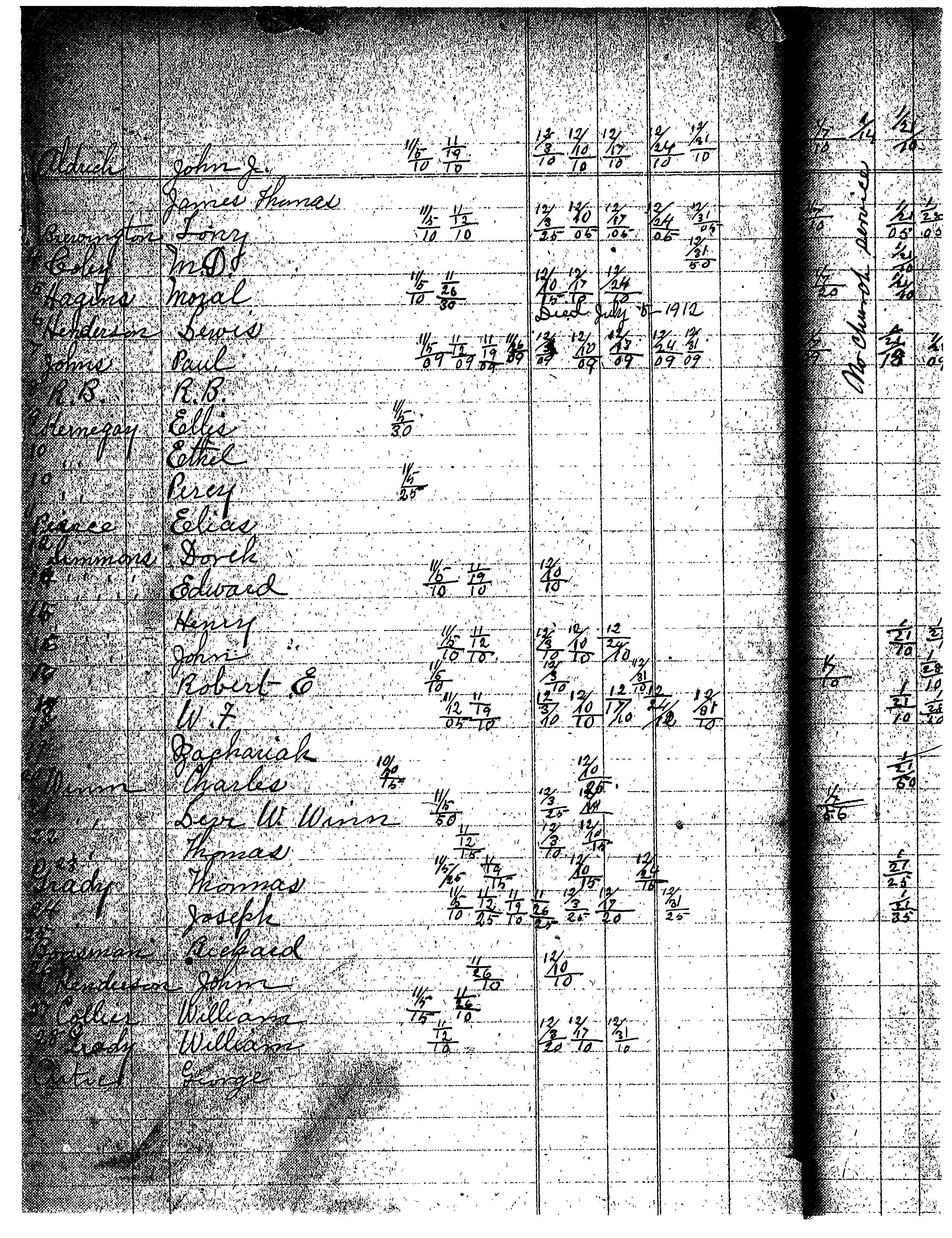
lhenders-20110225152701My grandmother, who was born in 1910, said her great-grandfather Lewis Henderson died when she was very small. She did not remember him, though her sister Mamie had reason to. He threw a brush at her — it hit her in the head —  because she was making too much noise. She could not have been older than four.

North Carolina did not keep death certificates until 1914, and Lewis’ grave is unmarked. How do we know exactly when he died? This is a page from one of the few volumes of early church records that survive for the Congregational Church of Dudley. Lewis had helped found the church in 1870, and this list shows tithes paid by male congregants. The sixth name: Henderson, Lewis. And this notation: “Died July 5 — 1912.” He would have been about 76.

Standard
Free People of Color, North Carolina, Paternal Kin, Photographs

The case for Margaret Henderson as daughter of Nancy Balkcum.

The case for Margaret Henderson as the daughter of Nancy Balkcum (and sister of Mary Eliza Balkcum Aldridge) —

1. Margaret was born 1833-1836, probably in Sampson County NC. Mary Eliza was born in 1829 in Duplin or Sampson County.

2. Her photo clearly indicates that she was mixed race, as was Mary Eliza. Mary Eliza Balkcum’s mother Nancy Balkcum was white.

3. Margaret is not listed in the 1850 census, and neither is Nancy Balkcum.

4. Nancy Balkcum’s will makes reference to a daughter Margaret Balkcum, as well as a daughter Eliza Balkcum.  The will was probated in 1854 in Sampson County, prior to Margaret Balkcum Henderson’s marriage circa 1855. Margaret Balkcum purchased a number of small items from her mother’s estate.

5. Margaret named her second son James Lucian Henderson in 1857.  Compare: James Lucien Balkcum, born 1838, son of Nancy Balkcum’s daughter Mariah Balkcum Johnston.

6. Margaret named her first daughter Isabella circa 1860.  Compare: Isabella Johnson, born 1858, daughter of Mariah Balkcum Johnson.

7. Margaret named her second daughter Ann Elizabeth circa 1866.  Compare: Ann Eliza Balkcum, born circa 1840, daughter of Nancy Balkcum’s son John Balkcum.

8. Margaret named her third daughter Mary Susan circa 1868.  Compare: Mary Susan Balkcum, born 1844 to John Balkcum, and Susan Johnson, born 1844 to Mariah Balkcum Johnson.

9. Between 1860 and 1870, Margaret and her husband Lewis Henderson and Eliza and her husband Robert Aldridge migrated to the Dudley area of southern Wayne County.  The families are listed side by side in the 1870 census.

10. Caswell C. Henderson’s November 1907 marriage license, issued in New York City, reports his mother’s name as Margaret Balkcum.

11. Matrilineal descendants of Margaret Henderson have mtDNA haplotype H3. Descendants of Mary Eliza Aldridge have mtDNA haplotype H3.

12. Certain descendants of Margaret Henderson share significant autosomal cM totals with descendants of Mary Eliza Aldridge, but have no other known lines of common descent.

Problematic points:

1. Margaret’s death certificate lists her mother as Margaret Bowkin, not Nancy.  Informant was her son Lucian Henderson.  (I have seen instances in which an informant listed his own mother’s name, instead of the decedent’s mother’s name. Is this the case here?)

2. Margaret’s son Lucian’s June 1934 death certificate lists his mother’s maiden name as Hill.

3. Margaret’s daughter Sarah’s January 1938 death certificate lists her mother’s maiden name as Carter.  Informant was Hattie Mae Henderson, Sarah’s great-niece, who told me 60 years later that she did not recall giving this information and did not believe it was correct.

4.  Perhaps most puzzlingly, there is absolutely no tradition of kinship between the two families. Hattie Mae Henderson was reared by her great-aunt (Lewis and Margaret’s daughter) Sarah Henderson Jacobs. If Sarah had been first cousin to Robert and Eliza Aldridge’s children, it seems that there would have been some acknowledgement of the relationship passed down — not only to Hattie (my grandmother), but to others descended from the free colored families in this small community. They (Simmonses, Winns, Jacobses, Hendersons, Aldridges, etc.) intermarried freely, so consanguinity would not have been shameful. The one exception: Hattie Henderson reported visiting with Sarah a “Cousin Tilithia” in Norfolk as a child. This was Tilithia Brewington King Godbolt Dabney, daughter of Robert and Eliza’s daughter Amelia Aldridge Brewington. Did Sarah call Tilithia “cousin” because they themselves were related, or because Hattie was related to Tilithia (through J. Thomas Aldridge, her father and Tilithia’s first cousin)?  A point to consider: all but one of Lewis and Margaret’s children (son Lucian, who himself had no children who lived to adulthood) had died or migrated from Dudley by about 1905. The “lack of tradition” I perceive may simply be a function of a gap in familiarity between those people who knew Lewis and Mag’s family and those I was able to interview 80-90 years later.

Image

 Photo of Margaret Henderson in collection of Lisa Y. Henderson.

Standard
Civil War, Free People of Color, North Carolina, Other Documents, Paternal Kin

Hillary Herring, Union man.

Image

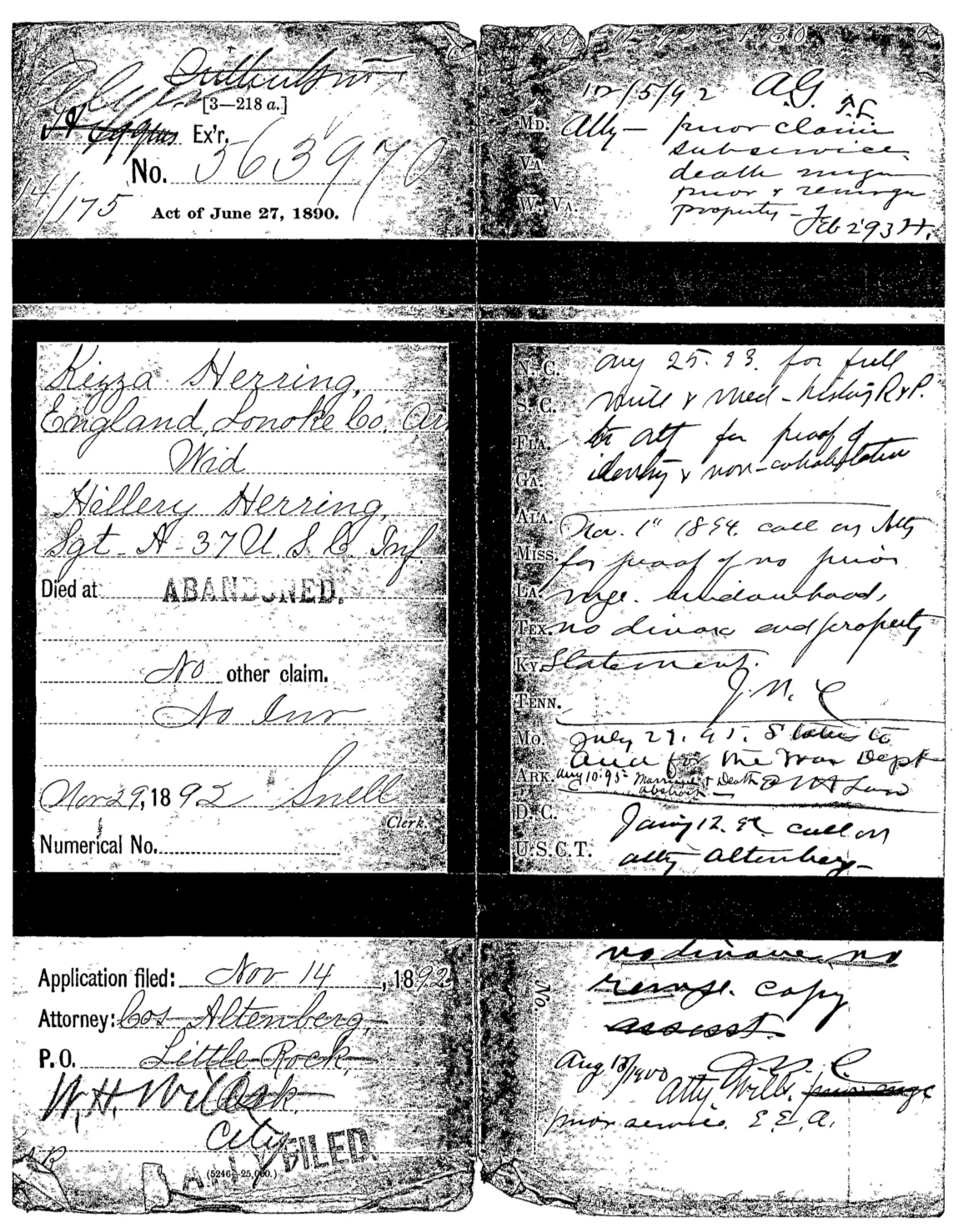
#563,970. Claim of Kizza Harring, widow of Hillary Harring, Co. A, 37 U.S.C.T., for Widow’s Pension.

Hillary Herring enlisted in the Union Army in 1864.  At his enlistment, he reported that he was 23 years old, 6 feet 1/2 inches tall, light-complexioned, with black eyes and dark hair, was born in Onslow County NC, and worked as a farmer. (Census records reveal that he grew up in Wayne County.) Documents in Herring’s widow’s pension application file show that he was discharged from the army on 11 February 1867, making it likely that he fought in the 37th in battles across southern Virginia and eastern NC. (See a history of the 37th U.S.C.T. here.)  He married Kizzy Dudley on 18 December 1869 in Burgaw, Pender County NC. Rev. Elisha Boon performed the ceremony. It was Hillary’s first marriage, but Kizzy was the widow of a John Herring that she’d married in 1863. (Hillary’s kin?) Hillery Herring died 30 June 1876 in Bentonsville, Johnston County, of “disease of lungs.” Dr. Martin Harper attended him during his final illness.  Lewis Hood furnished his coffin and served as undertaker, and Rev. John James Harper, a white man, preached the funeral sermon.

On 21 November 1872, Hillery and Keziah Herring and my great-great-great-grandparents Lewis and Margaret Henderson sold two tracts in Wayne County totalling about 80 acres to John P. Cobb and Jesse Hollowell. The four had purchased the tracts from William R. Davis, but the deed was not recorded. Both Lewis and Hillery were born in Onslow County.  Were they related?  If not, why did they buy land together?


Standard
Births Deaths Marriages, Free People of Color, North Carolina, Paternal Kin, Photographs

On the Stoney Run Branch and Wilmington & Weldon Railroad.

On 4 July 1902, dower laid off and partition made of Robert Aldridge‘s land as follows:

Dower — Eliza Aldridge received 53 acres on a run of Stoney Run Branch.

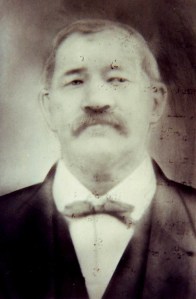
Lot No. 1 — Mathew W. Aldridge received 100 acres on Stoney Run and Hurricane Branches, excluding the Agustus Church and free school house lots.  An interest Mathew had bought from his father was included in the described tract and the residue was valued at $200.
matthew-aldridge

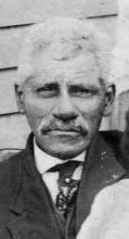
Lot No. 2 — George W. Aldridge received 42 acres on Stoney Run and the county road valued at $200.
george-aldridge

Lot No. 3 — Joseph Aldridge received 53 acres on Stoney Run and the county road valued at $200.

Lot No. 4 — David Aldridge received 80 acres on Stoney Run and the county road valued at $200.

Lot No. 5 — Robert Aldridge received 41 acres on a prong of Stoney Run and the Spring Road valued at $200.

Lot No. 6 — John W. Aldridge received 50 acres on Stoney Run Branch below the mineral spring and the Spring Road valued at $285.

Lot No. 7 — Frances Locust received 33 acres on Stoney Run and the Spring Road valued at $200.

fannie-a-randall

Lot No. 8 — Talitha Brewington, Hattie Brewington, Elijah Brewington, Mattie Brewington, Lundy Brewington, and Toney Brewington jointly and subject to the life estate of Joshua Brewington, received 33 acres on W&W Railroad valued at $193.

Lot No. 9 — Louetta Aldridge received 32 acres on Stoney Run Branch valued at $193.

Lot No. 10 — Lizzie Aldridge received 32 acres on the W&W Railroad and Stoney Run Branch valued at $193.

Lot No. 11 — Louetta Artis, Robert Artis, Columbus Artis, Josephine Artis, J. Scott Artis, J.B. Artis, Lillie Artis, Annie Artis and Elberta Artis, jointly and subject to the life estate of Adam Artis, received 32 acres at the mouth of a ditch on the run of Stoney Run and the railroad valued at $193.

Submitted by Sam C. Casey, Walter C. O’Berry, Ira W. Hatch.

The margins of this document contain notations and signatures acknowledging receipt of moneys due to balance the lot values, including signatures of Lizzie Aldridge, Tilithia King, J.W. Aldridge, Joseph Aldridge, Hattie Brewington, Columbus Artis, Elijah Brewington, Tony C. Brewington, Robert Aldridge, Lundia Brewington, and June Scott Artis, and Eliza Artis’ mark.

John Aldridge, owner of Lot No. 6, paid $7 each to the owners of Lots 8-11, and $57 to the Clerk of Superior Court for costs of the division.

Louetta Aldridge’s share was divided among her siblings “the owner of said amount now being dead this day Aug 22=1904.”

——

Robert Aldridge, my great-great-great-grandfather, was born circa 1819, probably in Duplin County NC, and died about 1899. He appears as a hireling in the 1850 census in Sampson County in the household of Calvin Simmons. By 1860, he and his wife Mary Eliza Balkcum Aldridge were living in southern Wayne County with their youngest children. His accumulation of property is something of a mystery, as his recorded deeds do not yield the acreage distributed in his estate.  Bits of the land remain in family hands.

There is a Stoney Run in Wayne County today, but it courses several miles northwest of the area in which Robert Aldridge is known to have owned land. I suspect that the waterway referred to above is now known as Yellow Marsh Branch, which has been dammed to form Durhams Lake. Robert owned a brickyard in the vicinity. “Agustus Church” is now Augustus Chapel Missionary Baptist Church, and the current edifice stands on the original land as what is now 599 Durham Lake Road, Dudley. The church celebrated its 145th anniversary in 2012. The Wilmington & Weldon Railroad is now owned by Atlantic Coast Line. My best guess for the “county road” is the road now known as the Old Mount Olive Highway, which runs alongside the railroad.

Abstract of document in the file of Robert Aldridge, Estate Records, Wayne County Records, North Carolina State Archives.

Photos of Mathew Aldridge, George Aldridge and Frances “Fannie” Aldridge Locust, alias Fannie Randall, in the collection of Lisa Y. Henderson.

Standard
Free People of Color, North Carolina, Oral History, Paternal Kin, Photographs

Introducing Lewis & Mag Henderson.

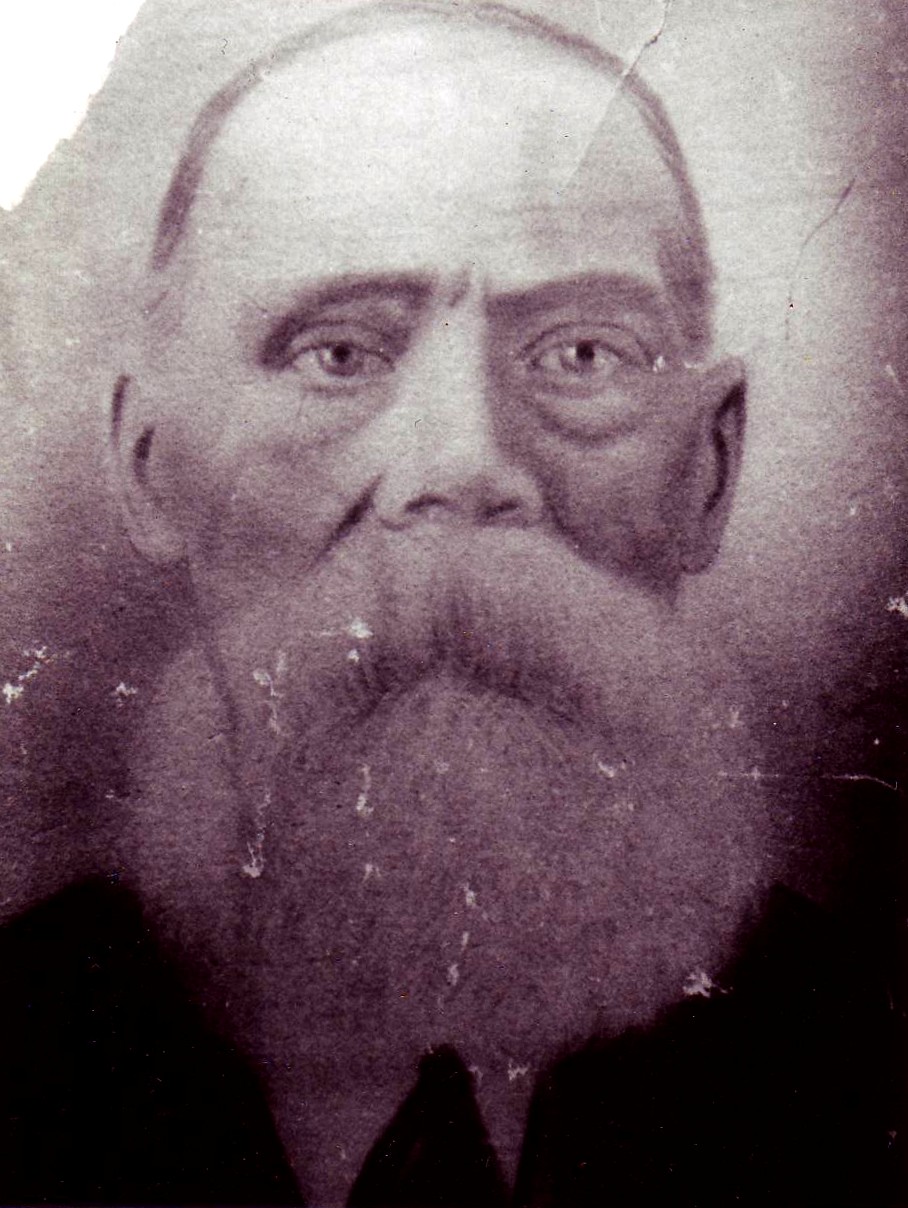
Though his brother Bryant disappeared from the record after apprenticeship, James Henderson achieved adulthood and shows up in the 1850 census as a mechanic and the father of four children whose last name was Skipp.  The children too were apprentices, which tells us that their mother, like James’ own, was unmarried. “Skipp” was an uncommon name in the area.  I know nothing else about her, and she apparently was dead by time the censustaker rode through their corner of Onslow County.  When James wandered 50 miles northeast to Sampson County to a tiny community of free people of color north of present-day Clinton, his sons Lewis and James Henry and daughter Eliza went with him. By this time, they had assumed their father’s last name.  Lewis Henderson, born about 1836, was my great-great-great-grandfather. There are no photographs of Lewis, but there is one of his brother James Henry, who was blue-eyed and bushy-bearded and generally indistinguishable from his Anglo-Saxon neighbors.

Image

Sometime around 1856 Lewis married a woman much like himself, free-born and colored and of uncertain antecedents.  Her first name was Margaret, and her last name seems to have been Balkcum.  And we do know what Grandma Mag looked like.  My great-aunt Mamie showed me the battered tintype; I was 21 years old and nearly lost consciousness.  Mag was born in 1836, too.  She was perhaps middle-aged when she sat for her portrait — her age, like her racial stock, is indeterminate.  But she had straight iron-gray hair parted down the middle and pulled back severely; high, broad cheekbones; and thin lips marking an ultra-wide mouth.  A handsome woman, if not a pretty one.  She seems to be smiling; there is a twinkle in her gray eyes.

Image

My grandmother remembered her like this:

We used to go down to Dudley to see Grandma Mag – we called her Mag, but her name was Margaret – before she died.  I remember her being alive, but she was in bed sick.  She was always in the bed.  Her hair looked like white, and she had it parted right in the middle and all carried back, don’t even look like she had none.  Couldn’t tell how much she had ‘cause she was laying on it, what I saw of it.  I don’t ever remember her getting up and down.  I remember ‘cause I wanted to know why she was in the bed all the time.  And I don’t remember seeing her walk but one time.  She stayed sitting around so much until she couldn’t hardly half walk – but she didn’t have nair stick with her.  She’d just hold on to different things.  I don’t know, I wouldn’t never ask a person, ask ‘em, “What’s wrong with your legs?” or “What’s the matter with you.  How come you can’t walk no better?”  But Mamie stayed with Grandma Mag and them until Grandpa Lewis died.  The house they was staying in where was up by the railroad, was just about to fall down.  So Mama Sarah built them a house.  

——

Photos of James H. Henderson and Margaret Henderson in the collection of Lisa Y. Henderson.

Standard