North Carolina, Other Documents, Paternal Kin

Jonah’s apprentices.

On 24 Sept 1870,  Geo. Jno. Robinson, Probate Judge, bound to “Jonah Williams (col)” John H. Britt, Ida Britt and Cora Britt, aged 12, 10 and 6, to “live after the manner of an apprentice and servant until the said apprentice shall attain to the age of twenty-one years and until Ida & Cora shall attain the age of eighteen years”  John was to be taught trade of a farmer, and Ida and Cora that of house servant.  Williams “shall further provide said apprentices each with a new suit of clothes, six dollars in cash & a new Bible at the end of said apprenticeship.”  Williams signed the indenture with an X.*

Who were the Britts to Jonah Williams?

They are not listed in Jonah’s household in the 1870 census. Rather, Ida, 9, and Corah Britt, 6, and their mother Hannah Britt, 39, appear in the household of drayman Doctor Thompson, his wife Feribee, and daughter Lucy in Goldsboro, Wayne County.  John Britt is not found.

Ten years later, Ida Britt, 20, is listed in the Wayne County household of Jonah’s 80 year-old father, Solomon Williams. Ida and Charity Artis, 42, were described as Solomon’s “daughters.”  Charity certainly was, but Ida? It is possible, certainly, that Solomon fathered three children with Hannah Britt in the eight years prior to Emancipation and his 1866 marriage to the mother of his 11 other children, born between 1828 and 1851.  If so, the arrangement with his son Jonah might have been a way to insure their care. Solomon did not legitimate the Britts, however, as none appear in his 1883 estate records. The more likely explanation is that Ida was in the household  as a quasi-servant, and the censustaker assigned her relationship based on his assumptions. I have not found her in any record after 1880.

——

*Wayne County Apprentice Bonds, NC State Archives.

Standard
Newspaper Articles, North Carolina, Paternal Kin

Church home, no. 6: Turner Swamp Primitive Baptist, Eureka NC.

Church Directory “Fremont Items” – Rev. Jonah Williams of Wilson filled his regular appointment at Turners Swamp last Sunday.

The Blade, Wilson NC, 20 Nov 1897.

Turner Swamp Primitive Baptist Church still meets in a small church north of Eureka, Wayne County. Jonah was a brother of my great-great-great-grandfather Adam T. Artis, and descendants of several of their siblings are buried in the church cemetery.

Standard
Births Deaths Marriages, Enslaved People, Free People of Color, North Carolina, Other Documents, Paternal Kin

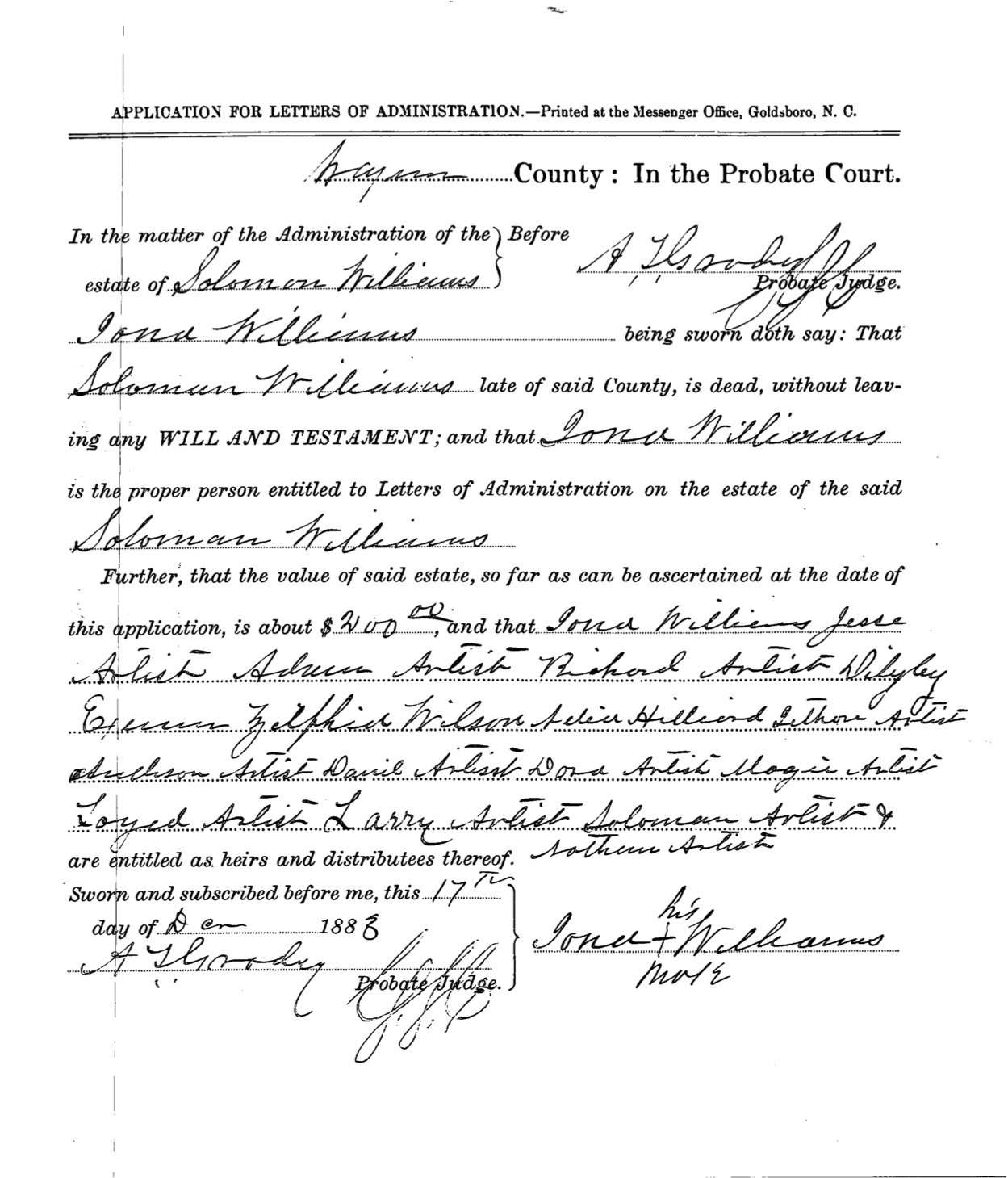
The estate of Solomon Williams.

Image

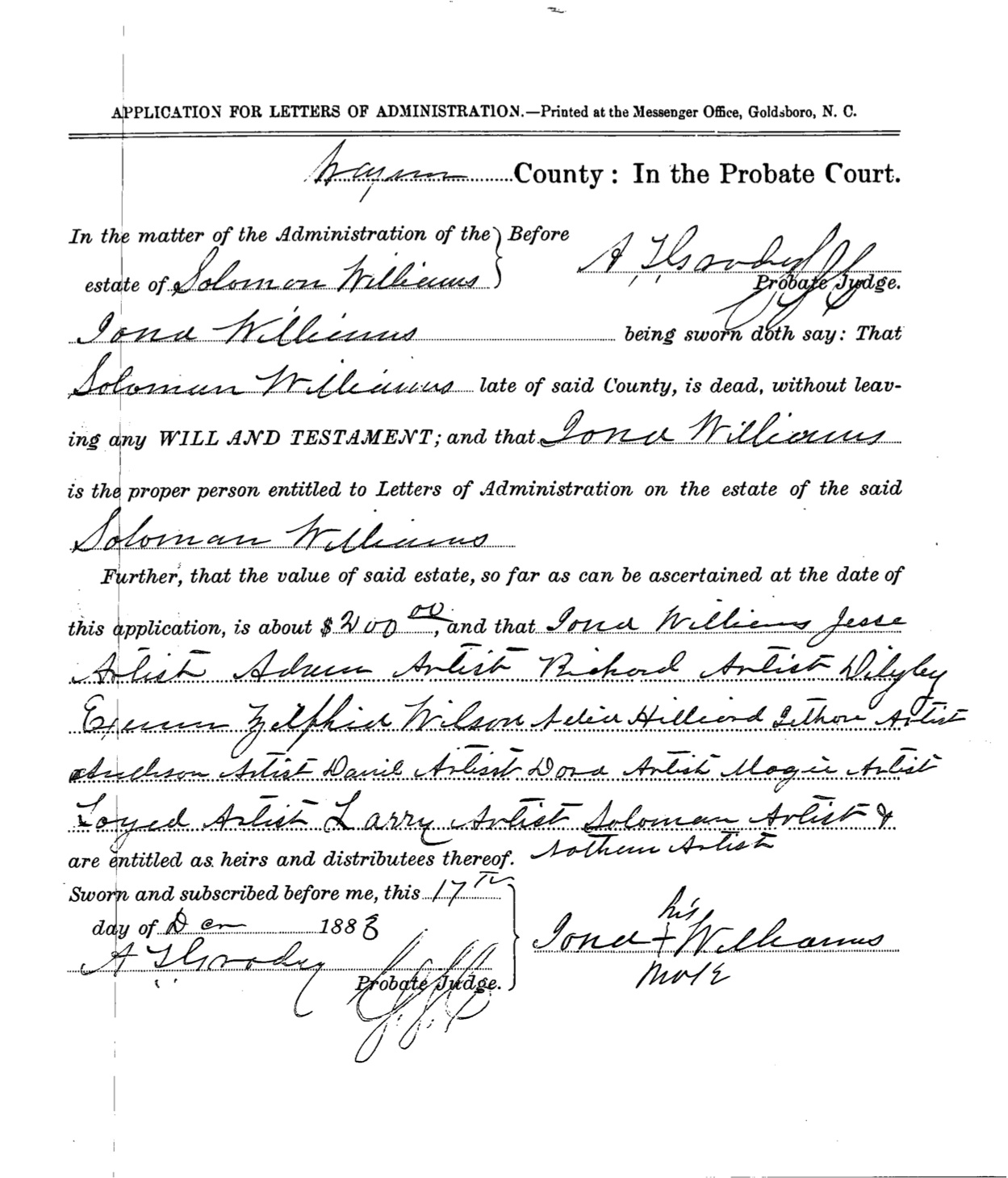
Vicey Artis, a free woman of color, and Solomon Williams, a slave, had eleven children together – Zilpha Artis Wilson, Adam Toussaint Artis, Jane Artis Artis, Loumiza Artis Artis, Charity Artis, Lewis Artis, Jonah Williams, Jethro Artis, Jesse Artis, Richard Artis and Delilah Williams Exum — before they were able to marry legally.  On 31 August 1866, they registered their 35-year cohabitation in Wayne County.  Vicey died soon after, but Solomon lived until 1883.  The document above, found among Solomon’s estate papers, names son Jonah as administrator and lists his and Vicey’s six surviving children and the heirs of their deceased children.

Little is known about Solomon. He was born about 1800. A few slaveowning Williams families lived in Vicey Artis’ vicinity in Greene County, but there is no evidence to link Solomon to them. He appears in the 1870 and 1880 censuses of Nahunta township, Wayne County, heading households comprised of his daughters and their children, and is recorded as father on the marriage licenses of daughter Lomisy (Loumiza) Williams and son Adam Artis and the death certificates of children Jonah Williams, Richard Artis and Delila Exum.

Standard
Births Deaths Marriages, Land, North Carolina, Paternal Kin

Coley v. Artis.

At the heart of Wayne County Superior Court proceedings stemming from the suit in J.F. Coley v. Tom Artis (1908) was a dispute over 30 acres of land. Thomas “Tom Pig” Artis began renting the property in 1881 from W.J. Exum.  In 1892, Exum’s widow Mary sold it to Napoleon “Pole” Hagans.  In 1896, after Napoleon’s death, the land passed to his sons Henry and William S. Hagans, and in 1899 Henry sold his interest to his brother.  In 1908, William S. Hagans sold the 30 acres to J.F. Coley.  Coley filed suit when Tom Artis laid claim to it, arguing that Napoleon had sold it to him.  Tom claimed that the 800 lbs. of cotton he tendered to Napoleon Hagans (and later, his son William) was interest on a mortgage, but William Hagans and other witnesses maintained that the payment was rent.

The trial transcript is replete with testimony revealing the personal relationships among witnesses. Tom Artis testified that he rented the “Adam Artis place.” William Hagans testified that his father was in feeble health in 1896 when he called him and Henry together “under the cart shelter” to tell them he would not live long and did not know to whom the land would fall.  William testified that Pole asked them to let “Pig” stay on as long as he paid rent, and they promised to do so.  Tom Franks testified that “Pole was a first-rate business man.” Jonah Williams, Adam Artis’ brother, testified that he borrowed money from Napoleon to open a brickyard in the spring of 1893 and had preached his funeral.  He also noted that “Tom married my sister [Loumiza Williams Artis, who was deceased by time of this trial].  He is not a member of my church.  I turned him out.  He is a Primitive Baptist.  I preached Napoleon Hagans’ funeral.”  Jesse Artis, another of Adam Artis’ brothers, testified that he had worked on Hagans’ property as a carpenter for 18 years and noted, “I don’t know that Tom and I are any kin, just by marriage.”   John Rountree testified that he was a tenant renting from Hagans on thirds.  Simon Exum, Delilah Artis‘ husband, testified: “I am no kin to Tom [Artis] as far as I know, except by Adam.  His first wife was my wife’s sister.”  H.S. Reid testified that he was Tom Artis’ son-in-law.

The court found for Coley and against Artis.

——

Thomas Artis was a son of a free woman of color, Celia Artis, and her enslaved husband, Simon Pig. Though, ultimately, nearly all free colored Artises are descended from a common ancestor in southside Virginia, by the late 1800s knowledge of these remote links had faded. There were dozens of Artis families in Wayne County during the antebellum period, and the relationships between them are unknown. Celia Artis was a close neighbor of Adam Artis, but the families apparently did not regards themselves as kin.  Still, they were inextricably intertwined.  The Artises, Haganses and Reids had been neighbors in the Eureka area for generations. Celia Artis and Henry S. Reid’s grandmother Rhoda Reid were the wealthiest free women of color in the county. Adam Artis married Napoleon Hagans’ half-sister Frances Seaberry. Adam’s sister Loumiza married Tom Artis, as noted above. Henry S. Reid, son of Washington and Penninah Reid, married Tom Artis’ daughter. Henry’s first cousin Henry Reid, son of John and Mozana Hall Reid, married Adam Artis’ daughter Georgianna Artis. Adam Artis’ son William Marshall Artis and grandson Leslie Artis married Tom Artis’ nieces, Etta and Minnie Diggs. And on and on.

Documents found in file of the Estate of Thomas Artis (1911), Wayne County, North Carolina Estate Files, 1663-1979, familysearch.org

Standard
Births Deaths Marriages, Enslaved People, Free People of Color, North Carolina, Other Documents, Paternal Kin

Up from slavery.

artis-solomon-williams-estate-records-dragged

Vicey Artis, a free woman of color, and Solomon Williams, a slave, had eleven children together – Zilpha Artis Wilson, Adam Toussaint Artis, Jane Artis Artis, Loumiza Artis Artis, Charity Artis, Lewis Artis, Jonah Williams, Jethro Artis, Jesse Artis, Richard Artis and Delilah Williams Exum — before they were able to marry legally.  On 31 August 1866, they registered their 35-year cohabitation in Wayne County.  Vicey died soon after, but Solomon lived until 1883.  The document above, listing his and Vicey’s six surviving children and heirs of their deceased children, is found among his estate papers.

Standard