Births Deaths Marriages, North Carolina, Paternal Kin, Photographs

Family cemeteries, nos. 11 & 12: Rountree & Rest Haven.

The wooden church was still standing then, on a sandy bank that rose from a curve in the highway at Lane Street.  In my father’s time, Rountree church was well beyond city limits, but our subdivision leapfrogged it in the early 1960s, and a grocery store popped up across the road, and it was no longer an outpost.  Still, when we were children, Lane Street was raw and unpaved and, for us, a gateway to adventure.  A hundred yards in, the road crossed over a sluggish branch, the pines began to crowd down to its ragged edge … and tombstones began to poke through the snarl of catbrier and cane choking the forest floor.  Here was the remnant of Wilson’s first colored cemetery*, abandoned at mid-century and, by the mid-1970s, when we prowled these woods, completely overgrown with bamboo and sweetgum and loblolly pine.  Burials by then had moved around the corner to Rest Haven cemetery, which is city-owned and maintained.  Perhaps 20 years ago, after several half-hearted clean-up efforts, a small, ragged section of Rountree was cleared and its remaining stones propped up.  A hundred yards down the road, in an open field, a memorial was erected to Rountree’s many hundreds of lost graves. A set of my great-grandparents were probably buried there, as well as my father’s stillborn brother, Uncle Jack’s sickly boys, and other kin unknown and maybe unknowable.
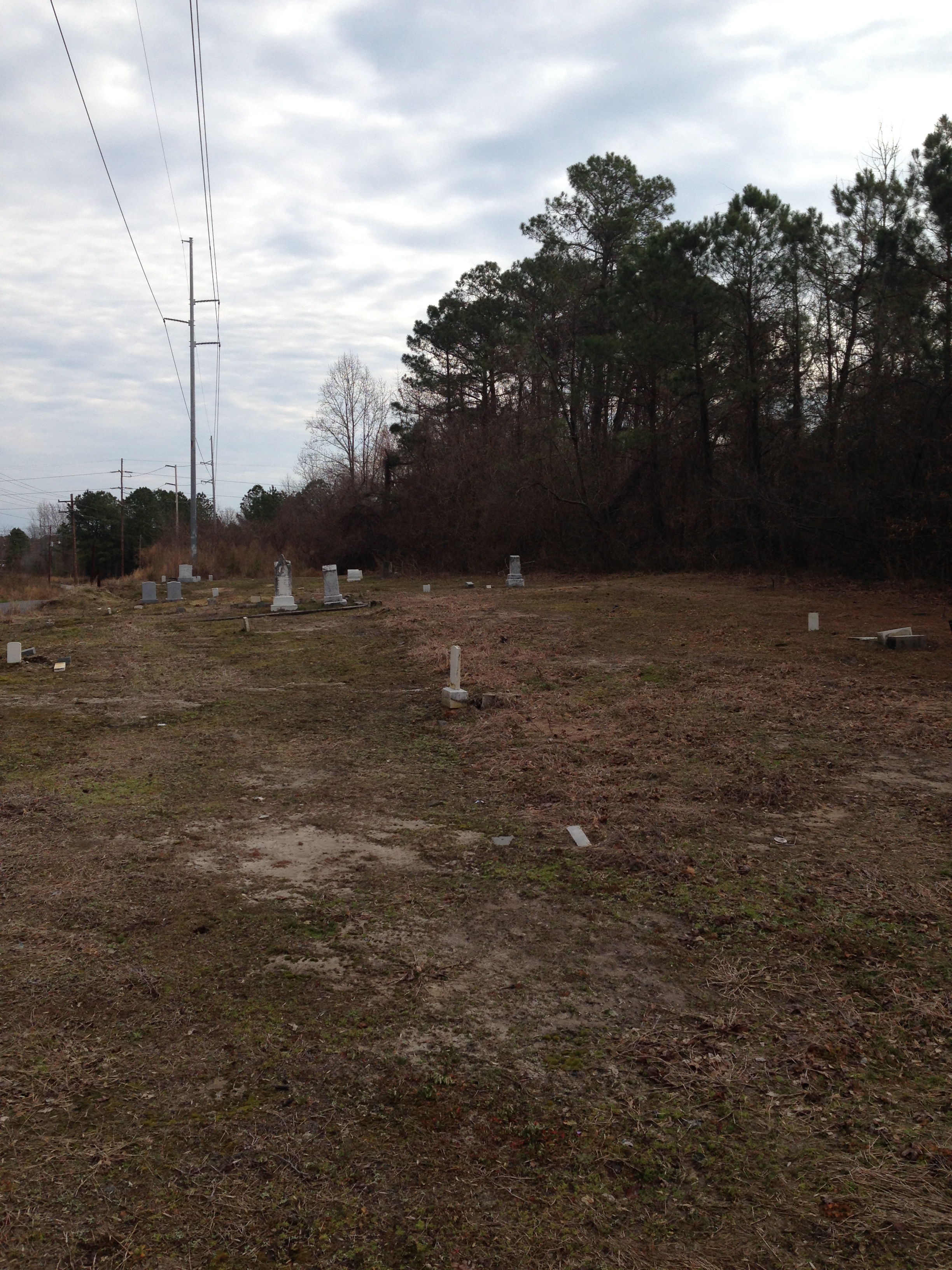
IMG_4992

 The sad remnants of Rountree cemetery, February 2014.

My grandmother was buried at Rest Haven in 2001 and my uncle in 2005, but only recently did I begin to regard that cemetery’s conventional, lettered rows as as interesting as wild Rountree. My grandmother’s headstone, like all from the last 30 years or so, is machine-cut, its lettering precise and even. Older markers, however, reveal an artist’s hand, quickly recognizable in a squarish font with flared serifs and, especially, the long, pointed tails of the 9’s. Marble cutter Clarence Benjamin Best carved headstones for more than 50 years, chiseling lambs, stars, flowers, and Masonic emblems, as well as pithy, grammatically idiosyncratic epitaphs, into slabs of gray granite. I have found his work in rural Wilson County cemeteries and as far afield as Wayne and Greene County, but Rest Haven is ground zero for his oeuvre.

IMG_4996

 An early example of Clarence Best’s marble-carving in Rountree — before he developed his signature long-tailed 9’s. (Foster was an early investor in Commercial Bank.)

IMG_8931

A late example — with 9’s and a bit of a extra verbiage, Rest Haven.

IMG_8937

 Rifle, fish, peaches — a Best creation for husband and wife, Rest Haven.

In addition to my father’s mother and brother, my paternal grandfather is buried in Rest Haven, as are my aunt’s husband; Uncle Jack and his family; Josephine A. Sherrod and countless other Artises; and, somewhere, Aunt Nina.

Jesse A Henderson headstone

My uncle, Jesse A. Henderson.

Jack Henderson headstone

Cousin Jesse “Jack” Henderson and wife, Pauline “Polly” Artis Henderson.

*I have since learned that it was not, in fact, the first. That distinction may belong to a small cemetery just off Pender Street, memorialized in today’s Cemetery Street. All traces of it have disappeared.

Standard
Business, Newspaper Articles, North Carolina, Other Documents, Paternal Kin

The colored people of Wilson have organized a bank.

In December 1920, five of Wilson, North Carolina’s leading African-American citizens executed a certificate of incorporation to establish the Commercial Bank of Wilson. The bank was necessary, they asserted, “to promote thrift and economy,” “to encourage agriculture and industrial enterprises,” and “to place in circulation money otherwise unavailable.” Farmer, realtor and businessman Samuel H. Vick; barber William H. Hines; school principal J. James D. Reid; funeral home operator and businessman Camillus L. Darden and physician Frank S. Hargraves — the unquestioned cream of east Wilson‘s crop — each invested in 100 shares of bank stock and, after filing the document, set about designating a president (Hines) and board of directors (J.R. Rosser, Isaac A. Shade, Cain D. Sauls, Charles S. Thomas, R.A. Worlds, John Lucas, C.S. McBrayer, J.O. Mitchell, Lee Pierce, Alfred Robinson and Judge D. Reid), and a cashier (G.W.C. Brown).

Attached to the filing are three pages listing the names of all the bank’s investors and providing information about their net worth and occupation.  Most of more than 150 shareholders — overwhelmingly African-American men — lived in Wilson or Wilson County, but adjoining counties like Wayne, Greene and Johnston were represented, as well as more far-flung cities like Durham and Elizabeth City, North Carolina.  They were farmers and contractors, merchants and ministers, teachers and barbers, with estimated worths ranging from $300 to $50,000.

Image

Image

Image

At least two of my relatives were among the bank’s investors. C.D. Sauls of Greene County, whose connection through Daniel Artis I chronicled here, was a bank officer, and his cousin Columbus E. Artis, who owned and operated a funeral business in Wilson, bought five shares.

ImageHill’s Directory of Wilson, North Carolina, 1922.

Newspapers reported the bank’s opening excitedly.

Wilm Morning Star 11 18 1920

Wilmington (NC) Morning Star, 18 November 1920.

The Independent Eliz City 2 25 1921

Elizabeth City The Independent, 25 February 1921.

E City Independent 3 4 1921Elizabeth City The Independent, 4 March 1921.

In the 1921-1922 issue of The Negro Year Book: An Annual Encyclopedia of the Negro, Monroe N. Work, editor, Commercial Bank of Wilson was listed as one of only eight black banks in the state of North Carolina, which trailed only Virginia (13) and Georgia (9) in the number of such institutions. [Sidenote: one of Virginia’s was Crown Savings Bank of Newport News, for which my great-grandfather John C. Allen served as board member.]

Alas, things fell apart. After a fire in the vault destroyed records, the State launched a criminal investigation that resulted in the closing of the bank on 4 September 1929 and the indictments of vice-president (and chief promoter) J.D. Reid and cashier H.S. Stanbank on charges of embezzlement, forgery and deceptive banking practices. As reported in the 22 February 1930 issue of the Pittsburgh Courier, the courtroom was daily packed with victimized depositors and shareholders, all of whom bore an “intense feeling of resentment against the accused….” Both were convicted and sentenced to five-year prison terms — at hard labor — but released after two years.

burlington Daily Times-News 12 22 1931

Burlington Daily Times-News, 22 December 1931.

Standard