DNA, Maternal Kin, North Carolina

DNA Definites, no. 4.5: Simonton.

Ten years or more ago, before repeated bad brushes with poison ivy wore me out, I was a member of the Georgia Native Plant Society. Atlanta’s economy was booming, subdivisions were sprouting like nutgrass, and GNPS was dashing across the city, rescuing ferns and trillium from the bulldozer’s scrape. I showed up for the last time at a site just southwest of the city, trailing plastic bags and a shovel. The owner of the parcel stopped by, and I stopped dead when I heard her name. “Simonton?” I said. “Your family wouldn’t be from Iredell County, North Carolina, would they?” She confirmed that they were, adding that they descended from a Theophilus Simonton. I laughed and exclaimed, “Hey! We’re probably distant cousins! I think I’m descended from him, too!” Small world, we agreed, and she went on her way.

A couple of months ago, my mother got a new match on 23andme — “M. Simonton.” Simonton! I contacted her and quickly established that she is descended from Theophilus Simonton of Ireland, then Lancaster County, Pennsylvania, then Iredell County NC. M. told me that her sister lived in Georgia and, on a hunch, I did a quick search of my Family Tree Maker tree. There — the very same M. Simonton and her sister S., who was indeed the woman whose family land I’d scoured for crane’s foot geraniums and astilbe.

——

My line of descent from Theophilus Simonton, who died in 1757: Magdelene Simonton > Theophilus Allison > Thomas Allison > Mary Allison > Thomas Nicholson > J. Lee Nicholson > Harriet Nicholson > Lon Colvert > Margaret Colvert > my mother. M. and S.’s line of descent from Theophilus: Robert Simonton > Adam Simonton > Abner Simonton > Albert Simonton > Adam Simonton > William Simonton > their father.

Standard
Maternal Kin, Newspaper Articles, North Carolina, Politics

The friends of prohibition.

Mt. Ulla.

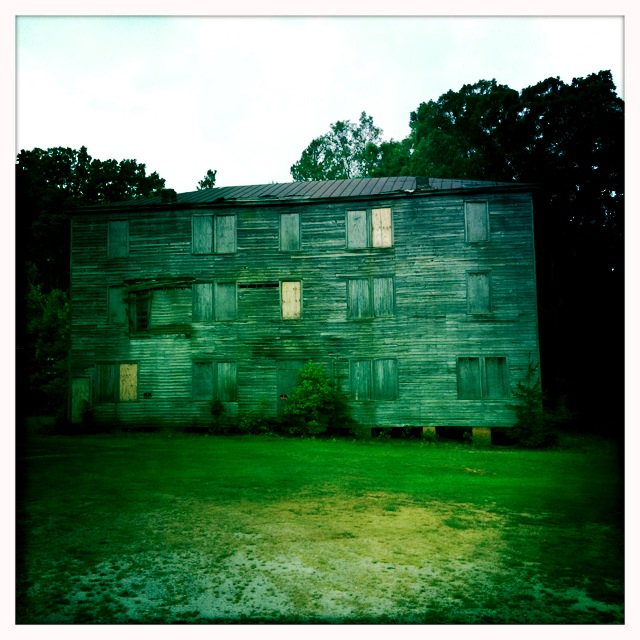
A meeting of the friends of prohibition was held at Wood Grove, Mt. Ulla Township, on the 4th instant. W.L. Kistler. Esq., was called to the chair and Rev. J. G. Murray, col. was elected secretary. The object of the meeting was explained by Dr. S.W. Eaton. The following resolution was offered by J.T. Ray and unanimously adopted after appropriate remarks from Rev. J.G. Murray and other.

Whereas, In consideration of the evil of Intemperance, caused by the sale and use of intoxicating liquors upon society, which promotes crime and other known vices, and thereby increasing taxation upon the citizens for the suppression, and also entailing injury in some or other upon all classes and conditions of our fellow men, Therefore

Resolved, That we do hereby heartily approve of the action of our County Commissioners in refusing to grant license for the retailing of intoxicating liquors to be used as a beverage in Rowan County.

Upon motion the chairman and secretary were requested to appoint a committee for permanent organization to meet on Saturday the 11th inst., at 3 o’clock, P.M.

The committee for permanent organization are as follows: White – S.A. Lowrance, D.M. Barrier, J.C. Gillespie, J.T. Ray, J.K. Goodman, S.C. Rankin, S.F. Cowan, J.M. Harrison, M.A. File, R. Lyerly, J.K. Graham, Esq.  Colered – W.W. Kilpatrick, Ransom Miller, Henry McNeely, Andy Gillespie, Amos Foster, George Miller, R.A. Kerr, James Rankin, Julius McNeely, Silas Gillespie, Gabriel Kerr.

Upon motion the meeting adjourned to meet on Saturday the 11th inst., at 3 o’clock, P.M.   W.L. KISTLER, Ch’m. J.G. MURRAY, Sec.

The Carolina Watchman, Salisbury NC, 9 June 1881.

ImageWood Grove, Rowan County, Library of Congress Prints and Photographs Division.

——

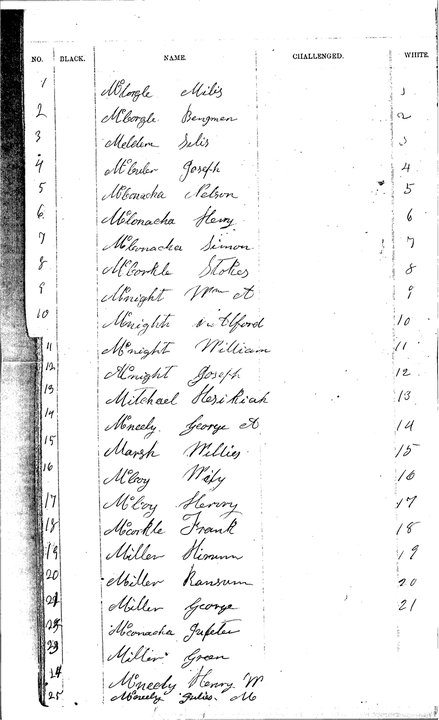
Henry McNeely and his half-brother Julius McNeely were joined on the committee by Henry’s brother-in-law George Miller and his wife Martha’s brother-in-law Ransom Miller.

Standard
Enslaved People, Land, North Carolina, Paternal Kin, Photographs

A thousand acres between creek and swamp.

Kinchen Taylor’s estate papers include two plats. One laid off his widow Mary Blount Taylor’s dower. The second divided his remaining land into two large parcels:

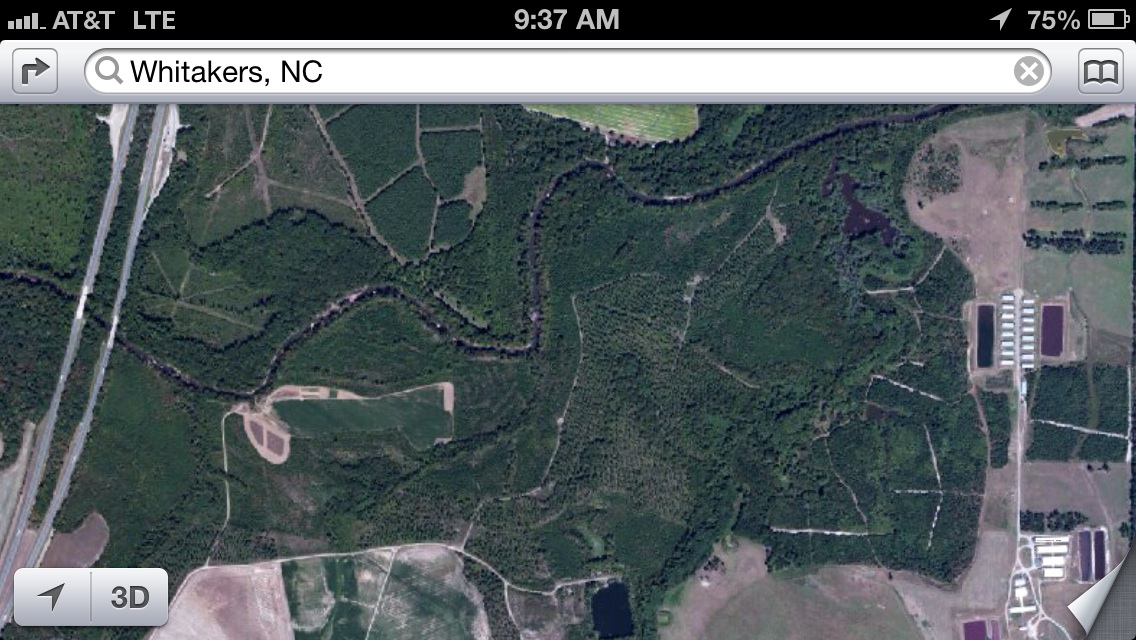
ImageIn some ways, Taylor’s old lands have not changed dramatically. Pine forest and tilled fields still predominate the landscape; far northern Nash County remains rural. Nonetheless, Taylor and enslaved workers like Green and Fereby, who walked and worked it intimately, might be pressed to recognize his property.

Image

I-95 — a far cry from the path shown in the plat — roars with traffic just west of Taylor’s acreage, hauling truckers and tourists from Maine to Florida. If you tilt your head sharply to the right, you’ll see that Fishing Creek, crawling across the top of the screen, still follows the same general course. Beaver Dam Swamp, however, has been dammed just below its confluence with the creek, forming a small body called Gum Lake. The watercourse of the swamp, probably largely drained, is barely detectable as an undulating line of taller vegetation angling southwest from the pond. Lost somewhere in its tangle of canes and catbrier is the Old Mill shown on the plat.

On the other side of Beaver Dam swamp, to the far right of the Google Map view, is an industrial hog farm, identifiable by the white structures with adjacent dark lozenges — barns holding up to 2500 hogs a piece and the lagoons that capture the stupendous quantities of waste they produce. This perhaps would have startled Kinchen Taylor most, as his hogs would have been free-range until time for fattening. (And it should startle you, too, as this is huge, nasty business.)

The file of Kinchen Taylor (1853), Nash County, North Carolina Estate Files 1663-1979, https://familysearch.org, original, North Carolina State Archives;

Standard
Free People of Color, North Carolina, Paternal Kin, Religion

Church home, no. 1: First Congregational, Dudley NC.

“History of the First Congregational Church of Dudley, North Carolina, Given by Mr. General Washington Simmons, born December 22, 1856.”

In 1867, after Emancipation, came the first school for Dudley, taught four months by a white confederate soldier, John P. Casey, who was paid by the community families. The only textbook was the “blue-back speller.”

George Washington Simmons, father of General W. Simmons, corresponded with Mr. James O’Hara in Wilmington, Delaware, though whom the services of another white friend, Miss Jane Allen of Delaware, were secured for another two months’ session. She, too was paid by families.

From Oberlin College in 1868, came D.C. Granison, 23 or 24 years of age, the first Negro teacher, who remained for two years, residing in the home of George Washington Simmons. … His correspondence with the A.M.A. brought visitors in 1870, among whom were many to be remembered, especially Rev. D.D. Dodge, at that time pastor of the First Congregational Church in Wilmington, North Carolina. With his guidance our first Sunday School was organized. After several visits, he sent Rev. John Scott of Naugatuck, Connecticut, who began work in 1870. …

Just after Rev. Scott’s ordination, the First Congregational Church of Dudley was organized in what is known as the old “mission home.” … Charter members of the church were George Washington Simmons, James KingLevi Winn Sr., Levi Winn Jr., Henry Winn, George Winn, and members of their families. The first converts were Charity Faison and Sylvania Simmons. They were baptized in the “Yellow Marsh Pond” just north of the cemetery. …

Volume II [of the church records] summarizes the history from March 9, 1870. … The list of members, dating from 1870, is divided by male and female. It includes the names of Frank Cobb, William AldridgeBryant Simmons (Sr. and Jr.), John AldridgeLewis Henderson, Levi Wynn, Richard Brunt, Amos Bowden, Charles Boseman, M.A. Manuel, Solomon Jacobs, George Washington Simmons, …

From the souvenir bulletin of the 100th Anniversary, First Congregational Church United Church of Christ, 1870-1880.  Copy of bulletin in possession of Lisa Y. Henderson.

Standard
Education, Letters, Maternal Kin, Other Documents, Photographs, Virginia

The Keysville school.

Acts of the General Assembly of the Commonwealth of Virginia.  Chap. 91.  An Act to Incorporate the Keysville Bluestone mission industrial school.  Approved January 17, 1900.

Be it enacted by the General Assembly of Virginia, that Reverend Nelson Jordan, R.C. Yancey, George D. Wharton, P.E. Anderson, F.L. Hall, Jesse H. Wilson, Jordan Moseley, Whitfield Clark, L.N. Wilson, A.J. Goode, S.L. Johnson, N.C. Ragby and Miss Mary E. Wilson [are appointed] board of trustees [of an institution] by the name and style of the Keysville Bluestone mission industrial school for the purpose of keeping and conducting at Keysville, Charlotte County, Virginia, a boarding and day school of the above name, and of giving instruction to such colored persons, male and female, as may be committed to their care as pupils of said school. …

Image

——

Rev. Whitfield Clark’s sister Mary married my great-great-great-great-uncle Joseph R. Holmes, who was murdered on the steps of Charlotte County courthouse in 1869. As shown below, Joseph Holmes had been instrumental in securing support for the precursor to this school:

record-image-2

Joseph homes letter

Photograph of Keysville Industrial School, Keysville, Virginia, by Lisa Y. Henderson, July 2012. Images of letters from Virginia Freedmen’s Bureau Letters of Correspondence 1865, 1872, www.familysearch.org (originals in Records of the Field Offices for the State of Virginia, Bureau of Refugees, Freedmen and Abandoned Lands 1865-1872, National Archives and Records Administration.)

Standard
Civil War, Maternal Kin, North Carolina, Other Documents, Rights

The first registration.

voter reg

Rowan County, North Carolina, 1866. The war is over. The 14th and 15th Amendments have not yet passed, but the county’s hopeful freedmen have come out en masse to register to vote, perhaps under the auspices of the Freedmen’s Bureau. Among them, my great-great-grandfather Henry W. McNeely, his half-brother Julius McNeely, and his future in-laws Ransom, George and Green Miller. Henry’s father John W. McNeely, Confederate allegiance renounced and U.S. citizenship restored, was also there — his world upside down.

Standard
Free People of Color, North Carolina, Paternal Kin

The case for the Skipps as James Henderson’s children.

1. In the 1840 census of Onslow County, James Henderson is listed twice.  First, his household includes 1 male 24-26 [James]; 1 female 10-24 [Sallie Skipp?]; 2 males under 10 [Lewis and James]; and 1 female under 10 [Mary], all colored, and is listed between Bryant Koonce and William Mills.  Second, the household composition is the same, but is listed between William Boyett and Jesse King.

2. In the 1850 census of Upper Richlands township, Onslow County:  at household #32, Jim Henderson, 35, mulatto, mechanic, in the household of B.S. Koonce, farmer; at #34, Eliza Skipp, 7, mulatto, in the household of Jesse Alphin, farmer; at #60, Jim Dove, 14, and Mary Skipp, 10, mulatto, in the household of John Humphrey, farmer; at #65, Lewis Skipp, 16, laborer, and James Skipp, 10, both mulatto, in the household of Stephen Humphrey.

3. Neither James “Jim” Henderson nor the Skipp children appear in any Onslow County census thereafter.

4. In the 1860 census of Westbrooks township, Sampson County (about – miles from Upper Richlands): at #1033, Lewis Henderson, 25, turpentine laborer, with wife Margaret, 26, and children Lewis T., 4, James L., 3, and Isabella J., 4 months; at #1038, James Henderson, 52, carpenter, wife Eliza, 25, and children Anna J., 8, Susan, 6, Hepsie, 4, and Alex, 1; at #1039, Eliza Henderson, 18, in the household of John B. Sutton; at #1113, James Henderson, 22, farm laborer, in the household of Louis C. King. (Mary Skipp/Henderson has not been accounted for.) They are the only Hendersons in Westbrooks and were not in Sampson County in 1850.

5. In the 1870 census of Faisons, Duplin County: James Henderson “senior” is listed with his wife and children, including 27 year-old James. In Brogden, Wayne County: Lewis Henderson with his wife and children.

6. In the 1880 census of Brogden, Wayne County, James is listed with his wife and daughters. Lewis and his family were also in Brogden township. James senior remained in Faison.

7. Lewis Henderson had sons Lewis and James and a daughter Mary. James H. Henderson had sons Lewis and Elias Lewis and a daughter Mary.

8. James Henderson died in Faison, Duplin County, on 21 June 1920, aged about 80. His death certificate listed his birthplace as Onslow County and his parents as James Henderson and Sallie Henderson.

9. My grandmother, a great-granddaughter of Lewis, recognized Elias L. Henderson as a cousin. She recognized as aunts the daughters of James Henderson by his second wife. (They were actually her grandmother’s aunts, though they were contemporaries.) She also recognized as cousins the son and daughter of James’ son John Henderson.

——

In other words: in 1850, four children of ages to be siblings appeared in Onslow in proximity to a man believed to be their father. One of the children, Lewis, was born approximately the same year as Lewis Henderson. Ten years later, three of the four children, now bearing their father’s surname, appeared in proximity to him in Sampson County. (Surname shifts, especially among the children of unmarried parents, were not uncommon in free families of color.) The sons, Lewis and James, named sons after one another and settled sequentially in Brogden township, Wayne County.  Most of their half-siblings also migrated to Brogden, and their descendants maintained close family ties into the early 20th century. When James “junior” died, his death certificate acknowledged his birth in Onslow County and named James Henderson as his father.

Standard
Maternal Kin, Virginia

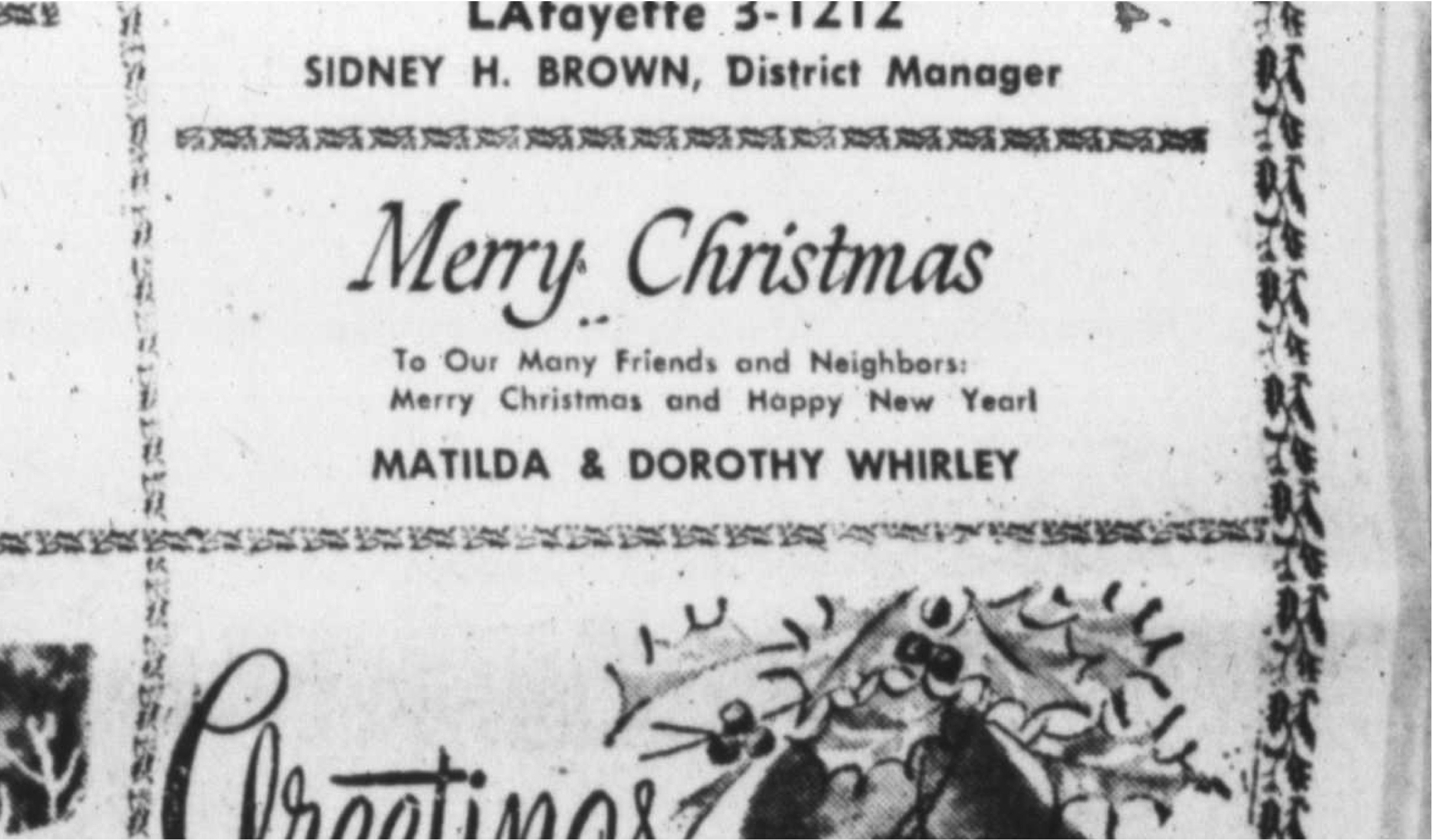
Matilda & Dorothy Whirley.

I called her cold, admittedly. Never could she have expected to pick up the phone to a call from her great-uncle’s great-granddaughter. Still, I’ve made lots of these kinds of calls in my life. Dorothy Whirley was decidedly more guarded than most and had a little edge in her voice that sounded almost irritated. She could not deny me though, for what slick stranger could pull names and dates out of Charles City County like that?

Dorothy was the daughter of Matilda Whirley and granddaughter of Emma Allen Whirley, my great-grandfather’s sister. Dorothy could not, or would not, tell me much, except to confirm that Emma, her husband and children had migrated to Baltimore, where she continued to live. Her mother, to whom she had been very close, had died not too many years before our connection, and she seemed somewhat estranged from her remaining kin. She knew of John Allen Sr., but had little more to say about him than that he held himself apart from — thought himself better than — his half-siblings because of his light skin. Our conversation foundered, and I hung up with a promise to send her a family tree. I never got around to it, and she died in 1999. I have not been able to track down any other living Whirleys, but have found small traces of Dorothy and her mother.

ImageThe Baltimore Afro-American, 26 December 1959.

Standard
DNA, North Carolina, Paternal Kin

DNAnigma, no. 3: An Artis match, after all.

I was geeked. After all, my great-great-great-grandfather Adam T. Artis had 25+ children, and I have thousands of cousins in their descendants. (Not to mention the descendants of Adam’s many siblings.)  I was crestfallen, then, when H.A. responded that he was descended from Absalom Artis, through Warren Artis, then Henry, then Alonzo, then William Henry Artis. I know the Absalom Artis line (though I didn’t know Warren was in it), and I have no known connection to them. Absalom was born in Virginia circa 1780 and was in northern Wayne County by the early 1800s. He and Adam lived in close proximity, but the record gives no clue to other links. Of course, ultimately, all of the free colored Artises in Wayne County – indeed, throughout Virginia and NC and out into Indiana and Ohio – were likely kin, but the links are so remote that reconstructing them is likely impossible. H.A. and I share enough DNA that our common ancestor had to have been within the last 5 generations or so. In other words, more recent than any common ancestor of Adam and Warren or Absalom.

But then….

While reviewing my notes for a post about Adam’s second set of children, I was reminded that his daughter Mary Jane Artis had married an Artis. Henry Artis. Son of Warren and Pearcy Artis. And mystery solved! H.A. and I are not related through his patrilineal Artis line, but via a wife whose father was my great-great-great-grandfather.

Standard
Enslaved People, Maternal Kin, North Carolina, Oral History

Henry W. McNeely.

My grandmother said he looked a bit like a poet. Or so she was told:

See, I never did know Grandpa Henry. I didn’t know him.  He died just as Louise was born. Mama had just had Louise, and it was real hot and all, and they told her she couldn’t go to the funeral because it was so warm and she would take cold.  But I didn’t know him. 

And:

Mama said he looked just like Walt Whitman.  You know, he was, his father was white. I don’t know who his mother was. I don’t know if she was mulatto or what.  But anyway, he was really light.  And he lived on the same farm as his daddy.  And he provided him, he provided for him as if he was his own child.

White child, that is.

Henry W. McNeely was 22 years old the year his father reported to the tax assessor that he was worth $1500. The tax list is his first named appearance in the record, and documentation of his life is relatively scarce thereafter. He registered to vote in Rowan County in 1868 and appears in his mother’s household in Atwell township, Rowan County, in the 1870 census.  (He was described as a schoolteacher. Had his father taught him to read while he was enslaved? Or was he a quick learner in a Reconstruction school?) In 1872, he married 18 year-old Martha Miller and, in a daring gesture, named Wilson McNeely as his father on the license. The register of deeds did not blink and dutifully noted that all parties, except Wilson, were colored.
Image

[Sidenote: “Louise” was Mary Louise Colvert Renwick, my grandmother’s sister, born in 1906. — LYH]

——

Interview of Margaret C. Allen by Lisa Y. Henderson; all rights reserved.

Standard