Births Deaths Marriages, Maternal Kin, North Carolina, Photographs, Vocation

Mercy me.

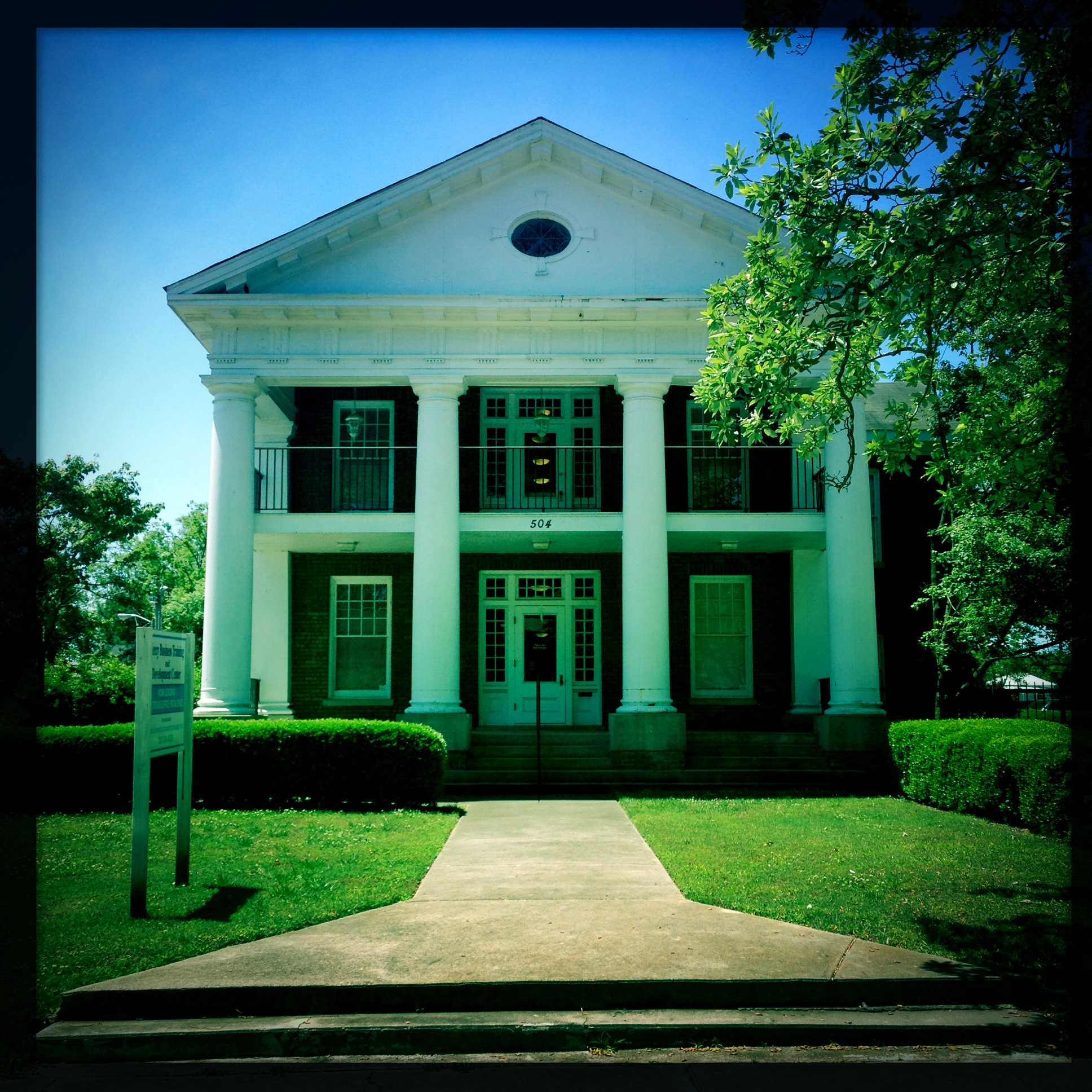
ImageThe hospital was on East Green Street, right around the corner from Jackson Chapel and Saint John AMEZ and Calvary Presbyterian. That last Sunday in June, two days after her first delivery, my mother lay perspiring in an iron bed, smiling uncomfortably as she accepted congratulations from church ladies making their post-service rounds. (The first reports went out: the Hendersons had a jowly yellow girl with a slick cap of black hair, a “Chink” baby, as one later indelicately put it.) She was desperate to be discharged, but had to wait for an all-clear from the pediatrician. It was not as if he were right down the ward. Dr. Pope was white, and as his black patients were forbidden to come to him, making his rounds meant driving across the tracks to them, laid up in sweltering Mercy Hospital. He arrived Sunday evening, turned me this way and that, pronounced himself satisfied, and granted us a release for the next morning. A few months later, when federal law mandated that Wilson’s new hospital open as an integrated facility, Mercy closed.

Founded in 1913 as the Wilson Hospital and Tubercular Home, Mercy was one of a handful early African-American hospitals in North Carolina and the only one in the northeast quadrant of the state. Though it struggled financially throughout its 50 years of operation, the hospital provided critical care to thousands who otherwise lacked access to treatment. A small cadre of black nurses assisted the attendant physician. One was Henrietta Colvert, shown below at far left, my great-grandfather’s sister. Henrietta was born in 1893 in Statesville, Iredell County, and received training at Saint Agnes School of Nursing in Raleigh. How she came to Wilson is unknown. This photograph suggests that she cared for Mercy’s patients in its earliest days. (The man seated in the middle is Dr. Frank S. Hargrave, a founder of the hospital, and he left for New Jersey in the early 1920s.)  My father’s mother recalled that Henrietta also worked as a visiting nurse for Metropolitan Insurance Company in the 1930s and attended her children for two weeks after they were born.  My great-great-aunt was still at Mercy in the 1940s, but had left Wilson by time my mother married my father and moved there in 1961, and my family had long lost contact with her when she died in 1980 in Roanoke, Virginia.

Image

Photograph of Mercy Hospital taken in June 2013 by Lisa Y. Henderson. Photo of Mercy’s staff courtesy of the Freeman Round House Museum, Wilson NC.

Standard
DNA, Maternal Kin

DNAnigma: Throwback Thursday.

First I wrote:

Just before I was about to pick up the phone again to lay into the African Ancestry people about my DNA results, the packet arrived in the mail. I’d had a mitochondrial DNA analysis done. In other words, AA examined a few cheek cells to isolate a segment of DNA that has passed consistently and unchanged from some distant ancestor through her daughter, and then her daughter, and so on, through Margaret McConnaughey (b. ca. 1820) and her daughter Martha Miller McNeely (1855-1934), and her daughter Caroline M.M.F.V. McNeely Colvert (1877-1957), and her daughter Margaret Colvert Allen (1908-2010), and her daughter, to me. It’s a bit of DNA from only one of innumerable and unknowable ancestors, but it’s the only genetic material that is absolutely passed on in women from generation to generation, ad infinitum. (For men, there’s also Y-DNA.) Theoretically at least, comparing an individual’s mtDNA to those in a database such as that assembled by AA yields a match with identical mtDNA sequences found in some part of Africa. So. Genealogy lunatic that I am, this whole process held exciting possibilities for me. I’m not silly enough to think that I look like I descend from people in Senegal or Guinea or Cameroon, or that my personality is shaped by some distant Nigerian cultural link, or that I’m on my way to discovering my own Kamby Balongo, but I was pretty geeked about discovering a little something about my personal connection to West Africa and the Middle Passage. Imagine my surprise, then, when I ripped open the packet to find a “Certificate of Ancestry” asserting that my mtDNA Sequence Similarity Measure is “100% the same as sequences from people in Sudan today.” SUDAN???? So I’m a DINKA? Not a Wolof or Igbo or Nupe or Asante? Not even a West African? Well, I’ll be damned. After my surprise wore off a bit, I did a little Wikipedia’ing and discovered that, while uncommon, an East African origin is plausibly explained by the trans-Sahara trade and the Fulani people who ranged well into western Sudan in ancient times. So, wow, huh? I’m not just a hyperbolic Nubian!

And then a few days later, after the wonderment wore off:

A little Internet delving into my mtDNA results reveals that my “Sudanese” match is, scientifically speaking, a variant of the d1 clade of the L2 haplogroup. Haplogroup L2 encompasses about 1/3 of all sub-Saharan African mtDNAs. The clades, labeled a-d, are further branches of L2, and the clades themselves have further variations, i.e. d1. Anyway, the most common haplotypes are shared by and within ethnic groups in multiple regions of Africa. In other words, because of thousands of years of migration (and consequent assimilation) among individuals and ethnic groups across the continent (or, at least, its broad midsection), a sample, like mine, may match L2d1 samples obtained from people living in modern Sudan, but it doesn’t mean that 50,000 years ago (or whenever my variation mutated), our common maternal ancestor was in what is now Sudan, and she certainly wouldn’t have been a Dinka or Nuer or any other ethnic group that exists as we know them today. She may not have been anywhere near Sudan, for L2d1 is also found in other modern-day tribes. Sooo?

——

I wrote this note in 2008. I’ve since tested at other sites and, though my haplogroup remains the same, have gotten different analyses of its origin. More on that later.

Standard
Civil War, Enslaved People, Maternal Kin, North Carolina, Other Documents

Total value: $7,600.

1863

Rowan County, North Carolina, 1863. The Civil War is dragging on, and the Rebs need money. In 1861, the Congress of the Confederate States of America had passed a statute authorizing a tax (at 50 cents per $100 valuation) to help finance the war effort. Taxable property included real estate, slaves, merchandise, stocks, securities, and money, and later agricultural products and anything else they could think of. In the 1863 assessment, for the first time, the North Carolina General Assembly required taxpayers to list their slaves by name. Assessments for only eight counties survive. Rowan is one of them.

Look in the bottom left corner. J.W. McNeely identified his seven slaves for the tax assessor, who duly recorded: Lucinda, age 47, value $750. Julius, 25, $1500. Henry, 22, $1500. Archy, 14, $1200. Mary, 13, $1000. Stanhope, 11, $900. And Sandy, 12, $950. Total valuation of Lucinda, her sons, and grandchildren: $7600. Remember Alice, the 3 year-old that Sam and J.W. McNeely bought with Lucinda? She was Archy’s mother, and Mary, Stanhope and Sandy were probably her children, too. Alice herself is gone — dead or sold — and John is not listed, though that seems to be oversight. Julius was born a few years after the McNeelys purchased his mother. His father is unknown, but was probably an enslaved man on a neighboring farm. Henry, though, was John Wilson McNeely’s boy. His only child, in fact. And worth exactly $1500.

Standard
North Carolina, Paternal Kin, Photographs

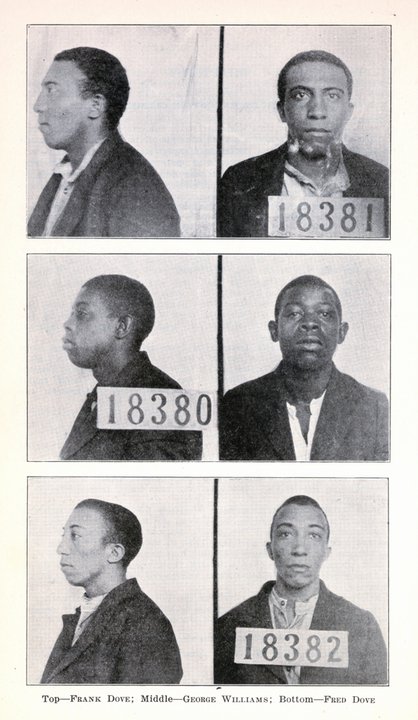
Conviction?

These men were convicted of the August 1922 murder of mail carrier Cyrus Jones in Swansboro, NC, largely on the testimony of another man, Willie Hardison, who was tried separately for the murder. Hardison later confessed that he had made up their involvement under the threat of being lynched. The state electrocuted Hardison in 1923, but both the trial judge and the prosecutor wrote letters requesting executive clemency for George Williams and the brothers Frank and Fred Dove. After almost six years on death row, the three were given full pardons in March 1928 by Governor A.W. McLean.

Image

Sidenote:  My people are from Onslow County, just west of Swansboro.  My furthest traceable Henderson ancestor was a free woman of color named Patsey Henderson, born about 1800.  Patsey’s sister Nancy married (or perhaps didn’t) a free man named Simon Dove.  The Onslow County Doves, including Fred and Frank, are descended from their son Durant Henderson, alias Durant Dove.

Image from “Capital Punishment in North Carolina,” Special Bulletin from the North Carolina State Board of Charities and Public Welfare, Raleigh, N.C. (1929). Copy courtesy of the North Carolina Collection, Wilson Library, University of North Carolina at Chapel Hill.

Standard
Births Deaths Marriages, Maternal Kin, Newspaper Articles, North Carolina

Witnesses to a homicide.

Harriet Nicholson, then about 16, married Abner Tomlin on November 20, 1877, in Iredell County. Their marriage license lists “L. Nicholson” as Harriet’s mother and leaves blank the space for a father’s name. Harriet’s son Lon Colvert was two years old and remained with his father’s grandparents.

The couple settled in Olin township, likely near Abner’s family. Harriet may have been pregnant when she married; their son Milas (named after Ab’s father) was born about 1877. In subsequent census records, Harriet reported having given birth to as many as nine children by Abner, but my grandmother knew only one, Harvey Golar Tomlin, born about 1891. However, at least one other child, Lena, lived to young adulthood, as the newspaper article below attests:

——

HOMICIDE FRIDAY NIGHT.  Jess Shaw, Colored, Shot and Killed in Wallacetown — Bob Owens Charged With Murder — Conflicting Testimony

Jess Shaw, a colored man probably about 19 years old, was shot and killed between 10 and 11 o’clock Friday night in Wallacetown, a colored suburb on the A., T. & O. Railroad, just south of the Statesville depot.  Bob Owens, a young colored man is charged with the killing and was held by the coroner’s jury.

The shooting took place near the house of Emma Rhinehardt.  According to the testimony Shaw had borrowed a guitar from Grace Belk, colored.  She told him he could pick it but not carry it away.  He did carry it away and when the woman saw him, shortly before the killing, she cursed him about the guitar and advanced on him with a knife.  Jess stooped down to pick up a rock, or did pick up one, and just then he was shot.  Three shots were fired, but only one took effect.  It is known that Bob Owens, Grace Belk, Maggie Morrison, Dovey Gray and Emma Rhinehardt were present when the shooting occurred.  Jess ran up the railroad when shot, a distance of 100 or 150 yards, and calling to Ab. Tomlin’s wife told her he had been shot and that Bob Owens had shot him.  Tomlin and his daughter Lena went to him and carried him to their house.  He died in about 15 minutes but before dying told them again that Bob Owens had shot him.

… Dr. Long, who made the post mortem examination, assisted by Dr. Carlton, found that one ball had entered the abdominal wall of Shaw’s body, passed through a large intestine in two places, completely severed a large artery and buried itself in the muscular tissue of the pelvis, from which it was removed by the surgeons.  Death was due to internal hemorrhage produced by the shot.

The testimony as to the shooting is conflicting.  Ab Tomlin and his daughter testified to Shaw’s telling them that Owens shot him. …

Owens is a small black negro and bears a fair reputation among white people, but his reputation is said to be bad among those of his own race.

The locality where the shooting occurred is a colored settlement that is noted for rowdyism. 

— Statesville Semi-Weekly Landmark, 4 October 1898.

——

Ab Tomlin apparently died soon after this incident, as his wife Harriet is listed as a widow in the 1900 census. Of their son Harvey Golar, known as “Doc,” more later.

Standard
Births Deaths Marriages, Free People of Color, North Carolina, Oral History, Other Documents, Paternal Kin

The death of Lewis Henderson.

lhenders-20110225152701My grandmother, who was born in 1910, said her great-grandfather Lewis Henderson died when she was very small. She did not remember him, though her sister Mamie had reason to. He threw a brush at her — it hit her in the head —  because she was making too much noise. She could not have been older than four.

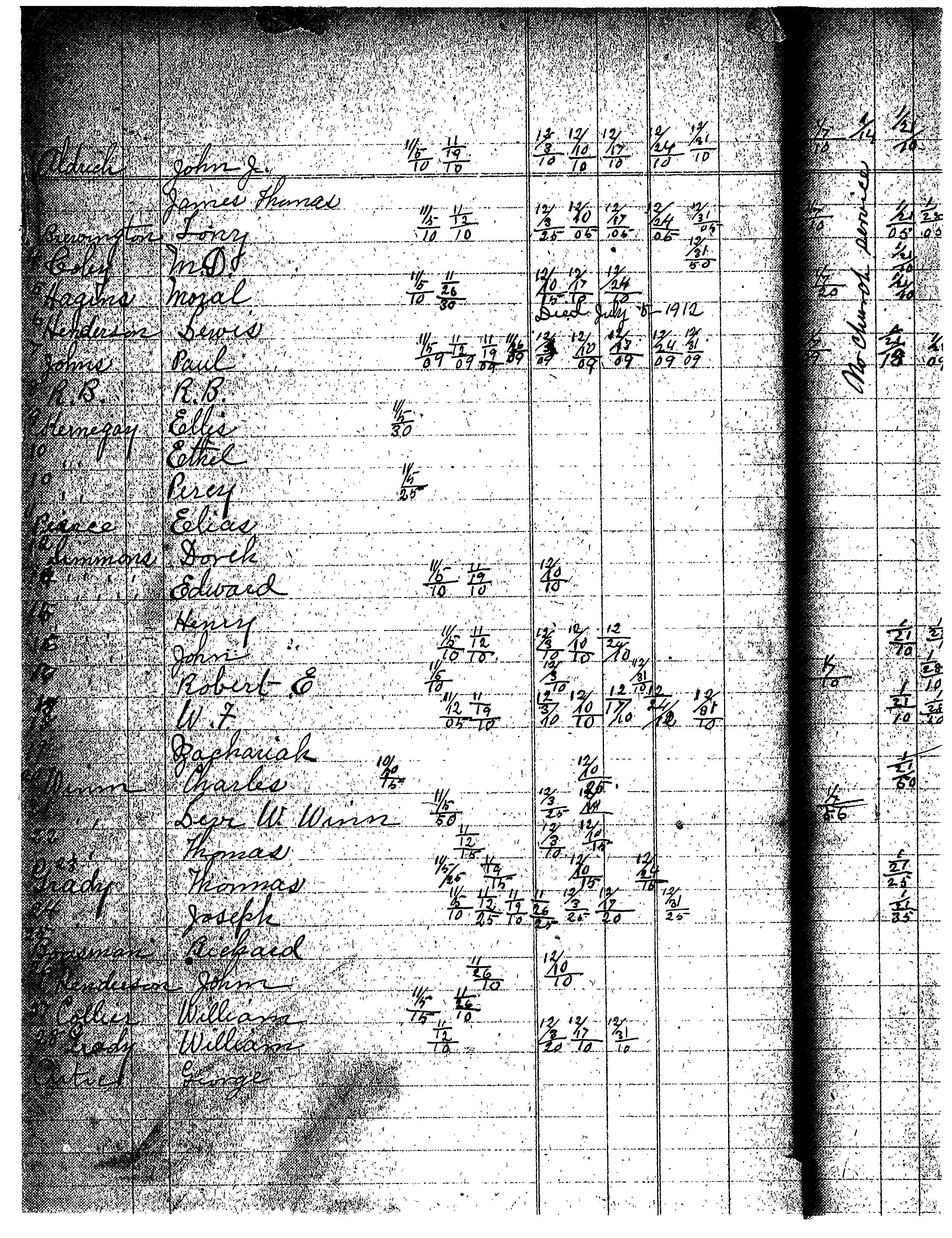
North Carolina did not keep death certificates until 1914, and Lewis’ grave is unmarked. How do we know exactly when he died? This is a page from one of the few volumes of early church records that survive for the Congregational Church of Dudley. Lewis had helped found the church in 1870, and this list shows tithes paid by male congregants. The sixth name: Henderson, Lewis. And this notation: “Died July 5 — 1912.” He would have been about 76.

Standard
Enslaved People, North Carolina, Other Documents, Paternal Kin

Kinchen Taylor’s inventory.


179360_500865558526_505368526_6215658_5475447_n

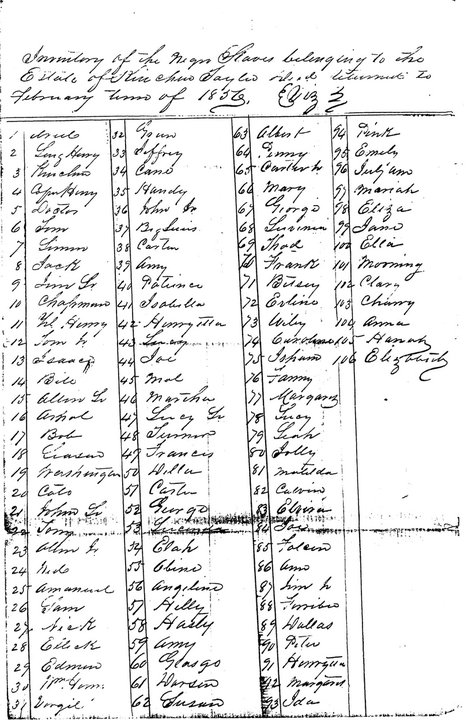
Nash County, North Carolina, 1856. An inventory of the slaves of Kinchen Taylor, deceased. Number 32 is Green. Number 88 is his wife Ferribee; and 89, 90 and 91, their oldest children. Most of Kinchen Taylor’s slaves were divided among his children, but two lots of slaves were sold. Green and Ferribee and their children were included in one of those lots, and it is not clear to whom they went, or if they went together. However, in 1870, in the first post-Emancipation census, they are listed in southern Edgecombe county as an intact family: Green Taylor, 52, his wife Phebe, 55, and children and grandchildren Dallas, 19, Christiana, 15, Mckenzie, 13, Mike, 9, and Sally Taylor, 1. Henry Michael “Mike” Taylor was my great-grandfather.

The file of Kinchen Taylor (1853), Nash County, North Carolina Estate Files 1663-1979, https://familysearch.org, original, North Carolina State Archives.

Standard
North Carolina, Oral History, Paternal Kin

Scuffalongs and muscadines.

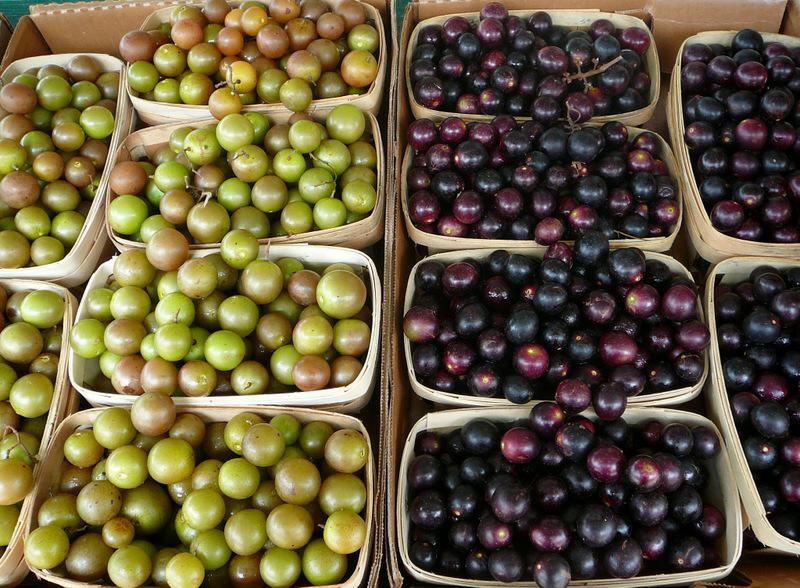
Great big old black ones.  Lord, he might as well have told me to go out there and eat all I wanted.  I eat all the way down the corn row down to that lady’s house, Mary Budd, and come up through the corn field and come back to the road and went over there stood up there and eat all I want and throwed the hulls over in the pasture.  The hog pasture, or whatever that thing was out there where pigs was.  They thought I was gon give ‘em something to eat, I reckon.  And I throwed the things over there, and I reckon that’s where Uncle Lucian discovered that we was eating ‘em.  And he said, “Y’all stay away from out there!  Somebody’s been out there —!”  “Wont me!”  [She laughs.]  Them things seem like was the best things I ever had.  And the arbor there on the yard where was all up in the trees, it’d be grapes.  And I’d go there and eat them, but they was little.  It was what they call scuffalongs.  White grapes.  And I’d eat them, too, but I wanted some of them old big ones.  Them old big black ones.

Image

I recorded interviews with my father’s mother in 1994, 1996 and 1998. Her scuppernong story was one of my favorites.

Interview of Hattie H. Ricks by Lisa Y. Henderson; all rights reserved.

 
Standard
Births Deaths Marriages, Enslaved People, Maternal Kin, Newspaper Articles, North Carolina, Virginia

The death of Walker Colvert.

Image

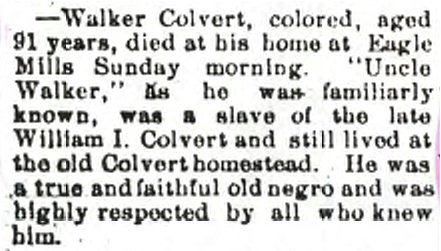
Born in Culpeper County, Virginia; bundled up with chairs and kegs and sundry and shipped to North Carolina after his first master died; reared with his future master, the William I. Colvert noted; husband to his beloved Rebecca; father of three, or maybe four (or more likely more); a middle-aged man when freedom came; a farmer who got a toehold and kept it long enough to pass it on. In the February 5, 1905, edition of the Statesville Landmark, a brief acknowledgement of the death of Walker Colvert, “a true and faithful old negro.” I feel some kind of way about the description, but I didn’t have to live in 19th century North Carolina, and I will not judge. (Him, anyway.)


Standard
Free People of Color, North Carolina, Paternal Kin, Photographs

The case for Margaret Henderson as daughter of Nancy Balkcum.

The case for Margaret Henderson as the daughter of Nancy Balkcum (and sister of Mary Eliza Balkcum Aldridge) —

1. Margaret was born 1833-1836, probably in Sampson County NC. Mary Eliza was born in 1829 in Duplin or Sampson County.

2. Her photo clearly indicates that she was mixed race, as was Mary Eliza. Mary Eliza Balkcum’s mother Nancy Balkcum was white.

3. Margaret is not listed in the 1850 census, and neither is Nancy Balkcum.

4. Nancy Balkcum’s will makes reference to a daughter Margaret Balkcum, as well as a daughter Eliza Balkcum.  The will was probated in 1854 in Sampson County, prior to Margaret Balkcum Henderson’s marriage circa 1855. Margaret Balkcum purchased a number of small items from her mother’s estate.

5. Margaret named her second son James Lucian Henderson in 1857.  Compare: James Lucien Balkcum, born 1838, son of Nancy Balkcum’s daughter Mariah Balkcum Johnston.

6. Margaret named her first daughter Isabella circa 1860.  Compare: Isabella Johnson, born 1858, daughter of Mariah Balkcum Johnson.

7. Margaret named her second daughter Ann Elizabeth circa 1866.  Compare: Ann Eliza Balkcum, born circa 1840, daughter of Nancy Balkcum’s son John Balkcum.

8. Margaret named her third daughter Mary Susan circa 1868.  Compare: Mary Susan Balkcum, born 1844 to John Balkcum, and Susan Johnson, born 1844 to Mariah Balkcum Johnson.

9. Between 1860 and 1870, Margaret and her husband Lewis Henderson and Eliza and her husband Robert Aldridge migrated to the Dudley area of southern Wayne County.  The families are listed side by side in the 1870 census.

10. Caswell C. Henderson’s November 1907 marriage license, issued in New York City, reports his mother’s name as Margaret Balkcum.

11. Matrilineal descendants of Margaret Henderson have mtDNA haplotype H3. Descendants of Mary Eliza Aldridge have mtDNA haplotype H3.

12. Certain descendants of Margaret Henderson share significant autosomal cM totals with descendants of Mary Eliza Aldridge, but have no other known lines of common descent.

Problematic points:

1. Margaret’s death certificate lists her mother as Margaret Bowkin, not Nancy.  Informant was her son Lucian Henderson.  (I have seen instances in which an informant listed his own mother’s name, instead of the decedent’s mother’s name. Is this the case here?)

2. Margaret’s son Lucian’s June 1934 death certificate lists his mother’s maiden name as Hill.

3. Margaret’s daughter Sarah’s January 1938 death certificate lists her mother’s maiden name as Carter.  Informant was Hattie Mae Henderson, Sarah’s great-niece, who told me 60 years later that she did not recall giving this information and did not believe it was correct.

4.  Perhaps most puzzlingly, there is absolutely no tradition of kinship between the two families. Hattie Mae Henderson was reared by her great-aunt (Lewis and Margaret’s daughter) Sarah Henderson Jacobs. If Sarah had been first cousin to Robert and Eliza Aldridge’s children, it seems that there would have been some acknowledgement of the relationship passed down — not only to Hattie (my grandmother), but to others descended from the free colored families in this small community. They (Simmonses, Winns, Jacobses, Hendersons, Aldridges, etc.) intermarried freely, so consanguinity would not have been shameful. The one exception: Hattie Henderson reported visiting with Sarah a “Cousin Tilithia” in Norfolk as a child. This was Tilithia Brewington King Godbolt Dabney, daughter of Robert and Eliza’s daughter Amelia Aldridge Brewington. Did Sarah call Tilithia “cousin” because they themselves were related, or because Hattie was related to Tilithia (through J. Thomas Aldridge, her father and Tilithia’s first cousin)?  A point to consider: all but one of Lewis and Margaret’s children (son Lucian, who himself had no children who lived to adulthood) had died or migrated from Dudley by about 1905. The “lack of tradition” I perceive may simply be a function of a gap in familiarity between those people who knew Lewis and Mag’s family and those I was able to interview 80-90 years later.

Image

 Photo of Margaret Henderson in collection of Lisa Y. Henderson.

Standard