Civil War, Enslaved People, Free People of Color

What’s in a name?

When James Barnes’ will was probated in 1848 in Edgecombe County, North Carolina, and its provisions carried out, ownership of Howell, an enslaved man, transferred to McKinley Darden. In the 1870 census, Howell Darden, his wife Esther, and their children appear in Black Creek township in Wilson County, North Carolina. Howell had adopted the last name of the family that had owned him most of his adult life. His choice, however, was the not only one available to freedmen. Unbeknownst to slaveowners, many enslaved people claimed surnames even during slavery, though these names were not recognized legally. Some former slaves cemented links to kin by taking the surnames their mothers or fathers used. Others adopted the name of their last master, or reached back to earlier owners, perhaps from their childhood. Still others declined to acknowledge their former bondage altogether, and took names related to a skilled trade, a physical feature, a famous figure, or some other personal idiosyncracy.

Researchers attempting to trace African-American family lines often hit a brick wall at 1870. Having identified an ancestor reported in that census, they invariably ponder the question: how can I find the parents and siblings of this newly freed person? Answering these questions requires flexibility and a willingness to consider indirect sources. Marriage and death records may reveal close familial relationships among people with different surnames. For example, Vicey Artis, a free woman of color, and her enslaved husband Solomon Williams lived separately in the area of northeastern Wayne County and southwestern Greene County, North Carolina. Vicey appears in the 1850 and 1860 censuses with several children named Artis. Vicey and Solomon recorded their cohabitation in 1866, when most of their children were adults. Examination of marriage and death records reveals that some of Vicey and Solomon’s children (who were all free-born) assumed their father’s last name after his emancipation and others (especially the older ones) retained their mothers’. While nothing immediately obvious links Jonah Williams of Wilson and Adam Artis of Nahunta, vital records and other documents establish that they were brothers.

Similarly, upon Emancipation, two of the children of Margaret McConnaughey and Edward Miller, formerly enslaved in Rowan County North Carolina, chose the surname McConnaughey and three, Miller. Margaret and her children had been owned by a McConnaughey. Death certificates, marriage records, and close examination of households in census records provide the clues that establish this family’s connections.

Researchers should also pay attention to groupings of first names.   Like whites during the era, former enslaved people often fortified the ties between generations by naming children after relatives. Thus the recurrence of certain given names among a group of families sharing the same surname could indicate kinship. For example, the fact that Benjamin Barnes’ son Calvin, born about 1836, named two sons Redmond and Andrew could indicate a sibling relationship between Benjamin, Redmond and Andrew Barnes, all born circa 1820 and listed near one another in the 1870 census of Wilson County. That the elder Redmond also had a son named Calvin further supports the possibility. In addition, when comparing documents, keeping an eye out for familiar first names may help identify freedmen who changed their surnames, perhaps rejecting one that had been chosen too hastily or that had not chosen for themselves. For example, the Isom, Guilford, Robert, Jackson, and Lewis Bynum who registered cohabitations in Wilson County in 1866 appear in the 1870 census and after as Isom, Guilford, Robert, Jackson and Lewis Ellis.

Also remember that freedmen who shared a surname and common former owner were not necessarily kin. A grouping of one hundred enslaved people may have comprised a dozen or more — many more — unrelated families. For example, Mack Coley of Wayne County, North Carolina, was the grandson of Winnie Coley and of Sallie Coley Yelverton. Several of Winnie Coley’s children were fathered by Peter Coley. Trying to understand how these Coleys — all of whom appear to have belonged to a single former master — relate to one another (or don’t) is a daunting task.

Civil war pension records are another rich source of evidence about naming choices and family ties. Consider this passage from the Confederate pension application of Jim Ellis Dew of Wilson County, North Carolina:

“It was at the time we were making ‘sorgum’ that I was sent to the war. I belonged to my master Mr. Hickman Ellis who married a Miss Dew. You know missus, the white folks are not as strong as the niggers and Mr. Jonathan Dew, brother to my missus, was not very well, and they let him draw a man to go in his place and they drew me. I was sent to Fort Fisher and went to work throwing up breastworks. … We stayed on the island for while. After a while, I came home. While I was in the war I was known as Jim Dew, but when I came back from the war I was called by my old name “Jim Ellis” because I belonged to my missus.”

Similarly, the file containing the Union Army pension application of Baalam Speight’s widow Hannah Sauls Speight reveals that Baalam had enlisted as Baalam Edwards, his owner’s surname, but later adopted his father’s surname Speight. His brother Lafayette, on the other hand, had kept Edwards as his name. A witness named Lewis Harper testified that he had a brother named Loderick Artis. (Artis, born enslaved, had taken his free father’s surname.)

Though researching enslaved ancestry is almost always difficult, creative consideration of the available evidence often yields surprising rewards. Marriage records for people born into slavery often show surnames for both parents that are different from the child being married. Cross-reference siblings, and you’ll often find a completely different set of surnames. Be careful when trying to match former enslave people to their kinfolk and their masters. Reasons for choosing names were varied and inscrutable, and people tried on different identities for a few years. Empowering for them — maddening for us!

(For a more in-depth analysis of slave naming practices and patterns, see Eugene D. Genovese’s Roll, Jordan, Roll: The World the Slaves Made and Herbert Gutman’s The Black Family in Slavery and Freedom.)
Standard
Births Deaths Marriages, Civil War, Military, North Carolina, Other Documents, Paternal Kin

I know they were married by law.

Feverish with malaria, friends and family at his side, Baalam Speight closed his eyes a final time on 21 December 1902, free of the pain that had wracked him for years. He left a widow, Hannah Sauls Speight, and nine children, but little otherwise to show for a lifetime of hard work. Hannah and youngest son, George Speight, just 13, faced uncertain times.

Baalam Speight was born about 1840 in Greene County. In the waning days of the Civil War, he and his brother Lafayette Edwards slipped away from their plantations to make their way to Morehead City, North Carolina. There, in March 1865, they enlisted in Company H, 14th United Stated States Colored Heavy Artillery. Baalam had not yet adopted his father’s surname and joined the army as “Baalam Edwards.” He and his company served garrison duty at Fort Macon until mustered out on 11 December 1865. In 1890 and again in 1892, 1895 and 1896, Baalam applied to the U.S. government for a veteran’s pension. Though he once been a “well developed, powerful built man,” he complained of “fluttering of the heart,” muscle pains, eye disease as a result of measles, rheumatism, lumbago, deafness and “misery in the head” attributable to exposure during his military service. Several doctor’s examinations concluded, however, that Baalam’s troubles were primarily attributable to old age, and his claims were rejected.

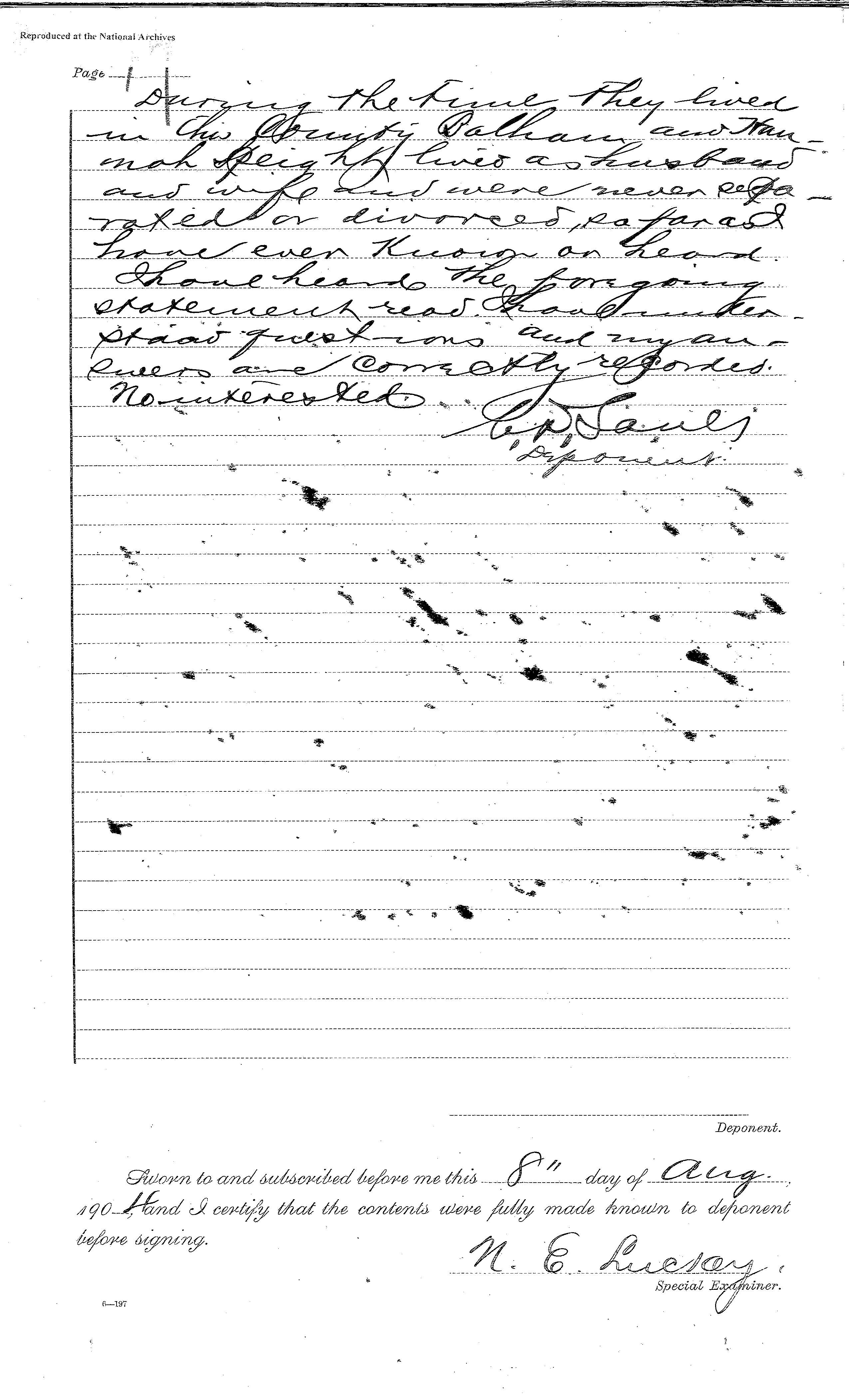
Despite Baalam’s failed attempts, Hannah Speight squared her shoulders and filed a widow’s claim in June 1903. It was assigned No. 786,944. Her burden? To prove that she and Baalam were legally married and never divorced. What might have been a straightforward task was complicated by the fact that Greene County’s courthouse had burned down with everything in it and the magistrate who had performed the ceremony was overworked and often drunk. Hannah turned to neighbors and friends to make her case, and nearly a dozen were deposed over the course of several days in August 1904. In addition to corroborating Hannah’s account of her marriage, they present a trove of personal information about the lives of Hannah and Baalam’s circle:

  • Mariah Moore – midwife; 78 years old in 1904;  lives near Kinston, Lenoir County; delivered Baalam and Hannah’s youngest son George Speight; her unnamed husband died in July 14 years ago.
  • Maria Loftin — about 62 years old, wife of Cornelius Loftin; lives near Kinston; lived on Harvey plantation at same time as Balaam Speight and recalled his marriage. “I used to patch his clothes before he was married … I was freed by Lincoln and staid on Bear Creek four years then I went to near Snow Hill on Harvey place where I met Baalam and I staid there two years.”
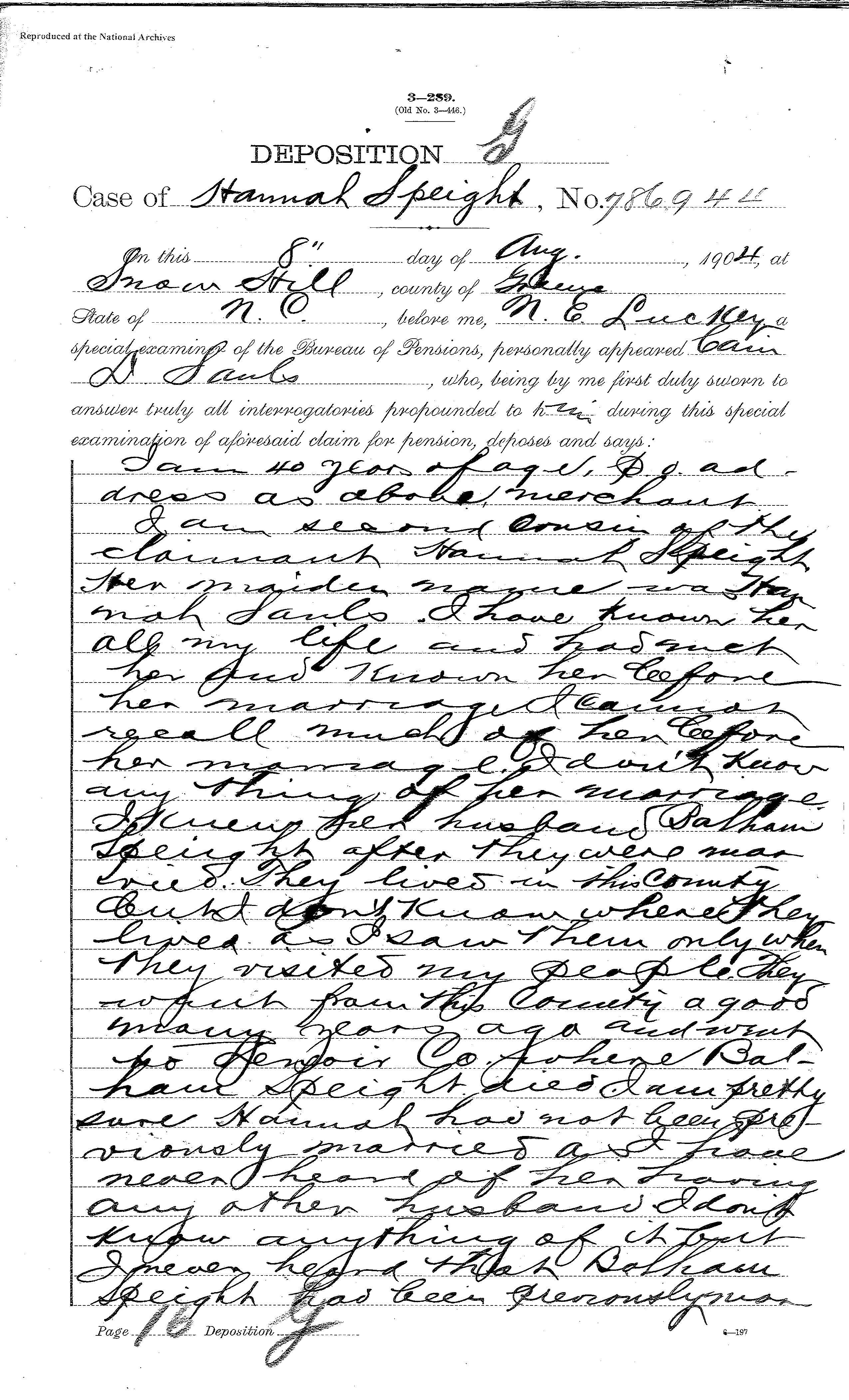
  • Cain D. Sauls – Lives in Snow Hill, Greene County NC. “I am 40 years of age … merchant. I am second cousin of the claimant Hannah Speight. Her maiden name was Hannah Sauls. I have known her all my life ….[She and Balham] lived in this county but I don’t know where they lived as I saw them only when they visited my people.” [Only witness who signed his own name. All others signed with X.]
  • Viola Edwards – Lives in Bull Head, Greene County. “I don’t know my age, am 50 or more. … Wife of LaFayette Edwards. … I lived just across the creek from [Hanna Sauls] when she married Baalam Speight. … I recollect that they were on the plantation next to the one I lived on at that time. It was the Rawls plantation …. I did not know Jennie the slave wife of Baalam Edwards ….”
  • Grace Harper – about 62 years old, wife of Lewis Harper, lives in Snow Hill. “I knew Balham Speight as a boy before he went away to go into the army. … I had known Hannah Sauls as a girl and lived in two miles of her before she married Balham Speight. … I think they had one child before they lived at Kinston … Yes Hannah had a child by Loderick Artist before her marriage to Balham Speight, but she did not marry or live with him or any other man until she married Balham. …”
  • Mary Shepard – About 70 years old, lives near Snow Hill. Widow of Marcus Shepard. “I knew [Hannah’s] aunt Becca [Best.] … They lived around here about two years after they were married and then moved away to Lenoir Co. … Baalam Speight was a brother of Fate Edwards. He was always called Baalam Speight. I think he was owned by Jim Edwards and that his father was Reddin Speight. … It seems to me that Hannah had a boy by Loderick Artist before her marriage to Baalam Speight …”
  • Lewis Harper – Lives in Snow Hill. “I am about 65 years of age … laborer…. I was born and raised in Greene County and knew Balham Speight as a boy. We lived about 3 miles apart and were right often together before he went away to go into the army. … I knew when Balham Speight was married to Hannah Sauls, it was not mighty long after the war. It may have been two or three years after. … They did not remain near Snow Hill very long until they moved to Kinston where they remained afterwards up to his death. … Hannah had a child by the man Loderick Artist a year and a half before she married Balham while she was living with her parents. … Loderick Artist was my brother and is dead.
  • LaFayette Edwards – 63 years of age, lives in Bull Head, Greene County. “I served as a corporal of Co. H, 14 U.S.C.H.A. and knew Baalam Edwards of that company; he was my brother and our father was Reddin Speight. In slave time I belonged to Ap. Edwards and he belonged to his brother Orfa Edwards. We were raised and enlisted, served and discharged together. After he came out of the army he worked in turpentine one year or so in S.C. or Georgia. … After that he came back and lived on Hill place near Kinston. But for two or three years after he came from the South he lived out near Snow Hill. He was married close to Jno. Harvey plantation to Hannah Sauls daughter of Shepard Sauls. … I know they were married by law as there was no taking up with each other in those days. … Before he married Hannah Baalam had lived with a woman named Jennie Suggs in slave time. She died while we were in the service. I did not go to the burial, but we were at Morehead City not far away when she died and heard of her death at the time.”
  • Peter Hood – 64 years old, farmer and pensioner, lives near Kinston. “I was a pvt. in Co H, 14 U.S.C.H.A. and knew Baalam Edwards. He was in my company and I was witness for him when he was trying to get pension. … He was a sort light complected spare somewhat tall man. I don’t know his height. I reckon he was about as tall as you (about 5 ft. 10 in.)”
  • Isaac Edwards alias Eddis — 67 year-old farmer. “I am not a pensioner but I served as a pvt. in Co. H, 14 U.S.C.H.A from Mch. 8, 1865 to Dec. 11, 1865. I knew a man named Baalam Edwards in my company. I had known him before we went into the army and we had both belonged to Betsy Edwards in slave time and lived not far apart. His father was Reddin Speight. He used the name of his mistress in the army and after he came out of the army he went by the name of his father Speight. … [H]e was married to a woman named Hannah Sauls. This was the first wife of Baalam Edwards except that he had a slave wife named Jennie.” “Baalam Edwards was not sick and did not get hurt in the army, except that he had mumps at Ft. Macon. He was a long slim, not very dark, dark hair and eyes. I am six feet high, he was not quite as tall as I am.”
  • Francis Williams — 70 year-old pensioner. “I was a corporal in Co. I, 14 U.S.C.H.A. and I knew Balham Speight. He was a member of my regiment.” [C.D. Sauls signed as witness.]

The testimony was satisfactory, and Hannah was granted a pension of $10/month.

A document in this pension file lists Baalam’s children as Charles, born 12 April 1870; Nancy Susan, 19 February 1872; Lizzie, 8 March 1874; Claiborn, 30 March 1876; Major, 27 September 1879; James, 8 April 1882; Franklin, 19 June 1885; Luvenia, 5 April 1887; and George Meade Speight, 26 September 1889. Census records reveal a tenth child, who was oldest. Lemon Speight’s Lenoir County death certificate lists his birthdate as 27 April 1867 — about a year-and-a-half before Baalam and Hannah married in late 1869. The certificate also names Baalam as Lemon’s father, but, as several witnesses testified, he was in fact the son of Loderick Artis.

The file reveals other tantalizing tidbits, in italics, related to my family. How were Loderick Artis and Lewis Harper brothers? On their mother’s side? Or through Loderick’s father Daniel Artis? Cain Sauls, who was Loderick’s nephew, testified that he was Hannah’s second cousin. Her parents were Rosetta Best and Sheppard Sauls. Who was Sheppard to Cain?

ARTIS -- CD Sauls Deposition_Page_1

ARTIS -- CD Sauls Deposition_Page_2

Deposition of Cain D. Sauls, 8 August 1904.

File #786944, Application of Hannah Speight for Widow’s Pension, National Archives and Records Administration. Hat tip to Trisha Blount Hewitt for pointing out the mention of Loderick Artis in Baalam Speight’s file, #988961, which is included in Hannah’s file.

Standard
Maternal Kin, North Carolina, Oral History, Photographs

Papa used to keep him just slick and pretty.

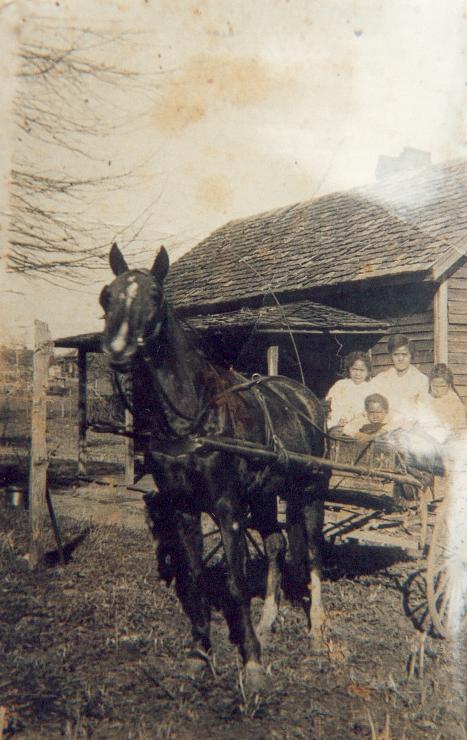
His name was Prince. And Papa sold Prince when he bought a car. But when he bought Prince, Prince had never been broken in. Nobody’d ever ridden him. And this man broke him in for Papa. But he was still high-spirited, because he was a race horse. And he had four white feet. That is what was so distinctive about him. He was chestnut. And we were so crazy about him that we would go in the – Papa had a big enclosed lot, like, that he could come out in. Other than the stable. And we would go in there with him, but he wouldn’t bother us. He would never bother us. And this old gentleman would be what was called currying. He would curry the horse and brush him and all, and he would hold me up and let me brush it. What was the man’s name? I can see him right now. He was an old man and real light. He was almost white. He had light hair, had white hair. And he loved Mama’s cooking. She used to bake something that was a pie. She called it a pie – but it was sweet potatoes. It was not mashed like you’d make up in a sweet potato pie ‘cause she would slice them and put them in the pie. Then she would make a sauce with nutmeg and lemon juice and thicken it with flour, you know. And then she would cook all of that in a big plate thing like that. And when Papa sold Prince, we went down where the man who had bought him had him, and he would look bad. His skin – you know Papa used to keep him just as slick and pretty. And that man would come to the house and wash him down with soap and water and everything and made him pretty. And he had pretty white feet. But Papa sold him to that man when he bought the car. And we went down there one day to see Prince, and he looked awful. He looked bony. He just looked awful. And we went down a little hill where he was in an enclosure. And we called him, and he came running over there where we were. We were so glad to see him. And we went home and told Papa that Prince said he wanted to come home. Yes, Lord. We wanted Prince moved.

COLVERT -- Colvert Girls & Bert

Possibly Prince (though he only has two white feet), circa 1913, with Louise Colvert, Launie Mae Colvert, Bertha Hart and Margaret Colvert.

—–

Interview with Margaret Colvert Allen by Lisa Y. Henderson; all rights reserved.

Standard
Foodways, Maternal Kin, North Carolina, Oral History, Virginia

I never ate a bite in my life.

My grandmother, Margaret Colvert Allen: Papa was a hunter.

Me: He hunted?

My aunt: Papa was?

Grandma: Yeah. He hunted.

Me: So, he had hunting dogs.

Grandma: Yes, indeed. He had a place made to put his dogs in and — hound dogs, you know. Hunting dogs.

Me: Did — he hunted deer or smaller things?

Grandma: Naw. He never hunted deer. But he hunted rabbits and squirrels and quail. [Inaudible] and he would catch ‘em [inaudible] but I didn’t ever cook one. [Laughs.] His mother used to cook possum.

Me: Used to cook possum?

Grandma: Oh, possum, honey. They would cook those dern things.

Me: Well, possum stew. I guess I have heard of that.

Grandma: Hmm?

Me: Possum stew. I guess I have heard people talk about that.

Grandma: Naw. They didn’t have no possum stew. They’d bake this thing.

Me: Awwww!

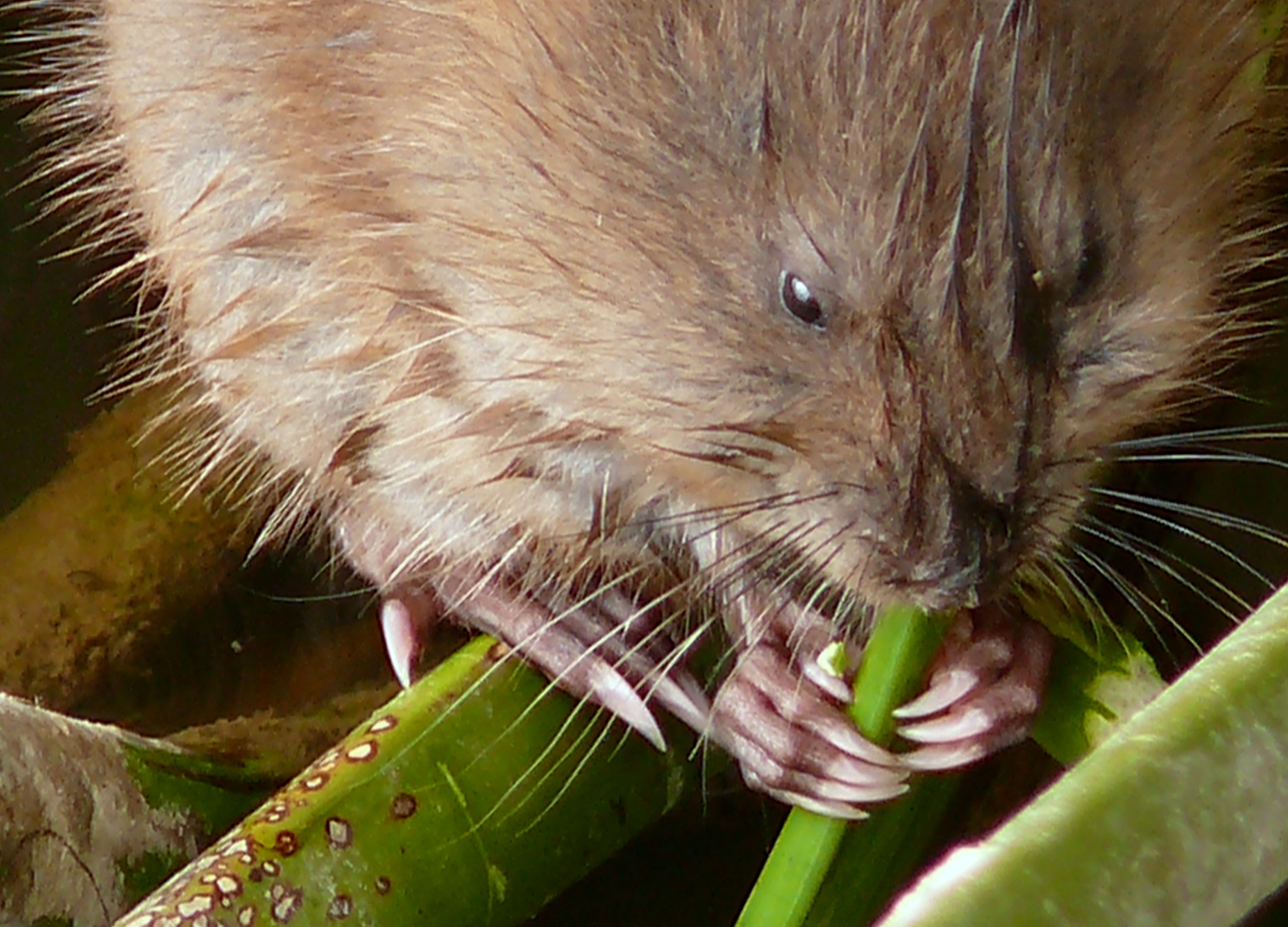
Grandma: And, look, wait a minute. You know they’ve got big mouths. Long mouths. A possum. And he’d put a sweet potato in the possum’s mouth. [I laugh, hard.] I don’t remember cooking one, but my grandmother sure used to cook ’em. And Papa cooked ’em. But I refused to cook ’em. Not me. And you know these people when I came here ate muskrats?

Me: [Laughing.] In Newport News?

Grandma: John’s people ate muskrats. And you know the merchants would have ‘em hung up all on the outside the street, you know, like you used to have chicken cages where you could go and pick ….? Well, they would have these muskrats killed, and they were real bloody, and they would be hanging, and they’d just be killed. I mean, it wasn’t nothing wrong with ‘em if you liked that kind of thing. I cooked it for your daddy, but I declare before God I have never eaten a bite. [I laugh.] Not a bite.

My aunt: When I went to Africa, and we would take our day trips, they would have some kind of animal that they had split open –

Me: Butterflied. [Laughing.]

My aunt: And a rodent. Some kind of rodent. And I ain’t eating that. They had some kind of little rodent. And they had, like, barbecued it or something. And his head was still on.

Grandma: What you mean – little or big?

My aunt: Ma’am?

Grandma: How big would it be? ‘Bout the size of a squirrel or something like that?

My aunt: I don’t think it was a squirrel.

Grandma: Aw. Well, I don’t know what they were then. But, honey, these merchants on Jefferson Avenue used to have those muskrats hanging out there, honey, and you talking ‘bout bloody, and they would have skinned them, you know. And they were hanging like that. Ah. And bloodied. Ooooo. They would be so bloody. I fixed one and cooked it, but seriously, my hand to God, I never ate a bite in my life. I never intended to eat a bite. And my daddy didn’t like ‘em either. So my grandmother used to always bring him something down, she’d come down sometimes Sunday afternoon or Saturday night.

My aunt: Grandma Allen?

Grandma: No, no, no, no, no. My daddy.

Me: Harriet.

Grandma: She would always bring him something. Always bring him something. And this day she was supposed to have brought him some rabbit. Fried rabbit, you know. And I never shall forget. He sat over there by the window. Now, he’d had his dinner. He’d had Mama’s dinner, but when Grandma came and brought something he had to have some of that. He sat over there, and he ate, ate that piece of what he thought was rabbit, and he got down to the bone, and he knew it wasn’t rabbit. Because he didn’t – and he said, “Mama, what is this?” And she was crying laughing at him eating muskrat when he swore he’d never eat a bite. And she, I can see her right now. She was sitting over there, and, child, she was laughing. Laughing ‘til she cried. And Papa said, “You better be glad you’re my mama, ‘cause I certainly would whip you today if you weren’t my mama.” He was so mad.

Muskrat_eating_plant

—–

Interview of Margaret C. Allen by Lisa Y. Henderson; all rights reserved. Photo courtesy of Wikipedia.


Standard
Vocation

Where we worked: department stores.

Lundy Brewington, Norfolk VA – elevator conductor, circa 1910.

R. Henry McNeely, Statesville NC – porter, Polk-Gray Drug Company, 1920s.

William McNeely, New York NY – elevator operator, circa 1930.

Jimmie Reaves, Greenville NC – deliveryman for department store, circa 1930; department store maintenance man, circa 1940.

Bertha Reaves, Greenville NC – department store “elevator girl,” circa 1940.

Bessie Henderson Smith, Wilson NC – “elevator girl,” circa 1940.

The thirteenth in an occasional series exploring the ways in which my kinfolk made their livings in the 19th and early 20th centuries.

Standard
Education, Newspaper Articles, North Carolina, Paternal Kin

School districts. (Colored.)


Gboro Messenger 11 19 1885 school commr

Goldsboro Messenger, 19 November 1885.

Phillip R. Coley, son of Winnie Coley, was the half-brother of Napoleon Hagans‘ son William M. Coley and Adam T. Artis‘ children Cain Artis and Caroline Coley Artis. Richard Artis was Adam T. Artis’ brother, and Simon Exum was his brother-in-law, husband of Delilah Williams Exum. Peter Coley may have been Phillip Coley’s father.


Standard