Births Deaths Marriages, Maternal Kin, North Carolina, Other Documents

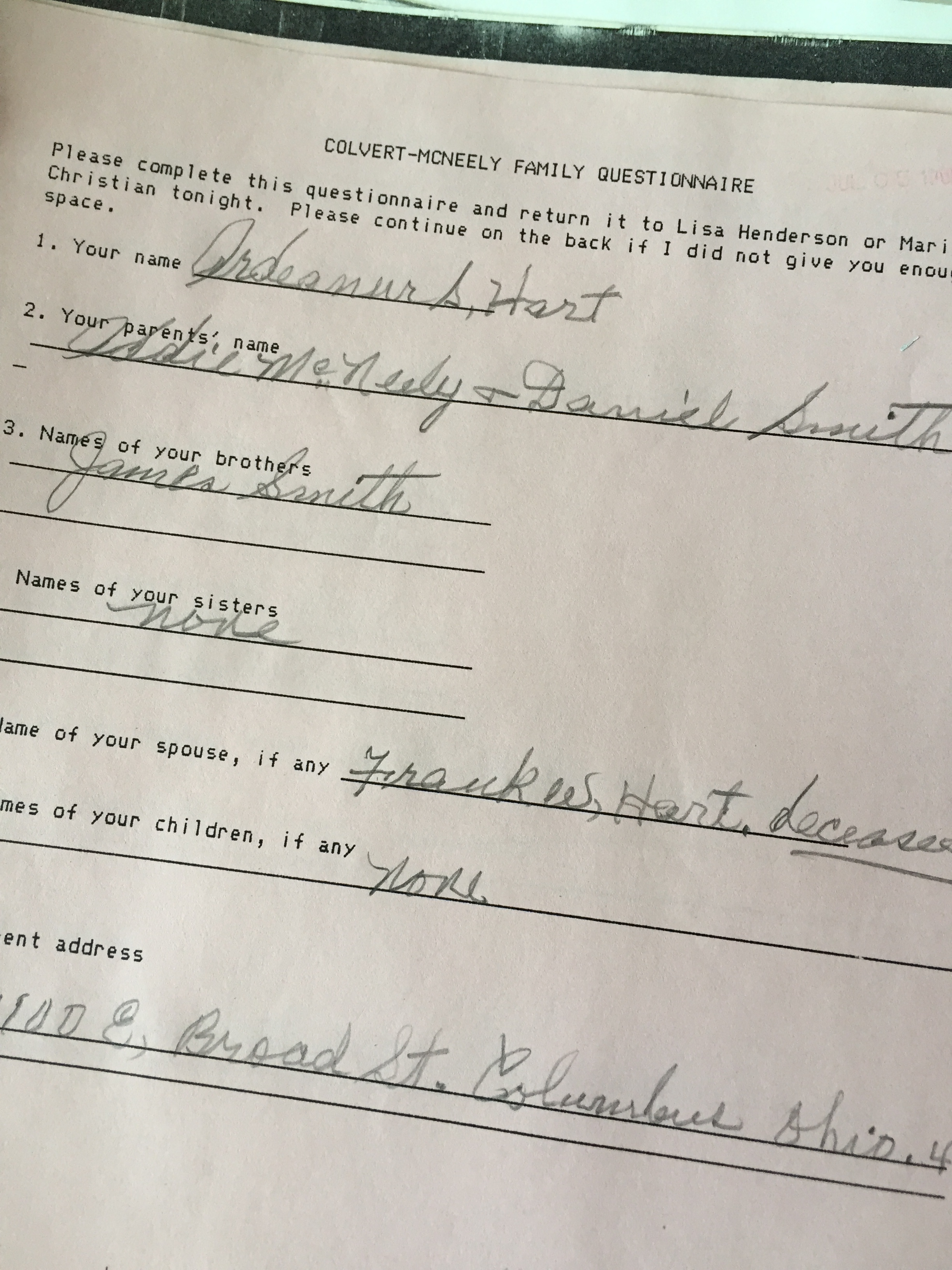
Name of your spouse, if any.

The new tenant wants access to the shed, so I trudged over to clean it out this morning. On the floor, behind a bicycle and some galvanized pails, I found two dusty three-ring binders. The papers in them were beginning to yellow and were foxing on the outer leaves, but basically in good shape. One contained notes and articles related to my graduate thesis — fodder for http://www.ncfpc.net — and the other contained copies of some of my earliest genealogical research, stuff I’d long thought lost.

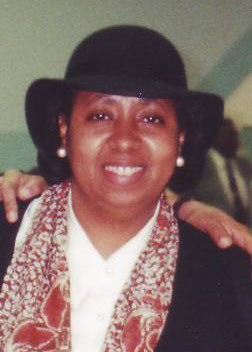
Among other things, there was a stack of the questionnaires distributed at the 1986 Colvert-McNeely family reunion in Statesville. That was the reunion at which I snapped this photo of Cousin Ardeanur S. Hart. Had she …?

Ha! Yes, she had:

IMG_5141 copy

And just like that, her husband’s name — Frank W. Hart.

Standard
Education, Newspaper Articles, North Carolina, Paternal Kin, Vocation

Bright lady teacher.

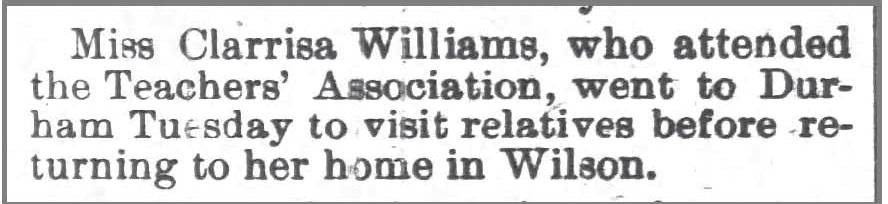
For the better part of a year, the doings of Jonah Williams‘ daughter Clarissa regularly made the society columns of the African-American Raleigh Gazette:

Ral_Gazette_1_30_1897_C_Wms

Raleigh Gazette, 30 January 1897.

Raleigh_Gazette_6_19_1897_C_Wms_teacher

Raleigh Gazette, 19 June 1897.

Raleigh_Gazette_6_26_1897_C_Wms

Raleigh Gazette, 26 June 1897.

Ral_Gazette_9_18_1897_C_Wms_bright_lady_teacher

Raleigh Gazette, 18 September 1897.

And then the paper folded.

More than 20 years passed before Clarissa next appeared in print. The “bright lady teacher” had fulfilled her promise and was elected principal of the Colored Graded School. Her tenure was not long, however. Clarissa Williams died of kidney disease on 26 October 1922, at the age of 51.

Wilson_Daily_Times_9_24_1918_C_Wms_Princ

Wilson Daily Times, 24 September 1918.


Standard
Births Deaths Marriages, Maternal Kin, Migration, North Carolina

Soprano.

Speaking of Ardeanur … Here’s what I know about her.

Ardeanur R. Smith was born 8 February 1903 in Statesville, North Carolina, to Daniel and Addie Lucinda McNeely Smith. Her brother James Garfield Smith was born four years later. I have not found the family in the 1910 federal population schedule, and the family had fallen apart before the census taker next came round. As revealed in the estate file of Ardeanur’s great-uncle Julius McNeely, Addie McNeely Smith died in early 1917. Her mother’s family, and in particular, her younger sister Minnie B. McNeely, took responsibility for the children.

McNEELY -- Bert_Minnie_Ardeanur 001

A Murphy, Bertha Hart, Alonzo Lord, Minnie McNeely, Ardeanur Smith, Statesville, mid-1920s.

But not for long. By 1920, Ardeanur had struck out on her own. She appears as “Ardenia” Smith in the 1920 census in Salisbury, 25 miles west of Statesville in Rowan County, her mother’s birthplace. At 17, she is the youngest of eight young African-Americans, men and women, occupying a boarding house at 319 South Lee Street. She reported no occupation, though it seems likely that she was engaged in domestic work. How long she remained in Salisbury is not clear, and on 13 February 1923, she stood as a witness at the marriage of her aunt Janie Caroline McNeely, 24, to James Martin Taylor, 21, by Reverend Zander A. Dockery, a Presbyterian minister. (The other witness was Archie Weaver, husband of Elethea McNeely.)

Whether in Salisbury or Statesville, Ardeanur did not have much longer for small town North Carolina. Sometime mid-decade, she joined the tide of black Southerners flowing North, setting her bags ashore in Bayonne, New Jersey. Though many McNeelys would follow, at that time only her aunt Emma McNeely Houser was there, and it is likely that Ardeanur lived initially with her family. She joined the Housers’ church, Wallace Temple A.M.E. Zion, and began to develop her gifts. By June 1928, she was taking elocution lessons in New York City and in 1929 sang in a program in honor of United States Congressman Oscar DePriest.

Even as she dreamed, though, Ardeanur had to make a living. In 1928, she lived at 115 Davis Avenue in the West New Brighton neighborhood of Staten Island, just across the Kill Van Kull from Bayonne. She undoubtedly worked as a live-in servant to William G. Willcox, a Tuskegee Institute board member whose wife Mary Gay Willcox was descended from a prominent abolitionist family. (In fact, the Gay house at 115 Davis is believed to have been an important station on the Underground Railroad.) By 1930, when the census taker came around, Ardeanur Smith, 25, shared a $50/month  apartment with Mary Snowden at at 2014 Seventh Avenue (now Adam Clayton Powell Boulevard) in Harlem. Both worked as housemaids for private families, and both were reported as South Carolina-born. Ardeanur seems still to have been living in New York three years later when she, her aunt Minnie and first cousin Charles McNeely accompanied the body of Charles’ brother Irving McNeely Weaver to Iredell County for burial.

I’m not sure where Ardeanur was in 1940. Her name does not appear in enumerations of New Jersey or New York. Ninety miles south, however, a census taker in Philadelphia, Pennsylvania, recorded North Carolina-born “Ardinia” Smith, age 40, living in a boarding house at 1710 West Fontain (just west of Temple University) and performing domestic work. Was this Ardeanur?

Sometime, probably in the early 1940s, Ardeanur Smith married. I have not found a marriage license for her, and no one I know knows her husband’s full name, much less where he was from. He was a Hart, a common name in Iredell County, but a common enough name everywhere that he is not necessarily someone she knew from “home.”** I only know for certain that the wedding took place before 2 October 1947, when the Bayonne Times printed an obituary for John McNeely that listed niece Ardeanur Hart among his survivors. (Three years later, when the Times ran the obit of Edward McNeely, another uncle, she was Ardeanur S. Hart.)

When James G. Smith died in 1960 in High Point, North Carolina, Ardeanur, living in Jersey City, New Jersey, provided personal information for his death certificate. We get another glimpse of her in May 1961, when a brief entry in the church calendar feature of the Jersey Journal noted a recital at Lafayette Presbyterian Church, Summit Avenue and Ivy Place in Jersey City, featuring Mrs. Ardeanur Hart, soprano, and Mrs. James Spaights, pianist.

I have no record of any job Ardeanur held other than domestic, though such her style and bearing do not square with my naive (and classist) vision of what service workers look like. In the 1970s or so, she moved out to Columbus, Ohio, to live with and look after the last of her aunts, Minnie McNeely Hargrove.

IMG_5133 copy

Cousin Ardeanur, Newport News, Virginia, July 1986.  She was 83 at the time. (I cannot begin to tell you why I used to cut out photos before mounting them in those terrible adhesive photo albums.)

Ardeanur Smith Hart died 14 January 1996 in Columbus.

**30 August 2015: Mystery no more: Ardeanur married Frank Wellington Hart of Jamaica.

Standard
Births Deaths Marriages, North Carolina, Paternal Kin

Lewis Henderson’s Simmons branch.

Of all Lewis and Mag Henderson‘s children, descendants of only Ann Elizabeth and Loudie walk this earth.  Loudie had just two children in her brief life, Jack and Bessie, but their collective offspring number in the hundreds. Ann Elizabeth did not live long either, but her children Daniel and Dollie ensured her legacy. I have talked about Loudie’s children here and introduced a purported photograph of Ann Elizabeth here. Now, more about Ann Elizabeth’s life.

Ann Elizabeth Henderson was born about 1862, probably in northern Sampson County. Her sister Isabella J. died early, leaving Ann Elizabeth the oldest girl in her family. The 1870 census of Brogden, Wayne County, North Carolina, shows Lewis Henderson, farmer, with wife Margarett and children James L. [known by his middle name, Lucian], Ann E., Caswell, and Mary S. [called “Sudie.”] On 21 January 1879, William Freeman applied at the Wayne County courthouse for a marriage license for Hilery Simmons, of Wayne County, age 24, colored, son of George Simmons and Axy Jane Simmons, both living, and Ann E. Henderson, of Wayne County, age 17, colored, daughter of Louis Henderson and Margret Henderson, both living.  Hillary’s brother, R[iley] H. Simmons, a Methodist minister of the AME Zion Church, married the couple on two days later at Ann’s father Lewis’ home in Dudley.  Hillary’s father G.W. Simmons (or maybe his brother General W. Simmons,) Hatch Brooks, and Ann’s brother Lucian Henderson officially witnessed the ceremony.

In the 1880 census of Brogden township, Wayne County, 28 year-old tenant farmer Hillory Simmons, his 17 year-old wife Ann Elizabeth, and 7 month-old daughter Abraskry shared a housheold with Ann’s sister nine year-old Sarah Henderson and 22 year-old brother Lucian Henderson. [“Abraskry”?!? Should that have been “Nebraska”? Was she named for a new state much in the news during the previous decade’s battles with Cheyenne, Pawnee, Sioux and other Natives?] The bulk of Ann Elizabeth Henderson Simmons’ life played in the two decades bracketed by the 1880 and 1900 censuses. We can assume that she was enumerated in 1890 with her husband and young children, but that record does not survive.

More intriguingly, the entire family is missing from the 1900 census, most likely the result of oversight but doubly unfortunate because she died around that time. In between, there are just a few glimpses of Ann Elizabeth in membership rolls of the Congregational Church of Dudley and in the deeds by which she and Hillary repeatedly mortgaged their 28-acre farm. In 1900 — 1901, at the latest — Ann Elizabeth Simmons died. She is surely buried in Congregational Church cemetery, perhaps next to her husband’s grave, or maybe with the Hendersons. Wherever she is, her grave is unmarked. Only children Minnie, Daniel and Annie C. “Dollie” survived her. In June 1902, Celestial Manuel Kemp, herself newly widowed, stepped into Ann Elizabeth’s shoes. Her first child with Hillary was born in 1904, the same year that H.B. Simmons applied for a marriage license for Jesse Budd of Wayne County, age 20, colored, son of John and Lou Budd, and Minnie Simmons of Wayne County, 17, colored, daughter of H.B. Simmons and Annie Simmons (he living, she dead).  Rev. W.H. Mapp, a Pentecostal Holiness minister from Norfolk, Virginia, performed the ceremony on 27 May at H.B. Simmons’ residence in the presence of Edie Hunter,  Cora Budd, and Sarah Jacobs, all of Wayne County.  Sarah Henderson Jacobs, Minnie Simmons’ aunt, was the little girl who lived with Ann Elizabeth and Hillary just after they married, as recorded in the 1880 census.

Minnie and Jesse Budd’s first child, Jesse Manuel Budd Jr., was born 27 February 1905. Shortly after, the family moved to Philadelphia, where William Edward Budd was born in October 1906. Eddie died at home at 1652 North Darien Street at the age of nine months.  Jesse Jr. died in Goldsboro of complications from an appendectomy in August 1916. Her own children lost, Minnie sought to adopt my grandmother Hattie Mae, her first cousin’s child, who was being reared by Sarah Henderson Jacobs. Sarah, however, would not separate Hattie from her sister Mamie.
Minnie Budd 001

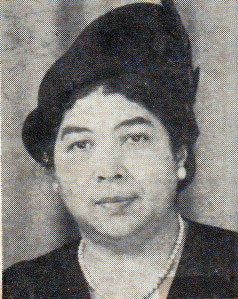
Minnie Simmons Budd, perhaps the 1940s.

In 1910, the censustaker found Hilory Simmons, wife Zalista, and children Daniel, Dollie, John, Susan A., Charles and Kajy living in Brogden township. The family remained in the Dudley area, and Hillary B. Simmons died 25 October 1941. On 24 Dec 1912, Hillery Simmons applied for a marriage license for Yancy Musgrave of Wayne County, age 21, colored, son of Alford and Pollie Musgrave, both living, and Annie C. Simmons, 17, colored, daughter of Hillery and Annie E. Simmons (he living, she dead).  Riley Simmons (now described as a Freewill Baptist minister) performed the ceremony the same day at Annie Simmons’ home in Dudley in the presence of Minnie Simmons of Dudley, Dave Budd of Mount Olive, and Liddie Winn of Dudley. Dollie’s children were Yancy Oliver (1913), Alfred Rudolph (1916), Bruce M. (1917), Marie Estelle (1920), Muriel (1922), Rossie Lee (1923), Ruth (1924), and Ralph Mordecai Musgrave (1926). Four months after Dollie’s marriage, on 10 April 1913, Daniel Simmons married Annie Irene Hogans, daughter of James and Annie Watson Hogans, in Goldsboro.

Daniel Simmons Annie I Hogans Wedding

The couple’s first two children, James Daniel (1914) and Hettie Louise (1915), died in infancy. The family then moved briefly to Rocky Mount, North Carolina, where daughter Harriet Latta Simmons (1916-1970) was born. Daniel and Annie Irene Simmons moved to Richmond, where a second James Daniel (1919-2001), Anna Bell (1921-2000) and twins Mary (1924-2004) and Martha (1924-2012) were born;  then to Philadelphia, where Hillary Bunn II (1926-2010), Stanley Armstead (1928-2000), and Matthew Dallas (1930-2009) were born; and finally Brooklyn, where twins Clement and Clifton (1931) died within a day of their birth. Annie Irene H. Simmons died soon after.
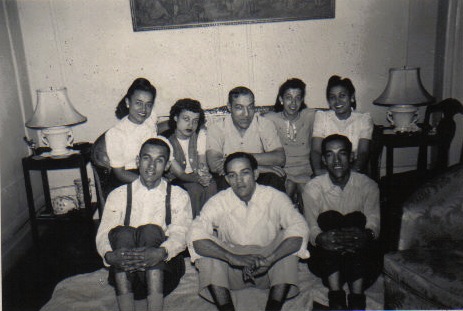
Annabelle Mary Daniel Martha Harriet Stanley Dallas Hillary Simmons

Top: Anna Bell, Mary, Daniel, Martha and Harriet. Bottom: Stanley, Dallas and Hillary.

Dollie Simmons Musgrave died in Norfolk, Virginia, in the early 1930s. Minnie Simmons Budd died in Philadelphia on 8 June 1961, and Daniel Simmons died in Farmingdale, New York, on 8 October 1964. Daniel Simmons in Dudley
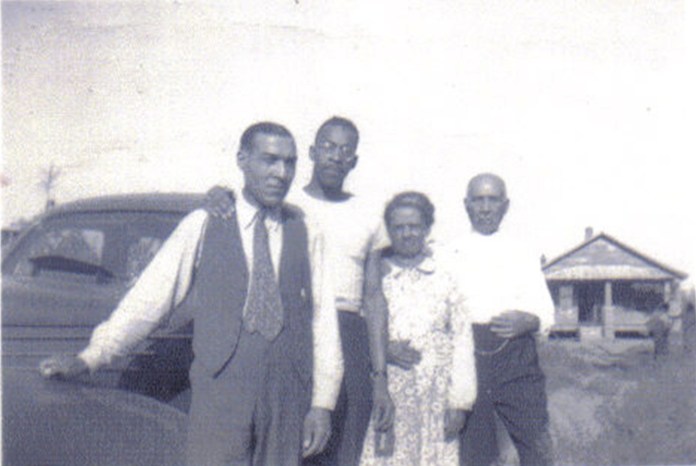
 Daniel Simmons at left, an unidentified man, and possibly his stepmother Celestial and father Hillary B. Simmons, perhaps late 1930s, Dudley, North Carolina.

Photo of Minnie S. Budd in collection of Lisa Y. Henderson; photos of Daniel Simmons and family courtesy of D. G. Campbell.

Standard
Free People of Color, Newspaper Articles, North Carolina, Paternal Kin, Politics, Rights

Enlighten me; or how to obtain just dues.

In 1899, North Carolina passed a constitutional amendment that created new literacy and property restrictions on voting, but exempted those whose ancestors had the right to vote before the Civil War. The intent and impact of the amendment was to prevent generally poor and often illiterate African-Americans from voting, without disfranchising poor and illiterate whites:

Public Laws of North Carolina, 1899, chapter 218.

(Sec. 4.) Every person presenting himself for registration shall be able to read and write any section of the constitution in the English language and before he shall be entitled to vote he shall have paid on or before the first day of March of the year in which he proposes to vote his poll tax as prescribed by law for the previous year. Poll taxes shall be a lien only on assessed property and no process shall issue to enforce the collection of the same except against assessed property.

(Sec. 5.) No male person who was on January one, eighteen hundred and sixty-seven, or at any time prior thereto entitled to vote under the laws of any states in the United States wherein he then resided, and no lineal descendant of any such person, shall be denied the right to register and vote at any election in this state by reason of his failure to possess the educational qualification prescribed in section four of this article….

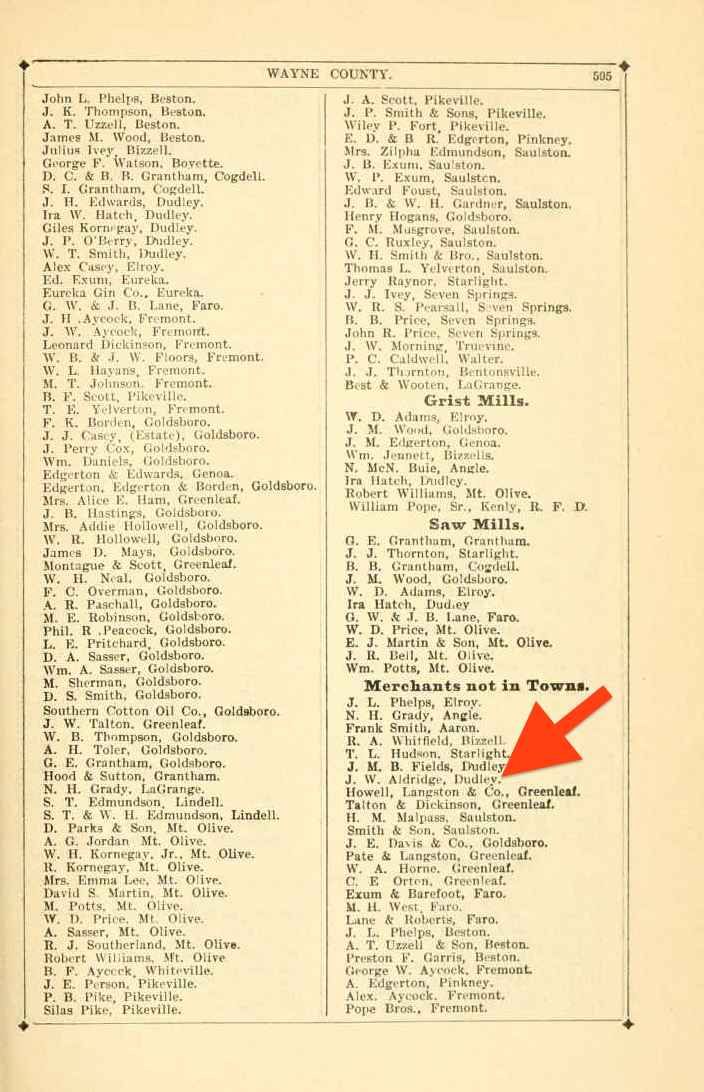
In 1902 — 112 years ago today — my great-great-grandfather John W. Aldridge, a steadfast if low-key supporter of local Republican politics, took pen in hand for a tight-jawed letter to the editor of a newspaper in the state capital:

Morning_Post_Raleigh_10_15_1902_JW_Aldridge_Voting_Rights

Raleigh Morning Post, 15 October 1902.

——

The following “colored” men were among those who registered to vote in Wayne County in 1902.  In accordance with Section 5, each was required to name the ancestor who “grandfathered” him in. Despite his very public protest, and his brothers’ successful registrations, John W. Aldridge’s name does not appear:

Joseph Aldridge, 36, Brogden, Robert Aldridge.

M.W. Aldridge, 45, Goldsboro, Robert Aldridge.

Robert Aldridge, 33, Brogden, Robert Aldridge.

Marshall Carter, 42, Brogden, Mike Carter. [Marshall Carter’s son Milford married John W. Aldridge’s daughter, Beulah.]

Williby Carter, 22, Brogden, Mike Carter. [Williby was Beulah Aldridge Carter‘s brother-in-law.]

H.E. Hagans, 34, Goldsboro, Napoleon Hagans. [Napoleon and Henry Hagans were the half-brother and nephew, respectively, of Frances Seaberry Artis, wife of Adam T. Artis.]

W.S. Hagans, 31, Nahunta, Dr. Ward. [William was another son of Napoleon. “Dr. Ward” was his white grandfather.]

John H. Jacob, 52, Brogden, Jesse Jacob.  [Jesse and John Jacobs were the father and brother of Jesse A. Jacobs Jr., who married Sarah Henderson.]

Wiley Mozingo, 76, Goldsboro, Christopher Mozingo. [Wiley Mozingo’s daughter Patience Mozingo married Noah Artis, son of Adam T. Artis. His granddaughter Ora B. Mozingo married John W. Aldridge’s son, John J. Aldridge.]


Standard
Other Documents

One lovely blog? Why, thank you!

In recent days, I’ve been twice nominated for a One Lovely Blog Award. Many thanks to Maryann Barnes and Tiffiny for their thoughtfulness and kind words. It’s always nice to know that one is not only heard, but appreciated.

The “rules” for the award:

  • Thank the person who nominated you and link to that blog.
  • Share seven things about yourself.
  • Nominate 15 bloggers you admire (or as many as you can think of!)
  • Contact your bloggers to let them know that you’ve tagged them for the One Lovely Blog Award.

Seven things:

  • I was born in a segregated hospital in Wilson, North Carolina.
  • I drew my first family tree in a fifth grade school project.
  • In a chance conversation in the spring of 1985, I learned that census records were on microfilm at my university library. I knew my great-grandmother’s name; I looked for it. When I found her living with her grandparents in 1910, I nearly passed out. I’ve been researching ever since.
  • My master’s thesis examined the involuntary apprenticeship of free children of color in Wayne County, North Carolina.
  • I descend from members of nearly every strata of antebellum North Carolina society – enslaved people, free people of color, Native Americans, white yeomanry, the white planter class. (I blog about free people of color at http://www.ncfpc.net.)
  • Since at least the Revolutionary War, all my ancestors have been born in either North Carolina or Virginia.
  • I have a Sankofa tattoo.

Blogs I admire (at the moment — the list changes):

Standard
Births Deaths Marriages, Free People of Color, North Carolina, Other Documents, Paternal Kin, Religion

He was faithful in all his houses.

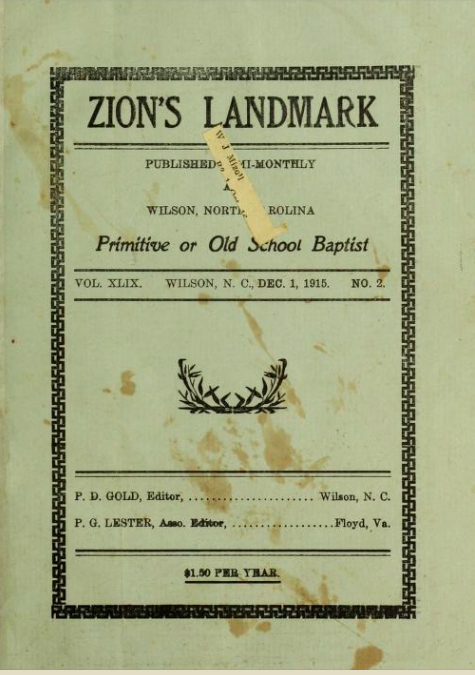
The Wilson Daily Times was an afternoon paper in my day. It was lying in the driveway when I arrived home from school, and I could read it first if I put it back like it was — pages squared and neatly folded. (Even today, I shudder at a sloppy newspaper, flipped inside out and pages sprawling.) The Daily Times‘ roots are in Zion’s Landmark, a semi-monthly newsletter begun in 1867 by Pleasant Daniel Gold. Elder Gold (1833-1920), pastor of Wilson Primitive Baptist Church, filled the periodical with sermons and homilies, ads for homeopathic remedies, testimonials, altar calls and, most enduringly, obituaries of Primitive Baptists throughout eastern North Carolina.

African-Americans did not often make it into the pages of the Landmark, but P.D. Gold held Jonah Williams in considerable esteem. Gold preached my great-great-great-great-uncle’s funeral and published in the Landmark a lengthy obituary by Brother Henry S. Reid, clerk at Turner Swamp Primitive Baptist Church:

Screen Shot 2014-10-12 at 10.41.54 PM

Screen Shot 2014-10-12 at 10.37.49 PM

Screen Shot 2014-10-13 at 7.34.42 AM

And what does this piece add to what I already know about Jonah Williams?

  • A marriage date for him and Pleasant Battle — 4 January 1867.
  • Some confusion about their children. I knew Pleasant had a slew of children from a previous marriage to Blount Battle. However, I had four children for Jonah and Pleasant — Clarissa (the surviving daughter referred to in the obit), Willie F. (1872-1895), Vicey (1874-1890), and J.W., whom I know only from a stone in the Williams’ cemetery plot. I’m thinking now that this is a foot marker, rather than a headstone, and I’ll revise my notes.
  • Jonah joined Aycock Primitive Baptist Church, part of the Black Creek Association, around 1875.
  • Around 1895, he and others were permitted to leave Aycock and form Turner Swamp Primitive Baptist Church, the first “organized colored” P.B. church in the area. The Black Creek Association ordained Jonah when he was called to serve at Turner Swamp.
  • Elder P.D. Gold preached Jonah Williams’ funeral.

Text found at https://archive.org/details/zionslandmarkse4919unse_0

Standard
Maternal Kin, Migration, North Carolina

William B. McNeely.

John Wilson McNeely‘s elder brother, William Bell McNeely, was born about 1804 in Rowan County. Their father was Samuel McNeely; their mother, Nancy Van Pool. The first known record of William’s life is John Van Pool‘s will, dated 13 October 1825 and probated in Rowan County at August term, 1827.  The document named John’s sons David, Jacob, and John Van Pool; his daughters Nancy [McNeely], Margaret [McNeely] and Maria Van Pool; son-in-law Samuel McNeely; grandson Elihu N. Pool; and granddaughters Eliza Pool and Margaret T. Pool. Samuel McNeely was named executor, and witnesses were John McNeely Sr. and Jr. and William B. McNeely. (“Senior” and “junior” did not necessarily mean father and son in that era. Rather, as “II” can today, a “junior” could simply be a younger relative with the same name. Margaret Van Pool married Samuel McNeely’s brother John McNeely, who was named after his father. However, John McNeely the elder died in 1801, so could not have been the Sr. here. If Samuel’s brother John himself had a son John, he would have been rather young to have been a legal witness in 1825. Long story short, I don’t know which John McNeely in the will is Margaret’s husband, or who the other one is. William B., of course, was Samuel’s son and may simply have been close at hand.)

Five years later, on 1 Aug 1832, William B. McNeely married Elizabeth McNeely in Rowan County. Undoubtedly cousins, their exact relationship is not known. Within just a few years, the family would leave North Carolina forever, headed west to Missouri to claim a land grant.

On 24 Jan 1837, William Bell McNeely of Cape Girardeau, Missouri, deposited a certificate with the registrar of the Jackson, Missouri, land grant office.  He registered a parcel described as the southwest quarter of the southeast quarter of section 25 in township 33, north, of Range 12, east and measuring 40 acres.

RHUSA2007B_MO0620-00086 copy

On 17 September, 1839, William B. McNeely married Elizabeth McPherson in Cape Girardeau County. William’s son Samuel was then about 4 years old, and it does not appear that William and his second wife had any children together.

On 10 Dec 1841, William McNeely made his final payment on the purchase of the parcel, which was located in Perry County, and took title. He had not finished moving though. In 1850, the censustaker of Saint Francois County, Missouri, counted among that county’s residents farmer William McNealy, 46, wife Elizabeth, 46, and Samuel E., 15. William claimed real estate valued at $300. Ten years later, after the formation of a new county, the family is listed in the Middlebrook postal district of Iron County: North Carolina-born farmer William B. McNeely, 56, wife Elizabeth, 56, and 7 year-old Catherine Green.  William claimed $2000 in real estate and $500 personal property.  Next door, son Samuel E. McNeely, 26, and his young family —  wife Emily, 20, and daughter Elizabeth, 5 mos. — appear.  Samuel reported $50 personal property.

William was too old to serve during the Civil War, and I have found no record that Samuel did either. William did, however, sign a loyalty oath in 1864.

In the 1870 census of Ironton, Iron County, Missouri, in Township 32, Range 3 East: Wm. B. McNeely, 66, farmer, appears with wife Elizabeth.  William claimed $2500 real estate; $200, personal property.

Meanwhile, back in North Carolina, William’s brother John W. McNeely edged toward death. John’s demise in mid-summer of 1871 makes clear the totality of William’s break with his home state. John’s administrator, Joshua Miller, initially named his heirs as his widow, “Acenith McNeely a sister reported to be in Missouri and a Brother name not known and residence not known.” A little information trickled in, and Miller’s next report  identified “Wm. B. McNeely, age 65, residing in Missouri Post Office unknown.” Though William had been in Iron County at least twenty years by then, Miller never found him (or Acenith), and the estate was settled without him.

Sometime between 1870 and 1880, William was again widowed. He appears in the census of Liberty, Iron County, in the household of his son, farmer S. McNeely, 45, with wife E., and children Ellen, Thomas, Owen, Margarett, Nancy, Charles, and George D. Samuel’s daughter Elizabeth — El. Huff — and her children William, 2, and Sam, 6 months, also lived in the house.

By 1900, Samuel McNeely was an elderly hired man living and working in Shoal Creek, Bond County, Illinois, some 125 miles northeast of Iron County. Samuel’s children, by this time, have moved west to Arizona and California. His father is not with him in Illinois and does not appear in the Missouri census. Most likely, he did not live to see the new century.

Standard