Births Deaths Marriages, North Carolina, Paternal Kin

Delayed birth certificates.

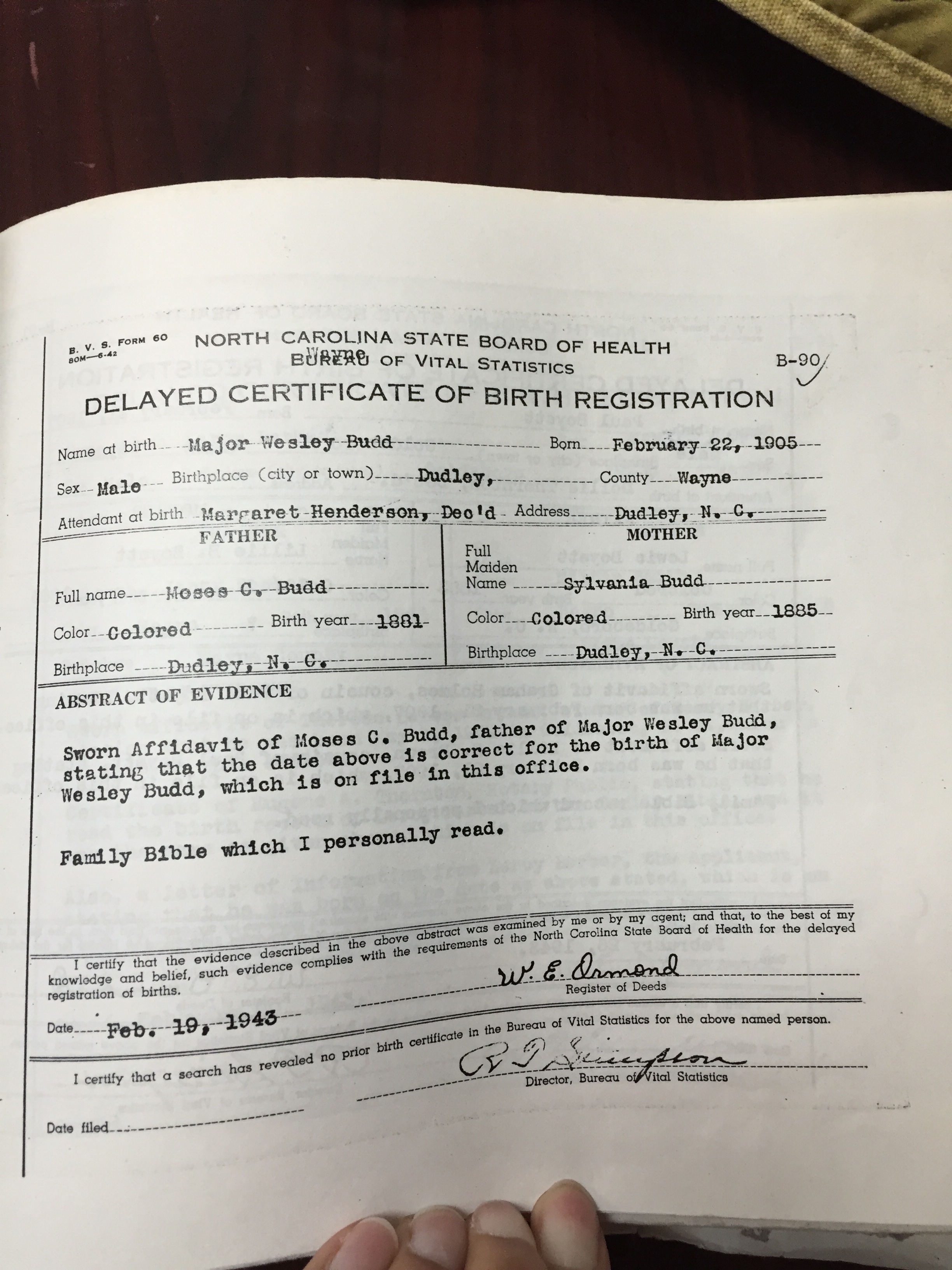
When I was home last week, I had some time to kill, so I spent an hour or so in the Wayne County Register of Deeds office, flipping through Delayed Birth registers. North Carolina did not mandate vital records until 1913, but people born before that year could obtain a “delayed” certificate if they could provide certain proof of their birthdate.

What struck me:

  • Certificate after certificate relied upon an entry in a family Bible to substantiate a birth date. Where have all these Good Books gone??? Who’s got them now?
  • The evidence of family midwives. For example, Major Wesley Budd’s delayed birth certificate cites my great-great-great-grandmother Margaret Henderson as the midwife for his 1905 birth; my great-great-grandmother Vicey Aldridge delivered her brother-in-law Joseph Aldridge‘s daughter Mary Eliza in 1906; and Frances Aldridge (which one?) delivered Joseph’s son William B. Aldridge in 1911.
  • My great-grandfather’s sister Catherine Aldridge Davis obtained two delayed birth certificates. The first, issued 10 February 1943, was based on affidavits from her sister Lenora Henderson and a family friend named W.N. Anderson. (She was described as “colored” in this document.) The second, issued 30 November 1943, was based on the affidavits of her sisters Frances Newsome and Lenora Henderson and of a New York Justice of the Peace who swore that he had examined her family Bible.  (In that one, she was described as “American Indian.”)
  • Mathew Aldridge‘s daughter Mamie Jael‘s delayed birth certificate was issued on the basis of affidavits provided by her cousins, Mary J. Simmons and Annie B. Hogans. (This isn’t Annie B. Watson Hogans, mother of Daniel Simmons‘ wife, Annie Irene Hogans — she died in 1906.) How were Hogans and Simmons related to Mamie Aldridge? And why is Mathew’s middle name listed as Augusta, when every other reference I’ve seen shows middle initial W.?
  • Further evidence of the sway of my great-grandfather Thomas Aldrich over his siblings — his sister Christena Lenora used his preferred alternate name spelling rather than “Aldridge” when she applied for a delayed birth certificate. Nora offered as evidence the license for her marriage to Henry Henderson and affidavits from her brother Johnnie and cousin A.J. Carter. Who was A.J. Carter??
FullSizeRender

Standard
Civil War, Free People of Color, Military, North Carolina, Paternal Kin, Photographs

Lane photographs.

My Daniel Artis/Christopher Lane posts have attracted even more fruitful attention. S.C. has researched the John Lane family for her half-brother, who is descended from one of Christopher Lane’s brothers, and has generously shared photos she has collected.

This photo, taken perhaps in the 1980s, depicts the ruins of John Lane’s house in Bullhead, Greene County. It was in and around this house, presumably, that Sylvania Artis‘ children worked during their involuntary apprenticeship to Lane. S.C. says the house has since been pulled down, though some its interior was salvaged. She also said the family’s cemetery is nearby.

LaneHouse

And then this rather leprous image shows Christopher C. Lane, the young soldier who took Daniel Artis with him as a valet when he entered Confederate service.

ChristopherCLane

Many thanks to S.C. for reaching out and for sharing these photographs.

Standard
Newspaper Articles, North Carolina, Paternal Kin

Matilda Love Divine?

Back when I took terrible notes, I wrote this on a slip of paper: LUCY MATILDA LOVETT DIVINE.

All I remember about it is that my grandmother told me that this was the name of a Henderson relative. There aren’t any Lucys in the family, so I’m fairly certain she was talking about her grandmother — whose name actually was “Ludie” or “Loudie” and who died when my grandmother’s mother was a toddler. If I probed for more details, though, I didn’t record them.

A couple of days ago, I ran across this:

Wilson_Advance_7_27_1883_euphonious_names

Wilson Advance, 27 July 1883.

What?!?!

I Googled “Matilda Love Divine” and found:

  • family trees containing Ann Matilda Love Divine Seymour Salmon, born maybe in Fayetteville, North Carolina, around 1900; Sarah Ann Caroline Matilda Love Divine Seymour Terry Bell Jones, born near Jones County, North Carolina, in 1915; and Lucy Matilda Love Divine Isabella Susan Caroline Bray, born Pike County, Alabama, in 1864; and
  • a snarky Tuscaloosa News article about “unique Southern Negro names,” dated 11 January 1938, that mentioned a Perry County, Alabama, girl named Melissa Ann Queen of Loaf Henry Foster’s Oldest Daughter Sarah Matilda Love Divine Seymoure Cyndie Caroline Foster; and
  • a snarky Raleigh Enterprise bit from 16 April 1906 about a local “chocolate”-colored girl named Lucy Matilda Love Divine Seymour Terry Belle Caroline; and
  • a marriage announcement in the Goldsboro Headlight, 15 July 1897, for Mary Margaret Lucy Levy Jane Sarah Matilda Love Divine Seymour Carrie Bell Caroline Bartlett; and
  • much further afield, a mention in Maine’s Daily Kennebec Journal, 1 August 1903, of Ruth Matilda Love Divine Seymour Terry Belle Caroline Finney.

So what to make of this? Was Loudie Henderson really another of the “Matilda Love Divine” sisterhood? Who in the world was the original? And how did her name seize popular imagination?

Standard
Maternal Kin, North Carolina, Oral History, Politics, Rights

When time came for women to vote.

In which my grandmother schools me on her grandmother and voting:

NICHOLSON -- Harriet Nicholson 1

Harriet Nicholson Tomlin Hart (1861-1926)

Me: How did she work that? How did Harriet get to be the first black woman to vote?

Grandma: Well, because her husband [T. Alonzo Hart] was a lawyer.

Me: Right.

Grandma: He was a, whatchacall – a real estate lawyer. And he taught her how to read and write and do everything after he married her. Or while he was marrying her. Or something. And when time came for women to vote, she was the first black – he carried her down to the polls, and she was the first black woman to vote. And then at that time, you know, they gave you a quiz.

Me: Right. Right. Right. For black people to vote. Yeah. ‘Cause did your parents – well, did your father vote?

Grandma: Oh, yeah. Papa voted. He voted. And the people in my home, Lisa, fought in the streets [Statesville, North Carolina]. It was dange – I mean, we could not go outside the house on election night. The people — “Who’d you vote for?” “I’m a Democrat.” “I’m a Republican.” Pam-a-lam-a-lam! [Swings fists, and I break into laughter.] People acted like they were crazy! Papa didn’t allow us out the house. “You better be getting on home!” ‘Cause they were terrible.

Me: And now you got to drag people out to vote. And then you hear people going: “I’m not gon vote now. What’s the point? I blah-blah-blah.”

Grandma: Yeah. When I came here [Newport News, Virginia] you had to pay poll tax.

Me: Yeah.

Grandma: It wasn’t a whole lot, but it was ridiculous.

Me: Yep.

[My grandmother cast her last ballot — at age 100 — for Barack Obama in 2008.]

——

Interview of Margaret C. Allen by Lisa Y. Henderson; all rights reserved.

Standard
Births Deaths Marriages, Free People of Color, North Carolina, Paternal Kin

She was named after …

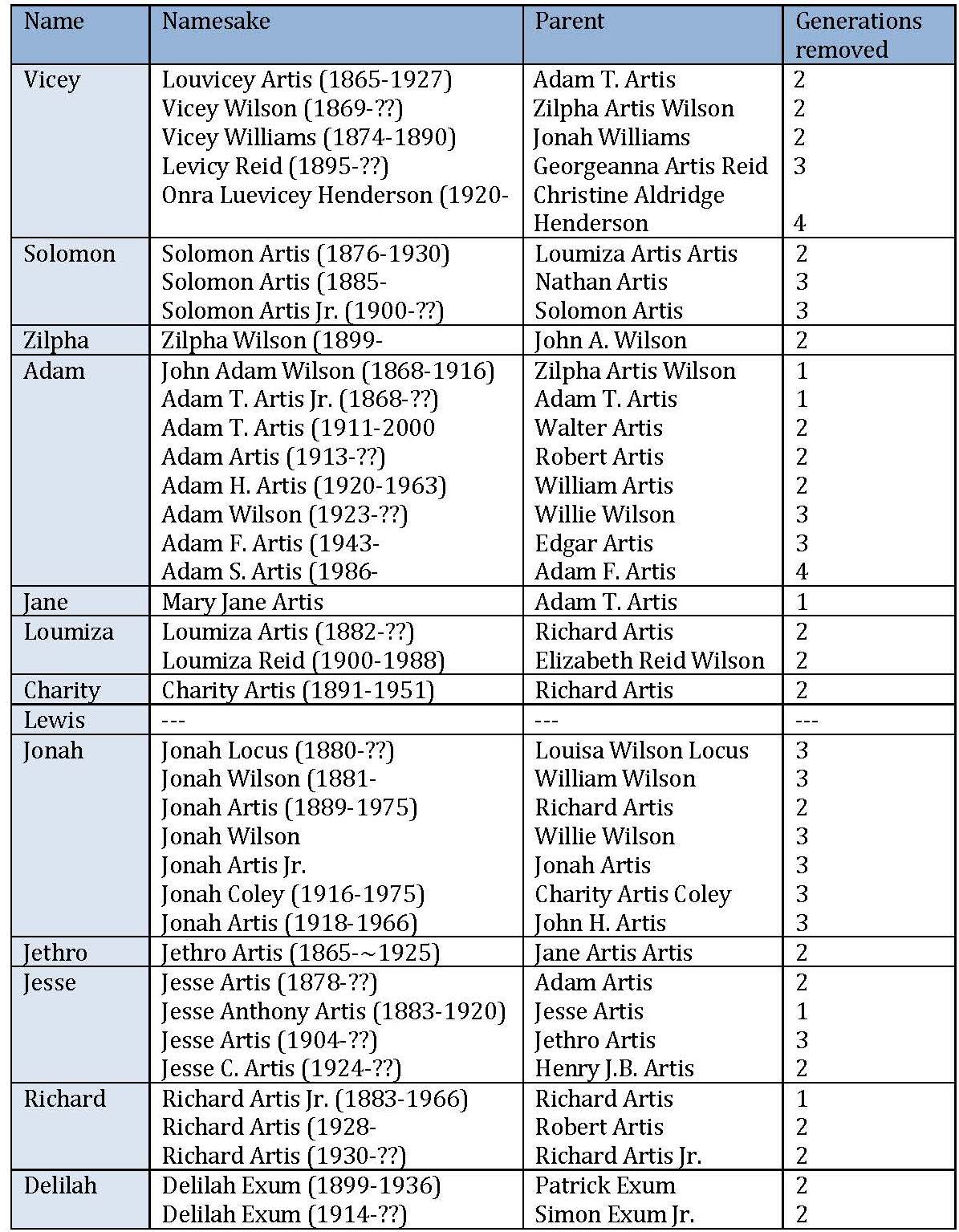
As in many early American families,  the descendants of Solomon and Vicey Artis Williams honored their forebears and living kin by naming children after them. The practice did not begin with them, and it is intriguing to speculate about which of the names that Vicey bestowed upon her offspring had been handed down from earlier generations.

The chart below sets forth all known namesakes of Solomon, Vicey or their children Zilpha, Adam, Jane, Loumiza, Charity, Lewis, Jonah, Jethro, Jesse, Richard and Delilah.

Match

Standard