
Exactly 100 years ago today, Miss Viola Houser visited her brother and his wife, Irving and Emma McNeely Houser, in Bayonne, New Jersey.
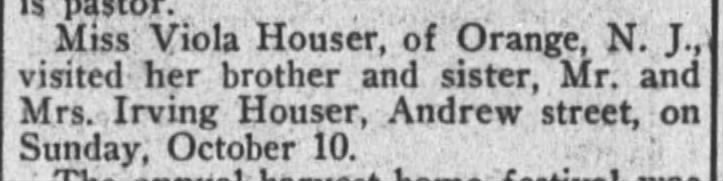
New York Age, 21 October 1915.
Exactly 100 years ago today, Miss Viola Houser visited her brother and his wife, Irving and Emma McNeely Houser, in Bayonne, New Jersey.
New York Age, 21 October 1915.
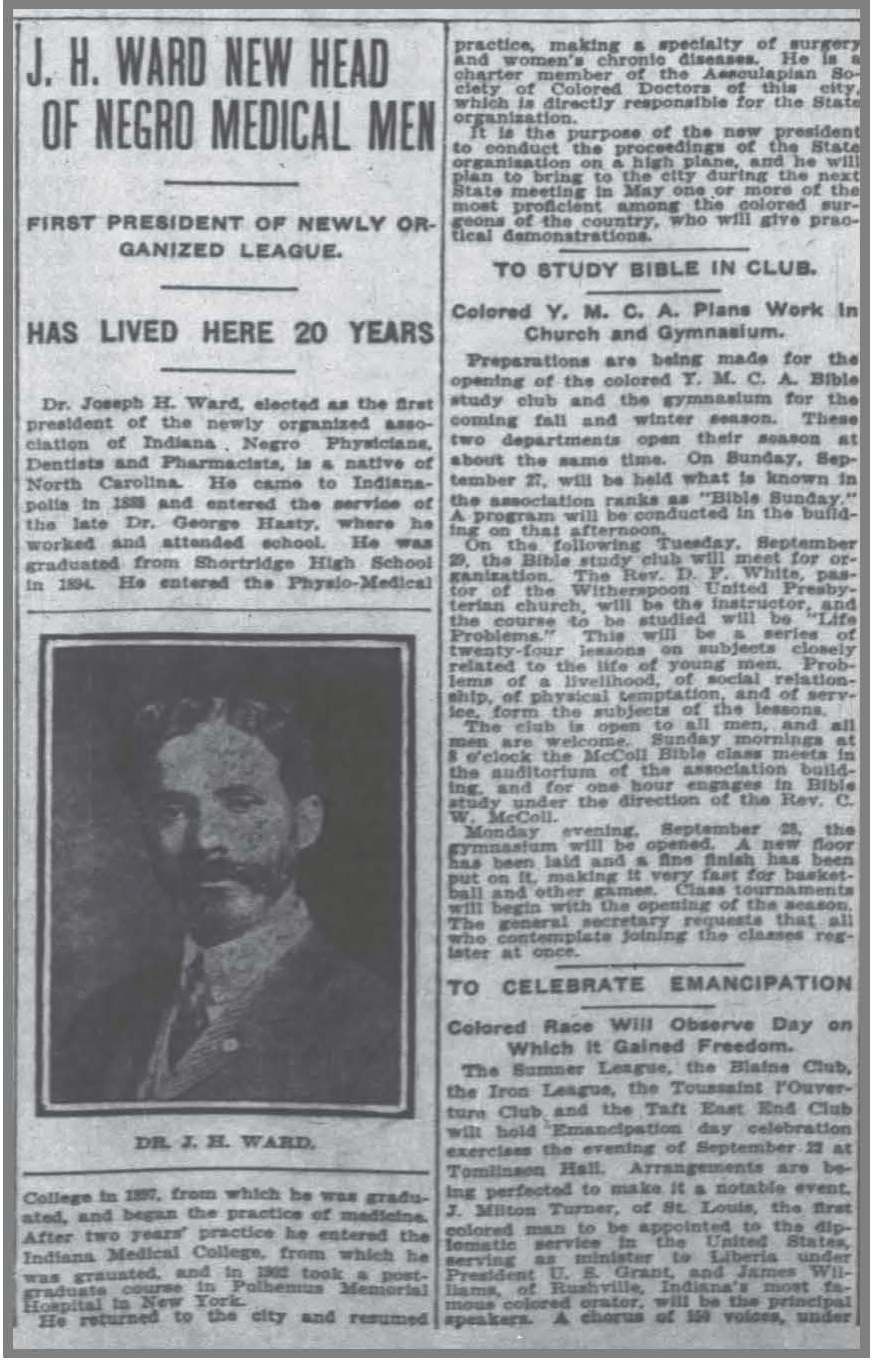
Indianapolis News, 18 September 1908.
Dr. Joseph H. Ward elected as the first president of the newly organized association of Indiana Negro Physicians, Dentists and Pharmacists.
In 1897, cousin Cain D. Sauls was one of two African-American members of a five-man delegation that traveled eastern North Carolina advocating for the “Snow Hill Railroad.”

Goldsboro Weekly Argus, 15 April 1897.
A little over a year later, North Carolina’s secretary of state approved the incorporation of the Great Eastern Railway Company, which planned to build and operate a 130+ mile railroad passing through Johnston, Wayne, Greene, Pitt, Beaufort and Hyde Counties. Among the 25 stockholders incorporating the railroad? C.D. Sauls!
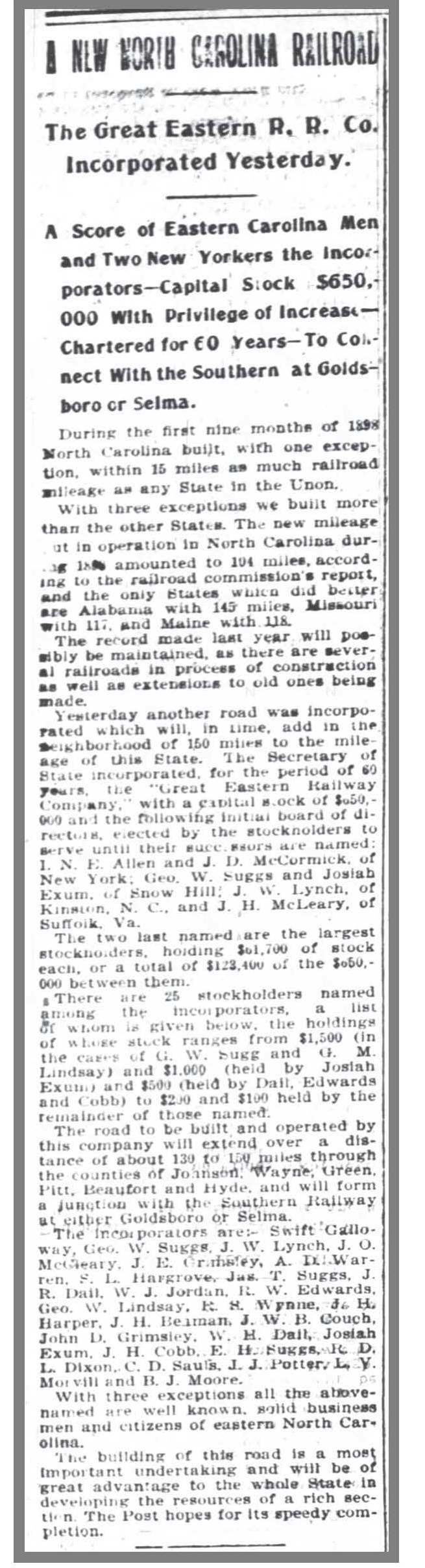
Raleigh Morning Post, 15 October 1898.
John Henry Henderson (1861-1924) was the youngest of James Henderson‘s sons to reach adulthood. He married Sarah Simmons, daughter of Bryant and Elizabeth Wynn Simmons, in 1886 near Dudley, Wayne County. Census records suggest that Sarah gave birth to as many as twelve children, but only three survived — Frances “Frankie,” Charles Henry and John Henry. I have found no record of John H. Henderson’s signature, but here are those of his sons and grandsons.

John and Sarah Simmons Henderson, perhaps the 1910s.
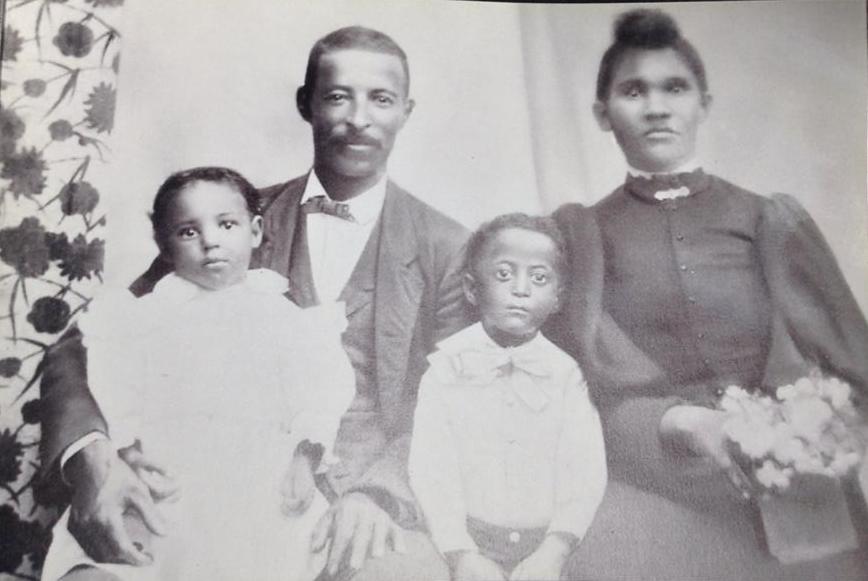
Charles H. Henderson, born about 1893, is something of a mystery. In 1900, he appears as “Charley” in the census of Dudley, Wayne County, with father John, mother Sarah and sister Frankie. There’s some uncertainty about the children’s identification, but this is a photo John and Sarah circa 1895. My best guess is that the image depicts Frankie and Charley.
Charles was not living in his parents’ home in 1910, however. Nor can I find him elsewhere. In 1917, however, he registered for the World War I draft in Richmond, Virginia. He reported that he was born 21 July 1893 in Dudley; resided at 114 E. Leigh Street, Richmond; and worked as a self-employed barber. He was of medium height with a slender build, brown hair and eyes and was slightly bald. (His signature is from this draft card.) In the 1920 census of Richmond, Henrico County, Virginia, at 614 Baker Street, in Lee Ward, Charles H. Henderson, 32, and wife Maria R., 32, with Maria’s parents Henry and Mary B. Stockes, sharing a household headed by Eddie Seigel. Charles worked as a barber and was recorded as being born in Virginia. (This and his age — he was actually about 27 — are erroneous.) It’s the last record I have for Charles Henderson.
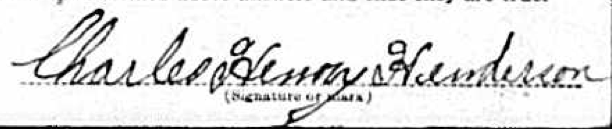
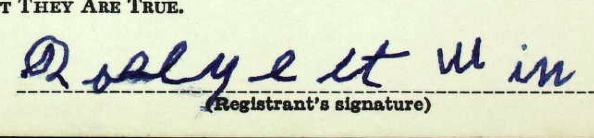
Eight years after Charles was born, Sarah Simmons Henderson gave birth to her last child, son Henry Lee (1901-1942). Henry married Christine Lenora Aldridge while both were still in their teens. I’ve written of their sons here, and samples of their signatures (all from World War II draft cards) are shown below Henry’s.

Henry Lee Henderson, perhaps the very early 1940s.




On Christmas Day 1911, Frances Ann “Frankie” Henderson (1891-1985) married her first cousin, Israel Henderson Wynn (1890-1967), son of Washington “Frank” and Hepsey Henderson Wynn. I have no sample of Frankie’s handwriting, and Israel was unable to read or write. (At least, as a young man.) He signed his World War I draft registration card with an X.
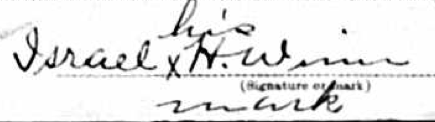
Frankie and Israel (called “H”) had at least 11 children, including sons John Franklin (1915-1981), George Roosevelt (1918-1986), Henderson B. (1924-1981), and Lawrence (1925-??), whose World War II draft card marks or signatures are shown:



While Americans fought in Europe, a war with influenza raged at home.

Indianapolis News, 19 October 1918.
Dr. Joseph H. Ward returned to Indianapolis eight months later to find his wife Zella and daughter Mary Roena recovered, but his beloved son gone. The boy was nine years old.
——
Coda
My grandmother Mary Ward Roberts, whom we called Mur, would cry remembering when Buddy was taken away. She and her mother couldn’t follow the hearse because they were still sick. The purple cloth they put outside of the door to let people know that the house was infected with Spanish Influenza. Mur said that Buddy pointed his finger upward and said goodbye. Her father went into a deep depression in France and was hospitalized. When he returned from France, he had Buddy’s body exhumed to say a final farewell. Can you imagine? — Z.P., great-granddaughter of Joseph H. Ward
A “pre-election fracas”? What happened? And why did eight of black Goldsboro’s leading lights — including my great-great-great-uncle Matthew W. Aldridge and cousin William S. Hagans — feel compelled to take to the newspaper, hat in hand?

Goldsboro Daily Argus, 18 November 1896.
I didn’t find anything in the Goldsboro papers to which I have access, but two weeks before this letter was published, newspapers across the country ran a sensational story about Negroes “taking control” of Goldsboro after a “clash with whites.” The alleged cause? “An incendiary speech” made by none other than John Frank Baker, “a colored Republican of Dudley,” and husband of Mary Ann Aldridge Baker.

Independence Daily Reporter (Kansas), 4 November 1896.
Four months later, Frank Baker was assassinated, shot dead as he went about his work in a Dudley grocery.
Were Matthew Aldridge and William Hagans and their peers moved to pour oil on the waters because they feared the fallout from Baker’s outspokenness? (I have yet to find anything that touches on what he actually said.) Their letter is frustratingly vague about the events that gave rise to a “race riot” in Goldsboro, speaking only of the aftermath of a recent election. The message is difficult to digest, greased as it is with deferential supplications to the “better class of our white citizens” and anxious apologies for the “slight ripple upon the formally [sic] smooth surface” of race relations in Wayne County. Reading from a 21st century vantage point, it is easy to dismiss this letter as Uncle Tommery. There is an undoubted and substantial element of self-preservation and middle-class conservatism at work here, but their fear was surely real and well-placed.
——

Howard University Record, volume 1, number 4, November 1907.
In which William S. Hagans delivers a short speech upon the occasion of alumni gathering for Howard University’s 40th anniversary and is elected vice-president of the newly formed alumni organization.
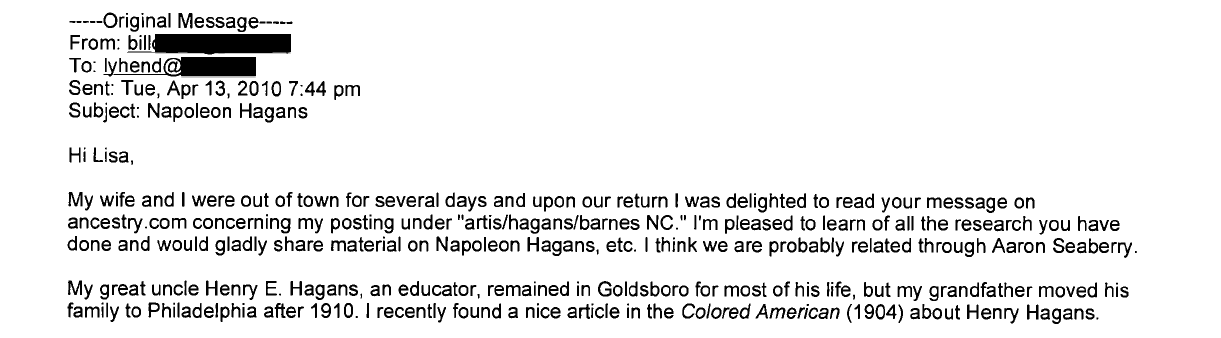
And with that introductory email began my fruitful and thoroughly enjoyable correspondence with B.H., my third cousin, twice removed. Our common ancestor was Levisa (or Eliza) Hagans Seaberry, mother of Napoleon Hagans (B.H.’s great-grandfather) and Frances Seaberry Artis (my great-great-great-grandmother). In the spring of 2010, B.H. and I entered into a mutually beneficial exchange of information about our shared family. I had little information about Napoleon beyond what I’d found in census records and deeds, I’d lost track of his sons Henry and William, and I was completely unaware of his son, the accomplished Dr. Joseph H. Ward. He cued me into William S. Hagans‘ post-migration life in Philadelphia, shared amazing photographs and documents, and lead me to “discover” Joseph Ward’s early years. In turn, I introduced B.H. to Wayne and Wilson Counties and the lives of the Haganses, Wards and Burnetts before they recreated themselves up North.
This past weekend, I traveled to Detroit for — astonishingly — the first time ever. Our primary purpose was to take in the city’s rich street art culture, but I added an item to the top of the agenda — meeting B.H. Friday night, he and his wife treated us to dinner at an old and storied restaurant near the city’s Eastern Market, and Levisa’s children came full circle.
On the 65th anniversary of her death (and her brother Edward‘s), another account of the terrible death of my grandmother’s aunt, Elizabeth McNeely Kilpatrick Long:

Statesville Record & Landmark, 28 September 1950.
My grandmother: I had another cousin that died. A man named Jay. He was Aunt Elethea’s boy. She died when I was about 12 years old, I think. Anyway, she died, and she had three sons.
Me: That was Jay and Charles and William.
Another time:
My grandmother, looking at a photo: Now, who is that?
Me: That’s William, isn’t it? Elethea’s son?
My grandmother: Ah, yeah. Yeah. Bill.
Me: Bill.
My grandmother: No — that’s Charles. Boy, they were crazy about us. I mean, no man bed’ not even look at us. Bed’ not even look at us. You know how men can say things about women when they walk by? Child, they bed’ not say one thing about us. …
——
In 1942, Charles Edward McNeely filed for a delayed birth certificate in Iredell County. The document issued by the Register of Deeds reported that he was born 15 Jun 1904 to Eleather B. McNeely. No father is named. I have not found a birth certificate for Charles’ brother William “Bill” McNeely.
In the 1910 census of Statesville, Iredell County, on Salisbury, three little boys surnamed McNeeley were listed in the household of their grandparents, Sam and Mary Steelman. William was five, James was three, and Charlie was two. I once was pretty sure that these were Elethea’s boys, but I’m pulling back. Charles and Bill appear nowhere else in the census, but the ages of these boys are off. And who is James? (He’s not Jay/J.T. — Irving McNeely Weaver — whose father was Archie Weaver and who was not born until 1911 or 1912.)
I’ve found none of Elethea’s sons in the 1920 census, though they were probably living in their grandmother Martha McNeely‘s house in Statesville with their mother and aunts Minnie and Janie McNeely:

On 23 May 1926, Charles Edward McNeely, 22, married Willie Ann Davidson, 18, before witnesses Mary Louise Colvert, Levi Moss and Bertha Mae Hart. Louise, my grandmother’s older sister, was his first cousin. Bertha was the half-sister of my grandmother’s father. Charles listed his parents as Ed Stockton (living) and Letha McNeely (dead.) John Edward Stockton (1881-1955) was born in Iredell County to Alfred and Caroline Kerr Stockton. He was working as a bellhop at the Hotel Iredell at the time of Charles’ birth. I don’t know whether he was also Bill McNeely’s father.

Charles and Willie Ann’s marriage apparently did not take. In the 1930 census of Manhattan, New York County, New York, Charles M. McNeely, 26, and Willy M. McNeely, 22, were listed as boarders in household headed by Lucy R. Reid. Both were North Carolina-born and reported being married, though their wives were not enumerated with them. Charles worked as a machine operator in a mayonnaise factory and Willy as an elevator operator in a private house.
In 1940, Charles McNeely was still in Manhattan, but I lose sight of Bill. Thirty-six year-old Charles lived at 308 W. 127th Street, a lodging house run by Lillie Collins. He gave his occupation as steamship laborer.
On 29 September 1950, William and Charles McNeely are listed as nephews in the death notice of Edward McNeely of 454 Avenue C on September 28, 1950. Other survivors included wife Delphine (nee Peterson), sisters Emma Hauser [sic], Carrie Taylor and Minnie McNeely, nieces Ardeanur S. Hart and Lonnie [sic] Mae Jones, and nephews Henry and Erving Hauser [sic].
Charles McNeely, resident of north Harlem, died 1 Apr 1968. Four and a half months later, on 15 August, Bloomfield, New Jersey, resident William M. McNeely passed away. This William, however, was not Bill, but a son of William E. and Sarah L. McNeely. I have no evidence that either Charles or Bill had children.
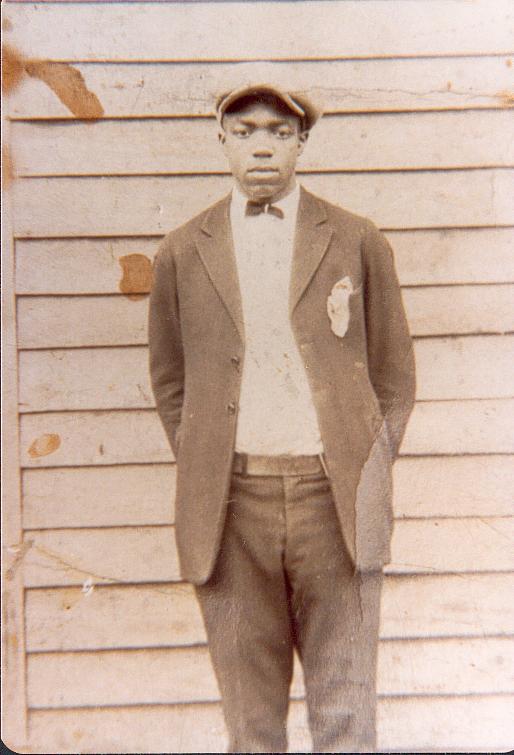
“No — that’s Charles.”
Interviews of Margaret C. Allen by Lisa Y. Henderson; photographs in the collection of Lisa Y. Henderson.
 Scuffalong: Genealogy.