Births Deaths Marriages, Newspaper Articles, Paternal Kin, Photographs

In memoriam: Louise Daniel Hutchinson.

Louise Daniel Hutchinson, scholar of black history, dies at 86

By Emily Langer, The Washington Post, 26 October 2014.

WASHINGTON — Louise Daniel Hutchinson, who gathered, documented and preserved African-American history during 13 years as director of research at the Smithsonian Institution’s Anacostia Community Museum in Southeast Washington, died Oct. 12 at her home in Washington. She was 86.

The cause was vascular dementia, said a daughter, Donna Marshall.

Mrs. Hutchinson spent much of her adult life working to collect and share with others the richness of African-American history in Washington and beyond. In 1974, after years of community activism, she joined the Anacostia Neighborhood Museum, as it was then known. She retired in 1987.

Under the leadership of founding director John Kinard, she oversaw exhibits covering years of history in the Anacostia community, the movement of blacks from Africa to overseas colonies, and the life and accomplishments of Frederick Douglass, the former slave, abolitionist and distinguished writer.

She took particular interest in documenting the lives of African-American women such as Anna Cooper, who was born into slavery and became a noted educator and equal rights advocate. “Even black history hasn’t given black women their proper place,” Hutchinson once told the New York Times.

Gail Lowe, the Anacostia Community Museum’s senior historian, credited Mrs. Hutchinson with elevating the work of the research department and using individual life stories to illuminate broader history. “In telling the local stories,” Lowe said in an interview, “she validated community experiences.” Mrs. Hutchinson was “a stickler for accuracy and authenticity,” Lowe said, and insisted researchers keep magnifying glasses on hand for the close inspection of old photographs. Hutchinson, Lowe recalled, spotted Harriet Tubman and W.E.B. Du Bois in previously unidentified images.

“Because of the level and depth of her work,” Lowe said, “she was able to … provide accurate, documented information that other researchers and scholars relied on.”

Louise Hazel Daniel, one of nine children, was born June 3, 1928, in Ridge, Maryland, and raised in the Shaw neighborhood of Washington. Her parents, Victor Hugo Daniel and Constance E.H. Daniel, were teachers and friends of the African-American intellectuals and educators George Washington Carver and Mary McLeod Bethune.

After graduating in 1946 from the old Armstrong Technical High School in Washington, Mrs. Hutchinson attended colleges including Howard University and did secretarial work before beginning her career in historical preservation. In the 1970s, she assisted curators at the Smithsonian’s National Portrait Gallery with the selection of paintings featuring prominent African-Americans, her daughter said.

Mrs. Hutchinson’s writings included the books “The Anacostia Story, 1608-1930″ in 1977, “Out of Africa: From West African Kingdoms to Colonization” in 1979 and “Anna J. Cooper: A Voice from the South” in 1981.

Mrs. Hutchinson’s daughter Laura Hutchinson died in infancy, and her son Mark Hutchinson died in 1974, at age 8, of a brain tumor.

Survivors include her husband of 64 years, Ellsworth Hutchinson Jr. of Washington; five children, Ronald Hutchinson of Fort Washington, Maryland, David Hutchinson of Clifton Park, New York, Donna Marshall of Laurel, Maryland, Dana McCoy of Washington and Victoria Boston of Clinton, Maryland; two brothers, John Daniel of Washington and Robert Daniel of Atlanta; a sister, C. Dorothea Lawson of Bay City, Texas; five grandchildren; and two great-grandchildren.

In addition to her museum work, Mrs. Hutchinson participated in such initiatives as the development of D.C. public school curriculum in the 1980s, which incorporated the roles of black leaders in local events.

“I have real concerns about accuracy of history,” she told The Washington Post. “I believe it must reflect [the] participation of all.”

——
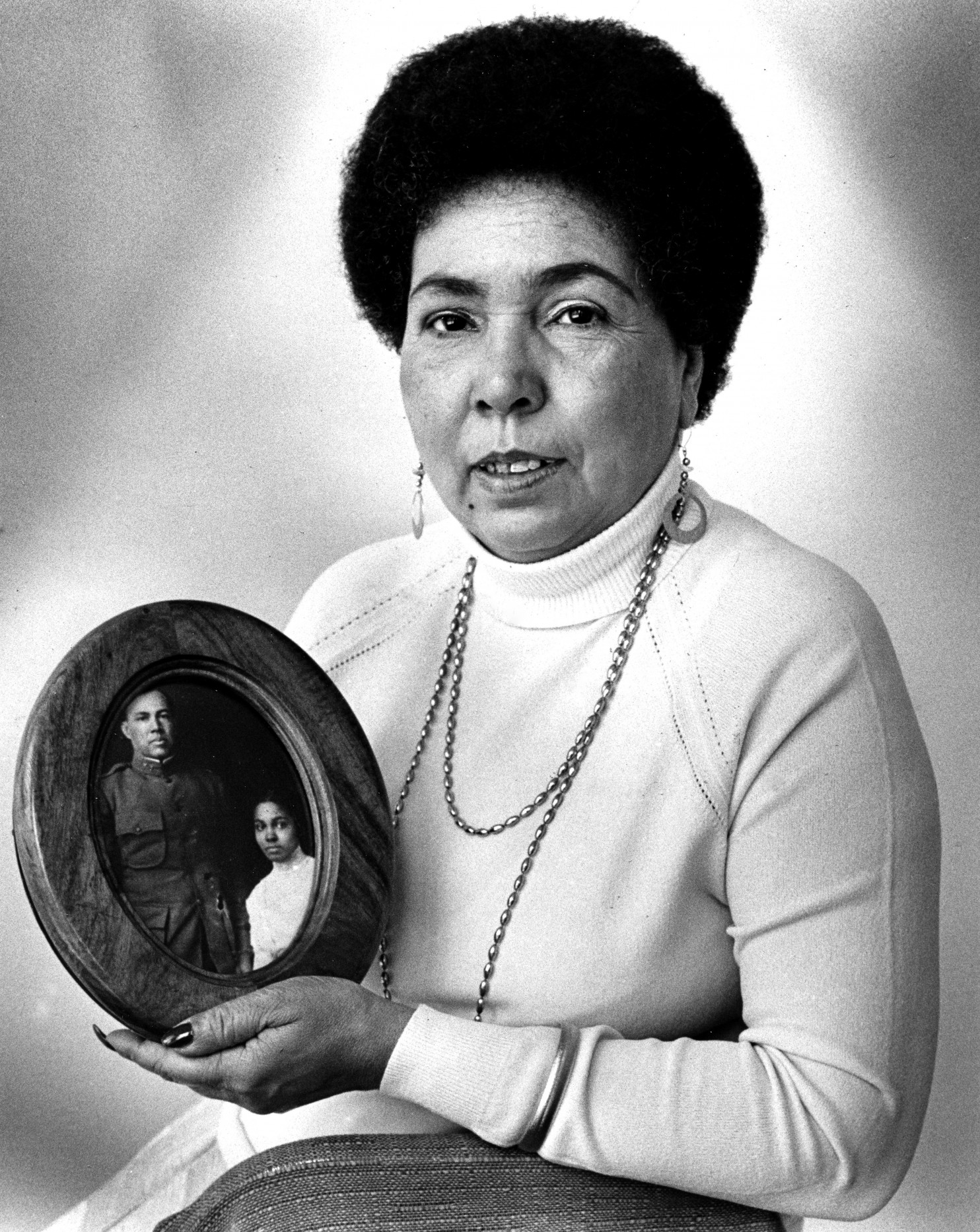
I met my Dudley cousins in the fall of 1985, just in time to be invited to the first (and last, as it were) Henderson-Aldridge Reunion in July 1986. That weekend turned out to have been a fortuitous window of time, in which I was privileged to meet so many elders not long for this world. Had I been more conscientious and intentional, I could have learned so much more than I did, but that’s a genealogist’s perennial regret. So many kin I saw only that one time — Johnnie “Dink” Henderson, Freeman Aldridge Sr., H.B. Wynn, Evelyn Williams McKissick, Virginia Aldridge Oldham. With others, however, I built relationships that lasted years.
Last night, I found Louise Daniel Hutchinson’s obituary. Her husband Ellsworth Hutchinson Jr., my cousin, sent me a copy of her work on Anna Julia Cooper shortly after the 1986 reunion. It was my introduction to the incredible Cooper, though she is from my home state. It was also an introduction to the wonderful work that Cousin Louise did as a researcher and historian. As we traded information about our Aldridge links — Cousin Ellsworth’s grandfather Zebedee Aldridge was my great-grandfather Thomas Aldridge‘s brother — she challenged me to take seriously and document diligently the stories of everyday families. In 2001, I spent a few days with her and Ellsworth at their home in Anacostia, poring over and copying family photos and lapping up her wisdom and knowledge of D.C.’s African-American history. We had lost contact as her health declined, but I have always treasured her warmth and encouragement and hope that in some small way, Scuffalong:Genealogy honors her memory.
ob-main-hutchinson25-0011414257190
Louise Daniel Hutchinson holding a photo of her parents. Courtesy of The Washington Post.
Standard
Education, Other Documents, Paternal Kin

Bison.

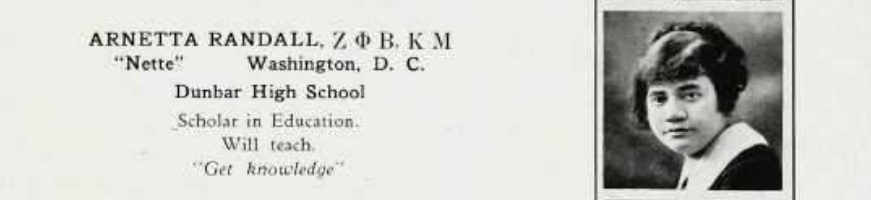
I’ve been striking gold with the Randalls. A number of Howard University’s yearbooks have been digitized, and searches of random years yielded these Randall collegians, as well as a cousin descended through their grandmother Fannie‘s brother Matthew: Screen Shot 2015-07-05 at 8.13.44 PM

Arnetta L. Randall, Class of 1925.

Arnetta was the second daughter and seventh child of George and Fannie Aldridge Randall. (Oscar and Fred Randall were among her brothers.) A teacher and lifelong resident of the District, she never married.

——

Screen Shot 2015-07-12 at 1.38.01 PM

Screen Shot 2015-07-12 at 1.45.27 PM

Mable Margaret Williams, Class of 1933.

Screen Shot 2015-07-05 at 8.24.02 PM

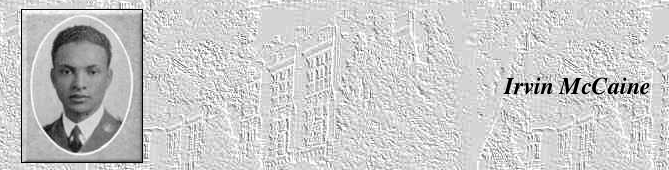
Irvin LeFetus McCaine, Class of 1934.

Irvin L. McCaine married Mable Margaret Williams, daughter of Clarence J. and Daisy B. Aldridge Williams of Goldsboro and later Asheville, North Carolina. Mable’s maternal grandparents were Matthew W. and Fannie Kennedy Aldridge. Here’s Cousin Irvin in high school (Class of 1929), courtesy of an Oakland High School memorial website:

Screen Shot 2015-07-05 at 11.00.51 PM

——Screen Shot 2015-07-05 at 8.02.52 PM

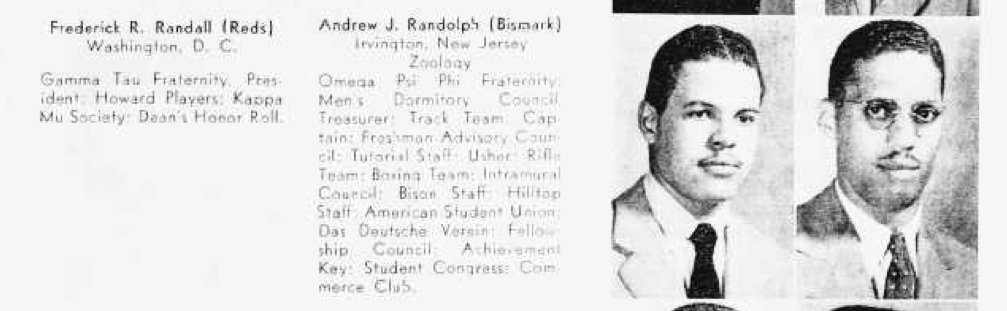
Frederick Russell Randall, Class of 1942.

Son of Fred R. and Lucille Stewart Randall, Frederick Randall also attended medical school at Howard and briefly practiced at the hospital there before moving to New York City. (Ada Randall Reeves was his sister.)

Screen Shot 2015-07-05 at 10.10.03 PM

The Crisis, December 1962.

Ten or 15 years ago, I received an email message from a professional genealogist in New York who had been hired to research Dr. Frederick Randall’s family. Through her I learned what had become of my great-great-grandfather’s youngest sister Frances Aldridge Locust — Cousin Frederick’s grandmother — whom I’d lost track of after her marriage. She and her husband had changed their surname to Randall, it turns out, and moved to Washington DC. The genealogist and I exchanged information over the course of several emails and letters, and I spoke with Cousin Frederick by phone — among other things, about his interaction with his cousin, and my great-grandfather J. Thomas Aldridge — but I never got the opportunity to meet him. I Googled his name tonight and found this:

RANDALL–Frederick R., MD. 91. Former Surgeon and Professor of Surgery at Columbia-Presbyterian Medical Center. He had compassion for his patients; and wisdom for his students. A devoted husband and loving father, he leaves Elizabeth [W. Glover], his wife of over 68 years and his sons, Derek and John. A bereaved family is consoled by cherished memories. What be it worth the life of a man, but that which he himself has given to it? This strong man gave much. Published in The New York Times on Apr. 6, 2014.
Standard
Land, North Carolina, Other Documents, Paternal Kin

Cousins and covenants.

“In November of 1945, Ada Reeves bought a charming little bungalow at 1303 Kearny St. NE in Brookland. She expected to move in without any problems, but instead was sued by her neighbors. The cause? The color of her skin. Ada Reeves was African American, and her new home’s deed contained a covenant that said the house was not to be sold to a black person.”

While running a Google search for Fred R. Randall, I happened upon a blog dedicated to the history of Brookland, a neighborhood in northeast Washington DC. A December post on racially restrictive covenants opened with the sentences above. Further down: “As for the case of Ada Reeves: her father, Fred Randall, contacted Charles Hamilton Houston in 1945 to look into the case,” and copies of a letter from Randal to Houston. Charles Hamilton Houston, called “The Man Who Killed Jim Crow” was an early African-American civil rights lawyer and mentor to Thurgood Marshall. And Fred Randall is Cousin Fred.

Many thanks to Bygone Brookland, and for the full post, see here.

Standard
Other Documents, Paternal Kin, Photographs

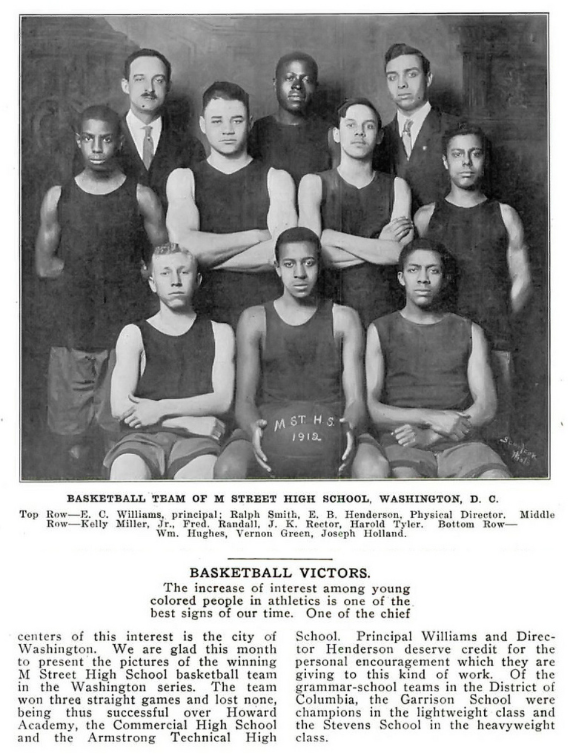
Basketball victors.

Screen Shot 2015-07-04 at 10.00.37 PM

Many thanks to Dena Banks for pointing out this post in Vieilles Annonces’ Flickr feed. It’s from the March 1912 issue of the NAACP’s The Crisis. (The first 25 years of which I have on CD; I need to study this thing more carefully.) Fred Randall was the 17 year-old son of George and Fannie Aldridge Randall, who migrated from Wayne County to Washington DC in the late 1890s. (Fannie Aldridge Randall, formerly known as Frances Aldridge Locust, was the sister of my great-great-grandfather John W. Aldridge.) Randall’s interest in athletics did not end in high school. As just posted here, he went on to become director of the city’s Cardozo Playground.

Standard
Agriculture, Enslaved People, Land, North Carolina, Paternal Kin

Kinchen’s Kinchen’s Kinchen’s Kinchen ….

“I found your blog posts on line,” he said. “If you don’t mind, I’d like to talk to you some more about them. Kinchen Taylor was my ancestor.”

It took a little while, but we finally caught up as I sat waiting for a flight to Philadelphia. I’ll call him “Cal.” He goes by a different nickname, but he bears — with pride, but some chagrin — the same name as his forebear. It’s been passed down generation after generation after generation and, in spite of himself, he passed it on, too.

Cal grew up within shouting distance of the Kinchen C. Taylor house that I wrote about, and his father and uncle are among the last of Kinchen Taylor’s descendants holding property passed down from him. He’s a few years younger than I am, and he thinks Kinchen Senior’s house was already in shambles during his childhood. He was aware that Kinchen had accumulated vast tracts of farm and woodland in northern Nash County, but dismayed that he had owned so many slaves. That he had owned any at all, really. Without them, of course, his great-great-great-grandfather’s thousands of acres would have been a wilderness of swamp and impenetrable forest. Cal also wondered if we were perhaps related, but I have no reason to believe that we are.

Many thanks to “Cal” for reaching out and for sharing his connection to Taylor Crossroads.

Standard
Uncategorized

Adam.

I count these Adam Artises:

Adam Toussaint Artis (1831-1919), the original. My great-great-great-grandfather.

Adam Toussaint Artis Jr. (1868-??), his son.

Adam Toussaint Artis III (1911-2000), son of Adam T. Artis’ son Walter S. Artis.

Adam Artis (1913-??), son of Adam Artis’ son Robert E. Artis. This Adam may have had a son, Adam Artis Jr.

Adam Huldah Artis (1920-1963), son of Adam Artis’ son William M. Artis.

Adam Freeman Artis (1943), grandson of Adam Artis’ son June Scott Artis.

Adam Scott Artis (1986), great-grandson of June S. Artis.

And, too:

John Adam Wilson (1868-1916), son of Adam Artis’ sister Zilpha Artis Wilson.

Adam Wilson (1923-??), son of Adam Artis’ nephew Willie Wilson.

Standard
Business

Where we worked: good government jobs.

Henry E. Hagans, Washington DC – secretary to U.S. Congressman George H. White, circa 1898.

William S. Hagans, Washington DC – secretary to Congressman White, circa 1899-1900.

J. Frank Baker, Dudley NC – husband of Mary Ann Aldridge Baker; postmaster, circa 1896.

Mary Ann Aldridge Baker, Dudley NC – postmaster (assumed husband’s position after his murder), 1897-1911.

Caswell C. Henderson, New York NY – laborer, clerk, courier, U.S. Customs House, 1900s-1926.

Fred Randall, Washington DC – director, Cardoza Playground, DC Government, circa 1917; clerk, post office, circa 1930; special mail clerk, circa 1940.

Hardy Randall, Washington DC – postal employee, circa 1917.

Toney C. Brewington, Norfolk VA – carrier, post office, 1936.

Jesse P. Breedlove, Washington DC – husband of Edna Randall Breedlove; manager, War Department, circa 1940.

Oscar Randall, Washington DC – skilled helper, US Government Bureau of Engraving & Printing, circa 1917; Chicago IL – civil engineer, Chicago Sanitary District, 1930s.

Standard
North Carolina, Oral History, Paternal Kin

Friend or family?

I used to go down there [to Mount Olive] and stay with her and Cousin Jesse. And Cousin Cousin Annie Cox and Uncle Hardy was living at that time, and I used to go down there. I stayed with her when Cousin Jesse, her husband, come up to bring tobacco to sell.

I don’t think neither one of ‘em ever went North. Cousin Annie and Cousin Hardy Cox. At least her husband [Hardy], his legs was twisted. They used to come to Wilson. When he walked, each of ‘em would go ‘round at the same time. They pushed up some kind of way. Worse than Bobby [Henderson, a cousin who’d had childhood polio.] And I asked Mama, I said, “What is wrong with him?,” and she said, “I don’t know.”  I guess he was doing right good. He could walk on ‘em. I didn’t see him with no stick. But he just real – one would go one way and then the other one’d go the other way. I didn’t want him to see me watching him, so I didn’t never ask him nothing about it. ‘Cause he was [inaudible] down there to Uncle Lucian [Henderson]’s house. 

Who were Hardy and Annie Carter Cox to my grandmother? Were either of them her blood relatives? I’ve talked about Annie Carter Cox’s family here. Hardy Cox was born about 1851, probably in Sampson County, to Henry Cox and Easter Bennett (or perhaps Beaman.) The family is not found in the 1860 census and was likely enslaved until Emancipation. In 1870, however, they were listed in Westbrook township, Sampson County: Henry Cox, 51; wife Esther, 37; children Hardy, 20; Martha, 18; Mariah, 14; Adaline, 12; George, 9; Isaac, 5; and Ida, 8 months; plus Phillis Bennet, 53. [Sidenote: my great-great-great-grandparents Lewis and Margaret Balkcum Henderson were also in Westbrook in 1860.] Ten years later, Hardy Cox, 30, and wife Martha, 28, were living a few miles north and are enumerated in Brogden township, Wayne County. [Again, as were the Hendersons.] Their little household was sandwiched between that of Green and Betsy Jane Thornton Simmons and his Bryan and Betsy Wynn Simmons. [North Carolina Marriage Indices show Hardy marrying Betsy J. Simmons on 16 January 1873 in Wayne County. Who is this? Neither Green nor Bryant had daughters by that name of an age to marry in 1873.] I have not found Hardy and Martha’s marriage license. [Is this actually Betsy J., misnamed?] However, in early 1884, Hardy married 20 year-old Virginia Ann “Annie” Carter.

42091_343598-01363

A few items in this license stand out. First, here’s another example of the lackadaisical data entry that undercuts the reliability of so many of these records. Annie certainly knew her parents’ names, though both may have been deceased when she married. More interestingly, the witnesses: Hillary Simmons (at whose home the wedding took place), “Lucious” Henderson and Bryant Simmons Jr. Hillary Simmons was a son of George W. and Axey Jane Manuel Simmons and a nephew of Green and Bryant Simmons above. Bryant Junior was either Bryant’s son, born in 1866, or Hillary’s brother Bryant C. Simmons, born 1851. Lucious, of course, was Lucian Henderson, whose sister Ann Elizabeth Henderson had married Hillary Simmons five years previously.

No smoking guns then, just an intricate interweaving of several families via marriage and proximity. The marriage of Annie Carter Cox’s brother Marshall Carter to M. Frances Jacobs (whose brother Jesse Jacobs married Lucian and Ann Elizabeth’s sister Sarah Henderson in 1896) was another binding tie between Hardy and Annie and my grandmother’s people. There were others, too, but later and less likely to have drawn Hardy and Annie close enough to my grandmother to be called “Cousin.” For example, in 1907, Ira Cox, son of Hardy’s sister Mariah Cox, married Louvenia Jacobs, daughter of Jesse and Frances Jacobs’ brother John R. Jacobs. And in 1915, Marshall and Frances Jacobs Carter’s son Milford E. Carter married Beulah Aldridge, my grandmother’s paternal aunt.)

Standard
Births Deaths Marriages, Free People of Color, North Carolina, Paternal Kin

Carter kin?

Several months, when I was examining delayed birth certificates filed in Wayne County, North Carolina, I asked who the A.J. Carter was listed as a cousin on Christine “Nora” Aldridge Henderson‘s birth record. Today I found a marriage license for A.J. Carter and Mallie Simmons, and it hit me suddenly that A.J. was Ammie James Carter, (1) oldest of A. Marshall and Frances Jacobs Carter’s sons, (2) thus, nephew of “Papa” Jesse A. Jacobs Jr., and (3) brother-in-law of Beulah Aldridge Carter, my great-grandfather Tom Aldridge‘s sister.

But how in the world was Ammie Carter Nora Aldridge Henderson’s cousin? “Play” cousin? Or blood?

Ammie Carter, born about 1881, was the son of Archy Marshall Carter and Margaret Frances Jacobs. His mother Frances was the sister of Jesse A. Jacobs Jr., who reared my grandmother, and the daughter of Jesse Sr. and Abigail Gilliam (or Gilliard) Jacobs. Jesse and Abigail’s parentage is unclear, but they are believed to have been born in Cumberland or perhaps Sampson County. As far as I know, neither was related to Nora Aldridge’s parents, John W. Aldridge and Louvicey Artis.

Marshall Carter (1860-1922) was the son of William and Mary Cox Carter of Sampson County. I know little about them. Their census records are muddled by duplicate, but conflicting, entries, and most of their children seem to disappear from the record. An exception: daughter Virginia Ann “Annie” Carter (1863-1930) married Hardy Cox. They were close enough to Sarah Henderson Jacobs that my grandmother called them Cousin Annie and Cousin Hardy Cox. Was Annie Carter Cox really a cousin?)

And there’s this: on Sarah H. Jacobs’ 1938 death certificate, her mother’s maiden name is listed as Margaret Carter. When I asked my grandmother about it, she did not know why. I believe Sarah’s mother, who was otherwise known as Margaret Balkcum, was the sister of Mary Eliza Balkcum Aldridge. Is the Aldridge-Carter connection actually via their Balkcum side? Was their unknown father — a man of color — a Carter?

William Carter was the son of Michael Carter (circa 1805-circa 1875) and Patience, maiden name unknown, of Sampson County, whom I know only through the 1860 and 1870 censuses, in which they are enumerated in Sampson County. They both seem to have died before 1880. My lack of knowledge about Robert Aldridge or Mary Eliza Balkcum Aldridge‘s parents makes me hesitate to say that either (or neither) was related to Michael or Patience Carter. The same holds for Mary Cox Carter’s parents, whoever they might have been.

In short, for now, I have no answers.

Standard
Agriculture, Maternal Kin, North Carolina, Oral History

He had it in his pocket.

My mother: Tell Lisa about that thing you were telling me about your step-grandfather. Mr. Hart.

My grandmother: Mm-hmm.

Mother: And what he brought you.

Grandmother: He used to always bring us something, you know. It wouldn’t be much, but it would be a little something, you know. So this night, he brought me a chick. A little live chick. And told me to raise the chick, and I did. And it was a –

Mother: Where was it, Ma? Where was it when he brought it to you?

Grandmother: He had it in his pocket. [We laugh.] He had it in his pocket. And, oh, they were called game chickens. And they got great big bodies and long necks and their heads were small. You know, they’re funny-looking, but they’re very productive. You know, they lay a lot of eggs. And he had all kinds of stuff like that. He was a lawyer, really. But he did real estate, and he farmed. But anyway, he gave me this chick, and it was a hen. And she laid eggs and everything. And so Mama sat the eggs, sat her on her own eggs, and she hatched this little group of chickens, you know. And I don’t know why it was separate from any other ‘cause Mama had chickens and all. She had chickens then, but anyway this chicken was separate from the chickens, and it was ‘round on the side of our house. And the house wasn’t, you know, where you cover the bottom of the house. It wasn’t –

Me: Oh, yeah. It was up on pillars.

Grandmother: Yeah. And right there where she was there was none, and she made a little coop for her and her chicks. They would run around, but they would come back to that thing ‘cause she was in there. And one day a dog came along and was messing with the chickens, and oh, this hen was just a-jumping up and screaming and carrying on and stuck her head out the thing, and the dog bit her head off. Lisa, I nearly died. And you know, Mama wouldn’t cook her. We wouldn’t have eaten her nohow.

Me: Did she have a name?

Grandmother: I can’t think of the hen’s name. I can’t think of it, Lisa. But I’m sure she had one.

006-2

Game hen, courtesy http://www.ultimatefowl.com.

Interview of Margaret C. Allen by Lisa Y. Henderson; all rights reserved.

Standard