
 Goldsboro Argus, April 10, 1903.
Matthew W. Aldridge was clearly an early adopter. (Though I don’t know who he would have been calling.)
Goldsboro Argus, April 10, 1903.
Matthew W. Aldridge was clearly an early adopter. (Though I don’t know who he would have been calling.)
Census records are the gateway to genealogical research for most people, and I am no exception. I can still remember hunkering over a microfilm reader in a dark corner of Davis Library in Chapel Hill, gaping at my great-great-great-grandparents’ names revealed in crabbed script in the 1910 federal population schedule. Like so many others, I squirmed impatiently for the release of the 1930 and 1940 censuses, anxious to determine what whos and wheres could be answered by the fresh infusion of data. As much as I have relied upon census data, however, I am acutely conscious of its limits. The census schedules are imperfect documents that qualify only barely as a primary resource. This is not to discount their usefulness for genealogical purposes. I’m just saying that — based as they are on a mishmash of personal knowledge, second-hand information, hearsay and rank speculation — they don’t prove much of anything about a person’s name, age, ethnicity, relationships, or occupation.
Here’s an example, courtesy of the 1920 census of Wilson, Wilson County, North Carolina:

A husband and wife with two daughters, no? If you didn’t have reason to know better, you might accept this at face value. “Hattie May” happens to be my paternal grandmother, however, so I do know better. (She was Hattie Mae, by the way.) Let’s take each person one-by-one:
“Jessie Jacobs” was Jesse A. Jacobs Jr. He was actually born in 1856, so was 63 or 64 years old, not 60, when the census taker stopped by. He is described as “B,” which is a designation he never would have provided. I am fairly certain that his wife gave information for the household, and I am equally certain that she described everyone in it as “colored.” Jesse himself might have offered “Croatan,” as the multi-racial, ethnically Native American members of the Coharie tribe were then called.
“Sara Jacobs” was Sarah Henderson Jacobs. She was, indeed, Jesse’s wife. She was born in 1872, so her age is a little off, too. She was 47 or 48, not 42.
“Mamie Jacobs” was born in 1907, so her age is basically correct. She was not, however, the daughter of either Jesse or Sarah Jacobs. Nor was she a Jacobs. She was the daughter of Bessie Henderson, who was the niece of Sarah H. Jacobs. In other words, Sarah was her great-aunt. Her mother died when she was three, and she was reared for her first eight years by her great-grandparents, Lewis and Margaret Balkcum Henderson. See:

Here, in the 1910 census of Brogden township, Wayne County, North Carolina, is a correctly described family unit. (This, by the way, is the census entry that dropped my jaw so many years ago and got me hooked.) My great-great-great-grandfather Lewis Henderson, great-great-great-grandmother Margaret, great-grandmother Bessie, and great-aunt Mamie. (Bessie was more than seven months pregnant with my grandmother when the census taker showed up on April 18. And look at how many children Margaret had lost. Only three of nine surviving. It breaks your heart.)
Back to 1920: “Hattie May Jacobs” was born in 1910, so her age is basically correct, too. She spent her first eight months or so in her great-grandparents house, but when Bessie died in the late winter of 1911, Sarah and Jesse Jacobs took her to Wilson to live with them. Mamie remained in Wayne County until her great-grandparents died, then she, too, went to Wilson. She and Hattie were known as Jacobses as a result, and for years my grandmother believed she had been formally adopted. Well into adulthood, when she learned that she had not, she reverted to her birth mother’s surname, Henderson.
Fast forward twenty years to the 1930 census of Wilson, Wilson County. Have things gotten better?

No. Sarah Jacobs was 58 years old, not 49. That was likely deliberate deception. Hattie, of course, was her great-niece, but their relationship was essentially mother-daughter and undoubtedly so reported to the census taker. Their occupations are not shown here, but Sarah was described as a laundress “at home” and my grandmother as a servant for a private family. The former accords with what I was told about Sarah’s work, but I have never heard that my grandmother worked as a maid. Most curious, however, is not what’s in this entry, but what is not. Namely, my two uncles. They were three and one in 1930, and I’ve found them listed nowhere else in the census either. A deliberate omission? A mistranscription? I don’t know, but it’s another stark example of the unreliability of census records.
So, three consecutive census schedules for one family and only the first reasonably accurate. As I’ll demonstrate in coming weeks, this was not the exception. Caveat emptor.
Adam T. Artis was illiterate. Though a smart and successful man, he executed contracts with a shaky X and probably conducted much of his business on the basis of verbal agreements. Here, his mark on a receipt for goods purchased from him by the Confederate government in 1863:

There’s little evidence to show whether Adam’s wives could read and write, but it seems doubtful that the first three or four could. His granddaughter Pauline Artis Harris told me that education was important to him, however, and he hired a teacher to live on his farm and school his children. His efforts bore fruit. Below, the signatures of eight of Adam’s 26 or so children.
The signature of the oldest son, Cain Artis (1853-1917):

The signature of Louvicey Artis Aldridge (1865-1927) on the final account of her husband’s estate:

It is, perhaps not surprisingly, the shakiest of the bunch. Vicey was among Adam’s earlier children and likely came along before her father’s resources allowed for tutors. She was also a girl.
From the World War I draft registration card of Walter Scott Artis (1874-1951):

From the World War I draft registration card of William Marshall Artis (1875-1945):

From the World War I draft registration care of Jesse Artis (1878-1922):

Jesse used the alternate spelling “Artice,” which was rarely adopted by members of this family. Notice that somewhere between William and Jesse’s early schooling, cursive capital A’s shifted in style from a form very similar to a printed “A” to one like an oversized small “a.”
From the World War I draft registration card of Robert Elder Artis (1883-1934):

From the World War I draft registration of Columbus Estell Artis (1886-1973):

C.E.’s signature is interesting. This round, upright script, from 1917, is a relatively early version. Later, over the course of the hundreds of death certificates he signed as an undertaker, he developed a bold, right-leaning, immediately identifiable signature characterized by a bold slash through the “r” in Artis:

From the World War I draft registration card of June Scott Artis (1889-1973):

Though his letters are well-formed and decisive, the missing “S” in Scott suggests a man who signed his name from memory and did not write much.
From World War I draft registration card of Henry J.B. Artis (1892-1973):

From the Social Security application of Alphonso Pinkney Artis (1903-1976):
[I’ve got this somewhere. I just need to find it.]
The third in an occasional series excerpting testimony from the transcript of the trial in J.F. Coley v. Tom Artis, Wayne County Superior Court, November 1908. Paragraph breaks inserted for better readability.
Plaintiff introduces Jonah Reid who being duly sworn, testifies as follows:
I have heard Tom Artis say that he was going soon to pay his rent with cotton to [William S.] Hagans. I don’t know how often I have heard him speak of that, I have heard him say something about it several times when rent was due. I didn’t hear him say what lands. Some times he was cultivating the three pieces, sometimes the 30 acre piece. I am his son-in-law. I never lived with him. Live back of his house. Never heard him call it anything but rent cotton, not interest cotton. (Defendant objects.)
CROSS EXAMINED.
I told Hagans that I heard the old man say he was going to pay his rent, that was along in September, I think this past September. The only reason I told him was he asked me. He came by where I was working on the road. He asked me how long I had been in the family. I told him 16 years. He asked if I had ever heard anything but rent. I told him no. That’s why I told him. That’s all he asked me. Tom worked the three pieces, then afterwards the 30 acre piece. That’s all I remember Hagans said. I didn’t know there had been a suit about the land. Hadn’t had the suit yet. I said I didn’t like to say anything about my father-in-law. Hagans didn’t tell me that he Artis was claiming that he was paying interest. I just answered what he asked me. I told him I had never heard any thing but “Rents”.
——
Jonah Reid was married to Magnolia Artis (1871-1939), daughter of Thomas and Loumiza Artis Artis. Loumiza Artis was a sister of my great-great-great-grandfather Adam T. Artis. One of Adam Artis’ wives, Frances Seaberry, was William Hagans’ paternal aunt.
My grandmother tells a story:
… Jay and I were supposed to clean the house on Saturday. You know, do the vacuuming and dusting and cleaning and everything. And then I would play, and we would play, and Grandma would say, “I’m gonna tell your mama. I’m gonna write your mama and tell your mama how you act.” She said, “I can’t write her right now ‘cause I’m nervous,’ you know.” Couldn’t write a lick. [I laugh.] Couldn’t read …. I don’t think she could read or write, but I know she couldn’t write. Bless her heart. She says, “I’m gonna tell your mammy on you. You see if I don’t. And, see, if I wont so nervous, I’d write her, but I’m too nervous” – couldn’t write any more than she could fly! [Laughs.]
Martha Miller McNeely, born into slavery in 1855, may not have been able to read or write, but her children signed their names in clear, firm hands that evidence both their early education and their easy familiarity with penmanship. Their father Henry, the literate son of a slaveowner, may have taught them rudiments, but they likely attended one of the small country schools that dotted rural Rowan County. (My grandmother said that her mother Carrie finished seventh grade and was supposed to have gone on to high school at Livingstone College, but the family used her school money to pay for an appendectomy for one of her sisters.) The document below is found in the estate file of Henry’s half-brother, Julius McNeely, who, unlike Henry, was not taught to read during slavery. Julius died without a wife or children, and Henry’s offspring were his sole legal heirs.

Signatures are often-overlooked scraps of information that yield not only obvious clues about literacy, but also subtleties like depth and quality of education and preferred names, spellings and pronunciations. They are also, in original documents, tangible traces of our forebears’ corporality — evidence that that they were once here.
——
Interview of Margaret C. Allen by Lisa Y. Henderson, all rights reserved. File of Jule McNeely, Rowan County, North Carolina Estate Files 1663-1979, https://familysearch.org. Original, North Carolina State Archives.
My grandmother and her sister Mamie had five sons between them. Two survive — the youngest, my father, and the oldest, my cousin John, who turns 91 today.
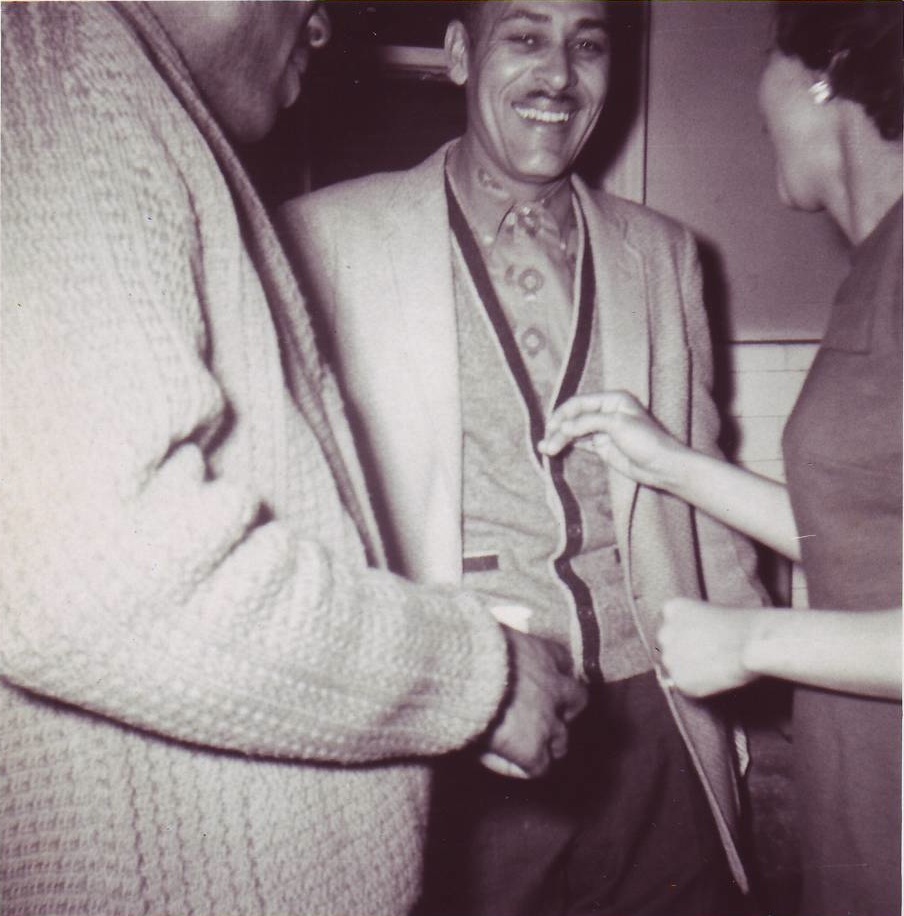
Happy birthday, John J. Holt!
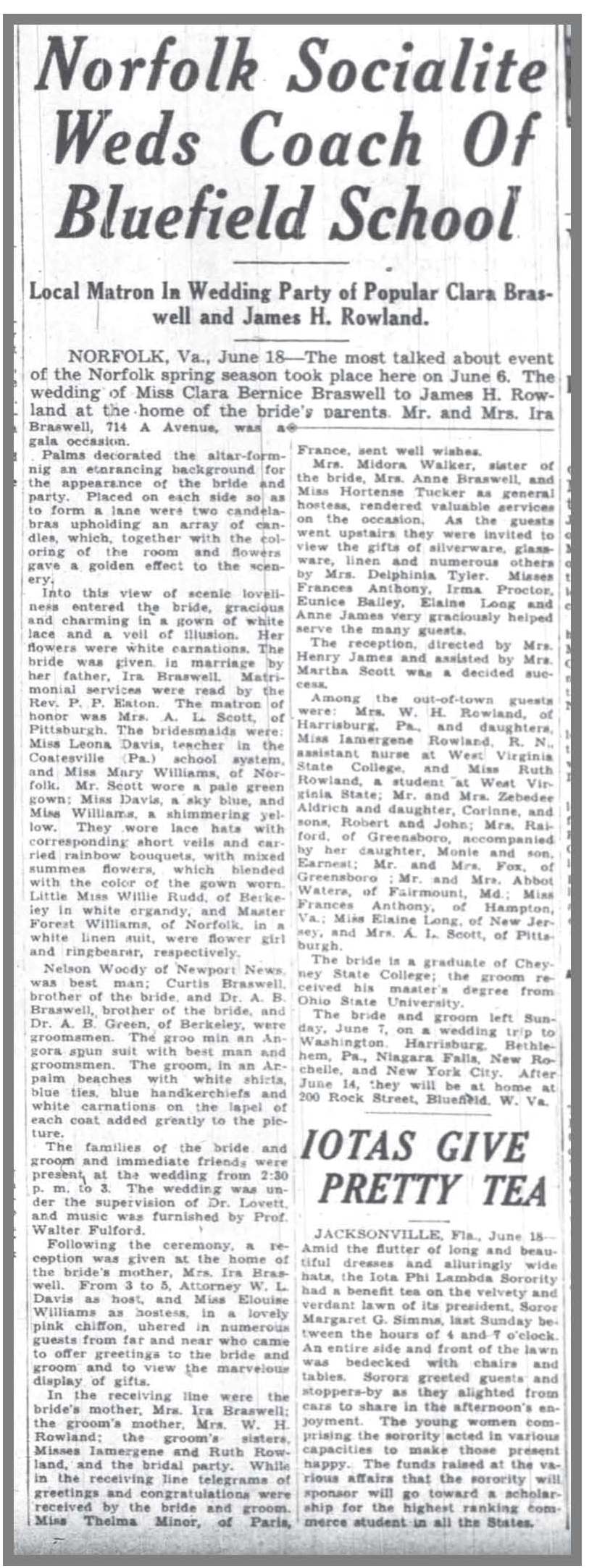
Pittsburgh Courier, 20 June 1936.
Socialite Clara B. Braswell‘s mother, Mattie Amelia Brewington Braswell, was a daughter of Joshua L. and Amelia Aldridge Brewington. Just after 1900, Mattie migrated to Norfolk, Virginia, where she married her husband, who was also a Wayne County native. Several of her siblings also made the move, including Tilithia Brewington King Godbold Dabney, much-beloved by my grandmother. Among the out-of-town guests noted at Clara’s nuptials were Mattie Braswell’s first cousin and his wife, Zebedee and Jennie Ridley Aldridge, with three of their children. The son of John W. and Louvicey Artis Aldridge, Zebedee had also migrated from Dudley, Wayne County, to rural Brunswick County, Virginia, in the first decade of the 20th century. Zebedee and Jenny traveled a hundred miles from their farm to attend his cousin’s gala wedding, touching evidence of enduring ties among Robert and Mary Eliza Balkcum Aldridge‘s descendants.

Zebedee and Jennie Aldridge, probably 1940s.
Photo courtesy of L.D. Hutchinson. Hat tip to B. Jones for the article.
I won’t say this one of my grandmother’s favorite stories. It was too painful to be favored. But it was a story she told me over and over, without prompting and with little variation. It tears me up to read it even now, nearly a hundred years after the events it memorializes. I imagine that frightened little girl, a near orphan, left with this relative and that, yearning for comfort from a great-aunt who generally offered little in the way of emotion, but who, to provide, went North for short stretches for the extra money she could make doing “day’s work” for white families. Theodore and the bread and the doorbell. My heart breaks.
——
And I went over to stay until – Mama was working. And so Edward, that was – Edward or Theodore? Theodore. It was Carrie’s, Papa’s daughter Carrie, like Annie Bell’s sister Carrie. That’s where I was staying, over to her house. And Mama was working and staying on the lot with the people, and I was supposed to stay with them while I was up there. Until Mama, I reckon ‘cause she was gon be making a little money to buy something with, but I don’t know what she said she wanted. So by her being one place and I was in another. And then when her son, Theodore – we went to the store to get a loaf of bread, and I went with him, I wanted to go with him. And he took me on down to the store, got the bread, then he give me the bread to hold, and there was a place in the sidewalk of dirt, where wasn’t paved, and he stopped there with some children and started shooting marbles in little space, that little square. So I walked on down the street, and we wont too far from the house, but I kept looking and trying to figure out what house we were in. They were all joined together. And I had seen him go up there and put a hand upside the thing, and I said, ‘Must be a bell up there.’ And I went up there and mashed that button, and the door didn’t come open. And so then I went back down the street to where Theodore was, and he was still shooting marbles. And so, I said, “You better come on, I’m tired of holding this bread.” And so he said, “Okay, okay.” And so then he stopped, and we come on up there, and the door was cracked open. The door was cracked open. So when we got there, I said, “The door was open. And you didn’t even have to mash the button up there.” Mash the button where was to the apartment where you live in? And they would mash the button back to open the door. But the door was already open. But I had mashed it, see? I didn’t know. So when Theodore and I went back up there, and we went in, and I had the bread, and the bread was all mashed up where I had held it so tight holding it. And so she fussed him out and whipped him on top of that, and I went to crying ‘cause I thought she was gon whip me, too, ‘cause it was both of us. And so I said, “I want to go home. I want to go to where Mama is.” They said, “Well, she’ll be over tomorrow.” And I don’t know if it was tomorrow or the next day or two after, but anyhow Mama come and got me, and I told her that I wanted to come home. And she said, “Well, I thought you was doing all right. What’s the matter with you and Carrie?” And I said, “She beat Theodore.” And I said we were at the store getting a loaf of bread, and so we stayed too long. He was shooting marbles, and I was holding the bread, and I had mashed the bread up, and I thought she was gon whip me ’cause I forgot about the bread, and I couldn’t get in the house to bring it to her. And when I mashed the button, the door didn’t come open. So then when Theodore and I came back, went on up there, and honey, she took her husband’s belt, one of his belts he had, and she whipped him, and I was crying, and I’m still crying. I said, I reckon that’s where I started crying ’cause every time I see somebody else cry …. So I told them I wanted to go home, and she said, “Well, Mama’s coming over tomorrow.” And so I stopped crying, but I thought Carrie was gon whip me, just like she whipped Theodore, and I was the one that mashed the bread. But I didn’t tell it. But she said we stayed out too long. Bread’s all mashed up, said, “Should have come on home.” She was fussing with him, and then she took the strap and hit him two or three licks with that, and I thought she was ton hit me, too. And so Mama came and got me and took me back over Frances’ house. So then she said she was going back South. And I was just happy to go back there.
——
They said, well, [inaudible] get some bread, went to the store. I didn’t know where the store was, but I was just going with him to the store, you know? I got the bread, he give me the bread to hold, while he was shooting marbles in that little space was out there. And come on back, and I went way to the house and mashed the button ‘cause I’d seen him mash it. Didn’t want to ask nobody nothing. I said, I didn’t know them peoples up there. So the door didn’t open, and I went on back to find him and get him to come home. And I had held that bread so much and turned it from one end to the other under my arm holding it, and mashed the bread up. So Carrie looked at him: “Well, where y’all been so long?” And then she got that strap, ‘bout this long and ‘bout this wide. And she hit him a lick or two with that, and said, “I sent you out there after some bread, and you went off and stayed and stayed and stayed.” And so when she was hitting him, I went crying. So I thought she was gon beat me, too. But she didn’t. She didn’t even try to chastise me or talk nice to me or nothing. It was just simply ‘cause I’d done mashed that bread up – I had the bread when I went up there, see. She wont thinking ‘bout me. But I didn’t think that, nothing about it until it was later. I said, ‘No wonder she was gon beat me.’ ‘Cause I had done mashed that bread all up holding it up in my arms and changing it from one arm to the other, waiting on him shooting marbles. But I didn’t tell on him. But she knew he was shooting marbles.
——
... Mama took me to New York and everywhere she’d go. I stayed with Frances and her husband and son, when Mama went up there to work. And so I stayed with Carrie first. That was Albert Gay’s mama’s sister. She had one son, Edward. And she sent us to the store to get a loaf of bread. I’ll never forget it. And in the sidewalk, it was a block out the sidewalk where was closed up. And it just had dirt in it, and we went to get that loaf of bread. He handed me the loaf of bread, and when we got to that block it was boys shooting marbles in that little square where it was dirt. And so I got tired of standing there waiting on him. And I went on up to the house. And had seen them where they go up there and pushed the button. And the door didn’t come open then, and I went on back to where Ed was. And stood there waiting ’til he come to go in the house. And when we got to the house, the door was open. So when we got upstairs to the apartment floor, Carrie commenced fussing with him about ‘Who’s that coming in there playing with that bell?’ and opening the door, or something, I started to say it was me, and then I — she talked so hateful, and she beat Theodore, ’cause he got the bread all mashed up, with the belt. So I went to crying. I cried and I cried. I wanted to go home. I wanted to go where Mama was, but Mama wasn’t supposed to come over there ’til the next day or a day or two after that. I don’t know where she was working. Except that she was doing some day’s work. ‘Cause day’s work was plentiful then. People would clean up. So Mama wanted [inaudible] carried me with her and left Mamie there with Papa and knowing, too, Papa didn’t like Mamie. So, anyway, I cried so, and Mama took me over to Frances’ house. That’s where Mama come, after they took me over to Frances.’ I don’t think either one of ’em had no phone at that time and … but anyway, she come on over and got me, and I told her I didn’t want to stay there no more, I wanted to go home. I said I wanted to go where she was. She said, “Well, you can’t go right now,” said, “I got a job to do.” She said, “Well, I’ll take you over to Frances’. So that’s when she took me over to Frances’ house, and Edward.
——
“Mama” Sarah Henderson Jacobs (1874-1938) reared my grandmother and her sister Mamie, her great-niece. Sarah’s husband, “Papa,” was Jesse A. Jacobs Jr. (1856-1926). Annie Bell Jacobs Gay and Carrie Jacobs Blackwell (1890-1963) were Jesse’s daughters by his first wife, and Theodore Blackwell (1908-??), not Edward, was Carrie’s son. At the time this story took place, the Blackwells were probably living at 37 West 112th Street in Harlem, just north of Central Park. In 1920, this was an all-African-American, fifteen-family building in a block otherwise occupied by Russian Jewish immigrants. Frances Aldridge Cooper Newsome was my grandmother’s paternal aunt, sister of her father Thomas Aldridge. Edward Cooper was Frances’ son.
Interviews of Hattie H. Ricks by Lisa Y. Henderson; all rights reserved.
The second in an occasional series excerpting testimony from the transcript of the trial in J.F. Coley v. Tom Artis, Wayne County Superior Court, November 1908. Paragraph breaks inserted for better readability.
Plaintiff introduces H.S. REID who being duly sworn testifies as follows:
I know the Defendant Tom Artis. I had a conversation with him in reference to payment of cotton to [William S.] Hagans. This last fall I was on the road with Hagans and met Tom Artis carrying a bale of cotton. Heard conversation between Artis and Hagans. When we met in the road Tom said, “You are leaving home, and I have started to your house with a bale of lint cotton.” Hagans told Tom to carry it on as quick as he could, for he needed it about as bad as he ever saw anyone. He said that in a joking way. Hagans started off, and he said, “Hold on Captain!” He told him that he understood that he was going to sell the land down there. Hagans said yes, that it was for sale. Tom said, “I would be glad if you would wait a few days Captain, I think I can raise the money for that place, didn’t say what place just then. Hagans said he had rather sell it altogether. Tom said if he would give him a few days until he could see his boys, he thought he could raise the money for it all. Hagans said alright, it was all for sale. That was about the end of the conversation and we parted. Later then that one day, at Eureka, Artis asked me if I knew when Hagans would be out at his place. I told him about the day Hagans told me he would be out there. Artis said I wish I would deliver a message to Hagans for him, “ask him not to sell that place to Mr. Wright Cook. Said if he did, he would be out of house and home. He said he would rather Hagans sell it to Coley, for he thought he could get along better with Mr. Coley. I delivered the message to Hagans when he came out home. I think this is about the substance. That last conversation was a short while before the sale I think. Am not real sure when it was.
CROSS EXAMINED.
I told this conversation about Tom wanting Hagans to wait before he sold the land. I told several people, I don’t remember all. I am not able to tell. I think Hagans and I talked about Tom Wanting to buy the land. I am not positive. I heard Hagans say that the old man wanted to buy the land from him, as I remember. I think I told the lawyer about the first conversation.
…
HENRY S. REID recalled by Defendant.
I don’t know that on the occasion I met Tom Artis, that he forbid Hagans selling his land. It wasn’t mentioned that day. I have never admitted to Tom that he forbid Hagans selling that land.
Goldsboro, N.C. Sept 19, 1905. On the 1st day of Oct 1906 for value received, with interest from date until paid at 6 per cent, per annum, we, or either of us, promise to pay Bennett Live Stock Co. or order twenty seven 50/100 DOLLARS, for bal[illegible] 2 horse Hackney wagon years old which stands security for this note and remains their property till paid for. And as further security for said indebtedness I hereby sell and convey to ________ the following property, to-wit: ________________ with full power to close this lien as provided in Section 1800 of the Code. /s/ Napoleon Artis. Witness Don Scott.
——
Goldsboro, N.C. Octo 26, 1905. On the 10 day of Jany 1906 for value received, with interest from date until paid at 6 per cent, per annum, we, or either of us, promise to pay Edgerton & Edgerton or order One hundred & two DOLLARS, for One bay mare about 8 years old and said mare 9 years old which stands security for this note and remains their property till paid for. And as further security for said indebtedness I hereby sell and convey to ________ the following property, to-wit: It is understood that if $5.00 is paid in this note the balance is to stand until the 1st day of Octo 1906 with full power to close this lien as provided in Section 1800 of the Code. /s/ Robert E. Artis, June Scott Artis. Witness Walter Sasser.
——
Napoleon, Robert and June Scott were sons of Adam T. Artis. Napoleon’s mother was Frances Seaberry; his brothers’ was Amanda Aldridge.
From Lien Record Book 44, Register of Deeds Office, Wayne County Courthouse, Goldsboro NC.
 Scuffalong: Genealogy.