Agriculture, Free People of Color, Land, Newspaper Articles, North Carolina, Paternal Kin, Politics

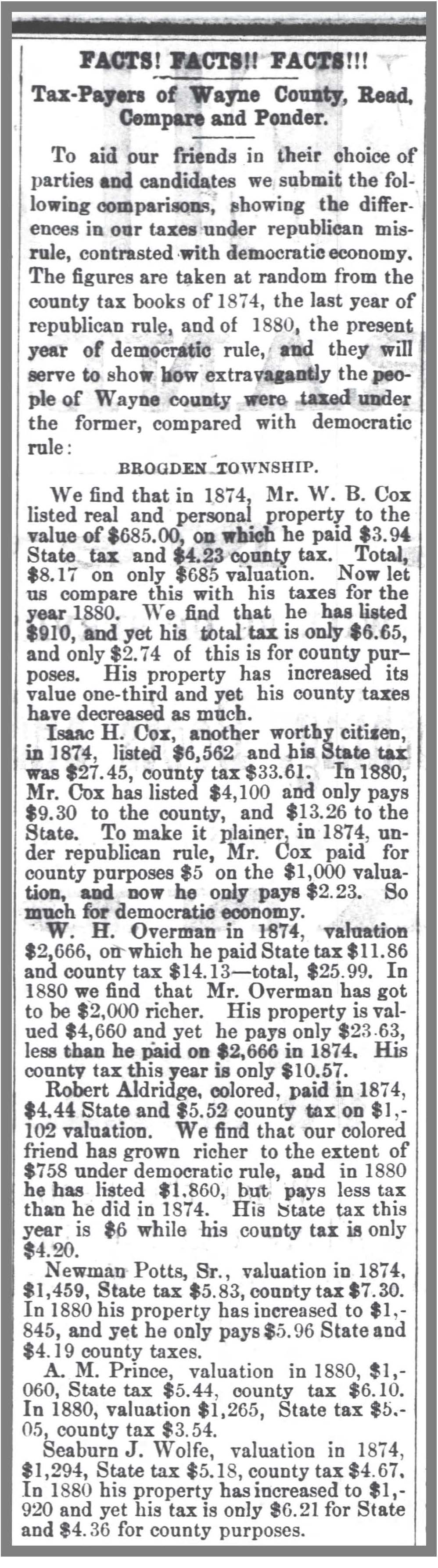
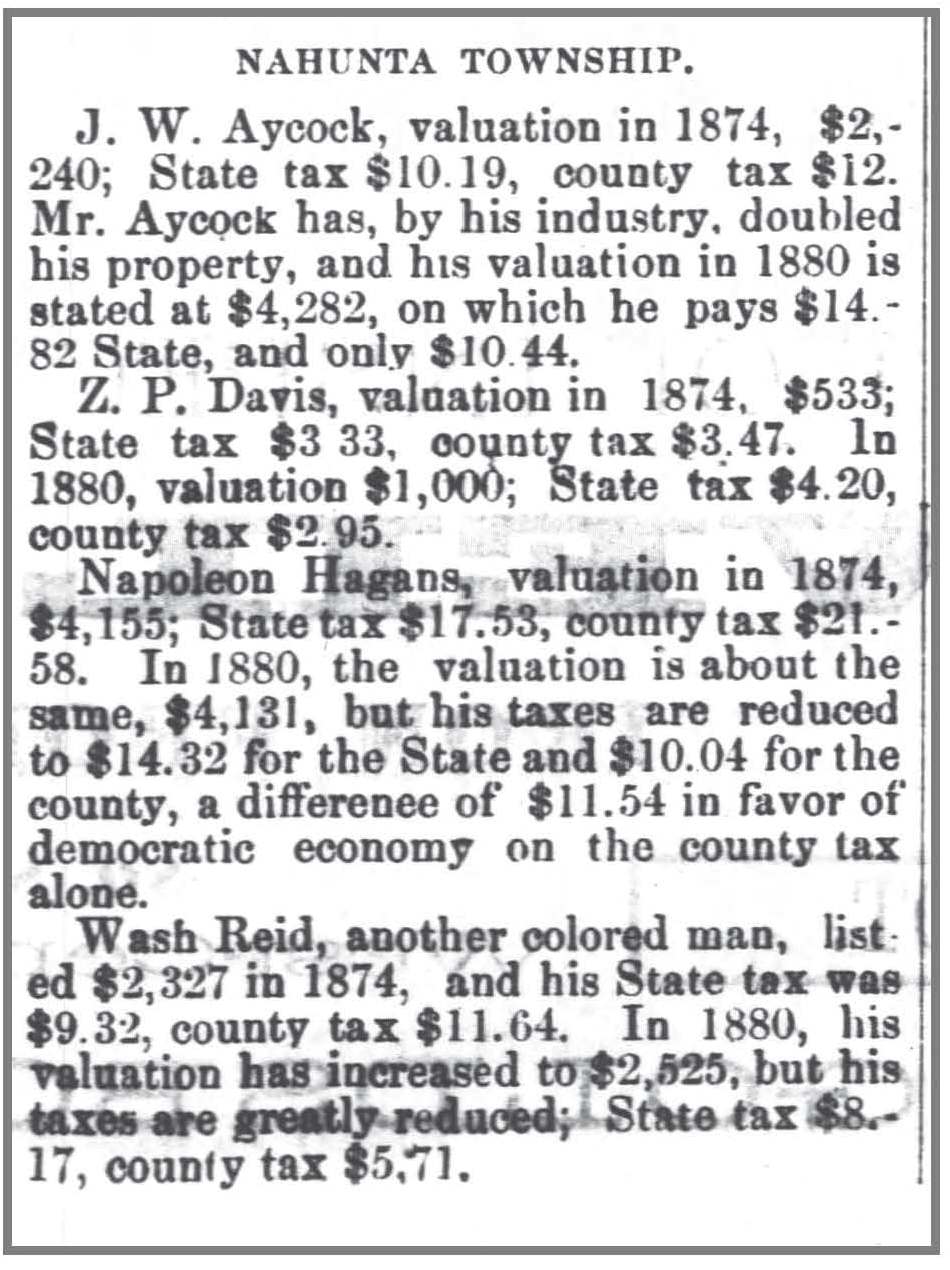
Our colored friend has grown richer.

Image

ImageGoldsboro Messenger, 21 October 1880.

These propaganda pieces are part of a single article published to demonstrate that the rising tide of Democratic rule had floated all boats as land values increased while taxes fell. (In other words, the end of Republican rule meant more money in the pocket, as well as a foot on the neck of African-Americans.)

Two of the “colored friends” noted were my kin — my great-great-great-grandfather Robert Aldridge and Napoleon Hagans, the brother of my great-great-great-grandmother Frances Seaberry Artis. (And Washington Reid’s nephews William and Henry Reid, sons of John Reid, married Adam Artis’ niece Elizabeth Wilson and daughter Cora Artis, respectively.) Aldridge, Hagans and Reid (as well as Artis, Frances’ father Aaron Seaberry and Betty’s father John Wilson) were all prosperous free-born farmers.

Standard
Business, Civil War, Enslaved People, Land, Maternal Kin, Newspaper Articles, North Carolina, Photographs

Eagle Mills.

An abstract from Heritage of Iredell County, Vol. I (1980) —

In 1846, peddlar Andrew Baggerly bought the old Francis Barnard mill tract on Hunting Creek in north Iredell County.  In 1849, he placed an ad in Salisbury’s Carolina Watchman: “Capital Wanted And If Not Obtained Then Valuable Property For Sale.”  He described the property as “the most valuable water power in the Southern Country … situated on Hunting Creek in Iredell County, twenty-eight miles west of Salisbury … [on] a never-failing stream, … remarkable for its purity, … [and] adapted to the manufacture of paper, to calico printing, to bleaching etc.”  Baggerly noted that there was a dam in place, an active sawmill, a grist mill soon to open, and a factory building about half-finished.

On 2 Mar 1850, Baggerly, James E.S. Morrison, William T. Gaither, William R. Feimster, William I. Colvert, G. Gaither Sr. and Andrew Morrison filed a deed for a 318 1/4-acre tract called the Eagle Mills place.  By 1852, the factory was operating with William I. Colvert as its agent.  It had 700 spindles and 12 looms and employed an overseer and 22 workers, 20 of whom were women. By 1854 the adjacent former Inscore Mill had been added to the works, and Baggerly claimed the “intrinsic and speculative value” of the complex was $2,700,000.  

In 1855, Baggerly advertised in Charlotte’s North Carolina Whig and in the Carolina Watchman, calling the complex “Eagle City, the Great Point of Attraction, Destined to be the great center of manufacturing interests in Western North Carolina and perhaps the United States.”  He deeded the president and Congress of the United States a ten-acre block in Eagle City called Eagle Square, located on Market Street.  

After Baggerly was forced to liquidate his assets during the Panic of 1857, William Colvert became the owner of his interest in Eagle Mills.  “According to tradition there was a tobacco factory, hotel, oil mill, and general store at Eagle Mills in addition to the grist mill and cotton factory.  A number of homes stood in the horseshoe bend above the mills and a church was eventually constructed on the edge of the settlement.”

In the spring of 1865, Stoneman’s raiders came upon Eagle Mills unexpectedly and burned it to the ground.  The mills were rebuilt, but Eagle Mills never recovered its former prosperity.  The cotton factory and grist mill operated until destroyed by fire in April 1894.  At that time, William I. Colvert, Robert S. Colvert, and James E.S. Morrison were the owners.  

The only remains at the site are gravestones in the church cemetery, traces of the main road to the mill, the grist mill’s foundation stones, and, a short distance upstream, remains of the stone supports where a covered bridge crossed the creek.

——

Sville_Record_and_Landmark_4_19_1894_Eagle_Mills

Statesville Record & Landmark, 19 April 1894.

——

When William I. Colvert took charge of Eagle Mills in 1852, my great-grandfather Walker Colvert was in his early 30s and father of a one year-old boy, John Walker Colvert. I don’t know exactly what kind of work Walker did for W.I., but they had grown up together, and Walker was an entrusted slave. Even if his primary labors were not at the cotton factory complex, I am certain that he spent considerable time in and around his master’s largest investment. So, too, would John Walker, who remained with W.I. after Emancipation. He is listed in W.I.’s household in the 1870 and 1880 censuses, and I suspect he stayed at Eagle Mills until the final fire closed down the works.

On a rainy December morning I cruised the backroads of northern Iredell County, drinking in the landscape that was home to my Colverts and Nicholsons for much of the 19th century. I made a left onto Eagle Mills Road, headed north. A sharp bend in the road and there, a bridge over Hunting Creek. I pulled over and, ignoring a No Trespassing sign, clambered down to the sandy bank. The waterway is too shallow and rocky to have been paddled or poled, but I imagine that Walker and John Walker knew its course very well. Hunting Creek powered Eagle Mills and was a direct link between W.I. Colvert’s lands and those of Thomas A. Nicholson, whose son James Lee married W.I.’s daughter and whose granddaughter, Harriet Nicholson, gave birth to John Walker Colvert’s first child.

IMG_4618

Photograph by Lisa Y. Henderson, December 2013.

Standard
Agriculture, Births Deaths Marriages, Free People of Color, Newspaper Articles, North Carolina, Paternal Kin

Well-to-do farmer — with lots of children.

An expanded version of the 47-children article that ran in the Statesville Landmark (and, indeed, all over North Carolina):

Image

Wilmington Messenger, 3 January 1906.

I still don’t know more than 25 or so of Adam Artis‘ children (which is gracious plenty) and don’t believe there were many more than that. But if he didn’t have 80+ grandchildren by 1906, he certainly had many, many more than that before all was said and done. (As always, I ignore the snark, but what is a “typical southern darkey”?)

Standard
North Carolina, Paternal Kin, Photographs

Ann Elizabeth?

My cousin L.E. sent me this photo a few days ago and asked if I could identify the woman depicted.

Unknown Portrait Musgrave

There are many possibilities, but here is my best guess:

I’d say the portrait dates from the 1880s to about 1900. It’s either a charcoal drawing or, more likely, a charcoal-enhanced photograph. I believe it to be a portrait of Ann Elizabeth Henderson Simmons, my cousin’s great-grandmother, and sister of my great-great-grandmother Loudie Henderson. Ann Elizabeth was born in 1862 and died in 1900, which matches the portrait’s time frame. The woman appears to be in her 20s, which approximates Ann Elizabeth’s age at the early end of the portrait’s range. Ann E. died young, as did her daughter Annie C. “Dollie” Simmons Musgrave, and it makes sense that her photograph would have passed to Yancy Oliver Musgrave Jr. (1913-1988), the oldest of Dollie’s children.

It is possible, of course, that the image depicts a relative of Oliver’s from a different line, but this seems unlikely.  His grandfather Hillary B. Simmons had two older sisters, but their ages do not match well with the portrait. However, Polly Ann King Musgrave (1855-1935), Oliver’s paternal grandmother, is a possibility, and I have no real basis for eliminating her.

I have photos of two of Ann Elizabeth’s sisters, Sarah Henderson Jacobs Silver and Carrie Henderson Boseman Grantham. Neither especially looks like the woman this photo, though they don’t favor one another either. Still, I have one very small additional basis for claiming this woman as a Henderson — the hint of protrusion in the lower lip. My grandmother had it and my father does, and so do some of their cousins. For now, I’ll regard this solemn lovely as my great-great-great-aunt.

My thanks to L.E. for sharing a copy of this photograph.


Standard
Newspaper Articles, North Carolina, Paternal Kin

Best of all.

Cain D. Sauls, grocer, banker, farmer, also wrote a society column — “News Among the Colored People” — for a short-lived newspaper in Snow Hill, Greene County, North Carolina. The piece that ran on 11 February 1898 reveals some of Sauls’ additional interests — an investment in Coleman Mills in Concord, North Carolina,

Image

The Great Sunny South (Snow Hill NC), 11 February 1898.

and a position as justice of the peace, in which presided over the marriages of neighbors and friends.

Standard
Agriculture, Civil War, Free People of Color, North Carolina, Paternal Kin

Confederate Citizens File: Durant Dove.

Form of the estimate and assessment of agricultural products agreed upon by the assessor and tax-payer, and the value of the portion thereof to which the government is entitled, which is taxed in kind, in accordance with the provisions of Section 11 of “an Act to lay taxes for the common defence and carry on the government of the Confederate States,” said estimate and assessment to be made as soon as the crops are ready for market.

Rice — Quantity of gross crop. — 5 bush. Quality — #2. Tithe or one-tenth. — 1/2 bush. Value of one-tenth. — $2.00

Cured Fodder – Quantity of gross crop. — 700 lbs. Quality — #2. Tithe or one-tenth. — 70 lbs. Value of one-tenth. — $280

Ground peas – Quantity of gross crop. — 7 1/2 bush. Quality — #2. Tithe or one-tenth. — 3/4 bush. Value of one-tenth. — $4.50

I, Durant Dove of the County of Onslow and State of N.C. do swear that the above is a true statement and estimate of all the agricultural products produced by me during the year 1863, which are taxable by the provisions of the 11th section of the above stated act, including what may have been sold of consumed by me, and of the value of that portion of said crops to which the government is entitled. /s/ Durant X Dove

Sworn to and subscribed to before me the 28th day of November 1863, and I further certify that the above estimate and assessment has been agreed upon by said Dove and myself as a correct and true statement of the amount of his crops and the value of the portion to which the government is entitled. /s/ F. Thompson, Assessor.

——

The Confederate Papers Relating to Citizens or Business Firms, 1861-1865 (NARA M346), often called the “Confederate Citizens File,” is a collection of 650,000 vouchers and other documents relating to goods furnished or services rendered to the Confederate government by private individuals and businesses.


Standard
Agriculture, Civil War, Free People of Color, North Carolina, Paternal Kin

Confederate Citizens File: Mathew Aldridge.

Form of the estimate and assessment of agricultural products agreed upon by the assessor and tax-payer, and the value of the portion thereof to which the government is entitled, which is taxed in kind, in accordance with the provisions of Section 11 of “an Act to lay taxes for the common defence and carry on the government of the Confederate States,” said estimate and assessment to be made as soon as the crops are ready for market.

Mathew Aldridge

Cured Fodder Quantity of gross crop. — 1000 Tithe or one-tenth. – 100 Value of one-tenth. — $3.00

I, Mathew Aldridge of the County of Wayne and State of North Carolina do swear that the above is a true statement and estimate of all the agricultural products produced by me during the year 1863, which are taxable by the provisions of the 11th section of the above stated act, including what may have been sold of consumed by me, and of the value of that portion of said crops to which the government is entitled. /s/ Mathew X Aldridge

Sworn to and subscribed to before me the 3 day of December 1863, and I further certify that the above estimate and assessment has been agreed upon by said Mathew Aldridge and myself as a correct and true statement of the amount of his crops and the value of the portion to which the government is entitled. /s/ J.A. Lane, Assessor.

Confederate Papers Relating to Citizens or Business Firms, 1861-1865, National Archives and Records Administration.

Standard