Enslaved People, Land, North Carolina, Other Documents, Paternal Kin, Photographs

Where we lived: Taylor’s Crossroads.

A plat included among Kinchen Taylor’s estate papers revealed the core of the man’s property.  With little difficulty, I matched waterways shown on one parcel with creeks running in modern Nash County. Fishing Creek forms its northern border with Halifax County, and Beaverdam Swamp flows into it a few miles northwest of the town of Whitakers. The hundreds of acres in the fork of these creeks belonged to Kinchen Taylor. For years I harbored a fantasy of hiring a prop plane to fly over this land while I scoured the ground for brick piers and broken chimneys and heaps of hewn logs and any other traces of Kinchen’s plantation.

Last year, I turned to the practical and learned that the I-house built by Kinchen’s son Kinchen Carter Taylor is not only still standing near Whitakers, but has been renovated and is occupied. After some sleuthing, I contacted the current resident, B.B., told him my interest in the place, and asked if I might be able to visit.  His response was quick and unequivocal: “Anytime.”

On disgracefully short notice, I emailed B.B. just before I went home last December. Would he have some time to show me around over the holidays? We made tentative plans for after Christmas and firmed them up a few days later. B.B. had to leave town for work, but his wife A. was more than happy to give me a tour.

On a sunny Saturday, I pointed my car north on US 301 and drove 40 minutes up to Whitakers. In the middle of town, I made a left and headed out Bellamy Mill Road toward Taylor’s Crossroads. Here’s the area on a 1918 map of Nash County:

Taylors XRoads

(A) marks the location of the largest chunk of Kinchen Taylor’s property at the fork of Fishing Creek and Beaverdam Swamp. (At some point the confluence was dammed to create Gum Lake shown above.) (B) is where Kinchen C. Taylor built his house, probably in the 1850s, on land inherited from his father called the Duncan Cain tract.

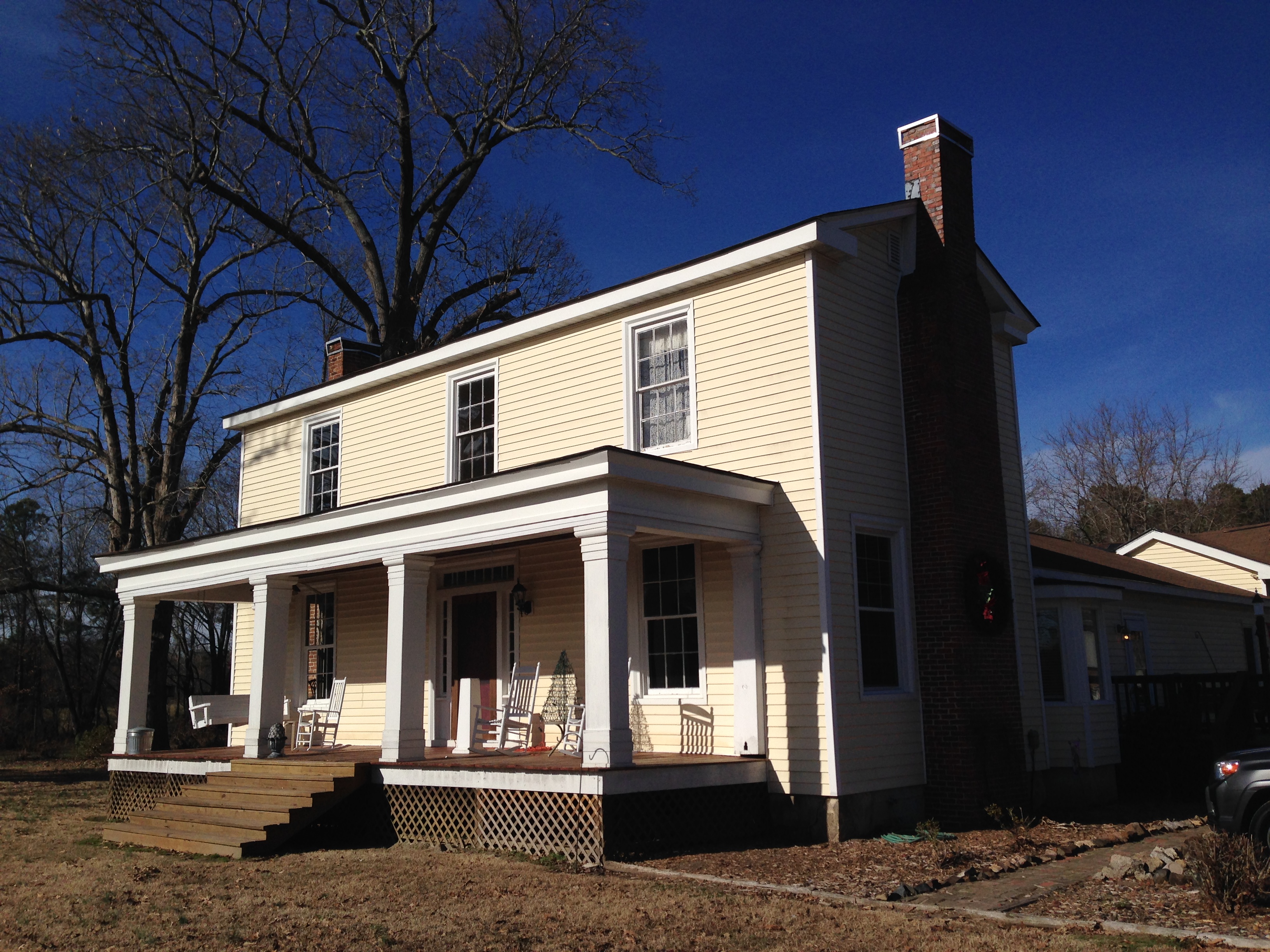
Taylors lived on the land well into the 20th century. In the 1980s, B.B.’s parents bought the house and surrounding acreage and set about repairing and renovating the abandoned dwelling, which looked like this:

IMG_4804

As set forth in Richard L. Mattson’s The History and Architecture of Nash County, North Carolina, “[t]his Greek Revival house symbolizes the role of the Taylor family in the early settlement of the Whitakers vicinity. It was built in the 1850s, probably by Kinchen Carter Taylor, whose father (also Kinchen Taylor) may have occupied a house (demolished) across the road. … Though deteriorating, this house remains one of Nash’s finest examples of the vernacular Greek Revival. The facade includes such notable features as end chimneys with tumbled-brick shoulders, moulded gable returns, and heavy square porch columns with simple square capitals. The central-hall plan is entered through original double doors framed by sidelights and transom. The rear kitchen ell, which may have been moved up to the house at a later date, includes an engaged porch, close eaves, and a nine-over-six windows. … The house stands at the northwest corner of Taylor’s Crossroads. Located well back from the road and shaded by a cluster of oak trees, the Kinchen Carter Taylor House still evokes the image of the plantation seat it once was.”

A.B. warmly welcomed me when I pulled up beside the house. She graciously shared not only the photo above, but a map drawn by Kinchen C. Taylor’s nearly 100 year-old grandson that showed the locations of surrounding outbuildings, groves and pastures. Where possible, the character of the original house has been preserved in its interior, and I could not help but wonder if my Taylors, Green and Fereby, who had belonged to Kinchen C.’s father, had ever walked where I did. Even if not, they surely knew this house and were intimately familiar with its inhabitants.
IMG_4813

Many thanks to Mark Bunn for alerting me that this house is still standing and putting me in touch with its owners and to them for opening their doors to give me a glimpse of my family’s world.
Standard
Other Documents

Passed over. (Or laying low.)

A running list of people missing from census enumerations (and the places I expected them to be):

Margaret Balkcum Henderson — 1850 Sampson County NC.

Nancy Balkcum — 1850 Sampson County NC.

Lucinda Nicholson — 1870 Iredell County NC.

Harriet Nicholson — 1870 Iredell County NC.

Walker Colvert — 1870 Iredell County NC.

John W. Colvert — 1870 Iredell County NC.

Daniel Artis — 1870 Greene County NC.

Mollie Henderson Hall Holt — 1900 Wayne, Randolph or Alamance County NC.

Louella Henderson King Wilson — 1900, 1910, 1920 Wayne County NC.

Adaline Hampton Colvert and daughters Selma, Henrietta and Ida Colvert — 1900 Statesville NC.

Hillary Simmons and children Minnie, Daniel and Dollie Simmons — 1900 Wayne County NC.

Minnie Simmons Budd — 1900 Wayne County NC; 1910 Wayne County NC or Philadelphia PA.

Alfonzo Pinkney Artis — 1910 Wayne County NC; 1920, 1930, 1940 Baltimore MD.

Ardeanur Smith Hart — 1910, 1920 Iredell County NC.

James G. Smith, alias McNeely — 1910, 1920 Iredell County NC; 1940 Guilford County NC.

Augustus Artis — 1920 Pulaski County AR.

J. Thomas Aldridge, alias Aldrich — 1920, 1930, 1940 Saint Louis MO.

Brothers Lucian and Jesse Henderson, alias Jacobs — 1930 Wilson NC.

Julia Holmes Jones — 1930 census, Orange NJ.

Janie McNeely Taylor — 1940 Statesville NC or Columbus OH.

Minnie McNeely — 1940 Columbus OH.

Frances McNeely Green — 1920 Statesville NC; 1940 Statesville NC or Columbus OH.

Sarah M. McNeely — 1920 Statesville NC.

Charles E. McNeely — 1920 Statesville NC; 1940 New York NY.

William M. McNeely — 1920 Statesville NC; 1940 New York NY.

Irving McNeely Weaver — 1920 Statesville NC.

Elethea McNeely Weaver — 1920 Statesville NC. [Seriously. What was with the McNeelys and the 1920 census? Were they all living in one uncounted household?]


Standard
Education, Newspaper Articles, North Carolina, Paternal Kin

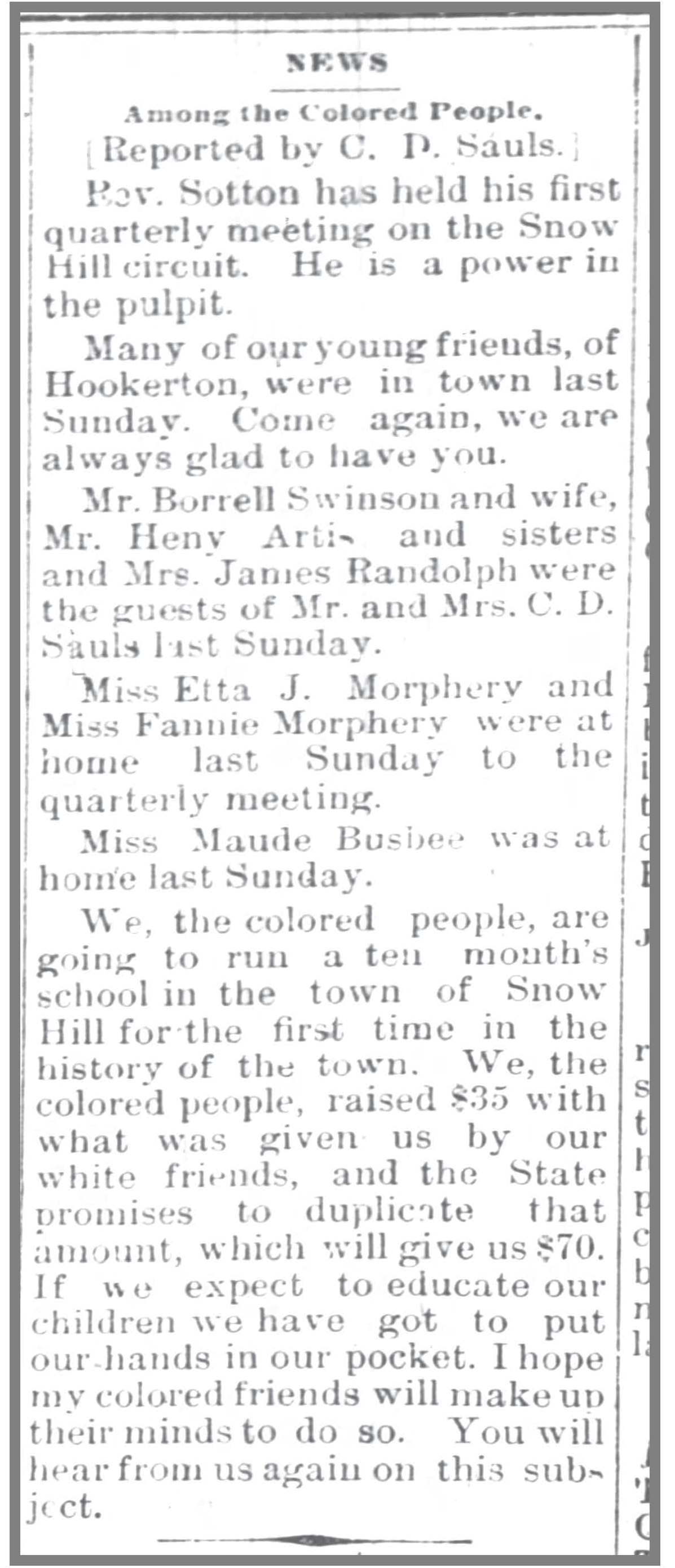
We, the colored people, are going to run a school.

Great_Sunny_South_2_25_1898

The Great Sunny South (Snow Hill), 25 February 1898. 

Cain D. Sauls revealed his civic commitment in this edition of his newspaper column. I need to research whether the efforts to fund and establish a ten-month school were successful.

(By the way, C.D.’s guests were primarily his relatives: first cousin Henry Artis Jr. and his sisters and first cousin Hannah Artis Randolph.)

Standard
Free People of Color, North Carolina, Oral History, Paternal Kin, Photographs

Collateral Kin: the Carters.

One of the most rewarding results of my decades of genealogical sleuthing has been the development of a deep connection with many of my Carter cousins, descendants of Milford and Beulah Aldridge Carter. My grandmother talked often of the Carter family, to which she was connected both via the Aldridges and “Papa” Jesse Jacobs, who was Milford Carter’s uncle.

The Carters looked ‘bout like white folks. I didn’t really know all of  ‘em. I think it was nine of them boys. The three I knew was Milford and Johnnie and Harold, I think. They used to come to Wilson, but the older one [Willoughby] didn’t come up. But Milford, Harold — the two youngest ones come over and stayed with Annie Bell [Jacobs Gay, Papa’s daughter.] Johnnie – and Freddie, too.   When I’d go to Uncle Lucian’s, they lived not too far from there. But I never went to their house. I think Harold was the youngest one. ‘Cause that’s the one came to Wilson, and Albert, Annie Bell’s husband, got him a job down to the station driving a cab. And he got his own car, and he was down there for a long time. Harold. He’s the youngest one. Carter. All of them was great big.

There were indeed nine Carter brothers — Willoughby (1880), Ammie (1881), Freddie (1890), Milford (1893), Granger (1895), Lippman (1898), John Wesley (1899), Harold (1903) and Richard (1906) — plus a sister Florence (1887). (Florence’s son William Homer Camp Jr. married Onra L. Henderson, Beulah A. Carter’s niece and my grandmother’s double cousin.) The brothers were born in Sampson and Wayne Counties to Archie Marshall (or Marshall Archie) Carter and Margaret Frances Jacobs, sister of Jesse A. Jacobs Jr. Marshall Carter (1860-1926) was the son of William and Mary Cox Carter of Sampson County. (My grandmother also spoke of Marshall’s sister, Virginia Ann “Annie” Carter, who married Hardy Cox and was a close friend of “Mama” Sarah Henderson Jacobs Silver.) William Cox (1833- ca. 1875) was the son of Michael Carter (ca. 1805-ca. 1875) and his wife, Patience.

As attached as Papa was to my grandmother, he did not take her with him on visits home to Dudley, very likely in deference to the feelings of his nephew’s wife Beulah, who had little use for the child her brother Tom fathered out of wedlock.

When Papa was living, he used to go to Dudley down there to the mill where they ground corn and all down there.   They’d carry him around down there on horse and buggy, wagon, whatever it was. He was their uncle. Their mama’s brother. He’d go there every once in a while. But he didn’t never say nothing ‘bout taking me down there with him. I guess ‘cause Beulah, Milford’s wife, was my daddy’s sister, but she was kind of cool toward me. And he know he wasn’t gon carry Mamie.  So we didn’t never get to go down there with him. 

Early in their marriage, Beulah and Milford Carter lived in Wilson in a small house on Green Street whose yard touched those of Milford’s uncle and first cousin Annie Bell. The Carters’ second child, son Dewey Belvin, who died before his second birthday, was born during their short stay there.

Beulah stayed in Cora Miller’s house there on Green Street. A little house down there ‘cross from where we were staying, first house behind the church, near ‘bout on the corner there. And she and Milford were there.

After a few years shifting between Wayne to Duplin Counties, Milford moved his family north to Coatesville, Pennsylvania, and then New York City — first Brooklyn, then Queens — where he pursued a long career as a chef.

OLYMPUS DIGITAL CAMERA

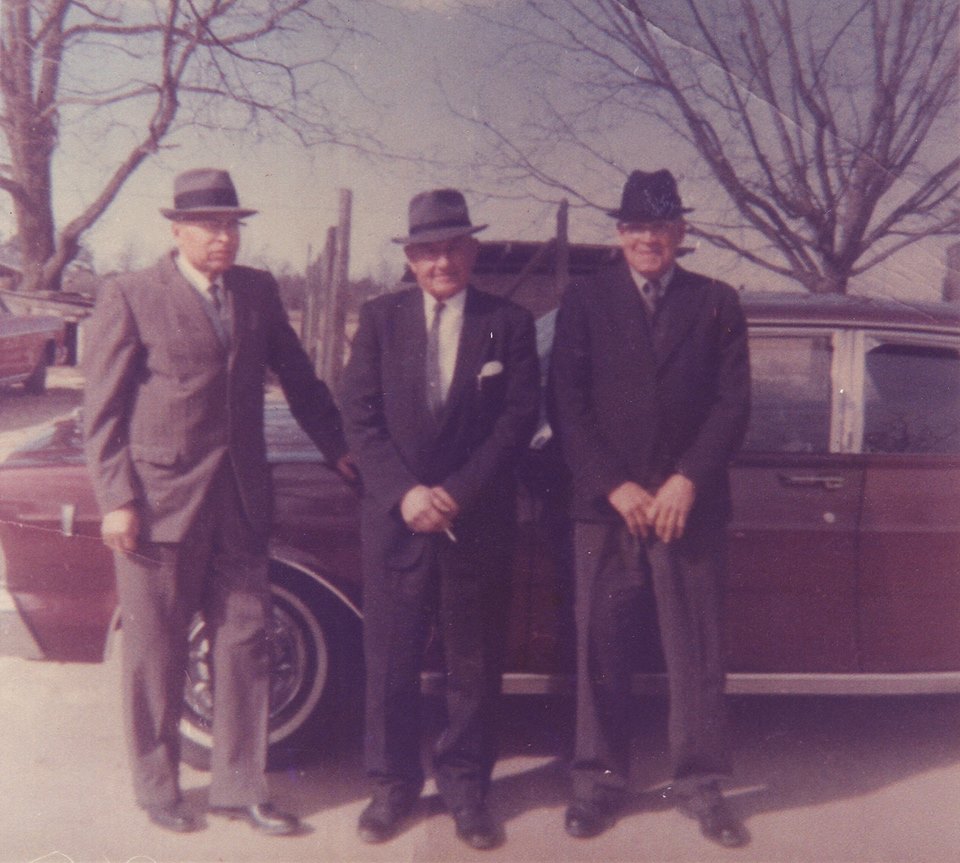
Milford E. Carter, during his time as a chef at H. Hicks & Son, 30 West 57th Street, New York City.

Freddie, Freddie was the one that went to Atlanta for a year and day. Moonshine. And Johnnie was fat. And rosy. Like, you know, like if somebody say like, seeing a baby and say that it was “oh so fat, look like you pinch they cheek the blood pop out?” And just fair, and just that red look.

Johnnie Carter was also the brother that cared for my grandmother’s great-uncle, J. Lucian Henderson, and his wife Susan Henderson in their final infirmity. In June 1934, John W. Carter was named administrator and sole legatee of Lucian’s estate. Johnnie and his family lived near Lucian just west of Dudley, but I am not sure of the genesis of their close relationship.

The Carter boys was always nice. They come up here, come to stay with Annie Bell, Papa’s youngest daughter. They wasn’t here at the same time. They was driving cabs. So they used to come over all the time. I went with Harold down to Dudley once ‘cause he was going and coming back that same day. See, Uncle Lucian was sick, so I went down with him and come back.

1780668_10151973289313527_579699652_n

1911665_10151973293123527_1534360898_n

Top: John, Ammie, Wesley (a cousin), Richard, Granger, Richard Jr. and Harold Carter; bottom: Milford, John and Harold Carter; both 1955. Copies of photos courtesy of Dorothy Carter Blackman and Daniel M. Carter.

Interview of Hattie H. Ricks by Lisa Y. Henderson; all rights reserved.

Standard
Births Deaths Marriages, Maternal Kin, Photographs

Family cemeteries, no. 14: Pleasant Shade.

Cardinal direction can be difficult to gauge on a peninsula, but you leave my late grandmother’s house in Newport News headed west (I think) on 35th Street. After a couple of blocks, you’ll cross Chestnut Avenue, and the street becomes Shell Road. You are now in Hampton, and a cemetery is on your left. Don’t turn at the entry to the first part — that’s white. Go down a little further to the second — Pleasant Shade.

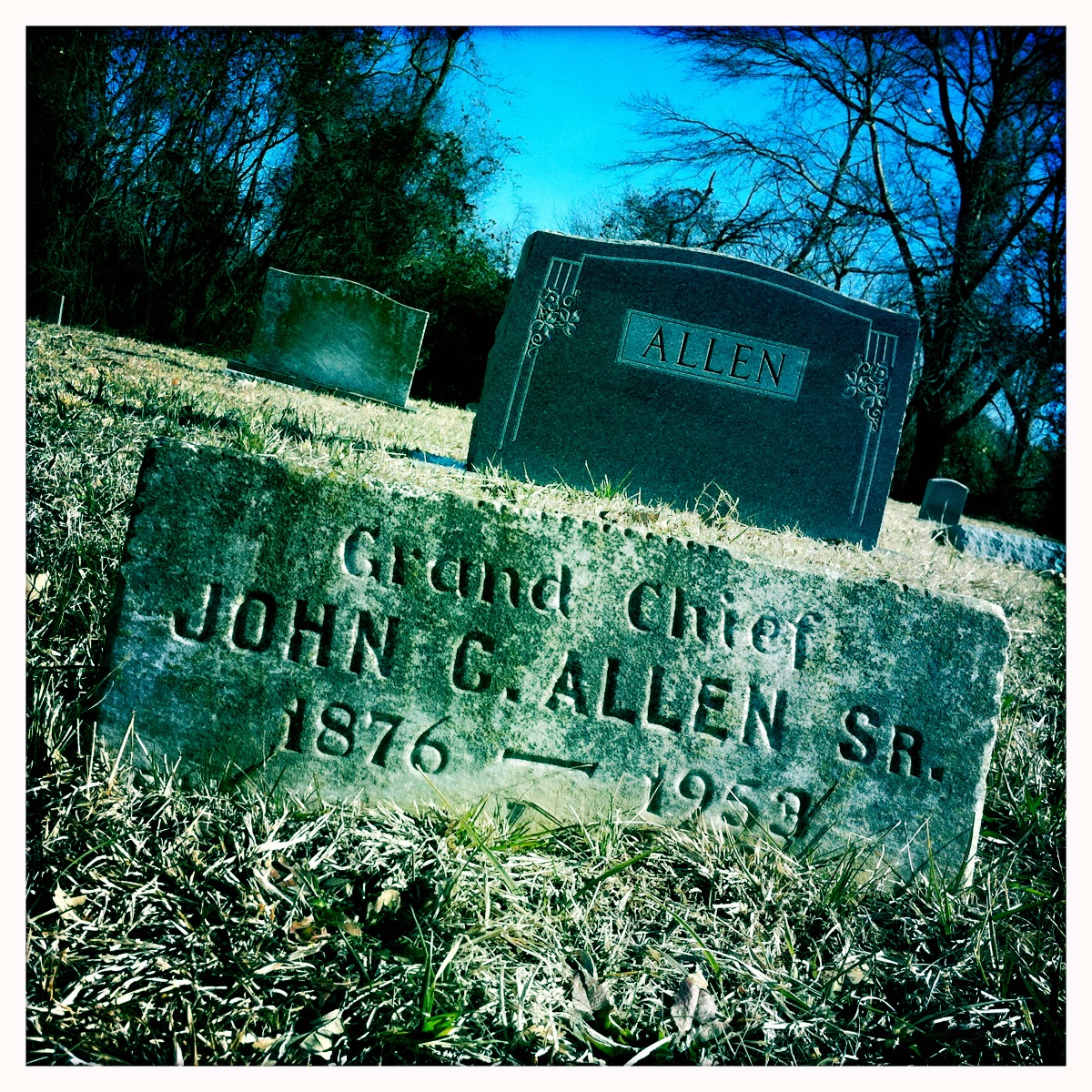
Pleasant Shade is, according to founder James East’s headstone, “the first cemetery to be operated and controlled by colored people in Tidewater Va.” My mother’s parents, John C. Allen jr. and Margaret Colvert Allen; her paternal grandparents, John C. Allen Sr. and Mary Holmes Allen; and her aunt Marion Allen Lomans are buried there.

I have never seen it looking wild (though it often feels desolate), but Pleasant Shade’s condition warranted the formation in 2011 of a restoration group. Its website mentions my great-grandfather John C. Allen Sr. among notable burials. Even had it not, I obviously need to contribute.

IMG_1275

IMG_1286

Photos by Lisa Y. Henderson, February 2011.

Standard
Newspaper Articles, North Carolina, Paternal Kin

A warrant charging forgery.

Shortly after my grandmother’s birth in the summer of 1910, her father, J. Thomas Aldridgedecamped for Shaw University.  Dudley’s colored school went only through eighth grade, so Tom, already in his mid 20s, had to start in Shaw’s preparatory division. (He shaved ten years of his age the rest of his life.) The family’s pride and joy, Tom was the first to pursue higher education. Near the start of his second year, however, Tom was arrested for forgery.  Ever vigilant for stories that cast colored people in a negative light, the story was picked up by newspapers across eastern North Carolina, no doubt amplifying his humiliation.

Wilmington_Dispatch_11_8_1911_Forgery

Wilmington Dispatch, 8 November 1911.

Image

Clinton Caucasian, 9 November 1911. 

Wilson_Daily_Times_11_10_1911_Tom_Aldridge_forgery

Wilson Daily Times, 10 November 1911.

I don’t know the outcome of the prosecution. Presumably, Tom, at least, was not convicted. He is listed as an enrolled student at Shaw University each year from 1911 through 1917, as he worked his way through its preparatory and undergraduate divisions. (Early in his studies, Tom changed the spelling of his name from ‘Aldridge’ to ‘Aldrich.’ I don’t know why.) After Shaw, he went on to Meharry Medical School in Nashville, his brush with the law far behind him.

T Aldrich Register

Sahw Register

37th Annual Catalogue of the Officers and Student, Shaw University, 1911.

Standard
Business, Newspaper Articles, North Carolina, Other Documents, Paternal Kin

Demanded possession of the body.

Wilson_Daily_Times__8_12_1921 Batts & Artis

Wilson Daily Times, 12 August 1921.

This terrible dispute over the body of a dead 12 year-old girl took place in the early days of C.E. Artis‘ first undertaking business, Batts & Artis. The death certificate of Martha Lucas, who died of peritonitis, shows that Darden & Son prevailed.

S123_124-1585

Standard