Births Deaths Marriages, Civil War, Enslaved People, Other Documents, Photographs, Virginia

Has the old fuss died out yet?

Here’s another account of Joseph Holmes‘ murder, presented as a pivot point in the romanticized life of the author’s father:

When Jim Wilkes rode into Raft River Valley in 1870, he had two pasts behind him though he was barely twenty-one. His real name was Griffin Seth Marshall. He had called himself Jim Wilkes only since a spring evening in 1867 when an incident in a Virginia village had sent him into exile as a fugitive from the law.

I heard the story from Mother — I am the daughter of Kate Parke and Griffin Marshall. Father wouldn’t have considered it suitable for a little girl, but Mother had no such qualms. Mother had a strong sense of drama, and for her the story was the thing.

“Your father changed his name,” she told us, “because he got in trouble back home and had to leave the country. He never done anything. No indictment was ever found” — Mother was careful to insert the formal, exonerating phrase — “but he was in a crowd one night with his brother John and this colored man was killed. He’d been a slave of your grandfather’s before the war, so when he was shot they thought the Marshall boys had something to do with it. There were soldiers there, northern soldiers, but your father and his brother got away. They left the country that same night — without even saying goodbye to their mother. That was when they changed their name. That’s History,” Mother would add, as she usually did when she told us a story about the early days. “Do what you will with it.”

The time came when I visited the Virginia village. And I discovered not only that every word of Mother’s account was true, but that the full story was adorned with details and a couple of postscripts that would have delighted her.

THE NAME of the village is Charlotte Court House and it is the seat of Charlotte County. It’s the courthouse, built in 1823, is a handsome building of red brick, with a white portico and four white columns overarched by venerable trees. Before the courthouse on an evening is the spring of 1867 a crowd had gathered to listen to a speech. The speaker was a Negro, who was able to make a speech only because Federal troops were camped in a grove of trees across the street. His name was Jo Holmes. He had been a slave, the butler of Judge Hunter Marshall whose plantation Roxabel was five miles from the village. Now Jo Holmes was not only a free man but also a member of the Virginia legislature. Jo Holmes’ podium was the slave block that still stands at the point where the walk from the courthouse joins the street. According to the local story, he was advocating mixed marriages. He didn’t get very far with his speech. A shot was fired and Jo Holmes fell dead. The bullet, I was told is buried in the front wall of the courthouse.

In the crowd were my father and his older brother John who were home on vacation from Clifton Academy in Fauquier County. John had been in the Confederate cavalry. (Their oldest brother Hunter had been killed in the Civil War — four days after Appomattox.) Griffin, who was only seventeen, had been too young to go to war. With them was cousin David Morton, actually a second or third cousin, and a friend named Fred Beal.

The shot that killed Jo Holmes came from the part of the crows where the four young men were standing. One of the four did fire the shot — then slipped the gun into the hand of a friend who threw it into the creek that runs through the hollow beside the courthouse. The Federals came running, but before they could get to the scene the four boys had made their escape with the help of relatives and friends. They were hidden for several hours in a house in the village. Before dawn they were driven to Pamplin, the nearest station on the Norfolk and Western Railway, and put on a train headed west.

The four fugitives soon parted. A letter from Griffin to his older sister Mary dated May 29,1867 — I got it from the daughter of Father’s sister — shows that he and John had been commended to the care of people named Taylor in country that might be Texas. There is no mention of the other two boys. The letter is written on a piece of stationery embossed in the upper left-hand corner with the head of an Indian and, beneath it, the legend “N.P. Co.”; but there is no place name on the letter and the envelope is missing. It reads as follows:

May 29, 1867

My Dear Sister: You must really excuse me for not writing to you sooner but I have been sick nearly ever since I have been here and the other part of the part of the time I didn’t feel like writing. I haven’t had anything to do at all- we have been waiting for Mr. Taylor’s son to come down here- but he has been sick and is now worse and probably never will be able to come. The old man said that he (his son) could get better situations than anyone else and advised us to wait for him and of course as we are under his care we took his advice and are now waiting to see what is going to turn up. Mr. T. Sr. went up to see about his son yesterday and we are expecting him back every day. Morgan is well and in pretty good spirits, but I am not in good spirits. I am getting tired of doing nothing and paying board.

This is the hardest country I ever saw; there isn’t a tree of any consequence in two hundred miles of this place. One day it is hot as five hundred (this was a simile my father often used) and the next day you can’t wrap up and keep comfortable-now today it is very hot. I wrote to Ma some two or three days ago; tell her to write to me and that often. Has the old fuss died out yet or not? I am very anxious to know the effect that thing produced. I haven’t got anything to write about and I am going to stop. Give my love to Bee Jim and all at Roxobel and regards to all of my friends and write soon to your affectionate Brother

The handwriting is the same that appears in two letters Griffin had written to his mother a few months before from Clifton Academy, but the writer signs himself not “G. S. M.” or “G. S. Marshall” as in the earlier letters but “J.T. Wilkes.” The “Morgan” he refers to can only be his brother John. “I never understood,” said my cousin Sarah when she handed me the worn sheet, “what a letter with that strange signature was doing in Mother’s papers.”

I once asked my father who killed Jo Holmes. He replied only it was not he.

— An American Memoir, Margaret Marshall, originally published in The Hudson Review, volume 24, number 2 (1971).

—–

Gawd.

I could pick at the details of this account — starting with the date of the letter, a full two years before Joseph Holmes was actually killed — but what’s the point? It is so obviously unconcerned with Joe Holmes — “delightful postscripts”? — or his life that accuracy is too much to ask.

This photo is found among literary editor Margaret Marshall’s papers in the Yale Collection of American Literature, Beinecke Rare Book and Manuscript Library, Yale University:

Roxabel Margaret Marshall papers

It is labeled “Roxabel.”  This is either a photograph of the back of the house, which has been much modified if it is, or is mislabled. It certainly does not match Marshall’s white portico-and-columns description. (That’s a shed roof porch with posts.) Further, Roxabel is still standing, and I’ve been there. It’s used primarily as the background for tasteless plantation-themed weddings these days, but was mercifully still when I drove up with Kathy Liston, a Charlotte County archeologist-cum-genealogical researcher who opened many a door, literal and figurative, for me in my quest for Jasper and Joseph’s roots. With a wing added long after the Marshalls left, here is Roxabel today:

IMG_9982

If Joseph R. Holmes was enslaved here, was his brother Jasper as well? Or had they been separated early, Jasper perhaps sold locally as excess or to settle a debt. I don’t know. But I do know that, emancipated in 1865 and at least free to build a relationship on their terms, the brothers’ bond was sundered forever by a rash pistol shot.

Standard
Births Deaths Marriages, Free People of Color, North Carolina, Other Documents, Paternal Kin

A Seaberry clue.

Back in December, I went on a hunt for Artis cemeteries in the Eureka area. One that I found, just south of the others, holds the remains of William M. Artis and his family. Today, while I was sorting old documents, I ran across William’s death certificate. His place of birth, which I’ve surely read a hundred times, seized my eye:

Wm_Artis_Death_Cert-1

“Family (Seabury)”? Was this graveyard originally the resting place of William’s maternal great-grandfather, Aaron Seaberry, who died just after 1910? Are there other Seaberrys here, including William’s mother Frances Seaberry Artis? (Who was erroneously referred to as Frances Hagans above. “Hagans” was her mother’s maiden name and the surname of her half-brother Napoleon Hagans. William’s age is off, too. He was 70 when he died.)

Standard
Civil War, Free People of Color, Land, North Carolina, Other Documents, Paternal Kin

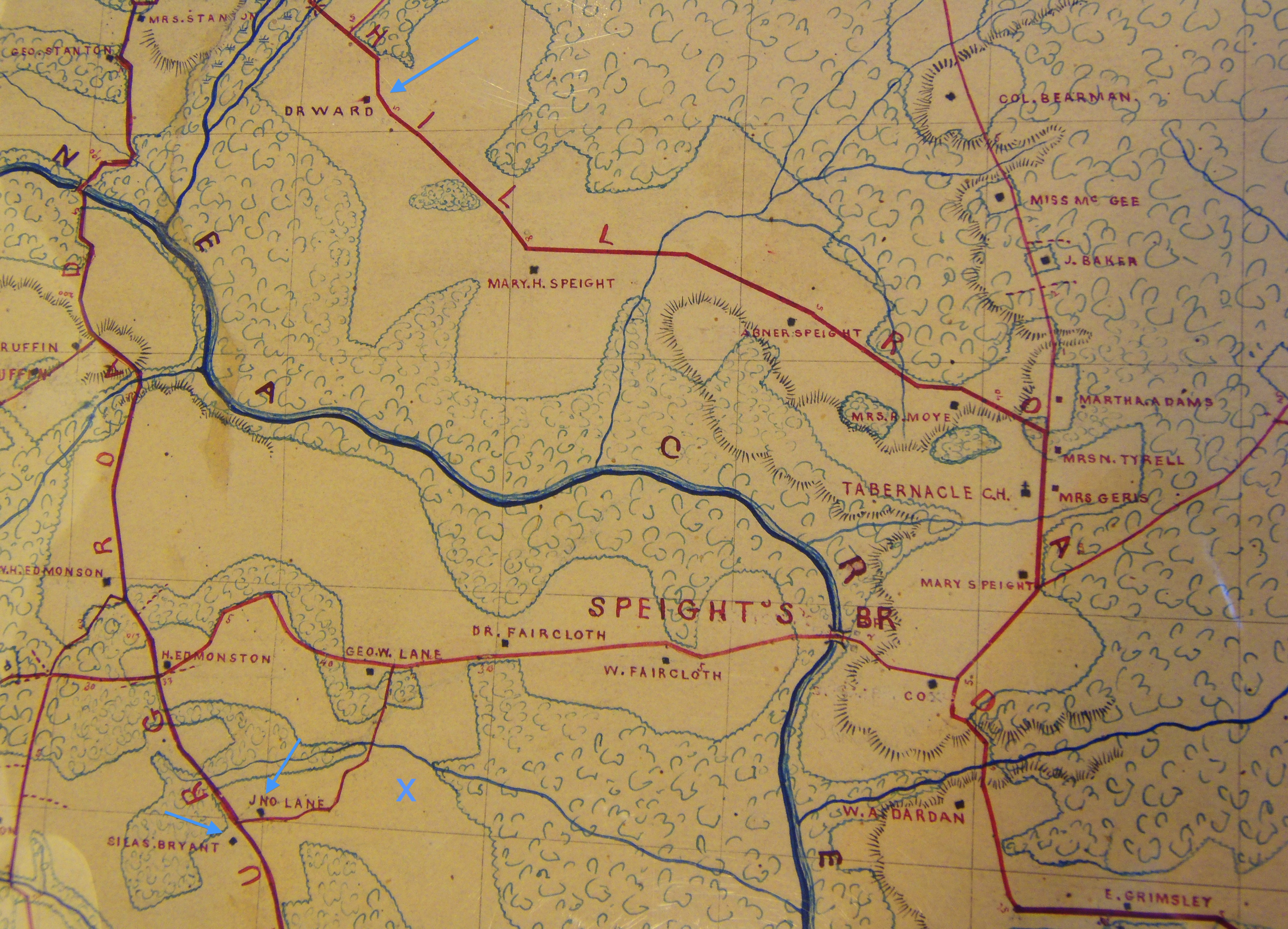
Map, in color.

Last time I was at the North Carolina State Archives, I went looking for the original of this Confederate field map. I didn’t find it, but Trisha Blount Hewitt did.

OLYMPUS DIGITAL CAMERA

Dr. David G.W. Ward’s plantation is just below Stantonsburg at the top, and Silas Bryant and John Lane’s farms — where the Artises were apprenticed — are bottom left. X marks the approximate spot of the Artis Town cemetery.

More thanks to Trisha.

Standard
Births Deaths Marriages, Free People of Color, North Carolina, Paternal Kin

Collateral kin: the Halls.

I was a child plagued by respiratory illness and nearly every winter endured a tough bout with bronchitis. When the worst was over, and I was in a recuperating stage, my mother returned to her teaching job, and I sometimes spent a few days at my Aunt Mildred’s house one street over.

Mildred Henderson Hall was not really my aunt. She was my grandmother’s first cousin, daughter of her uncle Jesse “Jack” Henderson. During my grandmother and father’s childhoods, Uncle Jack and his children were the only nearby Henderson relatives. By time I came along, Mildred, her youngest sister Doris Henderson Ward and some of their children were the only other Hendersons left in Wilson. Mildred’s youngest daughters were still at home when I was child, and I grew to know them and the younger of their two brothers best.

I loved my brief stays at Aunt Mildred’s, wrapped in blankets and installed on the couch in her wood-paneled den, drowsing before the television while she handled calls related to the family business. Occasionally, I got a glimpse of the teenaged Patricia, impossibly glamorous in my eyes, leaving for school. More often, Aunt Mildred’s husband, Louis Hall, would stop at home between jobs. He was not a tall man, but he seemed to me a big one. In later years he had a belly, but I think my impression came more from his persona than his actual size. He had a warm smile and a ready laugh, and I, who had no living grandfathers, was drawn to him.

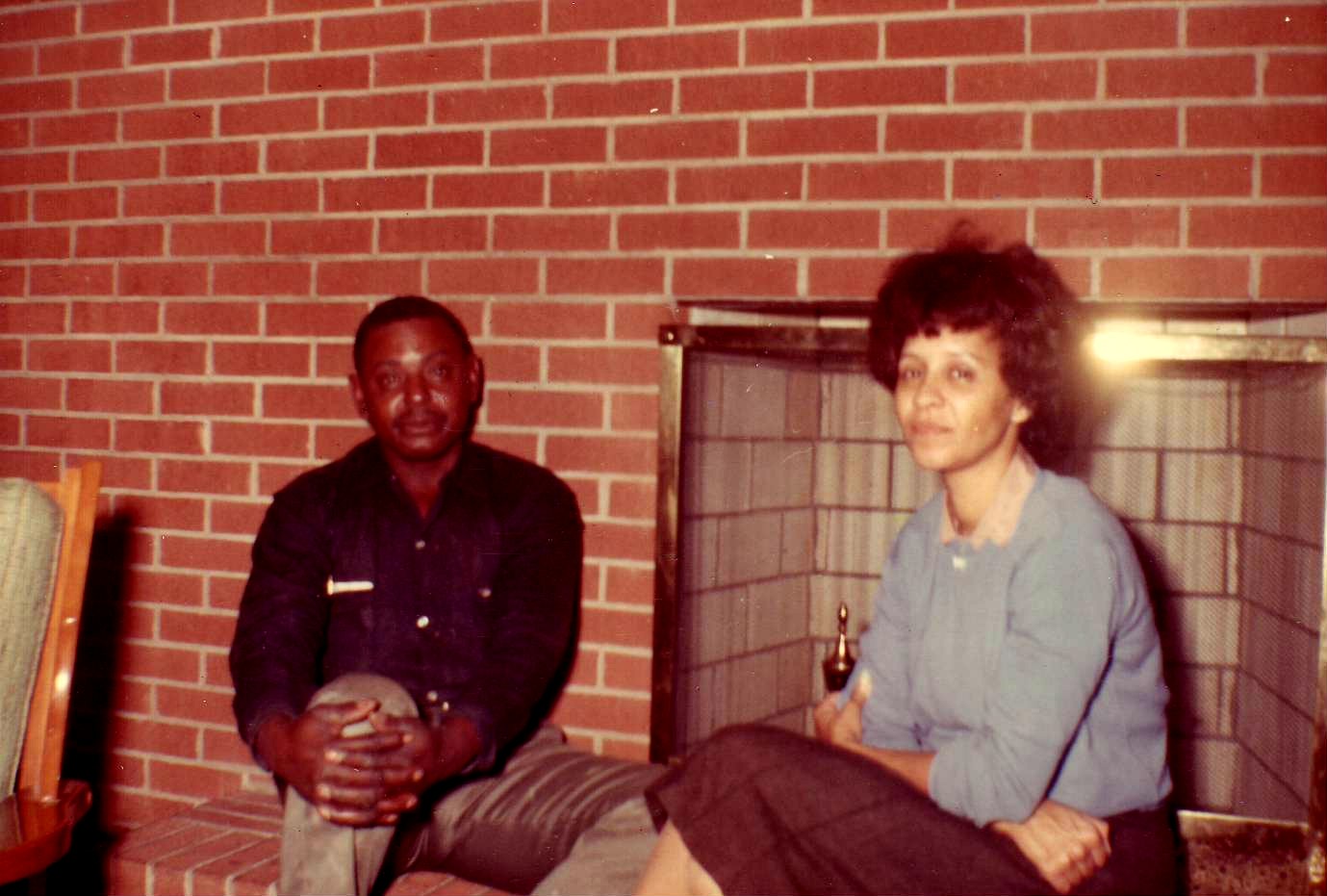
Louis & Mildred Hall fireplace

Louis and Mildred Henderson Hall at home, probably mid-1960s.

Years later, as I researched a thesis examining the involuntary apprenticeship of free children of color, I grew familiar with all the free families of color in Wilson and Wayne Counties. I came upon a set of Halls from the Stantonsburg area and, curious, traced them forward. I was delighted to find that Uncle Louis was descended from this very family. Years after that, I was even happier to be able to provide my Hall cousins with rare documentation of their antebellum forebears’ births.

The family’s earliest known ancestor was Eliza Hall, a free woman of color born about 1820, probably in what was then the heel of southwest Edgecombe County. How she met James Bullock Woodard, a prosperous white farmer and slaveowner, is unknown, but by Eliza’s early 20s they had begun a relationship that would last at least a decade. A sympathetic relative of Woodard’s, perhaps feeling that blood is blood, recorded the births of James and Eliza’s children in her family’s Bible:

Ages of The children of Eliza Hall

William Henry Hall was born Feb the 11th 1844 Patrick Hall was born October the 6th 1845 Margaret ann Hall was born Feb the 12th 1847 Louiser Hall was born April the 9th 1849 Balam Hall was born Feb 7th 1851

William H. Hall lived and farmed near Stantonsburg, Wilson County, most of his life. He married three times — to Lucy Barnes, Annie E. Smith and Mamie Artis — and had at least nine children. His fifth, more or less, was Robert Hall, born 18 July 1886. When Robert was about 4 years old, his father sold to trustees the quarter-acre of land upon which Bethel African Methodist Episcopal Zion Church was founded. William H. Hall spent his last years living in his son Robert’s household and died 23 June 1925.

On 7 January 1908 in Wilson County, Robert Hall married Katie Farmer, daughter of Robert and Marenda Bynum Farmer. (And Katie’s sister Ida married Robert’s brother Thomas Hall.) Robert supported his large family as his father had done, by farming. Uncle Louis, born in 1920, was Robert and Katie Hall’s fifth child. He and Aunt Mildred reared six children on Queen Street in Wilson as they built East Carolina Vault Company, a family-owned business that now employs third-generation Halls.

Wilson County is a small world of criss-crossing family lines, and Uncle Louis was not the only descendant of Eliza Hall that I knew. Once, I saw my cousin (his daughter) hugging my geometry teacher at the mall. They, in fact, are first cousins. Another of their first cousins was the assistant principal at my high school. And as I prepared this blogpost, I ran across a marriage license for a daughter of William H. Hall’s brother Balam and one of my cousins, Snow B. Sauls.

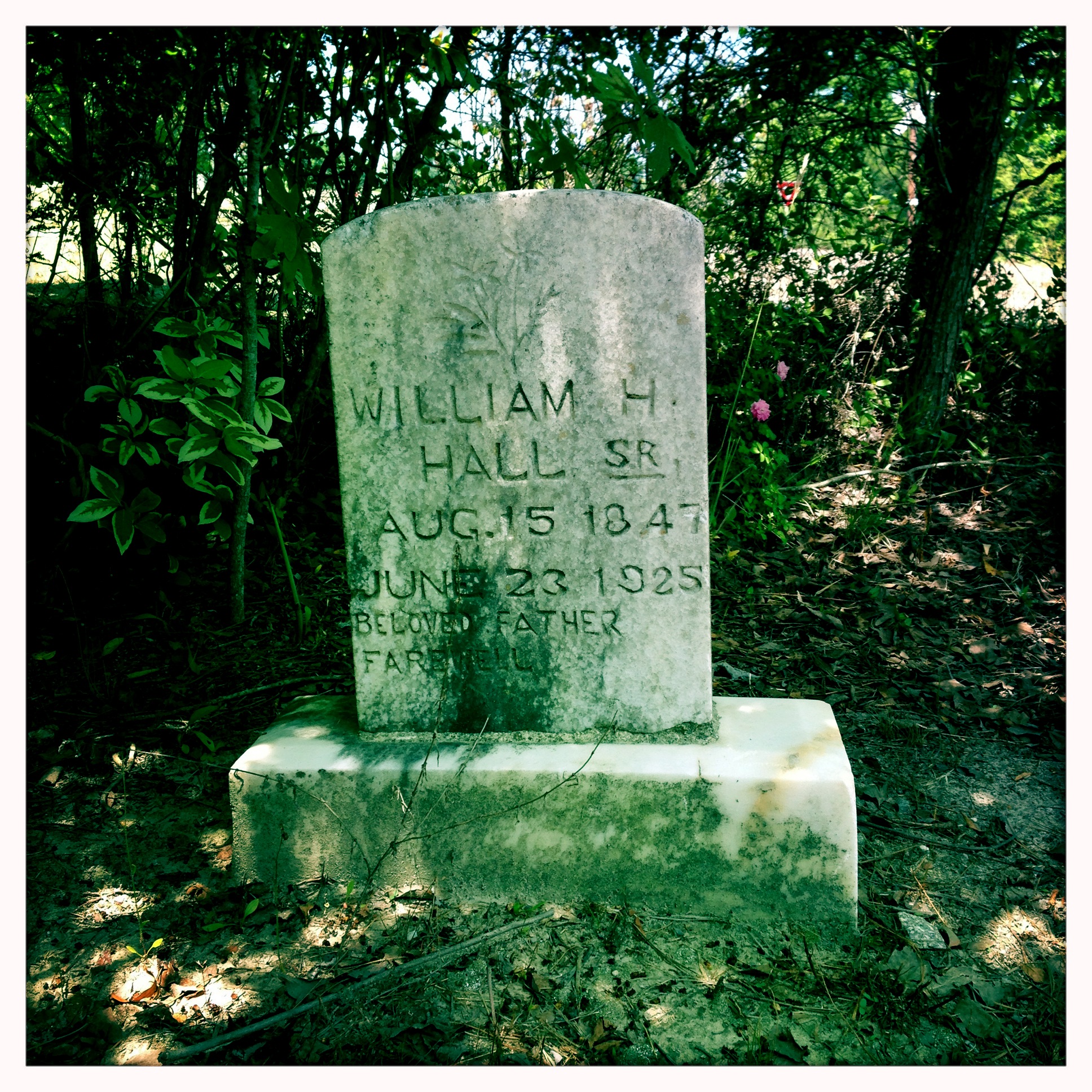
IMG_2194

William H. Hall is buried in the cemetery of the church he helped establish.

Photographs from collection of Lisa Y. Henderson; excerpt from Lewis Ellis Bible courtesy of Henry Powell; sources include birth and death certificates, World War I draft registration, deeds.


Standard
Civil War, Free People of Color, Newspaper Articles, North Carolina, Paternal Kin, Politics

He would be murdered if he did not cease.


Weekly Standard Raleigh 5 6 1868 Jacob Ing

Raleigh Weekly Standard, 6 May 1868.

Jacob Ing’s radical ideas surfaced well before Reconstruction. As made clear in his last will and testament, he had a long relationship with a free woman of color named Chaney Jones (also known as Hester or Easter Jones) and fathered several children for whom he provided. One, daughter Lucinda, was the first legal wife of my great-great-great-grandfather Adam T. Artis.

[Small world: Jacob Ing witnessed the last will and testament of Reubin Taylor of Nash and Edgecombe Counties and served as executor of the estate of Reubin’s sons Dempsey and Kinchen Taylor, who owned my great-great-grandparents.]

Standard
Births Deaths Marriages, Enslaved People, Maternal Kin

Jasper Holmes.

All this (much-deserved) shine on Joseph R. Holmes, but he is not my direct ancestor.  What do I know about Jasper Holmes?

  • Jasper Holmes was born about 1841 in Charlotte County, Virginia. He was probably the son of Payton and Nancy Holmes, who are listed on his brother Joseph’s death certificate. His step-father may have been Walter “Wat” Clark.
  • Circa 1862, presumably in Charlotte County, Jasper married a woman named Matilda, who is nearly a complete enigma. Though she is consistently named in census records, her children’s birth certificates call her Matilda, Mary and Ellen. I have never found her and Jasper’s marriage license, nor is her maiden name listed elsewhere. She died 26 July 1885 in Charles City County, Virginia, and her death certificate lists her place of birth of Charles City County, but this is doubtful.
  • Jasper and Matilda’s first child, Robert Holmes, was born about 1863, probably in Charlotte County.
  • Tax records filed in Charlotte Court House for 1866 list Jasper Holmes in District #2 (T.M. Jones, revenue commissioner) and paying one black poll tax.
  • Charlotte County tax records for 1867 show that Jasper had moved to District #1, Charles W. Harver, commissioner, and was living at J.A. Selden’s. He paid one black poll tax.
  • Second child Walter Holmes was born about 1867, probably in Charlotte County. He presumably was named after his step-grandfather.
  • Third child Angelina “Lina” Holmes was born about 1869, probably in Charles City County.
  • On 3 May 1869, Jasper’s brother Joseph R. Holmes was shot dead at Charlotte Court House while asserting the rights of a freedman against a former slaveowner. Around this time, whether in direct response to this terrible crime or not, Jasper and his family, as well as his mother and stepfather’s family, moved more than 100 miles east to Charles City County.
  • In the 1870 census of Harrison, Charles City County, Virginia: in Wilsons Landing post office district, Jasper Holmes, wife Matilda, and children Robert, 7, Walter, 3, and Angeline, 1, plus William Jones. (Was Jones a relative, perhaps of Matilda? Thomas and Louisa Jones and family lived next door.)
  • Fourth child William Holmes was born in 1872 in Charles City County.
  • On 4 Apr 1873, Jasper Holmes filed a deed (book 12, page 483) at Charles City County Courthouse for the purchase for $5 of 10 acres in the Mill Quarter tract from A.H. Drewry et ux.  The sale took place 18 Feb 1873.
  • Fifth child Joseph Holmes was born in 1874 in Charles City County. He was named after his uncle, Joseph R. Holmes.
  • On January 20 and 21, 1875, William and Joseph Holmes died of whooping cough.
  • Sixth child Emma V. Holmes was born about 1876 in Charles City County.
  • Seventh child Mary Agnes Holmes, my great-grandmother, was born 15 October 1877 in Charles City County. Her birth certificate notes that the family lived at R.L. Adams’ place.
  • On 20 Jan 1879, Jasper Holmes filed a deed (book 12, page 332) at Charles City County Courthouse for the purchase on 16 Oct 1878 of 9 acres from Robert L. Adams et ux.  The tract was bordered by William Rolands, Robert L. Adams, the old breastworks or fortifications, and the old ditch.
  • Eighth child Martha “Mattie” Holmes was born about 1879.
  • In the 1880 census of Harrison, Charles City County: Jasper Holmes, wife Matilda, and children Robt., 19, Walter, 13, Lena, 10, Emma, 4, Agness, 2, and Mattie Holmes, 1.
  • A ninth child, an unnamed male, was born in 1880 in Charles City County. On 18 November 1880, that child died.
  • Tenth child Julia Ellen Holmes was born on 1 July 1882 in Charlotte County. [A second birth registration lists her year of birth as 1872, but she is not listed in the 1880 census.]
  • An eleventh child, unnamed, was born 26 July 1885 and died 2 September 1885.
  • On 26 July 1885, Jasper registered a death certificate for wife Matilda Holmes, who died in childbirth.
  • On 4 June 1886 (or 1887, there are conflicting duplicate records), son Walter died of consumption.
  • On 8 November 1886 (or 1887, there are conflicting duplicate records), daughter Angelina died of consumption.
  • On 30 Dec 1890, Alonzo P. Patterson filed a deed of transfer at Charles City County Courthouse for the transfer of 10 acres from Jasper Holmes to him.
  • On 7 Aug 1897, Jasper Holmes filed a deed at Charles City County Courthouse for the purchase of two lots, one 6 acres, the other 1 3/4 acres from A.H. Drewry et ux.
  • On 30 Dec 1899, at Charles City County Courthouse, the estate of Jasper Holmes, dec’d, filed a deed of transfer for 10 acres to Mary H. Allen and John C. Allen, her husband (my great-grandparents), and Martha H. Smith and Jesse Smith, her husband, all of Newport News VA; and Julia E. Holmes, unmarried, of Charles City County VA, heirs at law of Jasper Holmes.
  • On 10 Jan 1910, at Charles City County Courthouse, Mary Allen of Newport News VA and Julia Holmes of the City of New York, children and only heirs of Jasper Holmes, dec’d, filed a deed of sale for the sale of 10-acre and 6 3/4-acre parcels to James Clark for $300.
Standard
Enslaved People, North Carolina, Other Documents, Paternal Kin

Where did they go?, no. 4: Taylor.

Kinchen Taylor’s death in 1853 sent shockwaves through the community of enslaved men and women who labored on his plantation. In addition to more than 100 slaves, Taylor owned more several thousand acres of land in northern Nash County. Half of Taylor’s children were minors, and his slaves had to have known that the division and distribution of his property would wrench apart their community.

Taylor’s executors filed at least two inventories of his property, listing his slaves in no apparent order, but grouping mothers with their youngest children. My great-great-grandfather Green, about 38 years old in the 1856 inventory and valued at $750, is #30, while his wife Fereby and their oldest children Dallas, Peter and Henrietta are #88-91. Though some of Kinchen Taylor’s slaves were apportioned to Taylor’s adult children, most, including Green and his family, were placed in a pool to be later divided among the minors. Or sold for their benefit. (In the meantime, adults and older children were likely leased to nearby farmers who needed labor.) Inevitably, this estate division sundered families, and none could have known that freedom — and the chance to regather their kin — was just a decade away.

Who were the men and women that Kinchen Taylor enslaved? What became of them?  Using names culled from the estate papers, I present them here, in alphabetical order, with notes recording what I know.

——

Albert.  Valued at $1110.

Allen Sr. Valued at $1110.

  • “Allen Black” in list of slaves distributed to Kinchen Taylor’s son Benjamin Taylor. (This could be either Allen Sr. or Jr.)

Allen Jr.  Valued at $800.

Amanuel.  Valued at $870.

Amy and child Patience.  Valued at $510.

  • Amy and Patience included in lot of slaves distributed to Kinchen Taylor’s daughter Elizabeth Taylor.
  • In the 1870 census of Liberty, Nash County: at #334, Simon Taylor, 60, and wife Amy.
  • In the 1880 census of Whitakers, Nash County: Ned Taylor, 39, wife Silva, 35, and children Myra, 16, William Ann, 17, James, 12, Eddie, 5, Aron, 3, and Ernest, 1 month; plus Simon Taylor, 75, “father,” and Amy Taylor, 80, “mother.”

Ann/Anna.  Valued at $621.

  • Anna included in lot of slaves distributed to Kinchen Taylor’s son Benjamin Taylor.

Arnold.  Valued at $870.

  • In 1866 in Nash County, Arnold Taylor and Matilda Harrison registered a 20-year cohabitation, legalizing their marriage.
  • In the 1870 census of Liberty, Nash County: at #351, Arnold Taylor, 45, wife Matilda, 40, and children Virgil, 17, Alice, 16, Ida, 14, Temperance, 12, Cora, 10, General, 8, Sherman, 6, William, 2, and John, 1 month.
  • In the 1880 census of Whitaker, Nash County: at #550, Kinchen Taylor, 87, and wife Anicha, 65. At #551, Arnold Taylor, 54, wife Matilda, 47, and children Tempie, 18, Cora, 17, General, 18, Sherman, 15, William H., 12, Jefferson, 10, and Ann M., 3. At #552, Virgil Taylor, 25, wife Secie, 19, and “baby boy,” 4 months.

Berry.

  • Kinchen Taylor’s 1851 will bequeathed Sam, Cassa, Harriett, Rosetta, Berry and Daniel to daughter Winifred Taylor Rosser.

Betsey.  Valued at $200.

Bill. Valued at $1310.

Bob.  Valued at $935.

  • Bob included in lot of slaves distributed to Kinchen Taylor’s son, John A. Taylor.

Cain.  Valued at $695.

  • Cain included in lot of slaves distributed to Kinchen Taylor’s son Henry A. Taylor.

Carter.  Valued at $1230.

Cato.  Valued at $1080.

  • In the 1870 census of Liberty, Nash County: at #332, Cato Taylor, 30, and wife Sarah, 22.
  • In the 1880 census of Whitaker, Nash County: Cator Taylor, 43, wife Sarah, 28, and children George, 10, Lee, 8, Peggie Ann, 6, Lucinda, 4, Cicero, 2, and Nero, 4. [Next door: Sip, 55, and Harriet Taylor, 50. There’s no Sip or Scipio listed among Kinchen Taylor’s slaves, but was he related to Cato? The family shows a penchant for classical Roman names.]
  • In the 1900 census of North Whitaker, Nash County: Cato Taylor, born March 1837; wife Sarah, born Jan 1849; and children Lee, 32, Cicero, 23, Blanche, 20, Mary, 15, Pink, 13, Indiana, 8, and grandsons Arthur, 8, and Clifton, 5. Sarah reported 8 of 11 children living.
  • In the 1910 census of North Whitakers, Nash County: Kato Taylor, 70, wife Sarah, 60, children Blanche, 26, Mary, 21, and India 17, and grandchildren Lizzie, 13, Vinnie, 12, and Arthur, 19. Next door: Lee Taylor, 41, wife Mattie, 24, and children Roy, 5, Brisco, 2, and Dan, 3 months. Cato reported having been married twice; Sarah, once, and 10 of her 11 children were living.
  • Mary Taylor Hilliard died 22 February 1914 in Nash County. Age 24. She was born in Nash County to Cato Taylor and Sarah Taylor. Informant, J.H. Cutchin. 
  • Lee Taylor died 11 March 1918 in North Whitakers, nash Ciunty. He was about 50 years old, born in Nash County to Cater Taylor and Sahrah [last name unknown]. Informant, Lumilia Hill. Buried Edgecombe County.
  • In the 1920 census of North Whitakers, Nash County: Nick Wright, 40, wife Endie, 23, and daughter Jennie, 4, with mother-in-law Sarah Taylor, 56, and father-in-law Cator Taylor, 58. Next door: Arch Wright, 39, wife Blanche 33, and children Bertha, 11, and Marion, 4.
  • Kater Taylor died 11 February 1922 in North Whitakers township, Nash County. Married to Sarah Taylor. Born 1830 to unknown parents. Informant, Nick Wright.
  • Sarah Taylor died 21 January 1924 in North Whitakers. Widow of Kater Taylor. Born 1834 to Nathan and Sindie Ricks. Informant, Nick Right.
  • Essix Taylor died 10 November 1931 in Whitakers, Nash County. He was born 15 November 1854 in Nash County to Kater Taylor and an unknown mother. Informant, Lumilia Hill. Buried Edgecombe County.

Ceasar.  Valued at $1080.

  • Kinchen Taylor’s 1851 will bequeathed Jane, Caesar, Harriett, Rosetta, Berry and Daniel to daughter Winifred Taylor Rosser.
  • Caesar included in lot of slaves distributed to Kinchen Taylor’s son Benjamin Taylor.
  • In the 1870 census of Liberty, Nash County: at #334, Simon Taylor, 60, and wife Amy; #335, Caesar Taylor, 34, wife Ann, 22, and daughter Amy, 3; #336, Edward Taylor, 32, wife Sylva, 23, and children Almira, 4, and James, 2.

Chaney.  Valued at $150.

  • Chaney included in lot of slaves distributed to Kinchen Taylor’s son Henry A. Taylor.

Chapman.  Valued at $900.

  • Chapman included in lot of slaves distributed to Kinchen Taylor’s son Henry A. Taylor.

Clara.  Valued at $300.

  • Kinchen Taylor’s 1851 will bequeathed Big Tom, Little Tom and Clary to wife Mary Blount Taylor.
  • Clara included in lot of slaves distributed to Kinchen Taylor’s widow, Mary Blount Taylor.
  • In the 1870 census of Liberty, Nash County: at #352, Clara Taylor, 72, in the household of Mariah Wheless.

Daniel.

  • Kinchen Taylor’s 1851 will bequeathed Sam, Cassa, Harriett, Rosetta, Berry and Daniel to daughter Winifred Taylor Rosser.

Dawson.  Valued at $195.

  • Dawson included in lot of slaves distributed to Kinchen Taylor’s daughter Caroline Taylor Knight, wife of William H. Knight.

Doctor.  Valued at $1020.

  • Doctor included in lot of slaves distributed to Kinchen Taylor’s son Henry A. Taylor.

Old Dred.  Valued $370.

  • Dred included in lot of slaves distributed to Kinchen Taylor’s son John A. Taylor.

Edmon.  Valued at $780.

  • Edmond included in lot of slaves distributed to Kinchen Taylor’s daughter Lucy H. Taylor Harvey, wife of John H. Harvey.

Eliza.  Valued at $640.

Elizabeth.  Valued at $70.

  • Elizabeth included in lot of slaves distributed to Kinchen Taylor’s son Henry A. Taylor.

Ella.  Valued at $535.

  • Ella included in lot of slaves distributed to Kinchen Taylor’s daughter, Lucy H. Taylor Harvey, wife of John H. Harvey.

Ellick.  Valued at $846.

  • Kinchen Taylor’s 1851 will bequeathed Isham, “Fany’s child Sandy,” and Simon “now in his possession” to son Kinchen C. Taylor. (Sandy and Ellick are nicknames for “Alexander.”)
  • Ellick included in lot of slaves distributed to Kinchen Taylor’s daughter Elizabeth Taylor.

Elvira and children Joe, Faulcon and Ann.  Valued at $1100.

Emily.  Valued at $720.

Eveline and children Willie/Wiley, Caroline and Isham.  Valued at $1100.

Eveline and children included in lot of slaves distributed to Kinchen Taylor’s daughter Elizabeth Taylor.

Fanny and children Margarett, Lucy, Leah and Jolly.  Valued at $1490.

  • Fanny and children included in lot of slaves distributed to Kinchen Taylor’s son Henry A. Taylor.

Feriby and children Dallas, Peter and Henrietta.  Valued at $1230.

  • In the 1870 census, Lower Town Creek, Edgecombe County: Green Taylor, 52, wife Phebe, and children Dallas, 19, Christiana, 14, McKenzie, 13, Mike, 9, and Sally, 1.  
  • In the 1880 census, Lower Town Creek, Edgecombe County, Green Taylor, 64; wife Phoebe; daughters Christiana, Kinsey, and Sarah; four granddaughters, Nannie, 5; Carrie, 1; Lizzie, 8; and Louisa, 5; and one grandson, Isaiah, 2.
  • Mike Taylor died 8 Jan 1927 in Wilson NC.  About 68 years old.  Widower of Rachel Taylor.  Born Wilson County NC to Green and Faraby Taylor.  Buried 9 Jan 1927, Wilson NC.  Informant, Roddrick Taylor.

Frances and children Della, Carter and George.  Valued at $1250.

  • Frances and children included in lot of slaves distributed to Kinchen Taylor’s daughter Caroline Taylor Knight, wife of William H. Knight.

Green.  Valued at $750.

  • In the 1870 census, Lower Town Creek, Edgecombe County, Green Taylor, 52, wife Phebe, and children Dallas, 19, Christiana, 14, McKenzie, 13, Mike, 9, and Sally, 1.
  • In the 1880 census, Lower Town Creek, Edgecombe County, Green Taylor, 64; wife Phoebe; daughters Christiana, Kinsey, and Sarah; four granddaughters, Nannie, 5; Carrie, 1; Lizzie, 8; and Louisa, 5; and one grandson, Isaiah, 2.
  • Mike Taylor died 8 Jan 1927 in Wilson NC.  About 68 years old.  Widower of Rachel Taylor.  Born Wilson County NC to Green and Faraby Taylor.  Buried 9 Jan 1927, Wilson NC.  Informant, Roddrick Taylor.

Haley/Hilly and children Hasty, Amy and Glasgo.  Valued at $1310.

  • Kinchen Taylor’s 1851 will bequeathed Haley, Hasty, Amy, Glasgow, Alfred and Susan to daughter Caroline Taylor Knight.

Handy.  Valued at $780.

  • Handy included in lot of slaves distributed to Kinchen Taylor’s son John A. Taylor.

Hanna.  Valued at $625.

  • Hanna included in lot of slaves distributed to Kinchen Taylor’s son John A. Taylor.

Cooper Henry.  Valued at $340.

  • Cooper Henry included in lot of slaves distributed to Kinchen Taylor’s son John A. Taylor.

Long Henry.  Valued at $60.

  • Long Henry included in lot of slaves distributed to Kinchen Taylor’s daughter Lucy H. Taylor Harvey, wife of John H. Harvey.

Yellow Henry.  Valued at $780.

  • Yellow Henry included in lot of slaves distributed to Kinchen Taylor’s daughter Elizabeth Taylor.

Ida.  Valued at $740.

  • Ida included in lot of slaves distributed to Kinchen Taylor’s son John A. Taylor.

Isaac.

  • Isaac included in lot of slaves distributed to Kinchen Taylor’s daughter Lucy H. Taylor Harvey, wife of John H. Harvey.

Isabella and children Henrietta, Lucy and Joe.  Valued at $930.

  • Isabella included in lot of slaves distributed to Kinchen Taylor’s son John A. Taylor.

Jack.  Valued at $450.

  • Jack in lot of slaves distributed to Kinchen Taylor’s son Benjamin Taylor.

Jane.  Valued at $640.

  • Kinchen Taylor’s 1851 will bequeathed Jane, Caesar, Harriett, Rosetta, Berry and Daniel to daughter Winifred Taylor Rosser.
  • Jane included in lot of slaves distributed to Kinchen Taylor’s widow, Mary Blount Taylor.
  • In 1866 in Nash County, Jane Taylor and Jack Earl registered their 4-year cohabitation, legalizing their marriage.
  • In the 1870 census of  Liberty, Nash County: at #327, John Earl, 25, Jane, 22, and children John H., 5, and Conner, 1.

Jefferson/Jeffrey.  Valued at $770.

Jim Sr.  Valued at $333.

  • Jim included in lot of slaves distributed to Kinchen Taylor’s son Caroline Taylor Knight, wife of William H. Knight. (This may be Jim Sr. or Jr.)
  • In the 1870 census of Liberty, Nash County: at #329, James Taylor, 60, and wife Chaney, 65.

Jim Jr.  Valued at $580.

Joe.

  • Joe included in lot of slaves distributed to Kinchen Taylor’s son John A. Taylor or to son Benjamin Taylor.

John Sr. Valued at $1025.

  • John included in lot of slaves distributed to Kinchen Taylor’s daughter Lucy H. Taylor Harvey, wife of John H. Harvey.

John Jr.  Valued at $670.

  • A second John included in lot of slaves distributed to Kinchen Taylor’s daughter Lucy H. Taylor Harvey, wife of John H. Harvey.

Julia/July Ann.  Valued at $200.

Old Kinchen.  Valued at $360.

  • “Old Kinchen” included in lot of slaves distributed to Kinchen Taylor’s widow, Mary Blount Taylor.
  • In the 1870 census of Liberty, Nash County: at #360, Kinchen Taylor, 70, and wife Bettie, 70, in the household of Kinchen Burtin, 32.
  • In the 1880 census of Whitaker, Nash County: at #550, Kinchen Taylor, 87, and wife Anicha, 65. At #551, Arnold Taylor, 54, wife Matilda, 47, and children Tempie, 18, Cora, 17, General, 18, Sherman, 15, William H., 12, Jefferson, 10, and Ann M., 3. At #552, Virgil Taylor, 25, wife Secie, 19, and “baby boy,” 4 months.

Levinia and children Thadious and Frank.  Valued at $1000.

  • Levinia and children included in lot of slaves distributed to Kinchen Taylor’s daughter Elizabeth Taylor.

Big Lewis.  Valued at $40.

Lucinda and children Ella, Olive and Angeline.  Valued at $1240.

  • Kinchen Taylor’s 1851 will bequeathed Lucinda, Jane, Washington and Ellin to wife Mary Blount Taylor.
  • Lucinda and children included in lot of slaves distributed to Kinchen Taylor’s widow, Mary Blount Taylor.
  • In 1866 in Nash County, Thomas Taylor and Lucinda Taylor registered their 35-year cohabitation, legalizing their marriage.

Lucy Sr. and child Turner.  Valued at $640.

  • Lucy and Turner included in lot of slaves distributed to Kinchen Taylor’s son Henry A. Taylor.
  • Perhaps, in the 1870 census, Liberty, Nash County: at #359, William Taylor, 24, and Lucy Taylor, 52.

Lucy.

  • Lucy included in lot of slaves distributed to Kinchen Taylor’s son John A. Taylor.

Margarett.  Valued at $790.

  • Margaret included in lot of slaves distributed to Kinchen Taylor’s daughter Elizabeth Taylor.

Mariah.  Valued at $770.

  • Mariah included in lot of slaves distributed to Kinchen Taylor’s daughter Caroline Taylor Knight, wife of William H. Knight.

Matilda and child Calvin.  Valued at $405.

  • Matilda and children Calvin, Lucy and Violet included in lot of slaves distributed to Kinchen Taylor’s son Benjamin Taylor.

Moll and child Martha.  Valued at $640.

  • Molly and Martha included in lot of slaves distributed to Kinchen Taylor’s daughter, Lucy H. Taylor Harvey, wife of John H. Harvey.

Mourning.  Valued at $290.

  • Mourning included in lot of slaves distributed to Kinchen Taylor’s widow, Mary Blount Taylor.
  • In 1866 in Nash County, Mourning Taylor and Jacob Ing registered their 20-year cohabitation, legalizing their marriage.
  • In the 1870 census of Formosa, Halifax County NC: Jacob Ing, 70, and wife Mourning, 65.

Ned.  Valued at $990.

  • In the 1870 census of Liberty, Nash County: at #334, Simon Taylor, 60, and wife Amy; #335, Caesar Taylor, 34, wife Ann, 22, and daughter Amy, 3; #336, Edward Taylor, 32, wife Sylva, 23, and children Almira, 4, and James, 2.
  • In the 1880 census of Whitakers, Nash County: Ned Taylor, 39, wife Silva, 35, and children Myra, 16, William Ann, 17, James, 12, Eddie, 5, Aron, 3, and Ernest, 1 month; plus Simon Taylor, 75, “father,” and Amy Taylor, 80, “mother.”
  • Miry Gunter died 16 April 1919 in Whitakers, Nash County. Widow. Born about 1865 in Edgecombe County to Ned Taylor of Nash County and Sylvia Bridges of Edgecombe County. Informant, Ed Taylor. Buried Whitakers.
  • Frank Taylor died 31 March 1923 in North Whitakers, Nash County. Married to Pearlie Taylor. Born 16 August 1881 in Nash County to Ned Taylor of Nash County and Sylvia Bridget of Edgecombe County. Informant C.W. Williams. Buried Edgecombe County.
  • Annie Parker died 23 April 1951 in Rocky Mount, Edgecombe County. Born 8 December 1871 in Nash County to Ned Taylor and Sylvester Williams. Informant, W.E. Parker.
  • Mary Ella Hunter died 12 October 1959 in Whitakers, Nash County. Born 1 May 1889 in Nash County to Ned Taylor and Sylvia Taylor.

Nick.  Valued at $795.

  • Nick included in lot of slaves distributed to Kinchen Taylor’s son Henry A. Taylor.

Penny and children Carter Jr., Mary and George.  Valued at $1300.

  • Penny and children included in lot of slaves distributed to Kinchen Taylor’s daughter, Lucy H. Taylor Harvey, wife of John H. Harvey.

Pink.  Valued at $830.

  • Pink included in lot of slaves distributed to Kinchen Taylor’s widow, Mary Blount Taylor.
  • In 1866 in Nash County, Pink Taylor and Abel Earl registered their 4-year cohabitation, legalizing their marriage.

Rosetta.

  • Kinchen Taylor’s 1851 will bequeathed Sam, Cassa, Harriett, Rosetta, Berry and Daniel to daughter Winifred Taylor Rosser.

Sam.

  • Kinchen Taylor’s 1851 will bequeathed Sam, Cassa, Harriett, Rosetta, Berry and Daniel to daughter Winifred Taylor Rosser.
  • Sam included in lot of slaves distributed to Kinchen Taylor’s daughter Elizabeth Taylor.

Simon.  Valued at $465.

  • Kinchen Taylor’s 1851 will bequeathed Isham, “Tany’s child Sandy,” and Simon “now in his possession” to son Kinchen C. Taylor.
  • Simon included in lot of slaves distributed to Kinchen Taylor’s daughter Elizabeth Taylor.
  • In the 1870 census of Liberty, Nash County: at #334, Simon Taylor, 60, and wife Amy; #335, Caesar Taylor, 34, wife Ann, 22, and daughter Amy, 3; #336, Edward Taylor, 32, wife Sylva, 23, and children Almira, 4, and James, 2.
  • In the 1880 census of Whitakers, Nash County: Ned Taylor, 39, wife Silva, 35, and children Myra, 16, William Ann, 17, James, 12, Eddie, 5, Aron, 3, and Ernest, 1 month; plus Simon Taylor, 75, “father,” and Amy Taylor, 80, “mother.”

Susan.  Valued at $800.

  • Kinchen Taylor’s 1851 will bequeathed Haley, Hasty, Amy, Glasgow, Alfred and Susan to daughter Caroline Taylor Knight.

Tom.  Valued at $570.

  • Kinchen Taylor’s 1851 will bequeathed Big Tom, Little Tom and Clary to wife Mary Blount Taylor.
  • “Big Tom” included in lot of slaves distributed to Kinchen Taylor’s widow, Mary Blount Taylor.
  • In 1866 in Nash County, Thomas Taylor and Lucinda Taylor registered their 35-year cohabitation, legalizing their marriage.
  • In the 1870 census of Liberty, Nash County: at #323, Thomas Taylor, 62, wife Lucinda, 50, and children Vinah, 20, Augustine, 18, and Jackson, 8. (Kinchen Taylor’s son Kinchen C. Taylor and family lived at #328, in this house.)

Tom Jr.  Valued at $820.

  • Kinchen Taylor’s 1851 will bequeathed Big Tom, Little Tom and Clary to wife Mary Blount Taylor.
  • “Little Tom” included in lot of slaves distributed to Kinchen Taylor’s widow, Mary Blount Taylor.
  • In the 1870 census of Liberty, Nash County: at #323, Thomas Taylor Jr., 35, wife Caroline, 25, and children George, 2, and John, 6 months. 
  • In the 1880 census of Whitaker, Nash County: Thomas Taylor, 36, wife Caroline, 30, and children George, 13, Mack, 11, Rosella, 6, Eddie, 5, Cindy, 3, and Fannie, 4 months.
  • Lucinda Arrington died 26 February 1933 in Rocky Mount, Nash County. Married to W.E. Arrington. Age 40. Born in Nash County to Thomas Taylor and Carolin Taylor. Informant, W.E. Arrington.
  • Lena Taylor died 19 July 1946 in South Whitakers, Nash County. Married to John Taylor. Born 31 December 1883 to Thomas Taylor and Carolina [last name unknown.] Buried Jerusalem cemetery.
  • Rose Ella Williams died 26 November 1960 in Nashville, Nash County. Resided Whitakers. Married to Robert Williams. Born in Nash County to Tom Taylor and Carolyn [last name unknown.] Informant, Thomas W. Williams. Buried “Jewrusalem,” Edgecombe County.

Toney.  Valued at $980.

Virgil.  Valued at $750.

  • Virgil in lot of slaves distributed to Kinchen Taylor’s son Benjamin Taylor.

Washington.  Valued at $990.

  • Kinchen Taylor’s 1851 will bequeathed Lucinda, Jane, Washington and Ellin to wife Mary Blount Taylor.
  • Washington included in lot of slaves distributed to Kinchen Taylor’s widow, Mary Blount Taylor.

William Henry.  Valued at $750.

  • William Henry included in lot of slaves distributed to Kinchen Taylor’s son John A. Taylor.
  • Perhaps, in the 1870 census of Liberty, Nash County: at #339, William Taylor, 21, wife Hannah, 23, and son Cato, 5; or, at #359, William Taylor, 24, and Lucy Taylor, 52.

——

Some preliminary thoughts: there were several unrelated white Taylor extended families in antebellum Nash County, North Carolina (not to mention bordering counties) and, while Kinchen may have been the largest among them, many owned slaves. Some of men and women listed died before freedom came or were sold away. Even taking these fates into account, surprisingly few African-Americans Taylors registered cohabitations in 1866 or were enumerated in the county in 1870. No doubt, many freedmen elected some other surname or moved a few miles away into adjoining counties. Women and small children may have adopted the surname of a husband (alive, dead or otherwise absent) or father (ditto). Moreover, as older children were not grouped with their mothers in the inventories, the relationships among members of the community are obscured. Naming patterns and living arrangements disclosed in censuses hint at such connections. Tracing Kinchen Taylor’s slaves has been frustratingly difficult, but I don’t quit.

Sources: the file of Kinchen Taylor (1853), Nash County, North Carolina Estate Files 1663-1979, https://familysearch.org, original, North Carolina State Archives; Nash County Cohabitation Records, North Carolina State Archives; federal censuses.


Standard
Births Deaths Marriages, Enslaved People, Maternal Kin, Newspaper Articles, Politics, Virginia

Misinformation Monday, no. 8.

The eighth in a series of posts revealing the fallability of records (or, in this case, secondary sources.)

My great-aunt Julia Allen Maclin told me that her grandfather Jasper Holmes‘ brother, Joseph R. Holmes, a politician, was shot and killed at Charlotte Court House, Virginia. Before I found contemporaneous newspaper articles detailing the murder, I had only a couple of brief mentions in scholarly works to establish his death date. The accounts varied so widely as to be completely irreconcilable.

First, in Luther P. Jackson’s Negro Office-Holders in Virginia 1865-1895, published in 1945:

Joseph R. Holmes, Constitutional Convention, 1867-68, Charlotte and Halifax. SHOEMAKER. Born a slave in Charlotte County. Was hired out by his master to engage in shoemaking by traveling from plantation to plantation. Joseph R. Holmes’ brother Watt was likewise a shoemaker. Joseph learned to read and write and was very intelligent. After the war he received some training in law from his former master. About 1870 he met a tragic death by a gun shot on the grounds of the Charlotte County court house. According to one report his former owner shot him because of an offensive political speech; according to another report he was killed by mistake. During the period of his activity in politics, Holmes bought a farm home consisting of 8 1/2 acres.

Then, in Virginius Dabney’s Virginia: The New Dominion, published in 1971:

… In 1892, Joseph R. Holmes of Charlotte County, a black who had served in the Underwood convention more than two decades before, decided to run for the legislature. He was shot dead by a white man in the audience he was addressing.

Dabney’s account is so far off the mark as to boggle the mind. By 1892, Joseph Holmes had been dead more than 20 years. He never ran for any legislative seat and, while his murderer was certainly a white man, he was not giving a stump speech when he was shot.

Jackson’s version is much closer to the truth, though some the details of Holmes’ life cannot be confirmed and neither of the motives for his assassination are correct.

Here are newspaper accounts of the murder, which themselves vary a bit on the facts. However, based on comparisons with other sources, to be detailed soon, the New York Times‘ 8 May 1869 version of events (reprinted from the Richmond Dispatch, set forth below, seems closest to the truth:

The Recent Homicide at Charlotte Court-House, Virginia

From the Richmond Dispatch, May 5. From persons who were present at Charlotte Court-House on Monday we gather the following particulars of a most lamentable homicide which occurred there on that day, resulting in the death of JOE HOLMES, a colored man, well known to our readers as a member of the Virginia Constitutional Convention. Early in the morning, Mr. JOHN MARSHALL JR. met a colored man named MINNIL, who was formerly a slave of Captain GILLIAM, and asked him if he was the man who attempted his life some time ago. The negro, without making any reply to the question, immediately raised his bludgeon as if to strike MARSHALL, who drew his pistol. The negro then took to his heels, and was pursued by MARSHALL and some of his friends, and it was rumored during the day that he had been killed by them. Such, however, was not the fact, for he was alive and well and his work yesterday. About 2:30 o’clock on Monday, while the rumor was rife, the question of arresting MARSHALL was agitated, and HOLMES made himself very officious in regard to it. MARSHALL spoke to him about it, and he made some insulting reply, when Mr. BOYD, a friend of young MARSHALL, struck him with a stick. HOLMES then drew, or attempted to draw, his pistol, when he was fired at by some unknown party. HOLMES immediately retreated, and, when near the Court-house door, turned and fired at the young man, when several shots were fired at him, only one, however, taking effect. HOLMES had strength enough left to walk to the Court-house, and fell dead. The deceased was a prominent member of the late Constitutional Convention, prominent rather from the merriment he created on rising to speak rather than from any participation in the serious work of the body. He was good-natured, polite, and a great favourite with the reporters, to whom he was specially courteous, and whose daily appearance he always greeted with a broad laugh. The nearest we ever knew of him to come to a quarrel was a laughable row with Dr. BAYNE over the disputed ownership of a law book. JOE’s death will be regretted by all who knew him in the Convention, and by those who have laughed over him in the Humors of Reconstructions, where he figured as the “great fire-eater.”

To celebrate the sesquicentennial of the Emancipation Proclamation on January 1, 2013, Virginia’s Dr. Martin Luther King Jr. Memorial Commission created a roll call of the African-American men who were elected to the Virginia Constitutional Convention of 1867–1868 and to the Virginia House of Delegates and Senate during Reconstruction. Unfortunately, it picked up Virginius Dabney’s wildly inaccurate date:

Joseph R. Holmes, a native of Virginia, was a shoemaker and farmer who represented Charlotte and Halifax Counties at the Virginia Constitutional Convention of 1867-1868. He ran for a seat in the Senate of Virginia, but was killed in 1892.


Standard
Land, North Carolina, Oral History, Paternal Kin

Uncle Lucian’s house.

My grandmother has been gone more than 13 years, and there are still days that I think, “Gahh! Mother Dear would be so tickled to hear this!” Yesterday was one of them.

After my Carter collateral kin post last week, my cousin C.J. posted the photos of the Carter brothers on her Facebook page. (Her great-grandfather was Milford Carter Sr.) Her grandfather’s first cousin D.C. responded, mentioning that he is a son of Johnnie Carter. I pounced. After a couple of email exchanges last week, I called D.C. yesterday. I clarified for him who my grandmother was and what her relationship was to Lucian Henderson. Not only did D.C. know who Uncle Lucian and Aunt Susie were, he was born in their house! Presumably the Carters moved in after Lucian’s death in 1934, but Johnnie and his wife Atha cared for both Lucian and Susie in their declining years. Susie died around 1940, and four years later the family sold the house and moved a few miles southeast to Clinton. The house eventually burned down, but was rebuilt in the same spot in essentially the same form. My grandmother had loved visiting her great-uncle Lucian’s house, and her warm memories of her time there inspired the name of this blog.

Several years ago, the late Mae Brewington Marks of Dudley sent me a photo of a house near the intersection of Sleepy Creek Road and Emmaus Church Road that she believed to have been Lucian Henderson’s. (Where is that picture???) She was right. I’d been a little skeptical because it looks too new to have been Lucian and Susie Henderson’s home. D.C.’s explanation and confirmation made my day.

Standard