Newspaper Articles, North Carolina, Paternal Kin

Church home, no. 6: Turner Swamp Primitive Baptist, Eureka NC.

Church Directory “Fremont Items” – Rev. Jonah Williams of Wilson filled his regular appointment at Turners Swamp last Sunday.

The Blade, Wilson NC, 20 Nov 1897.

Turner Swamp Primitive Baptist Church still meets in a small church north of Eureka, Wayne County. Jonah was a brother of my great-great-great-grandfather Adam T. Artis, and descendants of several of their siblings are buried in the church cemetery.

Standard
Land, Other Documents, Paternal Kin, Photographs

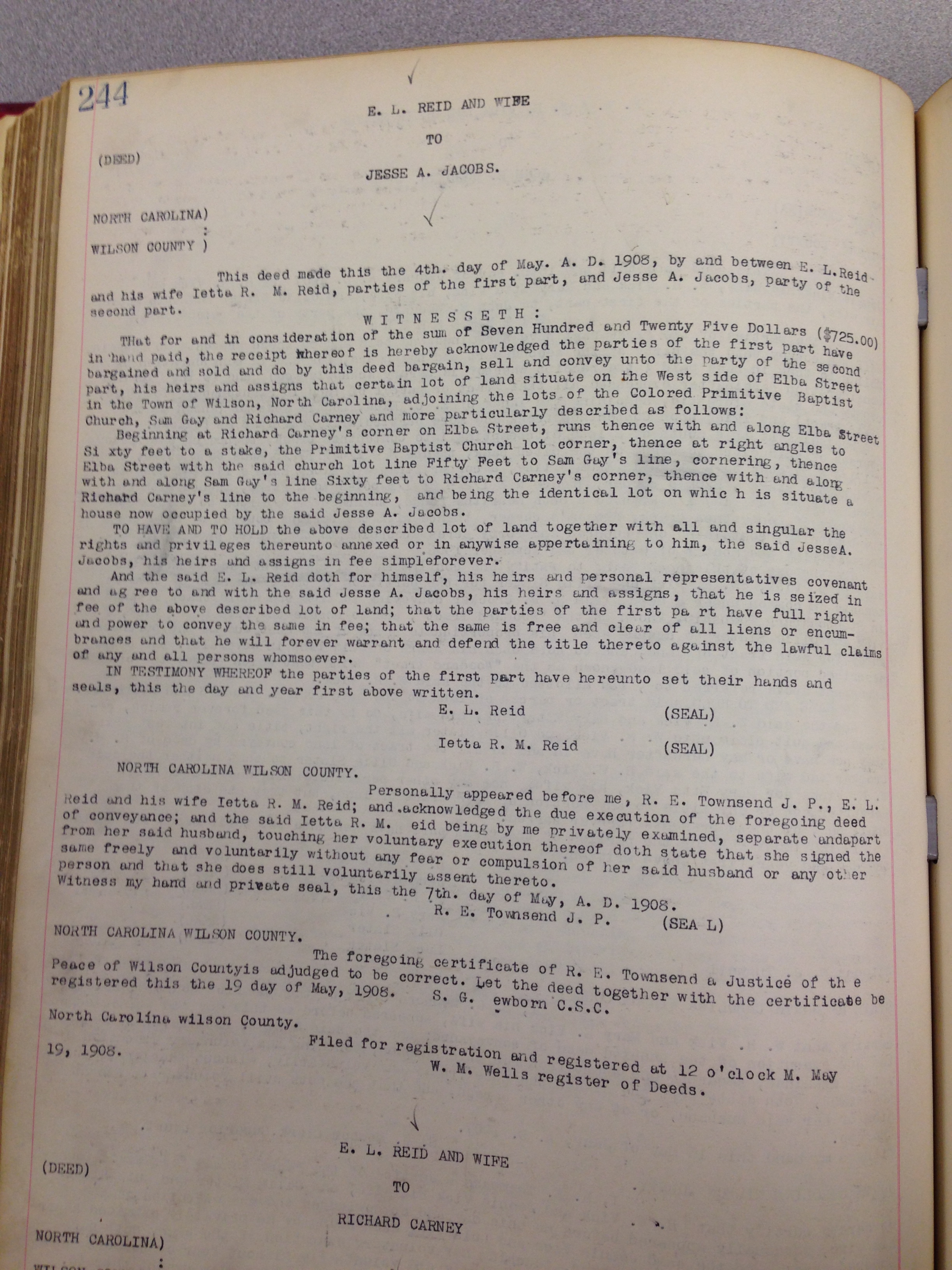
This deed.

Image

This is the deed for Jesse Jacobs‘ purchase of 303 Elba Street. He bought the house (in which he was already living) and lot for $725 from E.L. and Ietta R.M. Reid on 4 May 1908. (Elijah Reid, a veterinarian, was born into a free family of color from the opposite end of Wayne County than Jesse and Sarah Jacobs.) The same day, Jacobs gave George W. Connor, Trustee, a mortgage on the property, perhaps to secure a $400 loan he used to buy it.  Jacobs was to repay Connor at the rate of $2.50 per week. 

On 10 April 1917, the Jacobses arranged another mortgage on their Elba Street home, this time promising to repay W.A. Finch, Trustee, $395 at 6% interest. Circumstances intervened. By about 1922 or ’23, Jesse Jacobs was too ill to work. He died in 1926. Sarah and Hattie Jacobs, her great-niece (and my grandmother) paid what they could from their meager earnings as laundresses. When Sarah Jacobs died in early 1938, the house remained encumbered. Finch’s loan was not repaid until September of that year, most likely from the sale of the property.

Standard
Births Deaths Marriages, Maternal Kin, Newspaper Articles, North Carolina, Oral History

Aunt Bert, as reported.

So, the conversation started with talk of Bill Bailey’s barbecue joint. Which was also a dance hall.  Which, though it was right up the road, was, as my grandmother put it, “strictly off-limits” to her and her sisters. “We couldn’t stand him,” she said, because “he did everything illegal and got away with it.” He had a great big stomach and was “trashy,” but his steaks pulled the best of Iredell County’s partying white folks.  And he was married to my grandmother’s Aunt Bert.

Me:  Now, she wound up … She shot somebody, or something, didn’t she?

My grandmother:  Yeah, she shot somebody.  She shot a white man.

My mother’s first cousin, N.:  What he do?  Slap her?  What did he do?  He did something to her.

My grandmother:  I don’t know what he did to her.  But maybe … seems like to me he kicked her.

N:  And she shot him.

My grandmother:  And she shot him.

N.: They had to take his leg off.

[Pause.]

Me:  Oh.  Well, good for Bert.

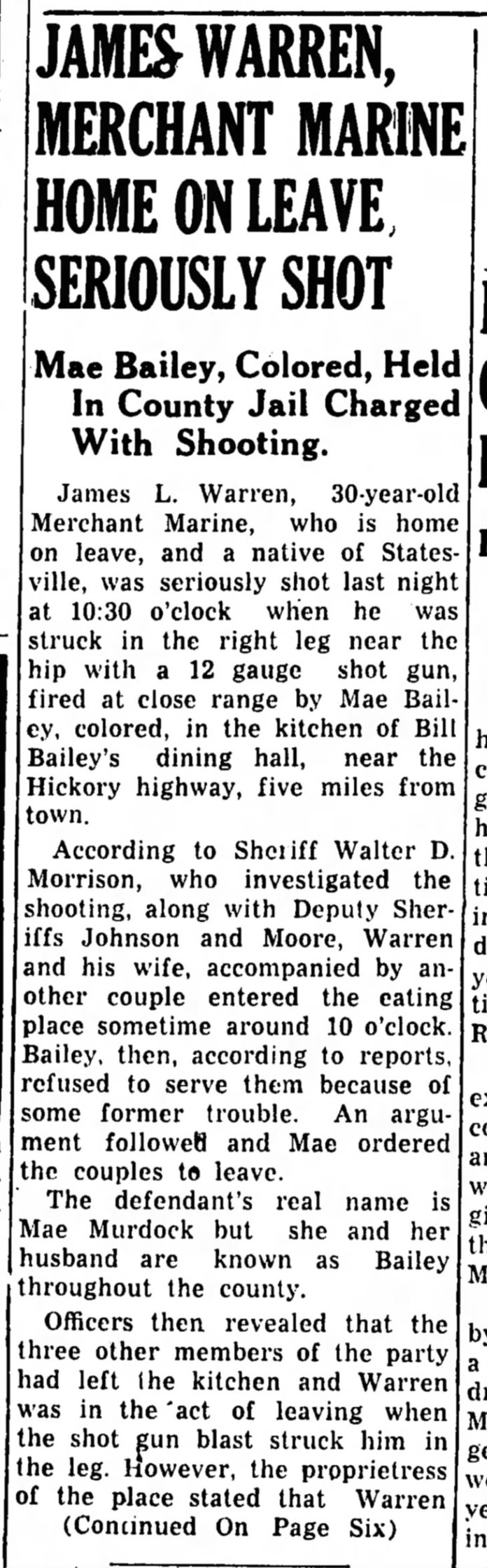
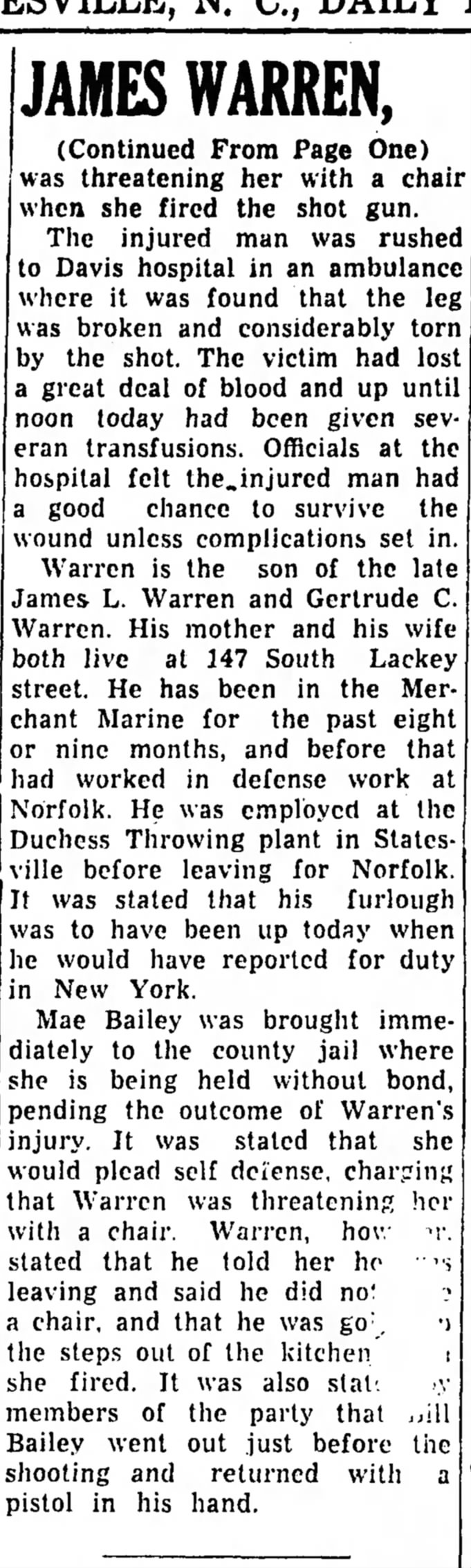
When I wrote about this before, I was looking for newspaper coverage of the incident, thinking that a black woman shooting a white man in North Carolina in 1944 had to have galvanized the public. Well, sure enough, the Statesville Record & Landmark covered every step of ensuing criminal trial, though in a considerably less salacious manner than I might have expected.  The headlines pretty much tell the tale:

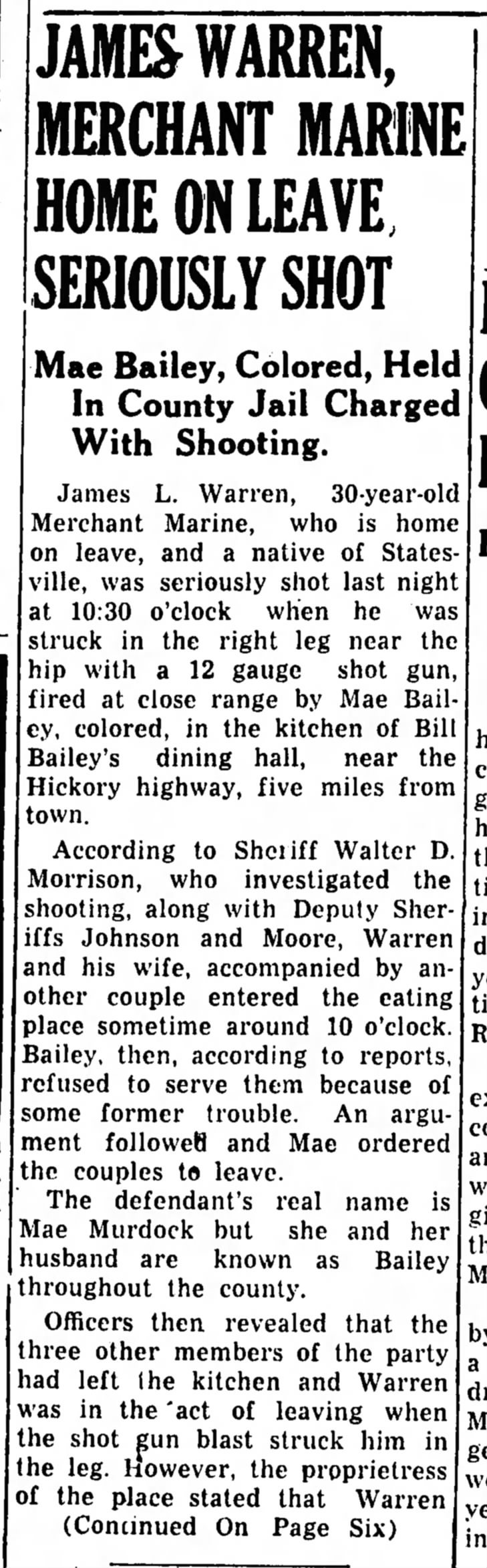
James Warren, Merchant Marine Home on Leave, Seriously Shot. Mae Bailey, Colored, Held in County Jail Charged with Shooting. 29 March.
Warren Shot 3 29 44Warren shot contd

Warren Holding Own, But Will Not Be Out of Danger For Week.  30 March.

James Warren’s Leg Amputated.  3 April.

James L. Warren Is Better But Not Yet Out of Danger.  6 Apr.

Mae Bailey Freed from Jail Today, Hearing May 8th.  11 April.

May Postpone Murdock Trial.  29 April.

Warren Removed to the Naval Hospital at Portsmouth, Va.  1 May.

M. Murdock Trial Postponed Until Monday, June 12.  8 May.

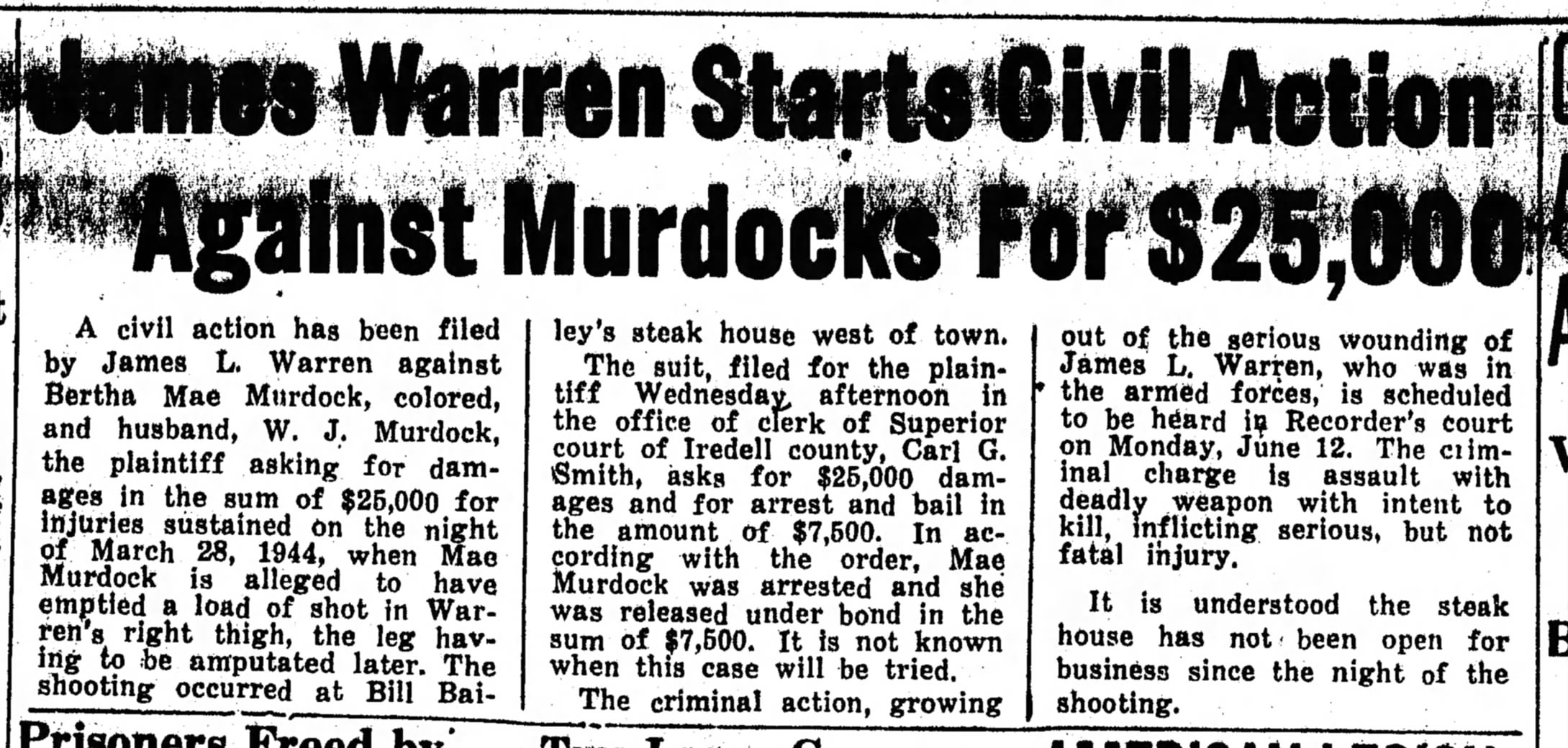
James Warren Starts Civil Action Against Murdocks for $25,000.  11 May.
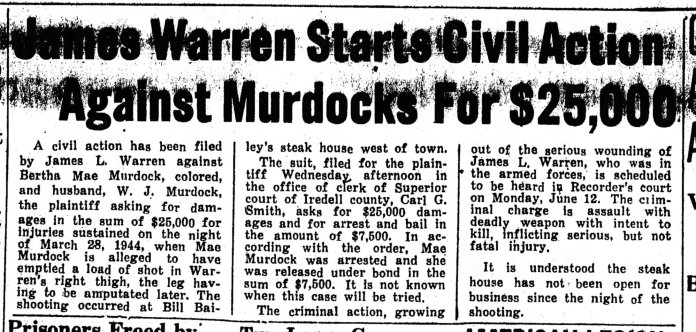
Murdock Civil Action 11 May 44 R and L

Mae Murdock Case Continued to August.  25 May.

Judge Bobbitt to Superior Court Preside August, Case of Mae (Bailey) Murdock Will Not Be Tried At This Term.  29 July 1944.

Murdock Trial Definitely Set For November 6, Warren is Able to Leave Hospital.  6 September.

Prosecuting Witness May Not Visit Scene of Shooting. 9 October.

Mae Murdock is Bound to Court Under $5000 Bond. 16 October.

Case Hinges on Warren’s Action Before Shooting, Testimony Rapidly Nearing Completion.  9 November.

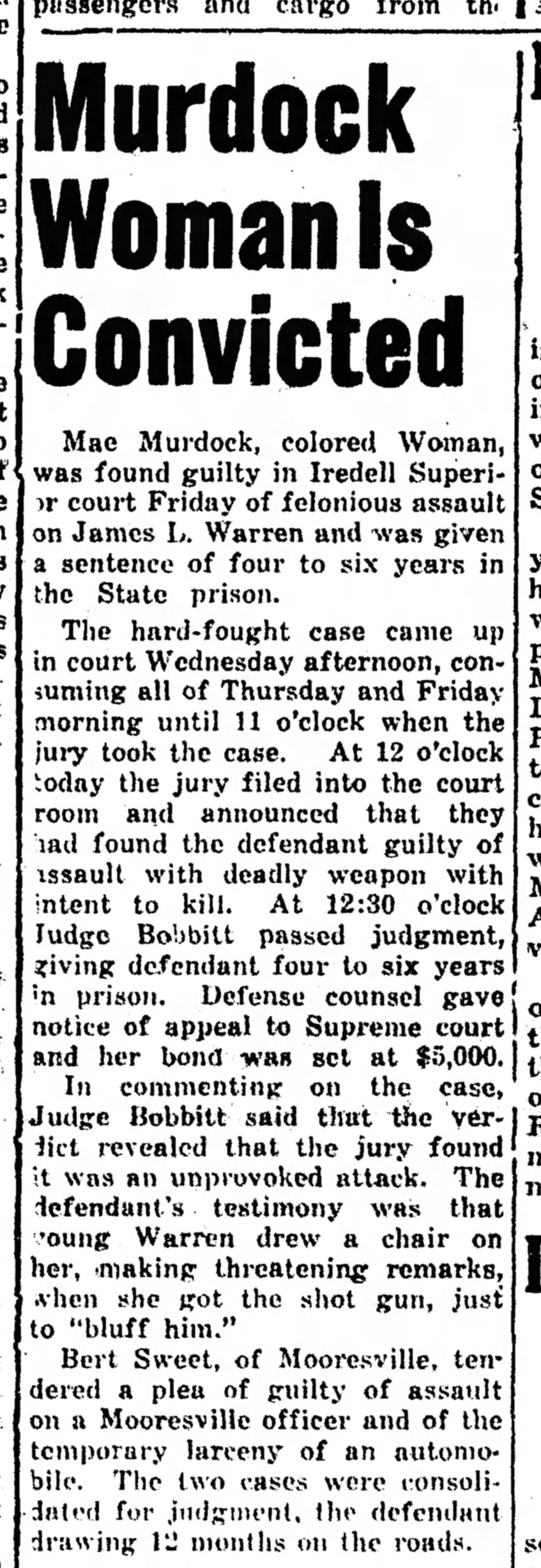
Murdock Woman is Convicted. 13 November.

Conviction 13 Nov 1944

Murdock Case to Go to State Supreme Court.  14 November.

$25,000 Law Suit Against Murdock Woman Continued.  14 November.

Aunt Bert served her time at the state women’s prison in Raleigh and returned to Statesville after to pass her few remaining years.  She had  possessed considerable wealth after her father’s death in 1929, but lost much of it while she was away. My family maintains that William “Bill Bailey” Murdock had entrusted whites to help hide his shady assets, and they betrayed him after Bert shot one of their own.

Bert died in 1955. The Landmark ran her death notice without comment or reference to the incident for which she had been infamous just ten years earlier.

Bert Murdock Obit 26 May 1955 Record and Landmark


Interview of Margaret C. Allen by Lisa Y. Henderson; all rights reserved.


Standard
Births Deaths Marriages, Maternal Kin, Migration, Newspaper Articles, North Carolina, Oral History, Photographs

Finding J.T.

My grandmother’s favorite cousin was her Aunt Lethea’s son, “Jay” or “J.T.”:

My grandmother:  I had a cousin named Jay.  Aunt Lethea’s son.  She died and left three sons.  James –

Me:  Charles.

My grandmother:  Charles.  And Jay.

Me:  Okay.  J.T.

My grandmother:  Mm-hmm.  And Jay stayed with Aunt Min ‘cause Aunt Min reared him after Aunt Lethea died.  And he was at this same house with Aunt Minnie and Grandma.  Let’s see.  It was Aunt Min and Grandma and Uncle Luther and Jay and I.  We were all in the same house during the summer that I worked up there.  And Jay and I used to have a good time.  Oh, he was so nice.  He would, the first time I rode on a rollercoaster, he took me.  And we used to have a good time.  He was really nice.  He was a nice person.

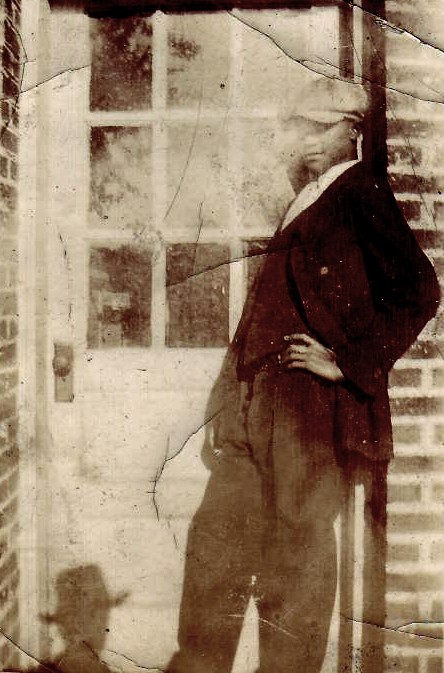
McNEELY -- Jay McNeely in doorway

Jay had two brothers, William and Charles. In the 1910 census of Statesville, Iredell County, I found three boys, William, 5, James, 3, and Charlie McNeeley, 2, living in the household of Sam and Mary Steelman and described as their grandsons. I identified these children, correctly I believe, as Elethea McNeely‘s children.  I also guessed that Charlie Steelman, listed in the household, was their father.  If he was, he and Lethea never married. Instead, in 1920, she wed Archie Weaver, a man my grandmother spoke of with vitriol.

My grandmother: Jay’s daddy had TB, and he just gave it to them.  And his mother and Jay.  But he lived years and years and years after both of them died.

Me: The father did?  

My grandmother: [Inaudible] give them all this stuff.  Oh, I could not stand him. She was my special aunt because she had boys, and she didn’t have any girls.  And she just took me over her house, you know, and let me do things that girls did, you know. 

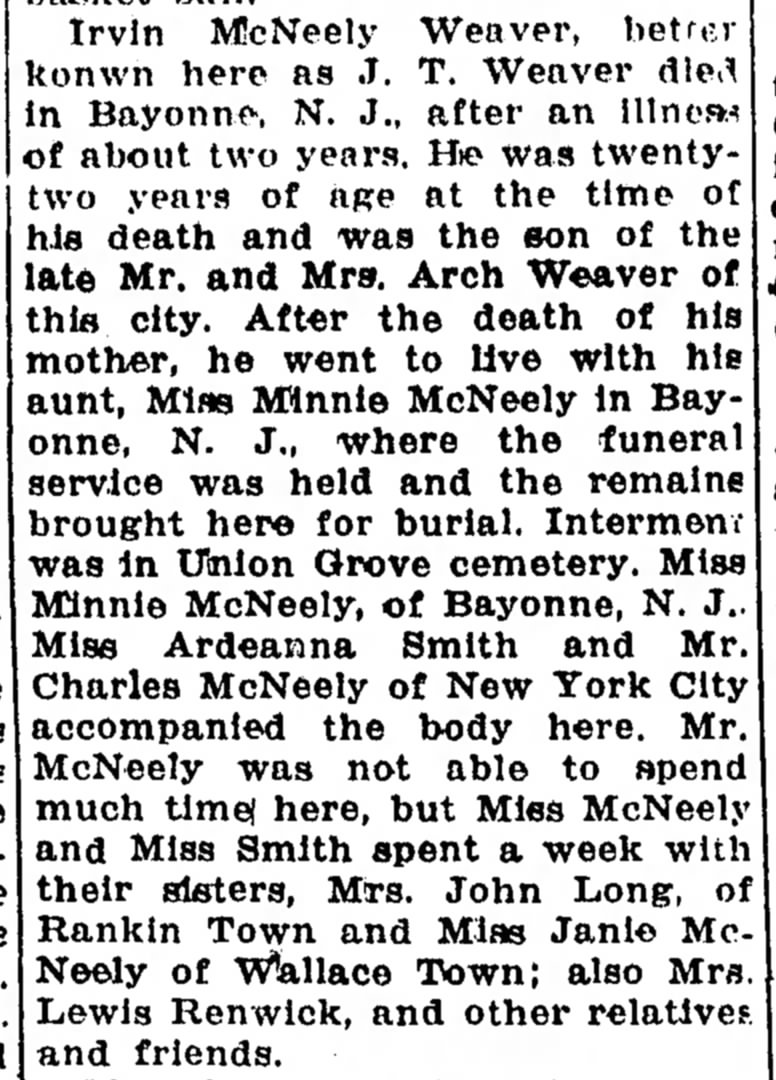
I was unable to find James McNeely, whom I believed to be “Jay,” in any other record. I knew Jay was reared by his aunt, Minnie McNeely, and died young of the same dread illness that killed his mother, but I was never able to find a trace of him. That changed last night, when I stumbled upon his death announcement in the 15 December 1933 issue of the Statesville Record & Landmark:

Image

As Grandma Carrie so memorably said, “Well, I’ll be damn.”  Here was J.T., as last. Not James McNeely — much younger, in fact — but Irvin McNeely Weaver. (The same “mysterious” Irving McNeely listed in the 1930 census in Martha McNeely‘s Bayonne household. He was described as her nephew, rather than her grandson, and I jotted in my notes: “Who is this???”) My grandmother was married and living in Newport News, Virginia, at the time of his death, and is not among his named survivors. Ardeanur Smith was his cousin, not his aunt, and Charles McNeely was his brother. Mrs. John Long was his aunt Lizzie McNeely Long, and Mrs. Lewis Renwick was his cousin Louise Colvert Renwick.

McNEELY -- McNeely Cousins

The first photo is Jay as a boy, perhaps around the time he moved to Bayonne. The second, taken in Bayonne circa 1928, shows Jay with his first cousins Ardeanur Smith, Margaret Colvert and Wardenur Houser, and an unknown girl seated in front. The last is Jay, alone, perhaps not long before he died.

McNEELY -- Jay McNeely near pole

——

This is just one of many, many times that I’ve found something that one or the other of my grandmothers would have been “tickled” to see. They both lived good, long lives — to 90 and 101 — but I would have kept them with me always if I could.

Interview of Margaret C. Allen by Lisa Y. Henderson; all rights reserved. Photos in the collection of Lisa Y. Henderson.
Standard
Births Deaths Marriages, Migration, North Carolina

Pre-World War I Migration: HENDERSON.

Anna J. Henderson Simmons (Anna<James).  Born 1852, Wayne County. After her marriage in 1871, she migrated with her husband Montreville Simmons to Chatham, Kent, Ontario, Canada, where his family had settled 20 years earlier.  They appear there in the 1881 census, which records all of their children born in the US except the youngest two, born in Ontario in 1877 and 1879. By 1900, the family lived in Cass County, Indiana, where Anna died.

Caswell C. Henderson (Caswell<Lewis<James).  Born 1865, Wayne County.  In 1886, he was listed in the Raleigh NC city directory as a hotel porter.  By 1893, when he married his first wife, he was living at 326 West 37th Street in New York City.  Other addresses at which he lived were: 47 West 66th Street, Manhattan; and 247 West 143rd, 901 Grant Avenue, 527 East 167th, 446 West 163rd, and 3777 Third Avenue, all in upper Manhattan or the Bronx. He died in Yonkers, Westchester County NY.

Julia “Molly” Henderson Holt (Julia<James).  Born 1872, Wayne County.  In 1902, Molly married Walter Holt in Randolph County NC. She listed her address as Julian NC, a small town in extreme southeast Guilford County. By 1910, the couple were living in Greensboro NC.

Fannie Wynn Price (Fannie<Susan<James.  Born 1879, Wayne County. She married William Thomas E. Price, and their oldest son Richard was born in Newport News in 1902.

Richard G. Winn (Richard<Hepsie<James).  Born 1881, Wayne County.  In 1903, Richard married Rosetta Robinson in Wilmington, New Hanover County NC.  Their addresses included 508 McRae Street and 222 South 13th Street. Richard died in Wilmington in 1957.

Minnie Simmons Budd (Minnie<Ann Elizabeth<Lewis<James).  Born 1887, Wayne County.  Minnie was living in Philadelphia, Pennsylvania, as early as 1906, when she gave birth to a son. She and her husband Jesse Budd apparently moved back and forth between Mount Olive NC and Philadelphia until the 1920s, when she seems to have settled there permanently.

Charles H. Henderson (Charles<John<James). Born 1893, Wayne County. He registered for World War I draft in Richmond, Virginia, listing 114 E. Leigh Street as his address. In 1920, the census recorded his address as 614 Baker Street, Richmond.

Daniel Simmons (Daniel<Ann Elizabeth<Lewis<James). Born 1895, Wayne County. Daniel is said to have worked in Oberlin, Ohio, circa 1912. He married in Wayne County in 1913 and moved his family to Rocky Mount NC about 1914. By 1920, they lived in Richmond, Virginia, and ten years later were in Philadelphia. By 1940, Daniel was living in New York NY. He died there in 1964.


Standard
Births Deaths Marriages, Paternal Kin, Photographs

In memoriam: Richard B. Aldridge (1939-2013).

Image

Richard Bradley Aldridge, Sr., will be buried tomorrow just outside Washington DC. Born in Dudley, Wayne County, in 1939, he was the youngest child of John J. and Ora Bell Mozingo Aldridge.  Rick’s wife Carmen survives; their only child, Richard Jr., died in 1995. He is also survived by a brother, Edison Monzel Aldridge.

Standard
Births Deaths Marriages, Free People of Color, North Carolina, Paternal Kin, Photographs

Joshua & Amelia Aldridge Brewington.

Image 

Image

Joshua Brewington, son of Raiford Brewington and Bathsheba Manuel Brewington, was born in 1846 in Sampson County and died in 1931 in Wayne County.  His wife, Amelia Aldridge Brewington, daughter of Robert Aldridge and Mary Eliza Balkcum Aldridge was born in 1855 in Sampson County and died in 1895 in Wayne County. Their children were: Tilithia Brewington King Godbold Dabney (1878-1965), Bashua M. Brewington (1879-1899), Hattie Bell Brewington Davis (1880-1981), Mattie Amelia Brewington Braswell (1883-1952), Elijah Coleman Brewington (1886), Amelia Brewington (1888),  Lundy Brewington (1891-1914), Toney Cemore Brewington (1894-1973), and Murine Brewington (1895).

Joshua and Amelia Brewington are buried in the cemetery of the First Congregational Church, Dudley, North Carolina.

“Sleep on and take thy rest.”

——

Photo by Lisa Y. Henderson, August 2010.

Standard
North Carolina, Oral History, Paternal Kin, Photographs

Was it that long?

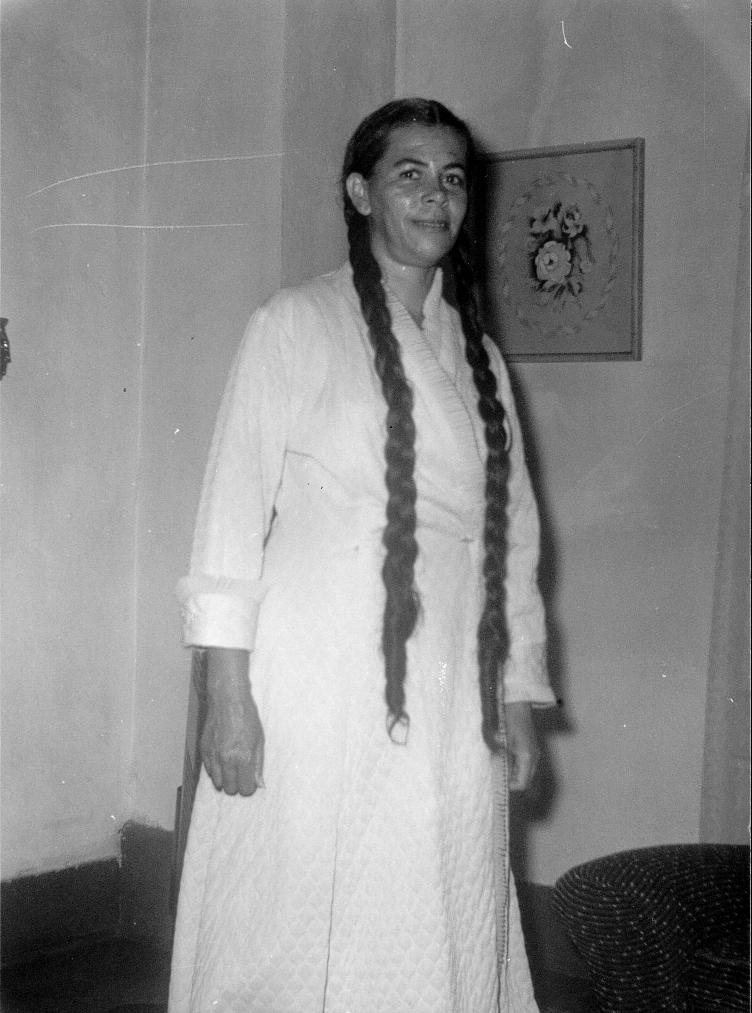
They are now swaddled in acid-free paper in an acid-free box: three coils of plaited hair. Two are narrow as fettucine (and nearly as flat after all this time), tapering through a curl to nothing; the first a deep, deep brown, the other sandy. The third braid is twice as long as the others and, at its thickest, the breadth of an infant’s forearm. If I place the cut end at the nape of my neck, the tip unfurls heavily to the seat behind me.

No visit to my grandmother was complete without her lifting a small green leatherette suitcase from atop a chifforobe in her bedroom. Underneath packets of photographs, which I also had to examine, she eased out the plastic bags preserving the hair cut from her own head (the great thick braid); her mother Bessie‘s (the thin dark brown one); and her mother’s first cousin, her namesake Hattie Mae (the blondeish plait.) Hattie Mae died in 1908 at the age of 13.  Bessie died in 1911 at the age of 19. Her own hair she cut in the late 1950s, after enduring years of headaches from the relentless pressure it exerted when coiled atop her head.  It was only the second time she’d cut it.

And so Mama was working at the factory, and I used to go up there and look at her.  And so that’s when I first cut my hair.  I went there, and the lady was asking Mama at the table where she worked to, and she didn’t say nothing to me, but she said, “Unh, who is that child with all of that long hair?”  And she took one of my plaits and held it up.  I had it in three plaits.  I’ll never forget it.  I had one down here used to come here.  Yeah, it come down to below the shoulder.  Like I plait it up, and it be from there.  Two plaits here and then this one down across.  And I always put that one behind my ear.   ‘Cause I didn’t like it parted in the middle.  Seem like it just wasn’t right in the middle.  So I asked Mama ‘bout cutting my hair, could I cut my hair.  ‘Cause everybody:  “How come you don’t cut your hair?  ‘Cause you’d look pretty in a bob.”  I don’t know.  I just wasn’t half combing it.  And it was nappy.  Like I’d go to try to comb it, and knots would be in there.  And then I’d get mad with it.  Then I’d take the scissors and clip that little piece off.    And then all that other part would come off.  And so I wondered, “Mama, could – ” “It’s your head.  It’s your hair.  I don’t care if you cut it off.”  And so one day, a fellow stayed up there on Vick Street was a barber downtown, a colored fellow, Charlie Barnes or whatever his name is.  So he passed there one day, and I asked him, “Would you cut my hair for me?”  And he said, “Yeah.”  Said, “You come on down to the shop.”  And I said, “Where is the shop?”  And he went on and tried to tell me, and then he stopped there one day, and he told me, he said, “You say you want to get your hair cut?”  He said, “You got too pretty a hair to cut.”  And I said, “Yeah, but I can’t half comb it.”   He said, “Well, anytime you want to come on down there, I’ll cut it for you, if it’s all right with your mama.  You ask your mama?”  I said, “Yeah, she allowed me to cut it.”  So sho ‘nough, I went around there one Saturday morning, went down there.  And so, he turned around and cut off my plaits on both sides ‘cause I had two plaits there.  He cut them off, and then he put some kind of stuff on it and then somehow fluffed it all up.  Awww, I thought I was something.  I reckon I was ‘bout 12, 13 years old.  After then I cut it off in a boyish bob. 

Image

I got a plait of Hattie Mae’s hair and a plait of my mama’s, Bessie’s hair, and then mine.  I was looking at that the other day, and I looked at it, and I said, “Huh, it was that long?”  Rudy, Rudy Farmer took that picture.  ‘Cause I –  He saw my hair.  I was standing there with my housecoat on.  I still got that thing now.  And: “Goodness!  I didn’t know your hair was that long!”  We were staying on Reid Street.  And he said, “I’d sure like to have a picture of that.”  And I said, “Well, you got a Kodak?”  And he said, “Yeah!  You’d let me take a picture?”  I said, “Yeah.”  And so he went home and got it and took a picture of it.  I was standing up in one and sitting down in one.

Image——

Interview of Hattie H. Ricks by Lisa Y. Henderson, all rights reserved. Photographs in the collection of Lisa Y. Henderson.
Standard