Free People of Color, North Carolina, Paternal Kin, Religion

Church home, no. 1: First Congregational, Dudley NC.

“History of the First Congregational Church of Dudley, North Carolina, Given by Mr. General Washington Simmons, born December 22, 1856.”

In 1867, after Emancipation, came the first school for Dudley, taught four months by a white confederate soldier, John P. Casey, who was paid by the community families. The only textbook was the “blue-back speller.”

George Washington Simmons, father of General W. Simmons, corresponded with Mr. James O’Hara in Wilmington, Delaware, though whom the services of another white friend, Miss Jane Allen of Delaware, were secured for another two months’ session. She, too was paid by families.

From Oberlin College in 1868, came D.C. Granison, 23 or 24 years of age, the first Negro teacher, who remained for two years, residing in the home of George Washington Simmons. … His correspondence with the A.M.A. brought visitors in 1870, among whom were many to be remembered, especially Rev. D.D. Dodge, at that time pastor of the First Congregational Church in Wilmington, North Carolina. With his guidance our first Sunday School was organized. After several visits, he sent Rev. John Scott of Naugatuck, Connecticut, who began work in 1870. …

Just after Rev. Scott’s ordination, the First Congregational Church of Dudley was organized in what is known as the old “mission home.” … Charter members of the church were George Washington Simmons, James KingLevi Winn Sr., Levi Winn Jr., Henry Winn, George Winn, and members of their families. The first converts were Charity Faison and Sylvania Simmons. They were baptized in the “Yellow Marsh Pond” just north of the cemetery. …

Volume II [of the church records] summarizes the history from March 9, 1870. … The list of members, dating from 1870, is divided by male and female. It includes the names of Frank Cobb, William AldridgeBryant Simmons (Sr. and Jr.), John AldridgeLewis Henderson, Levi Wynn, Richard Brunt, Amos Bowden, Charles Boseman, M.A. Manuel, Solomon Jacobs, George Washington Simmons, …

From the souvenir bulletin of the 100th Anniversary, First Congregational Church United Church of Christ, 1870-1880.  Copy of bulletin in possession of Lisa Y. Henderson.

Standard
Education, Letters, Maternal Kin, Other Documents, Photographs, Virginia

The Keysville school.

Acts of the General Assembly of the Commonwealth of Virginia.  Chap. 91.  An Act to Incorporate the Keysville Bluestone mission industrial school.  Approved January 17, 1900.

Be it enacted by the General Assembly of Virginia, that Reverend Nelson Jordan, R.C. Yancey, George D. Wharton, P.E. Anderson, F.L. Hall, Jesse H. Wilson, Jordan Moseley, Whitfield Clark, L.N. Wilson, A.J. Goode, S.L. Johnson, N.C. Ragby and Miss Mary E. Wilson [are appointed] board of trustees [of an institution] by the name and style of the Keysville Bluestone mission industrial school for the purpose of keeping and conducting at Keysville, Charlotte County, Virginia, a boarding and day school of the above name, and of giving instruction to such colored persons, male and female, as may be committed to their care as pupils of said school. …

Image

——

Rev. Whitfield Clark’s sister Mary married my great-great-great-great-uncle Joseph R. Holmes, who was murdered on the steps of Charlotte County courthouse in 1869. As shown below, Joseph Holmes had been instrumental in securing support for the precursor to this school:

record-image-2

Joseph homes letter

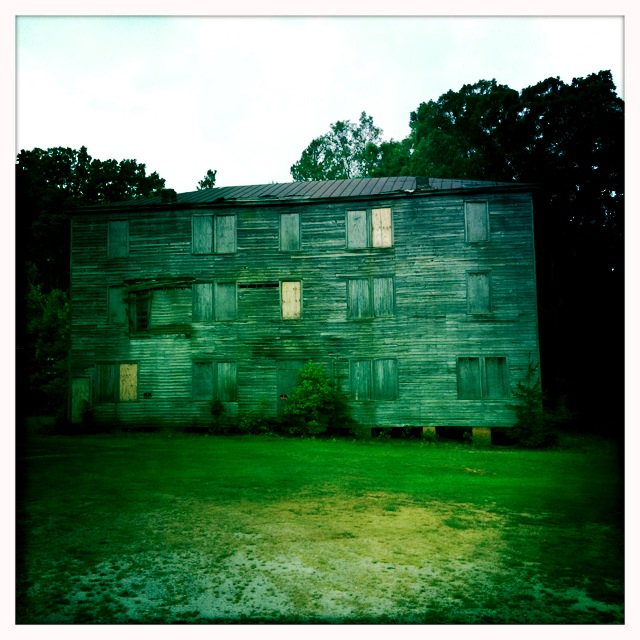
Photograph of Keysville Industrial School, Keysville, Virginia, by Lisa Y. Henderson, July 2012. Images of letters from Virginia Freedmen’s Bureau Letters of Correspondence 1865, 1872, www.familysearch.org (originals in Records of the Field Offices for the State of Virginia, Bureau of Refugees, Freedmen and Abandoned Lands 1865-1872, National Archives and Records Administration.)

Standard
Civil War, Maternal Kin, North Carolina, Other Documents, Rights

The first registration.

voter reg

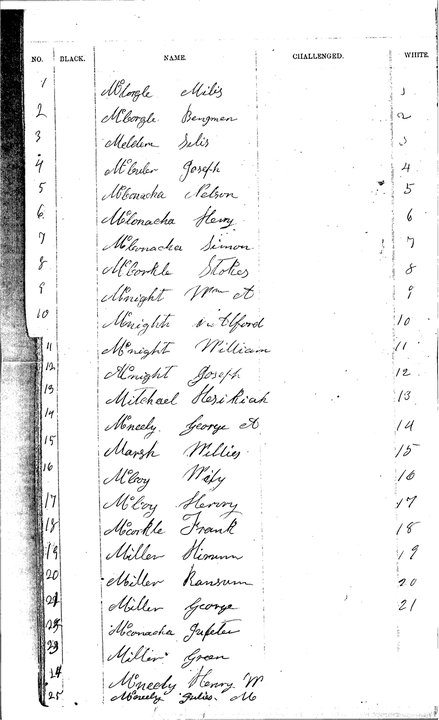
Rowan County, North Carolina, 1866. The war is over. The 14th and 15th Amendments have not yet passed, but the county’s hopeful freedmen have come out en masse to register to vote, perhaps under the auspices of the Freedmen’s Bureau. Among them, my great-great-grandfather Henry W. McNeely, his half-brother Julius McNeely, and his future in-laws Ransom, George and Green Miller. Henry’s father John W. McNeely, Confederate allegiance renounced and U.S. citizenship restored, was also there — his world upside down.

Standard
Free People of Color, North Carolina, Paternal Kin

The case for the Skipps as James Henderson’s children.

1. In the 1840 census of Onslow County, James Henderson is listed twice.  First, his household includes 1 male 24-26 [James]; 1 female 10-24 [Sallie Skipp?]; 2 males under 10 [Lewis and James]; and 1 female under 10 [Mary], all colored, and is listed between Bryant Koonce and William Mills.  Second, the household composition is the same, but is listed between William Boyett and Jesse King.

2. In the 1850 census of Upper Richlands township, Onslow County:  at household #32, Jim Henderson, 35, mulatto, mechanic, in the household of B.S. Koonce, farmer; at #34, Eliza Skipp, 7, mulatto, in the household of Jesse Alphin, farmer; at #60, Jim Dove, 14, and Mary Skipp, 10, mulatto, in the household of John Humphrey, farmer; at #65, Lewis Skipp, 16, laborer, and James Skipp, 10, both mulatto, in the household of Stephen Humphrey.

3. Neither James “Jim” Henderson nor the Skipp children appear in any Onslow County census thereafter.

4. In the 1860 census of Westbrooks township, Sampson County (about – miles from Upper Richlands): at #1033, Lewis Henderson, 25, turpentine laborer, with wife Margaret, 26, and children Lewis T., 4, James L., 3, and Isabella J., 4 months; at #1038, James Henderson, 52, carpenter, wife Eliza, 25, and children Anna J., 8, Susan, 6, Hepsie, 4, and Alex, 1; at #1039, Eliza Henderson, 18, in the household of John B. Sutton; at #1113, James Henderson, 22, farm laborer, in the household of Louis C. King. (Mary Skipp/Henderson has not been accounted for.) They are the only Hendersons in Westbrooks and were not in Sampson County in 1850.

5. In the 1870 census of Faisons, Duplin County: James Henderson “senior” is listed with his wife and children, including 27 year-old James. In Brogden, Wayne County: Lewis Henderson with his wife and children.

6. In the 1880 census of Brogden, Wayne County, James is listed with his wife and daughters. Lewis and his family were also in Brogden township. James senior remained in Faison.

7. Lewis Henderson had sons Lewis and James and a daughter Mary. James H. Henderson had sons Lewis and Elias Lewis and a daughter Mary.

8. James Henderson died in Faison, Duplin County, on 21 June 1920, aged about 80. His death certificate listed his birthplace as Onslow County and his parents as James Henderson and Sallie Henderson.

9. My grandmother, a great-granddaughter of Lewis, recognized Elias L. Henderson as a cousin. She recognized as aunts the daughters of James Henderson by his second wife. (They were actually her grandmother’s aunts, though they were contemporaries.) She also recognized as cousins the son and daughter of James’ son John Henderson.

——

In other words: in 1850, four children of ages to be siblings appeared in Onslow in proximity to a man believed to be their father. One of the children, Lewis, was born approximately the same year as Lewis Henderson. Ten years later, three of the four children, now bearing their father’s surname, appeared in proximity to him in Sampson County. (Surname shifts, especially among the children of unmarried parents, were not uncommon in free families of color.) The sons, Lewis and James, named sons after one another and settled sequentially in Brogden township, Wayne County.  Most of their half-siblings also migrated to Brogden, and their descendants maintained close family ties into the early 20th century. When James “junior” died, his death certificate acknowledged his birth in Onslow County and named James Henderson as his father.

Standard
Maternal Kin, Virginia

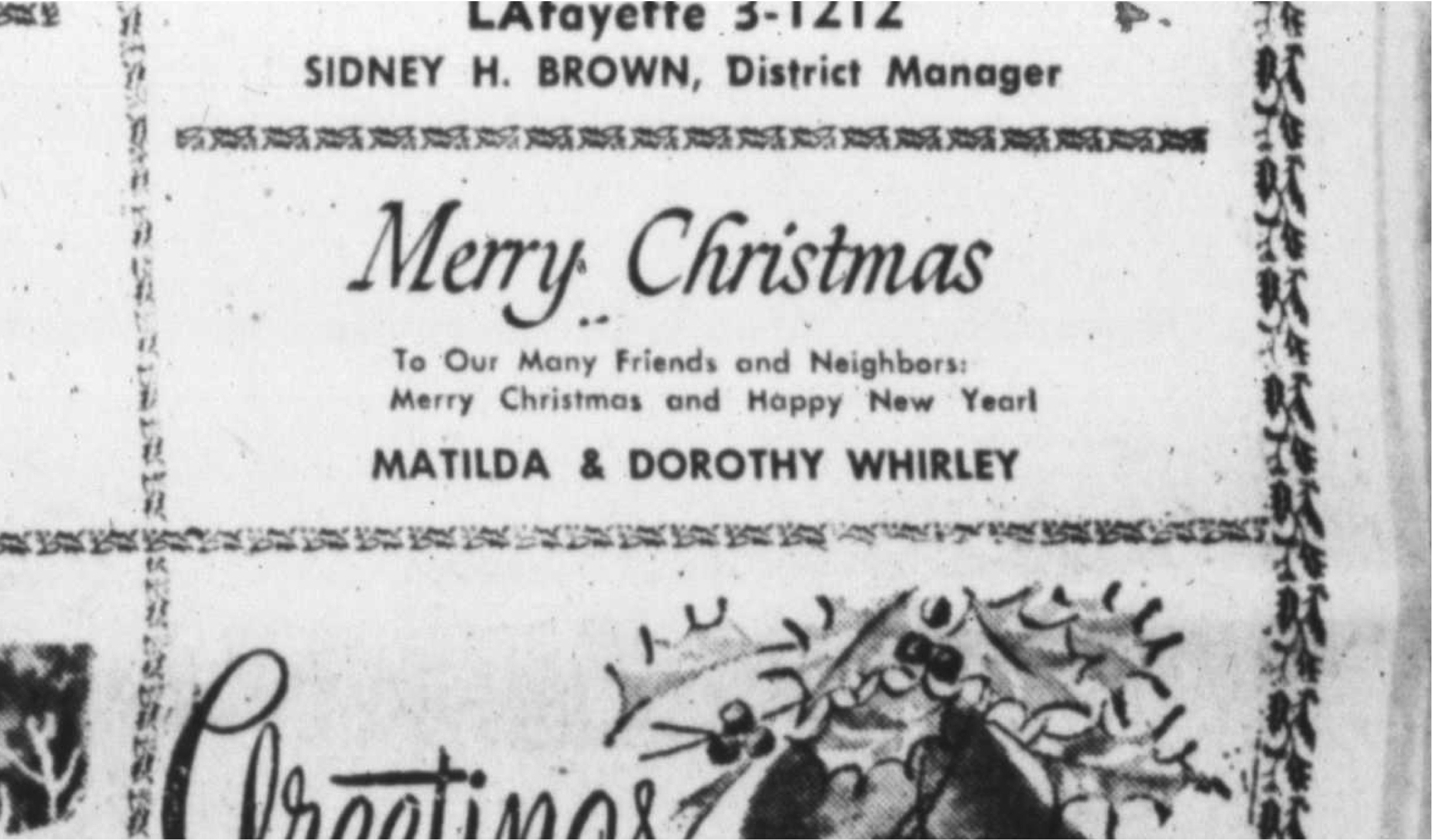
Matilda & Dorothy Whirley.

I called her cold, admittedly. Never could she have expected to pick up the phone to a call from her great-uncle’s great-granddaughter. Still, I’ve made lots of these kinds of calls in my life. Dorothy Whirley was decidedly more guarded than most and had a little edge in her voice that sounded almost irritated. She could not deny me though, for what slick stranger could pull names and dates out of Charles City County like that?

Dorothy was the daughter of Matilda Whirley and granddaughter of Emma Allen Whirley, my great-grandfather’s sister. Dorothy could not, or would not, tell me much, except to confirm that Emma, her husband and children had migrated to Baltimore, where she continued to live. Her mother, to whom she had been very close, had died not too many years before our connection, and she seemed somewhat estranged from her remaining kin. She knew of John Allen Sr., but had little more to say about him than that he held himself apart from — thought himself better than — his half-siblings because of his light skin. Our conversation foundered, and I hung up with a promise to send her a family tree. I never got around to it, and she died in 1999. I have not been able to track down any other living Whirleys, but have found small traces of Dorothy and her mother.

ImageThe Baltimore Afro-American, 26 December 1959.

Standard
DNA, North Carolina, Paternal Kin

DNAnigma, no. 3: An Artis match, after all.

I was geeked. After all, my great-great-great-grandfather Adam T. Artis had 25+ children, and I have thousands of cousins in their descendants. (Not to mention the descendants of Adam’s many siblings.)  I was crestfallen, then, when H.A. responded that he was descended from Absalom Artis, through Warren Artis, then Henry, then Alonzo, then William Henry Artis. I know the Absalom Artis line (though I didn’t know Warren was in it), and I have no known connection to them. Absalom was born in Virginia circa 1780 and was in northern Wayne County by the early 1800s. He and Adam lived in close proximity, but the record gives no clue to other links. Of course, ultimately, all of the free colored Artises in Wayne County – indeed, throughout Virginia and NC and out into Indiana and Ohio – were likely kin, but the links are so remote that reconstructing them is likely impossible. H.A. and I share enough DNA that our common ancestor had to have been within the last 5 generations or so. In other words, more recent than any common ancestor of Adam and Warren or Absalom.

But then….

While reviewing my notes for a post about Adam’s second set of children, I was reminded that his daughter Mary Jane Artis had married an Artis. Henry Artis. Son of Warren and Pearcy Artis. And mystery solved! H.A. and I are not related through his patrilineal Artis line, but via a wife whose father was my great-great-great-grandfather.

Standard
Enslaved People, Maternal Kin, North Carolina, Oral History

Henry W. McNeely.

My grandmother said he looked a bit like a poet. Or so she was told:

See, I never did know Grandpa Henry. I didn’t know him.  He died just as Louise was born. Mama had just had Louise, and it was real hot and all, and they told her she couldn’t go to the funeral because it was so warm and she would take cold.  But I didn’t know him. 

And:

Mama said he looked just like Walt Whitman.  You know, he was, his father was white. I don’t know who his mother was. I don’t know if she was mulatto or what.  But anyway, he was really light.  And he lived on the same farm as his daddy.  And he provided him, he provided for him as if he was his own child.

White child, that is.

Henry W. McNeely was 22 years old the year his father reported to the tax assessor that he was worth $1500. The tax list is his first named appearance in the record, and documentation of his life is relatively scarce thereafter. He registered to vote in Rowan County in 1868 and appears in his mother’s household in Atwell township, Rowan County, in the 1870 census.  (He was described as a schoolteacher. Had his father taught him to read while he was enslaved? Or was he a quick learner in a Reconstruction school?) In 1872, he married 18 year-old Martha Miller and, in a daring gesture, named Wilson McNeely as his father on the license. The register of deeds did not blink and dutifully noted that all parties, except Wilson, were colored.
Image

[Sidenote: “Louise” was Mary Louise Colvert Renwick, my grandmother’s sister, born in 1906. — LYH]

——

Interview of Margaret C. Allen by Lisa Y. Henderson; all rights reserved.

Standard
Births Deaths Marriages, Enslaved People, Maternal Kin, North Carolina, Other Documents

Cohabitation as man and wife.

COLVERT -- Walker Colvert Rebecca Parks CohabitationIn March 1866, in order to ratify marriages and legitimate children, the North Carolina General Assembly passed an Act directing Justices of the Peace to collect and record in the County Clerk’s office the cohabitations of former slaves. Freedmen who did not record their marriages by September, 1866, faced misdemeanor charges. Stragglers rushed the courthouse that August, and on the 25th Walker Colvert and Rebecca Parks traveled the 12 miles or so from Eagle Mills to stand in line. They declared that they had been together for 13 years and named three children, John, Elvira and Lovenia. (There should also have been a son Lewis, the youngest — and who in the world is Lovenia? I have found no trace of her.)

Walker, fifty-ish at the time, was my great-great-great-grandfather. He was born in Culpeper County, Virginia, then passed, like a bedframe or milk cow, from one Colvert to another and into Iredell County, North Carolina. Rebecca was not his first wife, and his age suggests earlier children, names and fates unknown. My grandmother, who died in 2010 at age 101, knew and remembered Rebecca. And, like that, a link across five generations.

Standard
Free People of Color, North Carolina, Oral History, Paternal Kin

Lewis & Mag’s children, part 1: sons.

Lewis and Margaret Balkcum Henderson had nine or so children in Sampson County before shifting a few miles north into Wayne County, where they settled with other free-issue families near a tiny crossroads town called Dudley.  Before the Civil War, Margaret bore Lewis T. (1856), James Lucian (1858), Isabella J. (1860), Ann Elizabeth (1862), and Caswell C. (1864), and after, Mary Susan (1868), Carrie (1870), Sarah Daisy (1872), and Loudie (1874).

Of Lewis T., Isabella and Mary Susan, there is not enough known to talk about; they died as children.  But Lucian was my grandmother’s favorite great-uncle; the only one of Lewis and Mag’s children to stay in Dudley and farm.  He and his wife Susie (born a McCullin) had only one child, a daughter Cora Q., who died early and is remembered only by her headstone in the cemetery of the Congregational Church.  (I am endlessly fascinated by the Q.  What could it possibly have stood for?) Lucian so impressed my grandmother that she named her firstborn son after him. He is gone, but my cousins Lucian Jr., the III and the IV, remain.

My grandmother said:

Uncle Lucian, now he look more like an Indian to me than anybody.  Didn’t have too much hair, but what he had was straight and was that brownish color like it was fair.  We’d come down there and stay with them.  Get off the train and run all the way down there to their house.  That wont nothing.  And they had two beds in that front room.  One on one side and one on the other’n, and they slept on that one side, and me and Mamie slept in the other’n.  In the same room.  ‘Cause it wasn’t no door to it, and the fireplace was in the front room.  I don’t think they ever had a lamp or no light.  We’d go to bed with the chickens and get up with the chickens.  ‘Cause time it’s day, Uncle Lucian was up.  A’nt Susie couldn’t cook.  Because she couldn’t be over the stove, she’d fall out if she was over the stove.  She never left the house that I know of.  ‘Cause she had this thing, that, her head shook all the time.  I said to Mama Sarah, I said, “That thing’s gon shake her head off.”  I told Mama, “She’s gon shake her head off.”  She said, “It was a palsy, that’s how come.”  So Uncle Lucian always got up and cooked breakfast.  And, Lord, I used to love to go down there.  We would get up early mornings, and Uncle Lucian would cook breakfast and, honey, that old ham where he cooked you could smell a mile!  Honey, you could smell that ham before you even got there.  It was on the highway, and we didn’t go all the way ‘round the bend and come up the road.  We’d come down over the fence and come down the cornrow and come up to the house.  And he’d make rice, and it would be that ham gravy.  And the biscuits, they looked like they’s hamburg muffins, the biscuits was so big.  And you talking ‘bout good.   Ooo, you’d be ‘bout to have a fit, it smelled so good. Cooking ham and rice, and had to have ham gravy, just pour water in there from frying.  Great big old milk biscuits.  You eat one of them — you couldn’t even eat a whole one, ’cause they was so big.  And cooked on a little old bitty tin stove, a four-cap stove — the burner wont no more than bigger than that — where you had to put two, three pieces of wood in the stove, and the pipe run right straight up in the house.  Yeah, I thought that was some good days and some good food.  Look like to me, I thought it was the best.  We had good food at home, but seem like down there, it just taste better.  We didn’t have no ham everyday like they had down there, and by him having and curing it, the way they cured ham, his was different from what we had.  Like with that pepper and salt and stuff and seasoning outdoors.  And every one they’d kill, he’d get the hog and cook ‘em and hang ‘em in his packhouse. 

But every great-uncle was not as favored as Lucian.  There was also Caswell, from whom my father gained his middle name, but about whom my grandmother was ambivalent.  Caswell was in New York City by 1890, where he was a white man on his job with the Customs House, but moved among colored folks at home in the Tenderloin and later in Harlem and the Bronx:

Uncle Caswell come to Wilson visiting Mama Sarah.  He didn’t never bring his wife down there ‘cause he was passing for white, and she was kind of brown-complexioned.  But he’d leave our house, and he would go and get a paper every morning down there to Cherry Hotel.  Walk down there for the exercise and get that paper.  He’d go in the hotel there and ask for a paper and talk to the people, and they all said, “Who is this white man?”  And then he’d come all the way back a different way, then walk back down Green Street and come on home, so they wouldn’t know he was crossing the tracks.   And so he wanted Mamie, he didn’t want me, he wanted Mamie to come stay with him and his wife.  And he was gon send her to school and take care of her.  He’d buy all her clothes and everything.  But me, he ain’t said nothing ‘bout me.  But Mama said, “Naw, you can’t. I don’t want her to go to New York.  ‘Cause she don’t know nothing ‘bout New York, and, too, that would leave Hattie down here by herself.”  She said, “They’s gon stay, she gon stay with me ‘cause I promised Bessie that I’d take care of them as long as I lived.  I promised Bessie I’d keep ‘em together.  But if you want to give her something, or help me out with her, buy ‘em clothes or something like that, you can.”  So I didn’t like that. He ain’t said nothing ‘bout me.  But then they said I liked to read, and so he saved the papers where he was taking, and he would send ‘em in the mail to me.  But he sent Mamie candy.  And I told him I wont no goat!  Uncle Caswell didn’t like me.  And I started to tell him he was down there trying to be cute, playing, wanting folks to think he was white.  Passing for white.  Well, he could pass for white.  Least that’s what he was doing up in New York.  ‘Cause he was working at the roundhouse, had a good job.

——

Interview of Hattie H. Ricks by Lisa Y. Henderson; all rights reserved.

Standard
Births Deaths Marriages, Maternal Kin, Newspaper Articles, North Carolina, Other Documents

A colored man of rare powers of mind.

Harriet pursued him, my grandmother said. Relentlessly. Followed him to Ohio to make her case for marriage. Certainly, that she, a widow in her early 40s, found (or allowed herself to become) pregnant suggests an impetus for her plans. Still, Thomas Alonzo “T.L.” Hart was not easily swayed. Their only child Bertha Mae was born in 1902 and not until December 1904 did he apply for a marriage license at the Iredell County Courthouse.

Alonzo was born about 1866 to Ephraim and Caroline Hart. Little is known about the years before he married Harriet Nicholson Tomlin. My grandmother asserted that he was a non-practicing lawyer, but no record has been found of his education or training.  In the late 1890s, he moved briefly to Ohio; a visit home was nearly disastrous:

——

Alonzo Hart, colored, who formerly lived here but has recently been in residence in Toledo, Ohio, was arrested yesterday on a warrant sworn out by Mr. O.P. Sowers, the latter charging him with having his purse and $90 in cash which he lost on Monday, December 26th.  Hart deposited $100 in cash with Justice White for his appearance at the trial which is set for to-morrow.  The defendant is represented by Mr. H.P. Owen and the plaintiff by Mr. L.C. Caldwell.  Mr. Sowers is positive that he lost his purse on the sidewalk in front of the Cooper block on Center Street.  It is said that Hart was present at the time and as he has been pretty flush with cash since then he is suspected of having picked it up.  — Statesville Landmark, 6 Jan 1899.

——

But:

At Alonzo Hart’s trial for theft, the witness testified that Hart was not the man, “and as there was no other evidence against him, [Hart] was discharged, Mr. Sowers paying the costs.” — Statesville Landmark, 11 Jan 1899.

Despite his ignominious arrest, Hart remained in Iredell County, farming in Shiloh township while his sister Etta kept house. A couple of years after marrying Harriet, he again made the local newspaper:

Alonzo Hart, colored, was severely injured Sunday night by Will Stevenson, colored, in a fight in the Poplar Branch neighborhood.  Hart received several severe cuts about the body and one on the neck.  The cause of the trouble is unknown.  A warrant for Stevenson is in the hands of the police. — Statesville Landmark, 18 Sep 1906.

——

Fifteen years later, Hart helped prevent a lynching by negotiating the surrender of a black man wanted for killing a white man:

BOB BENSON SURRENDERS.

“Slayer of Robert Dishman Surrenders to Alonzo Hart, Colored, and Sends for the Sheriff — Others Capture Benson Before the Sheriff Arrives on the Scene and Take Him to Lincolnton — Now in the Mecklenburg Jail”

Working on clues set forth by Alonzo Hart, colored, Bob Benson was captured late yesterday evening by Messrs George Ayers, Fred Claywell, Pam Morrow, Vance Jenkins and Everett Wilkinson.

Lacking only a few hours of being a fugitive from justice a week, Bob Benson, who assaulted and killed Robert Dishman is today resting behind bars in the Mecklenburg county jail, where was taken to escape possible violence.  Thus ended one of the most thrilling searches for a criminal in the history of the county.

Friday during the search on Third creek, near Morrison’s store, Alonzo Hart came to Sheriff Alexander and asked the sheriff if he should find Benson and turn him over to the sheriff would there be any violence.  Upon receiving the sheriff’s promise that he would keep Benson from violence and see that he received justice, Hart said he would do all in his power to get in touch with Benson and have him give him up to the sheriff.

Early Sunday morning between 6 and 7 o’clock Benson came to the home of Hart, which is south of Hoyt Morrison’s store, wearing only a shirt and an old sack tied around his loins, and begged Hart for something to eat and a chance to rest.  According to Hart, Benson said he had been lying in a thicket near Third creek during the search Friday night and Saturday, and had more than one time heard searching parties passing near him so close that he could plainly understand their conversation.

Throughout the day, Sunday, Hart persuaded Benson that it was best for him to give up to the officers, which Benson agreed to do provided he was turned over to the officers, who would take care of him.  About 5 o’clock yesterday afternoon Hart came to town after the sheriff and was seen by some of the party who captured Benson, who surmised Hart was in town on business concerning Benson, and went immediately to Hart’s home, where they captured Benson in one of the rooms of the house.

Benson was carried by his captors to the Lincoln county jail last night.  Early this morning Sheriff Alexander had Benson moved to the Mecklenburg County jail at Charlotte, so as to be doubly sure of his safety.

It was just one week ago yesterday evening, about 8 o’clock, on the Chipley Ford road, six miles north of Statesville, that Bob Benson, a negro, dealt Robert Dishman, white, a blow, or blows, on his head with a stick or other weapon, that resulted in Dishman’s death about 30 hours later at the Carpenter-Davis hospital.  It was a week ago today that the searchers for Benson assumed the proportion of a posse.  A few officers and others had begun the search soon after the killing.

Probably the search for a criminal in no other case in Iredell county has attracted more interest than has been evidenced in the Benson case.  Reports which came to the officers and the posse kept this interest alive.

After the crime he is alleged to have committed Benson lost himself in the neighborhood of his home and in the neighborhood of his victim for the first night of his get-away.  The earlier hours of the day following the crime brought some reports of his having been seen.  Late the same afternoon came the report that up to that time had had the semblance of assurance — someone had seen him making his way from woods to woods in the country around the pump station.  It was then that the crowd assumed the proportion of a posse and it was on this clue that the bloodhounds were introduced and initiated.  They struck a trail and followed it to the right house but the wrong person.  The search continued that night, dissipating other reports of Benson’s whereabouts.  The same program was gone over day after day and night after night.

The all night man hunt was without reward Thursday.  Benson had not been seen since he was shot at about 4:30 o’clock that afternoon, near the home of Mr. D.L. Raymer.

The bloodhounds were brought from Salisbury about 7 o’clock that night and were placed where Benson was last seen, but did not hit a trail durng the night.  — Statesville Landmark, 26 Sep 1921.

——

THE BOB BENSON REWARD.

Attorney Z.V. Long Will Share Burden of a Decision in This Matter to Iredell Superior Court.

No decision yet has been reached in paying the reward of $300 [illegible] by the County and $200 by the [illegible] for the apprehension of Bob Benson, colored, who killed Robert Dishman and who has been convicted and sentenced to electrocution.

Two claims are offered for the reward, one by Alonzo Hart, colored, whose home Benson went and [illegible] until a number of white men went and got him and took him to the Lincolnton jail, while Hart was in town looking for Sheriff Alexander to report Benson’s presence at his house.

The matter of determining proper disposition of the reward was left to County Attorney Z.V. Long.  Since it has become apparent that an amicable settlement can not be made this way, the matter will be left to Iredell Superior court to say how and to whom the reward shall be paid.  — Statesville Landmark, 5 December 1921.

——

Harriet Nicholson Tomlin Hart died in 1924. When Alonzo Hart’s sister died four years later, the Landmark breathlessly reported every detail of the disposition of her sizeable estate, worth about $81,000 in 2013 dollars.

Margaret Richardson Leaves Will Disposing of $6,000 Estate

The will of the late Margaret Richardson, colored, which has been filed with the Clerk of Superior Court John L. Milholland for probate, provides for the distribution of the estate, estimated to have a value of $6,000, as follows:

The farm, one mile north of Statesville, is given to a sister, Lula Loyd; two acres laid off the northern end of the farm, adjoining the lands of J.C. Duke, and the city pump station, to Gilmer Walker; all the rest of the land and personal property to be sold and the cash distributed as follows: $10 to Mollie Alexander of Wilkes County; $10 each to Florence Camp and Minnie Brawley, both of Toledo, Ohio; $100 to Alonzo Hart of Iredell county; $25 to Zion Methodist church, colored, on South Center street; $25 to Broad Street Presbyterian church, colored; $25 to John Adkins, of Winston-Salem; $300 to Lula Loyd; $100 to Preston Smith of Virginia; $200 to Alonzo Loyd and the rest of the property to be divided equally among Lula Loyd, Bertha May Hart, Mollie Alexander, Florence Camp, Minnie Brawley, Earl Smith, and Rebecca Bailey.  Mr. John A. Scott, Jr., is designated as executor of the will. — Statesville Landmark, 19 Mar 1928.

——

At the end of the following year, Thomas Alonzo Hart succumbed to tuberculosis at a Hoke County sanatorium. His final appearance in the Landmark was a respectful and laudatory one:

FUNERAL SERVICE FOR ALONZO HART.

Will Be Held Sunday Afternoon from Centre Presbyterian Church — Was Respected Colored Citizen

Funeral services for Alonzo Hart, 63, well known colored man, whose death occurred Tuesday at State Sanatorium, where he had been a patient for a short time, will be held from Center presbyterian church Sunday, December 22, at 2:30 o’clock in the afternoon.  Interment will follow in the cemetery there.  The surviving members of the family are one daughter, two step-sons and four sisters.

Alonzo Hart, by his extraordinary habits of frugality and industry, had accumulated a considerable estate.  Although living in an age of speedy travel, he held on to an older and slower method of transportation, his regular visits to town having been made in his buggy, drawn by his faithful, dependable mule.  He was a colored man of rare powers of mind, having a valuable library and keeping fully informed on the events of the day by reading newspapers and periodicals.  A unique Iredell citizen has passed to his reward. — Statesville Landmark, 19 Dec 1929.

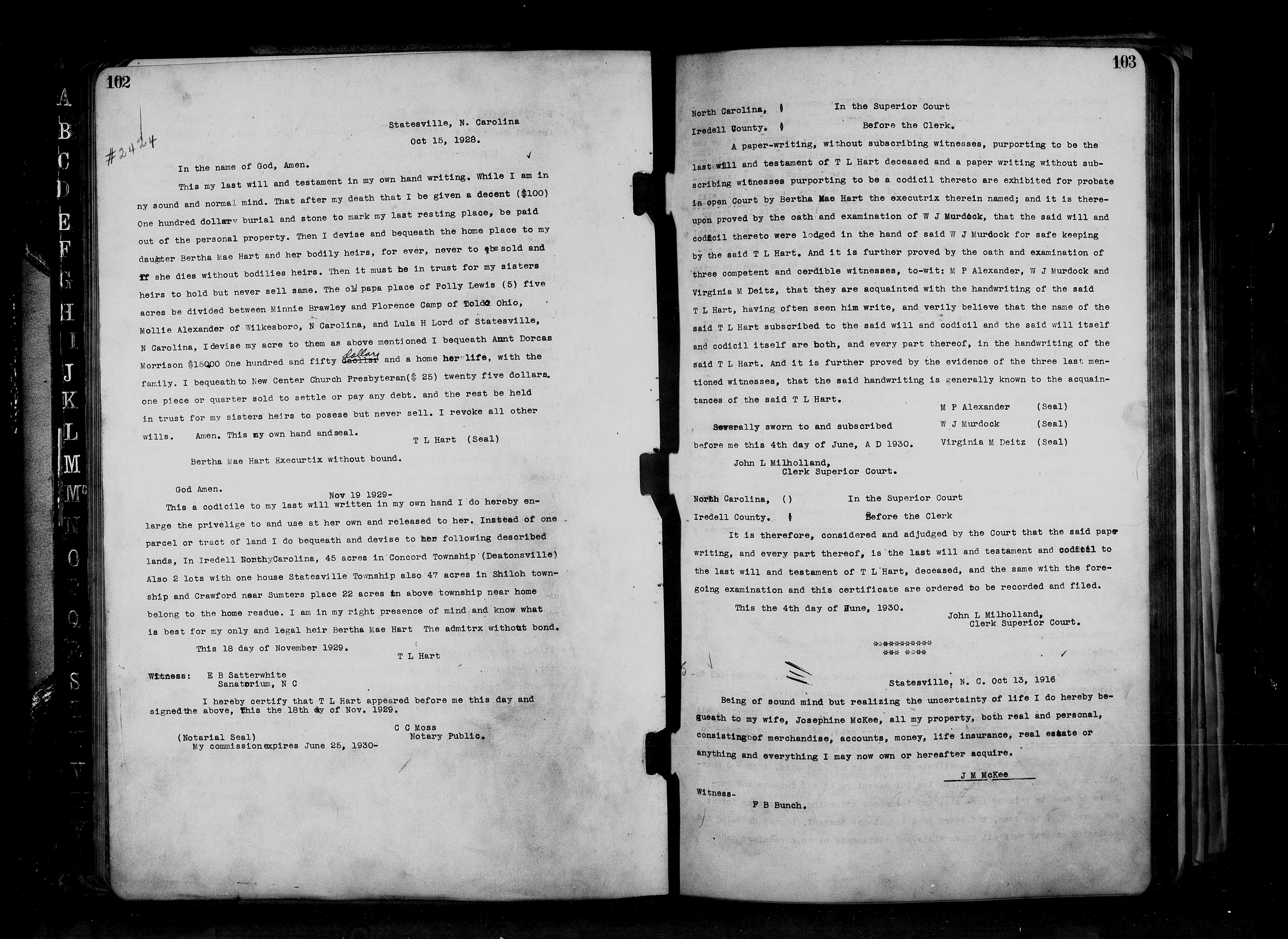
His will confirms Hart’s prosperity and reveals as well his deep ties to his family:
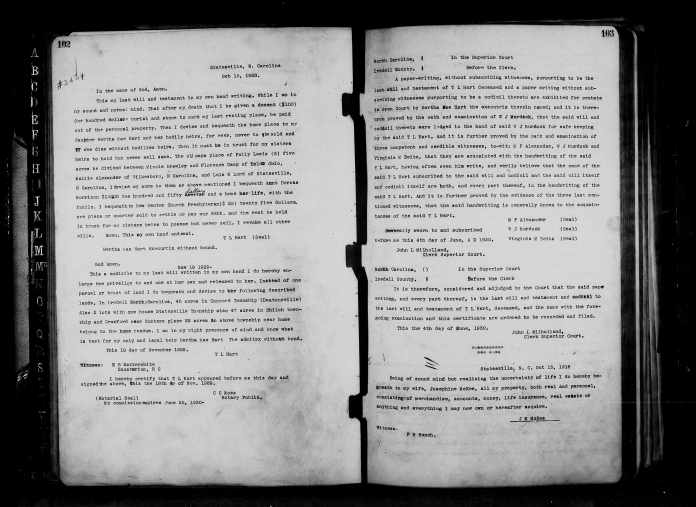
TL Hart Will

Standard