Births Deaths Marriages, Maternal Kin, Other Documents, Photographs, Virginia

Mary Brown Allen.

There’s a Mary Brown, age 20, listed in the 1870 census of Amelia County, Virginia. She worked as a laborer and shared her home with a 24 year-old man named Grief Bratcher. This is probably my great-great-grandmother.

Mary Brown Allen

Six years later, Mary Brown was in Charles City County, perhaps with a young daughter Nannie, and certainly pregnant. By a white man. A rape? A convenience? Love? We may never know. We do know, however, that just a few months into the pregnancy she married Graham Allen, a 24 year-old laborer from the other side of the James River in Prince George County. When she bore a son on Christmas, 1876, he was named John Christopher Allen. Over the next 40 years, Mary reared four children to adulthood (another four or five died), as well as some grandsons, while Graham farmed the small parcels of land he painstakingly accumulated and led a flock at New Vine Baptist Church. She never learned to read or write and left scant trace in the public record. Mary Brown Allen died April 1, 1916.

ImagePhotograph from the collection of Lisa Y. Henderson.

[UPDATE, 27 July 2015: As detailed here and here, DNA testing has led to the discovery of the father of Mary’s oldest son, John C. Allen, Sr. He was Edward C. Harrison of Charles City County.]

Standard
Births Deaths Marriages, Maternal Kin, Newspaper Articles, North Carolina, Oral History

Introducing Martha McNeely.

My grandmother had the sweetest memories of her mother’s mother, Martha Margaret Miller McNeely.Image

In the 1920s, Martha McNeely left Statesville for Bayonne, New Jersey, where her daughter Emma McNeely Houser had settled, followed by several siblings. She settled a few blocks in from the river at 87-A West Sixteenth Street, a 1920 duplex that is still occupied. Said my grandmother:

I went up there one summer from Hampton and worked, and she would let me help her in the kitchen and everything like that, and so I told her, I said, “I’ll cut the corn.”  And she said, “Baby, you can’t cut no corn.  You can’t cut my corn.”  And I said, “Yes, I can, too.”  She said, “I’m sure you can’t, but if you insist, let me see you cut it.”  So I cut the ear of corn like Mama had done, you know.  And she said, “Mmph.  Your mammy taught you.”  [Laughs.]  I didn’t ever forget that.  “Your mammy taught you.”  I said, “Yes, she did.”

And the same story, another time:

… She was so sweet and — I said, “Grandma, now, I can cut the corn.” And she liked to cook. She didn’t think anybody could cook but her. I said, “I can cut the corn for you.” She said, “Honey, you can’t cut no corn for me.” I said, “Yes, I can, too.” And so she said, “well, I’ll let you try it,” she said, “to get rid of you.” So I cut this corn down. She would split the grain, split the grain, and then you cut the top of the grain off, and you cut the second one off, and then you scrape it. And when I did this first ear, she said, “Hmph! Your mammy must have taught you!” “She did.”

When my great-great-grandmother died in 1934, two newspapers marked her passing.  On June 16th, the Bayonne Times announced:

“McNEELY – Martha, at her residence, 87A West Sixteenth street, on Saturday, June 16, 1934, beloved mother of Mrs. Emma Houser, Mrs. Carrie Colvert, Miss Minnie McNeely, John and Edward.  Notice of funeral later.”

Two weeks later, the New York Age informed readers that:

“Mrs. MARTHA McNEELY, one of the older residents of our city, died at her home on Saturday.  Her body was taken to Statesville, N.C. for burial.  Funeral service was preached by Rev. W. Atkinson at Wallace Temple.”

Photo of Martha M. McNeely in the collection of Lisa Y. Henderson.

Standard
DNA, Free People of Color, North Carolina, Paternal Kin, Photographs

DNAnigma, no. 2: Armwood????

There was a woman at home whom we called Cousin Inez. She had been born down in Dudley a few years after my grandmother, and we thought that connection was what motivated her insistence that we were kin. When I began my genealogical sleuthing, I discovered that Cousin Inez had been born an Armwood — another link, though not a blood one. The second wife of my great-great-great-great-grandfather James Henderson had been Louisa Armwood. I am not descended from her, but many of my cousins are. So, cousin-ish, but not actually kin.

Then, a couple of months ago, Ancestry.com pegged me as a  4th-6th cousin to a woman I’ll call A.G. This surprised me on two counts. (1) I’d recently “met” A.G. on a cousin’s family page on Facebook. A.G. and my cousin D. are related via the Simmonses, a free family of color centered in southern Wayne County. I’m not a Simmons – that I know of – but D. and I are 3rd cousins and some change via Lewis Henderson. (2) A.G. is an Armwood! Her ancestor William Armwood, son of Major and Eliza Armwood and born about 1835, married Martha “Matta” Simmons, daughter of William and Penny Winn Simmons, in Sampson County. This is William:

william-armwoodSo, what are the possibilities? What do we know?

  • A 4th to 6th cousin relationship suggests a common ancestor in the early 1800s. (Ancestry estimates very conservatively, so we may be closer.)
  • The relationship is almost certainly on my father’s side.
  • All of A.G.’s mother’s lines, back to the mid-1800s, were in the Wayne/Duplin/Sampson County area.
  • I have focused on her Armwood and Simmons lines because they are most familiar and intersect mine indirectly, but I may be making unwarranted assumptions.
  • A.G.’s Simmons line includes Wynn/Winn and Medlin lines. And I don’t know the maiden name of Major Armwood’s wife.
  • My Hendersons did not arrive in the area until the 1850s. I’ll eliminate them.
  • For the time being, I’ll eliminate my Euro-descended lines.
  • My Hagans line was probably from Nash County. I’ll eliminate them, too.
  • A.G. has a Yelverton line from northern Wayne County. Perhaps an Artis or Seaberry connection?
  • My Aldridge and Balkcum lines began with white women who bore children by black or mixed-race men circa 1820-1830 in Duplin and Sampson County. Is one of these unknown fathers the link to A.G.?


Standard
Enslaved People, Maternal Kin, North Carolina, Other Documents

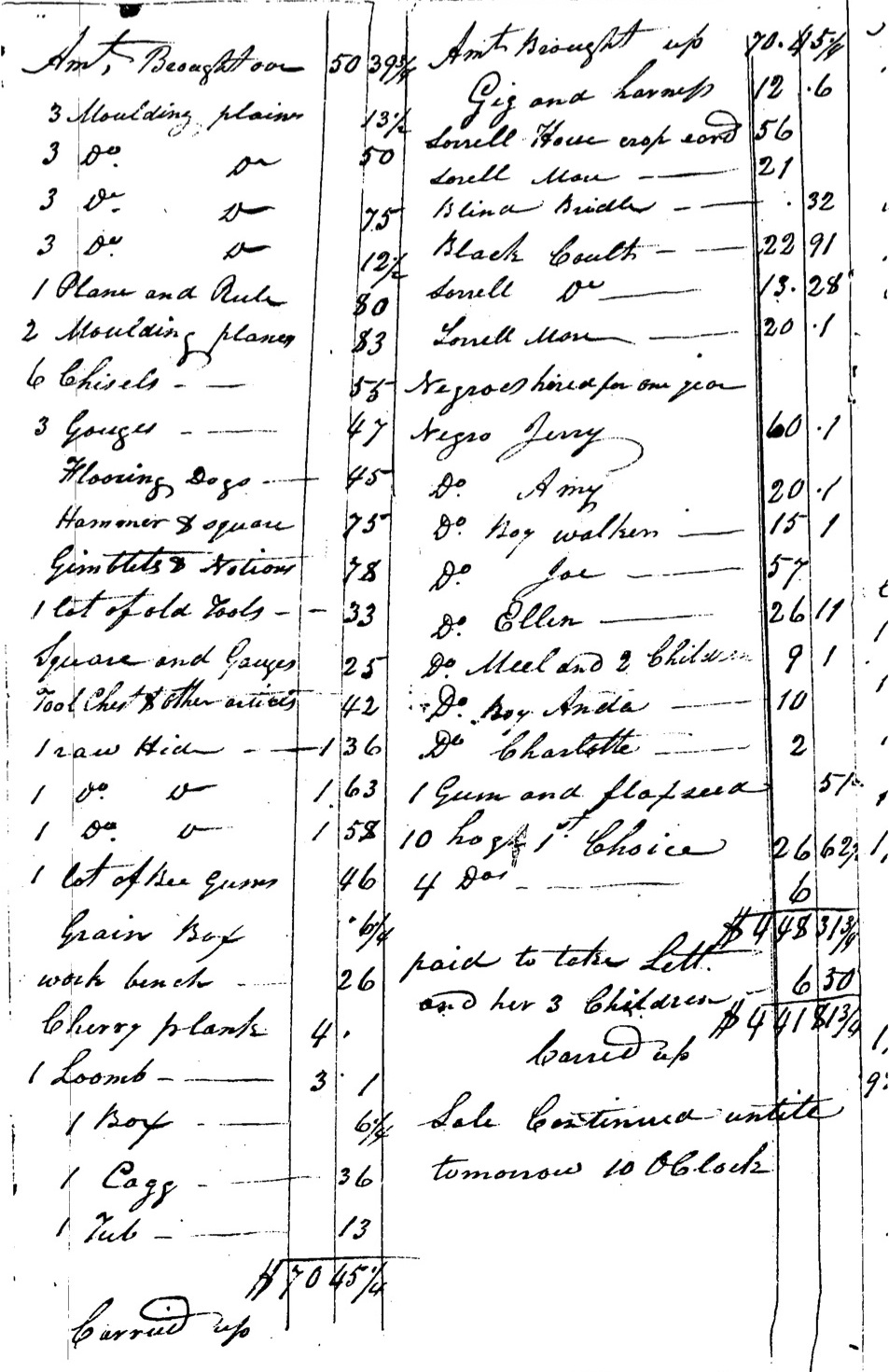
6 chisels, a hammer & square, a grain box, a sorrell mare, 10 hogs and …

Inventory of the estate of John Alpheus Colvert, Iredell County, North Carolina, 1827.

ImageImage

On the second page, in the second column, are “Negroes hired for one year,” that is, slaves leased to neighbors to earn money for Colvert’s estate. “Boy Walker” was about eight years old. That he was listed without his mother suggests that he was an orphan, though he may have been kin to the others who appear in this list. Walker had arrived in North Carolina only two or three years before, passed to John Colvert from the estate of John’s father Samuel. When John’s died, his son William I. Colvert inherited Walker. William was even younger than his own slave, however, and Walker was likely hired out until the boy came of age.

Standard
Births Deaths Marriages, Enslaved People, Maternal Kin, Newspaper Articles, Virginia

Tragedy at Charlotte Court House.

I first heard a version of the story of Joseph Holmes’ assassination from my great-aunt, Julia Allen Maclin. Joseph Holmes was brother to her grandfather Jasper Holmes. I later found a few references to the murder in books about Virginia’s political history, but details conflicted widely. A few years ago, I found these digitized articles, which firmly established the date of the incident and seemed to offer better insight into what actually happened. Last summer I visited Charlotte County and, with the invaluable assistance of archaeologist Kathy Liston, began to explore the landscape of Joseph and Jasper’s lives and shine light on the aftermath of his assassination.

 Tragedy at Charlotte Court House – A Negro Shot by a White Man – Particulars of the Affair – Result of the Inquest – Order for the Arrest of Those Concerned.

Richmond, May 4, 1869.

A tragedy occurred at Charlotte Court House, Va., yesterday, in which Joseph Holmes, a negro member of the late Constitutional Convention, lost his life. A few weeks since John Marshall, a son of Judge Marshall, of that county, was fired at in the night while in his residence by some unknown person. Yesterday being court day, Mr. Marshall was at the village, and there recognized a negro whom he suspected of having attempted to assassinate him. Marshall charged the negro with the crime, and he at once fled into the woods and was pursued without avail. A few hours afterwards, Joseph Holmes, who was formerly body servant of Judge Marshall, encountered young Marshall and threatened to have him arrested. A fight thereupon ensued, and both parties having pistols, firing commenced – Marshall aided by his friends. Holmes was shot through the breast, and staggering to the Court House fell dead. An inquest was hold, the jury returning a verdict that the deceased came to his death from a gunshot wound at the hands of some person unknown. The affair creates the greatest excitement in the county, where Holmes was exceedingly popular among the negroes, having been elected to the convention by a 2,000 majority over a white candidate. An order has been issued for the arrest of Marshall and party, but they have not yet been apprehended. — New York Herald, Wednesday, 5 May 1869.

——

THE WRIT OF HABEAS CORPUS IN VIRGINIA. –

Soon after the shooting of Joseph Holmes by young Marshall, in Charlotte county, Virginia, a meeting of the republicans of the county was held, speeches were made by prominent members of the party, and among the speakers were John Watson, George Tucker and Ross Hamilton. These parties were arrested and committed to jail under an indictment which charges that they did, on the 20th May, “feloniously conspire one with another to incite the colored population of Charlotte to make war against the white population by acts of violence,” &c. A petition for a writ of habeas corpus was on Monday presented to Judge Morton of the Circuit Court of Henrico, at Richmond, wherein it is alleged that the parties are illegally detained in the custody of the Sheriff of Charlotte county, and they are innocent of the charge brought against them. This writ was granted and made returnable on Tuesday. In accordance therewith the prisoners were brought before Judge Morton on Tuesday afternoon and after discussion of certain points of law the prisoners were hailed for their appearance before the County Court of Charlotte, Va., to answer the indictment. — New York Herald, Friday, 25 June 1869.

Standard
Free People of Color, North Carolina, Other Documents, Paternal Kin

Adam Artis’ children, part 2: Lucinda Jones.

artis-guardianship-application

“Adam Artist” and “Lousinda” Jones married 10 October 1855 in Nash County. Lucinda’s father Jacob Ing (who was white) was bondsman, William T. Arrington witnessed, and justice of the peace D.A.T. Ricks performed the ceremony. Lucinda Jones Artis died circa 1860, and in 1870 her children Augustus Kerney, Noah and Mary Jane inherited her share of her father Jacob Ing’s estate.  In 1872, Adam Artis filed this guardianship application in order to manage their estate.

Augustus “Gus” K. Artis was born about 1857. Some time after the birth of their daughter Lena in 1882, Gus and wife Mary migrated to the Little Rock, Arkansas area. The city’s 1914 directory lists him as a laborer at J.W. Vestal & Son, a nursery. He died in 1921.

Noah Artis, born in 1856, remained in northeastern Wayne County, where he farmed, married Patience Mozingo, and fathered children Nora Artis Reid, Pearl Artis, Pauline Artis Harris, Rena Belle Artis, William N. Artis, and Bessie Artis. He died in 1952 in nearby Wilson NC.

Mary Jane Artis, born in 1859, married Henry Artis, son of Warren and Percey Artis. (Though all of Wayne County Artises are probably ultimately related, the exact kinship between Warren Artis, whose father was supposedly Absalom Artis, and Adam Artis is unknown.) Mary Jane remained in the Nahunta area of Wayne County all her life and died after 1900. Her and Henry’s children were Armeta Artis, Alonzo Artis, Lucinda Artis, Callonza Artis, Mattie Artis Davis and Marion Artis.

Standard
Births Deaths Marriages, Enslaved People, Free People of Color, North Carolina, Paternal Kin

Adam Artis’ children, part 1: the Coleys.

In 1863, when the Confederate tax assessor queried administrator John Coley of Wayne County about W.W. Lewis’ estate, Coley enumerated several slaves, including Winney, age 29, Cane, age 9, and Caroline, 7. Adam Artis, the father of Winny’s children, lived nearby. He was a free man of color, and his and Winny’s relationship had not lasted long.

By adulthood, Cain Artis had adopted his father’s surname and farmed his own land in northwest Wayne County.  By 1890, he had bought a house in the nearby town of Wilson and the 1912 city directory shows him operating a small business just outside city limits on the town’s main road. He died of tuberculosis in Wilson County in 1917, survived by his second wife, Margaret Barnes.

In 1878, Caroline Coley married Madison Artis, son of Calvin and Serena Seaberry Artis. Her uncle Jonah Williams was a witness to the ceremony. Caroline and Madison appear in the 1880 census of Wayne County, but have not been found after.

Standard
Births Deaths Marriages, Maternal Kin, North Carolina, Photographs, Vocation

Mercy me.

ImageThe hospital was on East Green Street, right around the corner from Jackson Chapel and Saint John AMEZ and Calvary Presbyterian. That last Sunday in June, two days after her first delivery, my mother lay perspiring in an iron bed, smiling uncomfortably as she accepted congratulations from church ladies making their post-service rounds. (The first reports went out: the Hendersons had a jowly yellow girl with a slick cap of black hair, a “Chink” baby, as one later indelicately put it.) She was desperate to be discharged, but had to wait for an all-clear from the pediatrician. It was not as if he were right down the ward. Dr. Pope was white, and as his black patients were forbidden to come to him, making his rounds meant driving across the tracks to them, laid up in sweltering Mercy Hospital. He arrived Sunday evening, turned me this way and that, pronounced himself satisfied, and granted us a release for the next morning. A few months later, when federal law mandated that Wilson’s new hospital open as an integrated facility, Mercy closed.

Founded in 1913 as the Wilson Hospital and Tubercular Home, Mercy was one of a handful early African-American hospitals in North Carolina and the only one in the northeast quadrant of the state. Though it struggled financially throughout its 50 years of operation, the hospital provided critical care to thousands who otherwise lacked access to treatment. A small cadre of black nurses assisted the attendant physician. One was Henrietta Colvert, shown below at far left, my great-grandfather’s sister. Henrietta was born in 1893 in Statesville, Iredell County, and received training at Saint Agnes School of Nursing in Raleigh. How she came to Wilson is unknown. This photograph suggests that she cared for Mercy’s patients in its earliest days. (The man seated in the middle is Dr. Frank S. Hargrave, a founder of the hospital, and he left for New Jersey in the early 1920s.)  My father’s mother recalled that Henrietta also worked as a visiting nurse for Metropolitan Insurance Company in the 1930s and attended her children for two weeks after they were born.  My great-great-aunt was still at Mercy in the 1940s, but had left Wilson by time my mother married my father and moved there in 1961, and my family had long lost contact with her when she died in 1980 in Roanoke, Virginia.

Image

Photograph of Mercy Hospital taken in June 2013 by Lisa Y. Henderson. Photo of Mercy’s staff courtesy of the Freeman Round House Museum, Wilson NC.

Standard
DNA, Maternal Kin

DNAnigma: Throwback Thursday.

First I wrote:

Just before I was about to pick up the phone again to lay into the African Ancestry people about my DNA results, the packet arrived in the mail. I’d had a mitochondrial DNA analysis done. In other words, AA examined a few cheek cells to isolate a segment of DNA that has passed consistently and unchanged from some distant ancestor through her daughter, and then her daughter, and so on, through Margaret McConnaughey (b. ca. 1820) and her daughter Martha Miller McNeely (1855-1934), and her daughter Caroline M.M.F.V. McNeely Colvert (1877-1957), and her daughter Margaret Colvert Allen (1908-2010), and her daughter, to me. It’s a bit of DNA from only one of innumerable and unknowable ancestors, but it’s the only genetic material that is absolutely passed on in women from generation to generation, ad infinitum. (For men, there’s also Y-DNA.) Theoretically at least, comparing an individual’s mtDNA to those in a database such as that assembled by AA yields a match with identical mtDNA sequences found in some part of Africa. So. Genealogy lunatic that I am, this whole process held exciting possibilities for me. I’m not silly enough to think that I look like I descend from people in Senegal or Guinea or Cameroon, or that my personality is shaped by some distant Nigerian cultural link, or that I’m on my way to discovering my own Kamby Balongo, but I was pretty geeked about discovering a little something about my personal connection to West Africa and the Middle Passage. Imagine my surprise, then, when I ripped open the packet to find a “Certificate of Ancestry” asserting that my mtDNA Sequence Similarity Measure is “100% the same as sequences from people in Sudan today.” SUDAN???? So I’m a DINKA? Not a Wolof or Igbo or Nupe or Asante? Not even a West African? Well, I’ll be damned. After my surprise wore off a bit, I did a little Wikipedia’ing and discovered that, while uncommon, an East African origin is plausibly explained by the trans-Sahara trade and the Fulani people who ranged well into western Sudan in ancient times. So, wow, huh? I’m not just a hyperbolic Nubian!

And then a few days later, after the wonderment wore off:

A little Internet delving into my mtDNA results reveals that my “Sudanese” match is, scientifically speaking, a variant of the d1 clade of the L2 haplogroup. Haplogroup L2 encompasses about 1/3 of all sub-Saharan African mtDNAs. The clades, labeled a-d, are further branches of L2, and the clades themselves have further variations, i.e. d1. Anyway, the most common haplotypes are shared by and within ethnic groups in multiple regions of Africa. In other words, because of thousands of years of migration (and consequent assimilation) among individuals and ethnic groups across the continent (or, at least, its broad midsection), a sample, like mine, may match L2d1 samples obtained from people living in modern Sudan, but it doesn’t mean that 50,000 years ago (or whenever my variation mutated), our common maternal ancestor was in what is now Sudan, and she certainly wouldn’t have been a Dinka or Nuer or any other ethnic group that exists as we know them today. She may not have been anywhere near Sudan, for L2d1 is also found in other modern-day tribes. Sooo?

——

I wrote this note in 2008. I’ve since tested at other sites and, though my haplogroup remains the same, have gotten different analyses of its origin. More on that later.

Standard
Civil War, Enslaved People, Maternal Kin, North Carolina, Other Documents

Total value: $7,600.

1863

Rowan County, North Carolina, 1863. The Civil War is dragging on, and the Rebs need money. In 1861, the Congress of the Confederate States of America had passed a statute authorizing a tax (at 50 cents per $100 valuation) to help finance the war effort. Taxable property included real estate, slaves, merchandise, stocks, securities, and money, and later agricultural products and anything else they could think of. In the 1863 assessment, for the first time, the North Carolina General Assembly required taxpayers to list their slaves by name. Assessments for only eight counties survive. Rowan is one of them.

Look in the bottom left corner. J.W. McNeely identified his seven slaves for the tax assessor, who duly recorded: Lucinda, age 47, value $750. Julius, 25, $1500. Henry, 22, $1500. Archy, 14, $1200. Mary, 13, $1000. Stanhope, 11, $900. And Sandy, 12, $950. Total valuation of Lucinda, her sons, and grandchildren: $7600. Remember Alice, the 3 year-old that Sam and J.W. McNeely bought with Lucinda? She was Archy’s mother, and Mary, Stanhope and Sandy were probably her children, too. Alice herself is gone — dead or sold — and John is not listed, though that seems to be oversight. Julius was born a few years after the McNeelys purchased his mother. His father is unknown, but was probably an enslaved man on a neighboring farm. Henry, though, was John Wilson McNeely’s boy. His only child, in fact. And worth exactly $1500.

Standard