North Carolina, Paternal Kin, Photographs

Conviction?

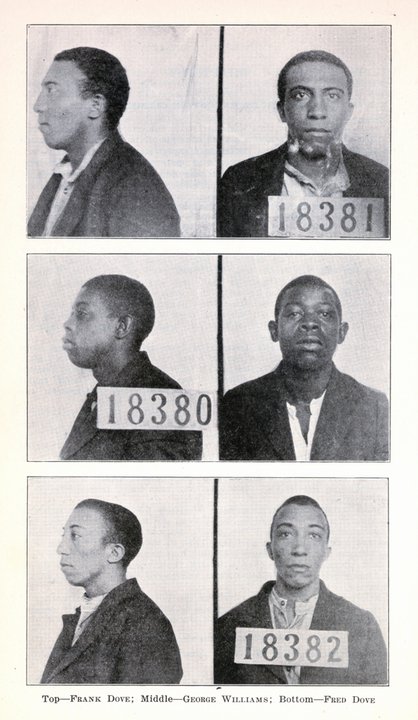
These men were convicted of the August 1922 murder of mail carrier Cyrus Jones in Swansboro, NC, largely on the testimony of another man, Willie Hardison, who was tried separately for the murder. Hardison later confessed that he had made up their involvement under the threat of being lynched. The state electrocuted Hardison in 1923, but both the trial judge and the prosecutor wrote letters requesting executive clemency for George Williams and the brothers Frank and Fred Dove. After almost six years on death row, the three were given full pardons in March 1928 by Governor A.W. McLean.

Image

Sidenote:  My people are from Onslow County, just west of Swansboro.  My furthest traceable Henderson ancestor was a free woman of color named Patsey Henderson, born about 1800.  Patsey’s sister Nancy married (or perhaps didn’t) a free man named Simon Dove.  The Onslow County Doves, including Fred and Frank, are descended from their son Durant Henderson, alias Durant Dove.

Image from “Capital Punishment in North Carolina,” Special Bulletin from the North Carolina State Board of Charities and Public Welfare, Raleigh, N.C. (1929). Copy courtesy of the North Carolina Collection, Wilson Library, University of North Carolina at Chapel Hill.

Standard
Births Deaths Marriages, Maternal Kin, Newspaper Articles, North Carolina

Witnesses to a homicide.

Harriet Nicholson, then about 16, married Abner Tomlin on November 20, 1877, in Iredell County. Their marriage license lists “L. Nicholson” as Harriet’s mother and leaves blank the space for a father’s name. Harriet’s son Lon Colvert was two years old and remained with his father’s grandparents.

The couple settled in Olin township, likely near Abner’s family. Harriet may have been pregnant when she married; their son Milas (named after Ab’s father) was born about 1877. In subsequent census records, Harriet reported having given birth to as many as nine children by Abner, but my grandmother knew only one, Harvey Golar Tomlin, born about 1891. However, at least one other child, Lena, lived to young adulthood, as the newspaper article below attests:

——

HOMICIDE FRIDAY NIGHT.  Jess Shaw, Colored, Shot and Killed in Wallacetown — Bob Owens Charged With Murder — Conflicting Testimony

Jess Shaw, a colored man probably about 19 years old, was shot and killed between 10 and 11 o’clock Friday night in Wallacetown, a colored suburb on the A., T. & O. Railroad, just south of the Statesville depot.  Bob Owens, a young colored man is charged with the killing and was held by the coroner’s jury.

The shooting took place near the house of Emma Rhinehardt.  According to the testimony Shaw had borrowed a guitar from Grace Belk, colored.  She told him he could pick it but not carry it away.  He did carry it away and when the woman saw him, shortly before the killing, she cursed him about the guitar and advanced on him with a knife.  Jess stooped down to pick up a rock, or did pick up one, and just then he was shot.  Three shots were fired, but only one took effect.  It is known that Bob Owens, Grace Belk, Maggie Morrison, Dovey Gray and Emma Rhinehardt were present when the shooting occurred.  Jess ran up the railroad when shot, a distance of 100 or 150 yards, and calling to Ab. Tomlin’s wife told her he had been shot and that Bob Owens had shot him.  Tomlin and his daughter Lena went to him and carried him to their house.  He died in about 15 minutes but before dying told them again that Bob Owens had shot him.

… Dr. Long, who made the post mortem examination, assisted by Dr. Carlton, found that one ball had entered the abdominal wall of Shaw’s body, passed through a large intestine in two places, completely severed a large artery and buried itself in the muscular tissue of the pelvis, from which it was removed by the surgeons.  Death was due to internal hemorrhage produced by the shot.

The testimony as to the shooting is conflicting.  Ab Tomlin and his daughter testified to Shaw’s telling them that Owens shot him. …

Owens is a small black negro and bears a fair reputation among white people, but his reputation is said to be bad among those of his own race.

The locality where the shooting occurred is a colored settlement that is noted for rowdyism. 

— Statesville Semi-Weekly Landmark, 4 October 1898.

——

Ab Tomlin apparently died soon after this incident, as his wife Harriet is listed as a widow in the 1900 census. Of their son Harvey Golar, known as “Doc,” more later.

Standard
Births Deaths Marriages, Free People of Color, North Carolina, Oral History, Other Documents, Paternal Kin

The death of Lewis Henderson.

lhenders-20110225152701My grandmother, who was born in 1910, said her great-grandfather Lewis Henderson died when she was very small. She did not remember him, though her sister Mamie had reason to. He threw a brush at her — it hit her in the head —  because she was making too much noise. She could not have been older than four.

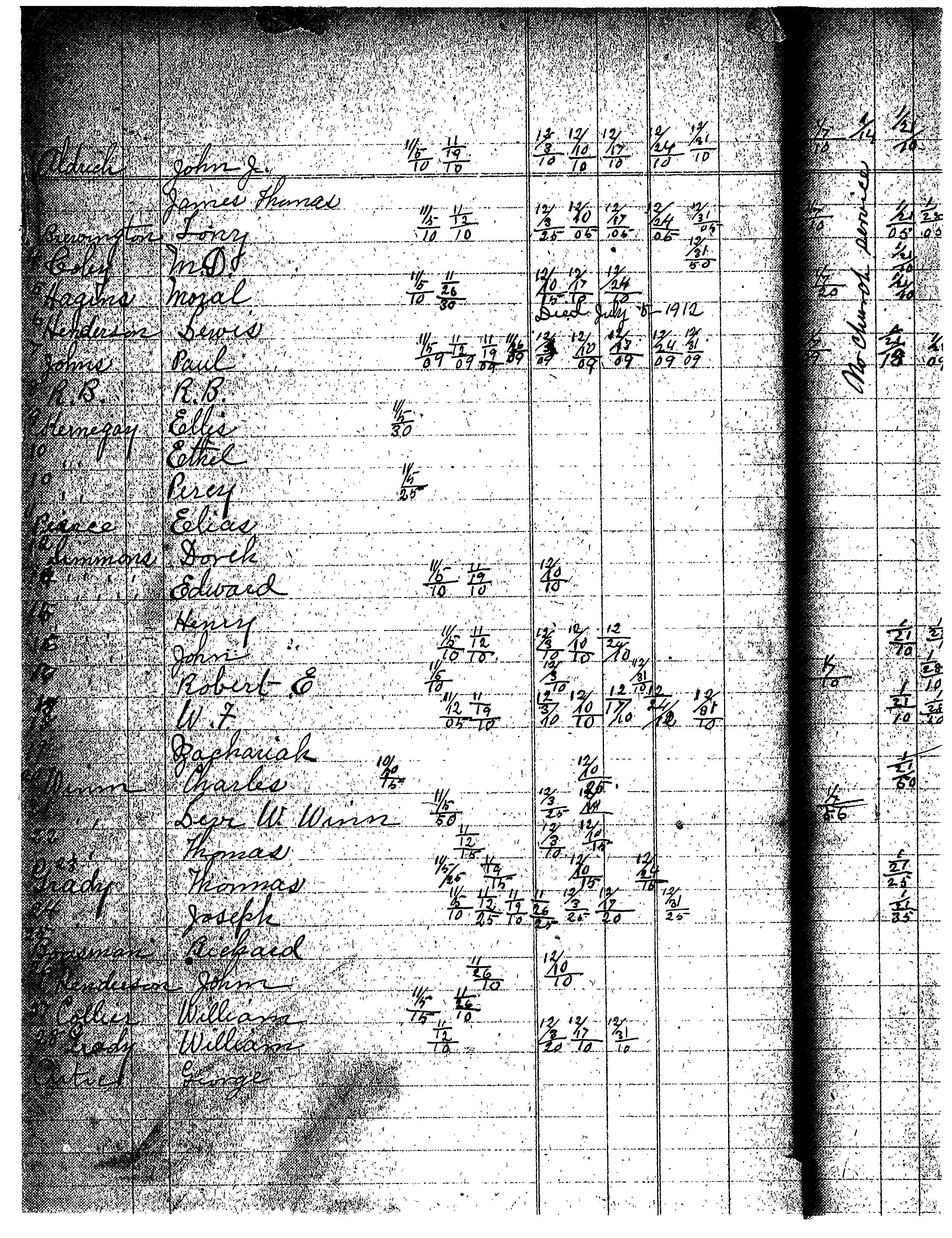
North Carolina did not keep death certificates until 1914, and Lewis’ grave is unmarked. How do we know exactly when he died? This is a page from one of the few volumes of early church records that survive for the Congregational Church of Dudley. Lewis had helped found the church in 1870, and this list shows tithes paid by male congregants. The sixth name: Henderson, Lewis. And this notation: “Died July 5 — 1912.” He would have been about 76.

Standard
Enslaved People, North Carolina, Other Documents, Paternal Kin

Kinchen Taylor’s inventory.


179360_500865558526_505368526_6215658_5475447_n

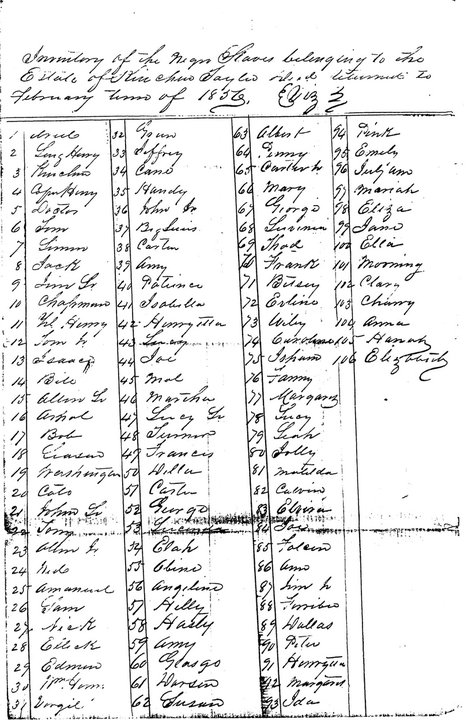
Nash County, North Carolina, 1856. An inventory of the slaves of Kinchen Taylor, deceased. Number 32 is Green. Number 88 is his wife Ferribee; and 89, 90 and 91, their oldest children. Most of Kinchen Taylor’s slaves were divided among his children, but two lots of slaves were sold. Green and Ferribee and their children were included in one of those lots, and it is not clear to whom they went, or if they went together. However, in 1870, in the first post-Emancipation census, they are listed in southern Edgecombe county as an intact family: Green Taylor, 52, his wife Phebe, 55, and children and grandchildren Dallas, 19, Christiana, 15, Mckenzie, 13, Mike, 9, and Sally Taylor, 1. Henry Michael “Mike” Taylor was my great-grandfather.

The file of Kinchen Taylor (1853), Nash County, North Carolina Estate Files 1663-1979, https://familysearch.org, original, North Carolina State Archives.

Standard
North Carolina, Oral History, Paternal Kin

Scuffalongs and muscadines.

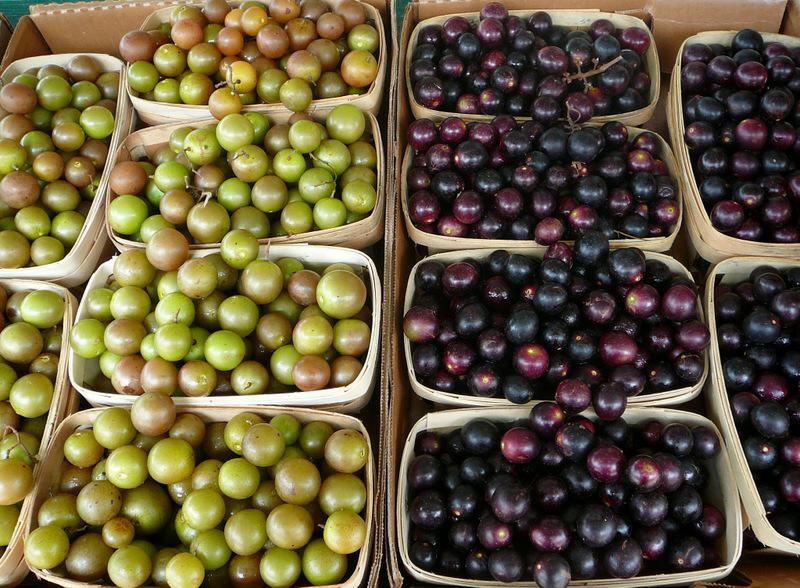
Great big old black ones.  Lord, he might as well have told me to go out there and eat all I wanted.  I eat all the way down the corn row down to that lady’s house, Mary Budd, and come up through the corn field and come back to the road and went over there stood up there and eat all I want and throwed the hulls over in the pasture.  The hog pasture, or whatever that thing was out there where pigs was.  They thought I was gon give ‘em something to eat, I reckon.  And I throwed the things over there, and I reckon that’s where Uncle Lucian discovered that we was eating ‘em.  And he said, “Y’all stay away from out there!  Somebody’s been out there —!”  “Wont me!”  [She laughs.]  Them things seem like was the best things I ever had.  And the arbor there on the yard where was all up in the trees, it’d be grapes.  And I’d go there and eat them, but they was little.  It was what they call scuffalongs.  White grapes.  And I’d eat them, too, but I wanted some of them old big ones.  Them old big black ones.

Image

I recorded interviews with my father’s mother in 1994, 1996 and 1998. Her scuppernong story was one of my favorites.

Interview of Hattie H. Ricks by Lisa Y. Henderson; all rights reserved.

 
Standard
Births Deaths Marriages, Enslaved People, Maternal Kin, Newspaper Articles, North Carolina, Virginia

The death of Walker Colvert.

Image

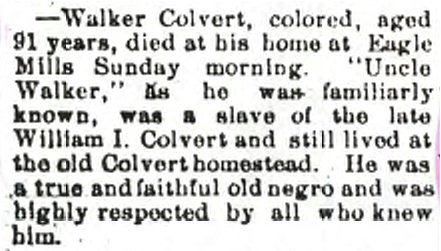
Born in Culpeper County, Virginia; bundled up with chairs and kegs and sundry and shipped to North Carolina after his first master died; reared with his future master, the William I. Colvert noted; husband to his beloved Rebecca; father of three, or maybe four (or more likely more); a middle-aged man when freedom came; a farmer who got a toehold and kept it long enough to pass it on. In the February 5, 1905, edition of the Statesville Landmark, a brief acknowledgement of the death of Walker Colvert, “a true and faithful old negro.” I feel some kind of way about the description, but I didn’t have to live in 19th century North Carolina, and I will not judge. (Him, anyway.)


Standard
Free People of Color, North Carolina, Paternal Kin, Photographs

The case for Margaret Henderson as daughter of Nancy Balkcum.

The case for Margaret Henderson as the daughter of Nancy Balkcum (and sister of Mary Eliza Balkcum Aldridge) —

1. Margaret was born 1833-1836, probably in Sampson County NC. Mary Eliza was born in 1829 in Duplin or Sampson County.

2. Her photo clearly indicates that she was mixed race, as was Mary Eliza. Mary Eliza Balkcum’s mother Nancy Balkcum was white.

3. Margaret is not listed in the 1850 census, and neither is Nancy Balkcum.

4. Nancy Balkcum’s will makes reference to a daughter Margaret Balkcum, as well as a daughter Eliza Balkcum.  The will was probated in 1854 in Sampson County, prior to Margaret Balkcum Henderson’s marriage circa 1855. Margaret Balkcum purchased a number of small items from her mother’s estate.

5. Margaret named her second son James Lucian Henderson in 1857.  Compare: James Lucien Balkcum, born 1838, son of Nancy Balkcum’s daughter Mariah Balkcum Johnston.

6. Margaret named her first daughter Isabella circa 1860.  Compare: Isabella Johnson, born 1858, daughter of Mariah Balkcum Johnson.

7. Margaret named her second daughter Ann Elizabeth circa 1866.  Compare: Ann Eliza Balkcum, born circa 1840, daughter of Nancy Balkcum’s son John Balkcum.

8. Margaret named her third daughter Mary Susan circa 1868.  Compare: Mary Susan Balkcum, born 1844 to John Balkcum, and Susan Johnson, born 1844 to Mariah Balkcum Johnson.

9. Between 1860 and 1870, Margaret and her husband Lewis Henderson and Eliza and her husband Robert Aldridge migrated to the Dudley area of southern Wayne County.  The families are listed side by side in the 1870 census.

10. Caswell C. Henderson’s November 1907 marriage license, issued in New York City, reports his mother’s name as Margaret Balkcum.

11. Matrilineal descendants of Margaret Henderson have mtDNA haplotype H3. Descendants of Mary Eliza Aldridge have mtDNA haplotype H3.

12. Certain descendants of Margaret Henderson share significant autosomal cM totals with descendants of Mary Eliza Aldridge, but have no other known lines of common descent.

Problematic points:

1. Margaret’s death certificate lists her mother as Margaret Bowkin, not Nancy.  Informant was her son Lucian Henderson.  (I have seen instances in which an informant listed his own mother’s name, instead of the decedent’s mother’s name. Is this the case here?)

2. Margaret’s son Lucian’s June 1934 death certificate lists his mother’s maiden name as Hill.

3. Margaret’s daughter Sarah’s January 1938 death certificate lists her mother’s maiden name as Carter.  Informant was Hattie Mae Henderson, Sarah’s great-niece, who told me 60 years later that she did not recall giving this information and did not believe it was correct.

4.  Perhaps most puzzlingly, there is absolutely no tradition of kinship between the two families. Hattie Mae Henderson was reared by her great-aunt (Lewis and Margaret’s daughter) Sarah Henderson Jacobs. If Sarah had been first cousin to Robert and Eliza Aldridge’s children, it seems that there would have been some acknowledgement of the relationship passed down — not only to Hattie (my grandmother), but to others descended from the free colored families in this small community. They (Simmonses, Winns, Jacobses, Hendersons, Aldridges, etc.) intermarried freely, so consanguinity would not have been shameful. The one exception: Hattie Henderson reported visiting with Sarah a “Cousin Tilithia” in Norfolk as a child. This was Tilithia Brewington King Godbolt Dabney, daughter of Robert and Eliza’s daughter Amelia Aldridge Brewington. Did Sarah call Tilithia “cousin” because they themselves were related, or because Hattie was related to Tilithia (through J. Thomas Aldridge, her father and Tilithia’s first cousin)?  A point to consider: all but one of Lewis and Margaret’s children (son Lucian, who himself had no children who lived to adulthood) had died or migrated from Dudley by about 1905. The “lack of tradition” I perceive may simply be a function of a gap in familiarity between those people who knew Lewis and Mag’s family and those I was able to interview 80-90 years later.

Image

 Photo of Margaret Henderson in collection of Lisa Y. Henderson.

Standard
Enslaved People, Maternal Kin, North Carolina, Other Documents

How we came to be McNeelys.

Image

Rowan County, North Carolina, 1819. Widow Elizabeth Kilpatrick is close to death. Her daughter Mary is to receive “one feather bed and all my beds clothing of every kind, all my dresser furniture, my chest, one pot, one dutch oven, one pot rack” and “my negro girl named Lucinda.”

Don’t forget Lucinda. She’s my great-great-great-grandmother, and you’ll see her again. And Juda? In paragraph 5? Probably Lucinda’s mother. “All her children (not disposed of)” suggests that Dave, who went to Robert Kilpatrick, and Lucinda, were Juda’s disposed-of children. Who were the others?

Image

Rowan County, North Carolina, 1834. Mary Kilpatrick files a deed for the sale of “one negro woman named Lucinda aged about twenty years one negro child named Alice aged three years and one negro child named John aged between one and two years,” plus a few other sundries to Samuel and John W. McNeely, who are father and son. This is the Lucinda that Mary Kilpatrick inherited from her mother in 1819. Remember John Wilson McNeely. You’ll see him again, too.

Image

Rowan County, North Carolina, 1843. Samuel McNeely‘s will. To his beloved son John W. McNeely, he leaves “a negro woman named Lucinda and all her offspring.” Lucinda, then, may have been the only slave Samuel ever bought, and she returned his investment handsomely.

One of Lucinda’s offspring was Henry W. McNeely, whose father was the very John W. McNeely who owned him.  Henry, my grandmother Margaret Colvert Allen‘s maternal grandfather, was born in 1841 in western Rowan County and died in Statesville, North Carolina, in 1906.

Standard
Civil War, Free People of Color, North Carolina, Other Documents, Paternal Kin

Hillary Herring, Union man.

Image

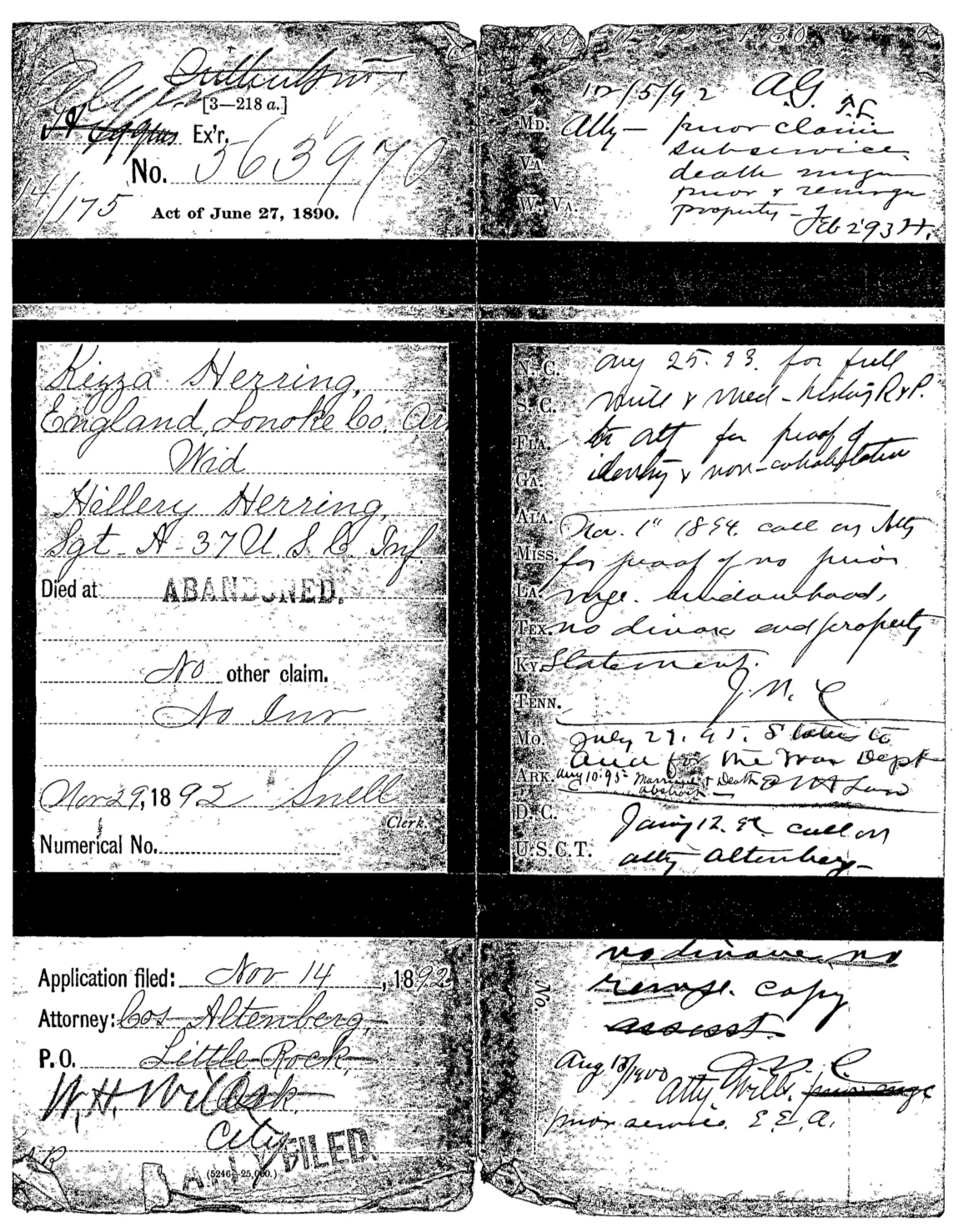
#563,970. Claim of Kizza Harring, widow of Hillary Harring, Co. A, 37 U.S.C.T., for Widow’s Pension.

Hillary Herring enlisted in the Union Army in 1864.  At his enlistment, he reported that he was 23 years old, 6 feet 1/2 inches tall, light-complexioned, with black eyes and dark hair, was born in Onslow County NC, and worked as a farmer. (Census records reveal that he grew up in Wayne County.) Documents in Herring’s widow’s pension application file show that he was discharged from the army on 11 February 1867, making it likely that he fought in the 37th in battles across southern Virginia and eastern NC. (See a history of the 37th U.S.C.T. here.)  He married Kizzy Dudley on 18 December 1869 in Burgaw, Pender County NC. Rev. Elisha Boon performed the ceremony. It was Hillary’s first marriage, but Kizzy was the widow of a John Herring that she’d married in 1863. (Hillary’s kin?) Hillery Herring died 30 June 1876 in Bentonsville, Johnston County, of “disease of lungs.” Dr. Martin Harper attended him during his final illness.  Lewis Hood furnished his coffin and served as undertaker, and Rev. John James Harper, a white man, preached the funeral sermon.

On 21 November 1872, Hillery and Keziah Herring and my great-great-great-grandparents Lewis and Margaret Henderson sold two tracts in Wayne County totalling about 80 acres to John P. Cobb and Jesse Hollowell. The four had purchased the tracts from William R. Davis, but the deed was not recorded. Both Lewis and Hillery were born in Onslow County.  Were they related?  If not, why did they buy land together?


Standard
Births Deaths Marriages, Free People of Color, Letters, Newspaper Articles, North Carolina, Oral History, Paternal Kin

Comments, upon the death of Rev. Silver.

REV. JOSEPH SILVER DIES AT HIS HOME AT 100 YEARS OLD

Reverend Joseph Silver, Sr., well known and highly respected Negro minister, died Tuesday at his home in the Delmar community, on Enfield Route 3.  He celebrated his 100th birthday anniversary last July 22 at a large gathering of friends and relatives. Rev. Silver had been in poor health about four years and had been confined to his bed for the past four months.

Funeral services will be held from the Plumbline Holiness Church, Sunday afternoon at 2 p.m. The body will lay in state at the church an hour before the funeral.  The Rev. L.G. Young, of Henderson, will preach the funeral and burial will be in the family plot.  Among those expected at the final rites are Bishop M.C. Clemmen of Richmond, Va., and Bishop H.B. Jackson of Ayden.

Rev. Silver began preaching in 1893 when he he organized and built Plumbline Church.  Among other churches built by his ministry are ones at Ayden and Summitt, near Littleton. He was an organizer of the United Holiness Church of America and served on the board of Elders until his death.

Rev. Silver was married three times; first to Felicia Hawkins, who died in 1931, then to Sarah Jacobs of Wilson, who died in 1938; and last to Martha Aldridge of Goldsboro, who survives.  In addition to his wife, Rev. Silver is survived by five sons N.D. and Samuel Silver, of Washington, DC; Gideon, of Pittsburg, Pa.; Joseph, Jr., of Halifax and A.M. Silver of Route 3, Enfield; three daughters, Epsi Copeland and Roberta Hewling, of Enfield, Route 3, and Emma Goines, of Pittsburg, Pa. Eighty grandchildren, 109 great-grandchildren, and 17 great great grandchildren also survive.

— Unnamed newspaper clipping, 10 January 1958.

——

P.O. Box 193 Nashville

N.C.   c/o Brake

Feb. 2, 1958

Dear Hattie –

You heard of Rev. Silver’s death Jan. 7th although I didn’t notify you as I was sick and still is sick but not confine to bed.  Sarah had some things in the home.  A bed which I am sure you wouldn’t care for and a folding single bed which I am going to get but my main reason for writing you she has an oak dresser and washstand that Rev. Silver told me you wanted and said he told you you could get it if you would send for it so it is still there and it is good material if you want it.  Amos has already seen a second hand furniture man about buying it.  The Silver’s will “skin a flea for his hide and tallow.”  The Aldridges holds a very warm place in my heart and always will.  If you wish to do so you may write to Rev. Amos Silver Route 3 Box 82 Enfield and ask him if your mother Sarah’s furniture is still there.  There is also a carpet on the floor in the living room you need not mention my name.  I am very fond of Johnnie Aldridge of Dudly.  Come to see me whenever you can I think you might get with Reka at Fremont some times, she and Luke come to Enfield to see me occasionally  I am going to write Reka next week.  I married your great uncle Rev Joseph Aldridge write me

Your friend and great aunt by marriage.

M.C. (Aldridge) Silver

——

And then this was what my grandmother had to say:

Mr. Silver, he had a bunch, he had 11 children, and his son had a whole bunch of ‘em.  Joseph Silver.  And I went up there one time and one of the brothers was crazy.  And they had one of them there things built up where you could put a person in it, and you can just slide their food right in it.  And it was a seat in there, least it was built in the thing where you could sit on.  When the person would act up, and you can’t do nothing with him, you’d lock him up in that thing, and he had one of them things in the backyard.  Big old thing.  It was just like one of them tanks where oil come in.  And I went in there, peeked through the thing, and I was scared, and I’m drawed all up and looked, but I couldn’t see in there.  But they told me how it was.  …  When Mama got married there on Elba Street, there at the house.  Yeah.  He come up there …  He was a little short brown-skinned man, and he was a elder and the head of the church where was down there in Halifax County.  And all the children ….  Epsie?  Epseline?  What was his first wife’s name?  But him and Mama fell out ‘bout the cooking stove.  She took and got the wood and got the little stove – was four caps on it.  I’ll never forget it.  And it was red-hot in the middle.  And he said, “Don’t put too much wood in that stove!  Get Epsie’s stove that hot!  I know she’ll turn over in her grave!”  And she told him, said, “What?  Epsie ain’t here!”  Said, “I’ll tear the whole stove down!” or something, and she hit the stove!  He didn’t want her to –  They had chinches all over the house.  It was a sealed plank house, and the chinches was all in the, where the cot was up against the wall?  And Mama said she went there and, I told her, I said, when she was telling me ‘bout she was scalding water, had the stove hot and had buckets of water up there on the stove so it would be hot enough to kill the eggs and everything.  And he didn’t want her to pour no water on it, talking ‘bout she got the stove red-hot and Epsie’ll turn over in her grave.   She had that stove that hot.  “Epsie didn’t never used to have it that hot.”  She said, “Well, Epsie ain’t here now, and I’ll burn it up!  House and all!”  She said, “To get rid of these here chinches.”  Chinches all over everywhere!

“Epsie,” of course, was Rev. Silver’s daughter, not his wife. This letter addressed to “Miss Hattie Jacobs  Sanatorium Wilson N.C.,” postmarked Feb 2 1958, Nashville N.C. is in my possession.  Martha Silver’s previous husband had been Joseph Aldridge, younger brother of my grandmother’s grandfather John W. Aldridge.  The Johnnie Aldridge referred to was my grandmother’s uncle.  Reka Aldridge Morrisey Ashford was the daughter of George W. Aldridge, John W. Aldridge’s older brother.  I interviewed my grandmother in her home in Philadelphia in 1994.

Standard