
Arsonists struck the Eureka community in the summer of 1960, destroying barns and tobacco at the Leslie Artis farm and the Adam Artis farm (owned by his descendants).
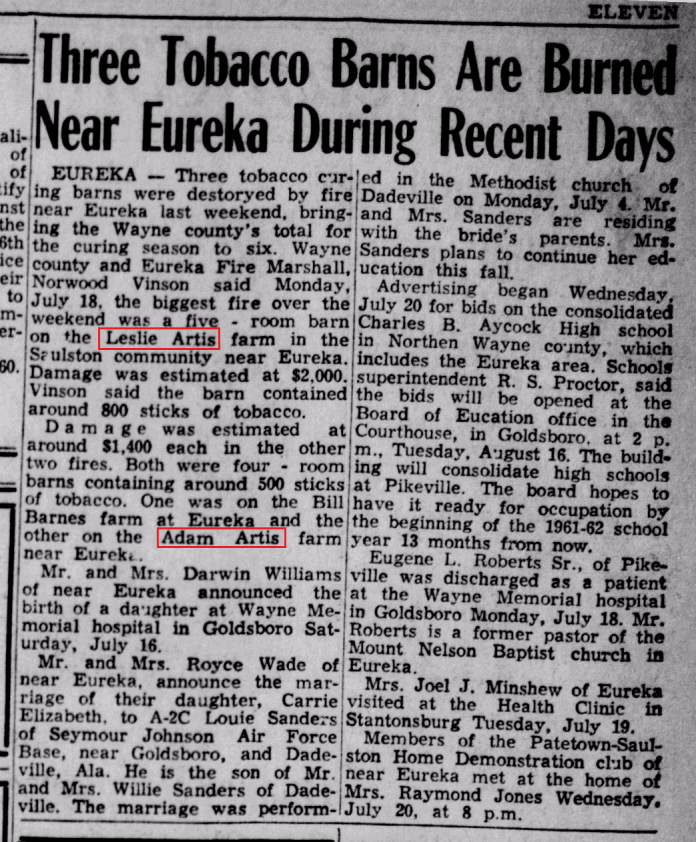
Wilson Daily Times, 23 July 1960.
Arsonists struck the Eureka community in the summer of 1960, destroying barns and tobacco at the Leslie Artis farm and the Adam Artis farm (owned by his descendants).
Wilson Daily Times, 23 July 1960.
DNA test results reflect only the tiniest inheritance, but today I honor my Native ancestors, the American Originals, on Indigenous Peoples Day.
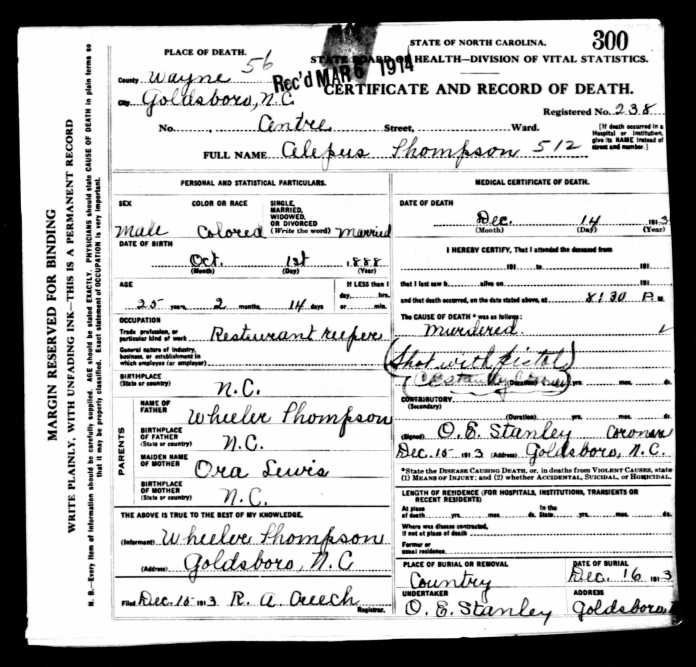
Celebus Thompson, was killed by gunshot in December 1913, leaving his widow, the former Lillie Beatrice Artis, and two small children.

Goldsboro Daily Argus, 15 December 1913.
The Wilmington paper’s coverage of the incident reversed the actors in its headline.

Wilmington Morning Star, 17 December 1913.
——
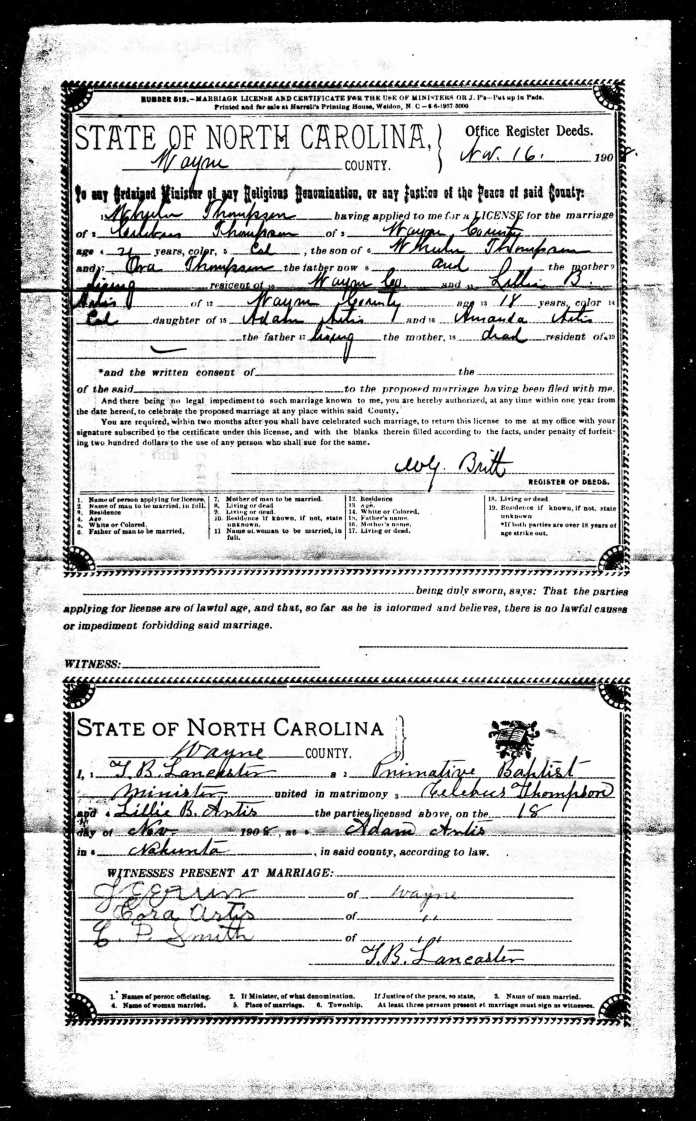
Celebus Thompson, 21, son of Wheeler and Ora Thompson, married Lillie B. Artis, 18, daughter of Adam and Amanda Artis, on 18 November 1908 at Adam Artis’ house in Wayne County.
In the 1910 census of Saulston, Wayne County: on Goldsboro and Snow Hill Road, Celepus Thompson, 23, wife Lillie, 20, and daughter Jenettie, 5 months. (Next door, Lillie’s half-brother Napoleon Artis and family.]


Brothers Jonah Artis (1889-1975) and John Henry Artis (1896-1963), sons of Richard and Susannah Yelverton (or Hall) Artis. Jonah was named for his paternal uncle, Rev. Jonah Williams.
I’m in D.C. for work this week, and I was able to steal away from my conference to spend a few hours with O.H.D., my grandmother’s first cousin. Cousin O. has lived in the District since 1940 and in her Capitol Hill row house since 1945. Our conversation was wide-ranging, but I, of course, drew out stories of our family’s history. Cousin O. spoke of my grandmother Hattie, of my grandfather, of her grandmother Louvicey Artis Aldridge (from whom she received her middle name), of her uncles Johnny and Zebedee Aldridge, of C.E. “Uncle Columb” Artis, of her aunts Lula and Frances Aldridge, of Uncle Fred Randall, of Alberta Artis Cooper, of C.C. Coley (in whose restaurants she occasionally filled in as cashier and in whose convertible she rode during Howard University homecoming parades), of Lucian and Susie Henderson, and of many others. She knows me well and had set aside a tiny treasure she’d recently uncovered — a postage stamp-sized photo of her first cousin, James Earl Aldridge. Cousin Earl, born the year before Cousin O., was the son of John and Ora Mozingo Aldridge. He passed away in 1975. As always, love and thanks, Cousin O.

James E. Aldridge Sr. (1919-1975).
During the school year, the rhythms of my childhood moved around my father’s coaching schedule. He assisted in football and track, but basketball was his forte. Tuesdays and Fridays were game nights from the time I was born — that first winter, students changed my diapers in the gymnasium bathroom while my mother cheered in the bleachers.
My father has been a rock and a guide to my sister and me, but he also deeply impacted the hundreds of young men who played basketball for him. He was a sternly principled coach who cared as much about their lives off the court as their production on it. Basketball had been a path to success for him, a means to get an education that his family could not otherwise have afforded. He is a great believer in “getting your books,” and he did all he could to prepare his players for college and to guide them to opportunities to play at that level.
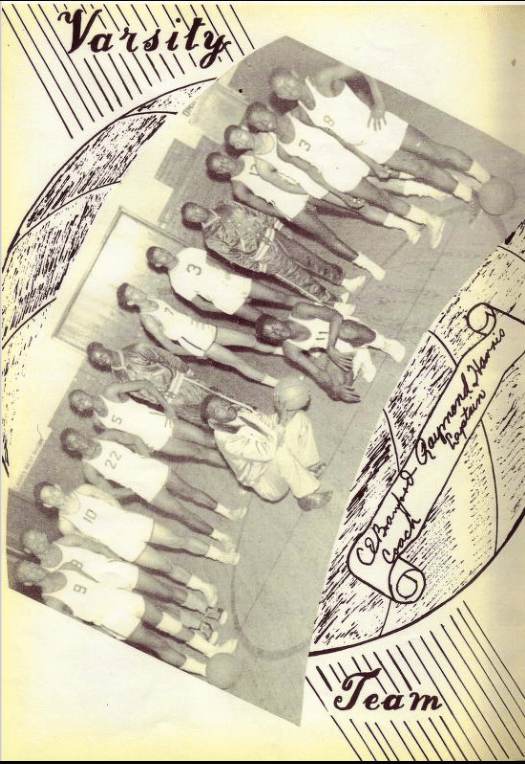
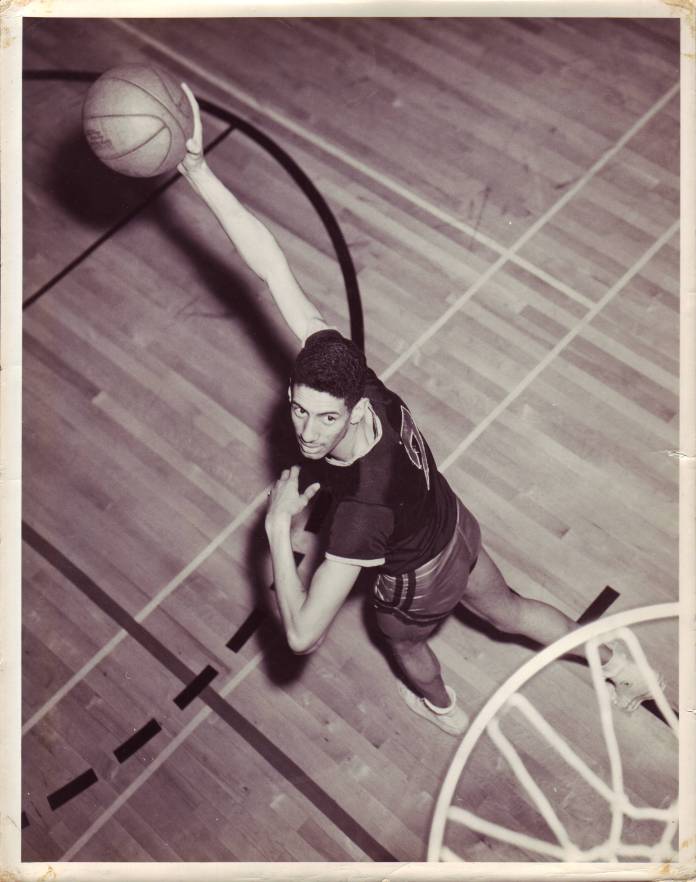
#7, center, C.H. Darden High School varsity basketball team, 1952.
During his years playing basketball in the Air Force, circa 1956.
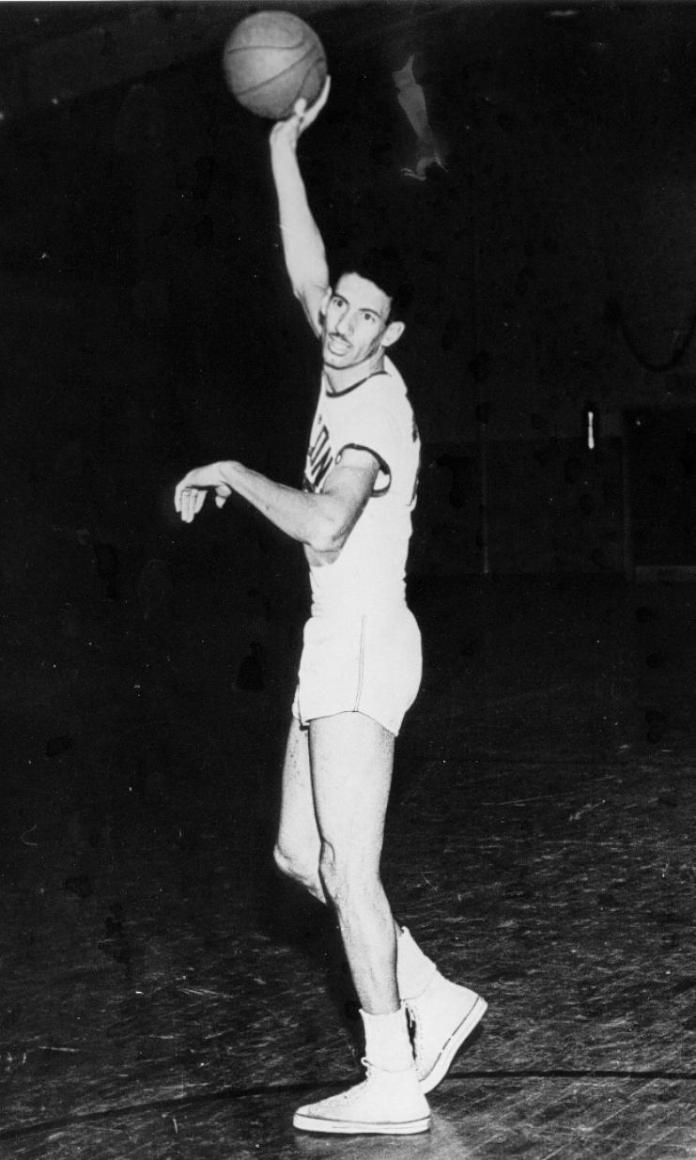
Playing center at Saint Augustine’s College, circa 1960.
Every once in a while, some of my father’s former players will get together to take him out to reminisce over a good meal. I’m sure they all join me, my mother and sister in wishing him the happiest of birthdays!
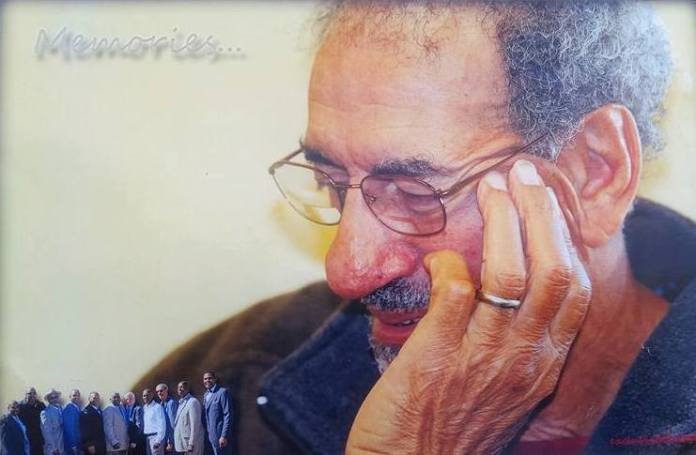
Photo credits: C.H. Darden High School yearbook, 1952; personal collection; courtesy of J. Battle.
Said my grandmother:
The house where Dollie, Cousin Min’s sister, lived, well, they had gone to Goldsboro to live. I think. First they were living in Mount Olive, then Dudley. She married Yancey Musgrave. He was a brown-skinned man. And Dollie used to visit, too. She had asthma real bad. And she used to come home and have to sit up. You had to take a quilt and fold it up and put it up in the bed for her to sit up on. ‘Cause she couldn’t lay down. She couldn’t breathe. I don’t know what become of Dollie. Her and Cousin Min’s mama was Ann Elizabeth. Mama Sarah’s sister. They had a brother named Daniel. Yeah. Daniel. Daniel, he lived, he come to Wilson and stayed with us a while, and then went back to Goldsboro. Got married anyway and had a whole bunch of children. And come up to … I believe he come up to Baltimore. And he had a whole lot of children.
I’ve written of Daniel Simmons and Minnie Simmons Budd here. With Annie C. “Dollie” Simmons Musgrave, they were the only children of Ann Elizabeth Henderson Simmons to live to adulthood. My grandmother’s “Mama” was their aunt Sarah Henderson Jacobs Silver. Her mother Bessie was their first cousin.
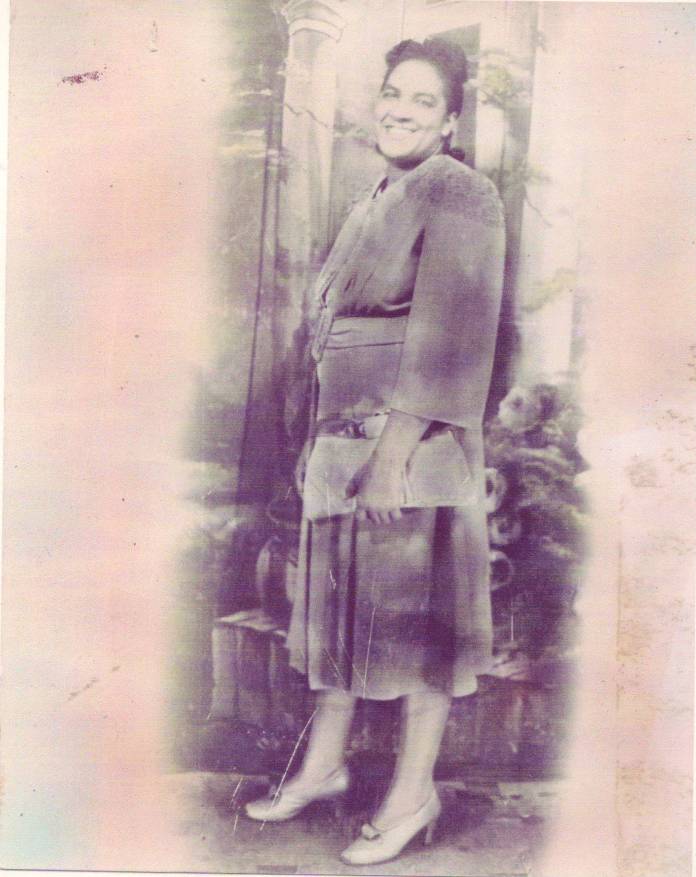
Annie C. “Dollie” Simmons Musgrave, perhaps in Norfolk.
Dollie Simmons Musgrave died in Norfolk, Virginia, in 1946 after a battle with cervical cancer. (She apparently had remarried to a Green — she and Yancey divorced? — but I do not know who, where or when. Her death certificate erroneously lists her mother as Annie Green, rather than Henderson.)
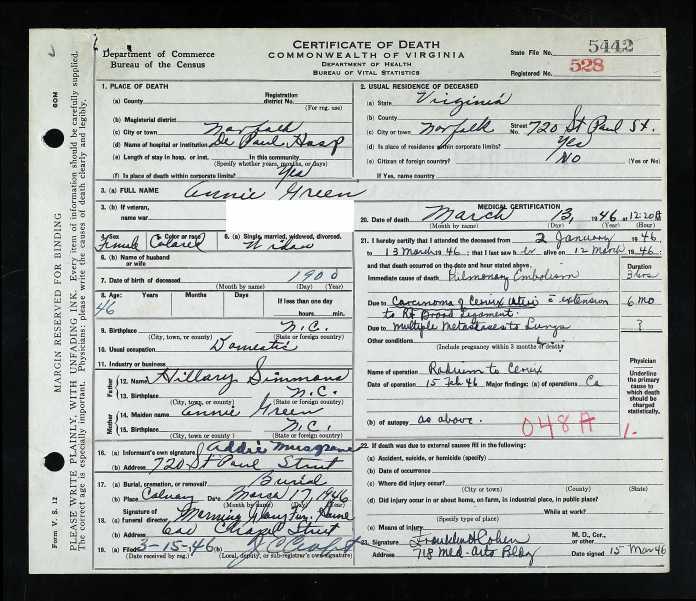
Virginia, Death Records, 1912-2014 [database on-line], http://www.ancestry.com.
Toward the end of his college days at Howard University, Aldridge descendant Charles Cromwell Coley married Harriet Purdy, a native Hawaiian athlete and performer and a descendant of King Kamehameha I.

Their only child, daughter, Laulupe Kaleilani Coley, was born in 1932 in Washington, D.C.
A post in the D.C. neighborhood blog Popville notes: “In March 1934, the Hi-Hat, a ‘smart new continental Cocktail Lounge and Cafe, styled in the modern manner,’ opened on the top floor of the Ambassador. The Post raved about its decorations: ‘The silvery iridescence of kapiz shell gives the mellow effect of moonlight on the water, and the imported blue and white mirrors trimmed in stainless steel surrounding the columns introduces a new note in modern interior decoration.’ The Hi-Hat Lounge quickly became a popular nightspot, offering top names in the nightclub circuit. Its opening act was Princess Harriet Purdy, a Hawaiian who strummed a ukulele while crooning languorous songs in her native tongue.”
Harriet and C.C. Coley divorced in the late 1930s. Their daughter was educated on the mainland, but married and settled in Hawai’i.

Yearbook of Packer Collegiate Institute, Brooklyn, New York, 1950.
Harriet also returned to Hawai’i where she continued to preserve the island’s traditional arts and culture. In this video posted to Youtube, Harriet Purdy dances hula as Sonny Chillingworth, Myrna English and Billy Hew Len perform “Kaula Ili”:
Harriet Keonaonalaulani Purdy Kauaihilo, 96, of Kapolei, a professional hula dancer, died Aug. 26 in Kapolei. She was born in Waimea. She is survived by son Bill, daughters Laulupe K. Dempster and Harriet Clark, hanai sister Olive S. Purdy, grandchildren, great-grandchildren and great-great-grand-children. Private graveside services. — Honolulu Bulletin, 11 September 2002.
HARRIET KEONAONALAULANI PURDY KAUAIHILO, 96, of Kapolei, died Aug. 26, 2002. Born in Waimea, Hawai’i. A high diver and swimmer, known as the Hawaiian Human Cannonball at Atlantic City’s Steel Pier in the early 1930s; and professional Island hula dancer. Survived by daughters, Laulupe Dempster and Harriet Clark; son, Bill; grandchildren, great-grandchildren and great-great-grandchildren; hanai sister, Olive Purdy. Private graveside services. Arrangements by Ultimate Cremation Services of Hawai’i.— Honolulu Advertiser, 11 September 2002.
Were the Henderson-Simmonses American or Canadian?
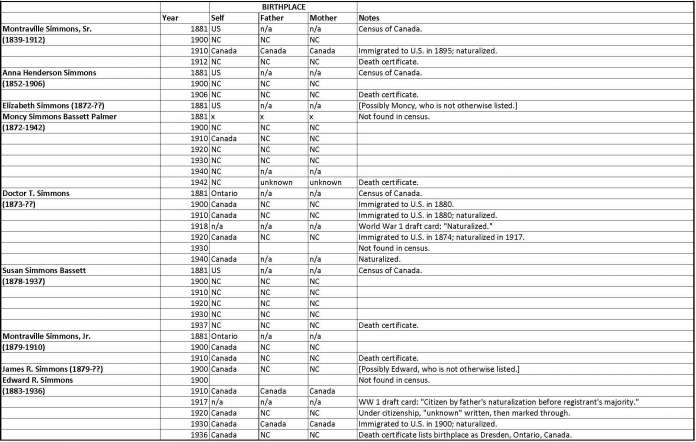
I have not been able to find naturalization records for any, and the evidence available points in conflicting directions. One by one:
Montraville Simmons, Sr. — Despite what the 1910 census enumerator recorded, Montraville was certainly born in the U.S. to American parents. It is also likely that he “immigrated” back into the U.S. long before 1895, and it is not clear why he would have naturalized, unless he renounced his citizenship as a young man. (Canada was a British colony until 1867.)
Anna Henderson Simmons — As the evidence consistently reflects, Anna was born in NC. She was American. Her obituary stated: “Mrs. Simmons was … born in North Carolina. For fifteen years she lived in Canada, where her five children were born.” That is likely inaccurate.
Elizabeth Simmons — This daughter only appears in the 1881 Canada census. She was born about the same time as daughter Moncy and, though the names are not the least similar, may in fact be the same person.
Moncy Simmons Bassett Palmer — Moncy is not listed in the 1881 Canada census in which Elizabeth appears. In U.S. censuses, her birth place is generally consistent, with 1910 as an exception. She provided no information about immigration or naturalization to censustakers.
Doctor T. Simmons — Dock was born in Ontario and consistently provided Canada as his birthplace in records. However, there is conflict about when he immigrated, and neither 1874 nor 1880 seems accurate. If he naturalized in 1917, where is the record?
Susan Simmons Bassett — Susie consistently is described as U.S.-born.
Montraville Simmons, Jr. — Montraville Jr. was also born in Ontario.
James R. Simmons — This son only appears in the 1900 census, was born about the same time as Edward, and was probably, in fact, Edward.
Edward R. Simmons — Edward was also born in Ontario. His World War I draft registration card notes that he gained citizenship when his father was naturalized before Ed turned 21. The 1930 census states that he immigrated in 1900, but that is surely wrong. His obituary says that he lived in Kokomo from the time he was seven years old, which implies that he arrived in the U.S. about 1890.
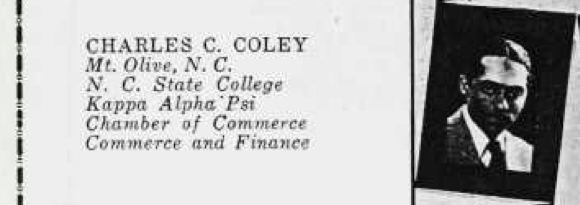
I was running some random Google searches when I ran across this Howard University yearbook entry. Charles C. Coley, class of 1930, was the son of Mack D. and Hattie Wynn Coley, grandson of Frances Aldridge Wynn, and great-grandson of J. Matthew Aldridge.
In the 1910 census of Brogden township, Wayne County: school teacher and widower Mack D. Coley, 45, and children Blonnie B., 12, Blanche U., 10, Charlie C., 7, and Rosevelt, 5, and great-aunt Kattie, 74.
In the 1920 census of Mount Olive, Brodgen township, Wayne County: on Rail Road Street, teacher Mack D. Coley, 54; wife Lillie, 40, teacher; and children Blonnie, 22, teacher; Blanche, 20; Charley, 17; Rosevelt, 15; and Harold, 2.
In the 1930 census of Washington, D.C.: at 70 Que Street, Northwest, Charles Coley, 26, and wife Harriett, 20, lodgers in the household of Oscar J. Murchison. Charles worked as a lunchroom waiter. Harriett was a native of Hawaii. They divorced before long, and Charles married Frances Elizabeth Masciana (1920-2010), the District-born daughter of an Italian immigrant father and an Italian-African American mother.
During the 1930s, Great Depression be damned, Coley began to build his entertainment and culinary empires, which eventually came together under C.C. Coley Enterprises, headquartered on U Street, D.C.’s Black Broadway. He rented jukeboxes to establishments across the city and owned several barbecue restaurants and other businesses in Northwest D.C. (More than a few Wayne County home folk newly arrived to the District got jobs working in Coley businesses.) On 16 December 1939, the Pittsburgh Courier screamed “Charge ‘Sabotage’ in Music Box Scandal” over a story whose heading was longer than its column inches.

Coley was unfazed by this dust-up. In 1942, he was able to place an ad in Howard University’s yearbook touting several of his enterprises, the Hollywood Tavern, the Varsity Grill, the New University Pharmacy, the Pig ‘N Pit, and Northwest Amusement Company Records.
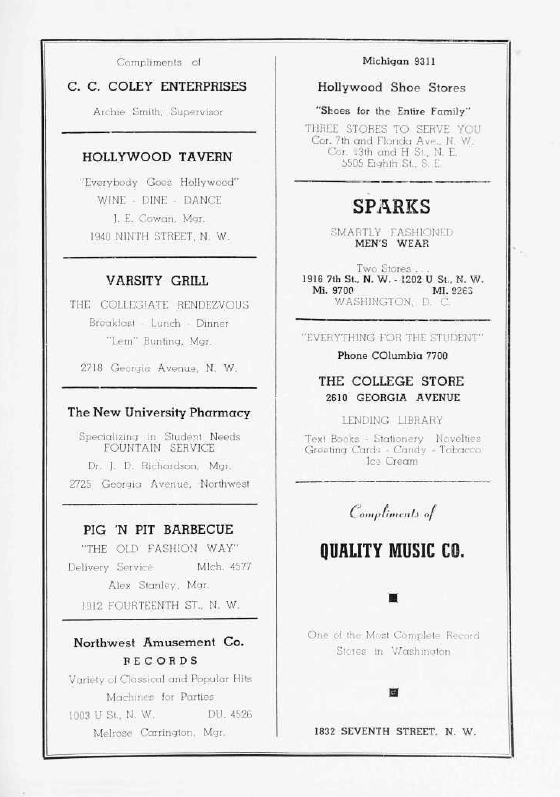
In 1942, C.C. put his financial weight behind the Capital Classic, an early fall match-up between black college football teams that anchored black D.C.’s fall social calendar. The Washington Post, in articles published 30 October 1980 and 9 September 1994, described the Classic’s genesis this way:
“Begun in 1942 by now-retired businessmen Charles C. Coley, Jerry Coward and Jessie Dedman, who were later joined by attorney Ernest C. Dickson, the Classic was a black business community extravaganza. From their offices on then fashionable U Street, the entrepreneurs founded the Capital Classic, Ltd. company to lure the interest and dollars of D.C.’s thousands of “colored” fans away from the professional teams which wouldn’t employ or seat blacks properly, and return those dollars to the black college teams.”
“The Classic offered the community, according to one of the printed programs, ‘. . . a massive arena where the radiant beauty of Negro women, who for so long, where beauty is concerned, have been in the shadows — shaded by the accepted Nordic ideal can move proudly to stage center and radiate the bronze charm that will always be the heritage of women of color.'”
Coley was also an early civil rights activist. His financial backing enabled trailblazer Hal Jackson break into D.C. radio, and an op-ed piece in the 14 April 1943 edition of the Pittsburgh Courier gave details of more direct action. Angered by the difficulty he had catching cabs in Washington, Coley contacted the Urban League with a proposal. He would pay the salary for a man to work full-time tracking instances of discrimination by cabbies. “Mr. Coley has these taxicab drivers who pass up passengers, white or colored, at the Union Station or anywhere else in the city, fighting for their licenses.” The city’s Public Utilities Commission was shamed into putting its own spotters on the street. “Discrimination is being met a knockout blow — not by what Mr. Coley said, but what he did. … This story is … being passed along for the benefit of some Negroes who, in similar situations, never think of putting their money where their mouth is.”

Baltimore Afro-American, 13 November 1948.
Despite the photo op above, the Classic soon met difficulties behind-scenes. Coley withdrew temporarily from active promotion in 1945, and Dr. Napoleon Rivers replaced him as guarantor. Quickly, according to a federal lawsuit, Rivers began to “usurp control” and failed to pay Coley’s partners their shares. In ’47, he even set up a rival match — the National Classic — at Griffin Stadium. (For details, see the 23 October 1948 edition of the New York Age. The National Classic, by the way, moved to Greensboro, North Carolina, in 1954 and morphed into the C.I.A.A. football championship game. See the Pittsburgh Courier, 23 October 1954.) The Classic recovered and prospered until fading away in the 1960s.
Charles C. Coley died 11 April 1986 in Washington, D.C. He is buried in Rock Creek Cemetery.


C.C. Coley’s Pig ‘N Pit Restaurant at 6th and Florida Avenue, Washington DC. This undated Scurlock Studios image is found in Box 618.04.75, Scurlock Studio Records, ca. 1905-1994, Archives Center, National Museum of American History.
 Scuffalong: Genealogy.