Births Deaths Marriages, Maternal Kin, Newspaper Articles, North Carolina

Double jeopardy.

Salisbury_Truth_4_23_1896_Cas_Brown_throat_slit

Salisbury Truth, 23 April 1896.

I can’t say for absolute certain, but I am pretty sure that the lucky man was William Caswell “Cas” Brown (1871-1934), husband of Mary Caroline Miller, both of Steele township, Rowan County, North Carolina. If so, the couple married two days after Hint Chambers succumbed and the day before this blurb was published.

Standard
Births Deaths Marriages, Maternal Kin, North Carolina

Such estate wherewith it has pleased God to bless me in this life.

In the name of God Amen, I John van Pool in the State of North Carolina, and County of Rowan, being perfect in mind and memory, calling unto mind the mortality of my body, and knowing that it is appointed for all men once to die, do make and ordain this my last will and testament, that is to say principally and first I give and recommend my soul into the hand of almighty God that gave it, and my body I recommend to the earth to be buried in a decent Christian burial, nothing doubting but at the general ressurrection I shall receive the same again by the mighty power of God. And as touching such worldly estate wherewith it has pleased God to bless me in this life, I give and dispose of the same in the following manner and form.

1st, I give and bequeth to my son-in-law Samuel McNeely my waggon and hind geers.

2nd, What household furniture I did not sell, I give and bequeth to my Daughters Nancy and Margaret.

3rd, I give an bequeth to my grand Daughter Eliza Pool fifty dollars if she lives to come of age. If not, it will be Equally Divided among my own children.

4th, I give to my grand Children Margaret T. Pool and Elihu N. Pool sixty dollars.

5th, I give to my well beloved son David Pool forty dollars.

6th, I give to my well beloved son Jacob Pool fifty dollars

7th, I give to my Daughter Margaret fifty dollars.

And the remainder of my Money to my other three children Nancy, John, and Maria to be equally divided amongst them.

I likewise constitute, make, and ordain Samuel McNeely Executor of this my last will and testament, and I do hereby disalow, revoke, and disanul all and every other testaments, Wills, Legacies, requests, and Executors by me in any wise

Willed, bequeathed, ratifying and confirming this and no other to be my last will and testament in Witness whereto I have there unto set my hand and seal this 13th day of October in the year of our Lord One Thousand Eight hundred and Twenty-Five.

John X Van Pool

Test. John McNeely Sen’r

Test. John McNeely Jun’r

Wm B. McNeely

Recorded at August Sessions, 1827, in Will Book H, page 401, Rowan County, North Carolina Probate Records 1735-1970, familysearch.org.

——

My great-great-great-grandfather John W. McNeely was the son of Samuel McNeely and Nancy Van Pool McNeely. Nancy Van Pool’s parents were John Van Pool, above, and Elizabeth (perhaps Peyser). John Van Pool was the son of Jacob Van Pool, a native of Cecil County, Maryland, and Elizabeth Hampton, who married in Rowan County in 1752. (This is all sort of accepted wisdom. I have not done any original Van Pool-Hampton research. And, sadly, my Van Pool matches were purged with the “new and improved” version of Ancestry DNA.)

Standard
Births Deaths Marriages, North Carolina, Paternal Kin

52 Ancestors in 52 Weeks: 2. King.

That’s this week’s thing — King. Whatever way you want to go with it. I thought I had a great Martin Luther King Jr. idea, but the photograph I thought I was going to build it on didn’t show what I remembered it showing. (That is, black folks’ Other Trinity — MLK, JFK and Jesus — mounted on my grandmother’s dining room wall. They were there, but outside the frame of the photo I wanted to use.) Another suggested King, Elvis, is not an option. The apocryphal “all Negroes can do for me is shine my shoes” story held sway in my family, and in consequence the man and his music play no role in any story I can tell. (Except the one in which my sister called her friend to tell him she’d heard Elvis had died. The girl gasped, hung up, then called back later to deliver a tearful thank you message from her father. We were mystified.)

I picked cousin Louella Henderson King instead. Said my grandmother, Hattie Henderson Ricks:

And I think Mama Sarah said that Molly was older than she was, but I reckon they was ‘long there together. Nancy was older than both of them, and A’nt Ella was the youngest one. She and Mama always were together, ‘cause they all played “sisters.” But Sarah was really Molly and Nancy and Ella’s niece. Their brother Lewis’ child.

Unfortunately, I have had few sure sightings of Louella “Ella” Henderson in the record. The first is the 1880 census of Faisons township, Duplin County, North Carolina: James Henderson, 62, wife Eliza, 38, and children Alexander, 21, John, 19, Nancy, 14, Julia, 8, Edward, 6, and Lewellen, 4. (My grandmother was not quite right.  Nancy was oldest, and Ella was youngest, but Julia, called “Molly,” and their niece Sarah Henderson Jacobs Silver were about the same age.)

My grandmother recalled that Ella was married twice, and her first husband was a King. In the 1900 census of Goldsboro, Wayne County, I found Adam King, day laborer, and wife Ella, cook, married 16 years and living on George Street.  There are a number of problems here though. This Ella was 34. Mine was ten years younger. Most critically, this couple’s marriage license (1) issued 29 August 1884, when my Ella was only 8 years old, and (2) it shows this Ella’s maiden name as Herring.

The same couple appeared in the 1910 census of Goldsboro, Wayne County.

On 22 April 1914, a woman named Ella King died of “exhaustion from acute mania” at the state hospital just Goldsboro. (This was a psychiatric facility reserved for African-Americans.) She was 34 years old, her parents were unknown, and she was buried in Forsyth County, North Carolina. I don’t think this is my Ella either. Her age is off by a few years, and there is no known reason for my Ella to have been buried half-way across the state near Winston-Salem.

Plus, on 27 Dec 1918, Lon Bryant applied for a marriage license for Patrick Diggs and Nancy Smith, both of Goldsboro.  One of the witnesses to the ceremony was Ella Wilson, also of Goldsboro NC.  Nancy Henderson Smith Diggs was the Nancy my grandmother spoke of, the elder sister of Ella.  I suspect that Ella Wilson is Ella Henderson King, remarried, but I have no evidence.

Perhaps: in the 1920 census of Goldsboro, Wayne County, living on Smith Street were South Carolina-born Ed Wilson, 39, a supervisor in a box factory, and his wife Ella, 30, a washerwoman.  Is this the right Ella? I don’t think so. Her age is off, too.

And that’s it. That’s all I have. My grandmother told me that Ella left Goldsboro and moved to a city in the western part of the state. Gastonia, maybe? Bessemer City? She could not definitely recall. I’ve searched statewide for women who could have been my Ella. Though I have not found her, but she is not completely lost.

Standard
Births Deaths Marriages, Maternal Kin, North Carolina

Ida Colvert Stockton … Stockton.

My great-grandfather, Lon W. Colvert, had four half-sisters — Selma, Ida May, Lillie and Henrietta. Selma died of “exhaustion from severe burns” when my grandmother was 8 years old. Ida May and Lillie remained in Statesville all their long lives. My grandmother of course knew them, but there is a disconnect somewhere in there that I can’t quite pinpoint. Why were there no extended Colvert relatives at our early family reunions (when many were still alive), as there were extended McNeely kin? Why didn’t my mother know her grandfather’s people? It is perhaps as simple as my grandmother and her sisters being closer to their mother’s large family in childhood, especially given their father’s relatively early death. Over the years — my grandmother left Statesville for good in 1932 — these patterns persisted, solidified and were passed down. Perhaps. It seems odd to me though. Lon’s sisters were roughly the same age as his oldest set of children, and Ida May’s oldest children were roughly the same age as Lon’s youngest. The families lived in close proximity in south Statesville. What was up….?

I have blogged quite a bit about Henrietta Colvert — the aunt my grandmother knew best — who was one of North Carolina’s early African-American registered nurses. I have tracked Henrietta across the arc of her career, which happened to unfold in my hometown of Wilson, North Carolina, almost 200 miles east of Statesville. She left Wilson sometime after World War II, and I have intermittent glimpses of her whereabouts prior to her death in Roanoke, Virginia, in 1980. What of the other sisters though? I’ll start with Ida May.

Though John W. Colvert and Myra Hampton began their relationship in the late 1880s, they did not marry until 1905. Ida, their first child, was born about 1887, and three more daughters followed in short order. None of the family, however — not John, not Addie, nor their girls — are found in the 1900 census.

A lot happened in the next decade though. The 1910 census of Statesville, Iredell County, at 214 Garfield Street, shows Ida M. Stockton, a 25 (actually, 23ish) year-old widow with one of three children living sharing a household with her brother-in-law Eugene Stockton, 37 and married, her brother-in-law Jesse Stockton, and her son John, 1.  Ida was a laundress, Eugene a tobacco roller at a tobacco factory, and Jesse, an odd job laborer.  This arrangement would not ordinarily raise eyebrows, but — widow?  Wasn’t Eugene Stockton Ida’s husband??? Why is he listed as her brother-in-law?  The birth certificates of all her children, including John, list Eugene as their father. Had Ida previously been married to one of Eugene’s brothers? (Census and death records identify several, including Arthur (born circa 1875), Fred (1885), Jakey (1887), Jesse Lee (1889), and David (1891).) If so, I have not found evidence of a license. And if not Ida, to whom was Eugene married in 1910?

That last question turns out to be pretty easily answered. On 24 June 1903, Eugene Stockton, son of Henry and Alice Stockton, married Ella Cowan, daughter of Peter and Clementine Cowan in Iredell County. I have found no evidence that the couple had any children. In the spring of 1912, their divorce suit, styled Eugene Stockton vs. Ella Stockton, was listed several times in the court calendar published in the Statesville Sentinel. By 1918, when Eugene registered for the World War I draft, he listed his sister Gertrude Stockton as his next of kin.

Ida’s children were John Walker Stockton (1910), Lillie Mae Stockton (1911), Sarah Eliza Stockton (1912), Alonzo Pinkney Stockton (1917),  Winnifred Josephine Stockton (1919), and Eugene A. Stockton (1924). As noted above, the birth certificates of all list Eugene as their father. (In sooth, though, all the children except Eugene had delayed birth certificates, i.e. certificates registered well after the birth of the child in question.)

Nothing had changed by time the enumerator arrived to record the 1920 census. At 214 Garfield Street in Statesville, Eugene Stockton, 46, is listed as the head of a household that included his sister Flossie Tomlin, 23, grandchild Annie L., 5 months, sister-in-law Ida M. Stockton, 33, and grandchildren Lilly M., Sarah E., Alonzo P., and Winnifred.  Eugene was employed as a tobacco factory laborer, Flossie as a teacher, and Ida as a laundress. Who made this up? The census taker, or a self-conscious Ida May? She is still listed as Eugene’s in-law, despite their apparent decade-long relationship, and Lillie, Sarah, Alonzo and Winnifred are identified as his grandchildren.  Eugene’s sister Florence “Flossie” Stockton Tomlin, was married to Harvey Golar Tomlin, who was the half-brother (on the maternal side) of Ida Mae’s half-brother (on the paternal side) Lon W. Colvert.  Accordingly, Annie L. Tomlin was Eugene’s niece, not his granddaughter. (In a separate listing in 1920, in Statesville’s “suburbs”: Jessie Stockton, 28, sister Flossie Tomlin, 25, niece Anna L. Tomlin, 4 months, and brother-in-law Havey Tomlin.)

Finally, as her mother’s had been, Ida May’s steadfastness was rewarded.  On 8 July 1922, Eugene Stockton, 49, son of Henry and Adley Stockton, and Ida May Stockton, 35, daughter of John and Adeline Colvert, were married by Z.A. Dockery, M.G., at “Eugene’s house” before Bessie Abernathy and E.A. Abernathy.

In the 1930 census, the family at last is listed openly: Eugene Stockton, 57, wife Ida M., 45, and children John, 20, Lily M., 18, Sara, 17, Alonzo, 12, Winifred, 11, and Eugene Jr., 6.

STOCKTON -- Eugene&Ida Stockton

Eugene and Ida May C. Stockton, probably the early 1940s.

Eugene Stockton died 26 February 1944 in Statesville. Ida May Colvert Stockton Stockton outlived him by more than 20 years. On 23 August 1967, she passed away a week after suffering a stroke.
Sville_R_amp_L_8_26_1967_IM_Stockton_obit

Statesville Record & Landmark, 26 August 1967.

Photo courtesy of A. S. Barton.

Standard
Births Deaths Marriages, Free People of Color, North Carolina, Other Documents, Paternal Kin

Misinformation Monday, no. 10.

Another example of the pitfalls of unquestioning acceptance of federal population schedules at face value. What you see (1) may not be what it seems and (2) is not all there is. Here, I follow my great-great-great-grandfather Adam T. Artis over the arc of his life, as recorded in census records.

Adam Artis was born in 1831 to a free woman, Vicey Artis, and her enslaved husband, Solomon Williams, most likely in Wayne or Greene Counties, North Carolina. In the 1840 census of one of those counties, he, his mother and siblings are anonymous hashmarks under the heading “free colored people” alongside the name of a white head of household.

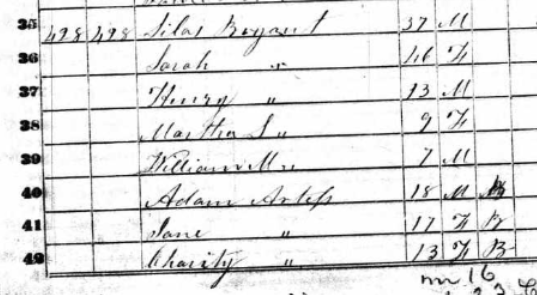
The 1850 census of Greene County is the first record of Adam’s existence:

AArtis 1850 Greene

White farmer Silas Bryant is the head of household. The other Bryants are presumably his wife and children. The significance of Adam Artess, Jane Artess and Charity Artess’ names listed below requires knowledge outside the four corners of the page. As I learned via subsequent research, Jane and Charity were Adam’s sisters. (Their mother and remaining siblings were listed next door at #429.) Though no bonds or other indenture documents survive, it is most likely that the Artis children were involuntarily apprenticed to Bryant until age 21 by the Greene County Court of Pleas and Quarter Sessions. Adam’s age is correct, so I assume that Jane’s and Charity’s are, too. The censustaker evinced some hesitation in describing Adam’s color, appearing to superimpose a B (black) over an M (mulatto.) This is a matter of some concern to descendants who deny that he was of African descent. No photographs of Adam survive, but his great-granddaughter D.B. told me she recalls seeing one in her childhood. It was later stored in a barn and ruined by rainwater. Adam, she said, was brown-skinned. Mulattohood was in the eye of the beholder, but I think it is safe to say that Adam had considerable African ancestry.

AArtis 1860 NNeuse Wayne

The 1860 census of the North Side of the Neuse River, Wayne County, tells a nuanced story. This entry contains the sole census reference to Adam’s skills as a carpenter, probably gained during his apprenticeship to Bryant. The $200 in personal property probably consisted mostly of the tools of his trade, and the $100 value of real property reflects his early land purchases. (I found a deed in Wayne County for Adam’s sale of ten acres to his brother-in-law John Wilson in 1855. The sale was a buyback, but Adam never recorded a deed for the original purchase.) Adam was a widower in 1860, and Kerney, Noah and Mary Jane were his children by deceased wife Lucinda Jones Artis. They were not his only children, however. His oldest two, Cain and Caroline, were enslaved alongside their mother Winnie Coley, and are not named in any census prior to 1870.) Jane Artis was Adam’s sister. Her age is about right, though his is off by a year or so. Her one month-old infant may have been daughter Cornelia, who is listed in the 1870 census as born in 1860. I’ve included two lines of the next household to highlight a common pitfall — making assumptions about relationships based on shared surnames. Though they were Artises and lived next door, Celia and Simon were not related to Adam Artis. At least, not in any immediate way. (Ultimately, nearly all Artises trace their lineage to a common ancestor in 17th-century Tidewater Virginia.) Adam’s son Jesse Artis testified directly to the matter in the trial in Coley v. Artis: “I don’t know that Tom and I are any kin. Just by marriage.”

So far, we’ve found basically accurate, if deceptively simple, census entries. 1870 is where the trouble starts. There’s this:

AArtis 1870 holden 1

But wait. There’s this, too:

AArtis 1870 holden 2

The first entry is found in the enumeration of Holden township, Wayne County. The second is in Nahunta. The first was taken 18 August by William R. Perkins. The second, 23 September. By William R. Perkins.

Huh?

I can’t begin to explain why Perkins rode the backlanes of northeast Wayne County twice and — in two different handwritings — recorded the same people living in the same houses as residents of different townships. Substantively, though, with a couple of exceptions, the two households attributed to Adam Artis are quite consistent. Adam and his wife Frances (Seaberry, whom he married in 1861) are shown with nine children whose ages are identical in both listings. The last six children were born to Frances, and some of their names take a gentle mauling between records. The oldest child was Ida, which is close to “Idar,” but not at all to the very modern-sounding “Jaden.” And who was Octavia/Tavious, a seven year-old male? Process of comparison and elimination identifies him as Napoleon Artis, often called Dock. Was Octavius his middle name? I’ve ever seen it used in any other place.

Fast forward ten years to 1880:

AArtis 1880 Nahunta 1880

Adam is again a widower, as wife Frances died shortly after the birth of son Jesse. Daughter Eliza is helping care for her eight siblings, plus grandbaby Frank, whose mother or father I have never been able to identify. (I have not even found clear evidence of Frank in any later record.) This living situation was not tenable, and Adam married again that very year to Amanda Aldridge, his son-in-law’s sister. Tragically, Adam and Amanda’s marriage was never recorded in a census record as she died days after the birth of her last child, Amanda Alberta, in 1899. Thus, Adam is a widower once more in 1900:

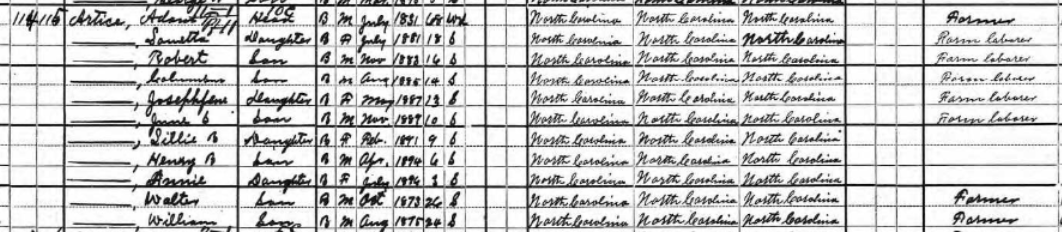
AArtis 1900

“Artice” is an alternate spelling of Artis seldom used by Artises themselves, but occasionally adopted by those recording them. In this record, two of Adam’s children with Frances, Walter and William, were still unmarried and living at home, but the remaining children are Amanda’s. Don’t be fooled by the absence of the infant Alberta. She survived her mother’s untimely death and was taken in by her half-sister Louvicey Artis Aldridge, who, presumably, nursed her along her own babies.

Adam remarried in 1903. The 1910 census accurately reflects his four legal marriages. (His informal relationship with Winnie Coley is omitted.) His latest (and last) bride, Katie Pettiford,  was 50+ years his junior. All of his older children have left (or fled) the nest except 12 year-old Annie Deliah Artis, whose status as “husband’s daughter” is carefully noted. Alphonzo Pinkney Artis was Adam’s last surviving child, though Katie reported giving birth to two others. Alberta was still with John and Vicey Aldridge — listed as “Elberta,” a “granddaughter,” speaking of misinformation — in their household at the other end of Wayne County in Brogden township. (Family stories say that this arrangement ended unhappily when Alberta learned, in her early teens, that she was not, in fact, Vicey and John Aldridge‘s child.)

1910 AArtis Nahunta Wayne

There is no 1920 census entry for Adam T. Artis. This father of nearly 30 children (23 of whom are listed with him in census records) and husband or partner of five (only two of whom show up in the census) died the 11th day of February, 1919.

Standard
Births Deaths Marriages, North Carolina, Other Documents, Paternal Kin

Misinformation Monday, no. 9: the census edition.

Census records are the gateway to genealogical research for most people, and I am no exception. I can still remember hunkering over a microfilm reader in a dark corner of Davis Library in Chapel Hill, gaping at my great-great-great-grandparents’ names revealed in crabbed script in the 1910 federal population schedule. Like so many others, I squirmed impatiently for the release of the 1930 and 1940 censuses, anxious to determine what whos and wheres could be answered by the fresh infusion of data. As much as I have relied upon census data, however, I am acutely conscious of its limits. The census schedules are imperfect documents that qualify only barely as a primary resource. This is not to discount their usefulness for genealogical purposes. I’m just saying that — based as they are on a mishmash of personal knowledge, second-hand information, hearsay and rank speculation — they don’t prove much of anything about a person’s name, age, ethnicity, relationships, or occupation.

Here’s an example, courtesy of the 1920 census of Wilson, Wilson County, North Carolina:

1920 real

A husband and wife with two daughters, no? If you didn’t have reason to know better, you might accept this at face value. “Hattie May” happens to be my paternal grandmother, however, so I do know better. (She was Hattie Mae, by the way.) Let’s take each person one-by-one:

“Jessie Jacobs” was Jesse A. Jacobs Jr. He was actually born in 1856, so was 63 or 64 years old, not 60, when the census taker stopped by. He is described as “B,” which is a designation he never would have provided. I am fairly certain that his wife gave information for the household, and I am equally certain that she described everyone in it as “colored.” Jesse himself might have offered “Croatan,” as the multi-racial, ethnically Native American members of the Coharie tribe were then called.

“Sara Jacobs” was Sarah Henderson Jacobs. She was, indeed, Jesse’s wife. She was born in 1872, so her age is a little off, too. She was 47 or 48, not 42.

Mamie Jacobs” was born in 1907, so her age is basically correct. She was not, however, the daughter of either Jesse or Sarah Jacobs. Nor was she a Jacobs. She was the daughter of Bessie Henderson, who was the niece of Sarah H. Jacobs. In other words, Sarah was her great-aunt. Her mother died when she was three, and she was reared for her first eight years by her great-grandparents, Lewis and Margaret Balkcum Henderson. See:

Screen Shot 2014-12-07 at 5.35.21 PM

Here, in the 1910 census of Brogden township, Wayne County, North Carolina, is a correctly described family unit. (This, by the way, is the census entry that dropped my jaw so many years ago and got me hooked.) My great-great-great-grandfather Lewis Henderson, great-great-great-grandmother Margaret, great-grandmother Bessie, and great-aunt Mamie. (Bessie was more than seven months pregnant with my grandmother when the census taker showed up on April 18. And look at how many children Margaret had lost. Only three of nine surviving. It breaks your heart.)

Back to 1920: “Hattie May Jacobs” was born in 1910, so her age is basically correct, too. She spent her first eight months or so in her great-grandparents house, but when Bessie died in the late winter of 1911, Sarah and Jesse Jacobs took her to Wilson to live with them. Mamie remained in Wayne County until her great-grandparents died, then she, too, went to Wilson. She and Hattie were known as Jacobses as a result, and for years my grandmother believed she had been formally adopted. Well into adulthood, when she learned that she had not, she reverted to her birth mother’s surname, Henderson.

Fast forward twenty years to the 1930 census of Wilson, Wilson County. Have things gotten better?

Screen Shot 2014-12-07 at 7.18.54 PM

No. Sarah Jacobs was 58 years old, not 49. That was likely deliberate deception. Hattie, of course, was her great-niece, but their relationship was essentially mother-daughter and undoubtedly so reported to the census taker. Their occupations are not shown here, but Sarah was described as a laundress “at home” and my grandmother as a servant for a private family. The former accords with what I was told about Sarah’s work, but I have never heard that my grandmother worked as a maid. Most curious, however, is not what’s in this entry, but what is not. Namely, my two uncles. They were three and one in 1930, and I’ve found them listed nowhere else in the census either. A deliberate omission? A mistranscription? I don’t know, but it’s another stark example of the unreliability of census records.

So, three consecutive census schedules for one family and only the first reasonably accurate. As I’ll demonstrate in coming weeks, this was not the exception. Caveat emptor.

Standard
Births Deaths Marriages, Newspaper Articles, Paternal Kin, Photographs, Virginia

The most talked-about wedding.

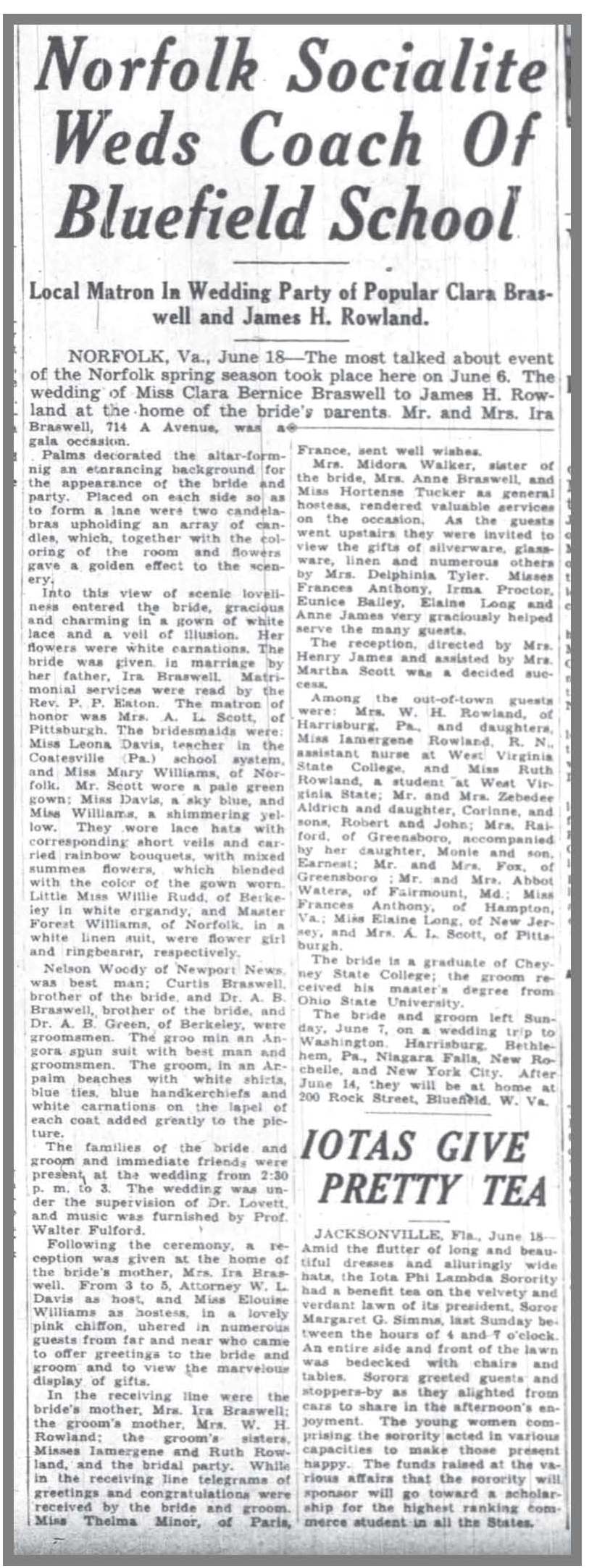
Pittsburgh Courier 6 20 1936 Clara Braswell wedding

Pittsburgh Courier, 20 June 1936.

Socialite Clara B. Braswell‘s mother, Mattie Amelia Brewington Braswell, was a daughter of Joshua L. and Amelia Aldridge Brewington. Just after 1900, Mattie migrated to Norfolk, Virginia, where she married her husband, who was also a Wayne County native.  Several of her siblings also made the move, including Tilithia Brewington King Godbold Dabney, much-beloved by my grandmother. Among the out-of-town guests noted at Clara’s nuptials were Mattie Braswell’s first cousin and his wife, Zebedee and Jennie Ridley Aldridge, with three of their children. The son of John W. and Louvicey Artis Aldridge, Zebedee had also migrated from Dudley, Wayne County, to rural Brunswick County, Virginia, in the first decade of the 20th century. Zebedee and Jenny traveled a hundred miles from their farm to attend his cousin’s gala wedding, touching evidence of enduring ties among Robert and Mary Eliza Balkcum Aldridge‘s descendants.

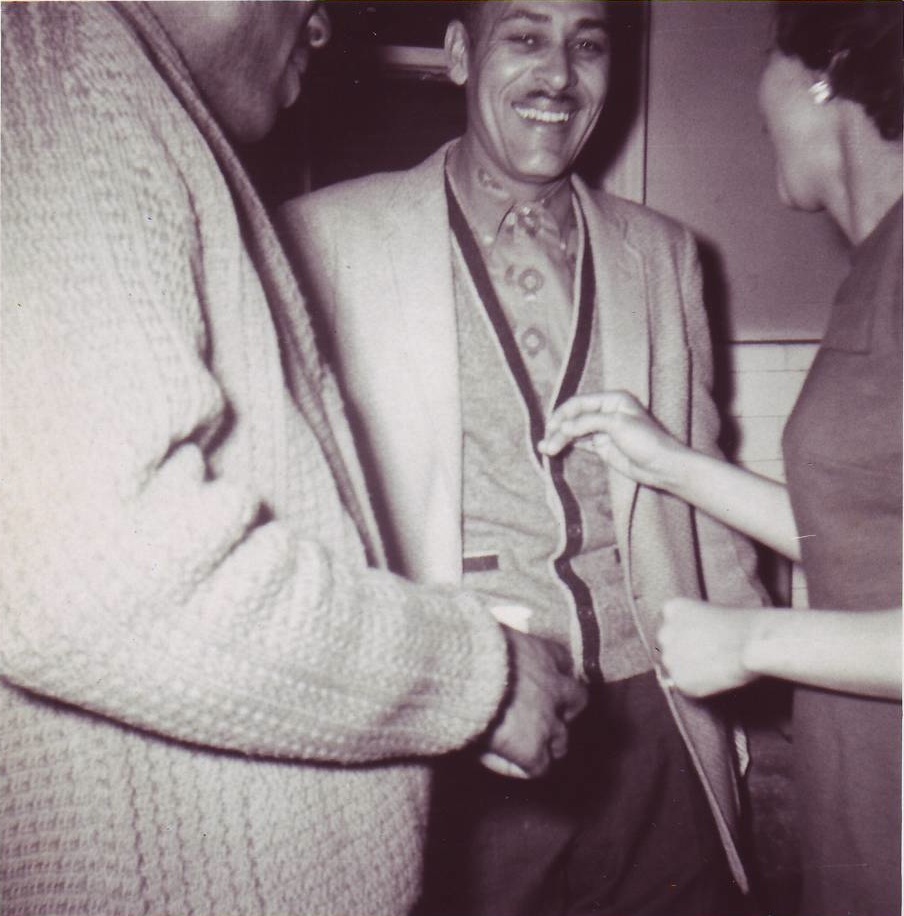
Zebedee & Jennie Aldridge

Zebedee and Jennie Aldridge, probably 1940s.

Photo courtesy of L.D. Hutchinson. Hat tip to B. Jones for the article.

Standard
Births Deaths Marriages, Enslaved People, Maternal Kin, North Carolina, Photographs

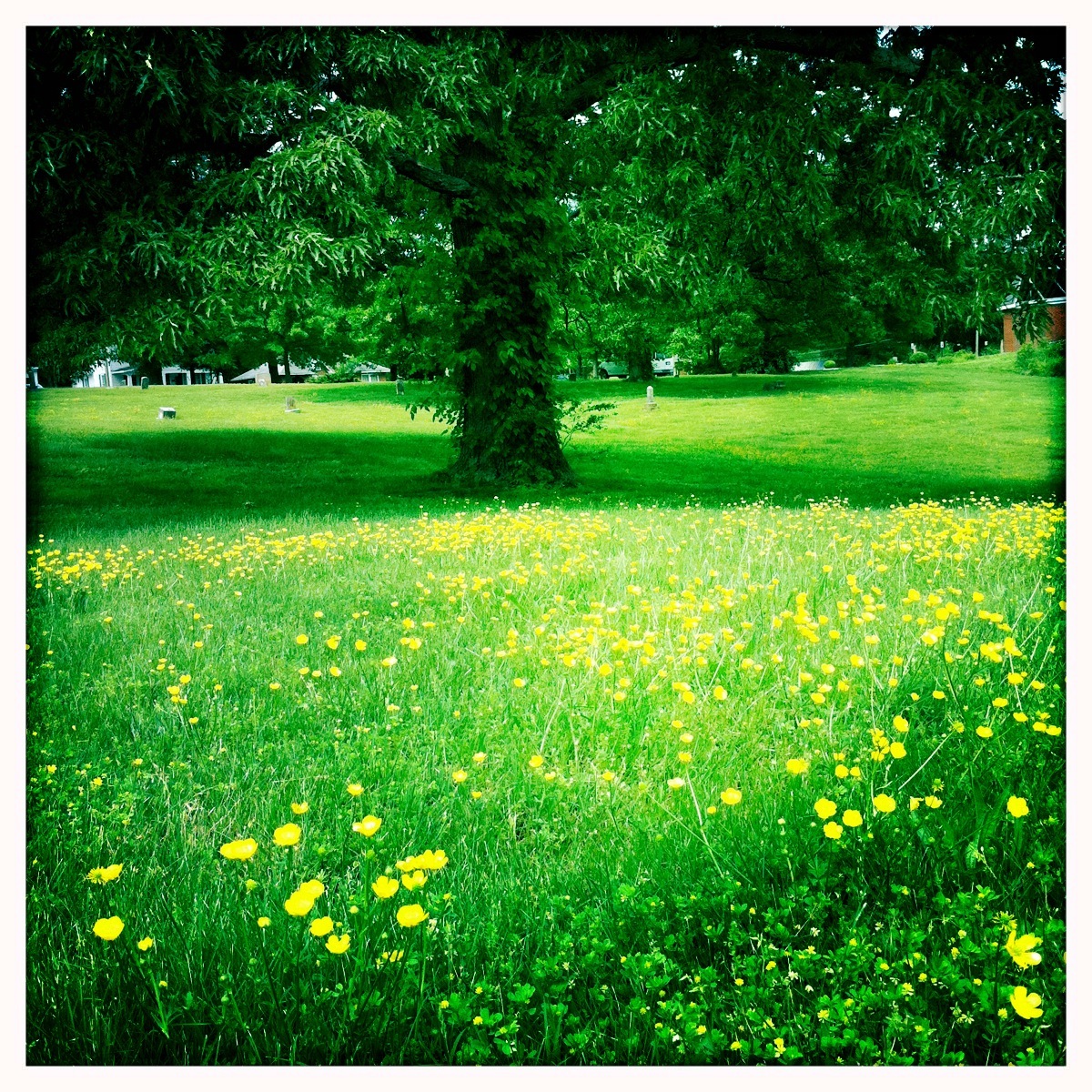
Landscape, no. 2.

tumblr_lke4bqgaJi1qd9jg8o1_r1_1280

Statesville, North Carolina. April 2011.

Green Street cemetery, Statesville, North Carolina, abloom in buttercups.  Though largely empty of headstones, this graveyard is probably close to full.  Most of the existing stones, including that of my great-great-grandfather John W. Colvert, date from 1890-1930 — ex-slaves and their children.  For some, it is the most detailed record of their lives.  One: MARY WILLIAMS passed away Mar. 13, 1917 in her 94th Year Blind cheerful her simple faith was an inspiration Rest in peace Aunt Mary.

Standard