Births Deaths Marriages, Land, North Carolina, Other Documents, Paternal Kin

To my ….

Abstracts of wills filed in Wayne County Superior Court, Goldsboro, North Carolina:

Lizzie E. Hagans — (1) to my beloved husband Will S. Hagans and his heirs in fee simple my house and lot in the town of Goldsboro, situated on Oak Street between West Center and James Streets and known as 104 West Oak Street; (2) to my husband $5000 with all benefits from life insurance policy #190279, Phoenix Mutual Life Insurance Company; (3) Will S. Hagans appointed executor. Signed 5 August 1904 in the presence of H[enry] S. Reid and J.A. Dees.

On 2 May 1917, C[larence] Dillard and J. Peele swore that they were knew Lizzie Hagans for a number of years, were well-acquainted with her handwriting and verified her signature. Henry S. Reid also swore that he witnessed the will, which was recorded and filed on 3 May 1917.

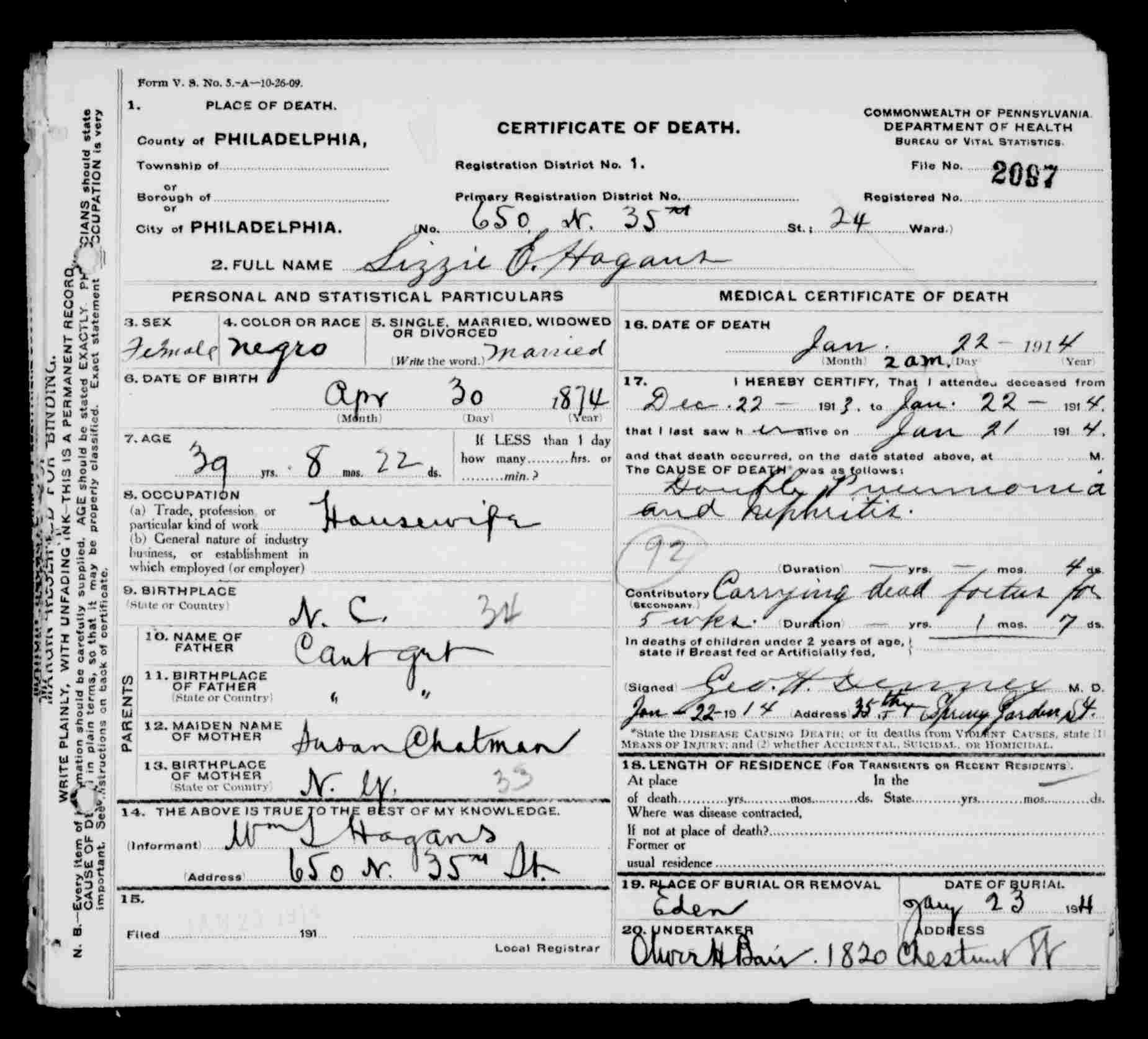
HAGANS -- Lizzie Hagans Death Cert

She had inherited Oak Street house from her (probable) uncle, William Burnett. Lizzie Hagans died shortly after William S. Hagans moved his family from Goldsboro to Philadelphia. 

——

Adam T. Artis — (1) S.S. Strother appointed executor; (2) a decent burial suitable to the wishes of my family and friends; (3) to my wife Katie Artis, all of the Thompson tract on which I now live, about 18 acres, all household and kitchen furniture and personal property; (4) to son Pinkney Artis, $100; (5) to son June Scott Artis, $10; (6) to son Henry Artis, $10: (7) to son Columbus Artis, $10; (8) to son William Artis, $5; (9) to son Walter Artis, $5; (10) to daughter Josephine A. Sherard, $15; (11) to son Robert Artis, $5; (12) sell the balance of my land to pay out the above, then divide the remaining in equal shares among my children Vicey Aldridge, Liza Evert, Augustus K. Artis, Georgana Reid, Mary Jane Artis, Emma D. Locus, Ida Reid, Lillie Thompson, Napoleon Artis, Haywood Artis, Addie Artis, Annie Artis, Alberta Artis, and Jesse Artis, and, at Katie’s death, property to be divided among the twelve heirs above whose gifts are not limited. Signed with an X in the presence of W.F. Lewis, J.J. Coley and J.E. Exum. Codicil: (13) to son Noah Artis, $10.

Recorded and filed 1 May 1919.

Adam Artis’ will includes the names of 23 of his children. Emma’s name is crossed out because she died before the terms of the will could be carried out. Known children whose names do not appear include Cain Artis, who died in 1917; Caroline Artis Coley and Louetta Artis, who presumably died before the will was made; Adam Artis Jr., who seems to have been very much alive in Washington DC. (Was the omission of his name inadvertent, as with Noah?) Despite newspaper reports claiming that Adam  fathered 47 “legitimate” children, these 27 are all I have been able to identify. Though there were doubtless others who died in childhood, I doubt there were 20 of them, and I am fairly certain that no other children reached adulthood.

——

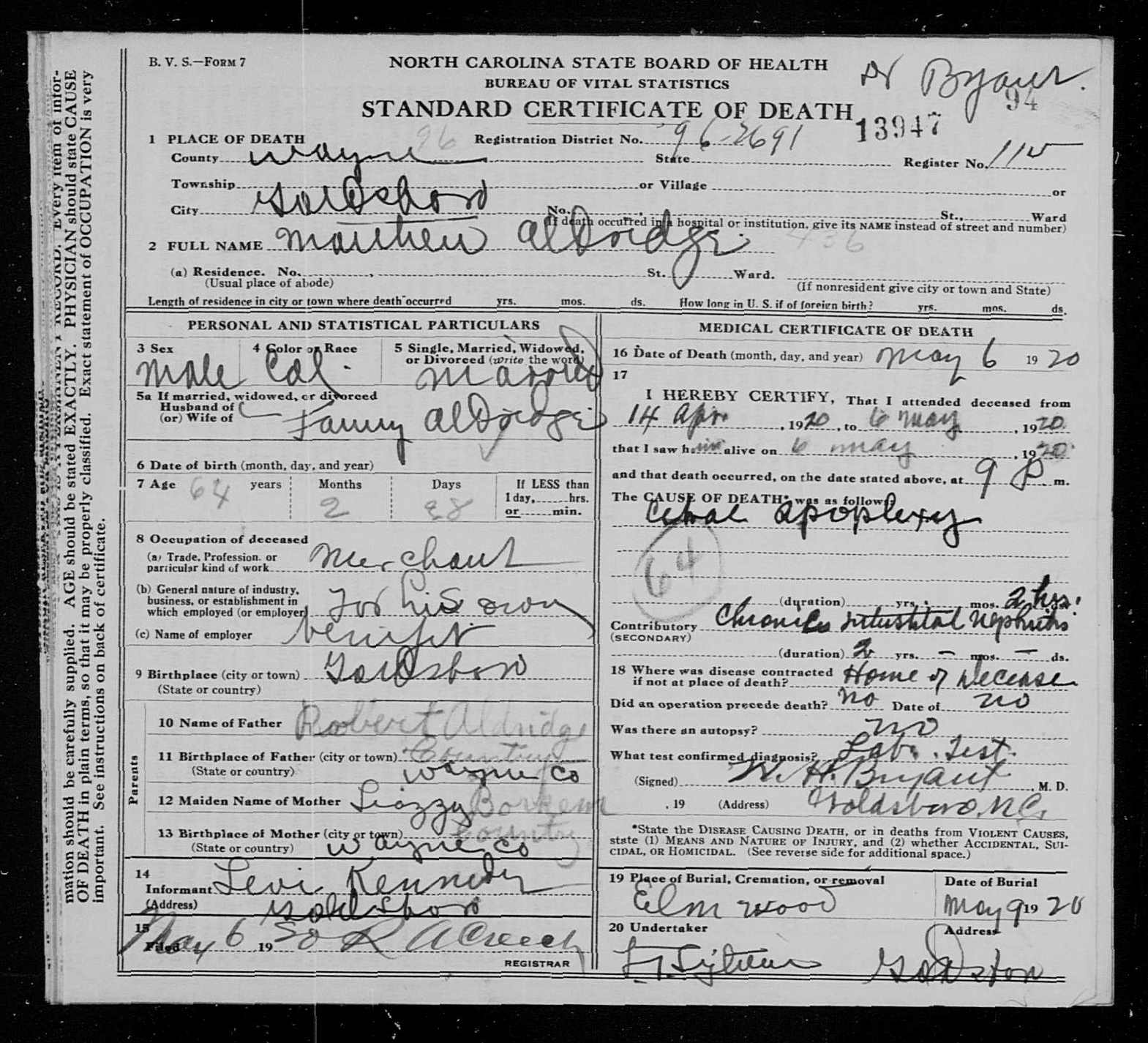
Mathew Aldridge — (1) to daughters Fannie B. Randolph and Mamie J. Aldridge, 1/2 undivided interest in my dwelling house and lot on Pine Street. Signed 27 August 1919 in the presence of N.D. White and Ida Darden.

Recorded and filed 18 May 1920. Fannie Aldridge was qualified as administratrix.

record-image-24 copy

Hmmm. Mathew Aldridge’s will provided for neither his wife, Fannie Kennedy Aldridge, nor his oldest daughter, Daisy Aldridge Williams. Perhaps he had settled property upon them prior to making his will.

——

Lucian Henderson — to John Wesley Carter, all my real estate known as my home place, 8 acres, provided that John W. Carter care for me and my wife Susan Henderson, otherwise null and void. My trusty friend John W. Carter appointed executor. Signed with an X in the presence of Everest Lewis and R.E. Simmons.

Lucian Henderson died 22 June 1934 and his will was recorded and filed 27 June 1934.

Lucian and Susan Henderson’s only child, Cora Q., died in 1907. For more re his friendship with John W. Carter, nephew of his sister Sarah’s husband Jesse A. Jacobs, see here.

——

Joseph Aldridge — (1) a decent burial; (2) to my wife Martha C. Aldridge, all my real and personal property during her lifetime or widowhood; (3) to my sons Allen Aldridge, Daniel Aldridge, William Aldridge and Milford Aldridge, $1 each, to my son Joseph Aldridge, my watch, to my son George Aldridge, my clock; (4) after Martha’s death, all my personal property to be divided between my sons Joseph and George and my daughters Mary Aldridge, Luella Aldridge and Lillie Mae Aldridge; as tenants i common, Mary, Luella and Lillie Mae to receive 12 acres to be laid out of the someplace on the east side of the old stagecoach road; to Joseph and George, all the remainder of the land between what I received from the estate of my father Robert and my brothers George and Dave. Signed 5 May 1934.

Recorded and filed 12 September 1934.

Martha Hawkins Henderson Aldridge remarried in 1940, triggering the terms of paragraph 4 of the will. As set forth here, she remained close to Joseph Aldridge’s children the remainder of her life. Also, a small clue I hadn’t noticed before: Joseph indicated that he received land from the estate of his brother Dave. As noted here, I had lost sight of David Sloan Aldridge after 1904, but now know that he died before 1934.


Standard
Births Deaths Marriages, Newspaper Articles, North Carolina, Paternal Kin, Photographs, Politics, Religion, Virginia

Henry Edward Hagans.

The second oldest of Napoleon Haganssons, Henry Edward Hagans was born in 1868 near Fremont, Wayne County. (Napoleon was the half-brother of my great-great-great-grandmother, Frances Seaberry Artis.) His mother was Apsilla “Appie” Ward Hagans. He and his brother William S. Hagans (then called “Snowbee”) appear with their parents in the 1870 and 1880 censuses. Little is known about their childhood, but it would have been one of relative and increasing comfort as their father’s landholdings expanded. Henry and William attended local elementary schools, then left home to enter the preparatory division of Howard University in Washington, DC. Henry returned to North Carolina to attend college at Shaw University in Raleigh, graduating in 1890.

HAGANS -- Henry Hagans Photo

Henry in his teens, probably as a young collegian at Shaw.

Most of what we know about Henry’s life is gleaned from numerous mentions in newspaper articles resulting from his social, professional, civic and political career. To call him an active man is an understatement. While still in college, he hit the ground running and slowed only in the last few years of his life, when ill health may have dampened his passions. What follows is a narrative built largely from his public life. The portrait is incomplete, but reveals a remarkable man nonetheless.

On 11 November 1885, the Raleigh News & Observer carried a glowing review of the “Colored Fair,” an annual exhibition convened by the North Carolina Industrial Association. The fair opened with a procession of the Association’s marshals, followed by their assistants, including H.E. Hagans of Fremont, who was only about 17 years old. NCIA, founded in 1879, was an organization of African-American civic leaders, founded “to encourage and promote the development of the industrial and educational resources of the colored people of North Carolina.” Governor Starks “spoke of his great surprise at the extent and merit of this the first colored fair he ever attended. He was really amazed to see what progress the colored people had made in twenty years. In that time he said they had really become a race ….”

On 6 November 1888, the New Bern Daily Journal announced that stockholders of the Eastern North Carolina Stock and Industrial Association had elected officers, including H.E. Hagans — then 20 — as chief marshal.

On 10 May 1890, the Washington Bee, an African-American newspaper in the nation’s capitol, noted in a “Personals” column that “Mr. H.E. Hagans of Tremont [sic], N.C. is in the city on a visit.” (The two entries preceding Henry’s notice detailed the travels of former U.S. senator Blanche Kelso Bruce and Congressman John Mercer Langston.)

In about 1892, Henry married Julia B. Morton, daughter of Andrew and Mary Morton of Danville, Virginia. Andrew Morton was a prosperous barber and entrepreneur. The nomination form for historic place registration for Danville’s Mechanicsville district notes: “Another freedman, Andrew Morton, built 543 Monroe Street ca. 1882. Morton became a successful barber and prominent member of the black community, helping to establish Calvary Baptist Church in 1892.” Images of America: Danville Revisited, a photographic history of this southwest Virginia city, includes photographs and brief bios of Andrew and Mary Morton. Henry and Julia may have met through connections at Howard — she graduated from the school’s Normal Department in 1888. Henry’s listing as a teacher in North Danville in the Virginia State Superintendent’s Report for School Years 1891-2 and 1892-3 reveals that the couple lived briefly in Danville before settling permanently in Fremont, then Goldsboro.
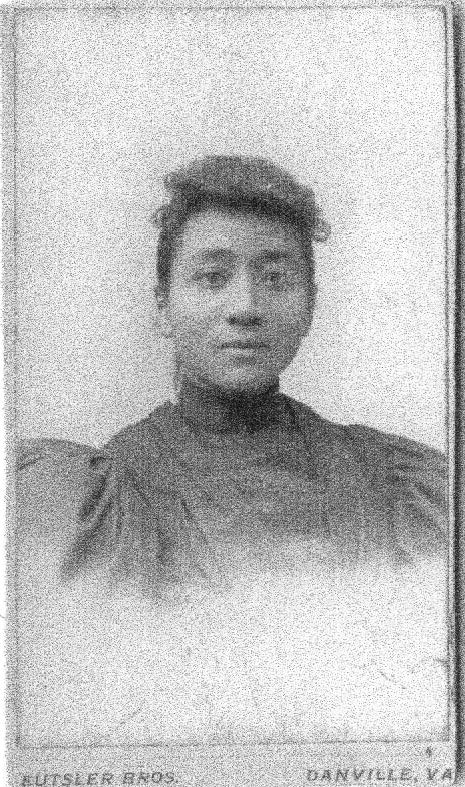
HAGANS -- Julia Hagans

Julia B. Morton Hagans.

On 15 September 1892, the Goldsboro Weekly Argus trumpeted big news: “The State Colored Normal School opened in this city yesterday, of which Prof. H.E. Hagans, son of Napoleon Hagans, one of the most respected and prosperous colored men in the State, from the Fremont section, has recently been elected principal.  The ARGUS is glad to note his election.  He merited the preferment, and we wish the school all success under his administration.” According to an article in the Colored American, see below, Henry left this position to become Chair of English at A&M College in Greensboro (now North Carolina A&T State University).

On 31 July 1893, Julia Hagans gave birth to Henry’s only child, son Earle Morton Hagans, in Danville.

Henry’s mother Appie died in 1895, and his father almost exactly one year later. Under the terms of Napoleon Hagans’ will, Henry and his brother William divided the estate equally.

On 26 June 1897, the Raleigh Gazette noted that “Prof. H.E. Hagans of Fremont” was an attendee at the North Carolina State Teachers Association’s 16th annual session at Shaw University.

On 23 October 1897, the Raleigh Gazette reported on the closing exercises of the city school of Eureka, whose “able corps of teachers” included Prof. George W. Reid, Mrs. H.E. Hagans and Miss Elnora S. Ferrell. After devotional exercises, students were examined — revealing “an amount of familiarity with the subjects taught very seldom witnessed in the average school of this kind” — then a “sumptuous repast” was served. (In fact, “the best dinner ever given in Eureka.”)

On 20 November 1897, the short-lived Wilson (NC) Blade noted in “Fremont Items,” that “Professor Henry E. Hagans made a flying trip to Goldsboro last Saturday and returned last Sunday.  While here he visited the Sunday school and delivered an elegant address.” After closing exercises were over, several distinguished persons spoke, including “Prof. H.E. Hagans, formerly an instructor in the A.&M. College, Greensboro.”

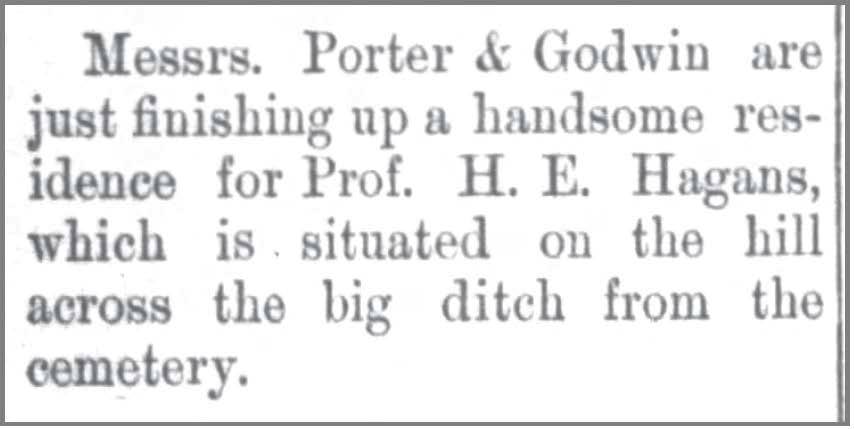
On 30 May 1898, the Goldsboro Daily Argus announced:

Gboro_Daily_Argus_5_30_1898_HE_Hagans_hours

This was surely 501 East Elm Street, a corner address just across the street and slightly northeast of Willow Dale, the cemetery for Goldsboro’s white residents. (The “big ditch” is still there.) There is a house on the lot today, but it dates from no earlier than the mid-20th century. Sanborn maps from the era show a large two-story dwelling.

On 25 June 1898, the Colored American, a Washington, DC, newspaper, noted that: “Mr. H.E. Hagans of Goldsboro, N.C., and a brother of Mr. W.S. Hagans, secretary to Hon. George H. White, was in the city for a few days last week. He is a splendid specimen of the superior young men of the race in North Carolina.” Henry previously had been White’s secretary.

On 27 June 1898, Henry and his wife “J.B.” were official witnesses at the marriage of his 27 year-old brother William Hagans and Lizzie E. Burnett, 23. The ceremony, conducted by Rev. Clarence Dillard, took place in the Nahunta district of Wayne County, probably at William’s home. Neighbor J.D. Reid was an additional witness.

By his late 20s, Henry was thick in the middle of local Republican politics. Coverage of African-American politicians in Goldsboro newspapers was snarky at best and crudely racist the rest of the time. A 20 September 1898 Weekly Argus article was typical, snidely mocking the elocution of black speakers and jabbing at their decorum. The point of the coverage — an agreement between black and white factions of the party concerning the nomination of a county ticket — arrives late in the piece, and there we learn that Professor Henry E. Hagans gained the chairmanship of Wayne County’s Republican executive committee.

On 9 Nov 1898, Daniel Vick and wife Fannie of Wilson NC executed to Henry E. Hagans of Goldsboro a promissory note for $400 with interest after maturity at 6% and payable 9 Feb 1899.  If Vick defaulted, Hagans would sell at public auction two lots on Church Street and Barefoot Road in Wilson.  The deed was registered and filed in Wilson County on 16 Apr 1903 in deed book 66, page 236.  A handwritten note on the entry: “The within papers transferred to S.H. Vick this the 6th day of May AD 1899 /s/ H.E. Hagans”  Another note: “This mortgage is satisfied in full by taking taking a new mortgage and is hereby cancelled 4 Dec 1903 /s/ S.H. Vick”  Samuel H. Vick, Daniel’s son, was turn-of-the-nineteenth-century black Wilson’s most prominent citizen and was active with George H. White and Henry Hagans in Republican politics.

On 21 March 1899, the nearly 476 acres comprising the bulk of Napoleon Hagans’ estate was divided between his sons. Parcels included two tracts in Nahunta township containing 173 and 48 acres; a tract containing 3 acres; two tracts containing 75 ¾ and 6 acres; three tracts containing 39 ¼, 30 and 8 1/3 acres; a tract containing 4 1/8 acres; a tract containing 25 acres; a tract containing 9 ¼ acres; a tract containing 24 acres; and a tract containing 30 acres.

On 21 July 1899, the Fayetteville Observer reported that “[t]he Summer School of Methods, which opened in this city on the 10th inst., for the benefit of colored teachers, closed its labors last night with an interesting programme.” The article noted that 183 teachers from 17 counties attended the school, and faculty included “Prof. E.E. Smith, the efficient conductor, Prof. Edward Evans, Prof. Emma J. Council, Profs. J.W. Byrd and G.W. Herring, Dr. R.S. Rives, Rev. W.M. Jackson, Supt. J.I. Foust, and Profs. H.E. Hagans and J.W. Woody.”

The following month, the Goldsboro Headlight reported that Henry Hagans had been selected for jury duty at the September term of court.

The Raleigh Morning Post carried pleasant coverage of commencement exercises at Goldsboro’s Colored State Normal School and credited Henry Hagans and his assistants, Ed. Williams and C.A. Whitehead, for an “excellent system of training.”

On 5 April 1900, the Goldsboro Weekly Argus cheerfully chronicled the “sorry plight” of the county’s Republican party, a mostly white faction of which was in open revolt against chairman Hagans. The white Republicans were “sick and sore” of Hagans and refused to attend a committee meeting he called. In their absence, delegates to the state and Congressional conventions were selected, with African-Americans gained the primo latter. Dark hints were thrown that “Czar Hagans” must have taken money for his brazen actions as, whatever the law, “public sentiment was opposed to negroes filling offices over white people.” The problem, railed a white Republican, was “educated negroes,” who wanted only to teach school, preach or engage in politics.

The same day, the Raleigh Morning Post published a letter from H.E. Hagans, coldly furious in his defense of his actions and honor:

Raleigh_Morning_Post_4_5_1900_Let_Hagans_SPeak

Exactly one month later, the Colored American‘s “Political Horoscope” column ignored the kerfuffle to record Henry’s rise in party leadership: “At the convention of the second district of North Carolina held at Tarboro April 26, Congressman George H. White and H.E. Hagans were chosen to the Philadelphia convention.”

In the 1900 census of Goldsboro, Wayne County, in Ward 2, Henry E. Hagans, born September 1867, is listed with wife Julia A., born July 1869, and son Earl, born September 1892.  Henry owned his home; no occupation listed. Earl is also listed 135 miles away in Danville, living with his Morton grandparents. This is, perhaps, the first clue that the boy was not following in his father’s footsteps.

Henry’s own steps were a little shaky in 1900. At the September term of Superior Court, judge W.S. Robinson entered a judgment against him in the matter of The Bank of Wayne vs. H.E Hagans: “It appearing to the County  that the Summons herein was duly served on the defendant the 10 days before the beginning of this term, and that a verified complaint was duly filed herein on the 4th day of Sept 1900 and  that the defendant has failed to appear and answer or demur to the complaints; It is thereupon on motion of Aycock & Daniels, attorneys for plaintiff considered and adjudged by the court, that the plaintiff, The Bank of Wayne, recover of the defendant H.E. Hagans, the sum of Three Hundred and Eighteen and 45/100 ($318.45) dollars of which Three Hundred ($300) dollars is principal and Eighteen and 45/100 ($18.45) dollars is interest, together with the costs of this action to be taxed by the clerk.”

On 19 March 1901, the Wilmington Messenger ran a story about an 18 year-old Goldsboro mulatto man arrested for stealing mail. Andrew C. Alexander, “an attache of the postoffice,” turned to Henry Hagans to stand surety for Alexander’s $200 bond.

On 19 April 1901, per the Raleigh News & Observer, Henry addressed the annual meeting of the alumni association during commencement week at Shaw University.

In 1902, H.E. Hagans, age 34, registered to vote in Wayne County under the state’s grandfather clause. He named Napoleon Hagans as his qualifying ancestor. (His brother William named their maternal grandfather, a white physician named David G.W. Ward.)

On 3 April 1902, the Charlotte Observer printed the following letter:

Charlotte_News_3_3_1902_Are_you_coming

The News & Observer covered the “negro mass meeting,” attended by about 150 men from 18 counties, on 16 April. The purpose of the gathering, headed by elected president Henry Hagans was “to discuss the status of the negro as an officeholder in the Republican party and to devise plans to make his power felt by the white Republicans his votes had elevated to power.” Senator J.C. Pritchard came in for especially harsh criticism. An appointed committee, which included Henry’s brother William, devised an address to the colored people of North Carolina that encouraged sober respectability, self-respect, home ownership, support of “race enterprises,” payment of poll taxes, country living, loyalty and thrift, while pointedly remarking upon pressing issues such as jury discrimination, Jim Crow laws, and the need for accountability from elected officials.

On 31 January 1903, the Colored American shone a spotlight on Goldsboro, “a progressive little town of 8000 inhabitants. It is historic,” it claimed, “for the peaceful relations existing between the races. The chief occupation of its people is trucking. Yet we have negroes who are rapidly forging their way to the front along all industrial lines. Our people own thousands of acres of forming land, as well as excellent city property….  Prof. H.E. Hagans, the principal of our State Normal School and also a farmer, is worth $20,000. Mr. W.S. Hagans, who is one of the most successful agriculturalists, is worth $20,000. …”

On 9 May 1903, the Colored American, “Mr. H.E. Hagans, formerly an attaché of the office of the Recorder of Deeds, and later private secretary to Congressman George H. White, is now principal of the Colored State Normal School of Goldsboro NC.  This office is in receipt of a unique invitation to attend the Commencement Exercises of this school Friday, the eighth, instant.” This is the only mention I have found of Henry’s service under Tarboro’s John C. Dancy, see below.

On 19 September 1903, the Colored American, “Prof. H.E. Hagans, of Goldsboro NC, who is principal of the public schools of that city and an extensive farmer and real estate owner, spent a few hours in the city last week, the guest of Hon. John C. Dancey [sic], recorder of deeds.  Mr. Hagans is a prominent Pythian and attended the conclave held in Baltimore last week.  He is one of the coming men of his State.”

On 24 September 1904, as Henry’s political career perhaps reached its crest, the Colored American paid him homage with a full front-page feature:

HE_Hagans_Colored_American_9_24_1904 (1)

“Educator, orator and scholar.”

On 10 July 1907, the Charlotte Observer‘s coverage of recent state legislative activity noted that the body approved a charter for the Southern Fidelity Life Insurance Company “to do also a health industrial and sick benefit business” and named J.E. Shepard, John C. Dancy and H.E. Hagans among the shareholders. Three days later, Greensboro’s Daily Industrial News announced the close of the Negro State Inter-Denominational Sunday School Convention. Henry E. Hagans had been elected secretary of the organization.

Henry played no direct role in the Wayne County Superior Court proceedings in J.F. Coley v. Tom Artis (1908), a dispute over 30 acres of land.  Thomas “Tom Pig” Artis began renting the property in 1881 from W.J. Exum.  In 1892, Exum’s widow Mary sold it to Napoleon Hagans.  In 1896, after his death, the land passed to Napoleon’s sons Henry and William.  William S. Hagans gained the 30 acres in partition and, in 1908, sold it to J.F. Coley.  Coley filed suit when Tom Artis laid claim to it, arguing that Napoleon had sold it to him.  At trial, William testified that his father was in feeble health in 1896 when he called him and his brother Henry together “under the cart shelter” to tell them he would not live long and did not know to whom the land would fall.  William testified that Pole asked them to let “Pig” stay on as long as he paid rent, and they promised to do so.

In the fall of 1908, the Haganses attempted a new tack with Earle, sending him to Indianapolis to live with his uncle/cousin Dr. Joseph H. Ward. The Indianapolis Freeman informed all that Earl was to  attend school in the city and that he was “the son of Prof. H.E. Hagans of Goldsboro, N.C., who is the head of one of the oldest and most substantial families in North Carolina. The Hagans [sic] are relatives of Dr. J.H. Ward …” [Italics added; mythmaking at work….]

The 1910 census of Goldsboro lists Henry L. Higgins [sic], 38, public school teacher, wife Julie, 34, and son Earl, 14.  (The ages of everyone in the household were off by about 4 years.)  Henry and Julia had been married 18 years, and she reported one of two children living. Earl left home within a few years of this census. When he registered for the World War I draft in June 1917, he was living in Norfolk, Virginia, working as a hotel waiter and had a wife and child. He was described as a chauffeur in the 1920 census and was dead by 1930. His wife Sarah and son Earle Jr. survived him.

On 21 July 1910, the Greensboro Daily News reported that the negro Knights of Pythias had met in Wilmington and among “those prominent in public affairs attending the grand lodge” was Professor H.E. Hagans of Goldsboro.

The 1911-1912 Goldsboro City Directory lists “Hagans Henry E tchr h 501 Elm e” and “Hagans Julia B mgr Beneficial Millinery Co h 501 Elm e.” I have not been able to find any additional information on the millinery company.

On 18 July 1913, the New Berne Weekly Journal reported on the annual session of the North Carolina Grand Lodge of Colored Knights of Pythians at which H.E. Hagans was elected Grand Lecturer.

On 21 May 1915, the Williamston (NC) Enterprise reported on commencement exercises at the Higgs Roanoke Institute at Parmele. The several-day event included a speech by Henry E. Hagans to the Invincible Literary Society.

In July and August 1916, large advertisements ran in the Washington Bee recruiting members to the Royal Knights of King David, Old North State Fraternal Insurance Organization, touting its “unblemished record of 33 years” and warning that “the usual life of a negro organization is 20 years, and usually it is 20 years of internal strife and mismanagement — then the inevitable failure.” Not so with R.K.K.D., whose financial policy was “safe, sound and sane.” A week or so before the ads, a small article announced the arrival of  H.E. Hagans and R.E. Owens, staying at the home of the “well-known” Mr. and Mrs. John Doster of 1205 Tea Street northwest. As for Hagans and Owens, “these two well known representatives of North Carolina are not only well known to the editor of The Bee, but they are known to every North Carolinian as being men of the highest business integrity.”

Henry was not the only one to move about. The 15 June 1918 New York Age reported that Mrs. Henry E. Hagans had stopped in D.C. a few days after visiting her sister, Mrs. M.A. Galloway, and niece, Mrs. William Solomon, in New York City and her youngest sister, Mrs. Charles Reid, in Danville.

It’s not clear whether Earle Hagans served in the war. However, on 6 July 1918, the Washington Bee trumpeted the establishment by the Colored Auxiliary of the War Community Service Commission of the District of a “finely equipped recreation center” for colored soldiers, “filling a long-felt want.” “Temporarily the club room is in the charge of Mr. Henry E. Hagans.” The 13 July edition of the New York Age provided additional details about the center’s “dedicatory services.”

In the 1920 census of Goldsboro, still living in the Elm Street house: H.E. Hagans and wife J.B., both teachers.

On 2 August 1920, Henry contributed to the Bee a long feature article entitled “James E. Shepard, President of National Training School, A Great Benefactor/ Manual Training Center / My Visit to the Summer School of the National Training School, Durham, N.C., and Some of My Observations.” In the typically ornate language of the day, Henry penned a paean to “that indomitable leader Dr. Jas. E. Shepard.” “To tell the story of the rapid growth of this institution would be too long; it is full of romance, and its development has, indeed, been so wonderful that it is almost beyond mental conception.” Nonetheless, despite this challenge, Henry managed to wring out several dozen column inches of praise for this institution and its founder, “the most constructive genius of the Negro race today.” The National Training School is today North Carolina Central University.

——

This is the only photograph I have seen of Henry in late maturity. He is probably not many years away from death here, but the boy that was is still visible in his thick eyebrows and the abundance of curly black hair swept back from his brow. Henry wears his prosperity in the fullness of his smooth-shaved face and his pinstriped suit; my best guess is that the picture was taken in Goldsboro.

Henry Hagans Brother of Wm S Hagans

Henry Edward Hagans died 17 Mar 1926 in Goldsboro of myocarditis and an enlarged liver.  He was 58 years old. He was buried 19 March 1926 at Elmwood cemetery. Before she returned to Danville to live out her years, his wife erected this headstone in his memory:
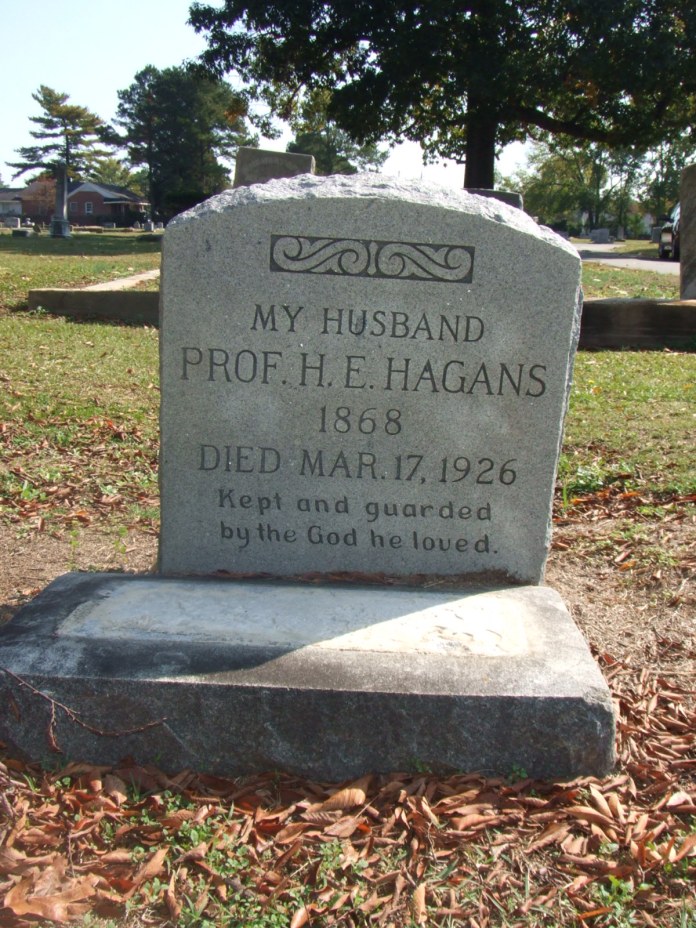
HAGANS -- HE Hagans headstone

Family photos courtesy of W.E. Hagans and W.M. Moseley; photo of grave marker by Lisa Y. Henderson, 2013.

Sources: Federal census records; deeds, birth, marriage and death records, Wayne County Register of Deeds office; deeds, Wilson County Register of Deeds office; North Carolina State Archives; others as cited.

Standard
Births Deaths Marriages, Free People of Color, Land, North Carolina, Paternal Kin, Photographs

Family cemeteries, no. 15: Henderson-Aldridge.

There was another Aldridge cemetery, but its whereabouts are only vaguely remembered.  Not far off Highway 117.  A few miles north of Dudley. Robert Aldridge was buried there about 1899 and, presumably his wife Mary Eliza Balkcum Aldridge, too. There they remain, though others who died in that era were disinterred and moved to what is now known as the Henderson-Aldridge cemetery.

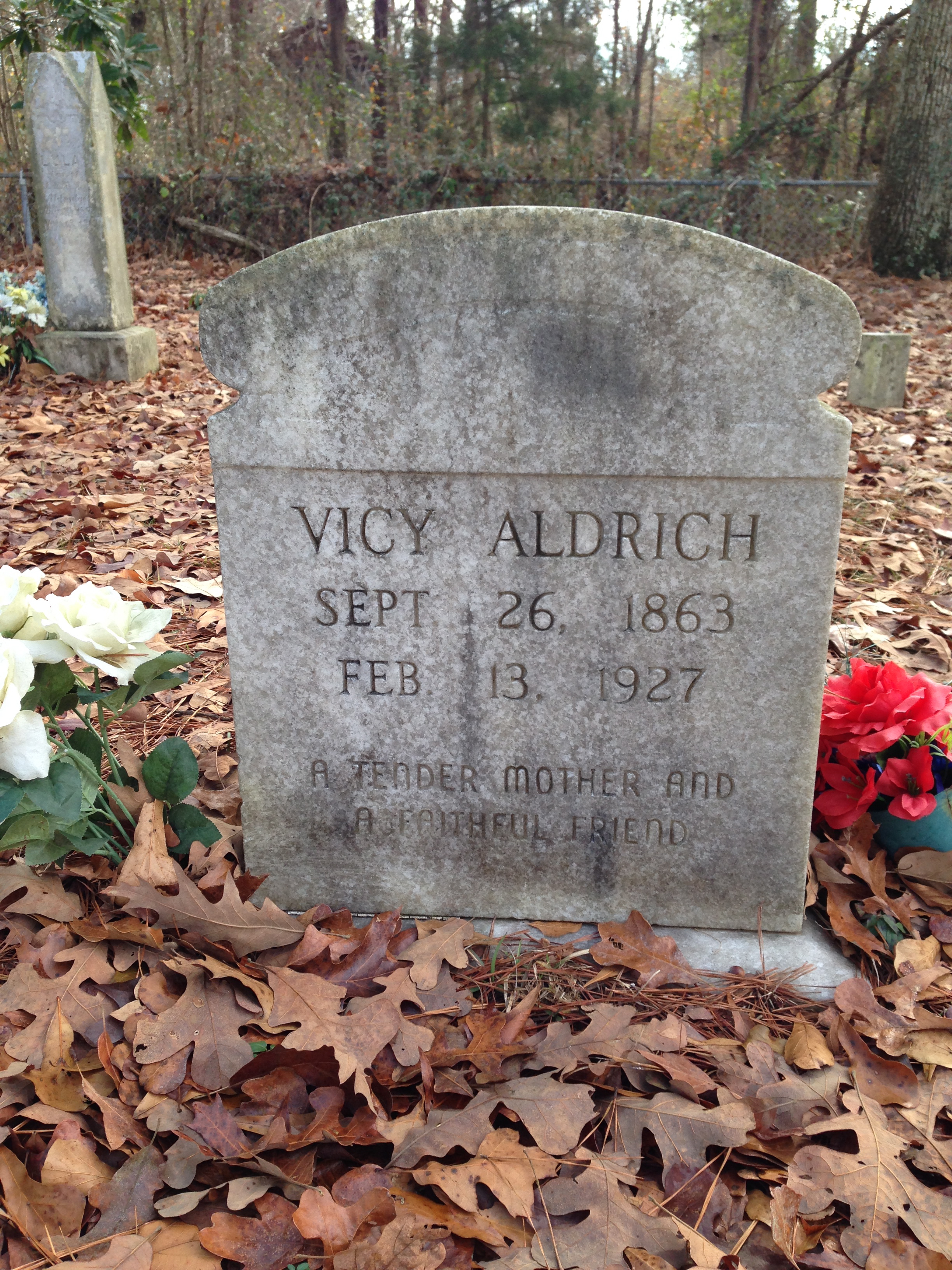
The oldest graves belong to Robert and Eliza’s son John W. Aldrich (1853-1910), his wife Vicey Artis Aldrich (1865-1927), and their daughters Lula Aldridge (1882-1918) and Amanda Aldridge Newsome. [“Aldrich” was the preferred spelling of son J. Thomas Aldrich, who erected the stones.] Most of the other graves belong to descendants of John and Vicey, or of John’s brother Robert Jr. and his offspring.

IMG_4665

IMG_4666

Burials include Catherine Aldridge Davis (1900-2009) and her son George E. Davis (1921-1964); Lenora Henderson (1902-1961) and husband Henry Lee Henderson (1901-1942); Aaron H. Henderson (1922-1943); Horace B. Henderson (1923-1984) and wife Katie Lee Henderson (1924-1963); Hoover Aldridge (1929-1970); Dr. James T. Aldrich (1890-1968) and wife Athalia F. Aldrich; Frances Newsome (1883-1961); Allen Aldridge (1908-1969); Milford Aldridge (1913-1985); Sarah Eliza Aldridge Powell (1918-1998); Paul Aldridge (1913-1947) and wife Lonie Mae Aldridge (1919-1940); Robert Aldridge (1865-1941); Lula Aldridge (1882-1919); Amanda A. Newsome (1892-1918); Bennie R. Aldridge Jr. (1940-2008); and, most recently, Isaiah Len Henderson (1998-2013) and Ross M. Sutton (1935-2013).

Photos by Lisa Y. Henderson, 2013.

Standard
Births Deaths Marriages, North Carolina, Oral History, Paternal Kin

“Your half-sister died.”

From one of my notebooks, circa 1987:

“LATE BREAKING NEWS — Daddy was at the cleaners when Mr. Barnes asked him if he knew his half-sister died. Half-sister? Yes. ‘Mike’ had a daughter who was an Adams.”

——

I don’t know how to even begin to follow this up or track her down. How old was she? Was Adams her maiden or married name? Did she live in Wilson? Did she die in Wilson?

Standard
Births Deaths Marriages, Maternal Kin, Migration, Other Documents

Funeral Program Friday: Matilda Whirley.

Not exactly a funeral program, but close enough:

Morning Star Baptist Church of Christ/In Remembrance.

MATILDA WHIRLEY.  December 7, 1910-March 5, 1992.  Matilda “Tillie” Whirley, one of Stephen and Emma Whirley’s eight children, was born on December 7, 1910 in Charles County, Virginia. She was educated in the public schools of Charles County until moving to Baltimore, Maryland. There she completed her education by attending evening classes.  For nineteen years, Miss Whirley worked as a housekeeper in the Ashburton section of Baltimore. She subsequently obtained employment at the University of Maryland, School of Dentistry from which she retired after working there for seventeen years.  At an early age Tillie received Christ as her personal Savior and became an active member of the New Vine Baptist Church in Charles County, Virginia. She was guided in the work of the church by her God-fearing parents. Her mother instructed her in baking the bread for the Lord’s Supper each month and Tillie, believing this was her sacred duty, continued baking the bread until she left Charles County.  After relocating to Baltimore, Maryland, Miss Whirley became affiliated with the Morning Star Baptist Church, under the pastorate of the late Reverend George Jacob Garnett. Because of her strong background as a servant of God, she became a great servant of mankind. At Morning Star, Miss Whirley was a member of the Senior Usher Board, Missionary Society, Samuel Ray Revival Choir, Church School, Building Fund, Lottie Henry Nurses’ Unit, Flower Circle, Women’s Ministry and Board of Christian Education. She was also a member, and later president, of the Pastor’s Aid and a loyal supporter of the Girl Scouts, Fuel Fund, Elevator Fund and any other fund or organization which would benefit her church or community.  Miss Whirley was a devoted, loving, effectual, caring Christian woman and was a friend to all who needed her. She freely gave wise and timely counsel, based on her life experiences, as she sought to make life go a bit smoother for her family, friends, church members, neighbors and co-workers. Miss Whirley was counted upon to be an integral part of church and community activities and participated and served wherever she could. Her dedication and love of God was evident in all she did. Miss Whirley was a good example of one of God’s servants; because of that, we take time to remember her this month.

Source: http://www.msbcoc.org/star/remember/matilda-whirley.asp

Standard
Births Deaths Marriages, Business, Land, Maternal Kin, Other Documents

How the matter stands about the mill property.

From the Nicholson family file in the local history room at the Iredell County Public Library in Statesville, this letter:

Nicholson’s Mills N.C.

March 4th 1886

Wesley J. Smith & Mary J. Smith

Dear Children we received Your letter of the 4 of Feb and was much rejoiced to hear that You had another fine son and all was doing well, but alas the last mail brough us another letter that give us the painful news that you had met with the sad misfortune to loss the child well my dear children greav not for the child it is gone to a far better state of existance and altho You can not call it back You can go to it where parting will be no more for ever in the sweet groves of bliss.  You wished to know how the matter stands about the mill property I can only say that Anderson Obtained Judgement against me at the last Court at Statesville and it will not be sold in a Short time but I do not know when as he has not Advertised Yet but it will not be long if I do not raise the money and there does not seem to be any Chance to do that.  James A. Barnard has been trying to sell his property ever since las fall so that he could buy mine but he has not met with the chance to do it Yet and I fear he will not find any one to buy his and if he dose not mine will have to go and it will go for nearly nothing.  but I can not help it unless some one would come to my help.  Watsons & family are all well except bad colds Barnard & family are in tolerble health only the baba it is not well nor has not been since xhrismast Wesley’s folks were well when he heard last but that is a month ago.  Sandford Reeces children have the hoopen cough very bad and they have lost little Mattie she died last Sunday morning was a week and they buried her ar Flatrock on monday following Cynthia May had been sick about four months and she died the first of Feb.  Old Miles was sick about two weeks and died the last day of January Jacks wife died the day before christmast.  I am no better off with my rhumatisam but get more and more helpless all the time.  Mama is very poorly at this time with cold but the most of the time she is tolerbly stout for one of her age we can not tell when we can go to see you we are feeble and the weather & the roads are bad,  You must come and see us when You can.

Your Affectionat father & mother     T.A. Nicholson  R.C. Nicholson

——
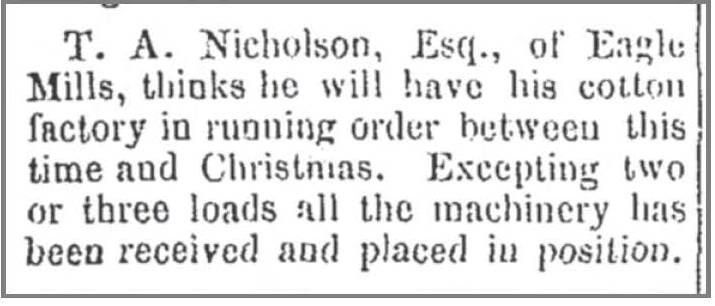
Two months later, Thomas Allison Nicholson was dead. The “mill property” — a cotton factory he had announced so confidently in newspapers —
Rec__amp__Landmark_11_25_1881_cotton_factory
Statesville Record & Landmark, 25 November 1881.
— had been in foreclosure for years.
Nicholson had tried to sell other property to raise cash:
Rec__amp__Lndmark_1_15_1884_Nich_Mill_land_sale
Statesville Record & Landmark, 15 January 1884.
And his creditors had tried repeatedly to unload the factory:
Rec_and_Landmark_4_17_1885_Nicholson_sale
Statesville Record & Landmark, 17 April 1885.
But nothing worked. Thomas Nicholson died with this burden, and soon after, his son’s father-in-law, William I. Colvert, administrator of the estate, announced the liquidation of the cotton factory’s machinery.
WS_Western_Sentinel_12_9_1886_T_Nicholson_sale
Winston-Salem Western Sentinel, 9 December 1886.
The loss of the mill property by no means impoverished the Nicholsons, despite the plaintive tone of Thomas’ letter. When his widow died in 1903, her estate included three large parcels of land on Hunting Creek.
Record_and_Landmark_11_17_1903_RC_Nicholson_sale
Statesville Record & Landmark, 17 November 1903.
Standard
Births Deaths Marriages, Civil War, Enslaved People, Maternal Kin, Virginia

The Allens.

My cousin is the fourth man in this family to bear his name, and those four generations of Johns are the exact measure of my Allen lineage. When Graham Allen married Mary Brown in Charles City County, Virginia, on 22 June 1876, she was six months pregnant with a white man’s child. We know nothing of the circumstances of conception, and nothing of the man’s identity beyond the Y-haplotype — R1b1b2a1a1 — that my uncles and cousins carry. [Update: I have identified John C. Allen‘s father.] Graham adopted Mary’s baby boy at birth, gave him his name, and reared him, as far as we know, with no distinction from their later children. So. We are Allens.

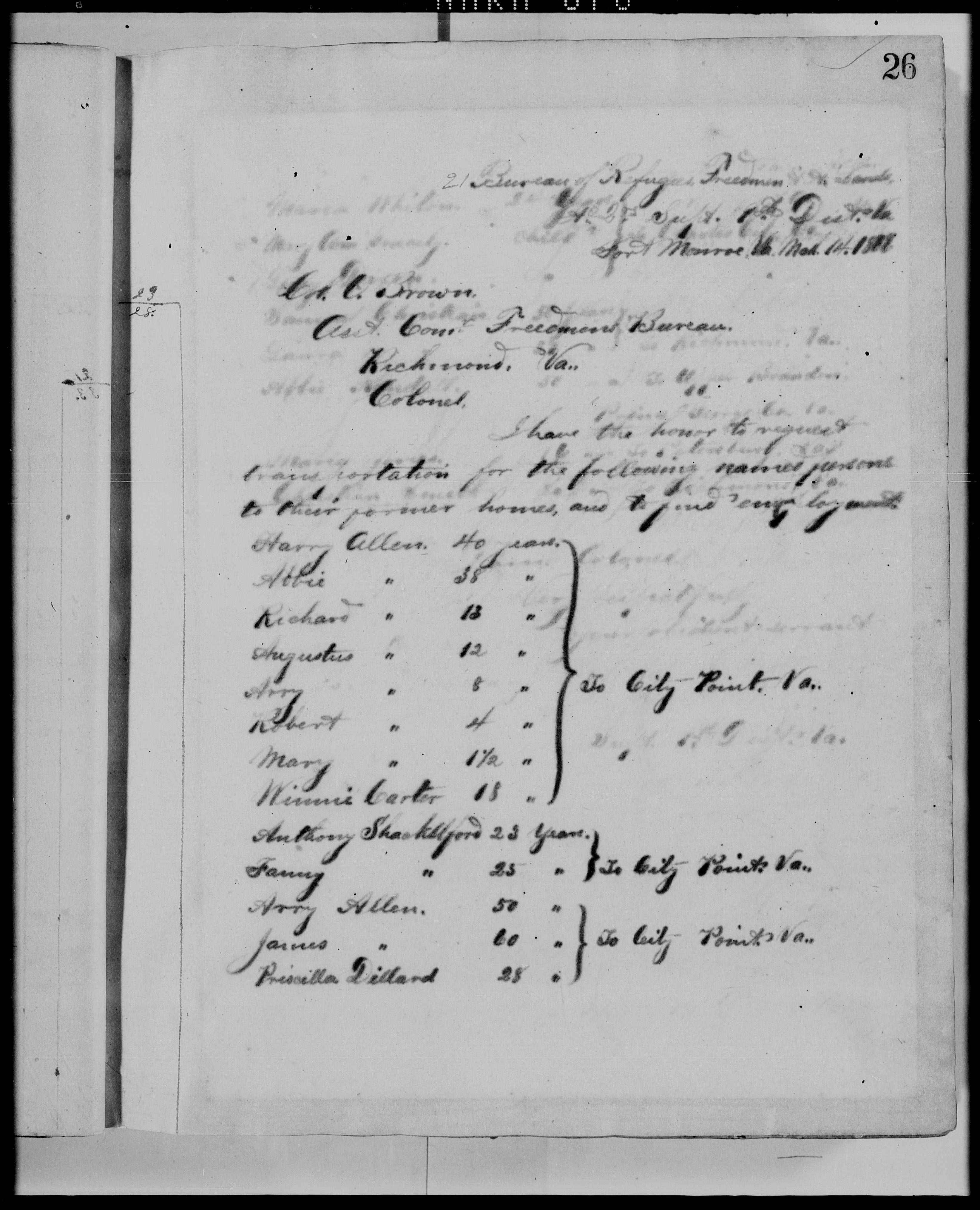
Graham Allen was born about 1852 in Prince George County, Virginia. His first marriage records lists his parents as Mansfield and Susan Allen. His second, as Edmund and Susan Allen. I have found no other trace of Edmund/Mansfield. However, in the 1870 census of Brandon, Prince George County, laundress Susan Allen, 50, and sons Alexander, 20, and Graham Allen, 17, appear in #14, the household of Anthony Shackleford, 26, farmer; wife Fannie, 24; and son Willie, 1. Also living in the house was Mary Hill, 23. I don’t know if the Allens, Shacklefords and Hill were related, or if they were related to two households of Allens listed nearby: #16, Harry Allen, 47, wife Abba, 43, Richard, 19, Augustin, 17, Assia, 13, Robert, 9, and Mary, 6; and #20, Joseph Allen, 42, wife Lucy, 37, and children Mildred, 8, Joseph, 6, and Willie, 1. However, an intriguing Freedmen’s Bureau document links those Allens and the Shacklefords:

record-image-22 copy

record-image-23 copy

“I have the honor to request transportation for the following named persons to their former homes, and to find employment,” wrote Samuel C. Armstrong, Superintendent of the Freedmen’s Bureau 1st District (and founder of Hampton Institute, which educated a dozen Allens between 1927 and the present.) Among those to be transported, Harry and Abbie Allen and their children and Anthony and Fanny Shackleford. City Point, in Prince George County, had been headquarters of the Union Army during the siege of Petersburg in the Civil War. The Allens and Shacklefords likely were refugees, so-called “contraband,” who fled their owners during the war to join a large camp near Fort Monroe. (For recent news of archaeological digs at the former Grand Contraband Camp in Hampton, see here.) Though none has surfaced to date, I will continue to look for links between these families and Edmund or Susan Allen.

Other than Graham and Mary’s marriage license, I have no other record of the family in the 1870s. (An Alexander Allen married Mary Wallace on 15 February 1872 in Charles City County. This Alexander was 30 years old and the son of James and Sophia Allen. Thus, he is not Graham’s brother.)

In the 1880 census of Harrison, Charles City County, 26 year-old farm laborer Gram Allen’s household includes wife Mary and children Nannie, 5, John, 3, and Emma, 1. I suspect that Nannie was Mary’s child by a previous relationship, but I don’t know. In the next few years, Mary gave birth to a son Willie, who died of burns in October 1885. (Graham Allen, who provided information, is listed on the boy’s death certificate as father, but the mother’s name is given as Sarah. A misunderstanding? A mistranscription? And “outside” child?) A month later, Mary gave birth to Alexander Allen.  Two years later, in December 1887, Graham Allen reported the death of Mary Allen, age 30. Graham’s relationship to the deceased was not stated, but this was not his wife. In 1892,  Mary Brown Allen gave birth to her last child, son Edward Noble Allen.  In 1896 and 1899, daughter Emma Allen gave birth to sons Milton and Junius Allen in Charles City County. I do not know their fathers.

On 18 Aug 1898, at Charles City County Courthouse, Graham Allen filed a deed for the purchase of two parcels on Hyde Road, one 12 acres and the other 2 3/4 acres, from A.H. Drewry et ux.  A plat filed with the deed shows a roughly trapezoidal lot 2 1/2 miles from Rolands Mill, surrounded by the land of Sarah Jones, Edward Jones, Frank Martin, and Peter Jefferson.

In the 1900 census of Harrison, Charles City County, Graham Allen is listed with wife Mary, sons Alexander and Edward, and grandsons Milton and Junius.  (I believe they were Emma Allen’s sons.) Mary was illiterate, but Graham could read and write.  Mary reported 4 of 8 children living. (John, Emma, Alex and Ed, living; Nannie, Willie and who, dead?) As detailed here, John had moved to the city by the late 1890s and married Mary Agnes Holmes in 1899.

On 3 Apr 1901, Emma Allen, 22, married widowed laborer Stephen Whorley [Whirley], 32, son of Stephen and Patsy Whorley.  W.E. Carter performed the ceremony at Graham Allen’s residence.

On 11 March 1902, at Charles City County Courthouse, Graham Allen filed a deed (book 17, page 437) for the purchase for $16 of 2 3/4 acres in the Grafton tract from Mary Harrison Drewry. The sale was made 27 Feb 1902, and the tract was located 4 miles northwest of Drewry’s Mill. Two years later, he filed a deed or the purchase of 4 1/2 acres in Turkey Trot from M.E. and W.E. Stagg and in 1909 filed another (book 20, page 165) for the purchase for $12 of 2 1/4 acres in the Bishops tract, west of Old Hyde Road in Turkey Trot, bordered on the east by Graham ‘s own land and True Reformers and on west by Peter, James B. and Elvina Jefferson and M.E. Stagg.

In the 1910 census of Harrison, Charles City County, on River Road, farmer Graham Allen is listed with wife Mary and son Edward. (Where were Milton and Junius?)  Mary reported 4 of 9 children living. (Eight children, or nine?) Also on River Road, farmer Steaven Whirley, wife Emma, and children Royal, John, Samuel, and Graham.  Royal and John were Stephen’s children by a previous wife, and the family lived next to Samuel and Mary E. Whirley, Stephen’s brother and sister-in-law. (River Road is now State Route 5, or John Tyler Memorial Highway.)

Mary Brown Allen died 1 Apr 1916, aged 67 in Harrison township, Charles City County.  Her death certificate reports that she was born in Amelia County, Virginia, to James Brown and Catherine Booker, both born in Virginia. She was buried 2 Apr 1916, and Junius Allen of Roxbury was informant for the certificate.

On 22 Nov 1917, in Roxbury, the widower Graham Allen, 58, widow, born Prince George County, resident of Charles City County, son of Edmund and Susan Allen, married Lenner Charles, 32, born Charles City County to William and Lucy Charles. The couple appear in the 1920 census of Harrison, Charles City County on Kemmiges Road with a five year-old daughter named Sallie. (Was she Graham’s child?)

John, Edward, Milton and Junius Allen registered for the World War I draft:

  • JOHN CHRISTFUL ALLEN.  Born 25 Dec 1876.  Resided 2107 Marshall Avenue, Newport News VA.  Laborer, Hampton Roads Stev. Co.  Nearest relative, Mary Holmes Allen (wife).  Medium height, stout build.  Brown eyes, grey hair.  (Signed “John Christful Allen” in the same hand as rest of the card.  A duplicate card shows the signature in a different hand, presumably John’s, as “John Christopher Allen.”)
  • EDWARD NOBLE ALLEN.  Born 17 May 1888, Charles City County VA.  Resided 6724 1/2 – 24th Street, Newport News VA.  Laborer, C&O Railway, Newport News.  Supports father.  Medium height and weight.  Brown eyes, black hair.  “Three fingers missing on right hand.”
  • MILTON ALLEN. Born 22 Nov 1895, Roxboro, Charles City County VA. Resides 318 N. 18th Street, Richmond VA. Laborer for Clarence Cosby, Richmond VA. Single. Signed Milton Allen. Registered 5 June 1917. Also,
  • MILTON ALLEN.  Born 20 Aug 1896, Richmond VA.  Resides 1011 N. Lafountaine, Kokomo, Ind.  Employed by Willis White, Kokomo, Ind., USA.  Nearest relative, Ed Allen, address “don’t know.”  Tall and stout.  Black eyes and hair.  Signed with an X.  Registered 5 June 1918. (Is this the same man who registered in Richmond the year before? If not, which is the right Milton?)
  • JUNIUS ALLEN.  Born 22 Feb 1899.  Resides 1752 Ivy Ave., Newport News, Warwick VA.  Carpenter, Boyle-Robertson Co., Newport News VA.  Nearest relative, wife Margaret Allen.  Medium height and weight.  Black eyes and hair.  (He was barely literate and signed his name something like ‘Juily Allen.’)

I have not found a card for Alexander and assume he died before the war. Edward actually served; I don’t know about Milton and Junius.

In the 1920 census of Harrison, Charles City County, on Kemmiges Road, Stephen Whirley, farmer, is listed with wife Emma and children Samuel, Graham, Matilda and Susie. John and his family remained in Newport News, as did “Junnus” Allen and his wife Margaret, with brother-in-law Samuel Johnson, at 1752 Ivy Avenue. Junius worked as a transfer drayman; Samuel as a bricklayer at the shipyard. Edward may have been living and working in Washington County, New York. Milton was definitely gone. In the 1920 census of Kokomo, Howard County, Indiana, at 1011 North LaFontaine Street, there is a listing for Virginia-born Milton Allen, single, age 21, living as a roomer in a household headed by Myrtle Harston.  Milton worked as a laborer in a stove factory.

On 10 January 1928, Graham Allen died of cerebral hemorrhage at the age of about 74.  According to informant William Webb, Graham was born in Charles City County to unknown parents and left a widow, Lena Charles. He was buried at New Vine Church on 14 January 1928.

In the 1930 census of Harrison, Charles City County: Emma Whirley and daughter Susie were listed “cook-private family” in household of Eugene A. Dietrich, a German-American grocery merchant. I have not found Edward, though I believe he was living in Charles City County. Nor can I locate Milton and Junius. (There is a Junius Allen listed in Newport News city directories in the 1940s, but I am not certain they are the same man. There is also a Junius Allen listed in the 1902 directory, which definitely is not Emma’s son, so I am cautious.) At least one of Emma’s children had gone North by this time and is found with her daughter in the 1930 census of Baltimore, Maryland, living with her half-brother.  At 1314 Mulberry Street, rented for $40, are listed John W. Whirley, 31, wife Susie, 28, sister Matilda, 20, boarder Sam Bradley, 30, and niece Dorothy Whirley, 1.  John worked as a laborer in a car shop; Matilda as a laundress in a laundry; and Sam as a hospital waiter.  All were born in Virginia except Susie, who was born in South Carolina. On 24 Dec 1930, in Charles City County, Graham Whirley, 22, laborer, son of Stephen Whirley and Emma Allen, residing Roxbury, married Arnether A. Harris, 20, daughter of John A. Harris and Mary Jefferson, residing in Providence Forge. I have not found Samuel Whirley in 1930.

Edward N. Allen died 25 Jan 1933 at the Marine Hospital in Norfolk, Virginia, of aortic aneurism and valvular heart disease.  Based on information he provided as a patient, Edward’s death certificate reported that he was born 17 May 1890 to Graham Allen and Mary Brown of Virginia and resided at RFD#2, Box 66, Roxbury, Virginia.  Edward was buried 30 Jan 1933 at Hampton National Cemetery, in section Fii, Site 6459-A.

In 1935, Samuel Whirley made a splash in Fredericksburg, Virginia, newspapers after being on the lam for a year on larceny and false pretense charges. It’s not clear whether this one-armed man was Emma Allen Whirley’s son, but an article noted that he had spent time in Baltimore while on the run.

In the 1940 census of Hopewell, Virginia, at 601 Maplewood Avenue, Graham Whirley, 25, a chemical plant laborer, is listed as a lodger with Andrew and Lena Joyner. There is no sign of his wife. On 21 January of that year, in Charles City County, his past behind him, Samuel Whirley, 37, born in Charles City County to Stephen Whirley and Emma Allen, residing Petersburg, married Alice Howard, 23, born Charles City County to Laura Howard. The rest of the Whirleys — Emma, Susan, Matilda — are nowhere to be found, though I know they were living. Similarly, of the Allens, I can only place John and his children.

I lose the thread of my great-grandfather’s extended family after 1940. I’ve written of my brief and unsatisfactory telephone conversation with Dorothy Whirley in 1996. She had no children, nor did Edward Allen, but it’s hard to believe that none of Graham’s sons, save John, or his grandchildren by his daughter Emma, have contemporary descendants.

Standard