Births Deaths Marriages, Free People of Color, Newspaper Articles, North Carolina, Paternal Kin

Nothing could swerve him.

I felt sure that Napoleon Hagans‘ death had merited more than the brief mention I’d seen in the Goldsboro Headlight, and last night I found it:
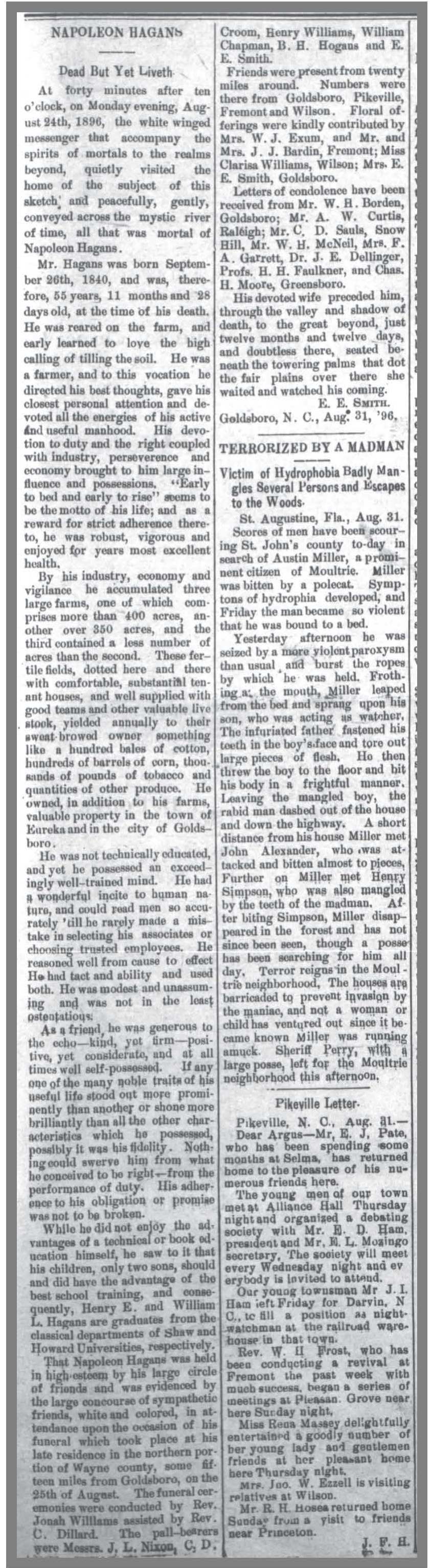
Goldsboro_Daily_Argus__9_1_1896_N_Hagans_Obit

Goldsboro Daily Argus, 1 September 1896.

This shining eulogy was penned by Ezekiel Ezra “E.E.” Smith (1852-1933), college president, recent United States Ambassador to Liberia, and arguably the most accomplished of Wayne County’s 19th-century African American citizens. (Smith was born free in Duplin County, just to the south, but moved to Goldsboro as a young man, married a cousin of Napoleon’s daughter-in-law Lizzie Burnett Hagans, and was principal for a time of Goldsboro’s colored school.)  Side-stepping the indelicate issue of Napoleon’s parentage, E.E. painted a glowing portrait of his friend’s virtues — his hard work, his astuteness, his self-built wealth, his determination to give his children what he lacked. Napoleon’s business acumen and successes won relationships across color lines and among North Carolina’s colored elite, and E.E. listed those who took part in the funeral or had taken the time to reach out to pay respects:

  • Rev. Jonah Williams, Eureka. Jonah Williams was the elder of a Baptist church a few miles from Napoleon’s home (and a central figure in the establishment of Primitive Baptist congregations in the area) and had, like Napoleon, been involved in Republican politics. Jonah’s brother, Adam T. Artis, married Napoleon’s half-sister, Frances Seaberry.
  • Rev. Clarence Dillard, Goldsboro. Clarence Dillard, Howard University Theology ’83, came to Goldsboro as a Presbyterian minister and was principal of the colored graded school at Napoleon’s death. (It is said that he traded a teaching position at Agricultural & Mechanical College for the Colored Race [now North Carolina Agricultural & Technical State University] to Napoleon’s son Henry E. Hagans for this job.) Dillard was active in Republican politics and was co-editor of a short-lived African-American newspaper in Goldsboro, The Voice.
  • J.L. Nixon, Goldsboro. John Louis Nixon (1855-1919) was co-editor and manager of The Voice and, later, secretary of the Goldsboro-based United Church Benevolent Society and a mail clerk for the United States Postal Service. He was a native of Wilmington.
  • C.D. Crooms, Goldsboro. Charles D. Crooms was a teacher and merchant.
  • Henry Williams.
  • William Chapman, Goldsboro. William Chapman (or Chatman) married Susan Burnett, mother-in-law of Napoleon’s son William S. Hagans.
  • B.H. Hogans, Goldsboro. Benjamin Harrison Hogans (1865-1926) was a teacher, a trustee of Saint James AME Zion Church and, later, a mail carrier. He was born in Orange County and came to Goldsboro as a child with his parents Haywood and Zilpha Latta Hogans.
  • E.E. Smith.
  • Mrs. W.J. Exum, Fremont. Mary Burt Alston Exum, white, was the widow of William J. Exum (1825-1885), a prominent farmer and former slaveowner in northern Wayne County. Napoleon bought land from William (and Mary, after William’s death).
  • Mr. and Mrs. J.J. Bardin, Fremont. John J. Bardin, white, was a druggist in Fremont.
  • Miss Clarisa Williams, Wilson. Clarissa Williams, Jonah Williams’ daughter, was a teacher in Wilson.
  • Mrs. E.E. Smith, Goldsboro. Willie Ann Burnett Smith, daughter of Dolly Burnett, was a cousin of Napoleon’s son William’s wife Lizzie E. Burnett. William Chapman was Willie Burnett Smith’s step-father.
  • W.H. Borden, Goldsboro. William H. Borden (1841-1905), white, was president of Goldsboro Furniture Company.
  • A.W. Curtis, Raleigh. Rev. A.W. Curtis, white, lead the Congregational Church mission in Raleigh.
  • C.D. Sauls, Snow Hill. Cain D. Sauls (1864-1938) of Greene County wore many hats — farmer, merchant, newspaper columnist, banker, justice of the peace, and all-around businessman. He was the grandson of Daniel Artis, who was a first cousin of Adam T. Artis.
  • W.H. McNeil, Greensboro. William H. McNeill was president of Suburban Investment Company of Greensboro and Piedmont Mutual Life Insurance Company. (The 18 July 1903 edition of Washington DC’s The Colored American reported that Mrs. W.H. McNeill had visited Mrs. F. Douglass at 1720 Fourteenth Street, NW.)
  • Mrs. F.A. Garrett, Greensboro.
  • J.E. Dellinger, Greensboro. J. Elmer Dellinger (1862-1920) was active in Republican politics and the development of Baptist Sunday Schools, was a physician, and taught chemistry at Agricultural & Mechanical College in Greensboro. He was also a manager of Suburban Investment Company. He was born in Lincoln County, North Carolina.
  • H.H. Faulkner, Greensboro. Henry H. Faulkner was a school principal in Greensboro.
  • Charles H. Moore, Greensboro. Moore was principal of the first graded school for African-American children in Greensboro.
Standard
Births Deaths Marriages, Maternal Kin, Virginia

The case for the Carters.

Were Walter “Wat” and Nancy Carter the step-father and mother of Joseph and Jasper Holmes? Here is the evidence:

  • Per my great-aunt, Julia Allen Maclin, her grandfather Jasper Holmes and Joseph R. Holmes were brothers.
  • According to historian Luther Porter Jackson, Joseph had a brother “Watt,” who was a shoemaker like Joseph.
  • Jasper Holmes and Joseph Holmes were born in Charlotte County, Virginia, circa 1838 and 1841.
  • In 1867, Watt Carter registered to vote at Clements’ in Charlotte Court House, as did Joseph Holmes.
  • About 1867, Jasper Holmes named a son Walter. (Another son, born in 1874, was named Joseph. And both Jasper and Joseph had sons named William.)
  • Joseph’s death certificate, issued in 1869 in Charlotte County, lists his parents as Payton and Nancy Holmes. Neither Payton Holmes nor Nancy Holmes have been found in the 1870 census or any other record.
  • In the 1870 census, Joseph Holmes’ children Payton, Louisa and Joseph, and possibly his widow, appear in the household of Wat and Nancy Carter in Charlotte County. Wat and Nancy have a son also named Wat.
  • In the 1870 census, Jasper Holmes and family are listed in Charles City County, some 100 miles east of Charlotte County. (Why Charles City County? What was the pull to that particular place?)
  • On 14 June 1873 in Charles City County, Lotsey Carter, age 22, born in Charlotte County to Walter Carter and a mother whose name is illegible, married Claiborne Booker, born in Chesterfield County and residing in New York.
  • On 10 January 1874, Lettie Booker opened account #6605 at the New York branch of the Freedmen’s Bank. She stated that she was 22 years old; born in Richmond, Virginia; and resided at 28 Cornelia Street. She was light brown in complexion; worked washing and ironing; and was married to Claiborne Booker. Her father was Watt Carter of Keysville [Charlotte County], Virginia; her mother was named Nancy; and her siblings were Watt, Eliza and Louisa.
  • In the 1880 census of Queens, Queens County, New York: living on premises, Claiborne Booker, 39, headwaiter in a hotel; wife Lettie, 28, laundress in hotel; and Walter Holmes, 12, “nephew.” All were born in Virginia.
  • On 23 October 1883 in Charles City County, Walter Carter, age 28, shoemaker, born in Charlotte County to Walter and Nancy Carter, married Alice Christian, 22, of Charles City County, at Shirley.
  • Watt Carter died 3 May 1885 in Charles City County at age 72. His death certificate states (probably erroneously) that he was born in Charles City County.
  • Nancy Carter, age 75, died 18 June 1884 in Charles City County. Her death certificate states that she was born in Charlotte County and was single (widowed?)
  • And possibly: “Claiborne Booker has been appointed guardian for the estate of the late Louisa McKie and in his custody her children, Wm. McKie and Clarence McKie, have been placed by the surrogate court of New York county.”  New York Age, 16 March 1905.

My conjecture: Nancy [last name unknown] married first Payton Holmes in Charlotte County and had at least two children, Joseph and Jasper. Nancy then married Walter “Wat” Carter in Charlotte County. Their children included Louisa, Lettie, Walter Jr. and Eliza. Between 1867 and 1870, perhaps in response to his brother’s murder, Jasper moved his family to Charles City County. Between 1870 and 1873, Wat and Nancy Carter and family also moved to Charles City County. Lettie Carter Booker married and settled in Queens with her husband. For some period, her nephew Walter Holmes, son of Jasper, lived with them. The fortuitous capturing of this stay in the 1880 census cements these relationships for me, as it is a direct connection between Jasper and his half-sister.

Sources: federal census records; Charlotte County VA death records; Charlotte County voter register; Charles City County VA birth, marriage and death records; Freedman’s Bank records.

Standard
Births Deaths Marriages, Civil War, North Carolina, Paternal Kin

Confederate dead and wounded.

When the call came, Hester Balkcum‘s grandsons answered. And paid.

——

James Lucian Balkcum, born about 1839, son of Mariah Balkcum and William L. Robinson. Lucian was a Sampson County farmer when he enlisted as a private on 9 May 1861 in Company F, 20th North Carolina Infantry.  He was captured 20 July 1864 at Stephenson’s Depot, Virginia, and confined at Camp Chase, Columbus, Ohio, where he died of variola on 4 Jan 1865. He is buried in the Confederate Cemetery in Columbus.

Josiah Johnson, born about 1844, son of William and Mariah Balkcum Johnson of Sampson County. Josiah enlisted as a private on the same day and in the same company as his half-brother Lucian Balkcum. He received a disability discharge on 6 May 1862, but re-enlisted 2 Jan 1864. Josiah died from wounds on 9 Nov 1864 at Mount Jackson, Virginia.

Harman Balkcum, born about 1822 to Nancy Balkcum and an unknown father. A 5’6″ farmer, he enlisted 4 Jan 1862 in Duplin County as a private in  Company A, Wilmington & Weldon Railroad Guards (later Company D, 13th Battalion, North Carolina Infantry.) A month later, records note that he missed duty for five days due to parotitis. He died 8 April 1863, probably of illness.

William James Balkcum, born 1841 to Lemuel and Jemima Rackley Balkcum of Sampson County.  W.J. enlisted on 10 Sept 1862 in the same company as Lucian Balkcum and Josiah Johnson. He was wounded 1 July 1863 at Gettysburg, and his left arm amputated.  He was captured as prisoner of war on 5 July 1863 and paroled circa 25 Sept 1867.  He arrived for prisoner exchange 27 Sept 1863 at City Point, Virginia, and transferred to Company F, 20th Infantry on 16 Apr 1864. Nancy’s great-grandson was the only Balkcum to come home.

Lemuel Balkcum, born about 1823. He was named as a grandson in Hester Balkcum’s will and was probably the son of Nancy Balkcum.  In the early 1840s, Lemuel Balkcum married Jemima Rackley. They had at least eleven children — the youngest just months old — before his enlistment on 2 September 1863 as a private in Company E, 30th North Carolina Infantry at Camp Holmes, Raleigh NC.  Lemuel died of typhoid fever on 26 Dec 1863 in a Richmond, Virginia, hospital and is buried in Hollywood cemetery, Richmond.

Standard
Births Deaths Marriages, Free People of Color, Migration, North Carolina, Paternal Kin

Artis in Arkansas.

Surprisingly few of Adam Artis‘ 25+ children migrated out of North Carolina, perhaps because the family’s relative farming wealth and good standing in their community made life in North Carolina — even in the 19th century — attractive. Two who did strike out went West. Sort of. They went to Arkansas.

——

Augustus Kerney “Gus” Artis was born about 1857 to Adam and his wife Lucinda Jones. He was a mere toddler when his mother died, and he was reared primarily by Frances Seaberry Artis, whom Adam married in 1861. Gus inherited one-third of his mother’s share of the estate of her father Jacob Ing, a small nest egg that may nonetheless have represented the pinnacle of his wealth. In 1879, Gus married Rebecca Morgan in Wayne County. Though a 13 year-old girl is implausibly described as their daughter in the 1880 census, there is convincing evidence of a daughter Lena, born in 1882. What Gus did or where he was over the years after her birth is a mystery, for in 1893 he suddenly appears in the city directory of Little Rock, Arkansas, living at the corner of Allen and Elm in North Little Rock. (Which, by all accounts, was a swampy outpost known as Argenta at that time.) In 1898, Lena Artis married Charlie Hill in Pulaski County. By 1900, however, she was back in her parents’ house on Washington Avenue in North Little Rock.  Farm laborer Gustice Artis and wife Mary R. (presumably Rebecca), married 19 years, are listed with Lena, 18, born in North Carolina, and Mary, 13, an adopted daughter born in Arkansas. By 1910, both daughters had left the household, though Mary reported them living. Augustus, then in his early 50s, worked as a laborer in a greenhouse. Lena, described as a widow, was living and working as a “dining room girl” in a Scott Street boarding house. I’ve found none of the Artises in the 1920 census, though Gus and Mary were still alive. Gus didn’t last much longer though. He died of heart disease 2 June 1921 in Brandie township, Pulaski County, and was buried in the “fraternal cemetery.” His death certificate lists his final occupation as “scavenger.”

——

Twenty-five miles east of North Little Rock, Gus’ younger sister Eliza Artis Everett also built a life far from her home. She was the twin of my great-great-grandmother Louvicey Artis Aldridge; the girls were born in 1865 to Adam Artis and his second wife Frances. I have not found their marriage license, but around 1890, Eliza married Haywood Everett. By 1900, they had migrated to Williams township, Lonoke County, Arkansas, and joined a veritable colony of Wayne County migrants, including Haywood’s elderly parents. Families listed near them in the census carried such familiar surnames as Barnes, Best and Coley. In 1910, the Everetts appear in the Richwoods section of the county. In 1920 and 1930, they are in Walls township. They never had children. On 10 October, 1936, Eliza Everett died of pancreatic cancer. Her husband remarried before she was cold in her grave.

——

Did Gus and Mary Rebecca Artis and Haywood and Eliza Everett migrate together in the late 1880s/early 1890s? Why Arkansas? Did Gus and family originally settle among other Wayne County families in Williams township, Lonoke County, before moving closer to Little Rock? And then there’s this — the Lonoke County Race War of 1897-1898?!?!

Standard
Births Deaths Marriages, Free People of Color, Land, North Carolina, Paternal Kin

The Balkcum women.

In the name of God, Amen, I Hester Balkcum of the State of North Carolina and County of Sampson, being of sound mind & memory, but of feeble health, and knowing that all must die; do make & ordain this my Last Will & Testament. And first I give my body to the dust, to be buried in a decent manner and commend my spirit to the care of God who gave it, as a being infinitely wise & good. As for my worldly goods, my will is that they be disposed of as follows – (viz):

1st. I give & devise to my daughter Nancy Balkcum, thirty acres of land, to be laid off by the direction of my executor, from the eastern extremity of a tract lying on the southside of Beaver Dam swamp, so as to include the house in which she now lives, & a part of the cleared land to her & her heirs forever, in fee simple. I also give & bequeath to my said daughter Nancy the sum of Six dollars in money to be paid her by my executor.

2nd.  I give & devise to my grandson, James Lucien Balkcum, son of my daughter Mariah, the residue of said tract of land, lying on Beaver Dam Swamp, after thirty acres as aforesaid shall have been given to my daughter Nancy, the said residue supposed to contain one hundred acres more or less with all the appurtenances thereunto belonging to said James L. Balkcum & his heirs forever in fee simple  and I hereby revoke all gifts, grants and deeds of whatsoever nature or kind coming within the meaning & purview of these devises & declare them utterly void as having been done for temporary purposes & having had their effect  I also give & bequeath unto said James Lucien Balkcum, one bed, bed-stead & furniture and one pot & skillet.

3rd. I give & bequeath unto my grand daughter Mary Ellen Johnson, daughter of my daughter Mariah, one bed and its necessary furniture and all my household & kitchen furniture not heretofore disposed of, with all clothes & cloths of every description, which I may leave at my decease.

4th.  I give & bequeath unto my grand son, John Balkcum, one common Bible, or its equivalent in money

5th.  I give & bequeath unto my two grand sons, Harman & Lemuel Balkcum, one common Bible each, or money sufficient to purchase the same

6th.  It is my will that my Executor pay all my legal debts, and the above legacies, with the Expense of Administration out of such money or notes as may be left by me at my death and the overplus (if any) be given to my daughter Mariah for her own proper use or benefit.

7th.  I hereby constitute & appoint my friend William L. Robinson Executor of this my last Will & Testament, hereby revoking all former Wills, Deeds, gifts or grants of what name or kind soever.

March the 9th day 1843          Hester X Balkcum

Signed, seal’d, publish’d & declared by the Testatrix to be her last Will & Testament in the presence of us, who were present at the signing of the same /s/ Isaiah Robinson /s/ Abner Robinson

State of North Carolina, Sampson County  } Court of Pleas and Quarter Sessions, May Term 1843

There was the foregoing will duly proven in open court by the oath of Isaiah Robinson a subscribing witness & ordered to be recorded.  /s/ Thomas J. Faison Clk

—–

About 1799, John Balkcum, a widower with two young children, married a woman named Hester in Duplin County NC. Her maiden name is unknown. John died in 1803, leaving as heirs only Hester and his children by his first wife, Tomsin and William.  In 1804, Hester received a widow’s allotment and two years later is listed in a Duplin County tax digest with 450 acres.

In the next few years, Hester Balkcum gave birth to two daughters, Nancy and Mariah. She gave them the last name Balkcum, though neither was John’s child. It was the beginning of an unconventional family, with both Nancy and Mariah giving birth out of wedlock, and one or two of Nancy’s children fathered by a black or mixed-race man. (This last circumstance was unconventional, but not nearly as uncommon in antebellum America as one might imagine.) Hester appears only sporadically in census enumerations, but in 1830 “Hester Baucom” is listed in Duplin County heading a household that consisted of a female aged 50-59; one male under 5; two males 5-9; one male 10-14; one male 20-29; one female under 5; one female 15-19; one female 20-29; one female 30-39; all described as white. Ten years later, in the 1840 census of Sampson County, Hester does not appear, but her daughter Nancy Balkcom, aged 30-40, is listed, heading a household of two females aged 5-10 and one female aged 10-14, all white, and one slave.

——

When Hester died in the spring or early summer of 1843, her executor W.L. Robinson listed the debts owed her estate — all to family members — and her meager belongings. Her real property had dwindled considerably since the early days of her widowhood, and I catch a bit of feeling that the family was struggling.

BALKCUM -- H Balkcum Inventory 1843

——

Ten years later, Hester’s daughter Nancy felt poorly enough to dictate her own last will and testament:

In the name of God Amen, I Nancy Balkcum of the State of North Carolina & County of Sampson being of sound & perfect mind & memory but feeble in body & feeling that the sentence if Death which has been passed upon all will probably ere long be executed upon me think fit to make this my last will & testament as follows.

First I give my body to be buried in a decent manner without parade or vain shew & commend my spirit to him who gave it as a being infinitely wise & good.

As for my worldly goods my will is that they disposed of as follows

First. I give & bequeath unto my daughter Margaret Balkcum one bed bedstead & furniture (the bed on which I have usuly lain) one wheel & cards one table one sow & pigs & twenty dollars to be paid by my executors. This is for her services in waiting on me in my last sickness to her & her heirs forever

Secondly, I give & bequeath unto my two daughters Eliza & Mary one bed & furniture to them & their heirs forever

Thirdly I desire that my Son Harman be paid back all expence that he may incur in providing for me by my Executor

Fourthly, All the residue of my property both real & personal ( desire to be sold by my executor to the best advantage & after paying all my just debts & funeral expences that the proceeds of said sale be equally divided among all my children

Lastly I hereby make constitute & appoint my friend William L. Robinson Executor of this my last will & testament with full powers to execute the same according to the true intent & meaning thereof & I hereby revoke all former will  this the 20th day of August 1853

Signed sealed published & declared by the Testatrix to be her last will & testament hereby revoking all former wills in the presents of us who witnessed the in the presents of the testatrix & of each oth  /s/ Nathan Johnson, Joshua X Rackley                         Nancy X Balkcum

Nancy was dead within six months. The same William L. Robinson who had administered her mother’s estate handled hers, and his inventory reveals Nancy’s slightly better-furnished life.

record-image

Inventory of Nancy Balkcum’s estate, 1854.

The account of sale of the property is even more detailed. With the exception of two or three neighbors, all the buyers were Nancy’s children or other close family and they seem to have gotten bargain basement prices. Subtracting the $200 that Harmon Balkcum paid for Nancy’s 32 acres, the remainder of her worldly goods netted only $12.86.

NBalkcum Sale 1854

BALKCUM -- N Balkcum Inv 1854 p 2

Account of sale of Nancy Balkcum’s estate, 1854.

Documents found in estate files of Hester Balkcum and Nancy Balkcum, Estates Records, Sampson County Records, North Carolina State Archives.

Standard
Births Deaths Marriages, Civil War, Enslaved People, Other Documents, Photographs, Virginia

Has the old fuss died out yet?

Here’s another account of Joseph Holmes‘ murder, presented as a pivot point in the romanticized life of the author’s father:

When Jim Wilkes rode into Raft River Valley in 1870, he had two pasts behind him though he was barely twenty-one. His real name was Griffin Seth Marshall. He had called himself Jim Wilkes only since a spring evening in 1867 when an incident in a Virginia village had sent him into exile as a fugitive from the law.

I heard the story from Mother — I am the daughter of Kate Parke and Griffin Marshall. Father wouldn’t have considered it suitable for a little girl, but Mother had no such qualms. Mother had a strong sense of drama, and for her the story was the thing.

“Your father changed his name,” she told us, “because he got in trouble back home and had to leave the country. He never done anything. No indictment was ever found” — Mother was careful to insert the formal, exonerating phrase — “but he was in a crowd one night with his brother John and this colored man was killed. He’d been a slave of your grandfather’s before the war, so when he was shot they thought the Marshall boys had something to do with it. There were soldiers there, northern soldiers, but your father and his brother got away. They left the country that same night — without even saying goodbye to their mother. That was when they changed their name. That’s History,” Mother would add, as she usually did when she told us a story about the early days. “Do what you will with it.”

The time came when I visited the Virginia village. And I discovered not only that every word of Mother’s account was true, but that the full story was adorned with details and a couple of postscripts that would have delighted her.

THE NAME of the village is Charlotte Court House and it is the seat of Charlotte County. It’s the courthouse, built in 1823, is a handsome building of red brick, with a white portico and four white columns overarched by venerable trees. Before the courthouse on an evening is the spring of 1867 a crowd had gathered to listen to a speech. The speaker was a Negro, who was able to make a speech only because Federal troops were camped in a grove of trees across the street. His name was Jo Holmes. He had been a slave, the butler of Judge Hunter Marshall whose plantation Roxabel was five miles from the village. Now Jo Holmes was not only a free man but also a member of the Virginia legislature. Jo Holmes’ podium was the slave block that still stands at the point where the walk from the courthouse joins the street. According to the local story, he was advocating mixed marriages. He didn’t get very far with his speech. A shot was fired and Jo Holmes fell dead. The bullet, I was told is buried in the front wall of the courthouse.

In the crowd were my father and his older brother John who were home on vacation from Clifton Academy in Fauquier County. John had been in the Confederate cavalry. (Their oldest brother Hunter had been killed in the Civil War — four days after Appomattox.) Griffin, who was only seventeen, had been too young to go to war. With them was cousin David Morton, actually a second or third cousin, and a friend named Fred Beal.

The shot that killed Jo Holmes came from the part of the crows where the four young men were standing. One of the four did fire the shot — then slipped the gun into the hand of a friend who threw it into the creek that runs through the hollow beside the courthouse. The Federals came running, but before they could get to the scene the four boys had made their escape with the help of relatives and friends. They were hidden for several hours in a house in the village. Before dawn they were driven to Pamplin, the nearest station on the Norfolk and Western Railway, and put on a train headed west.

The four fugitives soon parted. A letter from Griffin to his older sister Mary dated May 29,1867 — I got it from the daughter of Father’s sister — shows that he and John had been commended to the care of people named Taylor in country that might be Texas. There is no mention of the other two boys. The letter is written on a piece of stationery embossed in the upper left-hand corner with the head of an Indian and, beneath it, the legend “N.P. Co.”; but there is no place name on the letter and the envelope is missing. It reads as follows:

May 29, 1867

My Dear Sister: You must really excuse me for not writing to you sooner but I have been sick nearly ever since I have been here and the other part of the part of the time I didn’t feel like writing. I haven’t had anything to do at all- we have been waiting for Mr. Taylor’s son to come down here- but he has been sick and is now worse and probably never will be able to come. The old man said that he (his son) could get better situations than anyone else and advised us to wait for him and of course as we are under his care we took his advice and are now waiting to see what is going to turn up. Mr. T. Sr. went up to see about his son yesterday and we are expecting him back every day. Morgan is well and in pretty good spirits, but I am not in good spirits. I am getting tired of doing nothing and paying board.

This is the hardest country I ever saw; there isn’t a tree of any consequence in two hundred miles of this place. One day it is hot as five hundred (this was a simile my father often used) and the next day you can’t wrap up and keep comfortable-now today it is very hot. I wrote to Ma some two or three days ago; tell her to write to me and that often. Has the old fuss died out yet or not? I am very anxious to know the effect that thing produced. I haven’t got anything to write about and I am going to stop. Give my love to Bee Jim and all at Roxobel and regards to all of my friends and write soon to your affectionate Brother

The handwriting is the same that appears in two letters Griffin had written to his mother a few months before from Clifton Academy, but the writer signs himself not “G. S. M.” or “G. S. Marshall” as in the earlier letters but “J.T. Wilkes.” The “Morgan” he refers to can only be his brother John. “I never understood,” said my cousin Sarah when she handed me the worn sheet, “what a letter with that strange signature was doing in Mother’s papers.”

I once asked my father who killed Jo Holmes. He replied only it was not he.

— An American Memoir, Margaret Marshall, originally published in The Hudson Review, volume 24, number 2 (1971).

—–

Gawd.

I could pick at the details of this account — starting with the date of the letter, a full two years before Joseph Holmes was actually killed — but what’s the point? It is so obviously unconcerned with Joe Holmes — “delightful postscripts”? — or his life that accuracy is too much to ask.

This photo is found among literary editor Margaret Marshall’s papers in the Yale Collection of American Literature, Beinecke Rare Book and Manuscript Library, Yale University:

Roxabel Margaret Marshall papers

It is labeled “Roxabel.”  This is either a photograph of the back of the house, which has been much modified if it is, or is mislabled. It certainly does not match Marshall’s white portico-and-columns description. (That’s a shed roof porch with posts.) Further, Roxabel is still standing, and I’ve been there. It’s used primarily as the background for tasteless plantation-themed weddings these days, but was mercifully still when I drove up with Kathy Liston, a Charlotte County archeologist-cum-genealogical researcher who opened many a door, literal and figurative, for me in my quest for Jasper and Joseph’s roots. With a wing added long after the Marshalls left, here is Roxabel today:

IMG_9982

If Joseph R. Holmes was enslaved here, was his brother Jasper as well? Or had they been separated early, Jasper perhaps sold locally as excess or to settle a debt. I don’t know. But I do know that, emancipated in 1865 and at least free to build a relationship on their terms, the brothers’ bond was sundered forever by a rash pistol shot.

Standard
Births Deaths Marriages, Free People of Color, North Carolina, Other Documents, Paternal Kin

A Seaberry clue.

Back in December, I went on a hunt for Artis cemeteries in the Eureka area. One that I found, just south of the others, holds the remains of William M. Artis and his family. Today, while I was sorting old documents, I ran across William’s death certificate. His place of birth, which I’ve surely read a hundred times, seized my eye:

Wm_Artis_Death_Cert-1

“Family (Seabury)”? Was this graveyard originally the resting place of William’s maternal great-grandfather, Aaron Seaberry, who died just after 1910? Are there other Seaberrys here, including William’s mother Frances Seaberry Artis? (Who was erroneously referred to as Frances Hagans above. “Hagans” was her mother’s maiden name and the surname of her half-brother Napoleon Hagans. William’s age is off, too. He was 70 when he died.)

Standard
Births Deaths Marriages, Free People of Color, North Carolina, Paternal Kin

Collateral kin: the Halls.

I was a child plagued by respiratory illness and nearly every winter endured a tough bout with bronchitis. When the worst was over, and I was in a recuperating stage, my mother returned to her teaching job, and I sometimes spent a few days at my Aunt Mildred’s house one street over.

Mildred Henderson Hall was not really my aunt. She was my grandmother’s first cousin, daughter of her uncle Jesse “Jack” Henderson. During my grandmother and father’s childhoods, Uncle Jack and his children were the only nearby Henderson relatives. By time I came along, Mildred, her youngest sister Doris Henderson Ward and some of their children were the only other Hendersons left in Wilson. Mildred’s youngest daughters were still at home when I was child, and I grew to know them and the younger of their two brothers best.

I loved my brief stays at Aunt Mildred’s, wrapped in blankets and installed on the couch in her wood-paneled den, drowsing before the television while she handled calls related to the family business. Occasionally, I got a glimpse of the teenaged Patricia, impossibly glamorous in my eyes, leaving for school. More often, Aunt Mildred’s husband, Louis Hall, would stop at home between jobs. He was not a tall man, but he seemed to me a big one. In later years he had a belly, but I think my impression came more from his persona than his actual size. He had a warm smile and a ready laugh, and I, who had no living grandfathers, was drawn to him.

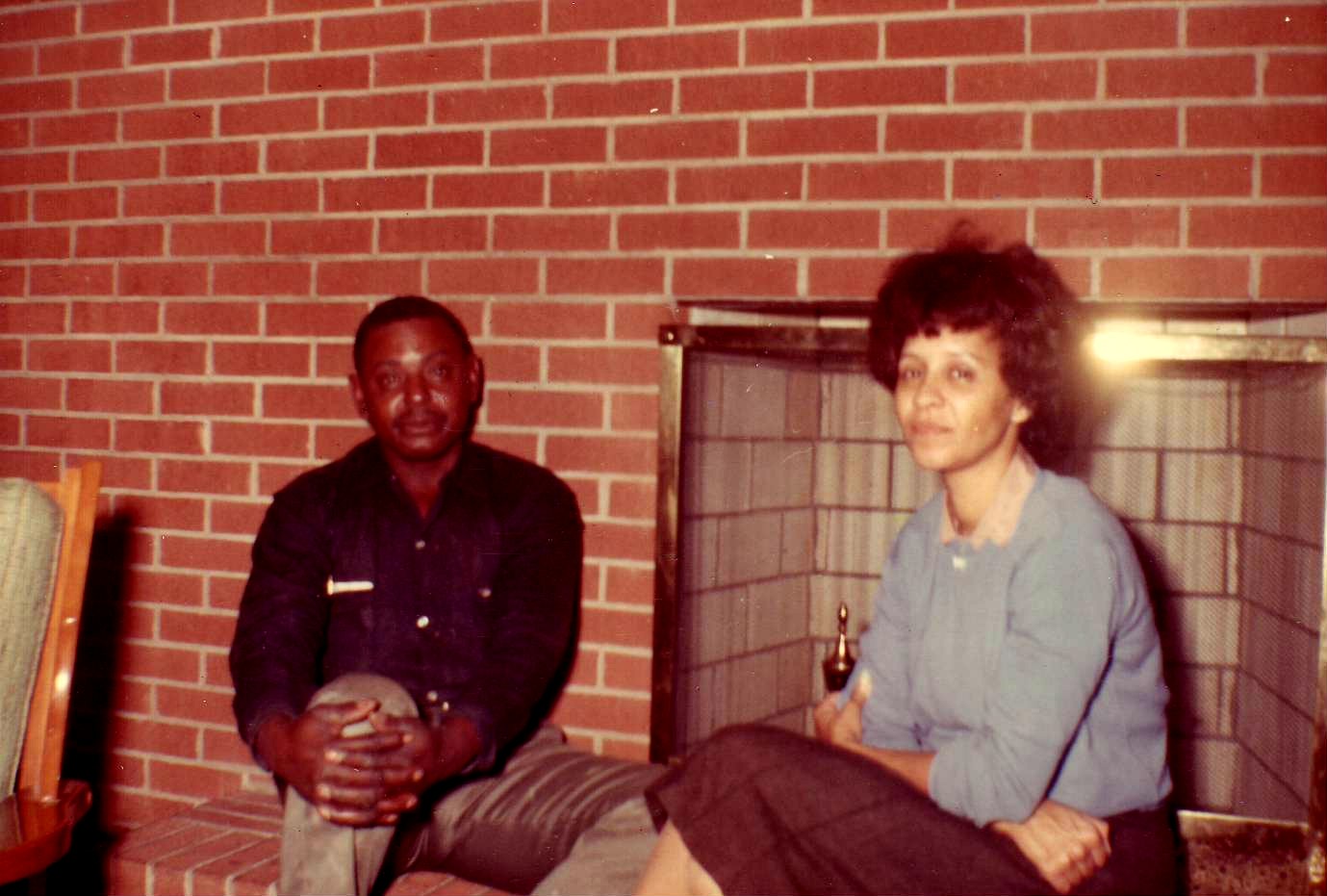
Louis & Mildred Hall fireplace

Louis and Mildred Henderson Hall at home, probably mid-1960s.

Years later, as I researched a thesis examining the involuntary apprenticeship of free children of color, I grew familiar with all the free families of color in Wilson and Wayne Counties. I came upon a set of Halls from the Stantonsburg area and, curious, traced them forward. I was delighted to find that Uncle Louis was descended from this very family. Years after that, I was even happier to be able to provide my Hall cousins with rare documentation of their antebellum forebears’ births.

The family’s earliest known ancestor was Eliza Hall, a free woman of color born about 1820, probably in what was then the heel of southwest Edgecombe County. How she met James Bullock Woodard, a prosperous white farmer and slaveowner, is unknown, but by Eliza’s early 20s they had begun a relationship that would last at least a decade. A sympathetic relative of Woodard’s, perhaps feeling that blood is blood, recorded the births of James and Eliza’s children in her family’s Bible:

Ages of The children of Eliza Hall

William Henry Hall was born Feb the 11th 1844 Patrick Hall was born October the 6th 1845 Margaret ann Hall was born Feb the 12th 1847 Louiser Hall was born April the 9th 1849 Balam Hall was born Feb 7th 1851

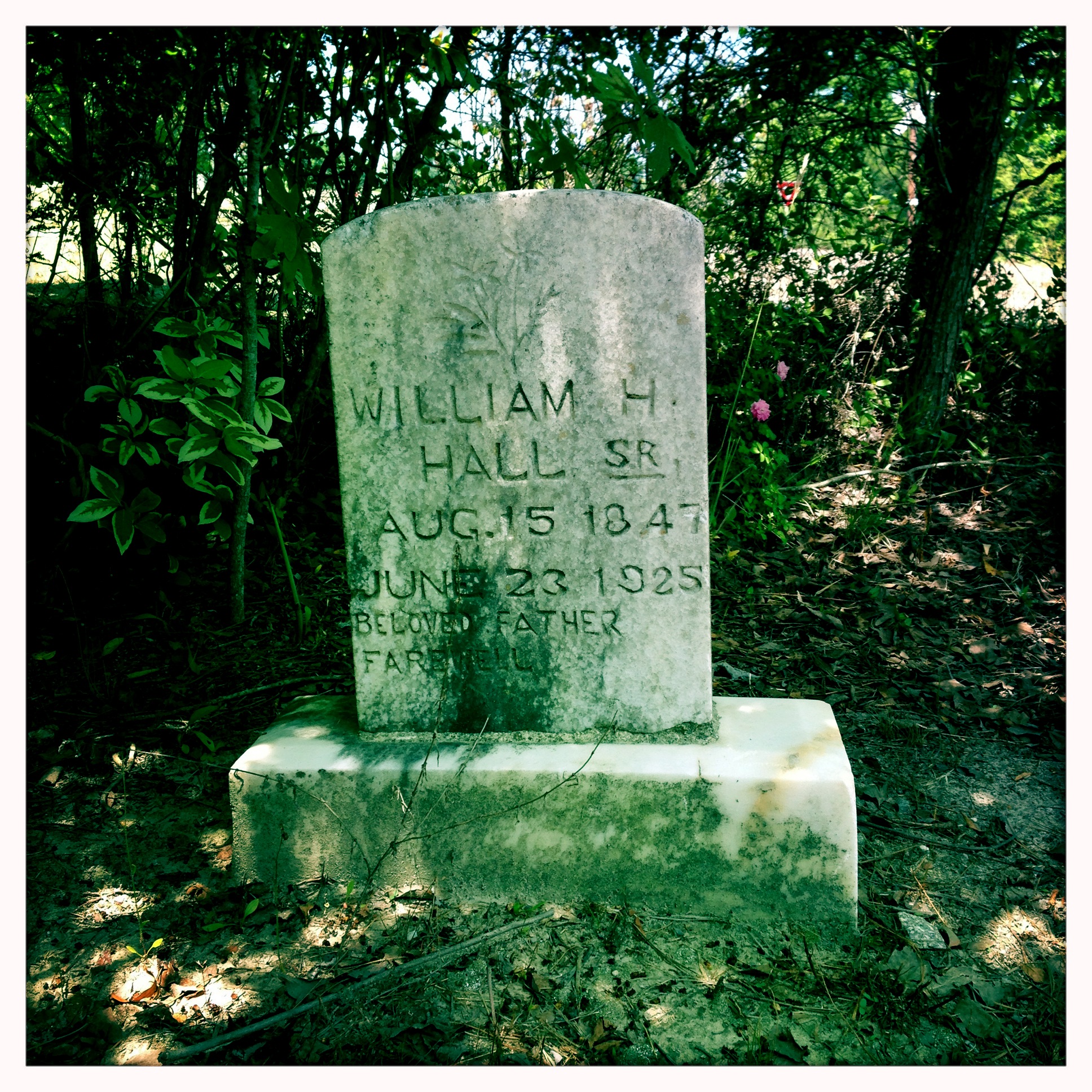
William H. Hall lived and farmed near Stantonsburg, Wilson County, most of his life. He married three times — to Lucy Barnes, Annie E. Smith and Mamie Artis — and had at least nine children. His fifth, more or less, was Robert Hall, born 18 July 1886. When Robert was about 4 years old, his father sold to trustees the quarter-acre of land upon which Bethel African Methodist Episcopal Zion Church was founded. William H. Hall spent his last years living in his son Robert’s household and died 23 June 1925.

On 7 January 1908 in Wilson County, Robert Hall married Katie Farmer, daughter of Robert and Marenda Bynum Farmer. (And Katie’s sister Ida married Robert’s brother Thomas Hall.) Robert supported his large family as his father had done, by farming. Uncle Louis, born in 1920, was Robert and Katie Hall’s fifth child. He and Aunt Mildred reared six children on Queen Street in Wilson as they built East Carolina Vault Company, a family-owned business that now employs third-generation Halls.

Wilson County is a small world of criss-crossing family lines, and Uncle Louis was not the only descendant of Eliza Hall that I knew. Once, I saw my cousin (his daughter) hugging my geometry teacher at the mall. They, in fact, are first cousins. Another of their first cousins was the assistant principal at my high school. And as I prepared this blogpost, I ran across a marriage license for a daughter of William H. Hall’s brother Balam and one of my cousins, Snow B. Sauls.

IMG_2194

William H. Hall is buried in the cemetery of the church he helped establish.

Photographs from collection of Lisa Y. Henderson; excerpt from Lewis Ellis Bible courtesy of Henry Powell; sources include birth and death certificates, World War I draft registration, deeds.


Standard
Births Deaths Marriages, Enslaved People, Maternal Kin

Jasper Holmes.

All this (much-deserved) shine on Joseph R. Holmes, but he is not my direct ancestor.  What do I know about Jasper Holmes?

  • Jasper Holmes was born about 1841 in Charlotte County, Virginia. He was probably the son of Payton and Nancy Holmes, who are listed on his brother Joseph’s death certificate. His step-father may have been Walter “Wat” Clark.
  • Circa 1862, presumably in Charlotte County, Jasper married a woman named Matilda, who is nearly a complete enigma. Though she is consistently named in census records, her children’s birth certificates call her Matilda, Mary and Ellen. I have never found her and Jasper’s marriage license, nor is her maiden name listed elsewhere. She died 26 July 1885 in Charles City County, Virginia, and her death certificate lists her place of birth of Charles City County, but this is doubtful.
  • Jasper and Matilda’s first child, Robert Holmes, was born about 1863, probably in Charlotte County.
  • Tax records filed in Charlotte Court House for 1866 list Jasper Holmes in District #2 (T.M. Jones, revenue commissioner) and paying one black poll tax.
  • Charlotte County tax records for 1867 show that Jasper had moved to District #1, Charles W. Harver, commissioner, and was living at J.A. Selden’s. He paid one black poll tax.
  • Second child Walter Holmes was born about 1867, probably in Charlotte County. He presumably was named after his step-grandfather.
  • Third child Angelina “Lina” Holmes was born about 1869, probably in Charles City County.
  • On 3 May 1869, Jasper’s brother Joseph R. Holmes was shot dead at Charlotte Court House while asserting the rights of a freedman against a former slaveowner. Around this time, whether in direct response to this terrible crime or not, Jasper and his family, as well as his mother and stepfather’s family, moved more than 100 miles east to Charles City County.
  • In the 1870 census of Harrison, Charles City County, Virginia: in Wilsons Landing post office district, Jasper Holmes, wife Matilda, and children Robert, 7, Walter, 3, and Angeline, 1, plus William Jones. (Was Jones a relative, perhaps of Matilda? Thomas and Louisa Jones and family lived next door.)
  • Fourth child William Holmes was born in 1872 in Charles City County.
  • On 4 Apr 1873, Jasper Holmes filed a deed (book 12, page 483) at Charles City County Courthouse for the purchase for $5 of 10 acres in the Mill Quarter tract from A.H. Drewry et ux.  The sale took place 18 Feb 1873.
  • Fifth child Joseph Holmes was born in 1874 in Charles City County. He was named after his uncle, Joseph R. Holmes.
  • On January 20 and 21, 1875, William and Joseph Holmes died of whooping cough.
  • Sixth child Emma V. Holmes was born about 1876 in Charles City County.
  • Seventh child Mary Agnes Holmes, my great-grandmother, was born 15 October 1877 in Charles City County. Her birth certificate notes that the family lived at R.L. Adams’ place.
  • On 20 Jan 1879, Jasper Holmes filed a deed (book 12, page 332) at Charles City County Courthouse for the purchase on 16 Oct 1878 of 9 acres from Robert L. Adams et ux.  The tract was bordered by William Rolands, Robert L. Adams, the old breastworks or fortifications, and the old ditch.
  • Eighth child Martha “Mattie” Holmes was born about 1879.
  • In the 1880 census of Harrison, Charles City County: Jasper Holmes, wife Matilda, and children Robt., 19, Walter, 13, Lena, 10, Emma, 4, Agness, 2, and Mattie Holmes, 1.
  • A ninth child, an unnamed male, was born in 1880 in Charles City County. On 18 November 1880, that child died.
  • Tenth child Julia Ellen Holmes was born on 1 July 1882 in Charlotte County. [A second birth registration lists her year of birth as 1872, but she is not listed in the 1880 census.]
  • An eleventh child, unnamed, was born 26 July 1885 and died 2 September 1885.
  • On 26 July 1885, Jasper registered a death certificate for wife Matilda Holmes, who died in childbirth.
  • On 4 June 1886 (or 1887, there are conflicting duplicate records), son Walter died of consumption.
  • On 8 November 1886 (or 1887, there are conflicting duplicate records), daughter Angelina died of consumption.
  • On 30 Dec 1890, Alonzo P. Patterson filed a deed of transfer at Charles City County Courthouse for the transfer of 10 acres from Jasper Holmes to him.
  • On 7 Aug 1897, Jasper Holmes filed a deed at Charles City County Courthouse for the purchase of two lots, one 6 acres, the other 1 3/4 acres from A.H. Drewry et ux.
  • On 30 Dec 1899, at Charles City County Courthouse, the estate of Jasper Holmes, dec’d, filed a deed of transfer for 10 acres to Mary H. Allen and John C. Allen, her husband (my great-grandparents), and Martha H. Smith and Jesse Smith, her husband, all of Newport News VA; and Julia E. Holmes, unmarried, of Charles City County VA, heirs at law of Jasper Holmes.
  • On 10 Jan 1910, at Charles City County Courthouse, Mary Allen of Newport News VA and Julia Holmes of the City of New York, children and only heirs of Jasper Holmes, dec’d, filed a deed of sale for the sale of 10-acre and 6 3/4-acre parcels to James Clark for $300.
Standard