Births Deaths Marriages, North Carolina, Oral History, Paternal Kin, Photographs

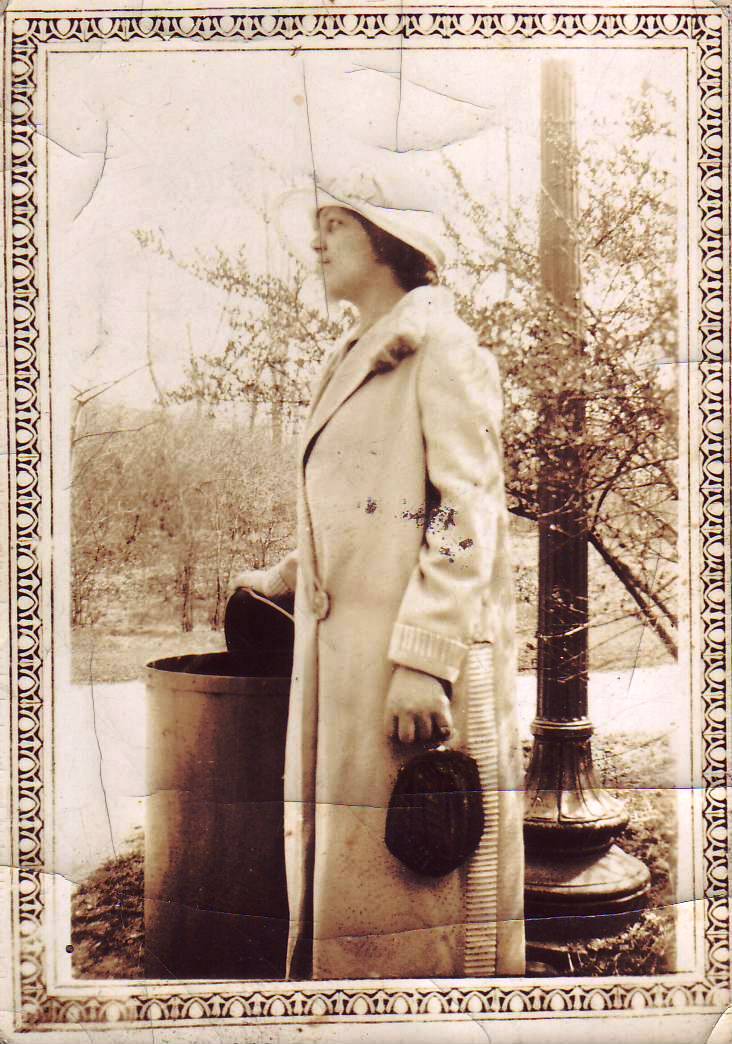
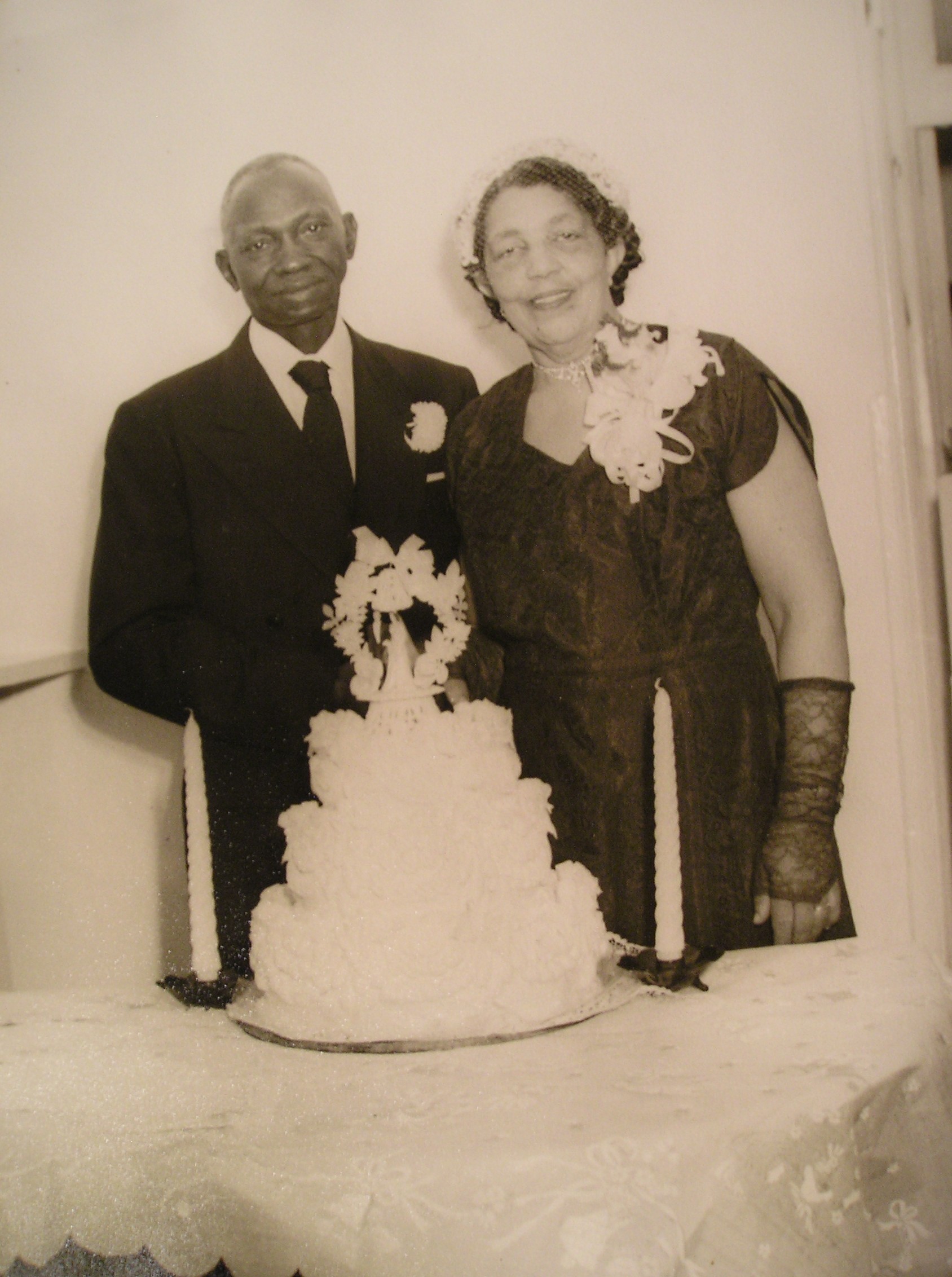
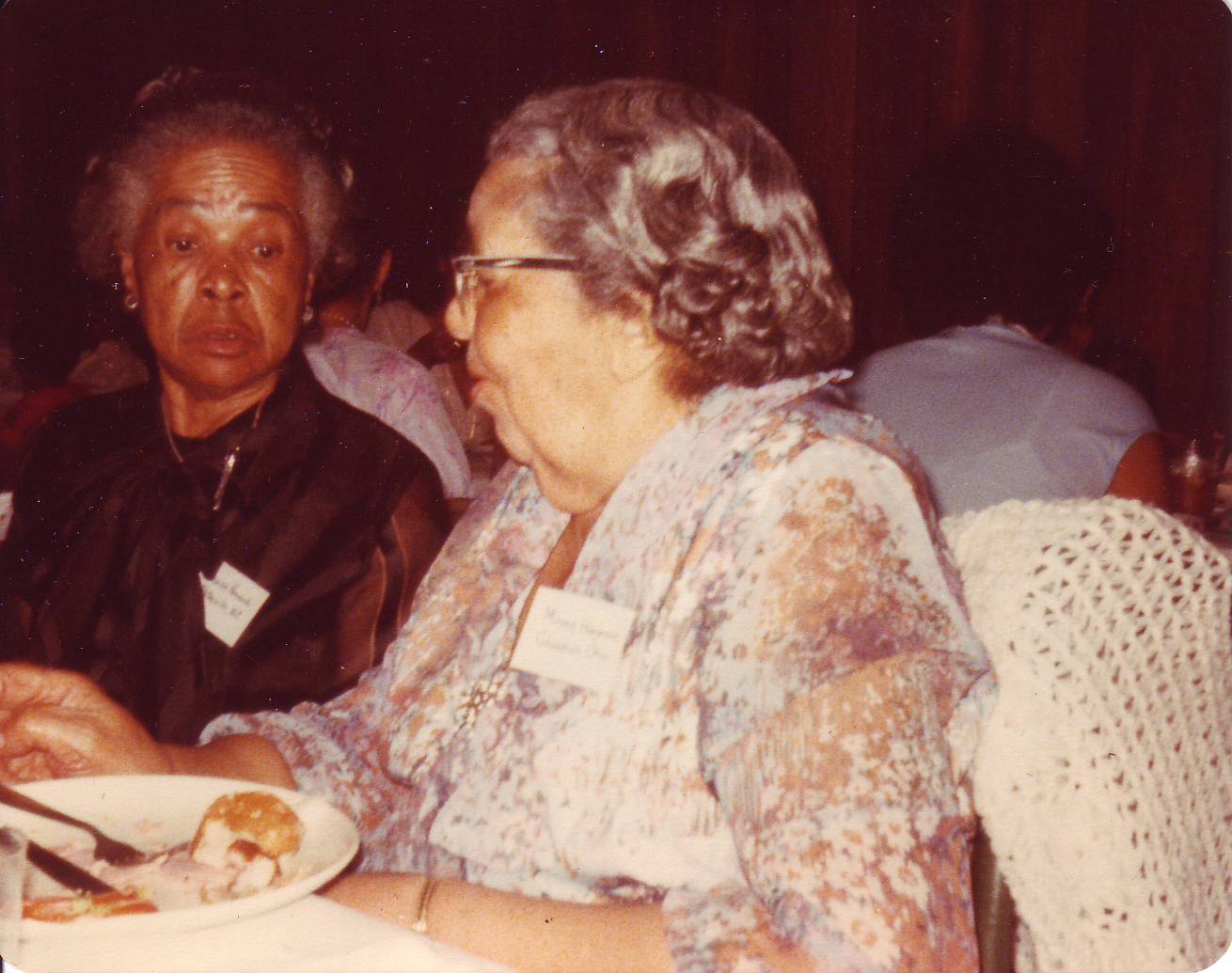
Remembering Mother Dear.

I had pneumonia twice.  The first day I went down to Graded School, that day it rained.  I come back – there was a hole in my shoe, and I slopped in all the water and got my feet wet.  That’s what Mama said, anyhow, and I taken with a fever.  

If I got wet – when I went to Graded School, it rained, and I slopped in all the water coming back from there.  Had a hole in my shoe.  Had pasteboard in there.  And then I’d go to sneezing and coughing.  And so Mama said, “You know you oughtn not to got wet!”  Well, how was I gon help from getting wet?  Had to come from school!  So that was the first year I went to school.  I remember that.  And I was sick that whole rest of the year.  I mean, wasn’t strong enough to go down to Graded School – she wouldn’t let me go down there.  So I stayed home, and Mama put all them old rags, that old flannel cloth, and she’d put it in red onions and hog lard.  And I had pneumonia.  And they was sitting up with me.  Said I hadn’t spoken in three days.  And so that old clock where Annie Bell took, it was up there on the mantel, it struck two o’clock.  Mama was sitting on one side of the stove, and Papa on the other.  So I said, when the clock struck, I said, “It’s two o’clock, ain’t it, Mama?”  And they thought I was dying.  So they had been sitting up with me.  So I think didn’t think nothing ‘bout it.  I went on back to sleep.  I didn’t know nothing ‘bout it.  Said I had double pneumonia.  So Mama got – honey, I had to wear a piece of cloth up here on my chest, one on the back, with Vick’s salve and hog grease or whatever that stuff was, mixed all up together and pinned it to my undershirt.  

And I thought about it, with Bessie dead — she died when I was eight months old.  And Mama Sarah took me as a baby and brought me to Wilson.  And I was the only child there.  Well, that’s how come, look like Papa, he felt sorry for me, I reckon.  Her husband did, and I called him the only Papa I knew.  So they all – I was always sickly and puny and: “Give her anything she wanted,” that’s what Dr. Williams – white doctor – so he said, “She can’t live nohow.”  And that’s when I had the pneumonia.  And so I didn’t want nothing but water.  So, “Well, give her all the water she want ‘cause she can’t live nohow.”  But I fooled ‘em!  Dr. Williams’ gone, Mama’s gone, all of ‘em, and I’m sitting right here!” 

IMG_2161

The mantel at 303 Elba Street, 2014.

And for most of my life, she was right there indeed. Every summer, when we drove up from North Carolina to spend a week with her in Philadelphia. Every winter, when she came down to spend the holidays with us and my aunt’s family and her sister. Later, when I was in law school and grad school, I spent my breaks with her, and I even lived with her a short bit when I moved to Philadelphia. I will regret till I’m gone that I did not visit her more often after I left, but when I did I had the good sense to record her stories. Her death was my first real loss, the one that broke the spell, and it pangs me almost as much now as it ever did. I miss this woman.
Image

Remembering Hattie Mae Henderson Ricks (6 June 1910-15 January 2001), my Mother Dear.

Standard
Births Deaths Marriages, Maternal Kin, Migration, North Carolina, Oral History, Photographs

Minnie Beulah McNeely Hargrove.

But there was Aunt Minnie, and then after Aunt Lethea died, Aunt Lethea told her to take care of me, and she just took me on, you know.  And she was always crazy about me.  The first percale sheets that I ever had Aunt Minnie sent them to me, and I never bought anything but percale sheets.  Boy, they were just so luxurious and so nice and everything.

Jay stayed with Aunt Min ‘cause Aunt Min reared him after Aunt Lethea died.  And he was at this same house with Aunt Minnie and Grandma.  Let’s see.  It was Aunt Min and Grandma and Uncle Luther and Jay and I.  We were all in the same house during the summer that I worked up there.

Ardeanur. And she had a brother named James.  And their mother died when they were little children, and Min reared them.  Reared the children.

——

Aunt Minnie, who had no children of her own, reared everyone’s. When her sister Addie McNeely Smith died in 1917, Minnie took responsibility for her children, Ardeanur and James. When sister Elethea McNeely Weaver died five years later, Minnie stepped in to care for her youngest boy, 11 year-old Irving “Jay” Weaver, and promised to keep an eye on Lethea’s favorite niece, my grandmother.

Aunt Min shared a home with her mother Martha Miller McNeely in Bayonne, New Jersey, and after her mother’s death, she and Ardeanur moved to Columbus, Ohio, to live near another sister, Janie McNeely Taylor. She was in her fifties when she defied her disapproving family and married John Hargrove. He did not live long to plague her, though, and in a reversal of roles, she spent her last years with Ardeanur.  Minnie Beulah McNeely Hargrove died 2 December 1982 in Columbus.  She was 93 years old.

Image

Above: Minnie hovering behind her flock. From left, a Murphy boy, Bertha Hart Murdock, Bertha’s cousin Alonzo Lord, Aunt Minnie, and Ardeanur Hart Smith, Statesville, circa 1920.

Image

Minnie in Bayonne, perhaps the late 1920s.

Image

Minnie in later years, Columbus, Ohio.

Image

Aunt Min marries John Hargrove, Columbus, early 1950s.

Image

Minnie McNeely Hargrove at the 1980 Colvert-McNeely family reunion, Newport News, Virginia. I was not there. At the time, I was too callow to know what I was missing. Today, I kick myself. I never met her.

Interview of Margaret C. Allen by Lisa Y. Henderson; all rights reserved.

Standard
Births Deaths Marriages, North Carolina, Paternal Kin, Photographs, Religion

Family cemeteries, no. 7: Turner Swamp Primitive Baptist Church.

Image

Rev. Jonah Williams once led the flock at Turner Swamp, and its cemetery is full of kin.

There’s Richard Artis (whose father Richard was Jonah’s — and my great-great-great-grandfather Adam Artis — brother) and his wife, Penny Coley Artis …

Image

… Richard’s brother John Henry Artis (1896-1963) and sister Emma Artis Reid (1877-1964) …

… and several of Richard and Penny’s children, including Alfonza Artis (1908-1948), C. Columbus Artis (1910-1985), Louis D. Artis (1916-1983), Jonah Artis (1918-1966) and Jesse L. Artis (1919-1960) …

… and Magnolia Artis Reid (1871-1939), daughter of Richard and Jonah’s sister Loumiza Artis Artis (wife of  Thomas Artis, no kin);

… and descendants of Adam, Richard, Jonah and Loumiza’s sister Zilpha Artis Wilson, wife of John Wilson, including her daughter Elizabeth Wilson Reid‘s children Milton C. Reid (1890-1961) and Iantha Reid Braswell (1893-1955) …

Nora Artis Reid (1894-1965), who was married to her cousin Milton Reid and was the daughter of Adam Artis’ son Noah Artis, and …

… even Wade Ashley Locus (1897-1945), a distant Seaberry relative of Adam’s wife Frances Seaberry Artis.

Photos taken by Lisa Y. Henderson, December 2013.

Standard
Births Deaths Marriages, Free People of Color, Migration, North Carolina, Other Documents, Paternal Kin

Misinformation Monday, no. 5.

The fifth in a series of posts revealing the fallability of records, even “official” ones.

——

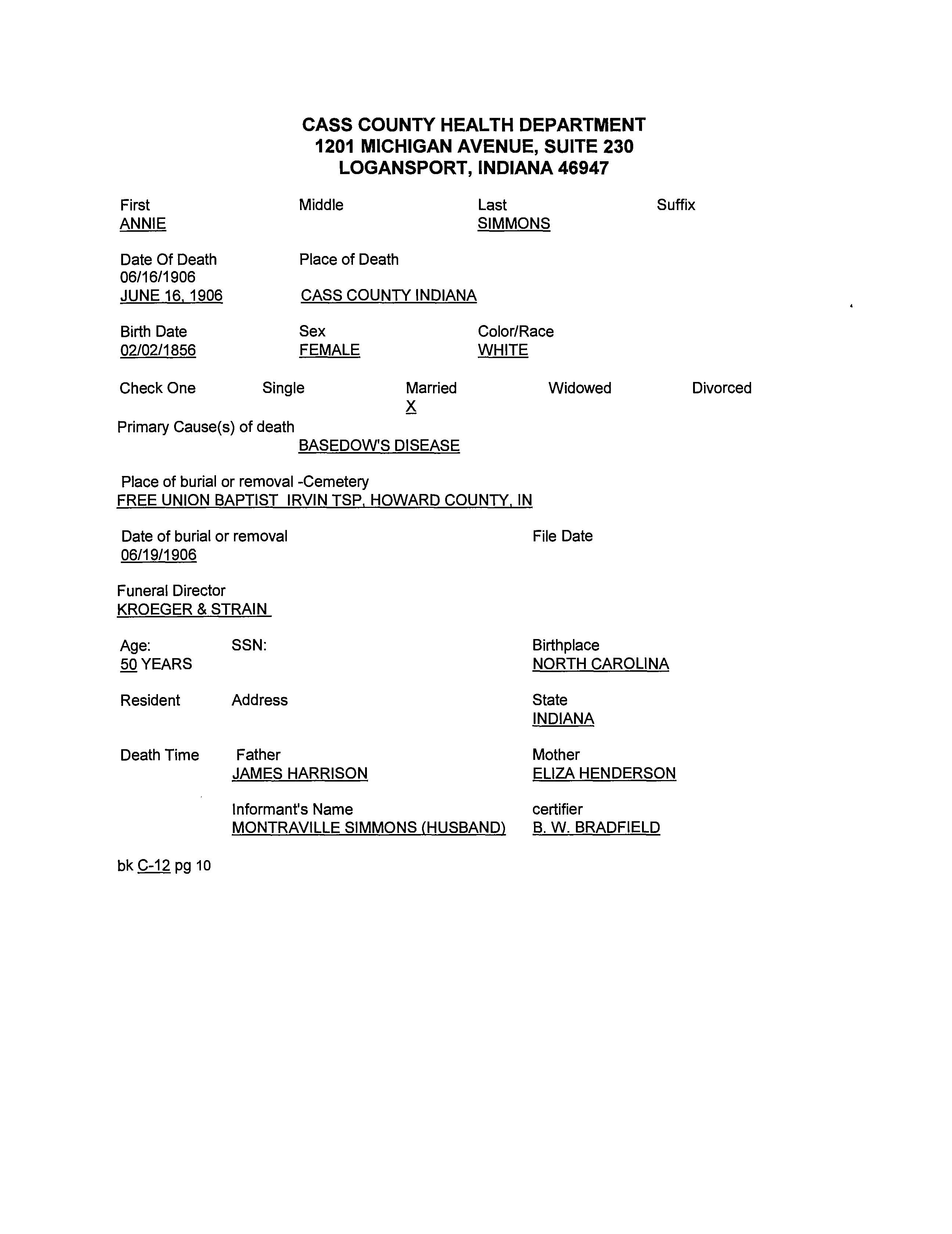
HENDERSON_--_Annie_Simmons_Death_Cert

What’s right with this death certificate? Annie Simmons‘ name — more or less, as she seems to have been called Anna in her youth. Presumably, her date and place of death. Her birthday may be right, though the birth year is probably three or four years late. She was certainly female.

But she was not white.

Annie Simmons was mixed-race, described as “mulatto” in early life and “colored” (and even “African”) thereafter. She is consistently classified in census records in two states (North Carolina and Indiana) and a province (Ontario), as well as her marriage license. The local newspaper avidly carried news of her husband Montraville Simmons’ antics and was quick to point out his non-white status.  (She was certainly married, if unhappily.)

(By the way, Basedow’s disease is more commonly known as Graves’ disease, or hyperthyroidism.)

Annie was probably 54, rather than 50, and she was certainly born in North Carolina, but not to “James Harrison” and “Eliza Henderson.” Rather, as is clearly set forth in her application for a marriage license in Duplin County NC, her parents were James Henderson and Eliza Armwood. Montraville Simmons probably had not seen his in-laws in more than 40 years when he gave this information. His errors are perhaps excusable, but there they are, enshrined as “fact” and forever leading researchers astray.

Standard
Births Deaths Marriages, Migration, North Carolina, Paternal Kin, Photographs

Funeral Program Friday: Fannie Aldridge Randolph.

FP Fannie Randolph Phila PA 1_Page_1

FP Fannie Randolph Phila PA 1_Page_2

For reasons that aren’t clear to me, the Aldridges that my grandmother was closest to in her adult life were two of her father’s first cousins, daughters of  Matthew W. Aldridge, Fannie Aldridge Randolph and Mamie Aldridge Abrams Rochelle. They grew up in Goldsboro, not Dudley, and both migrated North before 1930, so I am guessing that she met them after she moved to Philadelphia in 1958.

I wish I’d probed these relationships more. Mother Dear and Cousin Fannie lived a short bus ride apart in West Philadelphia and saw each often enough that I recall visiting her house on Filbert Street and seeing her at my grandmother’s on Wyalusing during our short summer stays. I never met Cousin Mamie, but know that my grandmother visited her in Union, South Carolina, and took at least one sightseeing trip (“excursion,” as she called them) with her.

Fannie B. Aldridge left Goldsboro for Philadelphia shortly after the 1910 census was recorded. In 1913, she married Virginia-born Elisha Randolph (1875-1940) and, by 1917, when he registered for the draft, had settled into the rowhouse in the 5800 block of Filbert Street in which she would remain the rest of her life.

Here is a bad partial copy of a photograph of Matthew Aldridge’s daughters. Fannie is at right, standing behind one of her nieces.  The boy in the middle, I believe, was Elijah Randolph, her only child. Her sisters Daisy Aldridge Williams and Mamie are left and center.

Daisy Mamie Fannie Aldridge & children

And here’s Cousin Fannie as I vaguely remember her. This Polaroid dates from about 1973 and was taken in my grandmother’s kitchen. (That’s Mother Dear at right.)

Fannie Aldridge Randolph & Hattie Ricks

Standard
Births Deaths Marriages, Letters, Migration, North Carolina, Paternal Kin

I guess this is what I was going to hear.

Sunday Jan. 9. 38

My Dear Hattie

I received your telegram to-day.  1 P.M.  it was certainly a shock to me you & family certainly have my deepest sympathy & also from my family.

I did not know your mother was sick you must write later and let me know about her illness.

It is so strange I have been dreaming of my husband Caswell so much for the past two weeks he always tells me that has something to tell me & that he feels so well so I guess this is what I was going to hear about your mother.

I wish it was so that I could come to you & family but times are so different now seems as if we cannot be prepared to meet emergencies any more but you must know that my heart & love is with you & family.

I am just writing to you a short note now will write you again.  Let me hear from you when you get time to write

From

Your aunt in law

Carrie L. Borrero

322 E. 100th St.  N. Y City

——

There is no envelope with this letter, which I found after my grandmother’s death in 2001. Carrie Borrero was Caswell C. Henderson’s second wife.  My grandmother never mentioned Carrie traveling to Wilson when Caswell visited, though she seems to have met her at least once during a visit to New York.

Standard
Births Deaths Marriages, North Carolina, Oral History, Paternal Kin, Photographs

Is Mama dead let me know at once.

Mama got sick after we come back from Greensboro.  She got sick.  At least, Mama, we never could tell when she was sick.  ‘Cause she put on so much.  If she wanted to go somewhere – go to New York, Norfolk, anywhere she could get, pack that bag, honey, and she’s gone.  And leave us home!  Leave us there.  She took me to New York with her, and she carried Mamie to Norfolk, carried me to Norfolk one time, then she carried Mamie there.  Oh, she was just always wanting to go.  And Papa didn’t have enough sense, but just wherever she said she was going, she was going, and he give her the money and she’d go. 

But Mama didn’t know she had a bad heart until two weeks before she died.  She was always sick, sick all the time.  She’d go to the doctor, and the doctor would tell her it was indigestion and for her not to eat no pork and different things she couldn’t eat.  ‘Cause Mama was fat.  She weighed 200.  She wasn’t too short.  She was just broad.  Well, she was five-feet-four, I think.  Something like that.  And so, but she loved pork, and she’d try to eat some anyhow ‘cause we always had a hog, growing up.  All the time.  So after they said she couldn’t, she tried not to eat no pork, much.  Fish and chicken, we eat it all the time.  But she was so tired of chicken until she didn’t know what to do.  And I was, too.  But Papa loved all pork, so he’d always get a whole half a shoulder or a ham or something and cook it, and she’d eat some.  But when she went to the doctor, and her pressure was up so high, and he told her, “By all means, don’t you eat no pork.  It’s dangerous to eat pork when your pressure is too high.”  And then that’s when she stopped eating pork.  Well, it didn’t help none, I don’t reckon. 

After that, when she was going to Mamie’s, she had that little bag.  A little basket.  A little, old basket ‘bout that tall with a handle on it.  She had all kinds of medicine in there to take.  And Mr. Silver told her, said, “Well, you just take your medicine bag.”  She’d been married to him a good while.  He said, “Well, you shouldn’t go up there by yourself.  Since I’m down here—”  See, she’d go up and stay with him a little while, and then he’d come back to Wilson and stay a while.  So he said, “You just take your little basket there with your medicine in it.”  So, he said, “Well, I’ll go with you up there and then I’ll come back on to Enfield.”  So he went with her down there to the station.  He was picking up the bags to go up there, told her to walk on up to the station and wait for the train.  

So, she went up there to the station and got on there, and went on and got on the train, and when she got off the train, in Selma —  ‘cause she’d done told me to send her insurance and everything to Greensboro, ‘cause she wont never coming back to Wilson no more.  Because she’d done seen, the Lord showed her if she stayed in Wilson, she wouldn’t live.  If she went ‘way from there, she could get well.  So she was going to Mamie’s.  And when she got off the train and went there – she’d just got to the station door.  And she collapsed right there.  And by happen they had a wheelchair, a luggage thing or something.  The guy out there, he got to her, and he called the coroner or somebody, but he was some time getting there.  But anyway, they picked her up and sat her in the wheelchair.  They didn’t want her to be out ‘cause everybody was out looking and carrying on, so they just pushed her ‘round there to the baggage room. 

And so when the coroner got there, he said, “This woman’s dead.”  So they called Albert Gay, and he was working for Artis then.  Undertaker Artis.  And Jimbo Barnes.  And called them and told them that she was dead.  So, Mr. Silver couldn’t even tell them who to notify. He had Mamie living in Thelma, North Carolina, on McCullough Street, but didn’t know what the number of the house was.  So he was so upset. So they had to call the police for the police to go find Mamie Holt.  On McCullough Street.  And her mother, they said, her mother died. Well, she did die.  But they said it was, I think, Thelma.  Not Selma, but Thelma.  “Well, where is Thelma?  It can’t be my mother. ‘Cause my mother don’t live in no Thelma.  I never heard of that place.  She live in Wilson.” But, see, it was Selma where she died. They got it wrong. 

So then Mamie went down to Smitty’s house and had Miss Smitty send a telegram to me.  On the phone.  Charge it to her bill, and she’d pay her: “IS MAMA DEAD LET ME KNOW AT ONCE”   She asked me if Mama was dead.  And I said, when I got that, Annie Miriam and all them, a bunch of kids was out there on the porch, and so at that time, Jimbo or one of ‘em come up.  And when I saw them, I knowed something.  I had just got the telegram.  Hadn’t even really got time to read it.  Had just read it.  And he said, “Well, you done got the news.”  And I said, “The news?  Well, I got a old, crazy telegram here from my sister, asking me is Mama dead, let her know at once.”  He said, “Yeah, we just, we brought her back from Selma.”  I said, “What in the – ”  Well, I went to crying.  And I don’t know.  Albert Gay or some of the children was ‘round there, and they was running.  Everybody in the whole street almost was out in the yard – the children got the news and gone!  That Mama had dropped dead in Selma.  So I said, well, by getting that telegram, I said, that’s what threw me, honey.  I wasn’t ready for that. I’d been saying I reckon Mamie’ll think Mama was a ghost when she come walking in there tonight.  Not knowing she was dead right at the same time. 

Evangelist

Remembering Sarah Henderson Jacobs Silver on the 76th anniversary of her death.

——

Interview of Hattie Henderson Ricks by Lisa Y. Henderson; all rights reserved. Photo in the collection of Lisa Y. Henderson.

Standard
Births Deaths Marriages, Land, Maternal Kin, North Carolina, Other Documents, Rights

Murdock v. Deal, 208 N.C. 754, 182 S.E. 466 (1935).

In case you’re interested, here’s the text of the Supreme Court’s decision regarding Bertha Hart Murdock’s land. Property law is not my strong suit, especially as it applies to inheritance, so I will not attempt an explication.

——

This is an action for a declaratory judgment construing the last will and testament of T. L. Hart, deceased, and adjudging that by virtue of said last will and testament the feme plaintiff is the owner of an indefeasible estate in fee simple in certain lands described in the complaint, and has the power, with the joinder of her husband, to convey the same in accordance with her contract with the defendant.

The facts admitted in the pleadings are as follows:

T. L. Hart died in Iredell county, N. C., during the year 1930, having first made and published his last will and testament, which was duly probated by the clerk of the superior court of Iredell county, and recorded in the office of said clerk on June 4, 1930.

By his last will and testament, the said T. L. Hart devised his home place in Iredell county “to my daughter, Bertha May Hart and her bodily heirs, forever, never to be sold, and if she dies without bodily heirs, then it must be in trust for my sisters’ heirs, to hold but never to sell the same.”

By a codicil to his said last will and testament, the said T. L. Hart devised to his daughter, Bertha Mae Hart, a tract of land in Iredell county, containing forty-five acres, and described in the complaint by metes and bounds.

At his death, T. L. Hart left surviving as his only heir at law his daughter, Bertha Mae Hart, who has since intermarried with the plaintiff W. J. Murdock. He also left surviving five sisters, three of whom are married. Each of these sisters has children. Neither of his two unmarried sisters has children. Both are now over fifty years of age.

On April 1, 1935, the plaintiffs and the defendant entered into a contract in writing, by which the plaintiffs agreed to convey to the defendant a fee-simple estate, free and clear of all liens or incumbrances, in two tracts of land, one tract containing twelve acres, and being a part of the home place of T. L. Hart, deceased, which was devised to the feme plaintiff by the said T. L. Hart in his last will and testament, and the other tract containing forty-five acres and being the tract which was devised to the feme plaintiff by T. L. Hart, deceased, by the codicil to his last will and testament. By said contract, the defendant agreed to pay to the plaintiffs the sum of $1,000, upon the execution and delivery to him by the plaintiffs of a deed conveying both said tracts of land to the defendant, in fee simple, in accordance with said contract.

The defendant has refused to accept the deed tendered to him by the plaintiffs, and has declined to pay the plaintiffs the sum of $1,000, in accordance with said contract, on the ground that the feme plaintiff is not the owner of an indefeasible estate in fee simple in said tracts of land, and for that reason the plaintiffs cannot convey to him such an estate in said lands, in accordance with their contract.

On these facts the court was of opinion and so held that the feme plaintiff is the owner of an indefeasible estate in fee simple in the forty-five-acre tract, but that she is not the owner of such an estate in the twelve-acre tract.

It was accordingly ordered, considered, and adjudged that plaintiffs are not entitled to the specific performance by the defendant of the contract set up in the complaint, and that the defendant recover of the plaintiffs the costs of the action. The plaintiffs appealed to the Supreme Court, assigning as error the holding of the court that the feme plaintiff is not the owner of an indefeasible estate in fee simple in the twelve-acre tract described in the complaint.

Opinion

CONNOR, Justice.

There is no error in the judgment in this action. By virtue of the last will and testament of her father, T. L. Hart, deceased, and under the statute, C. S. § 1734, the feme plaintiff is the owner of an estate in fee simple in the twelve-acre tract described in the complaint. This estate, however, is defeasible upon the death of the feme plaintiff without bodily heirs. Whitfield v. Garris, 131 N. C. 148, 42 S. E. 568, and Id., 134 N. C. 24, 45 S. E. 904. It is clear that the words “bodily heirs,” used by the testator, must be construed as meaning children or issue; otherwise the limitation over to the heirs of the sisters of the testator would be meaningless. Rollins v. Keel, 115 N. C. 68, 20 S. E. 209. See Pugh v. Allen, 179 N. C. 307, 102 S. E. 394.

The limitation over to the heirs of the sisters of the testator, upon the death of the feme plaintiff, without bodily heirs or issue, is not void. The provision in the will that the home place of the testator, which includes the twelve-acre tract described in the complaint, shall not be sold by either the feme plaintiff or the remaindermen is void as against public policy. This provision, however, does not affect the validity of the devise either to the plaintiff or to the remaindermen. See Lee v. Oates, 171 N. C. 717, 88 S. E. 889, Ann. Cas. 1917A, 514.

There is nothing in the codicil which affects the estate in the home place of the testator devised in the will to the feme plaintiff.

The judgment is affirmed.

Standard
Births Deaths Marriages, Free People of Color, North Carolina, Paternal Kin

Misinformation Monday, no. 4.

The fourth in a series of posts revealing the fallability of records, even “official” ones.

——

Margaret Henderson‘s maiden name was Balkcum. I think. I wouldn’t go so far as to describe this as a “true fact,” but I stand by my theory about it. Getting to it, however, means reconciling a tilting plane of evidence (and lack thereof):

1. Margaret does not appear in the 1850 census under any name.

2. Nancy Balkcum of Sampson County NC lists a daughter Margaret Balkcum in her will. For reasons set forth here, I believe this was my Margaret.

2. No marriage license for Lewis and Margaret Henderson has been found.

3. Son Caswell Henderson‘s marriage license, issued in New York City in 1907, reports his mother’s name as Margaret Balkcum.

4. Margaret’s own 1915 death certificate, issued in Wayne County NC, lists her mother as Margaret Bowkin and her birthplace as Sampson County. Son Lucian Henderson was the informant, and I suspect he gave his own mother’s name in response to a query, rather than his mother’s mother’s. It’s a mistake I’ve seen before. But “Bowkin” is nicely evocative of “Balkcum,” and I believe that’s what he meant.

5. Lucian Henderson died in 1934 in Wayne County NC. His death cert lists his mother as Margaret Hill.  Hill???  Johnny Carter was the informant. Johnny was not a blood relative, though his maternal uncle Jesse Jacobs married Lucian’s sister Sarah Henderson. Lucian’s only child died young, and Johnny cared for him in his dotage. He left his estate to Johnny Carter, but I have no reason to believe that Johnny had any certain knowledge of Lucian’s mother’s maiden name.

6. Daughter Sarah Henderson Jacobs Silver, the last surviving child, died in 1938 while traveling from Wilson to Greensboro NC. Her death certificate names her mother as Margaret Carter. My grandmother Hattie Henderson Jacobs is listed as the informant. When I asked her about it, she had no independent recollection of being asked anything. She averred that she didn’t know Grandma Mag’s maiden name and certainly would not have told anyone that it was “Carter.” (She knew Johnny Carter’s family very well, but regarded them as Papa Jesse’s people.)

Margaret Henderson is a case in point.  One should regard early death certificates with skepticism. They are no stronger — or more accurate — than the informant’s personal knowledge, and the source of the informant’s knowledge was not questioned.  The two bits of evidence from Mag’s own sons, Caswell and Lucian, are fairly consistent, but reports originating beyond their generation diverge widely. The death certs of Mag and her children reflect what people thought they knew, or had heard, or maybe even made up, about Mag’s early life. They are useful — but flawed.

Standard
Births Deaths Marriages, Free People of Color, Migration, North Carolina, Other Documents, Paternal Kin, Photographs

The Randalls of Washington DC.

fannie-a-randall  George Randall

On 18 Dec 1890, Fannie Aldridge married Robert Locust in the presence of her sister Lizzie Aldridge, brother M.W. Aldridge, and Robert’s neighbor George W. Reid. Robert’s first wife, Emma Artis, had died the previous year, and it is likely that he met Fannie, who lived at the other end of Wayne County, through her family. Fannie’s sister Amanda was married to Emma’s father Adam T. Artis, and her brother John was married to Emma’s sister Louvicey Artis.

Fannie and Robert’s first two children, William Hardy and Fred Robert, were born in Wayne County. Circa 1895, the family left North Carolina for Washington DC after– it is said —  Robert and a couple of Fannie’s relatives were involved in the murder of a white man. By time Robert, Fannie, his older daughters, and their boys arrived in DC, they were no longer Locusts. Robert, in fact, assumed a whole new name, and was George R. Randall ever after. According to their grandson, in order to collect Fannie’s inheritance when her father’s estate settled in 1902, the couple had to cross over into Alexandria, Virginia, where they were not known and could safely sign documents as Robert and Fannie Locust.

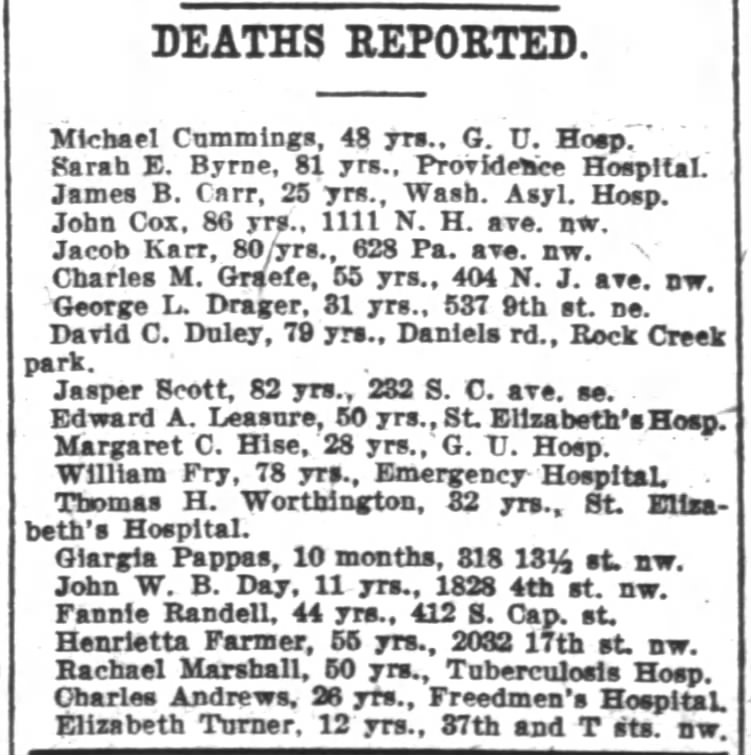
The 1900 and 1910 censuses recorded the family at 1238 Madison, then 138 B Street (no quadrant designated.) On 20 March 1917, Fannie “Randell” of 412 South Capitol Street was dead of heart disease. She was 44.

Wash Post 3 24 1917Washington Post, 24 March 1917.

In their 20 years in DC, she and Robert/George had been able to usher their children along the path to the middle class. Hardy Randall (1891-1967) went to work for the United States Postal Service. Fred R. Randall (1894-1996), a high school football standout, was a parks director. We met decorated officer Oscar Randall (1896-1985) here. Fannie Randall Dorsey (1900-1994) taught school, as did her sister Arnetta Randall (1904-1993). Edna Randall Breedlove (1909-1990) did not work after her marriage to Jesse Breedlove. George Randall died in infancy, as did two unnamed brothers.

Standard