Births Deaths Marriages, Maternal Kin, Oral History, Photographs, Virginia, Vocation

He designed every house he built.

About ten years ago, when we were all in Newport News for a family reunion, I asked my uncle to take us on a tour of houses our grandfather built.

——

He designed every house he built. And there were a couple he designed that he didn’t build. I’ll show you those, too. One of them, he really hated to lose. That was a, Dr. Woodard was a dentist. I mean, a pharmacist. And so, he – that was one of the lots that Daddy had sold, and so I think Daddy was a little ticked with the guy. He sold him the lot and designed the house, then the man went to another contractor. But you know what was interesting at that time? There were about five or six good general contractors around, you know, that did small buildings. And Daddy was one of those, but these guys were pretty competitive. They had a decent market. Daddy built an average of about a house a year, I guess. The war cut him off, you know. He had to get reestablished after the war. But he had a friend named Buster Reynolds. And Buster Reynolds was reputed to have made his money in the numbers, and so when the numbers were getting real hot and heavy, when it was reputed that the Mafia was trying to take the numbers over, Buster got out. And he built this service station, and he had a Texaco franchise, and he had Daddy to build the station. And Texaco liked the work so much that Daddy built two more stations for Texaco. And both of the stations that were built in the black community are still up. They’re not gas stations anymore, but the buildings are still up. And the one that was built Overtown is gone. But even the station that was in the white community Texaco had him to build that one, too. And with the money Daddy bought – I’ll never forget – he bought an International truck, great big truck, to carry his materials around.

Texaco 2

——

… the churches that he used to do expansions and modernizations on all the time, but I know one of ‘em is gone, and I don’t know where the other one is. I know the one – he used to take me down to that one from time to time. But I don’t know where they are now. The thing he did throughout all of these communities – he had a strong maintenance clientele, but Daddy was a – you see these cabinet shops now? Well, Daddy used to make, put in new cabinet work in people’s kitchens for them. And, so, that’s what carried him through the winter. ‘Cause he would also do designs and drawings for other contractors. Like Jimmy’s daddy. Mr. Scott. He used to do most of their design work, he’d sit there and draw those drawings for them. But that’s what got him through the winter. That and he used to do a lot of maintenance. Put in new windows, cabinet work, doors. Put little small additions to houses. But that was generally for a white clientele. He used to do a lot of work for the shipyard management people up in North Huntington Heights.

——

This house Daddy was building when he died. He was building it for a family named Kramer. A white family. See the one with the little entrance and the white wrought iron?

House 1

1316 – 22nd Street

——

The 800 block of Hampton Avenue, this is where Daddy owned those lots. Slow down … this house right here. This tan house. 855. This house was built at that time for the Tynes family, which owned a very nice house and property up in the next block.

Hampton Avenue 1

855 Hampton Avenue

But the Tynes family ran into some – I guess it was financial difficulty. Anyway, that house was sold to Wendell Walker, who was a lawyer and a part of the Walker family. You know his father was a lawyer, who was William. And his son William jr. is Howard Walker’s father, who was my classmate. And then there were, like, four sons and a daughter, I believe it was. Three of ‘em were lawyers, and then Wendell and Phillip were lawyers. The son William was an engineer, but when he came back home, he was manager of Aberdeen. He went into real estate and insurance. Daddy sold him the lot, designed and built the house.

——

Hampton Avenue 3.1

819 Hampton Avenue

Let me tell you about this house right here. This house was the undoing. This house was built for his friend Leroy Ridley. And there were, I think, four lots – four or three lots. Leroy Ridley was the son of John Ridley, who founded Crown Savings Bank with Pa Pa Allen. Okay? But he became – one of the Ridley sons, he became the one who took over the bank. And the man turned out to be not the most moral and forthright businessman. He talked into Daddy into $5000 worth of extras in this house, which was almost the same size as the house. And then when it came time to close the deal, he refused to pay Daddy because he said Daddy had not duly executed the extensions in the contract to do that. And not only that – Daddy had borrowed money from his bank. The long and short of the story is the last of that was paid when Pa Pa’s estate was executed [in 1961, 13 years after John Allen’s death.] We told Mother to pay that loan off ‘cause she still owed a thousand dollars. But this house turned out to be what kept Daddy from building Mama her house. ‘Cause he was gon build it on another lot. See? But when he got caught in that deal, then he couldn’t. So then he had to sell off all the lots that he had for houses, okay? So that’s when he sold this lot – the Woodard lot. And designed that house for Dr. Woodard.

Me: This incredible – this house right here?

My uncle: Yes. That’s Daddy’s design.

My cousin, J: Wow!

Me: Sheeze. Oh, my God.

He did not do it. He designed it. Okay. See, this was an extra lot. This is another one of the large lots he had. You see what I’m saying? And this house was across the street, that was his pride and joy. That was a Cape Cod. But I’m saying, the Ridley house was a fantastic house. I mean, you know, the design was great, but anyway, so this was done for his buddy Picott. Mr. Picott. He was president — well, he wasn’t president – yes, well, he was, of Virginia Education Association, which was the black unit of the National Education Association. He was one of the guys who lost their jobs over the equal rights fight with Mr. Palmer for black teachers to have equal pay. And he left and moved to Richmond, and that’s when he sold his house. But that was a beautiful home. Solid oak floors, cabinetry that Daddy built. All of that, that house. But that’s the thing that – she won’t talk about it too much – but that’s the thing that really embittered Mother, was when she lost the opportunity to build her house because of that deal.

Hampton Avenue 2

816 Hampton Avenue

——

2107 Marshall Ave

2107 Marshall Avenue, my great-grandparents’ house.

You know, he did all that for his father. He put the addition – designed that addition to go on the back. Right behind the bathroom window. Okay, that’s where the bathroom was. And then Daddy designed and started that addition for the house. And that’s when he went to the Army. And they put that addition up there so – so the bottom addition was the barbershop, remember? You remember the beauty shop? Yeah, the bottom addition was the beauty shop, and the upper addition was the bedroom for Aunt Nita for the war. Pa Pa did that for his children.

——

House 3

3105 [I didn’t note the street name]

On the corner here, similar to the Kramer house. Designed it and built it. That was done for Dr. Fultz, who was a dentist. Actually, he was the school dentist. He built 3015. This at that time was a predominantly white neighborhood. Yeah, that’s the house. See that little carpentry he did? Those little arched doorways? That’s the original wood. That’s Daddy’s work.

——

Remembering John Christopher Allen, Jr., carpenter, draftsman, builder, contractor, father of five, grandfather of eight, great-grandfather of six, born 107 years ago today.

—–

Interview by Lisa Y. Henderson; all rights reserved. Photos taken by Lisa Y. Henderson, 2002.

Standard
Births Deaths Marriages, Other Documents, Paternal Kin, Photographs

Funeral Program Friday: Bessie Henderson Smith.

Bessie Henderson schoolgirlBessie, aged about 12.

Jack Henderson named his first child, born 24 September 1917, after his sister Bessie Lee Henderson. In the early years of World War II, she and her only child moved from Wilson to Baltimore, where she lived for 54 years.

zeke & bessieCousin Bessie, right, with her sister Alice Henderson Mabin on the porch of their sister Mildred Henderson Hall in Wilson, 1986.

FP Besse H Smith_Page_1FP Besse H Smith_Page_2

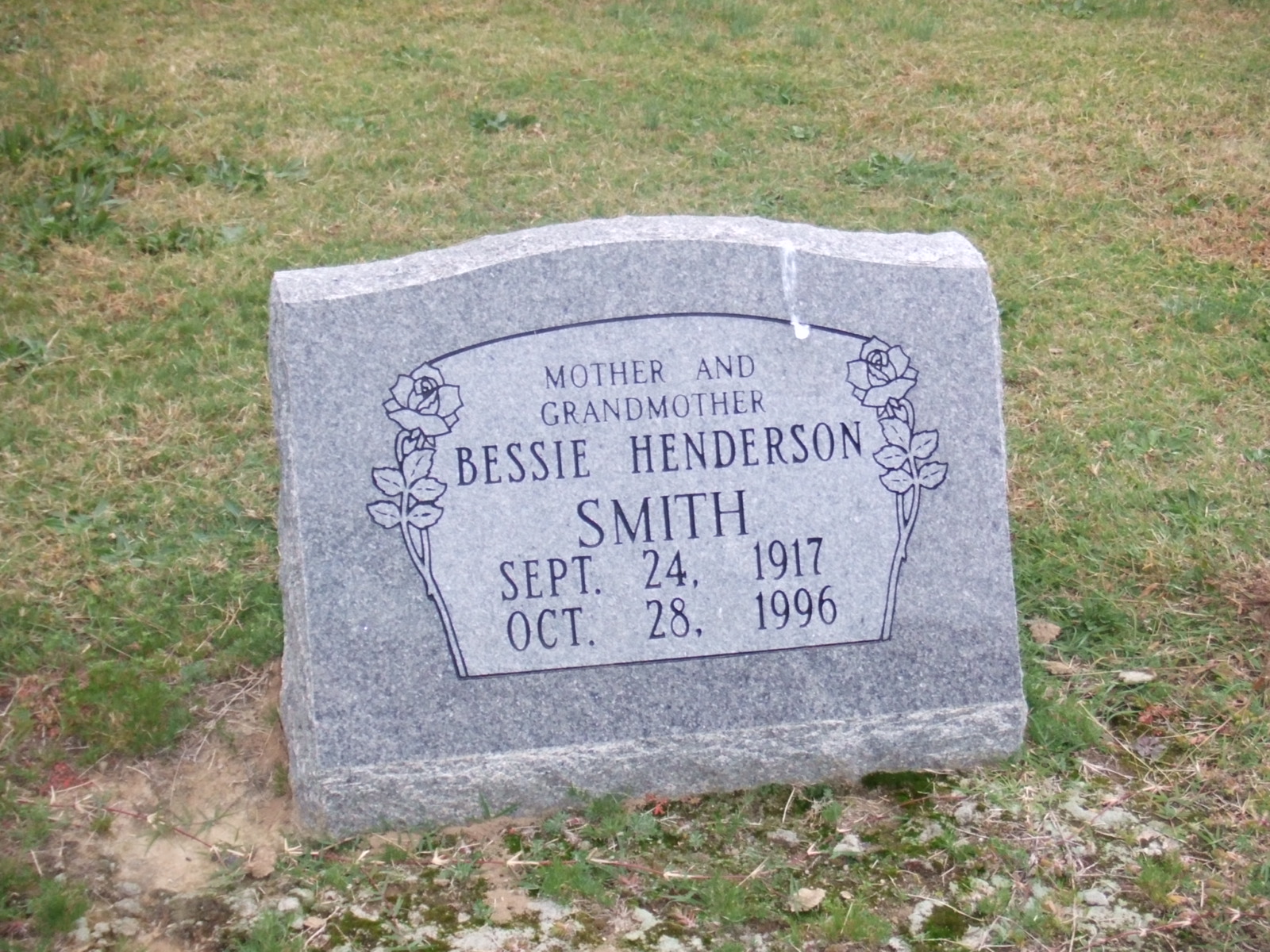
Cousin Bessie is buried in Rest Haven cemetery, Wilson NC.

Bessie H Smith headstone

Standard
Births Deaths Marriages, North Carolina, Paternal Kin, Photographs

Remembering Jesse Lee.

My Aunt Mamie had two handsome boys. John‘s birthday was last week. Jesse Lee‘s would have been today.

Image

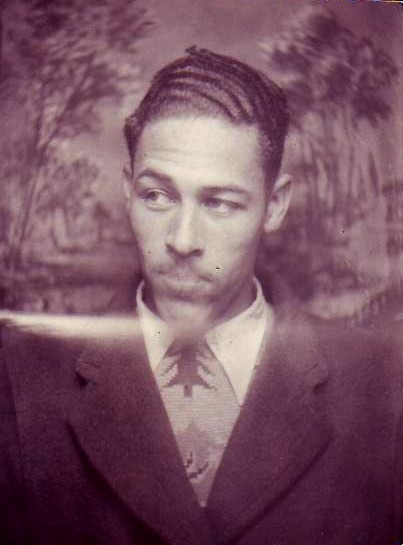
Jesse Lee was a quiet, brown-eyed, blunt-featured version of his brother. Together, they were beautiful.

Image Happy birthday, Jesse Lee Holt (11 December 1927-27 May 1993).

——

Photographs (or copies) in the possession of Lisa Y. Henderson.

Standard
Births Deaths Marriages, Paternal Kin, Photographs

Family cemeteries, no. 2: Artis & Bunch.

Image

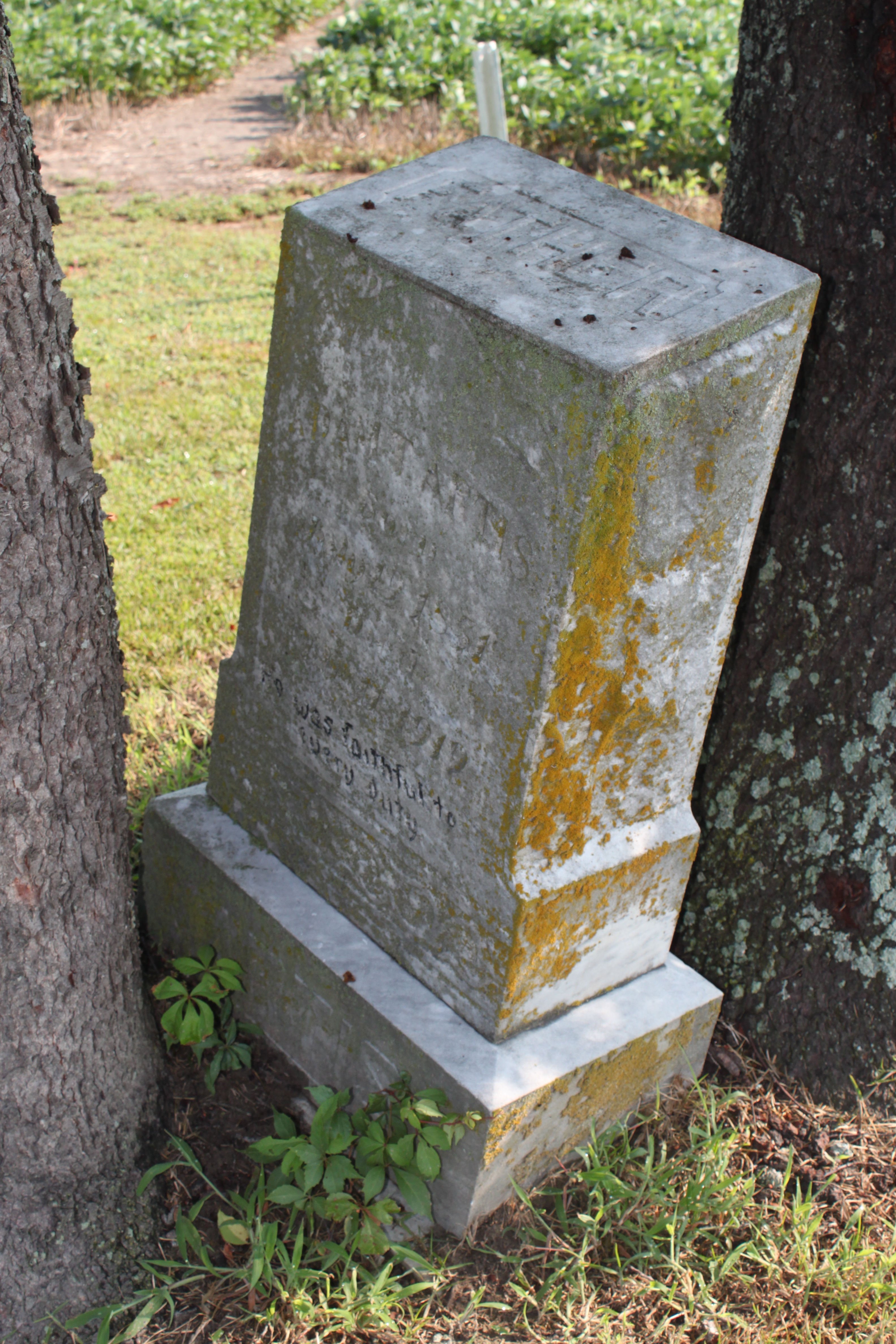
The small “Artis & Bunch” cemetery is located on Highway 222 East in Wayne County between Stantonsburg and Eureka NC on land still owned and occupied by Adam’s descendants. There are several graves, including those of Adam T. Artis (9 July 1831-11 February 1919) and his granddaughters Odessa Artis Baker and Esther Artis Bunch. (Apparently, none of Adam’s wives are buried with him.)

Image

——

Photographs taken by Lisa Y. Henderson, 2010.

Standard
Births Deaths Marriages, Paternal Kin, Photographs

Happy birthday, John J. Holt.

My grandmother said:

Papa closed John up in the couch.  Closed up the davenport on him. Just by it — he was grunting or groaning for breath or something.  I went out to see what it was, coming from out of the kitchen and dining room where he was in that room across the hall on that open couch.  That’s where Papa was looking his old shoes or something to put on, and he went there and turned up the end of that thing.  If he had shut him up in there, it’d a killed him, but he just turned up the end of it.  And he didn’t see his shoes, so he come on out.  And we heard this noise – “nyyyaaa-nya, nyyyaaa-nya.”  And we looked in and saw that thing turned up, and Mamie run in there and grabbed him, she grabbed up John and, oh, she was shaking and shaking and shaking, crying, and I was crying ‘cause I thought he had killed him.  So we had him up by the arms, just holding him, just fanning him and fanning him and fanning him, and I was just scared he was gon die.  You never know.  And so after that Mamie said, “Let me get out of here.”  ‘Cause you know Mamie and Papa didn’t get along – and she said that he was trying to kill her child.  Papa, well, he didn’t know what he’d done.  And he was sorry.  He said he was so sorry it happened, he wouldn’t hurt that child for nothing in the world.  And he was just crazy ‘bout John.  But Mamie left there that night, honey.  She left there with that baby, and she said, “I don’t know when I’ll be back here.”  So I got after Papa ‘bout it.  And he said he didn’t know the baby was in there.  He wouldn’t hurt that baby for nothing.  And so Annie Bell, she heard about it, and she come over there and laid Papa out.  He said he didn’t know the child was there.  He said, “Well, y’all ought to have taken up the bed when you got out.”  But the child was in there still sleep.  “But take him up and put him in another room.”  Not put him in that thing so he couldn’t get out.  So Mamie left there and went on back to Greensboro, and she didn’t never like Papa after that.  She didn’t like him no how.  Yeah, she just felt like he did it for meanness, but he didn’t.  Then Mamie said, well, she know he was getting old, and so she forgive him ‘cause things like that happen. She said, “I’m not gon fault him for doing that.  I don’t think he would have did it to the child.  He might would do something to me, but….” 

Image
 Cousin John around the time of the sofa debacle, circa 1924, Wilson NC.

John J. Holt was the first child born to Bazel and Mamie Henderson Holt. His harrowing enclosure in the couch left him with lingering injuries, but he overcame them to grow into a lean, green-eyed hipster with “Latin lover” looks.

Image

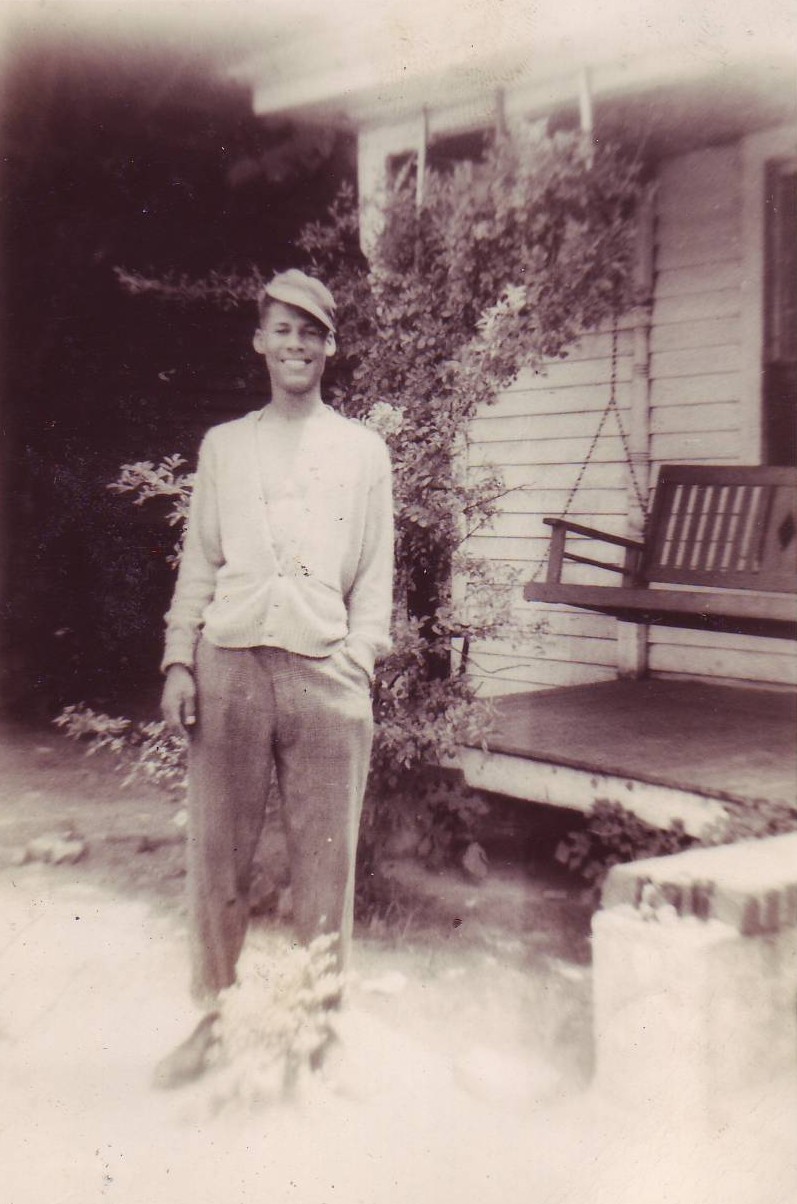
John Holt fedora

Cousin John, early 1940s.

After serving in the Army in World War II, John married Helen Mack and reared six children in Bronx, New York. At 90, he is the oldest living Henderson male.

Image

Happy birthday, John J. Holt!

——

Interview with Hattie H. Ricks by Lisa Y. Henderson, all rights reserved; photos or copies in collection of Lisa Y. Henderson.

Standard
Births Deaths Marriages, Free People of Color, North Carolina, Other Documents, Paternal Kin

Adam Artis’ children, part 5: Katie Pettiford.

From the “Adam Artis Family History”:

After Amanda died, Adam died Katie Pettieford of Goldsboro. They had one son, Pickney. Adam was 71 and she was 21 when they got married. Katie employed a male nurse to look after Adam. She sold off his land bit by bit.

Adam died of old age at about 100 years. His last wife, Katie, in 1923, had someone dig down to his coffin and saw off his feet. Several years later she committed suicide. She poured kerosene around a room and set it on fire.

In fact, Adam Artis married his fourth and final wife, Katie Pettiford, on 9 July 1902 in Wayne County. He was 71, as told, and she was about 20. Their only son, Alphonzo Pinkney Artis, was born in April 1903. By common account, Pinkney left home as a boy — ran away, in fact, to Baltimore. Adam died in 1919 at age 87. Katie, who remarried, died in 1940.  Her death certificate notes that she burned up inside her house, but does not mention suicide.

As for the rest, the story I’ve heard is that Katie, guilt-ridden over her abuse of Adam in his decline, grew convinced that he was haunting her from the grave. On the advice of a root doctor, she had his body exhumed and his feet cut off to keep him from walking the world.

Standard
Births Deaths Marriages, Maternal Kin, Newspaper Articles, North Carolina, Oral History, Photographs, Vocation

Lon Colvert: straight and shady.

If reports are to be believed, Lon Colvert had a bit of a shaky start. “Otho Turner”?

Image

Statesville Landmark, 18 August 1898.

Carolina_Mascot_Sville_2_8_1900

Statesville Carolina Mascot, 8 February 1900.

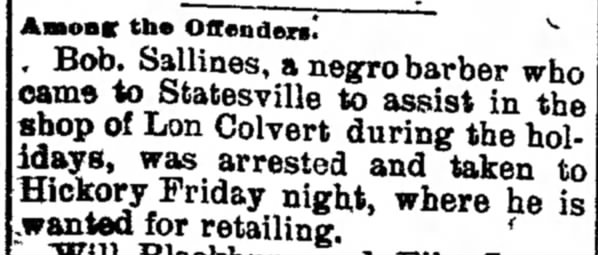
Lou Colvert was Lon’s uncle. No details on Lon packing. But he switched gears a bit.  To retailing, which specifically meant selling liquor — unauthorized.

Iredell County Superior Court —

Lon Colvert, retailing; guilty.  

— Statesville Landmark, 5 Nov 1901.

Another poor outcome.

“Cases Disposed of Since Monday — Some Recruits for the Chain Gang — A City Ordinance Held Invalid”

The following cases have been disposed of in the Superior Court since Monday:    …

Lon Colvert, convicted of retailing, was discharged on payment of the costs. 

— Statesville Landmark, 8 Nov 1901.

But somewhere along in here, he began to right his ship.

Notices of New Advertisements.

L.W. Colvert has moved his barber shop from Depot Hill to 109 east Broad street.

— Statesville Landmark, 23 Aug 1904.

It’s not clear when Lon first opened his barber shop, or how he got into the business, but it was a good move. Depot Hill was a few blocks south of downtown; the 100 block of East Broad was right at the heart of the business district. He had arrived.

Still, there were setbacks. (I read “liquor” in this “little pilgrimage,” but I could be wrong.)

“Played His Bondsman False and Will Spend his Holidays in Jail.”

Thursday afternoon a colored barber, Lon Colvert by name, braced Mr. J.P. Cathey for a horse and buggy with which to make a little pilgrimage that night, and Mr. Cathey refused.  Lon was just obliged to make that little run, so later he stated the case to Jo. Thomas.  Jo. is the colored individual who worked for Mr. Cathey then and who is now being boarded by the county.  Jo. slipped out with a horse and buggy.  Lon made his trip, came back, paid Jo. one plank, which he shoved down in his jeans, and then Jo. slept the sleep of the consciousless offender.

But the snow that fell during the interval between the exit and return of that buggy caused Jo’s little house of cards to tumble.  Next morning Mr. Cathey saw the tracks, asked Jo. who had got a buggy the night before, and Jo straightaway told the thing that was not.  So Mr. Cathey got off of Jo’s bond, which he had signed not long since, and now Jo. is behind bars.

— Statesville Landmark, 20 Dec 1904.

He pressed on.

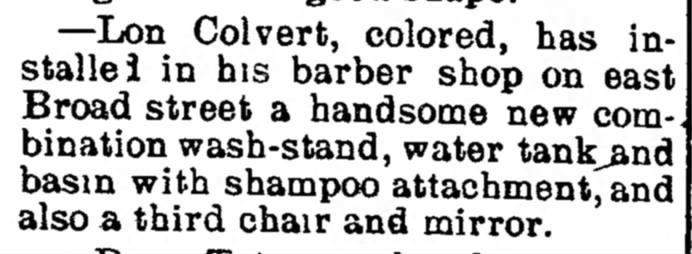
Lon Colvert, colored, has recently equipped his barber shop on east Broad street with a handsome two-chair dressing case and has made other improvements in the shop.

— Statesville Landmark, 1 Jan 1907.

Occasionally, his friends let him down.

Image

Statesville Landmark, 1 January 1907.

But he had a new wife and a new baby to add to his first three, and the straight and narrow was starting to win.

Image

Statesville Landmark, 7 May 1907.

Image

Statesville Landmark, 7 January 1910.

A momentary setback, no more. Lon moved his business back down Center Street toward the train depot and entered the golden age of his entrepreneurship, the period of my grandmother’s childhood.

Papa had a barber shop.  Well, of course, Papa did white customers. And, see, the trains came through Statesville going west to Kentucky and Tennessee and Asheville and all through there.  They came through, and they had, they would stop in Statesville to coal up and water up, you know.  There were people there to fill up that thing in the back where the coal was.  And there was another — it had great, big round things that they’d put in water.  And when those trains would stop for refueling, they would, there were a couple of men who would come. I can see Walker and my uncle and Papa standing, waiting for these men who were on the train to give them a shave and get back on the train in time.  And there wasn’t any need of anybody else coming in at that time ‘cause they couldn’t be waited on.  They were waiting for these conductors and maybe mailmen, but I know there would be at least three at a time.  And Papa would shave them.  And he made a lot of money.

Papa had a taxi, too. Walker drove it most of the time.  And then he would hire somebody to drive it other times.  And then when people had to go to Wilkesboro, Papa would take them.  Because Wilkesboro was a town north of Statesville. And there was no transportation out there.  No buses, no trains, or anything.  So when people would come on the train that were, what they call them, drummers, the salesmen, when they would come through, Papa would carry them up there. 

And he had this clean-and-press in the back of the barbershop. And, look, had on the window, on the store, ‘Press Your Clothes While You Wait.’  I can see those letters on there right now.  ‘Press Your Clothes While You Wait.’  And people would go in there, get their clothes pressed, you know.  And I know ‘barber shop’ was on the door….  ‘L.W. Colvert Barber Shop.’  ‘L.W.’ was on the side of this door, and ‘Colvert’ was on this side of the door.  They had a double door.

There were, of course, risks to doing business. Though I’m casting a side-eye at the carnie. (“H.G.” was Lon’s 21 year-old half-brother Golar, and I never knew he was a partner in the business.)

Damages for Scorching Suit — Court Cases.

Lon Colvert and H.G. Tomlin, doing a pressing club business under the name of Colvert & Tomlin, were before Justice Sloan Saturday in a case in which Chas. Moore, white, a member of the carnival, was asking $18 damage for them.  They pressed a suit for Moore and it was scorched, for which Moore asked damage.  The case was finally compromised by Colvert & Tomlin paying Moore $5 and $1.20 cost. 

— Statesville Landmark, 27 March 1917.

And there was the little matter of a charge of carrying a concealed weapon in 1919; a jury returned a not guilty verdict.  Still, a burglary at the shop was an omen. The good years were coming to an end. Lon was struck with encephalitis in the 1920s and was largely unable to work in his final years.

Image

Statesville Landmark, 25 September 1925.

By this time, Golda had embarked upon a peripatetic life in the Ohio Valley, and  Walker was left to keep his father’s businesses running.  He exercised his best judgment.

Walker Colvert, driver of the Wilkesboro jitney Steve Herman, driver of the Charlotte jitney, and Henry Metlock, driver of the Taylorsville jitney were charged with delivering passengers to the depot rather than the jitney station.  It appearing that all the violations were emergency calls, the defendants were discharged.

Statesville Landmark, 1 Mar 1926.

Lon Colvert died 23 October 1930.  “He was an old resident of Statesville,” his obituary noted, “and for a number of years had a barbershop on South Center street, near the Southern station.”

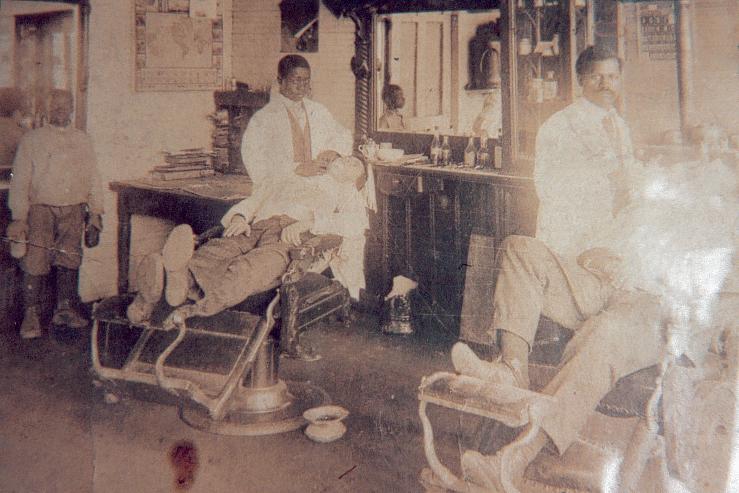
COLVERT -- Barbershop 2 The barbershop, 1918, when it was at 101 South Center Street. Walker Colvert, center, and L.W. Colvert, right.

——

Interview of Margaret C. Allen by Lisa Y. Henderson; all rights reserved. Copy of photograph in possession of Lisa Y. Henderson.

Standard
Births Deaths Marriages, Free People of Color, Migration, Other Documents, Paternal Kin

Age 121?!?

ImageOn March 30, 1932, in Lucy, Tennessee, just north of today’s Memphis International Raceway, an old man closed his eyes a final time. His doctor described his death in an unusually detailed, almost poetic, passage: “causes due to advanced age weakening of heart muscles beats slowing down until stopping quietly but regular.” He was, according to the death certificate, 121 years old, and his name was Guy Lane.

Guy Lane?!?!

I scanned the rest of the form: farmer … living in Shelby County … born in North Carolina … son of Guy Lane … an informant named Lillie ….

My great-great-great-great-grandmother, Vicey Artis, born free in or near Wayne County around 1810, had a sister named Sylvania. Both women married enslaved men. (And their brother Daniel married an enslaved woman.) On 31 August 1866, Vicey Artis and Solomon Williams and Sylvania Artis and Guy Lane registered their decades-old cohabitations in Wayne County and thereby legalized their marriages. Old Man Guy died before 1880, but ….

Sylvania and Guy Lane’s twelve children, who used both parents’ last names, were born over the course of more than twenty years.  Morrison Artis, born 1837, was first, followed by Mary Artis (1839), Jane Lane Sauls (1842), Daniel Artis (1843), Mitchell Lane (1845), Mariah Artis (1846), Guy Lane Jr., Penny Lane (1850), Dinah Lane (1851), Julie Lane Sutton (1853), Washington Lane (1855) and Alford Lane (1859).

In 1869, Guy Lane Jr. married Dinah Dew in Wayne County. They appear together in the 1870 and 1880 censuses and had at least six children: Ora, Moses, Lizzie, William, Mary S., Milton F. Lane, and a girl. By 1900, though, Guy and his family are nowhere to be found in North Carolina. Instead, they surface 800 miles due west, just outside Memphis. (Had they been Exodusters sidetracked on the way to Arkansas?)  Guy had a new wife, of four years — Eliza, born in Tennessee — but his youngest two children, Milton and Guy Jr. (actually III), both born in NC, were with him. In 1910, on the Memphis & Shakerag Road, 60 year-old Guy and Eliza Lane are listed with eight year-old daughter Lilly. Both reported that they had been married twice, and Eliza reported that only one of her nine children was living. In the 1920 census, the couple are living with Lillie and her husband Robert Burnett. Guy continued to work as a farmer, and his age is reported as 78. Ten years later, in 1930, Guy and Liza are living alone again, and his age has leapt inexplicably to 114. By time he died in 1932, Guy had gained another seven years.

The credible evidence suggests that cousin Guy Lane, in fact, was born about 1848, making him a more reasonable 84 years old when his heart slowed down until stopping quietly. He is not forgotten.

Standard
Births Deaths Marriages, North Carolina, Other Documents, Paternal Kin, Photographs

Funeral Program Friday: Bettie Aldridge Saunders.

BASaunders_Page_1BASaunders_Page_2

Betty Cecilia Aldridge Saunders was born in Dudley, Wayne County, North Carolina, the second daughter among John and Ora Bell Mozingo Aldridge‘s 11 children.  She died in 1990 and was buried in the cemetery of the church to which Aldridges have belonged since the 1870s.

Henderson group shot DudleyL. to R.: Horace “Snook” Henderson, Cecilia A. Saunders, William Saunders, Catherine Aldridge Davis, Frances Henderson Taylor, Carrie Lee Henderson Hill, ??, Johnnie “Dink” Henderson, Annabelle Henderson. Dudley NC, 1970s. Snook, Frances and Dink were Cecilia’s first cousins. Their mother, Nora Aldridge Henderson, was a sister of Catherine A. Davis and Cecilia’s father Johnnie Aldridge. Carrie was the Hendersons’ cousin on their father’s side.

——

(The first of an occasional spotlight on these funeral staples.)

Standard