Births Deaths Marriages, Free People of Color, North Carolina, Other Documents, Paternal Kin, Rights

Her freedom has never been disputed.

State of North Carolina Onslow County

To all persons whom it may concern we the under Signed being called on to State what we Know concernning the Freedom of Nancy Dove formerly Nancy Henderson do certify that Nancy Ann Henderson the Mother of the said Nancy Dove was a Free born white Woman and that the Freedom of the said Nancy Dove never has been disputed given under our hands this 3rd March 1860  /s/ John Mills {seal} Nancy Parker {seal}

Test J.W. Thompson X

——

I believe that Nancy Henderson alias Dove and my great-great-great-great-great-grandmother Patsey Henderson were sisters. More on that later.

Standard
Births Deaths Marriages, Enslaved People, Free People of Color, North Carolina, Other Documents, Paternal Kin

Up from slavery.

artis-solomon-williams-estate-records-dragged

Vicey Artis, a free woman of color, and Solomon Williams, a slave, had eleven children together – Zilpha Artis Wilson, Adam Toussaint Artis, Jane Artis Artis, Loumiza Artis Artis, Charity Artis, Lewis Artis, Jonah Williams, Jethro Artis, Jesse Artis, Richard Artis and Delilah Williams Exum — before they were able to marry legally.  On 31 August 1866, they registered their 35-year cohabitation in Wayne County.  Vicey died soon after, but Solomon lived until 1883.  The document above, listing his and Vicey’s six surviving children and heirs of their deceased children, is found among his estate papers.

Standard
Births Deaths Marriages, Free People of Color, North Carolina, Oral History, Other Documents, Paternal Kin

He was gon make something off the crop.

And Papa was sick, and somebody had to watch him.  He wasn’t down in the bed, but his mind was kind of off.  Now he’d listen to you, you’d talk to him, and anything he wanted, had to tell you about it.  “Naw, you can’t go there.  I got to go home.  I got to go home.”  Said he had to go home.  I said, “We are home.”  Said, “Naw, we’re not.”  That’s the way his mind worked.  Like that. 

So after Mamie got married in Greensboro, I come on back to Wilson, and then, after I come back, I hated I’d come back ‘cause I had to – Papa’s mind was bad, and I had to stay home.  To keep him.  He’d go ‘way from the house and couldn’t find his way back. And he was ruptured from the time I can remember. And so at that time Mama was working in the factory, and school wasn’t open, but when school opened, I had to stay home and look out for him.  And then, so finally, when he died.  He was supposed to have an operation.  He was ruptured, and Carrie, she claimed she didn’t know it.  And I said, now, I was the youngest child was there, and I knowed that all that stuff that was down ‘tween his legs was something wrong with him.  He went up to Mercy Hospital for something, probably his rupture – I know he had to go to the hospital for treatments or something.  Anyway, the last time, Carrie came down and she was fussing about if she’d known Papa had to have an operation, she’d have come down and he’d have had it.  Instead of waiting until it was too late.  Now the last week they wasn’t expecting him to live.  But, no bigger than I was, I knew he had it.  And she was grown, old enough for my mother, and then she talking ‘bout she didn’t know he was ruptured?  Well, all his tubes was, ah –  And he always had to wear a truss to hold hisself up.  And when he’d be down, I’d be down there sweeping at the school, and he’d be out there plowing a field he rented out there, and he’d come up, lay down on the floor and take a chair and he’d put his legs up over the chair like that, and I’d wet the cloths from the bowl where was in the hall, some of the old dust cloths, and hand them to him, and he’d put them down on his side, and you could hear it ‘bluckup’ and that thing would go back there.  But see it had got, his intestines, that tissue between there had bursted, and the doctor told him he needed an operation.  So he was gon get it, but he didn’t have money enough to get it.  Didn’t save up money enough to have the operation.  So none of the children – all of them know, as large as his – but leastways he couldn’t hide himself, ‘cause even from a little child, I could see that for years, and I wondered what it was.  ‘Cause I know everybody didn’t have it, at least didn’t have all that in their britches ….  And Carrie come down there, and she fuss Mama out about him not having the operation and this kind of stuff.  And she said, “Well, we never had the money to get the operation.”  We tried to go and get it, and we’d pay on it by time.  But, naw, he wanted, he was gon make something off the crop, and he’d pay.  Pay it and have it then.  But he never got the chance.  So when they put him in the hospital and operated on him, say when they cut him, he had over a quart of pus in him.  I think it was on a Thursday, and he lived ‘til that Tuesday.

NorthCarolinaDeathCertificates1909-1975ForJessieAdamJacobs——

Oh, this breaks my heart. (And she was absolutely right. July 6, 1926, was a Tuesday.)

Excerpts from interviews of Hattie Henderson Ricks by Lisa Y. Henderson; all rights reserved.

Standard
Births Deaths Marriages, Maternal Kin, North Carolina, Oral History

William. And William.

Me: There was something I was going to ask you …. Now, I knew — I found out that she had a brother. Named William.

My grandmother: Who?

Me: Nicholson. Ommm, Harriet.

My grandmother: He was a white man, honey.

Me: Her real brother.

Grandmother: It was her half-brother. He was a white man that owned the undertaking business.

——

Harriet Nicholson Tomlin Hart had two brothers named William. One black, one white.

The first, with whom she shared a mother, was William H. Nicholson, born Christmas Day 1842. After her husband Abner’s death, Harriet and her youngest son Golar went to live with him in Charlotte, North Carolina, about 35 miles south of Statesville. In 1900, the censustaker recorded the family at 611 E. Stonewall. William worked as a plasterer, and Harriet is designated as his sister. She acted as informant on his death certificate, filed a few days after he died 17 December 1909, naming his parents as Burwell Carson and Lucinda Cowles. I have found no other references to his life.

The other brother, with whom she shared a father, was William Thomas Leonadas Nicholson, one of two sons of James Lee Nicholson and Martha “Mattie” Colvert Nicholson. (The other was John Walter Lee Nicholson.) William was a boy of 7 when Lee Nicholson died in 1871, and he was reared with his mother’s family in northern Iredell County. (She was the daughter of William I. Colvert, former owner of Walker and John W. Colvert. The latter fathered Harriet Nicholson’s oldest child.) In 1878, the Nicholson family “began to make and sell caskets at the general store they operated [in] northern Iredell County. As was common in the late 1800s, many undertakers were also furniture makers, and the Nicholsons continued to sell caskets and conduct funerals in their furniture store when they moved to Statesville. At the time, a casket’s price was based on the wood used and its size—probably between $25 and $35 for an adult casket. W.T. Nicholson moved the funeral home into its current location in 1920, and he remained its owner until his death in 1951.” William T. Nicholson handled preparations for his sister’s burial — whether he acknowledged her or not — as well as John W. Colvert. Nicholson Funeral Home, at 135 East Front Street, Statesville, remains in operation.

Standard
Births Deaths Marriages, Maternal Kin, Military, North Carolina, Oral History

We the 3rd N.C. regiment soldiers.

And again:

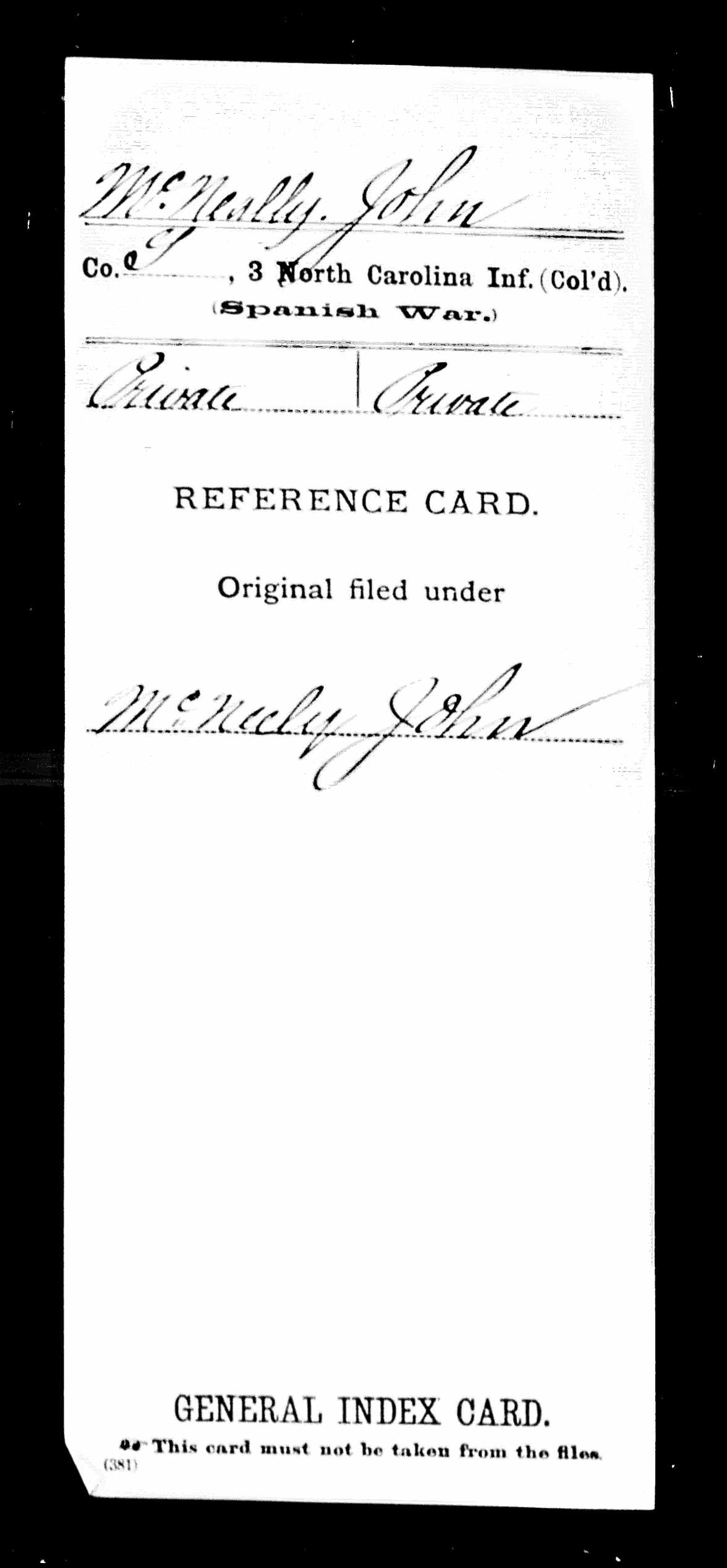
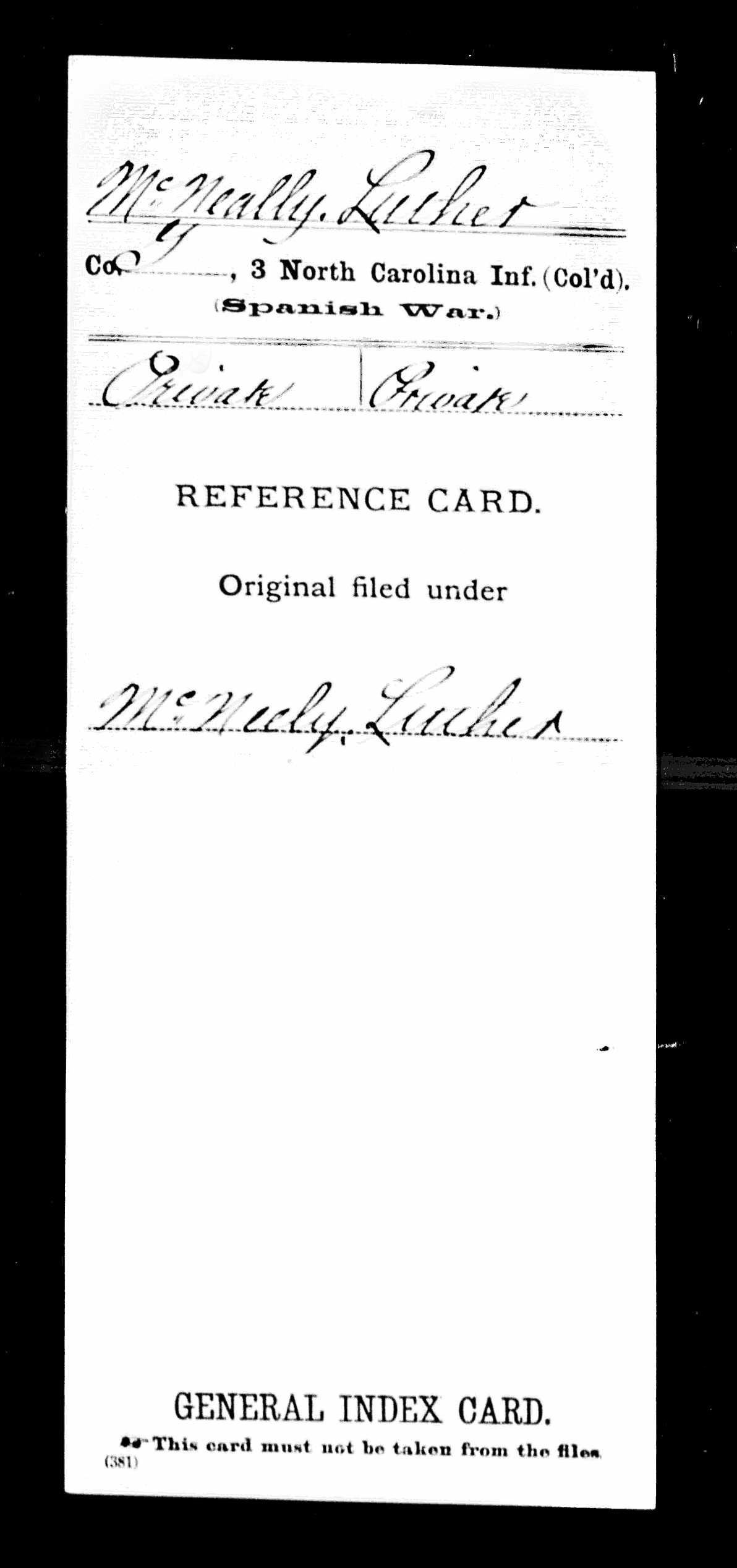
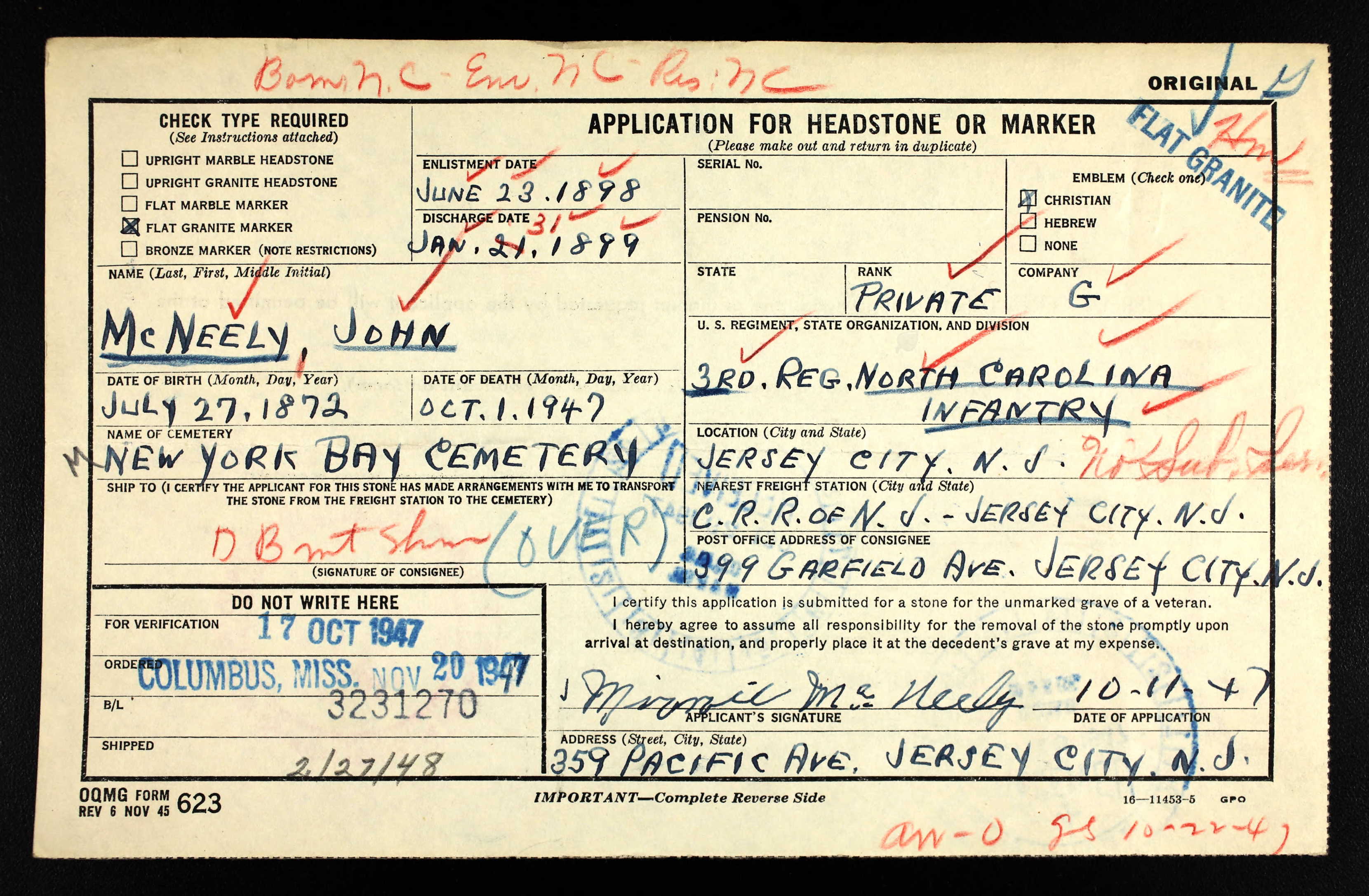
My mother’s brother went to World War I. Not Uncle John and Uncle Luther.  Oh, they were old.  Old men.  They went to the Spanish-American War.

Image

Image


In response to President William McKinley’s call for volunteers, the 3rd Battalion of North Carolina Volunteers mustered in on 12 May 1898 at Fort Macon, North Carolina. Seven companies — including Company G of Iredell County — joined them in July, forming the 3rd North Carolina Regiment.  The Regiment moved west to Knoxville in September, then to Macon, Georgia in January 1899. Though the 3rd NC was alerted to prepare to ship out to Cuba, the war ended before it saw action in battle.

The following letter is reported to have been sent to Secretary of War Alger by members of this regiment. The names of those who signed the letter were not given to The Journal and Tribune reporter with the copy of the letter.

Third North Carolina Regiment 
(All companies) Sept. 23, 1898,

To the Secretary of War:

Dear Sir:–We the undersigned many soldiers, heard that you had been instructed that we wanted to stay in service as garrison duty, but my dear sir, we are now pleading with mercy and deny any such report as there had been reported and we feel that our superior officers has treated us wrong to hold us in service without we knowing anything about it.

We the undersigned did not join the service for garrison duty. We only sacrificed our lives and left our homes simply for the honor of our flag and the destruction of our country and families as the war was going on at that time, but now the war is over and we do feel that we might be mustered out of service because we are getting letters from our families every day or two stating the suffering condition, and oh my God, the way that we are treated. We have to drill harder than any other regiment on the grounds and after drilling so hard, we have to work so hard. We have to cut ditches, sink holes and fill up gullies, put in water pipes. We, the 3rd N.C. regiment soldiers has not had but one pair of pants, one coat, two undershirts, one top shirt. We are in a box fit. Our food is not fit to eat, and oh my dear sir, we are bound up in a little place about 400 feet long 3 feet wide. Just think of the confinement we are under just because we volunteered freely to fight for our country.

We the undersigned many soldiers did not volunteer for garrison duty and we do not think that our honorable government will take the advantage of willing and faithful men who came to the rescue of the flag, stars and stripes. We have a great deal more to tell you but we can not express ourselves like it ought to be done.

Down at Fort Macon we was misled. The question was asked who wanted to stay in the service and go to the front if necessary, called upon them to raise hands, but the question never was asked if we wanted to do garrison duty. If they had of asked that question we never would have been in Knoxville today. Why don’t you know as a good thinking man that we don’t want to leave our wives and families to go on garrison duty. Why if so you would have had more applications in the white house than the mail box would have helt.

You know that these officers is getting a very good salary and they would go in three miles of hell after that dollar, but we who are brave men did not come for the sake of that $15.60, but we gloried in the flag and come to hold it up by the balls and shells. So as we did not get a chance to do so we hope that you will consider this matter. Look it over, give us the judgment of justice and if you do we will go home to our families who are in a suffering condition, so we will not write any more.

We the undersigned await your earliest reply. Many soldiers of the Third North  Carolina regiment. We want to go home. 

Journal and Tribune, Knoxville, 5 October 1898.

U.S.HeadstoneApplicationsforMilitaryVeterans1925-1963ForJohnMcNeely

U.S.HeadstoneApplicationsforMilitaryVeterans1925-1963ForLutherMcNeely

Standard
Births Deaths Marriages, Maternal Kin, North Carolina, Religion

Church home, no. 5: A.R. Presbyterian, Statesville NC.

The Associate Reformed Presbyterian church is a blending of two groups that began in Scotland in the early 1700s. The Associate Presbyterians and the Reformed Presbyterians migrated to America as a result of religious and political upheaval in Britain. The two churches merged in 1782 to form what is now known as the ARP church.

After the Civil war, Associate Reformed Presbyterians from Amity (now New Amity), New Perth and New Sterling Churches moved to Statesville. On August 7, 1869, a meeting was held in Stockton hall to organize the First Associate Reformed Presbyterian Church of Statesville. About 15 people were present at this first meeting, and Reverend W. B. Pressly was chosen as pastor as well as Elders R.R. White, A.M. Walker, George White and John Patterson.

After meeting in the Iredell County Courthouse for a short period, the early church shared the Presbyterian sanctuary for about six years. In 1875, Colonel S.A. Sharpe and other interested friends donated labor and materials to build the first church.

Reverend W. B. Pressly served as pastor until his death November 25, 1883. After several ministers had supplied the pulpit for brief periods, Reverend D. G. Caldwell served as pastor from 1885 to 1891. In 1892, Reverend J. H. Pressly, then a student at Erskine Seminary, accepted the call to this pastorate and served this church for 54 years.

During the pastorate of Dr. Pressly, First ARP Church made several significant steps. The church built a manse in 1897. In 1900, a new sanctuary was built, replacing the first structure and in 1902 the session approved the establishment of a second church in south Statesville. Out of this decision came the organization and building of Pressly Memorial Church in 1907. — Excerpt from http://firstarpchurch.us/about-us/

——

Lon W. Colvert and Carrie McNeely were married in 1906 at A.R. Presbyterian Church. Rev. J.H. Pressly officiated, and he and his wife signed the marriage license as witnesses. My grandmother said that Carrie’s father Henry McNeely was a “big” Presbyterian — it was the denomination of his Scotch-Irish forebears — though Carrie joined the Episcopal church. I’ve contacted First ARP for information about their early membership rolls and will post the results.

Standard
Births Deaths Marriages, Maternal Kin, Newspaper Articles, North Carolina, Oral History, Photographs

Edward Murray McNeely.

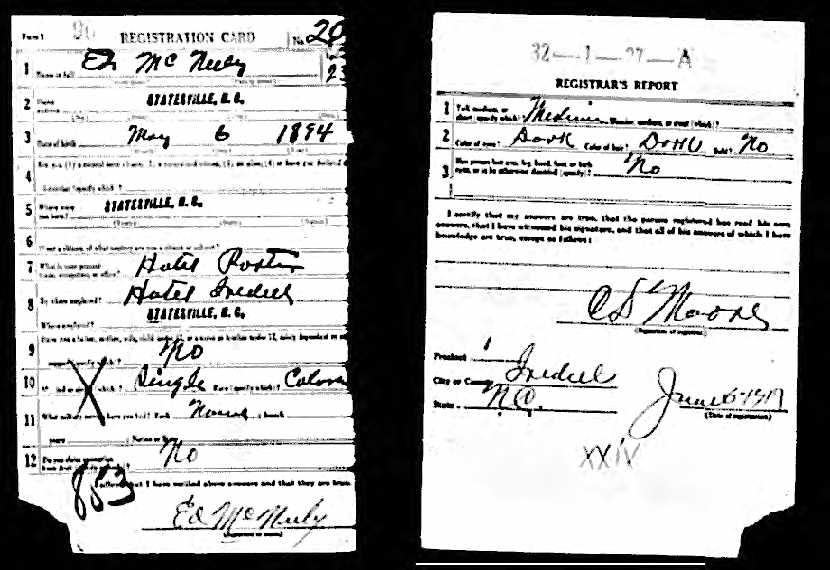
My mother’s brother went to World War I. Not Uncle John and Uncle Luther.  Oh, they were old.  Old men.  They went to the Spanish-American War.  Edward went to World War I — 

ed mcneely draft card

Yeah.  If he went.  ‘Cause he was the laziest man, dodged everything.  Running all the time.  The ladies were just crazy about him.  He had to leave Statesville.  He went to Asheville and, too ….  They were just about to lynch him because of, you know, these women running after him.  He went to New York.  I think he married two or three women up there.  [I laugh.]  Honey, he was sharp as a tack.  Lord, Lisa, that was one good-looking man.  Tall.  Like Carey.  And he was sharp.  I remember when I went to New York from Hampton to work, went to Jersey from Hampton to work.  He carried me to New York.  First time I had ever been to New York, and he carried me to New York to this Elks Club.  He was a big-time Elk, you know.  And those men swore that I was not his niece, that I was somebody else.  And they said, “Man, you know that’s….”  And I liked to dance with them, you know, and all.  And I would just go with him – I mean, I didn’t go there a lot of times, but I might have went two, three times, but he would take me to that Elks Club.  And he would never let me have anything to drink.  He would drink some wine or something like that.  But he would take me, and one time when I was in New York — Wardenur and I, he used to take us.

McNEELY -- Edward McNeely


Edward Murray McNeely, born 15 June 1894, was the youngest of Henry and Martha McNeely’s sons. He married Lucille Tomlin in 1910 in Statesville and worked as a bellhop in a local hotel. He and Lucille had a son, Quincy Edward McNeely, in late 1910. When the marriage broke up, the boy and his mother moved to Asheville and were lost to the rest of the family. (Or to my grandmother, his first cousin, in any case.) Ed McNeely was in fact inducted into the Army in 1917, but I have no details of his service. By the late 1920s, he had migrated north to join his mother and several siblings in and around Bayonne, New Jersey. In 1942, he registered for the “Old Man’s Draft” and reported his address as 344 Grand Avenue, Brooklyn. (A two-story brownstone in Clinton Hill worth $1 million today. He also gave his height as  5’11, some considerable inches shorter than my cousin Carey.) When he died on 28 September 1950, Edward was living at 454 Avenue C in Bayonne and was married to Delphine Peterson McNeely. Two days later, the Statesville Daily Record published this tragic report:

“Double Funeral Service Planned”

Double funeral services will be conducted for brother and sister here Monday.

Lizzie Long, who burned to death when her home on Bingham Street was almost completely destroyed by fire Thursday morning, will be buried with her brother who died that night in New York.  The brother, Edward McNeeley, a veteran of World War I, died in Veterans hospital, Staton [sic] Island, upon hearing the news of his sister’s death.  His body will be returned here Monday morning and services will be conducted jointly for them at 2:30 p.m. Monday.  Burial will be in Belmont cemetery.  

The funeral will be conducted by Rev. Spurgeon Frost at Rankintown Congregational church.

Photo of Edward McNeely in collection of Lisa Y. Henderson. Interview of Margaret C. Allen by Lisa Y. Henderson, all rights reserved.
Standard
Births Deaths Marriages, Free People of Color, North Carolina, Oral History, Paternal Kin, Photographs

Papa Jesse.

Bessie died when I was eight months old.  And Mama Sarah took me as a baby and brought me to Wilson.  And her husband was the only papa I knew.  His daughters all disliked me being there, but I loved him and he loved me.  But they all just said he loved me better than he did them, and I wont nothing no kin to him.  But when you take a child that’s with you all the time, and every Sunday you send to the store to get you some oil to wash your feet … just nobody but me there.  Nobody but Mama, Papa, and me.  Mamie wasn’t even there then.  She was down in Dudley with Grandma Mag.  And so, I guess he just learned to love me.  And he told me, if I wanted to stay with him, I could stay, and if he didn’t have but one biscuit, he’d divide it and give me one half and he’d have the other half.  And that way I wanted to go with him ‘cause Mama’d fuss all the time.  She was always talking, got to be doing something.  And so I wanted to follow him.  And so I went with him everywhere. 

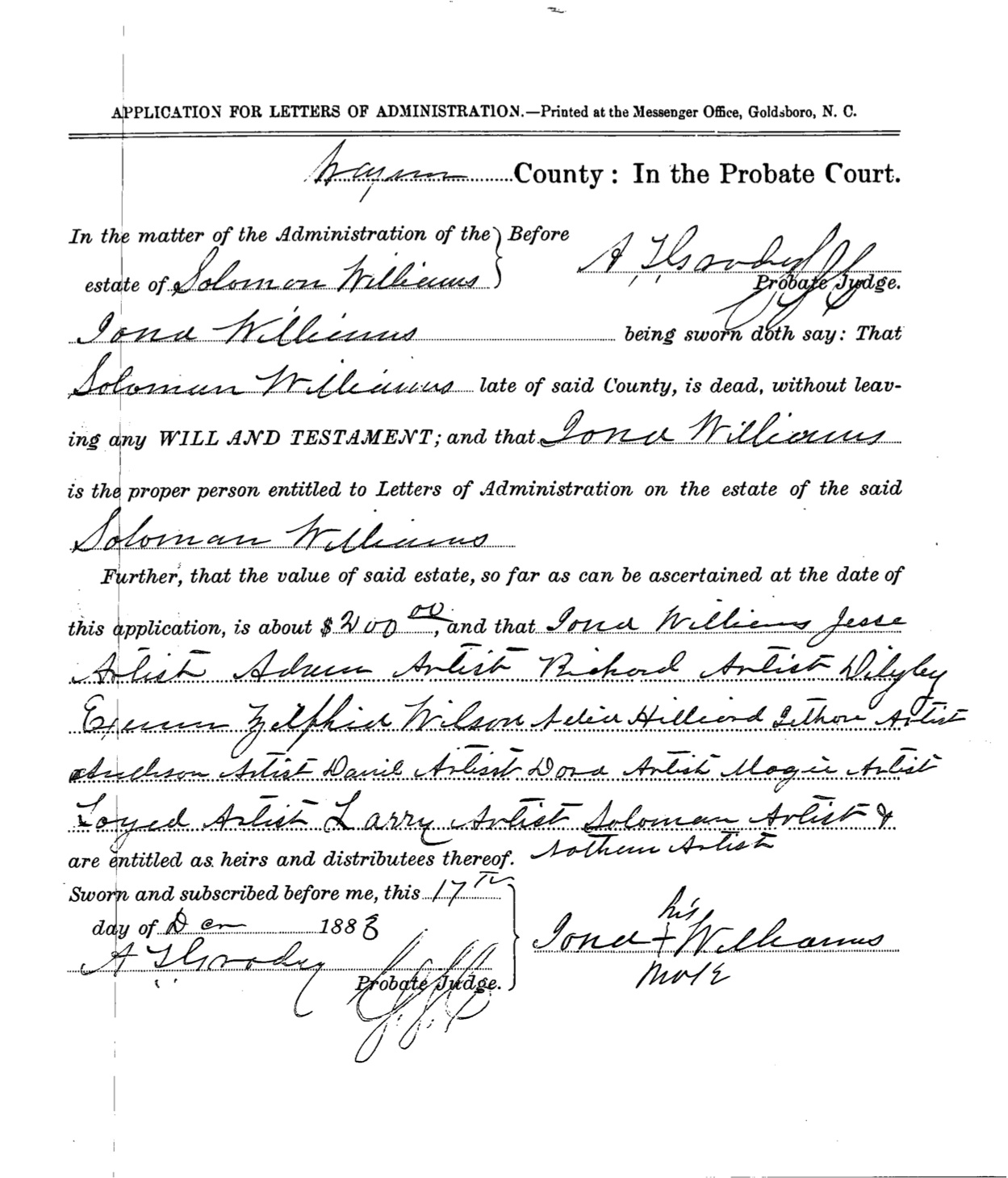
In late 1895, the freshly widowed Jesse Adams Jacobs Jr. married Sarah Daisy Henderson in Dudley, Wayne County. He brought children as young as a year old to the marriage, and she brought a daughter, a niece and a nephew. Around 1905, Jesse, Sarah, his youngest children and her nephew Jesse Henderson joined the flow of farm dwellers to Wilson, then entering into its golden era as the World’s Largest Tobacco Market. A couple of years later, when Sarah’s niece, Bessie Henderson, died, Jesse and Sarah took in her small children, the younger of which was my grandmother.

Jesse&Sarah Jacobs

Jesse was born in 1856 in Sampson County to Jesse Jacobs Sr., a prosperous free colored farmer, and his wife Abigail. Many of Jesse and Abigail’s modern descendants are members of the Coharie Native American tribe. Others, like Jesse Jr.’s descendants, identify as African-American.

Jesse A. Jacobs bought a small house at 303 Elba Street in 1908. Over the years, he worked as a hostler and a janitor and for extra cash farmed small plots of land he rented on the edge of town. My grandmother was his constant companion.

And so I wanted to follow him.  And so I went with him.  Up there to First Baptist Church, help him dust the seats, and he’d run the sweeper and all that kind of stuff.  And when he was over to another school up there, the college.  He used to be janitor to the college.  And then he had the school out there at Five Points.  Winstead School out there at Five Points.  And I would be the one at all those places.  Go cut Professor Coon’s grass, I’d be right with him. And then, out to Five Points. I went out there – I was in school ‘cause I run all the way from up the school, came by the house, get me a bite to eat and run from there to clean to Five Points School where was out there – white folks.  And sweep up that whole building by myself.  Papa’s down there in the field, up there by – uh, what is the people be putting them … they had chains on their legs and had the white stripes – convicts.  It was a place up there.  And I’d go ‘round there and sweep that whole building up by myself.  Papa was gon get me a bicycle so I could ride over there.  ‘Cause, see, he had the horse and wagon, and so he was already over there, and he had been there by where the pigpen was down by that little stream, that little ditch.  And I’d come back on the wagon at night with him.  But while he was plowing, ‘cross the street over there where he had a acre of cotton.  And while he was working, plowing that garden where was on the side, Professor Coon let him have whatever he put in it.  He would buy all the stuff to go in the ground, if Papa would just work it.  So he’d plant that, and then me and Mamie had to get up two o’clock in the morning, go down there and pick up potatoes.  Light night.  It’d be so bright you could see ‘em. He’d plow it up, turn that ground over, and all them old potatoes down there, put ’em in baskets, and what we couldn’t see ‘fore it got real daylight, we had to go out there and pick ‘em up when it got day. 

My grandmother’s young life was difficult, and she carried scars of hurt and disappointment even into the years that I knew her. But her voice always softened when she spoke of her adored Papa, the single source of unconditional love in her childhood.

I used to brush Papa’s hair.  He didn’t have much. Take one of them soft brushes, hand brushes.  Two of ‘em, he brought ‘em from New York.  He brought the brushes home, and I was always messing with his hair.  And I’d get the brush and hold it on one side and part it off and brush it down.  It was real soft.  And near ‘bout all of it come off where was on top.   And I was always asking a nickel, a penny:  “What, ain’t you got some change in your pocket?  I want to go the store.”  So I was feeling his legs, feeling for pennies or nickels up there.  So I said, want to know if he’d give me a nickel, or give me a penny, or whatever it is.  So he run his hand in his pocket, a penny or a nickel or whatever, he’d give it to me.  I’d go on to the store, and he said, “Wait.  Wait a minute.”  He had to have tobacco.  So then he’d give me a dollar.  And he told me to go down to the store down, right down there from our house.  Old Man Bell’s store, the white man that run the store.  “Get me a quarter.  Don’t spend it all.”  It’s three sections or four sections on a plug of tobacco.  And they cut into it where the cracks is, and it sells for so much.  And so I’d go down there to the store and get it and come back and give it to him. 

——

Original photo of Jesse and Sarah H. Jacobs on their wedding day in the collection of Lisa Y. Henderson. Edited excerpts from interviews of Hattie H. Ricks by Lisa Y. Henderson; all rights reserved.

Standard
Births Deaths Marriages, Maternal Kin, Virginia

John C. Allen arrives.

JC Allen 1

John Christopher Allen made his way down-river to the newly established city of Newport News around 1899, a thick-set country boy with dark curly hair.  In April of that year, he had purchased ten acres in Turkey Trot from A.H. Drewry and wife, but he did not hang around to farm it. What pulled — or pushed — him out of Charles City County is not precisely clear, but he would never turn back.

va_hm_newport_news01

Newport News was a boomtown at the turn of the 20th century. The extension of the Chesapeake & Ohio Railroad down the peninsula, bringing coal from West Virginia for world-wide transport, was followed shortly by the development of the shipyard for which the city is still famous.

In June of 1900, the census taker found John Allen sharing a boarding house run by Henry Burrell with several single men.  The house was in the crowded East End, near the heart of industrial Newport News.  John was working as a shipyard laborer, and he was illiterate.  That year, on the day after Christmas, the 24 year-old son of Graham and Mary Allen, married 23 year-old Mary A. Holmes, daughter of Jasper and Matilda Holmes, at New Vine Baptist Church in Charles City County. They returned to Newport News to start their 50-plus years together.

Standard
Births Deaths Marriages, Land, Maternal Kin, North Carolina, Other Documents

Jule McNeely leaves a toehold.

I did not doubt that Henry and Julius McNeely were brothers, but here is proof-positive: Julius died widowed, childless and intestate, and his sole heirs were Henry’s children.Image“Jule” McNeely’s thin estate file, opened in 1913 in Rowan County Superior Court, is devoted to the distribution of his tiny plot of farmland to John, Luther, Emma, Addie, Carrie, Ed, Litha, Janie, Lizzie and Minnie McNeely as tenants in common. When Addie died in the middle of matters, a guardian was appointed for her children, “Ardenia” [actually, Ardeanur], 14, and James Smith, 9. At issue: “Beginning at a stone on D.S. Cowan’s line, and runs S. two degrees W 7.10 chains to a stone thence; N. 85 degrees W. 3.50 chains to a stone, thence; N. 2 degrees E. 6.50 chains to a stone on Cowan’s line, thence; E. to the beginning, containing two and a half acres more or less.” “The above land is the old Jule McNeely place, lying just east of Mount Ulla in Rowan County, and” — despite its tininess — “is a very desirable lot.” The heirs’ attorney petitioned for the sale of the lot, noting that it was too small to be advantageously divided or to justify continued possession by so many heirs, all of whom lived in Iredell County except Emma and her husband Ervin Houser of Bayonne, New Jersey. The petition was granted, and at auction on April 21, 1917, Carrie’s husband Lon W. Colvert placed the highest bid at $80.

[Sidenote: Before I found this file, I did not know that (1) Lizzie McNeely was first married to Watt Kilpatrick; (2) when Addie McNeely Smith died; or (3) Lon Colvert owned property in Rowan County, much less property that had belonged to his wife’s late uncle.]

Standard