Business, Civil War, Enslaved People, Land, Maternal Kin, Newspaper Articles, North Carolina, Photographs

Eagle Mills.

An abstract from Heritage of Iredell County, Vol. I (1980) —

In 1846, peddlar Andrew Baggerly bought the old Francis Barnard mill tract on Hunting Creek in north Iredell County.  In 1849, he placed an ad in Salisbury’s Carolina Watchman: “Capital Wanted And If Not Obtained Then Valuable Property For Sale.”  He described the property as “the most valuable water power in the Southern Country … situated on Hunting Creek in Iredell County, twenty-eight miles west of Salisbury … [on] a never-failing stream, … remarkable for its purity, … [and] adapted to the manufacture of paper, to calico printing, to bleaching etc.”  Baggerly noted that there was a dam in place, an active sawmill, a grist mill soon to open, and a factory building about half-finished.

On 2 Mar 1850, Baggerly, James E.S. Morrison, William T. Gaither, William R. Feimster, William I. Colvert, G. Gaither Sr. and Andrew Morrison filed a deed for a 318 1/4-acre tract called the Eagle Mills place.  By 1852, the factory was operating with William I. Colvert as its agent.  It had 700 spindles and 12 looms and employed an overseer and 22 workers, 20 of whom were women. By 1854 the adjacent former Inscore Mill had been added to the works, and Baggerly claimed the “intrinsic and speculative value” of the complex was $2,700,000.  

In 1855, Baggerly advertised in Charlotte’s North Carolina Whig and in the Carolina Watchman, calling the complex “Eagle City, the Great Point of Attraction, Destined to be the great center of manufacturing interests in Western North Carolina and perhaps the United States.”  He deeded the president and Congress of the United States a ten-acre block in Eagle City called Eagle Square, located on Market Street.  

After Baggerly was forced to liquidate his assets during the Panic of 1857, William Colvert became the owner of his interest in Eagle Mills.  “According to tradition there was a tobacco factory, hotel, oil mill, and general store at Eagle Mills in addition to the grist mill and cotton factory.  A number of homes stood in the horseshoe bend above the mills and a church was eventually constructed on the edge of the settlement.”

In the spring of 1865, Stoneman’s raiders came upon Eagle Mills unexpectedly and burned it to the ground.  The mills were rebuilt, but Eagle Mills never recovered its former prosperity.  The cotton factory and grist mill operated until destroyed by fire in April 1894.  At that time, William I. Colvert, Robert S. Colvert, and James E.S. Morrison were the owners.  

The only remains at the site are gravestones in the church cemetery, traces of the main road to the mill, the grist mill’s foundation stones, and, a short distance upstream, remains of the stone supports where a covered bridge crossed the creek.

——

Sville_Record_and_Landmark_4_19_1894_Eagle_Mills

Statesville Record & Landmark, 19 April 1894.

——

When William I. Colvert took charge of Eagle Mills in 1852, my great-grandfather Walker Colvert was in his early 30s and father of a one year-old boy, John Walker Colvert. I don’t know exactly what kind of work Walker did for W.I., but they had grown up together, and Walker was an entrusted slave. Even if his primary labors were not at the cotton factory complex, I am certain that he spent considerable time in and around his master’s largest investment. So, too, would John Walker, who remained with W.I. after Emancipation. He is listed in W.I.’s household in the 1870 and 1880 censuses, and I suspect he stayed at Eagle Mills until the final fire closed down the works.

On a rainy December morning I cruised the backroads of northern Iredell County, drinking in the landscape that was home to my Colverts and Nicholsons for much of the 19th century. I made a left onto Eagle Mills Road, headed north. A sharp bend in the road and there, a bridge over Hunting Creek. I pulled over and, ignoring a No Trespassing sign, clambered down to the sandy bank. The waterway is too shallow and rocky to have been paddled or poled, but I imagine that Walker and John Walker knew its course very well. Hunting Creek powered Eagle Mills and was a direct link between W.I. Colvert’s lands and those of Thomas A. Nicholson, whose son James Lee married W.I.’s daughter and whose granddaughter, Harriet Nicholson, gave birth to John Walker Colvert’s first child.

IMG_4618

Photograph by Lisa Y. Henderson, December 2013.

Standard
Agriculture, Civil War, Free People of Color, North Carolina, Paternal Kin

Confederate Citizens File: Durant Dove.

Form of the estimate and assessment of agricultural products agreed upon by the assessor and tax-payer, and the value of the portion thereof to which the government is entitled, which is taxed in kind, in accordance with the provisions of Section 11 of “an Act to lay taxes for the common defence and carry on the government of the Confederate States,” said estimate and assessment to be made as soon as the crops are ready for market.

Rice — Quantity of gross crop. — 5 bush. Quality — #2. Tithe or one-tenth. — 1/2 bush. Value of one-tenth. — $2.00

Cured Fodder – Quantity of gross crop. — 700 lbs. Quality — #2. Tithe or one-tenth. — 70 lbs. Value of one-tenth. — $280

Ground peas – Quantity of gross crop. — 7 1/2 bush. Quality — #2. Tithe or one-tenth. — 3/4 bush. Value of one-tenth. — $4.50

I, Durant Dove of the County of Onslow and State of N.C. do swear that the above is a true statement and estimate of all the agricultural products produced by me during the year 1863, which are taxable by the provisions of the 11th section of the above stated act, including what may have been sold of consumed by me, and of the value of that portion of said crops to which the government is entitled. /s/ Durant X Dove

Sworn to and subscribed to before me the 28th day of November 1863, and I further certify that the above estimate and assessment has been agreed upon by said Dove and myself as a correct and true statement of the amount of his crops and the value of the portion to which the government is entitled. /s/ F. Thompson, Assessor.

——

The Confederate Papers Relating to Citizens or Business Firms, 1861-1865 (NARA M346), often called the “Confederate Citizens File,” is a collection of 650,000 vouchers and other documents relating to goods furnished or services rendered to the Confederate government by private individuals and businesses.


Standard
Agriculture, Civil War, Free People of Color, North Carolina, Paternal Kin

Confederate Citizens File: Mathew Aldridge.

Form of the estimate and assessment of agricultural products agreed upon by the assessor and tax-payer, and the value of the portion thereof to which the government is entitled, which is taxed in kind, in accordance with the provisions of Section 11 of “an Act to lay taxes for the common defence and carry on the government of the Confederate States,” said estimate and assessment to be made as soon as the crops are ready for market.

Mathew Aldridge

Cured Fodder Quantity of gross crop. — 1000 Tithe or one-tenth. – 100 Value of one-tenth. — $3.00

I, Mathew Aldridge of the County of Wayne and State of North Carolina do swear that the above is a true statement and estimate of all the agricultural products produced by me during the year 1863, which are taxable by the provisions of the 11th section of the above stated act, including what may have been sold of consumed by me, and of the value of that portion of said crops to which the government is entitled. /s/ Mathew X Aldridge

Sworn to and subscribed to before me the 3 day of December 1863, and I further certify that the above estimate and assessment has been agreed upon by said Mathew Aldridge and myself as a correct and true statement of the amount of his crops and the value of the portion to which the government is entitled. /s/ J.A. Lane, Assessor.

Confederate Papers Relating to Citizens or Business Firms, 1861-1865, National Archives and Records Administration.

Standard
Civil War, Enslaved People, Free People of Color, North Carolina, Oral History, Paternal Kin

Daniel was always spoken of with respect and love.

I recently received a comment from a reader in response to my posts on the Daniel Artis family. She was hesitant to contact me because her ancestor John Lane had owned slaves — quite possibly some of the people I’ve written about — but was anxious to share a story about Daniel that had been passed down in her family for 150 years. I was surprised and excited to read her message and encouraged her to get in touch. Here’s our April 28 exchange:

Hi, Tammi! Please forgive my excitement and inability to wait for your response. I’m traveling to NC next week to meet some of my newfound Sauls relatives — descendants of Daniel Artis. I’m just beside myself wondering about John Lane — whom I believe apprenticed several of Daniel’s sister Sylvania’s children and might have owned Sylvania’s husband, Guy Lane. I know you’re busy, but I hope you’ll be able to touch base soon. Thanks again!

——

Lisa, thank you for getting back to me! … Yes, apparently there were a few children apprenticed. I recall, I think, five or six on one census. The younger Daniel Artis was 17 years old on, I think, the 1860 census in my g-g-grandfather John Lane’s home. From my family’s handed down stories, the little Daniel was my g-g-g-uncle Christopher Lane’s body servant. Christopher was one of John’s sons and only about seven years older than little Daniel. So they kind of grew up together. The story is that when they both grew up Christopher went to War and Daniel was allowed to go with him as his servant because Christopher was an officer. Only officers could take a servant with them. Daniel was considered free before the war although an apprentice as you probably know. Well, Christopher was captured by the northern troops and taken to their POW camp at Fort Pulaski, Ga. He died there from dysentery. The thing that my family is grateful for is that Daniel went to the camp with Christopher and stayed with him until his death, never leaving his side. When he died, Daniel made his way back to Bull Head, NC to let Christopher’s family and his father John Lane know what happened to him. Daniel was always spoken of with respect and love for what he did for Christopher.

I thank you so much for replying to me, Lisa, because I’ve always wanted to thank his descendants for what Daniel did and for his devotion to our family in such a terrible time. I always wondered if the Daniel Artis next door who was older was related to little Daniel. I saw on the census that he owned property near John Lane, my relative. I hope this information helps some, and I wish all of his relatives happiness and blessings.

——

What a pleasure to hear from you! The Daniel you speak of was the older Daniel’s nephew. “Your” Daniel was the son of Sylvania Artis, a free woman of color, and Guy Lane, her enslaved husband. My direct ancestor, Vicey Artis, was the sister of Sylvania and Daniel the elder. Vicey also married a slave, Solomon Williams. Most of their children were apprenticed by Silas Bryant, a close neighbor of John Lane’s. Daniel the elder’s wife was enslaved, as were their children.

Thanks so much for sharing the story about Daniel the younger. I had no idea that he served in the War. I need to look in my files, but I don’t think I know much about him, though I recall that he married Eliza Faircloth. I do not know of any his descendants either. I grew up in Wilson NC, but with no knowledge of my Greene County links. During a visit home this weekend, I’m going down to Bull Head to meet some Saulses and visit Artis Town cemetery, which is where Daniel the elder was buried in 1905. I’ll keep you posted on anything I find about Daniel the younger.

If you are willing, I would love to share Daniel and Christopher’s story on my blog. I so appreciate your coming forth with this bit of history. Researching African-Americans is generally incredibly difficult, and so much lies locked away with other families. I always dream that someone will contact me just like you did!

Best wishes, keep in touch, and thanks again!

——

I’d be honored for you to use Daniel’s story, of course. I’ve also dreamed and wanted for years to find his relatives, as I mentioned, so I could thank all of them. To be honest, I don’t know if the younger Daniel was enlisted or just went along as an aide to Christopher. I’m only learning recently about the service of black troops both Confederate and Union. I don’t think Daniel was enlisted but I may be wrong. I’ve found the Saulses in many of my genealogy searches but not able to make a connection directly to the Lanes. I can’t remember if I mentioned but my genealogy research came to a brick wall with my g-g-grandfather John Lane. No one anywhere, not even Ancestry.com knows who his father was for sure. I have hints but nothing else. It’s all fascinating.

I can only imagine the difficulty there must be tracing African American genealogy, but I see DNA is being used which is great. It’s part of why I find Scuffalong so interesting. There’s so much information. I really love hearing about Vicey, Sylvania and the elder Daniel since their names have come up so often in my own research. And so happy to meet you, a descendant! Many of my Lane ancestors ended up in Wilson, NC after leaving Bull Head. I’m not sure why, but there were many there in my research including a great-grandmother of mine. Please pay my respects at the Artis Cemetery, to their memory, Lisa, when you visit it. Feel free to write me anytime, if you have any thoughts or questions or just to say hello!

——

CCLane Page 2

Christopher C. Lane enlisted in the 3rd North Carolina Infantry on 23 April 1861 at Snow Hill, Greene County. He was wounded at Gettysburg on September 1863, recuperated at home, then returned to war. He was captured 12 May 1864 at the Battle of the Wilderness, Virginia, and sent to Fort Delaware. In August, in retaliation for the Confederate Army’s imprisonment of Union officers as  human shields in Charleston, U.S. Secretary of War Edwin Stanton sent 600 Confederate officers to Morris Island, South Carolina, to serve as human shields. Lane was among them. After 45 days, the men were transferred to Fort Pulaski, Georgia, and imprisoned in dismal conditions. Christopher Lane died there on 8 December 1864.

I have found no record of Daniel Artis’ service to Christopher Lane during the Civil War, which is not surprising. He was not a soldier; he would not have enlisted. The role of body servants in the early days of the War is the subject of intense debate, and Artis’ status as a free man of color, rather than a slave, further complicates any assessment of his motives (or volition) in following Lane to war.

Many thanks to Tammi Lane for reaching out and sharing a part of Daniel Artis’ life that would otherwise be lost to his family.

——

Image found at http://www.fold3.com.

Standard
Births Deaths Marriages, Civil War, Enslaved People, Military, North Carolina, Other Documents, Paternal Kin

They would not have taken them in church.

Part II of Bailham and Hannah Sauls Speight’s pension application file arrived today, and here are some extracts from witnesses deposed 4 June 1904:

  • Hannah Speight – “I claim pension as the widow of Bailham Speight but who served during the Civil War in the U.S. Army under the name of Bailham Edwards.” His brother Lafayette Edwards “lives at Bull Head which is eight miles from Goldsboro.” “I was born on Appletree Swamp near the town of Stauntonberg, Greene County. N.C. and was a slave; was owned by Lawrence Brown. I am the daughter of Rosetta Sauls. My father was Sheppard Sauls. I was known as Hannah Sauls prior to my marriage to Bailham Speight. … [A]fter our marriage we lived as husband and wife till he died December the 21st 1902.” “My husband was born and raised in Greene County. He was about six years older than I was still I knew him before he was grown….” “After his discharge he went to Georgia and was there just twelve months I do not know in what part of Georgia he was. No, I guess it was South Carolina where he went for he went away with Capt. Bill Taylor to work turpentine. … I married my husband about four years after the close of the war and we were married in the month of November in Snow Hill….” Married at Rebecca Bess’ house. She is deceased, as are witnesses Martha Sheppard, Luke Sheppard, and Charles Moseley. Maria Lofton did not witness, but could testify to marriage. She lives on Dr. Parrott’s plantation near Falling Creek. Amos Ellis, Lafayette Edwards, and Violet Edwards would have heard of the marriage, as would Isaac Lynch. … “My husband was raised five miles from Snow Hill on the Betsey Edwards place.” “My husband had a woman before the war. She might be called a slave wife and her name was Jennie. My husband told me she died in Newbern about the close of the war.” “At date of death of my husband I had one child under 16, viz., George Speight and he was fourteen on the 26th of last September. I never had George’s age set down by I remembered it all the same and I have always celebrated the twenty sixth of September as being his birthday and I am absolutely sure that he is now fourteen going on fifteen.” Midwife Mariah Moore lived one mile from Kinston in Harveytown. “After my marriage I lived for twelve months on the place of Dr. John Harvey and then I moved down here; moved here in the Fall of 1870 and have been here ever since. Everybody both white and black know me around here.” Deposition A.
  • Hannah Speight — Sixty-one years of age and lives four miles from Kinston. “I have had eleven children – ten by Bailham Speight and one by Loderick Artist. I never lived with Loderick Artist for during the time he came to see me I was living in the house with my mother and father. We were engaged to be married but after he got me in trouble he went and married another woman. He married her before I married Bailham Speight. He married a woman named Mandy and lived with her till he died ten years ago. He died in the neighborhood of Speights Bridge. No, I never went under the name of Artist nor was I ever known as his wife and never lived with him a day. Our relations were all of a secret nature.” Deposition B.
  • Rosetta Sauls – “I think I am 85; I can do no work and live with my grandson.” “Hannah Speight is my daughter.” … “I did not see her married because she married in Snow Hill and I was living in the country but Bailham come and got her from her my house and took her to Snow Hill where they were married and then they came right back to my house where they lived some three or four months and then they moved in a house to themselves.” “No, my daughter was never married to Loderick Artist and they never did live together but he was the father of her oldest child. He deceived my daughter and got a child by her and then went and married Mandy. All the time he was keeping company with my daughter she was living with me. My daughter never went under the name of Artist nor did she ever go under any name except Sauls and Speight. …” “Bailham Speight and Hannah were both members of the Baptist Church and had they been living improperly and not regularly married they would not have taken them in church.”
  • Lemon Speight – “On the 27th of last April I was 37 years of age.” Farmer four miles from Kinston. “Hannah Speight is my mother. I am the son of Loderick Artist who died ten years go. He never married my mother and I am the only child she ever had except those belonging to Bailham Speight. My father had a wife and her name was Mandy.” “I was married December the 12th 1889 and my brother George was born September the 26th 1889.”

And a letter dictated by Bailham Speight himself:

February 11th 1896, Kinston N.C.

Mr. I.S. Kurtz       Dear Sir, Relative to my age and the way that my name has been spelled. Now I wished to informs you that I used to belong to the old man names Edwards before the war (white) Therefore I enlisted in the Military Services of the United states. I enlisted by the name of Bailham Edwards and I answered at roll call. Bailham Edwards. But the Yankees, they called the name some what like this. Balum Edwards. But however you is speaking to the same man after all. …” [The letter is written in a very florid hand, and the signature does not show his “X.” However, other documents reveal that Bailham Speight could not, in fact, read or write.]

Standard
Civil War, Enslaved People, Free People of Color

What’s in a name?

When James Barnes’ will was probated in 1848 in Edgecombe County, North Carolina, and its provisions carried out, ownership of Howell, an enslaved man, transferred to McKinley Darden. In the 1870 census, Howell Darden, his wife Esther, and their children appear in Black Creek township in Wilson County, North Carolina. Howell had adopted the last name of the family that had owned him most of his adult life. His choice, however, was the not only one available to freedmen. Unbeknownst to slaveowners, many enslaved people claimed surnames even during slavery, though these names were not recognized legally. Some former slaves cemented links to kin by taking the surnames their mothers or fathers used. Others adopted the name of their last master, or reached back to earlier owners, perhaps from their childhood. Still others declined to acknowledge their former bondage altogether, and took names related to a skilled trade, a physical feature, a famous figure, or some other personal idiosyncracy.

Researchers attempting to trace African-American family lines often hit a brick wall at 1870. Having identified an ancestor reported in that census, they invariably ponder the question: how can I find the parents and siblings of this newly freed person? Answering these questions requires flexibility and a willingness to consider indirect sources. Marriage and death records may reveal close familial relationships among people with different surnames. For example, Vicey Artis, a free woman of color, and her enslaved husband Solomon Williams lived separately in the area of northeastern Wayne County and southwestern Greene County, North Carolina. Vicey appears in the 1850 and 1860 censuses with several children named Artis. Vicey and Solomon recorded their cohabitation in 1866, when most of their children were adults. Examination of marriage and death records reveals that some of Vicey and Solomon’s children (who were all free-born) assumed their father’s last name after his emancipation and others (especially the older ones) retained their mothers’. While nothing immediately obvious links Jonah Williams of Wilson and Adam Artis of Nahunta, vital records and other documents establish that they were brothers.

Similarly, upon Emancipation, two of the children of Margaret McConnaughey and Edward Miller, formerly enslaved in Rowan County North Carolina, chose the surname McConnaughey and three, Miller. Margaret and her children had been owned by a McConnaughey. Death certificates, marriage records, and close examination of households in census records provide the clues that establish this family’s connections.

Researchers should also pay attention to groupings of first names.   Like whites during the era, former enslaved people often fortified the ties between generations by naming children after relatives. Thus the recurrence of certain given names among a group of families sharing the same surname could indicate kinship. For example, the fact that Benjamin Barnes’ son Calvin, born about 1836, named two sons Redmond and Andrew could indicate a sibling relationship between Benjamin, Redmond and Andrew Barnes, all born circa 1820 and listed near one another in the 1870 census of Wilson County. That the elder Redmond also had a son named Calvin further supports the possibility. In addition, when comparing documents, keeping an eye out for familiar first names may help identify freedmen who changed their surnames, perhaps rejecting one that had been chosen too hastily or that had not chosen for themselves. For example, the Isom, Guilford, Robert, Jackson, and Lewis Bynum who registered cohabitations in Wilson County in 1866 appear in the 1870 census and after as Isom, Guilford, Robert, Jackson and Lewis Ellis.

Also remember that freedmen who shared a surname and common former owner were not necessarily kin. A grouping of one hundred enslaved people may have comprised a dozen or more — many more — unrelated families. For example, Mack Coley of Wayne County, North Carolina, was the grandson of Winnie Coley and of Sallie Coley Yelverton. Several of Winnie Coley’s children were fathered by Peter Coley. Trying to understand how these Coleys — all of whom appear to have belonged to a single former master — relate to one another (or don’t) is a daunting task.

Civil war pension records are another rich source of evidence about naming choices and family ties. Consider this passage from the Confederate pension application of Jim Ellis Dew of Wilson County, North Carolina:

“It was at the time we were making ‘sorgum’ that I was sent to the war. I belonged to my master Mr. Hickman Ellis who married a Miss Dew. You know missus, the white folks are not as strong as the niggers and Mr. Jonathan Dew, brother to my missus, was not very well, and they let him draw a man to go in his place and they drew me. I was sent to Fort Fisher and went to work throwing up breastworks. … We stayed on the island for while. After a while, I came home. While I was in the war I was known as Jim Dew, but when I came back from the war I was called by my old name “Jim Ellis” because I belonged to my missus.”

Similarly, the file containing the Union Army pension application of Baalam Speight’s widow Hannah Sauls Speight reveals that Baalam had enlisted as Baalam Edwards, his owner’s surname, but later adopted his father’s surname Speight. His brother Lafayette, on the other hand, had kept Edwards as his name. A witness named Lewis Harper testified that he had a brother named Loderick Artis. (Artis, born enslaved, had taken his free father’s surname.)

Though researching enslaved ancestry is almost always difficult, creative consideration of the available evidence often yields surprising rewards. Marriage records for people born into slavery often show surnames for both parents that are different from the child being married. Cross-reference siblings, and you’ll often find a completely different set of surnames. Be careful when trying to match former enslave people to their kinfolk and their masters. Reasons for choosing names were varied and inscrutable, and people tried on different identities for a few years. Empowering for them — maddening for us!

(For a more in-depth analysis of slave naming practices and patterns, see Eugene D. Genovese’s Roll, Jordan, Roll: The World the Slaves Made and Herbert Gutman’s The Black Family in Slavery and Freedom.)

Standard
Births Deaths Marriages, Civil War, Military, North Carolina, Other Documents, Paternal Kin

I know they were married by law.

Feverish with malaria, friends and family at his side, Baalam Speight closed his eyes a final time on 21 December 1902, free of the pain that had wracked him for years. He left a widow, Hannah Sauls Speight, and nine children, but little otherwise to show for a lifetime of hard work. Hannah and youngest son, George Speight, just 13, faced uncertain times.

Baalam Speight was born about 1840 in Greene County. In the waning days of the Civil War, he and his brother Lafayette Edwards slipped away from their plantations to make their way to Morehead City, North Carolina. There, in March 1865, they enlisted in Company H, 14th United Stated States Colored Heavy Artillery. Baalam had not yet adopted his father’s surname and joined the army as “Baalam Edwards.” He and his company served garrison duty at Fort Macon until mustered out on 11 December 1865. In 1890 and again in 1892, 1895 and 1896, Baalam applied to the U.S. government for a veteran’s pension. Though he once been a “well developed, powerful built man,” he complained of “fluttering of the heart,” muscle pains, eye disease as a result of measles, rheumatism, lumbago, deafness and “misery in the head” attributable to exposure during his military service. Several doctor’s examinations concluded, however, that Baalam’s troubles were primarily attributable to old age, and his claims were rejected.

Despite Baalam’s failed attempts, Hannah Speight squared her shoulders and filed a widow’s claim in June 1903. It was assigned No. 786,944. Her burden? To prove that she and Baalam were legally married and never divorced. What might have been a straightforward task was complicated by the fact that Greene County’s courthouse had burned down with everything in it and the magistrate who had performed the ceremony was overworked and often drunk. Hannah turned to neighbors and friends to make her case, and nearly a dozen were deposed over the course of several days in August 1904. In addition to corroborating Hannah’s account of her marriage, they present a trove of personal information about the lives of Hannah and Baalam’s circle:

  • Mariah Moore – midwife; 78 years old in 1904;  lives near Kinston, Lenoir County; delivered Baalam and Hannah’s youngest son George Speight; her unnamed husband died in July 14 years ago.
  • Maria Loftin — about 62 years old, wife of Cornelius Loftin; lives near Kinston; lived on Harvey plantation at same time as Balaam Speight and recalled his marriage. “I used to patch his clothes before he was married … I was freed by Lincoln and staid on Bear Creek four years then I went to near Snow Hill on Harvey place where I met Baalam and I staid there two years.”
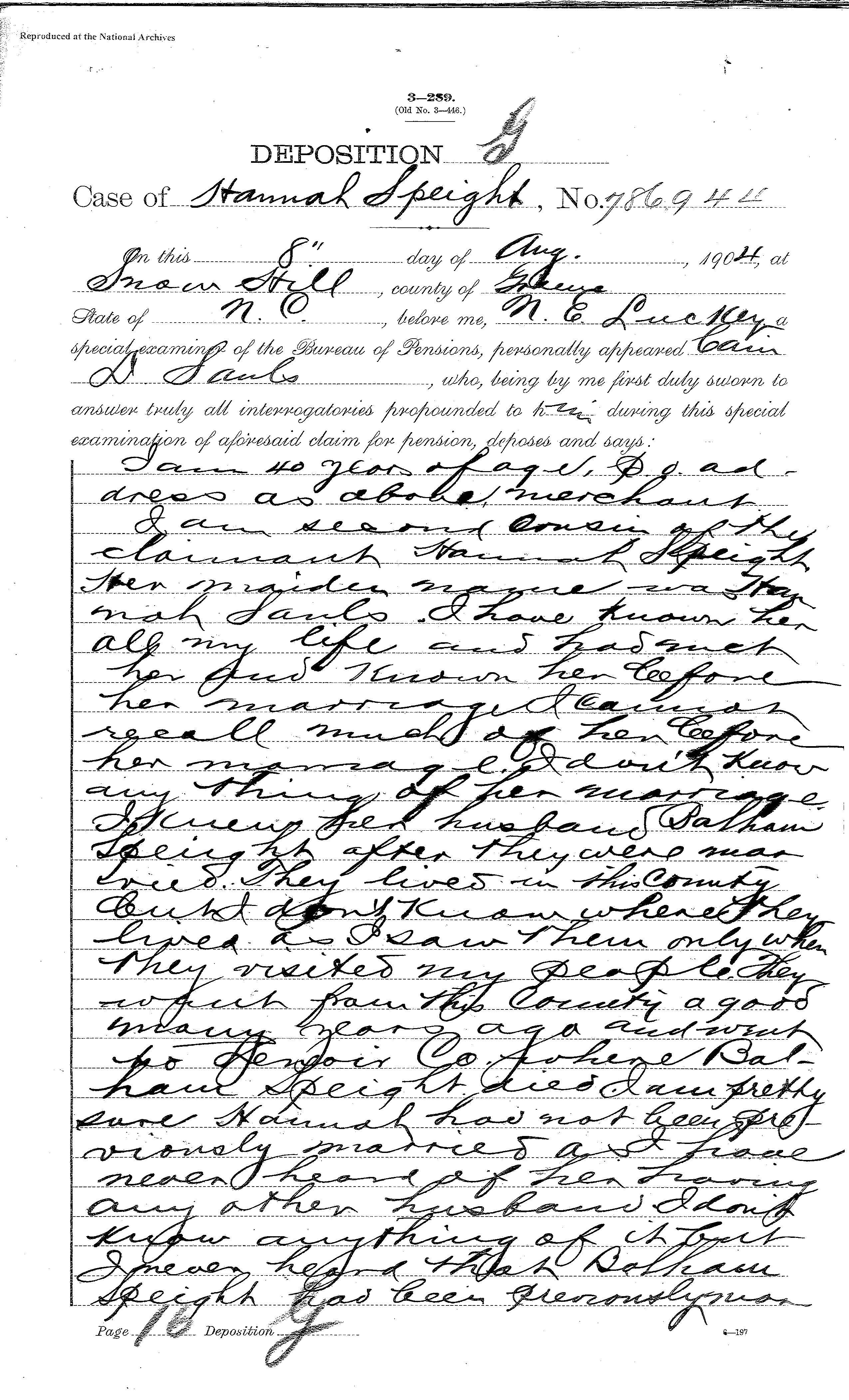
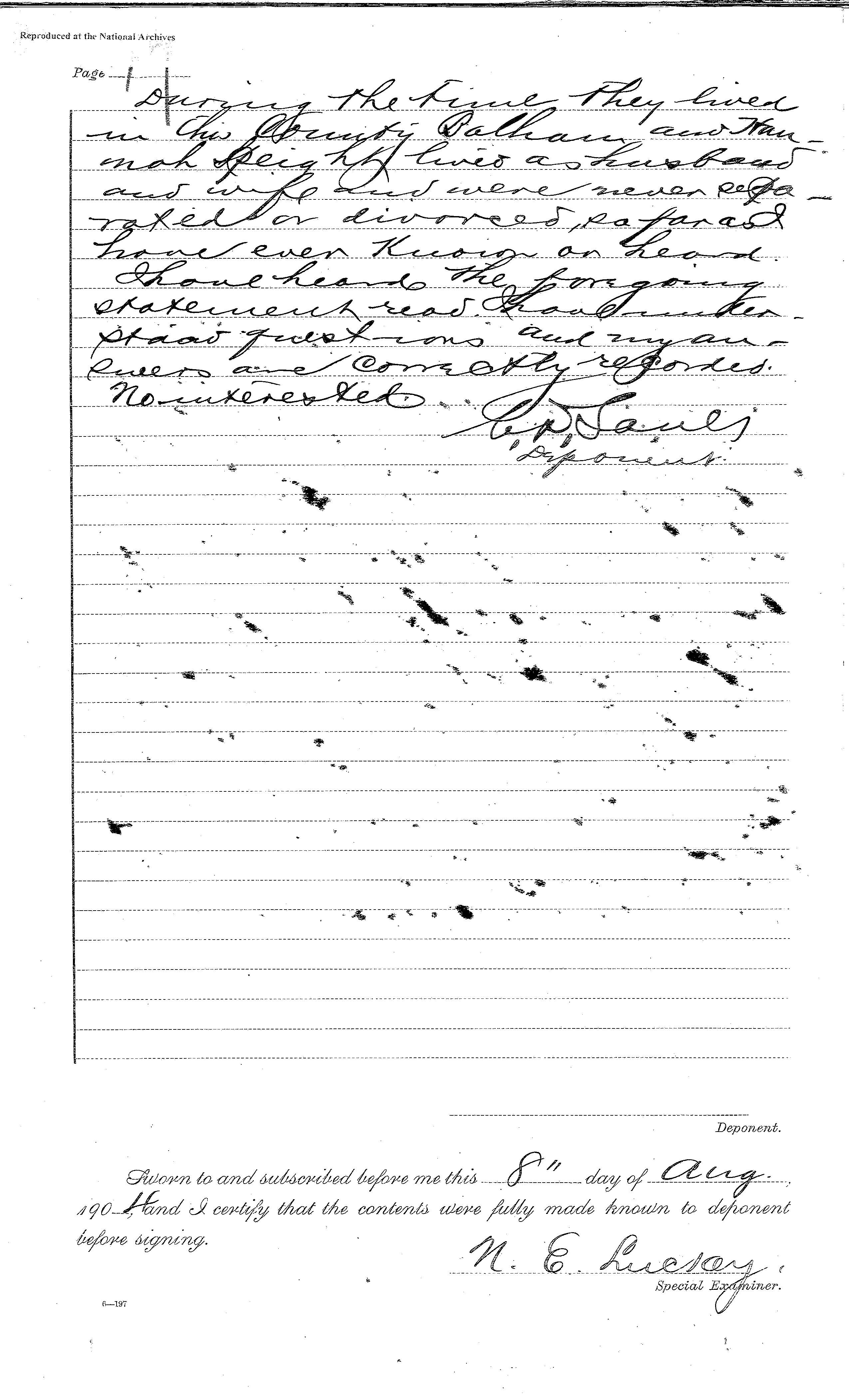
  • Cain D. Sauls – Lives in Snow Hill, Greene County NC. “I am 40 years of age … merchant. I am second cousin of the claimant Hannah Speight. Her maiden name was Hannah Sauls. I have known her all my life ….[She and Balham] lived in this county but I don’t know where they lived as I saw them only when they visited my people.” [Only witness who signed his own name. All others signed with X.]
  • Viola Edwards – Lives in Bull Head, Greene County. “I don’t know my age, am 50 or more. … Wife of LaFayette Edwards. … I lived just across the creek from [Hanna Sauls] when she married Baalam Speight. … I recollect that they were on the plantation next to the one I lived on at that time. It was the Rawls plantation …. I did not know Jennie the slave wife of Baalam Edwards ….”
  • Grace Harper – about 62 years old, wife of Lewis Harper, lives in Snow Hill. “I knew Balham Speight as a boy before he went away to go into the army. … I had known Hannah Sauls as a girl and lived in two miles of her before she married Balham Speight. … I think they had one child before they lived at Kinston … Yes Hannah had a child by Loderick Artist before her marriage to Balham Speight, but she did not marry or live with him or any other man until she married Balham. …”
  • Mary Shepard – About 70 years old, lives near Snow Hill. Widow of Marcus Shepard. “I knew [Hannah’s] aunt Becca [Best.] … They lived around here about two years after they were married and then moved away to Lenoir Co. … Baalam Speight was a brother of Fate Edwards. He was always called Baalam Speight. I think he was owned by Jim Edwards and that his father was Reddin Speight. … It seems to me that Hannah had a boy by Loderick Artist before her marriage to Baalam Speight …”
  • Lewis Harper – Lives in Snow Hill. “I am about 65 years of age … laborer…. I was born and raised in Greene County and knew Balham Speight as a boy. We lived about 3 miles apart and were right often together before he went away to go into the army. … I knew when Balham Speight was married to Hannah Sauls, it was not mighty long after the war. It may have been two or three years after. … They did not remain near Snow Hill very long until they moved to Kinston where they remained afterwards up to his death. … Hannah had a child by the man Loderick Artist a year and a half before she married Balham while she was living with her parents. … Loderick Artist was my brother and is dead.
  • LaFayette Edwards – 63 years of age, lives in Bull Head, Greene County. “I served as a corporal of Co. H, 14 U.S.C.H.A. and knew Baalam Edwards of that company; he was my brother and our father was Reddin Speight. In slave time I belonged to Ap. Edwards and he belonged to his brother Orfa Edwards. We were raised and enlisted, served and discharged together. After he came out of the army he worked in turpentine one year or so in S.C. or Georgia. … After that he came back and lived on Hill place near Kinston. But for two or three years after he came from the South he lived out near Snow Hill. He was married close to Jno. Harvey plantation to Hannah Sauls daughter of Shepard Sauls. … I know they were married by law as there was no taking up with each other in those days. … Before he married Hannah Baalam had lived with a woman named Jennie Suggs in slave time. She died while we were in the service. I did not go to the burial, but we were at Morehead City not far away when she died and heard of her death at the time.”
  • Peter Hood – 64 years old, farmer and pensioner, lives near Kinston. “I was a pvt. in Co H, 14 U.S.C.H.A. and knew Baalam Edwards. He was in my company and I was witness for him when he was trying to get pension. … He was a sort light complected spare somewhat tall man. I don’t know his height. I reckon he was about as tall as you (about 5 ft. 10 in.)”
  • Isaac Edwards alias Eddis — 67 year-old farmer. “I am not a pensioner but I served as a pvt. in Co. H, 14 U.S.C.H.A from Mch. 8, 1865 to Dec. 11, 1865. I knew a man named Baalam Edwards in my company. I had known him before we went into the army and we had both belonged to Betsy Edwards in slave time and lived not far apart. His father was Reddin Speight. He used the name of his mistress in the army and after he came out of the army he went by the name of his father Speight. … [H]e was married to a woman named Hannah Sauls. This was the first wife of Baalam Edwards except that he had a slave wife named Jennie.” “Baalam Edwards was not sick and did not get hurt in the army, except that he had mumps at Ft. Macon. He was a long slim, not very dark, dark hair and eyes. I am six feet high, he was not quite as tall as I am.”
  • Francis Williams — 70 year-old pensioner. “I was a corporal in Co. I, 14 U.S.C.H.A. and I knew Balham Speight. He was a member of my regiment.” [C.D. Sauls signed as witness.]

The testimony was satisfactory, and Hannah was granted a pension of $10/month.

A document in this pension file lists Baalam’s children as Charles, born 12 April 1870; Nancy Susan, 19 February 1872; Lizzie, 8 March 1874; Claiborn, 30 March 1876; Major, 27 September 1879; James, 8 April 1882; Franklin, 19 June 1885; Luvenia, 5 April 1887; and George Meade Speight, 26 September 1889. Census records reveal a tenth child, who was oldest. Lemon Speight’s Lenoir County death certificate lists his birthdate as 27 April 1867 — about a year-and-a-half before Baalam and Hannah married in late 1869. The certificate also names Baalam as Lemon’s father, but, as several witnesses testified, he was in fact the son of Loderick Artis.

The file reveals other tantalizing tidbits, in italics, related to my family. How were Loderick Artis and Lewis Harper brothers? On their mother’s side? Or through Loderick’s father Daniel Artis? Cain Sauls, who was Loderick’s nephew, testified that he was Hannah’s second cousin. Her parents were Rosetta Best and Sheppard Sauls. Who was Sheppard to Cain?

ARTIS -- CD Sauls Deposition_Page_1

ARTIS -- CD Sauls Deposition_Page_2

Deposition of Cain D. Sauls, 8 August 1904.

File #786944, Application of Hannah Speight for Widow’s Pension, National Archives and Records Administration. Hat tip to Trisha Blount Hewitt for pointing out the mention of Loderick Artis in Baalam Speight’s file, #988961, which is included in Hannah’s file.

Standard
Civil War, Free People of Color, North Carolina, Other Documents, Paternal Kin

Confederate Citizens File: Adam Artis.

Adam T. Artis was 30 years old at the start of the Civil War, a farmer and carpenter who had already begun to amass relative wealth. Men much poorer than he lost stock and provisions to foraging Union soldiers, and I wondered why he had not filed with Southern Claims Commission to recoup any losses. Perhaps he had none, but the more likely answer is that, because he supplied fodder and other items to the Confederate government, he knew he was ineligible for reimbursement from the United States.

Form of the estimate and assessment of agricultural products agreed upon by the assessor and tax-payer, and the value of the portion thereof to which the government is entitled, which is taxed in kind, in accordance with the provisions of Section 11 of “an Act to lay taxes for the common defence and carry on the government of the Confederate States,” said estimate and assessment to be made as soon as the crops are ready for market.

Adam Artis by wife

Cured Fodder     Quantity of gross crop. — 1500     Tithe or one-tenth. — 150     Value of one-tenth. — $4.50

I, Adam Artis of the County of Wayne and State of North Carolina do swear that the above is a true statement and estimate of all the agricultural products produced by me during the year 1863, which are taxable by the provisions of the 11th section of the above stated act, including what may have been sold of consumed by me, and of the value of that portion of said crops to which the government is entitled.   /s/ Adam X Artis

Sworn to and subscribed to before me the 3 day of December 1863, and I further certify that the above estimate and assessment has been agreed upon by said Adam Artis and myself as a correct and true statement of the amount of his crops and the value of the portion to which the government is entitled.  /s/ J.A. Lane, Assessor.

Page 6

The Confederate Papers Relating to Citizens or Business Firms, 1861-1865 (NARA M346), often called the “Confederate Citizens File,” is a collection of 650,000 vouchers and other documents relating to goods furnished or services rendered to the Confederate government by private individuals and businesses.  The “Citizens File” was created by the Confederate Archives Division of the Adjutant General’s Office from records created or received by the Confederate War and Treasury Departments that were in the custody of the U.S. War Department. The Citizens File was created to aid in determining the legitimacy of compensation claims submitted for property losses allegedly inflicted by Union forces. The records were used by the Treasury and Justice Departments, Southern Claims Commission, Court of Claims, and congressional claims committees to determine whether the claimant had been loyal to the Union or had aided the Confederate government and thus not eligible for compensation.

——

Document accessed at www.fold3.com.

Standard
Civil War, Free People of Color, North Carolina, Paternal Kin

$573.00 allowed.

Under an act of Congress approved March 3, 1871, a three-member commissioners Southern Claims Commission received, examined, and considered the claims of “those citizens who remained loyal adherents to the cause and the Government of the United States during the war, for stores or supplies taken or furnished during the rebellion for the use of the Army of the United States in States proclaimed as in insurrection against the United States.” The commissioners’ principal duties were to satisfy themselves of each claimant’s loyalty and certify the amount, nature, and value of the property taken or furnished.

The files of claimants under this act are rich with personal details, including age and place of birth; residence during the Civil War; occupation; names and ages of family members; names of neighbors; and types of crops grown and animals raised. For free people of color, these records are especially valuable, as there seldom are other sources for this type of information.

Robert Aldridge is my only known direct ancestor to file with the SCC. Indexes show that his claim was assigned number 14,758; that he asserted losses of $832.00; and that, in 1873, he was allowed $573.00 in compensation.

Some years ago, while in Washington DC, I made a beeline up Pennsylvania Avenue to the National Archives to get a look at Robert’s folder. I sat in the research room, a faint smile on my lips, heart rate slightly elevated, alert. And then: “I’m sorry. That file is missing.” Gone. And has been for years, for it was never microfilmed, and even indexes leave blank the summary of its contents.

To think of this still makes me nauseous, as Robert Aldridge is an elusive figure with murky antecedents and obscure dealings. Few of his deeds were recorded, and the extent of his landholdings is unclear. A statement to the SCC — in his own words, precious in and of itself — would have been a goldmine of information.

Standard
Civil War, Maternal Kin, North Carolina, Other Documents

I will henceforth faithfully support, protect and defend.

The war is over. The Union has won. There is nothing to do but accept it and move on. Two months after the Surrender, his enslaved son now free, John W. McNeely swore his allegiance to the United States.ImageHalf-way across the country, in Iron County, Missouri, William B. McNeely had not waited for the war to end and beat his brother to the punch by nine months.Image

[Sidenote: Compare the W, M and N in John and William’s signatures. They clearly learned to write from the same instructor.]

Oath of Allegiance. Union Provost Marshals’ File of Papers Relating to Individual Claims, National Archives and Records Administration.

Standard